Exhibition | 50 Years and Forward: Works on Paper Acquisitions
Now on view at The Clark:
50 Years and Forward: Works on Paper Acquisitions
The Clark Art Institute, Williamstown, MA, 16 December 2023 — 10 March 2024
Curated by Anne Leonard

Ubaldo Gandolfi, Seated Male Nude, ca. 1770, red chalk on paper, 41 × 29 cm (Williamstown: The Clark, gift of David Jenness in honor of Arthur Jenness, Professor at Williams College, 1946–63, 2012.17.4).
When the Clark Art Institute opened in 1955, it had 500 drawings and 1,400 prints, totaling 1,900 works on paper. In the past fifty years, 4,000 works on paper have been added—more than double the museum’s founding gift—and acquisitions continue apace. While these numerical increases are important, they are only part of the story. What they fail to convey is the change in the collection’s character over time. With constant reappraisal over the decades, new dimensions have emerged, building upon Sterling and Francine Clark’s original vision.
50 Years and Forward: Works on Paper Acquisitions marks the fiftieth anniversary of the Manton Research Center—the home of the works on paper collection—with a selection of prints, drawings, and photographs acquired between 1973 and 2023. Featuring recent acquisitions and other works never shown here before, the exhibition starts from classic territories with which the Clark has long been closely identified—such as early modern drawings and nineteenth-century French art—and shows how those pockets of strength continued to grow in later decades. In a parallel development, the Institute initiated fresh collecting areas such as photography and Japanese prints. Such additions, while hewing to the same standards of quality and art-historical significance, have allowed the Clark to fill acknowledged gaps and raise its institutional profile.
In this anniversary exhibition, we explore and celebrate the developments of the past fifty years. Along with familiar works by Albrecht Dürer, Francisco de Goya, Édouard Manet, and Mary Cassatt, we highlight lesser-known areas of the collection, including early twentieth-century art, photographs by Berenice Abbott and Doris Ulmann, and important images of and by Black Americans. With each passing year and decade, the Clark reaffirms its commitment to the founders’ storied collecting mission, modifying and expanding it to meet the needs of a new era.
50 Years and Forward: Works on Paper Acquisitions is organized by the Clark Art Institute and curated by Anne Leonard, Manton Curator of Prints, Drawings, and Photographs.
A checklist of all works is available here»
The Magazine of the Decorative Arts Trust, Winter 2023–24
The Decorative Arts Trust has shared select articles from the winter issue of their member magazine as online articles for all to enjoy. The following articles are related to the 18th century:
The Magazine of the Decorative Arts Trust, Winter 2023–24
 • Catherine Carlisle , “Inspiring Thomas Jefferson: Art and Architecture in France” Link»
• Matthew A. Thurlow, “Papered and Painted in Providence” Link»
• Charles Dawson, “The Finest Regency Porcelain Painter: Thomas Baxter in Worcester” Link»
• Philip D. Zimmerman, “Historic Odessa Collections Published” Link»
• Reed Gochberg, “Interwoven: Women’s Lives Written in Thread” Link»
• Kaila Temple, “‘A Place to Cultivate Her Mind in by Musing’: New Exploration of Anne Emlen’s 1757 Shellwork Grotto” Link»
• Laura Ochoa Rincon, “A Million Hidden Stories: Uncovering Materials at the New Orleans Museum of Art” Link»
• Laura C. Jenkins, “French Interiors for an American Gilded Age” Link»
• Alyse Muller, “18th-Century Marine Imagery in the Sèvres Archive” Link»
The printed Magazine of the Decorative Arts Trust is mailed to Trust members twice per year. Memberships start at $50, with $25 memberships for students.
Pictured: The magazine cover features the front parlor of the Rhode Island Historical Society’s John Brown House, which contains a Providence-made nine-shell desk and bookcase (1760–80) flanked by variants of Providence-made Neoclassical side chairs (1785–1800). The wallpaper is a 1975 reproduction by the Birge Co. of Buffalo, NY, based on a 1790s French example.
Online Talk | Ivan Day on Ice Cream Coolers
From the Connecticut Ceramics Circle (with the full 2023–24 lecture schedule available here). . .
Ivan Day | Frozen Treats: The Development of the Ice Cream Cooler
Online, Connecticut Ceramics Circle, Monday, 12 February 2024, 2pm (Eastern)

Worcester Ice Cream Cooler (Ice Pail), ca. 1770, ‘Jabberwocky’ design, soft-paste porcelain (Houston: Rienzi Collection, 84.584.1.A-.C). Images of the bucket, liner, and cover pulled apart are available at Day’s Instagram account here.
Ice creams and water ices evolved in Italy in the second half of the seventeenth century. Initially they were a high-status luxury confined to court entertainments. Serving ices at table was not easy, as they had to be kept in a frozen state. Eventually, attractive three-part tin-glazed earthenware vessels called seaux à glace started to appear in France in the 1720s. Only a few of these faïence examples have survived, the earliest from Rouen dating from 1700–25. Another from Moustiers made in the Clérissey manufactory dates from circa 1725.
In order to keep the contents frozen, ice mixed with salt needed to be placed in the lower pail and the lid, with the ice cream contained in a bowl between. However, earthenware was not an ideal material for this purpose. It is likely that salt eventually found its way through any crazing in the glaze and was absorbed by the porous clay body, resulting in the glaze flaking off. Soft-paste and later hard-paste porcelain proved to be a much more durable material for making these beautiful vessels. The Sèvres manufactory based their porcelain seaux on the earlier faïence shapes, but developed a range of new forms closely allied to their own wine cooler designs. At first other European factories based their designs on the Sèvres model. In this illustrated Zoom lecture, Ivan Day will not only outline the development of these wonderful vessels, but demonstrate how they were used with an example from his collection.
Ivan Day is an independent historian of the social history and culture of food. He is celebrated for his reconstructions of historical table settings, which combine museum objects with accurate re-creations of period dishes. His work has been exhibited in many major museums in the UK, Europe, and North America, including the Getty Research Institute, Detroit Institute of Arts, Gardiner Museum, and Minneapolis Institute of Arts. In 2007, he worked on a re-creation of an imperial table featuring a Meissen Parnassus by Johann Joachim Kändler for the BGC exhibition Fragile Diplomacy: Meissen Porcelain for European Courts, ca. 1710–63, curated by Maureen Cassidy-Geiger.
◊ ◊ ◊ ◊ ◊
As Day notes through his Instagram account,
“The lecture is a much revised version of one that I once delivered at a symposium at the Gardiner Museum in honour of the truly great porcelain scholar Meredith Chilton. Meredith is a close friend and colleague, but also a highly valued mentor. I have learnt so much from her. So my presentation is in honour of this wonderful woman.”
New Book | The Art of Cooking
Montiño’s cookbook appeared in new editions throughout the 17th and 18th centuries. Carolyn Nadeau’s English translation was just published in November. Her Instagram account is immense fun (and I’m grateful to Ivan Day for noting it on his account). –CH
From the University of Toronto Press:
Carolyn Nadeau, edited and translated, Francisco Martínez Montiño, The Art of Cooking, Pie Making, Pastry Making, and Preserving: Arte de cocina, pastelería, vizcochería y conservería (Toronto: University of Toronto Press, 2023), 760 pages, $150. Bilingual edition.
 In 1611 Francisco Martínez Montiño, chef to Philip II, Philip III, and Philip IV of Spain, published what would become the most recognized Spanish cookbook for centuries: Arte de cocina, pastelería, vizcochería y conservería. This first English translation of The Art of Cooking, Pie Making, Pastry Making, and Preserving will delight and surprise readers with the rich array of ingredients and techniques found in the early modern kitchen. Based on her substantial research and hands-on experimentation, Carolyn Nadeau reveals how early cookbooks were organized and read and presents an in-depth analysis of the ingredients featured in the book. She also introduces Martínez Montiño and his contributions to culinary history, and provides an assessment of taste at court and an explanation of regional, ethnic, and international foodstuffs and recipes. The 506 recipes and treatises reproduced in The Art of Cooking, Pie Making, Pastry Making, and Preserving outline everything from rules for kitchen cleanliness to abstinence foods to seasonal banquet menus, providing insight into why this cookbook, penned by the chef of kings, stayed in production for centuries.
Francisco Martínez Montiño was a Spanish cook and writer of the Golden Age.
Carolyn A. Nadeau is a Byron S. Tucci Professor of Spanish at Illinois Wesleyan University.
c o n t e n t s
List of Figures and Tables
Acknowledgments
Introduction
1 The Cookbook as Cultural Artefact
2 Martínez Montiño’s Biography and the Early Modern Spanish Kitchen
3 Cookbook Organization
4 Ingredients
5 Taste at Court and the Emergence of Spanish Cuisine
6 Curiosities of Martínez Montiño’s Cookbook
7 Martínez Montiño’s Legacy
8 Previous Editions
9 This Edition and Commentary
Arte de cocina, pastelería, vizcochería y conservería
Tasa / Certificate of Price
El Rey (Privilegio) / The King (Privilege)
Prologo al lector / Prologue for the Reader
Advertencia / Notice
Tabla de los banquetes / Table on the Banquets
Chapter 1
Chapter 2
Appendix 1: Kitchen Furnishings and Equipment
Appendix 2: On Measurements
Appendix 3: Images from Recipes Recreated
Glossary
Bibliography
Index
Performance | Handel: Made in America
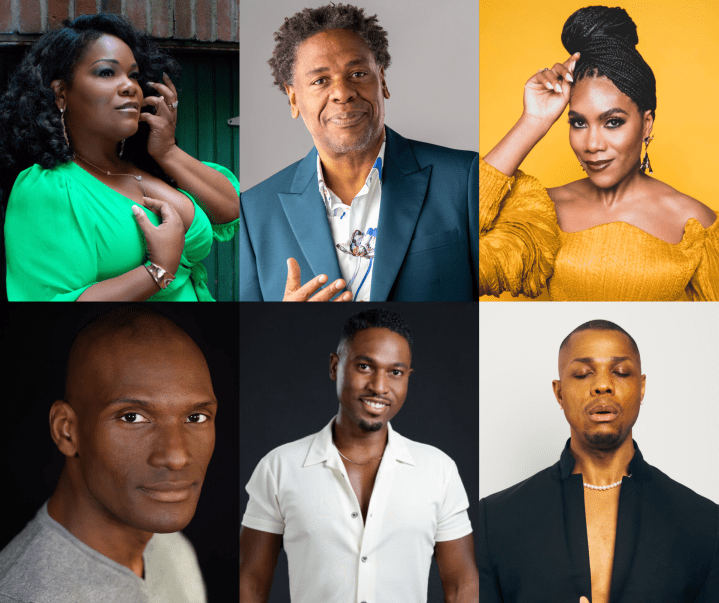
Image (clockwise from top-left): Latonia Moore, Terrance McKnight (photo by Julie Yarbrough Photography), J’Nai Bridges (photo by Dario Acosta), Davóne Tines (photo by Noah Morrison), Malcolm J. Merriweather, and Noah Stewart.
◊ ◊ ◊ ◊ ◊
Two performances, next week at The Met:
Handel: Made in America
Grace Rainey Rogers Auditorium, The Metropolitan Museum of Art, New York, 15 and 16 February 2024
Friday, February 16 at 6pm, join us for a pre-concert discussion with Juilliard ethnomusicology professor Fredara Hadley and Handel scholar (and Handel: Made in America co-creator) Ellen Harris, moderated by journalist Eric V. Copage (The New York Times)—free with ticketed admission to the performance
George Frideric Handel was the it-boy of 18th-century England. His music spread across boundaries of genre and social class, making his operas, oratorios, and instrumental works wildly popular with the British masses. But Handel rose to fame atop the burgeoning British Empire, history’s most influential global superpower, and in Georgian England, the same trading companies that underwrote arts and culture turned their profits from sinister activities: the trade of exotic goods and, most notably, enslaved people.
Through the lens of Handel’s life and works, musician and storyteller Terrance McKnight (WQXR) leads an intimate and revealing journey about art, power, history, and family, weaving his own history as a young African American man inspired by classical music with the story of Handel’s world and the money, power, and people that moved and were moved by it. Director Pat Eakin Young (La Celestina at The Met), conductor Malcolm J. Merriweather (The Ballad of the Brown King at The Met), and famed Handel scholar Ellen Harris complement a cast of star opera singers: soprano Latonia Moore, mezzo-soprano J’Nai Bridges, tenor Noah Stewart, and bass-baritone Davóne Tines. Commissioned by MetLiveArts. Tickets start at $35.
• Terrance McKnight, co-creator and performer
• Pat Eakin Young, co-creator and director
• Ellen Harris, co-creator and dramaturg
• Malcolm J. Merriweather, conductor
• Latonia Moore, soprano
• J’Nai Bridges, mezzo-soprano
• Noah Stewart, tenor
• Davóne Tines, bass-baritone
• Voices of Harlem, choir
Exhibition | Is It Any Good?
Now on view at The Walpole Library with a talk from Dr Roman on February 4:
Is It Any Good? Prints, Drawings, and Paintings at the Lewis Walpole Library
The Lewis Walpole Library, Farmington, CT, 22 September 2023 — 28 June 2024
Curated by Cynthia Roman
 Art historians, curators, and connoisseurs often pose the question, ‘Is it any good?’ evoking a sense of quality manifest in canonical works of art. By contrast, when building a collection of 18th-century prints that would become a cornerstone for research at the Lewis Walpole Library, W.S. and Annie Burr Lewis envisioned a visual collection that is essentially archival. Prints were valued foremost as documents that would improve their library dedicated to the life and times of Horace Walpole and to 18th-century studies. The Lewises’ iconographic approach, however, does not preclude the importance of assessing what is good. Aesthetic, material, and technical attributes are integral to understanding the power of visual art and artifacts to communicate the eighteenth-century histories they document. Asking Is it any good? this exhibition presents a selection of prints, drawings, and paintings at the Lewis Walpole Library to explore the intersections of quality and documentary value.
◊ ◊ ◊ ◊ ◊
Cynthia Roman, Curating the Caricature Collection at the Lewis Walpole Library
Sunday, 4 February 2024, 2.00pm
Cynthia Roman, Curator of Prints, Drawings and Paintings at the Lewis Walpole Library will present the story of the library’s internationally recognized print collection. Often in W.S. Lewis’s own words, this talk will explore the commitment that he and Annie Burr Lewis shared to “make more use of political and personal caricatures” when building a research collection for 18th-century studies that included Annie Burr’s celebrated chronological and subject-based card catalog. Reflecting on more than twenty years of stewarding the print collection, Roman will present both the Lewises’ vision of caricature as archival documents and subsequent curatorial initiatives to acquire prints that more deliberately embrace material, technical, and aesthetic considerations; circumstances of production, marketing and circulation including prolific practices of copying; as well as the legacy of caricature today.
Cynthia E. Roman, PhD, is Curator of Prints, Drawings and Paintings at the Lewis Walpole Library, Yale University. Her research focuses on 18th-century British art, particularly prints. She has published essays on graphic satire, collecting history, and ‘amateur’ artists, and has edited and co-edited collected volumes including Horace Walpole’s Strawberry Hill Collection with Michael Snodin (2009–10), Hogarth’s Legacy (2016), Staging ‘The Mysterious Mother’ with Jill Campbell (2024), and Female Printmakers, Printsellers, and Print Publishers in the Eighteenth Century: The Imprint of Women, c. 1700–1830, with Cristina Martinez (2024).
Conference | Eco Edo: Ecological Perspectives
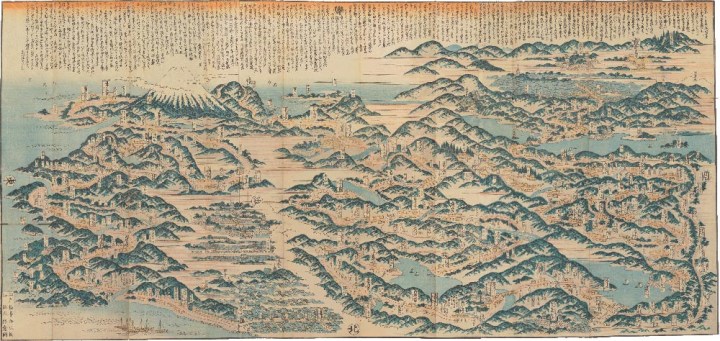
Panoramic Map of the Tōkaidō Highway, Shōtei Kinsui, drawn by Kuwagata (better known as Keisai). Published by Sanoya Ichigorō, Izumiya Hanbei, and Izumoji Manjirō, n.d. (likely 1810). Polychrome xylography, 52 x 24 inches (Los Angeles: Richard C. Rudolph Collection of Japanese Maps, Special Collections, UCLA Library).
◊ ◊ ◊ ◊ ◊
As noted yesterday at ArtHist.net:
Eco Edo: Ecological Perspectives on Early Modern Japanese Art
William Andrews Clark Memorial Library, UCLA, Los Angeles, 2 February 2024
Organized by Kristopher Kersey
On 2 February 2024, the William Andrews Clark Memorial Library at UCLA will host the conference Eco Edo: Ecological Perspectives on Early Modern Japanese Art. This is the second of three conferences at UCLA this year on the theme of early modern Japanese art.
The art of Japan’s Edo period (1603–1868) presents a paradox. On the one hand, the nineteenth-century proliferation of ukiyo-e—polychrome woodblock prints of the ‘floating words’ of theater and sex work—made the popular visual culture of this city a familiar component of modern art in the nineteenth and twentieth centuries. Yet the outsize fascination with ukiyo-e outside Japan has sorely obscured Edo’s far more diverse social, material, and artistic landscapes. In an effort to countervail the enduring stereotypes of early modern Japanese art, Open Edo will present a suite of conferences addressing three interlinked themes: the representation and agency of marginalized groups, the ecological horizons of artistic production, and the ongoing need to counter the myth that Japan in early modernity was somehow disconnected from the rest of the world. Throughout the year-long series, the focus will be both historical and historiographical inasmuch as Open Edo asks how Japanese art history might challenge the discourse of early modernity writ large.
If interested in attending, please register, as space is limited in the Clark Library (also, note that the Clark is housed in a villa in West Adams, about 8 miles east of the main UCLA campus in Westwood). The conference is free and open to the public. Parking is free, and lunch is provided. To register, follow this link. There is no livestream or recording, but an edited volume should follow. Should you have any questions, please email kersey@humnet.ucla.edu.
p r o g r a m
9.30 Coffee and registration
10.00 Director’s welcome by Bronwen Wilson (UCLA), with opening remarks by Kristopher Kersey (UCLA)
10.15 Panel 1
Moderator: Kristopher Kersey (UCLA)
• Greg Levine (University of California, Berkeley), ‘Close Looking,’ but at What? Hasegawa Tōhaku’s Pine Grove and ‘Attentional Deviance’
• Rachel Saunders (Harvard Art Museums), The Birds, Flowers, and Botany of Edo Rinpa
11.45 Lunch, with a display of Clark Library materials in the North Book Room
1.00 Panel 2
Moderator: William Marotti (UCLA)
• Chelsea Foxwell (University of Chicago), What Are Bugs Doing in Edo-Period Paintings?
• Kit Brooks (National Museum of Asian Art, Smithsonian Institution), Morphing into Madness: Shifting Perceptions of the Japanese Wolf
2.30 Coffee break
3.00 Panel 3
Moderator: Kendall Brown (California State University Long Beach)
• Christian Tagsold (Heinrich Heine University Düsseldorf), The Thousand Gardens of Edo: Exploring the Nature of the Cultivated Environment
• Nobuko Toyosawa (Oriental Institute of the Czech Academy of Sciences), The Place of Ecology in Matsudaira Sadanobu’s Gardens
4.40 Plenary discussion with all speakers
5.30 Reception
Scholarships | The Aesthetic Inventions of Ecology, ca. 1800
From ArtHist.net:
The Aesthetic Inventions of Ecology around 1800
Doctoral and Post-Doctoral Scholarships
Johannes Gutenberg-Universität Mainz, 1 October 2024 — 30 September 2027
Applications due by 15 May 2024
Johannes Gutenberg University Mainz announces the following scholarships within the framework of the new Mini Graduate College (MGRK), The Aesthetic Inventions of Ecology around 1800 (Die ästhetischen Erfindungen der Ökologie um 1800), funded by the Gutenberg Junior College (GNK):
• 4 doctoral scholarships (m/f/d) with a monthly stipend of EUR 1,550
• 1 postdoctoral scholarship (m/f/d) with a monthly stipend of EUR 1,900
The scholarships are to be filled by 1 October 2024, with a duration of three years. Selection interviews will take place in June 2024.
Requirements
• Excellent university degree (state examination, MEd, MA, or equivalent) in German Studies, English Studies, Art History, Music Theory, or related fields
• An innovative project idea within the research area of MGRK
• Knowledge in the areas of Classicism and Romanticism, as well as in ecological matters
• Interest in interdisciplinary work and team collaboration
• Proficiency in the college’s languages German and English
• Postdoctoral applicants should also present an outstanding dissertation, along with initial presentation and publication activities
Application Documents
• A one to two-page motivational letter explaining the reasons for pursuing the planned doctoral or postdoctoral project, demonstrating expectations from a Mini Graduate College and convincing statements about interdisciplinary work
• Curriculum vitae and academic certificates (high school diploma, MA, state examination, transcript of records for all courses in the master’s program, equivalent foreign degrees, and PhD for postdocs)
• If possible, a list of publications
• If necessary, language proficiency certificates
• A project outline (approximately 5–7 pages) for a project tailored to the college’s theme and methodology
• A work sample (e.g., master’s thesis, dissertation for postdocs) and an abstract (approximately 1 page) of the work sample
• Identification of two university professors who can provide information about personal suitability and academic qualifications
Further details of the research and study program of the Mini Graduate College are available by AESTHOEK1800@uni-mainz.de on request.
The university aims to increase the proportion of women in research and teaching and encourages qualified female academics to apply. Disabled individuals will be given preferential consideration if equally qualified. The college is committed to the principles of diversity and gender equality. International applicants should have sufficient knowledge of German. The MGRK accepts fellows from other funding organizations and guest scholars without offering funding, but with full integration into research.
For inquiries, please contact the participating faculty representatives:
• Prof. Dr. Barbara Thums, Department of German, Johannes Gutenberg University Mainz, thums@uni-mainz.de
• Prof. Dr. Rainer Emig, Department of English and Linguistics / English Literature and Culture, Johannes Gutenberg University Mainz, emigr@uni-mainz.de
• Prof. Dr. Immanuel Ott, Music Theory, Mainz University of Music at the Johannes Gutenberg University Mainz, immot@uni-mainz.de
• Prof. Dr. Gregor Wedekind, Department of Art History and Musicology / Art History, Johannes Gutenberg University of Mainz, Gregor.wedekind@uni-mainz.de
Please send your complete application documents in electronic form as a consolidated PDF file titled “Name-First Name-Application” by 15 May 2024, via email to the spokesperson of the MGRK:
Prof. Dr. Barbara Thums
Johannes Gutenberg University Mainz
Faculty 05 – Philosophy and Philology
aesthoek@uni-mainz.de
New Book | Bagatelle: A Princely Residence in Paris
From Rizzoli:
Nicolas Cattelain, with photographs by Bruno Ehrs, Bagatelle: A Princely Residence in Paris (Paris: Flammarion, 2023), 280 pages, ISBN: 978-2080247520, $85.
 In 1775, the Comte d’Artois, brother of Louis XVI and future King Charles X, purchased the Bagatelle estate in the Bois de Boulogne on the outskirts of Paris. The sumptuous château he constructed there—designed by François-Joseph Bélanger and modeled on a neo-Palladian villa—along with its picturesque gardens were lauded by prestigious European and American visitors, including Thomas Jefferson. Spared by the Revolution, Bagatelle became the setting for many important moments in European history and was acquired by the city of Paris in 1905. While the park with its magnificent rose garden remained open, the Mansart Foundation, with a team of experts, oversaw an extensive renovation of the château to restore the architectural jewel to its former glory. This beautifully illustrated volume recounts the fabulous history of Château de Bagatelle and its various owners, with spectacular new photography, unpublished archival documents, and insightful text.
Philanthropist and art collector Nicolas Cattelain worked in finance before dedicating himself to art, history, and heritage. He is involved with many international museums and is chairman of the Fondation du Château de Bagatelle. Bruno Ehrs is an award-winning Swedish photographer whose work has been published in Jacques Garcia: A Sicilian Dream, Villa Elena; Vaux-le-Vicomte: A Private Invitation; Château de Villette; Villa Balbiano; A Day at Château de Vaux-le-Vicomte; and Chaumet: Parisian Jeweler Since 1780, all published by Flammarion.
Symposium | Portraiture in 18th-Century Europe
From the DFK:
Portraiture in 18th-Century Europe: Artwork—Social Practice—Circulation
Le portrait au XVIIIe siècle en Europe: Œuvre d’art—pratique sociale—objet de transfert
Deutsches Forum für Kunstgeschichte, Paris, 11–12 March 2024
Organized by Markus Castor, Martin Schieder, and Marlen Schneider

Alexandre Roslin, Self-Portrait with the Artist’s Wife Marie-Suzanne Giroust Painting a Portrait of Henrik Wilhelm Peill, detail, 1767, oil on canvas, 131 × 99 cm (Stockholm, Nationalmuseum, NM 7141).
Whether a manifestation of political power, expression of intimate feelings, an embellishing masquerade, or a faithful likeness, the art of portraiture in the Age of Enlightenment was marked by exceptional diversity throughout Europe. Between the apogee of absolutism and the political, social, and intellectual upheavals of the revolutionary era, it became a mirror of a society in full mutation. The differentiation of taste, changes in the art market, and the gradual establishment of public exhibitions were decisive factors contributing to the variety of effigies. Finally, the criticism of portraiture that flourished at the same time as this artistic genre, wrongly considered as ‘minor’, testified to the growing tension between its social functions and its claim to be a work of art in its own right.
The aim of the symposium is to study portraiture from a multifaceted perspective, tracing its social, theoretical, artistic, and material conditions. Focusing on its development during the Enlightenment in the French context, we also wish to open the discussions up to a European perspective. What concepts and themes shaped the debates surrounding portraits? How did the usages and functions of portraits evolve, and what were the consequences for the production and materiality of these objects? By what means and networks did portrait modes circulate in the various European artistic centers? We intend to shed light on these different aspects in their interdependence, in order to better understand the complex success story of portraiture in the 18th century.
Concept and Organization
Markus A. Castor (DFK Paris), Martin Schieder (Universität Leipzig), and Marlen Schneider (Université Grenoble Alpes/LARHRA)
◊ ◊ ◊ ◊ ◊
m o n d a y , 1 1 m a r c h 2 0 2 4
Speakers are assigned 45-minute slots; specific times, along with breaks, are available here»
14.30 Opening remarks by Peter Geimer (Director of the DFK Paris) and introduction by Markus Castor, Martin Schieder, and Marlen Schneider
15.00 I | Social Practices
Moderation: Martin Schieder
• Elise Urbain Ruano (Musée royal de Mariemont), Portraits transgressifs et modes négligées
• Gerrit Walczak (Zentralinstitut für Kunstgeschichte, München), Silk, Lace, and Deception: The Rococo Dummy Board Princesses of Georg David Matthieu
• Lara Pitteloud (Université de Neuchâtel), S’entourer de portraits « regardés comme uniques » : le cas parisien du Comte de Baudouin
• Philippe Bordes (Université Lumière Lyon 2 / LARHRA), Le piège de la célébrité sous la Révolution: les portraits de députés par Adélaïde Labille-Guiard et Jean Louis Laneuville
18.30 Conférence du soir
• Melissa Hyde (University of Florida), Gifted: Women, Portraiture, and the Art of Friendship
Drinks reception
t u e s d a y , 1 2 m a r c h 2 0 2 4
9.30 II | Circulations and Transfer
Moderation: Markus Castor
• Hannah Williams (Queen Mary University of London), Linked Lives: Portraits as Traces of Colonial Networks in Paris’s 18th-Century Art World
• Ulrike Kern (Goethe-Universität, Frankfurt am Main), License to Portrait: Annexation of a Genre in Early 18th-Century British Art Theory
• Marlen Schneider (Université Grenoble Alpes / LARHRA), Portraits à la française? Appropriations et détournements du portrait déguisé entre Paris et Berlin
• Agata Dworzak (Jagiellonian University, Cracovie), Representation and Creation: The Tradition of Portraiture of Church Hierarchs in Central and Eastern Europe in the Second Half of the 18th Century: A Case Study of the Polish-Lithuanian Commonwealth
12.45 Lunch break
14.00 III | Theories and Techniques
Moderation: Marlen Schneider
• Marianne Koos (Universität Wien), Resemblance as a Passing Quality: Liotard, La Tour, and the Question of le faire in 18th-Century Portraiture
• Juliette Souperbie (Université Toulouse II Jean Jaurès), L’artiste à l’œuvre: Une mise en abyme du portrait au XVIIIe siècle
• Andreas Plackinger (Albert-Ludwigs-Universität Freiburg), Zwischen Konventionsbruch, Kunsttheorie und Sociabilité: Plastische Bildhauerselbstporträts im Frankreich des späten Ancien Régime
• Jan Mende (Stadtmuseum Berlin), Die Porträtbüste geht in Serie: Neue Technologien und preiswerte Werkstoffe um 1790
• Amy Freund (Southern Methodist University), Who/What is a Self? Animal Portraiture in 18th-Century France
18.15 Conclusion and perspectives










 Enfilade
leave a comment