Exhibition | The Regency in Paris, 1715–1723
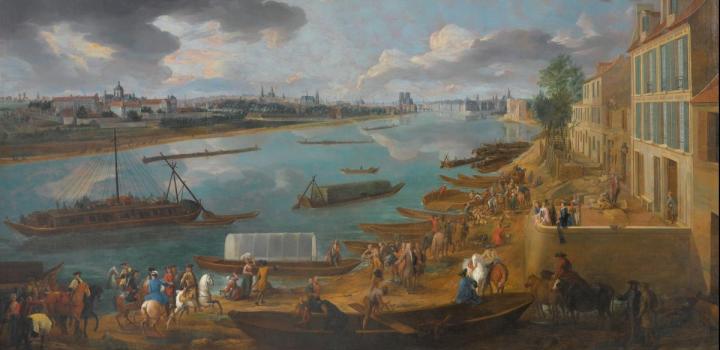
Pierre Denis Martin, View of Paris from the Quai de la Rapée toward la Salpêtrière, l’île Saint-Louis, and l’île de la Cité, 1716, oil on canvas, 170 × 315 cm (Paris: Louvre / Musee Carnavalet)
◊ ◊ ◊ ◊ ◊
Now on view at the Musée Carnavalet:
The Régence in Paris, 1715–1723: The Dawn of the Enlightenment
Musée Carnavalet, Paris, 20 October 2023 — 25 February 2024
Curated by Valérie Guillaume, with José de Los Llanos and Ulysse Jardat
The Musée Carnavalet – Histoire de Paris presents an exhibition on the Regency, a forgotten period in history, marking the return of the King and of political, economic, and cultural life to Paris.
Louis XIV died in Versailles on 1 September 1715, leaving behind a nation in debt and a five-year-old child too young to rule, Louis XV, as his heir. On 2 September, the Duke Philippe d’Orléans (1674–1723), nephew of the late King, took on the role of Regent of France. This exhibition takes place as part of the tricentennial commemoration of the Regent’s death.
In 1715, the court, the government, and all the administrations moved back to Paris, the second city in Europe, whose population then increased significantly. Thus, the city, and notably the Palais-Royal, the Regent’s residence, became the heart of all political life. A period of intense cultural effervescence ensued, giving rise to a world of philosophical, economic, and artistic innovations. Voltaire, Marivaux, Montesquieu, Law, and Watteau are some the most well-known figures of the time. With the invention of paper money and the bankruptcy of 1720, these years of economic and financial frenzy were interspersed with significant twists and turns. Under the Régence emerged a newfound freedom of criticism, which would become known as the spirit of the Enlightenment.
The exhibition’s thematic structure highlights the innovations of the period in order to illustrate the breadth of their historical significance. Over 200 works from public and private collections—paintings, sculptures, prints, items of decor, and pieces of furniture—help us explore this period of history, accounting for the mutations of society at a time when Paris was becoming the cultural capital of France in a permanent way.
Curators
• Valérie Guillaume, director of the Musée Carnavalet – Histoire de Paris
• José de Los Llanos, head curator, in charge of the Graphic Arts Department and the Maquettes Department
• Ulysse Jardat, curator, head of the Decor, Furniture, and Decorative Arts Department
La Régence à Paris (1715–1723): L’aube des Lumières (Paris: Paris-Musées, 2023), 224 pages, ISBN: 978-2759605705, €39.
Study Day | Spectacle and Representation during the Régence
From the Carnavalet:
Spectacle et représentation royale durant la Régence, 1715–1723
Orangerie du musée Carnavalet, Paris, 16 November 2023
 Dans le cadre des manifestations organisées autour de l’exposition La Régence à Paris (1715–1723): L’aube des lumières, le Centre de musique baroque de Versailles et le musée Carnavalet – Histoire de Paris proposent une journée d’études pluridisciplinaire sur les divertissements du jeune Louis XV. Cette journée réunit historiens, historiens de l’art, historiens de la danse et musicologues pour une journée d’études pluridisciplinaire autour des trois ballets dansés devant toute la cour par le jeune Louis XV aux Tuileries en 1720 et 1721 (L’Inconnu, Les Folies de Cardenio, Les Éléments), peu de temps avant sa majorité, son sacre et donc sa prise de souveraineté. S’inscrivant à la fois dans la lignée des grands divertissements royaux du Grand Siècle, mais dans des inspirations et une esthétique plus modernes, annonciatrices des Lumières, ces spectacles royaux ont participé à la construction de l’image publique du jeune souverain. Au-delà des aspects musicaux, littéraires, chorégraphiques et esthétiques, ces spectacles de cour, seront ainsi envisagés au travers de la question, transversale, de la représentation du pouvoir royal durant la Régence.
Réservation recommandée, jcharbey@cmbv.com.
m o d e r a t e u r s
Alexandre Dupilet
Petra Dotlačilová (Stockholm University, CMBV-CESR)
Thomas Leconte (CMBV-CESR)
i n t e r v e n a n t s
• José de Los Llanos (Conservateur en chef, responsable du Cabinet des Arts graphiques et du département des Maquettes, Musée Carnavalet – Histoire de Paris) et Ulysse Jardat (Conservateur du patrimoine, responsable du département des Décors, Mobilier et Arts décoratifs, Musée Carnavalet – Histoire de Paris), commissariat scientifique de l’exposition La Régence à Paris (1715–1723): L’aube des Lumières
• Laurent Lemarchand (Université de Rouen, GHRis) — Louis XV et Philippe d’Orléans : l’Union sacrée
• Vivien Richard (Musée du Louvre) — Les Tuileries : résidence du jeune Louis XV, 1715–1722
• Thomas Leconte (CMBV-CESR) — Le roi en sa capitale, 1715–1722 : l’image de la majesté à travers le cérémonial royal et le maillage urbain
• Pascale Mormiche (CY Cergy Paris Université) — Louis XV aimait-il danser ?
• Nathanaël Eskenazy (Université Paul-Valéry-Montpellier III, IRCL) — Convaincre, persuader, exhorter : repenser le discours encomiastique et la célébration de la figure royale dans les trois ballets dansés par Louis XV
• Barbara Nestola (CMBV-CESR) — Réunir pour mieux régner ? Fusion et collaboration entre troupes de cour et de ville pour la représentation des ballets dansés par Louis XV, 1720–1721
• Petra Dotlačilová (Stockholm University, CMBV-CESR) — Terpsichore durant la Régence : entre la tradition de cour et la danse théâtrale
• Mickaël Bouffard (Sorbonne Université, Théâtre Molière Sorbonne, CELLF) — Les habits des ballets de Louis XV : goût nouveau ou recyclage de vieilles idées ?
Call for Papers | From the Low Countries to Sweden, 1400–1800
From ArtHist.net:
Art on Demand: Objects, Knowledge, and Ideas from the Low Countries in Sweden, 1400–1800
RKD – Netherlands Institute for Art History, The Hague, 8 May 2024
Proposals due by 20 December 2023
The risks and challenges of migration are of compelling interest today. Over the past thirty years, research on the migration of early modern artists and on cultural exchange between the Low Countries and Sweden has advanced steadily, and addressed many themes. The Dutch and Flemish artists’ communities in Stockholm, and the careers of individual artists at the Swedish court, in the service of the Swedish nobility or Dutch industrial entrepreneurs in particular, have received fresh attention, as has the history of the collecting of Netherlandish art in Sweden.
On 8 May 2024, a symposium at the RKD – Netherlands Institute for Art History will mark the launch of the heavily annotated and illustrated digital English language version of Horst Gerson’s chapter on ‘Sweden’ from his Ausbreitung und Nachwirkung der holländischen Malerei des 17. Jahrhunderts of 1942 (The Dispersal and Legacy of Dutch 17th-Century Painting). For historians of Dutch 17th-century painting, in 1942, Gerson’s study of the integration of Dutch art in Sweden was largely uncharted territory, although there were Swedish studies in the field. The launch of the translated and annotated version of Gerson’s text marks the perfect occasion to discuss, contextualize, and rethink his original ideas in the light of present and developing knowledge.
The organizers welcome unpublished contributions on a broad range of topics relating to Dutch and Flemish artists, artisans, and art production in Sweden and its then major territories. These include: painting, drawing, graphic arts, tapestry, jewellery, sculpture and architecture, collecting and the art market, the looting of Dutch and Flemish art during the Thirty Years’ War, as well as the contribution of Dutch and Flemish migrants to many forms of material culture.
Papers will be 20 minutes long, and might address the following themes and questions:
• Fresh approaches to the careers of practitioners from the Low Countries at the Swedish court, in the service of the Swedish nobility, Dutch entrepreneurs and in urban centres (including monographic studies)
• How did those interconnected fields function as hubs of cross-cultural exchange between individuals, and of production?
• Less-studied works by Dutch and Flemish artists and artisans who were active in Sweden between 1400 and 1800
• What were the workshop practices and techniques employed by Dutch and Flemish artists and artisans in Sweden, and how did these interact with local artistic traditions and impact on technical and art literature?
• What were the social networks and professional relationships that linked and supported Netherlandish and Swedish makers, art dealers and collectors?
• What was the market for Dutch and Flemish artistic goods in Sweden, and how did it develop over time?
Please submit a preliminary title, an abstract (maximum of 300 words), and a short CV to Rieke van Leeuwen (leeuwen@rkd.nl) before 20 December 2023. Speakers will be notified by 15 January 2024. Selected presentations will be considered for publication. Please contact the organizers with any questions concerning the conference and this call for papers.
Academic Committee
Alex Alsemgeest (Rijksmuseum, Amsterdam), Quentin Buvelot (Mauritshuis, The Hague), Angela Jager (RKD, The Hague), Rieke van Leeuwen (RKD, The Hague), Martin Olin (Nationalmuseum, Stockholm), and Juliette Roding (independent, previously Leiden University)
New Book | Interiors in the Age of Enlightenment
From Bloomsbury:
Stacey Sloboda, ed., Interiors in the Age of Enlightenment: A Cultural History (London: Bloomsbury Visual Arts, 2023), 248 pages, ISBN: 978-1350408029, $120.
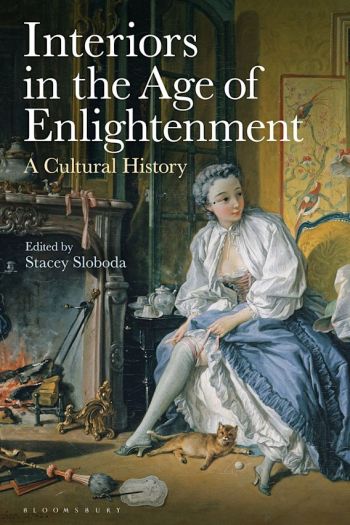 Interiors in the Age of Enlightenment provides a comprehensive and interdisciplinary overview of the cultural history of interior design and interior spaces from 1700 to 1850. Considering the interior as material, social, and cultural artefact, this volume moves beyond conventional descriptive accounts of changing styles and interior design fashions, to explore in depth the effect on the interior of the materials, processes, aesthetic philosophies, and cultural attitudes of the age. From the Palace of Versailles to Virginia coffeehouses, and from chinoiserie bathhouses to the trading exchanges of the West Indies, the chapters in this book examine a wide range of themes including technological advancements, public spaces, gender and sexuality, and global movements in interior designs and decorations. Drawing together contributions from leading scholars, this volume provides the most authoritative and comprehensive survey of the history of interiors and interior architecture in the long eighteenth century.
Stacey Sloboda is Paul H. Tucker Professor of Art at the University of Massachusetts Boston.
c o n t e n t s
Preface
Introduction: The Interior in the Age of Enlightenment — Stacey Sloboda
1 Beauty: Cultural Aesthetics in the Enlightenment Interior — Anne Nellis Richter
2 Technology: Cultural Transfer, Imitation, and Improvement of Materials and Surfaces of the Interior — Noémie Étienne
3 Designers, Professions, Trades: Conceiving and Making the Interior — Conor Lucey
4 Global Movements: Exoticism and Hybridity in the Globalized Interior — Vanessa Alayrac-Fielding
5 Private Spaces: Performing the Home — Mimi Hellman
6 Public Spaces: Staging Ritual and Shaping Identity — Laurel O. Peterson
7 Gender and Sexuality: The Desire of Decor — Michael Yonan
8 The Interior in the Arts: Literary and Visual Representations — Karen Lipsedge and Melinda McCurdy
Bibliography
Index
Conference | The Scottish Interior
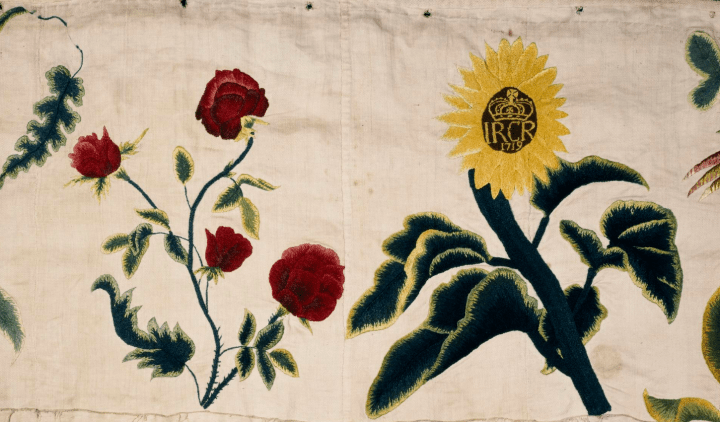
Embroidered valance celebrating the marriage of James Francis Stuart and Clementina Sobieska, 1719 (Edinburgh: National Museum of Scotland, A.1988.263 C). Part of a set of two crewel work wall hangings and four valances of white linen embroidered in coloured wool with a ‘Tree of Life’ pattern. This valance is embroidered with the cypher ‘IRCR / 1719’ under a crown within a sunflower, for ‘Jacobus Rex Clementina Regina’, referring to the marriage of James Francis Stuart and Clementina Sobieska.
◊ ◊ ◊ ◊ ◊
From the National Museum of Scotland:
The Scottish Interior
National Museum of Scotland, Edinburgh, 1 December 2023
A one-day conference on aspects of the Scottish interior from the 16th century to the present.
Thirty years on from the publication of Ian Gow’s defining book The Scottish Interior, this conference brings together specialists from a range of backgrounds to discuss questions of Scottishness—or lack thereof—in Scottish interiors from the 16th century to the present. Exploring a range of themes from the Renaissance to the Arts and Crafts movement via ‘Balmoralisation’, and with an interdisciplinary approach looking at patronage, collecting, architecture, and design, this event will appeal to anyone interested in Scottish history, design, and identity. The event is free, but booking is essential. Lunch and refreshments will be provided.

Armchair designed by Robert Adam for Sir Lawrence Dundas and made in Thomas Chippendale’s workshop, 1765 (Edinburgh: National Museum of Scotland, K.2002.9).
p r o g r a m m e
9.00 Arrival
9.30 First Panel
• Helen Wyld — Introduction
• Sally Rush — The Renaissance Interior in Scotland
• Michael Pearce — North-Britons: Interiors for an Anglicised Scottish Aristocracy
10.50 Tea
11.20 Second Panel
• Ian Gow — The Scottish Interior
• Stephen Jackson — The Role of Antique Furniture in the Scottish Interior
• Annette Carruthers — The Arts and Crafts Interior in Scotland
12.40 Lunch
13.50 Third Panel
• Emma Baillie — Messages in Plaster: The Work of Thomas Clayton at Blair Castle
• Calum Robertson — The Scottish Armoury
• Godfrey Evans — Hamilton Palace: The Projection of Exceptional Connoisseurship and Exalted Status by the Premier Peers of Scotland
15.10 Tea
15.40 Fourth Panel
• Mary Miers — Romantic Retreats
• Mhairi Maxwell, James Wylie, and Jonathan Faiers — Balmoralisation
16.20 Round table discussion with all speakers
New Book | A Cultural History of the Home
The 6 volumes appeared in 2020; the stand-alone volume on the Enlightenment became available in 2022 (see below); another option will appear in 2024.
Amanda Flather (anthology editor), A Cultural History of the Home, volumes 1–6 (London: Bloomsbury Academic, 2020), ISBN: 978-1472584410, $610.
 A Cultural History of the Home provides a comprehensive survey of the domestic space from ancient times to the present. Spanning 2800 years, the six volumes explore how different cultures and societies have established, developed and used the home. It reveals a great deal about how people have lived day-to-day in a range of regions and epochs by providing a historical focus on the location in which they will have spent much of their time: the domestic space.
1 Antiquity, 800 BCE–800 CE
2 Medieval Age, 800–1450
3 Renaissance, 1450–1648
4 Age of Enlightenment, 1648–1815
5 Age of Empire, 1815–1920
6 Modern Age, 1920–Present
Each volume discusses the same themes in its chapters:
• The Meaning of the Home
• Family and Household
• The House
• Furniture and Furnishings
• Home and Work
• Gender and Home
• Hospitality and Home
• Religion and Home
This structure offers readers a broad overview of a period within each volume or the opportunity to follow a theme through history by reading the relevant chapter across volumes.
Amanda Flather is Lecturer in the Department of History at the University of Essex. She is the author of Gender and Space in Early Modern England (2006).
◊ ◊ ◊ ◊ ◊
Clive Edwards, ed., A Cultural History of the Home in the Age of Enlightenment (London: Bloomsbury Academic, 2022), 264 pages, ISBN: 978-1472584250, $110. The paperback edition will be available in 2024.
 During the period of the Enlightenment, the word ‘home’ could refer to a specific and defined physical living space, the location of domestic life, and a concept related to ideas of roots, origins, and retreat. The transformations that the Enlightenment encouraged created the circumstances for the concept of home to change and develop in the following three ways. First to influence homemaking were the literary and cultural manifestations that included issues around attitudes to education, social order and disorder, sensibility, and sexuality. Secondly, were the roles of visual and material culture of the home that demonstrated themselves through print, portraiture, literature, objects and products, and dress and fashion. Thirdly, were the industrial and sociological aspects that included concepts of luxury, progress, trade and technology, consumption, domesticity, and the notions of public and private spaces within a home. The chapters in this volume therefore discuss and reflect upon issues relating to the home through a range of approaches. Enlightenment homes are examined in terms of signification and meaning; the persons who inhabited them; the physical buildings and their furniture and furnishings; the work undertaken within them; the differing roles of men and women; the nature of hospitality, and the important role of religion in the home. Taken together they give a valuable overview of the manners, customs, and operation of the Enlightenment home.
Clive Edwards is Emeritus Professor of Design History at Loughborough University. He is editor of The Bloomsbury Encyclopedia of Design (2015) and author of Turning Houses into Homes: A History of the Retailing and Consumption of Domestic Furnishings (2017), The Twentieth Century Interiors Sourcebook (2013), Interior Design: A Critical Introduction (2010), How to Read Pattern: A Crash Course in Textile Design (2009), Encyclopedia of Furnishing Textiles, Soft Furnishings and Floor Coverings (2007), British Furniture: 1600–2000 (2006), and Encyclopedia of Furniture Materials, Trades, and Techniques (2001).
c o n t e n t s
1 The Meaning of Home — Karen Lipsedge
2 Family and Household —Helen Metcalfe
3 The House — Stephen Hague
4 Furniture and Furnishings — Clive Edwards
5 Home and Work — Leonie Hannan
6 Gender and Home — Ruth Larsen
7 Hospitality and Home — Woodruff Smith
8 Religion and the Home — Matthew Neal
New Book | A Cultural History of Furniture, volumes 1–6
From Bloomsbury:
Christina Anderson (anthology editor), A Cultural History of Furniture, volumes 1–6 (London: Bloomsbury Academic, 2022), 1824 pages, ISBN: 978-1472577894, $550.
Furniture is an artifact, so what can it tell us about culture? What social, religious, political, and economic factors have shaped its form and functions? How does furniture demonstrate the transformations in private and public life across time and cultures?
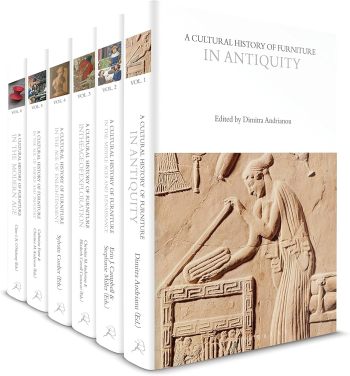 In a 6-volume work spanning 4,500 years, 70 experts chart the changing cultural framework within which furniture was designed, produced, and used in Western Europe. Individual volume editors ensure the cohesion of the whole, and, to make it as easy as possible to use, chapter titles are identical across each of the volumes. This gives the choice of reading about a specific period in one of the volumes or following a theme across history by reading the relevant chapter in each of the six.
1 Antiquity, 2500 BCE–500 CE
2 Middle Ages and Renaissance, 500–1500
3 Age of Exploration, 1500–1700
4 Age of Enlightenment, 1700–1800
5 Age of Empire and Industry, 1800–1900
6 Modern Age, 1900–Present
Chapters address: Design and Motifs; Makers, Making, and Materials; Types and Uses; The Domestic Setting; The Public Setting; Exhibition and Display; Furniture and Architecture; Visual Representations; and Verbal Representations. The total extent of the pack is approximately 1,824 pages. Each volume opens with a series preface, an introduction, and notes on contributors; each concludes with notes, bibliography, and an index.
A Cultural History of Furniture is part of the Cultural Histories Series. Titles are available both as printed hardcover sets for libraries needing just one subject or preferring a one-off purchase and tangible reference for their shelves, or as part of a fully searchable digital library available to institutions by annual subscription or on perpetual access.
Christina M. Anderson is Research Fellow, History Faculty and Ashmolean Museum, University of Oxford.
◊ ◊ ◊ ◊ ◊
Sylvain Cordier, Christina Anderson, and Laura Houliston, eds., Volume 4: A Cultural History of Furniture in the Age of Enlightenment (London: Bloomsbury Academic, 2022), ISBN: 9781472577856.
c o n t e n t s
List of Illustrations
Notes on Contributors
Series Preface
Introduction — M. B. Aldrich with Sylvain Cordier
1 Design and Motifs — Barbara Lasic
2 Makers, Making, and Materials — Yannick Chastang
3 Types and Uses — Mary-Eve Marchand
4 The Domestic Setting — Antonia Brodie
5 The Public Setting — Jeffrey Collins
6 Exhibition and Display — Frederic Dassas
7 Furniture and Architecture — Peter N. Lindfield
8 Visual Representations — Michael Decrossas and Sylvain Cordier
9 Verbal Representations — Tessa Murdoch
FHS Annual General Meeting
From the FHS (membership information is available here) . . .
Furniture History Society, Annual General Meeting
The East India Club, St James’s Square, London, 25 November 2023
The FHS Annual General Meeting for the year ending 30 June 2023 will be held at the East India Club. The meeting will start at 11.00am, with coffee from 10.30am. Talks will follow the business of the day. Admission to the AGM is free for members, but all members wishing to attend should notify the Events Secretary at least seven days in advance. Tickets for a sandwich lunch with a glass of wine (£22 per head) should also be booked with the Events Secretary at least seven days in advance. We plan to record the talks for those who cannot attend in person.
t a l k s
• Louis Platman (Curator at the Museum of the Home) will talk about Real Rooms, a massive redevelopment project that will see the construction on many new period rooms and immersive displays at the Museum. He will also provide updates on the Cotton Collection of English Regional Chairs and the recently acquired Cotton Archive.
• Dr Tessa Kilgariff (English Heritage Curator of Collections and Interiors, South London). Marble Hill is a villa situated on the banks of the river Thames in Twickenham, London. Built in the 1720s, it was home to the courtier Henrietta Howard, Countess of Suffolk. In the spring of 2022, English Heritage re-opened Marble Hill following an extensive National Lottery Heritage funded project. This talk will explore that project, Marble Hill Revived, by detailing the restoration of the house and gardens and sharing discoveries made in the course of research in the villa’s interiors, collections, and occupants. With a particular focus on the conservation of some important pieces of furniture, we will explore the history of Henrietta Howard’s riverside home.
• Stacey Clapperton (Curator of Works of Art for the Palace of Westminster) and Lucy Odlin (Collections Conservation Manager for the Palace of Westminster) on the history of the design and use of the Speaker’s State Coach (ca. 1690s). Full details will be in the November issue of the Newsletter and also on the website later in the year.
• Dr Amy Frost (Senior Curator at Bath Preservation Trust) will reveal the work currently underway at Beckford’s Tower in Bath to conserve the building and refit the museum, including how William Beckford’s collection and furniture will be presented and interpreted when the museum reopens in March 2024.
New Book | America’s Collection
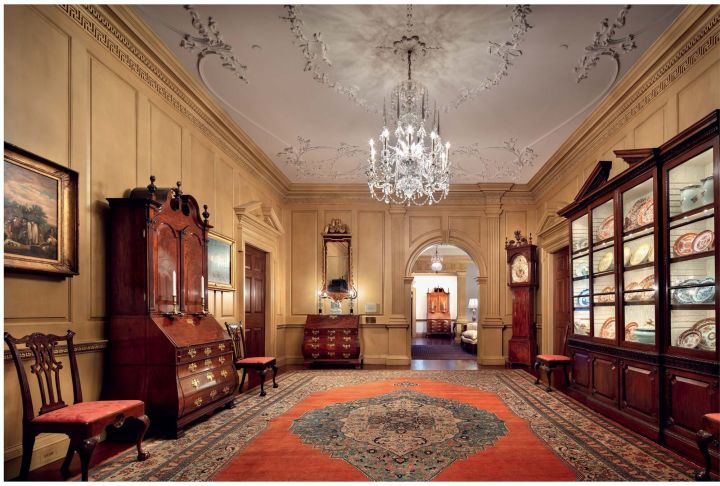
The entrance hall of the Diplomatic Reception Rooms at the U.S. Department of State; completed in 1979, the room includes a rococo ceiling taken in part from Philadelphia’s Powel House, now installed as a period room at the Philadelphia Museum of Art (Photograph by Durston Saylor). For more information on the book and the history of the reception rooms, see James Tarmy’s August 24th article for Bloomberg.
◊ ◊ ◊ ◊ ◊
From Rizzoli:
Virginia Hart, America’s Collection: The Art and Architecture of the Diplomatic Reception Rooms at the U.S. Department of State (New York: Rizzoli Electa, 2023), 352 pages, ISBN: 978-0847873272, $100. With a foreword by John Kerry and contributions by Bri Brophy, Allan Greenberg, Mark Alan Hewitt, Stacy Schiff, Elizabeth Mankin Kornhauser, Alice Cooney Frelinghuysen, Alexandra Alevizatos Kirtley, Elliot Bostwick Davis, Deborah Dependahl Waters, David Rubenstein, Carolyn Vaughan, and Laaren Brown.
The first volume in more than 20 years tells a new and modern story of the U.S. State Department’s Diplomatic Reception Rooms, one of the top collections of American fine and decorative arts in existence.
 The art of United States diplomacy has been conducted over more than two centuries with figures from all over the world, in peacetime and in conflict. For the last six decades, these negotiations have taken place in the rarified environment of the Diplomatic Reception Rooms at the U.S. Department of State. Tucked inside the modern Truman Building in the center of Washington, D.C., lies this special suite of rooms transformed by four renowned architects—gems of classical architecture brimming with exceptional American art and artifacts that tell the story of the nation’s founding and represent the singular ideals of the American character.
Housing one of the finest collections in the world, along with The Metropolitan Museum of Art and Winterthur, these rooms display more than 5,000 objects, including paintings by John Singleton Copley and Gilbert Stuart; silver and porcelain owned by George Washington and other presidents; fine furniture; maps and documents; prints and drawings, not to mention the very desk the Treaty of Paris that ended the Revolutionary War was signed on. With all-new photography and essays, this book captures the history of the rooms and explores more than 150 examples of the extraordinary American art that animates the exquisite spaces.
Virginia B. Hart is director and curator of the Diplomatic Reception Rooms and Bri Brophy is deputy chief curator. The Honorable John F. Kerry is U.S. Special Presidential Envoy for Climate, and former U.S. Secretary of State. Allan Greenberg is an architect and author. Mark Alan Hewitt is an architect and architectural historian. Stacy Schiff is a Pulitzer-Prize-winning author. Elizabeth Mankin Kornhauser is the Senior Curator for the 2026 Bicentennial at Frederic Chruch’s home Olana and Curator Emerita of American Paintings and Sculpture at The Metropolitan Museum of Art. Alice Cooney Frelinghuysen is the Anthony W. and Lulu C. Wang Curator of American Decorative Arts at The Metropolitan Museum of Art. Alexandra Alevizatos Kirtley is the Montgomery-Garvan Curator of American Decorative Arts at the Philadelphia Museum of Art. Elliot Bostwick Davis is Senior Editor, Harvard Social Impact Review, Arts and Culture and a former museum curator and director. Deborah Dependahl Waters is an independent decorative arts historian and part-time assistant professor at Parsons, New School University. David M. Rubenstein is a financier and philanthropist. Carolyn Vaughan is a writer and editor of art books and exhibition catalogues. Laaren Brown is a writer and editor for art and natural history topics. Durston Saylor is a photographer of contemporary interior design and architecture. Bruce M. White is a photographer of works of art and historic architecture. Sarah Gifford is an award-winning graphic designer.
New Book | Americana Insights, 2023
From Penn Press:
Robert Shaw, ed., Americana Insights, 2023 (Philadelphia: University of Pennsylvania Press, 2023), 288 pages, ISBN: 979-8988533108, $65.
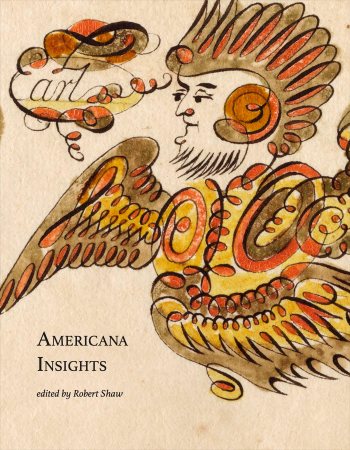 Americana Insights 2023 presents the latest research and discoveries on traditional American folk art and material culture. Groundbreaking essays by leading scholars provide a wealth of new insights on a wide array of artistic traditions. Covering a broad geographic area—including New England, the mid-Atlantic, South, and mid-West—and spanning the colonial era to early twentieth century, these essays enhance our understanding of the diverse American experience. This is the only interdisciplinary publication devoted exclusively to traditional Americana and folk art.
Contributors cover a range of topics including portraiture, furniture, jewelry, textiles, and works on paper. In the first volume, authors share groundbreaking research on the use of hooked rugs in the colonial revival era; revisit the work of a famed Connecticut portrait painter known as the Beardsley Limner and his namesake sitters; Rufus Porter’s work as an artist and entrepreneur; a distinctive group of paint-decorated dressing tables from New Hampshire; delicate cutworks made by an incarcerated inmate in Philadelphia’s Eastern State Penitentiary; painted tavern signs; jewelry in folk portraiture; New Jersey schoolmaster and calligrapher Thomas Earl; and signature quilts from the nineteenth century.
Contributors: Deborah M. Child, Pamela and Brian Ehrlich, Cynthia Fowler, Emelie Gevalt, Mark D. Mitchell, Eileen M. Smiles, Laura Fecych Sprague.
Robert Shaw is an independent curator and art historian who has written and lectured extensively on many aspects of American folk art. His many critically acclaimed books include Bird Decoys of North America: Nature History and Art (2010), American Quilts: The Democratic Art (2017), and American Weathervanes: The Art of the Winds (2021). He has curated exhibitions at the Dallas Museum of Natural History, the National Gallery of Art, the American Folk Art Museum, and the Shelburne Museum, where he served as curator from 1981 to 1994.
Americana Insights is a nonprofit publication dedicated to the study of Americana and American folk art. It was founded in 2021 by Jane Katcher in collaboration with David A. Schorsch, her longtime friend and mentor in the field, founding editor Robert Shaw, and a distinguished advisory board of museum professionals and scholars. In 2023, curator and scholar Lisa Minardi was appointed editor of Americana Insights. More information is available here»










 Enfilade
leave a comment