Conference | Elizabeth Montagu and the Bluestocking Corpus Online
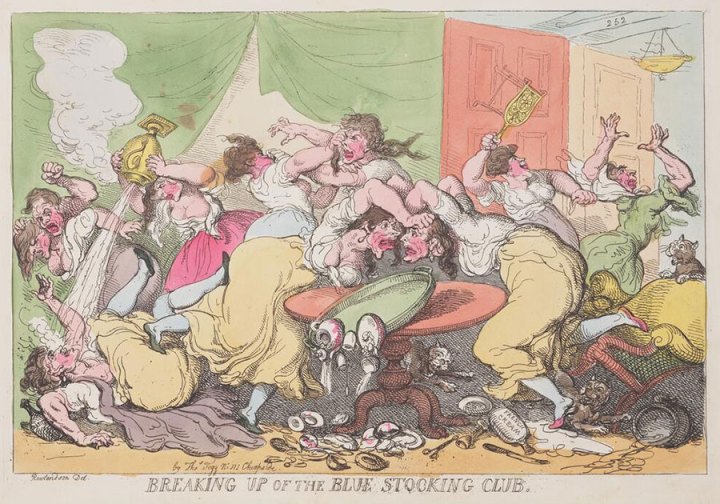
Thomas Rowlandson, Breaking Up of the Blue Stocking Club, 1815, hand-colored etching
(San Marino: Huntington Library, Art Museum, and Botanical Gardens)
◊ ◊ ◊ ◊ ◊
Next month at The Huntington:
Correspondence and Embodiment: The Bluestocking Corpus Online
The Huntington Library, Art Museum, and Botanical Gardens, San Marino, 8–9 December 2023
Organized by Elizabeth Eger and Nicole Pohl
This conference, organized in collaboration with the Elizabeth Montagu’s Correspondence Online (EMCO) project, explores themes related to The Huntington’s Elizabeth Montagu Papers. Topics include the letter as object, historical document, linguistic artifact, as well as a carrier of objects and messages about friendship, health, the mind and body, and politics. The Huntington’s collection of Elizabeth Montagu’s extensive correspondence has provided a rich source—as well as a practical challenge—for scholars working in a variety of fields, from social and economic history to histories of medicine, aesthetics, authorial selfhood, and literary genres.
Elizabeth Robinson Montagu (1718–1800) combined many roles: pioneering Shakespeare critic, businesswoman, manager of coalmines and agricultural estates, philanthropist, and patron of artists and writers. She pivoted between several important social, political, religious, and intellectual networks. Her letters connect people, places and concepts with graphic immediacy.
In 2017, the registered charity Elizabeth Montagu Correspondence Online (EMCO) was founded to fund the digitization of her 8000 extant manuscript letters, most of which are curated by The Huntington Library. This conference will explore themes connected to the archive, the letter as object, historical document, linguistic artifact, as well as a carrier of objects and messages about friendship, health, the mind and body, and politics.
This conference is organized by Elizabeth Eger (King’s College, London) and Nicole Pohl (Oxford Brookes, Oxford). Funding is provided by The Homer Crotty Lecture Endowment and the Edward A. Mayers Fellowship Endowment.
f r i d a y , 8 d e c e m b e r 2 0 2 3
8.45 Registration and Coffee
9.15 Welcome by Susan Juster (The Huntington Library) and Conveners
9.30 Session 1 | A History of the Montagu Collection at The Huntington
• Vanessa Wilkie (The Huntington Library)
• Karla Nielsen (The Huntington Library)
10.00 Break
10.30 Session 2 | EMCO: The Physical Archive and Its Virtual Other
Moderator: Joanna Barker (Durham and EMCO Senior Editor)
• Alexander Roberts (Swansea University)
• Daniel Archambault (Swansea University)
• Nicole Pohl (Oxford Brookes and EMCO Editor in Chief)
Noon Lunch
1.00 Session 3 | Gender and Knowledge
Moderator: Emily Anderson (University of Southern California)
• Rachael Scarborough King (UC Santa Barbara), Improving Letters: Self- and Literary Improvement in Women’s Epistolary Genres
• Nataliia Voloshkova, (Kazimierz Wielki University), Bluestockings and Science: Acquiring, Sharing, and Employing Knowledge, read by Nicole Pohl
2.30 Break
3.00 Session 4 | Absence and Presence
Moderator: Susan Carlile (Cal State Long Beach)
• Elizabeth Eger (King’s College London and EMCO Consultant Editor), Embodying Mind: Portraits of Elizabeth Montagu
• Felicity Nussbaum (UCLA), The Beloved Absent: The Correspondence between Elizabeth Montagu and Hester Thrale Piozzi
s a t u r d a y , 9 d e c e m b e r 2 0 2 3
8.30 Registration and Coffee
9.00 Session 5 | Embodying Language: The Letter and Creative and Critical Modes of Writing
Moderator: Nicole Pohl (Oxford Brookes)
• Betty A. Schellenberg (Simon Fraser University), Unclothed Bodies: The Problem of Enclosures in the Montagu Collection
• Mike Cousins (Historian), Keeping Track of Mrs. Montagu: Challenges in Dating Her Correspondence with Lord Lyttelton, and a Comparison with Unpublished Letter Collections of Some Other Contemporary Women Writers
10.30 Tours of the Library and Gallery
Noon Lunch
1.00 Session 6 | Bodies in Letters, Letters as Bodies
Moderator: Dena Goodman (University of Michigan)
• Lisa Forman Cody (Claremont McKenna College), Pregnant Pauses: Reproduction in—and as—Letter Writing
• Karen Harvey (University of Birmingham), ʽWe Must Chat about Invalids’: The Lived Body in British Women’s Letters, 1730–1800
2.30 Break
3.00 Session 7 | In Sickness and in Health: Bluestocking Friendship
Moderator: Karla Nielsen (The Huntington Library)
• Anna Senkiw (Oxford Brookes), ʽSeveral Weeks Indisposition, a Little Dastardly Fever Lurking about Me, Has Hinderd My Coming to the Adelphi’: Friendship with the Garricks, in Sickness and in Health
• Helen Deutsch (UCLA), Symptomatic Correspondences, Female Complaints: Authorship, Friendship and Illness in the Montagu Letters
4.30 Concluding Remarks
Panel Discussion | Caricature Collectors in Conversation
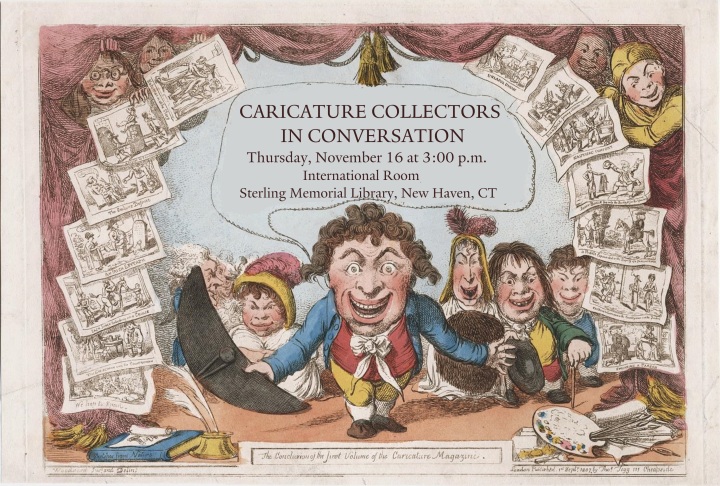
Modified version of Charles Williams, after George Moutard Woodward, The Conclusion of the First Volume of the Caricature Magazine, published by Thomas Tegg, 1807, hand-colored etching.
◊ ◊ ◊ ◊ ◊
Sponsored by The Lewis Walpole Library:
Panel Discussion | Caricature Collectors in Conversation
Sterling Memorial Library, New Haven, Thursday, 16 November 2023, 3pm
Please join us for a panel of distinguished private collectors and print curators for lively conversation about their interests, expertise, and adventures in building their collections of eighteenth- and early nineteenth-century British caricature and satiric prints. They will share stories of discovery and the pursuit of coveted acquisitions, and we will invite their thoughts on the role of appreciation, connoisseurship, and learning that grows along with the collection and the value that they find in engagement with fellow collectors and curators, and in research at library and museum print rooms. The program is free and open to the public.
Call for Papers | The First Public Museums, 18th–19th Centuries
From ArtHist.net:
The Public of the First Public Museums: II. Literary Discourses, 18th–19th Centuries
Durham, 23–24 May 2024
Proposals due by 22 December 2023
The upcoming workshop The Public of the First Public Museums: II. Literary Discourses, 18th–19th Centuries is part of the research project Visibility Reclaimed: Experiencing Rome’s First Public Museums, 1733–1870 — An Analysis of Public Audiences in a Transnational Perspective (FNS 100016_212922).
Marking the second of three encounters, this workshop delves into the examination of literary discourses vital to understanding the experiences of early museum-goers. Travel literature has long represented a privileged source for investigating the origins of the first public museums and the practices of access to public and private collections in Europe. However, in the light of recent studies aimed at deepening the material history of the museum and the encounter of the public with the institutions, these sources deserve a closer scrutiny in both methodological and critical terms. As museums sought to define and engage their public, literature often became both a mirror and a mould, reflecting and shaping societal perceptions. With a spotlight on interdisciplinary and transnational approaches, the Durham workshop calls for a deeper probe into the visual and material realms of museums, emphasizing the interplay between literary discourses and artworks, collections, display, space, audiences ‘narrated’ in the museum and the evolving institutional norms of the 18th and 19th centuries.
Following the inaugural Rome session centred on institutional sources, the Durham workshop turns its gaze towards the rich tapestry of literary narratives with the aim of analysing them also in a comparative perspective with the primary sources. Periegetic literature—inclusive of travel accounts, artist correspondences, poetic endeavours, and Grand Tourist insights—stands as a testament to the artistic engagement with museum spaces over two defining centuries. At the heart of this exploration is the figure of the writer as a museum visitor. These writers, often esteemed poets and authors, are not just passive observers; their perspectives and critiques actively shape museum dynamics and public perceptions. Such literary visits, sometimes critical towards the museum as institution, have left a lasting impact, influencing subsequent generations of museum-goers. The writer’s dual role as a visitor and critic underscores the need to reassess these literary accounts in the broader context of museum studies.
From the poetic allure of lyrical evocations that captured the emotions of an ambient to ekphrastic descriptions which meticulously transform artworks into written words, the literature of the time offered a multifaceted view of the museum experience. Anecdotes and reported conversations in situ provided a window into the immediacy of exchanges, offering insight into contemporaneous views and reactions. Reviews in periodicals played a pivotal role, often influencing broader public perceptions, while a comparison between published and unpublished literary accounts unveils disparities in representation and reception. Erudite exploits presented readers with insightful perspectives, illustrating the convergence of art, history, and scholarly pursuits. Museums emerged as hubs of social interaction, where the intellectual and cultural elite converged but not only. The belletristic narratives wove tales that blurred the lines between fact and fiction. Each genre added a unique voice, contributing to a comprehensive and nuanced understanding of the period. We aim to broaden the horizon by drawing parallels with analogous documentation from other cultural spaces that the project seeks to study in comparative terms. This includes libraries, academies, galleries, private collections, villas, both ancient and modern monuments, archaeological sites, places of worship, theatres, ateliers, and more.
The questions presented below are designed to stimulate discussions and kindle in-depth explorations into the confluence of literature and the publics of first public museums:
1 How do literary works contribute to the construction of common themes and stereotypes associated with museum audiences?
2 How has literature influenced and shaped the evolution of the culture of the museum guides or cicerones over time, and to what extent has this literary impact altered visitor experiences and expectations in museums?
3 What are the origins, characteristics, and specificities of literary genres targeted towards museum-goers, especially concerning guides, itineraries of visits, and public lectures? How do they transform based on the evolution and variations of museum audiences themselves?
4 How do notions of time during a museum visit compare and contrast with the temporal dynamics of literary narration?
5 How do ekphrastic descriptions in literature enhance our comprehension of the visitor’s gaze when engaging with artworks, architecture, museum displays?
6 How do various literary genres, such as periegetic literature, artist correspondence, diaries and reviews, serve as either sources or models for understanding the museum experience and the role of audiences?
7 How do the narratives and insights from published literary accounts of museum visits compare and contrast with those from unpublished sources, and what implications arise from these distinctions in shaping our understanding of museum-going experiences?
8 How does the concept of a museum as a space to ‘read’ differ from its traditional perception as a space to ‘visit’, and what are the implications of this distinction in literary and museological discourses?
9 How does literature play a pivotal role in crafting horizons of expectation for museum-goers influencing their anticipation and reception of museum exhibitions?
10 How did differences in gender, religion, social status, and cultural background influence writers’ portrayals of museums, and what do these varied perspectives reveal about the socio-cultural dynamics in museum narratives?
Key points of consideration:
• To foster dialogue around the most recent research endeavours, we especially encourage submissions from doctoral candidates and early-career researchers, who are currently delving into original themes and sources resonant with the seminar’s objectives.
• Preference will be given to applications showcasing interdisciplinary research approaches. This encompasses the melding of art history with literature, visual studies, and beyond. Proposals that venture beyond the traditional realms of art and architectural history, such as linguistic history, literature, tourism studies, and geography, are particularly sought after.
• Submissions emphasizing digital humanities are highly regarded. This includes, but is not limited to, cataloguing projects, databases concerning the relating in particular to literary sources concerning the visiting experiences and audiences of the first public museum and comparisons with other institutions and places (e.g., libraries, academies, galleries, villas, ancient and modern monuments).
• We highly value case studies adopting transnational and/or transregional perspectives. Proposals exploring underrepresented geographies within the sphere of Museum Studies are particularly encouraged.
• The primary focus of this workshop is on the 18th and 19th centuries. However, topics on the 17th and the early 20th century are also welcome, provided they maintain a strong engagement with or connection to these two centuries.
Contributors are invited to submit an abstract (max. 2,000 characters, including spaces) accompanied by a brief CV (max. 1,500 characters, including spaces) and a minimum of three keywords to: visibilityreclaimed@gmail.com.
• Accepted languages: Italian, English, French, Spanish
• Deadline for abstract submission: 22 December 2023
• Notification of acceptance: 10 January 2024
For further information, please contact the organising secretaries: Gaetano Cascino and Lucia Rossi at visibilityreclaimed@gmail.com.
Direction and scientific coordination
Carla Mazzarelli (Università della Svizzera italiana, Accademia di architettura di Mendrisio, Istituto di storia e teoria dell’arte e dell’architettura), carla.mazzarelli@usi.ch
Project Partners
Giovanna Capitelli (Università di Roma Tre), Stefano Cracolici (Durham University), David Garcia Cueto (Museo del Prado), Christoph Frank (Università della Svizzera italiana), Daniela Mondini (Università della Svizzera italiana), Chiara Piva (Sapienza Università di Roma)
Call of Papers | Rimini in the 18th Century
From ArtHist.net (which also includes the Call for Papers in Italian). . .
Rimini in the 18th Century: Between Art, Science, Antiquarianism, and the Grand Tour
Rimini nel Settecento: Tra arte, scienza, antiquaria e Grand Tour
Online / Università degli Studi di Bologna, Campus di Rimini, 26 January 2024
Proposals due by 23 December 2023
During the eighteenth century, Rimini opened to Europe, becoming a destination for artists, travelers, and curious intellectuals. These visitors came to discover the archaeological and artistic testimonies of the city and to observe its rediscovered natural realities. A center of “European local learning” (Raimondi) in dialogue with Enlightenment Europe, Rimini became a necessary stop of the Grand Tour to and from Rome along the Adriatic coast. Science, art, architecture, and erudite interests acted as catalysts to spotlight the city.
Throughout the eighteenth century, Rimini was in constant relationship with Rome and Bologna, and it thrived thanks to the contribution of many scholars and scientists, including the physician Giovanni Bianchi (1693–1775), refounder of the Lincei in Rimini and papal archiatra of honor, together with his most famous disciples (such as Giovanni Antonio Battarra, Giovanni Cristofano Amaduzzi, Gaetano Marini, Giuseppe Garampi), and the architect Gianfrancesco Buonamici (1692–1759), an antiquary and man of letters, an academician of honor of the Accademia Clementina in Bologna and the Accademia di San Luca in Rome.
This international workshop will investigate the different aspects of Rimini culture and the impact of foreigners on the coastal city through original, unpublished papers. The focus of this study will encompass the testimonies of travelers and amateurs, the role of architects and artists in the exchanges between Italy and Europe. If you would like to participate in the workshop by presenting a paper (20–25 minutes), please send an abstract (as a PDF file) to ilaria.bianchi5@unibo.it and valeria.rubbi2@unibo.it before 23 December 2023. The document should contain the title of your presentation, your name and affiliation, a 300-word abstract, and a brief CV. Applicants will be notified on the acceptance of proposals by 8 January 2024.
Dissertation Listings, 2020 and 2021
CAA publishes titles of dissertations in progress and completed by students at American and Canadian institutions. Clearly, however, there are problems (the index is neither timely nor comprehensive). Penn State University maintains its own list of “Art History Dissertations and Abstracts from North American Institutions,” as compiled by Catherine D. Adams and Carolyn J. Lucarelli. If your dissertation has been overlooked, please feel free to report it directly to them. I’m conflicted because I’m not in a position to maintain a list with any credibility on my own, but I also realize this is an incredibly frustrating system. Very belated congratulations to the four scholars named below and to many of you who have also finished more recently but are not yet named on either list. –CH
The CAA index for 2020 lists nine ‘eighteenth-century art’ dissertations in progress and one ‘eighteenth-century art’ dissertation completed:
• Christine Brander, “Addressing the Body: The Artless Art of Jean-Étienne Liotard” (Yale University, N. Suthor).
• Katherine Calvin, “Antiquity and Empire: The Construction of History in Western European Representations of the Ottoman Empire, 1650–1830” (The University of North Carolina at Chapel Hill). [Calvin’s dissertation is not noted on CAA’s index, but it appears at Penn State’s list.]
The CAA index for 2021 lists seventeen ‘eighteenth-century art’ dissertations in progress, and two ‘eighteenth-century art’ dissertations completed:
• Jennifer Baez, “Painting the Miracles of Altagracia: Art, Piety, and Memory in Hispaniola, 1751–1795,” (Florida State University, P. Niell).
• Emily Thames, “Empire, Race, and Agency in the Work of José Campeche, Artist and Subject in Late Spanish Colonial Puerto Rico, 1751–1809,” (Florida State University, P. Niell). [At Penn State’s list, Thames’s dissertation is listed under 2022.]
Exhibition | On the Reverse

Installation view of Reversos / On the Reverse, at The Prado in Madrid, 2023.
◊ ◊ ◊ ◊ ◊
Now on view at The Prado:
On the Reverse
Museo Nacional del Prado, Madrid, 7 November 2023 — 3 March 2024
Curated by Miguel Ángel Blanco
Until 3 March 2024, the Museo Nacional del Prado and Fundación AXA are undertaking a journey that moves beyond the surface of artistic masterpieces to allow for the contemplation of a fascinating reality: the hidden side of the work of art, its reverse. Alongside works from the Prado’s own collection, On the Reverse includes generous loans from other national and international institutions. They include Assemblage with Graffiti by Antoni Tàpies from Fundación Telefónica, Cosimo I de’Medici by Bronzino from the Abelló Collection, Self-Portrait as a Painter by Van Gogh from the Van Gogh Museum, Amsterdam, Artist in His Studio by Rembrandt from the Museum of Fine Arts, Boston, and The Empty Mask by Magritte from the Kunstsammlung Nordrhein-Westfalen, Düsseldorf. In all, about a hundred works are on display.
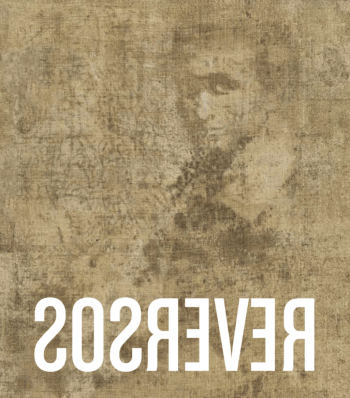 For the exhibition, curated by artist Miguel Ángel Blanco, rooms A and B of the Jerónimos Building have been painted black for the first time. On the Reverse takes the form of an open survey that gives maximum freedom to the spatial relationship between the works, devoid of any hierarchy or chronological ordering and including the presence of creations by contemporary artists such as Vik Muniz, Sophie Calle, and Miguel Ángel Blanco himself, who is represented by three of his box-books from the Library of the Forest. Taking his starting point from a contemplation of Las Meninas—in which the reverse of the vast canvas on which Velázquez is working occupies a large portion of the pictorial surface—Blanco proposes an unusual approach to painting by turning the works around in order to encourage visitors to establish a new and more complete relationship with the artists whose work is included.
Numerous studies have been undertaken to date on individual works that have interesting backs for different reasons, and some museums have explored this aspect in a partial manner through small exhibitions focused on the reverse of works in their collections. However, with the collaboration of Fundación AXA, it is the Museo Nacional del Prado that is now approaching this subject with the necessary ambition. In addition to undertaking a complete reassessment of the backs of works in its collections, the Museum has also located examples in some of the world’s leading museums that reveal how an appreciation of works of art is enriched when their contemplation is not limited to the front.
Structured thematically, the exhibition includes artists never previously seen at the Prado, among them Van Gogh (1853–1890), René Magritte (1898–1967), Lucio Fontana (1899–1968), Pablo Palazuelo (1915–2007), Antoni Tàpies (1923–2012), Sophie Calle (b. 1953), Vik Muniz (b. 1961), Michelangelo Pistoletto (b. 1933), José María Sicilia (b. 1954), Wolfgang Beurer (active 1480–1504), Louis-Léopold Boilly (1761–1845), Carl Gustav Carus (1789–1869), Vilhelm Hammershøi (1864–1916), Martin van Meytens (1695–1770), Wallerant Vaillant (1623–1677), Ernst Ludwig Kirchner (1880–1938), and Max Liebermann (1847–1935).
On the Reverse opens with ‘The Artist behind the Canvas’, crossing that dimensional threshold to which Velázquez draws our attention with the enigmatic reverse of the canvas depicted in Las Meninas. Painters frequently portrayed themselves behind a picture, but even when these backs are not so directly associated with the artist’s activity, they acquire a prominent presence as objects of special significance in painters’ studios.
The depiction of the back returns in ‘This Is Not a Reverse’, a section that paraphrases Magritte in order to bring together various trompe l’oeils that represent backs of paintings. This meta-artistic subject reveals the enormous significance that the hidden side of works could acquire for artists, leading them to imitate the annotations, inscriptions, drawings, etc, habitually found on picture backs.
One of the elements that makes up the pictorial support is the subject of ‘The Stretcher as Cross’, the exhibition’s third section. This concealed structural element normally takes the form of a wooden cross that can be used to carry the painting from one place to another. When—in a habitual, everyday action that also emphasises the three-dimensional status of the work which this exhibition analyses—an artist picks up the cross of the stretcher in order to move the work in the studio or take it outside for the purpose of painting outdoors he/she is performing a type of ‘Via Crucis’ that symbolises the effort and difficulties of artistic endeavour.

Martin van Meytens, Kneeling Nun, obverse and reverse, ca. 1731, oil on copper, 28 × 21 cm (Stockholm: Nationalmuseum, NM 7036; purchased in 2006 with the Axel och Nora Lundgren Fund). The painting was also included in the 2017–18 exhibition Casanova: The Seduction of Europe.
◊ ◊ ◊ ◊ ◊
The exhibition’s central section, ‘B-Sides’, focuses on works that can be termed ‘two-sided’. Here the back has its own artistic status and complements the principal image in various ways. It may feature the back of a figure seen from the front on the other side, a landscape or allegorical scene that modifies the meaning of the principal representation, heraldic information, associated religious themes, portraits, and more. Continuing this theme, the section ‘The Hidden Side’ includes works in which the back reveals traces of the creative process in the form of drawings, geometrical designs, or expressive whimsies.
‘More Information on the Back’ looks at a classic problem in painting. Although word and image coexisted relatively easily until the Middle Ages, a moment arrived when artists entrusted all the weight of the narrative to the latter. Furthermore, when they needed to convey information, identify subjects or individuals, or include additional information or commentaries on the execution of the work, they almost invariably wrote on the back. In some cases information has been added to backs at a later date in the form of labels and stamps or seals that help us to trace the history of the works: the collections they belonged to, the palaces they adorned, their changes of location, and any restoration undertaken on them.

Zacarías González Velázquez, Reverse of Two Fishermen, One with a Rod and the Other Seated, 1785, oil on canvas (Madrid, Cuartel General del Ejército, depósito del Museo Nacional del Prado). The back of the painting reveals a strip of canvas that was folded over the stretcher at some date in order to fit the work into a narrower space.
In other cases, as seen in ‘Ornaments and Ghosts’, the backs reveal stories contained in the works’ actual materials: textiles that had domestic uses or patterned weaves that contain unintentional ghosts which appear when oil soaks into the cloth. In addition, the section ‘Folds, Cuts, and Cutouts’ shows how old restorations and alterations made to adapt paintings to new locations or functions are visible on reverses that include repairs, cuts, and folds that result in part of the image being relegated to facing the wall.
It is easy to simplify the experience of ‘facing’ a painting to a question of fronts: the work’s and the viewer’s. Looking at a painting implies locating ourselves before it with our ‘front side’, where our eyes are located. However, for some time now, the experience of art has been understood as something more physical; our entire body in all its dimensions participates in it. In fact, in both depictions of artists working in their studios and in images of the public looking at art in museums and exhibitions these figures are often seen ‘From behind, In front of the Painting’.
Finally, ‘Nature in the Background’ investigates the unusual or less common materials that have been used over the centuries as the supports for paintings in the Museum’s collection. This research has identified copper, tin, slate, alabaster, cork, brick, porcelain, and ivory. Furthermore, dust is always present. Regular cleaning is, of course, undertaken at the Museum, but the largest and heaviest works are less frequently moved. A short time ago the Museo del Prado removed The Transfiguration by Giovanni Francesco Penni from the wall, allowing Miguel Ángel Blanco to collect some of the dust accumulated on its reverse, which he has used to make three box-books for his Library of the Forest.
Miguel Ángel Blanco, ed., Reversos (Madrid: Museo del Prado, 2023), 336 pages, ISBN: 978-8484806042, €38. With additional contributions by Ramón Andrés, Ana González Mozo, Antonio Muñoz Molina, and Victor I. Stoichita.
Call for Papers | Unfolding the Coromandel Screen
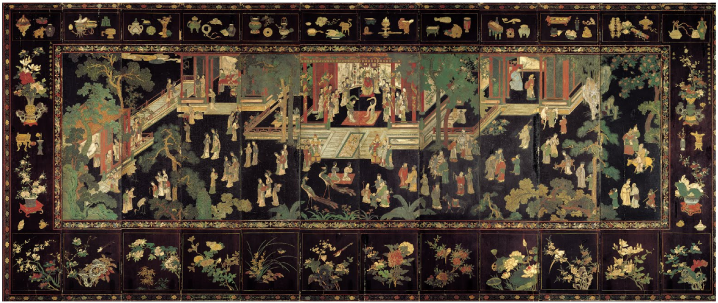
Coromandel Screen, Kangxi reign (1662–1722), Qing dynasty, carved lacquer, 258 × 52 × 3.5 cm
(Art Museum, The Chinese University of Hong Kong, 2001.0660)
◊ ◊ ◊ ◊ ◊
From the City University of Hong Kong, as posted at ArtHist.net:
Unfolding the Coromandel Screen
Online and and in-person, City University of Hong Kong, 22–25 November 2024
Organized by Wang Lianming with Mei Mei Rado
Proposals due by 20 January 2024
With the generous support of the Bei Shan Tang Foundation, the Department of Chinese and History at City University of Hong Kong will host a two-part academic event titled Unfolding the Coromandel Screen in celebration of the department’s tenth anniversary. This four-day event will bring together an international group of art historians, museum curators, conservators, collectors, and global historians to delve into various facets of the Coromandel screen and its intricate histories of interrelations with paintings, prints, decorative arts, palatial and interior designs, global maritime trade, and the fashion industry. The conference, organized by Wang Lianming (City University of Hong Kong) in collaboration with Mei Mei Rado (Bard Graduate Center, New York), will take place on-site at City University of Hong Kong and via Zoom on November 22–23. The keynote speech will be delivered by Jan Stuart, the Melvin R. Seiden Curator of Chinese Art at the Smithsonian National Museum of Asian Art, Washington D.C. Following the conference, participants will be invited to join a two-day traveling seminar from November 24 to 25, visiting lacquer and conservation workshops and museum collections in and around Guangzhou.
Context and Scope
During the second half of the seventeenth century, the production of the Coromandel screens, also known as kuancai (‘carved polychrome’), thrived along China’s southeast coast. These screens gained immense popularity domestically and in European markets, fostering connections between regional artisans, merchants, and prominent European figures such as royalty and nobility. In the last two decades of this century, the Coromandel screens emerged as one of China’s most frequently exported commodities, rivaling porcelain and challenging Japanese lacquerware exports. Their significance extends far beyond the general perception of being merely mass-produced craftwork of subpar quality. The conference will focus on two interconnected yet distinct lines of development: the screens encapsulated social cohesion, domestic networks, and transoceanic encounters while simultaneously becoming entwined in global histories that positioned them as coveted commodities, commemorative gifts, sites of maritime connectivity, and evocative artistic expressions originating from the Orient. Following this view, three key areas of investigation are at the forefront of discussions:
A) Transported Visions and Spatial Mobility unravels the role of the Coromandel screens in facilitating visual communication during the early modern world. Drawing inspiration from Aby Warburg’s concept of the ‘Image Vehicle’ (Bilderfahrzeuge, 1932), this inquiry delves into the dynamic and creative exchange of ideas, compositional elements, and ‘pictorial formulas.’
B) Inscribed Surfaces and Social Cohesion delves into the societal aspects of the Coromandel screens within domestic contexts. They were widely circulated as inscribed gifts among middle- and low-ranking, yet affluent, Qing officials stationed on the frontier. Their indexical nature provides a distinct perspective to unravel the interconnected social networks, political gatherings, interactions among officials and merchants, and intertextuality within and across regions.
C) Deconstruction and (Re)Framing: The Afterlives encompasses a wide range of transcultural practices applied to Coromandel screens after their removal from their original context. This scope analyzes and conceptualizes the procedural aspects of integrating Coromandel screens into new displays, such as European palatial interiors, marquetry furniture, and new works of art created by fragmenting, reassembling, refurbishing, and (re)appropriating lacquer panels.
Proposals may address, but are not limited to, the following topics:
• The mobility, intermingling, and dissemination of certain pictorial formulas through the Coromandel screen, such as the ‘Han Palace’ (estate celebration) or ‘Wenji Returning to Han’
• The interplay between various types of screens, porcelain, lacquerware, carpets, wallpaper, prints, furniture, and other decorative arts
• The interplay between various formats, materiality, and techniques along China’s southeast coast
• Regional divergences in terms of style, motif, lacquer and carving techniques, overall designs, etc.
• Recent discoveries in museum conservation
• The entangled histories with other screens produced in East Asia, such as the Nanban screen, the gilt biombo produced in Macao, and the painted screen in Korea
• Inscriptions, gift-giving, official-merchant interaction, political manifestos, social cohesion, and practices, etc.
• Sawing, reassembling, refurbishing, and (re-)appropriating lacquer panels in new contexts, and other framing practices
• Imitation and transmedial practices, such as leather imitation of the Coromandel screen
• The Coromandel screen’s entanglement with Japonisme painting, haute couture, and the fashion industry
• Theoretical discourses on the Coromandel screen’s valence in Orientalism, transculturalism, and global (art) history, etc.
Proposals from all disciplines are welcome. Please send an abstract of no more than 300 words, along with a brief bio, to unravelingcoromandel@googlemail.com by 20 January 2024. Presentations in English or Chinese (with pre-translated lecture notes required) should not exceed 20 minutes. The proposals accepted will be announced in early April 2024.
The Bei Shan Tang Foundation, in conjunction with the Department of Chinese and History of City University of Hong Kong, will cover the costs of lodging and travel. We also encourage speakers who can fund their own travel to participate. For further inquiries, please contact lianming.wang@cityu.edu.hk.
The organizers envision publishing selected conference papers in an edited volume.
Advisory Board
Ching May Bo, City University of Hong Kong
Burglind Jungmann, UCLA
Mei Mei Rado, Bard Graduate Center, New York
Anton Schweizer, Kyushu University
Wang Lianming, City University of Hong Kong
Xu Xiaodong, CUHK Art Museum
Call for Articles | On Borders and Boundaries
From the Call for Papers:
On Borders / Boundaries in Art and Art History | O granicach w sztuce i historii sztuki
Artium Quaestiones 35
Proposals due by 10 December 2023, with full texts due by 25 February 2024
Artium Quaestiones is an academic journal published by the Department of Art History at Adam Mickiewicz University in Poznan, Poland.
The problem of borders/boundaries in art history, both ancient and modern, recurs in various guises and meanings. A border as a dividing line—structuring political, national, or regional geography—is often an object of conflict that translates into both artistic practices and discourses that attempt to systematize and qualify art created in a given area, thus influencing artistic geography. Art is often an attempt to answer or problematize borders on the grounds of cultural, economic, or racial, differences. This is the subject of the recently opened exhibition at the National Museum in Poznań, About Sharing: Art on the (Polish-German) Border, curated by Marta Smolińska and Burcu Dogramaci, or the numerous art and exhibition projects dealing with the US-Mexican or Israeli-Palestinian borders (border art). The ongoing war in Ukraine also forces us to rethink the problem of the border and identity in art.
However, a border can also be viewed more abstractly, as a boundary, a line that delineates structures and systems of practices and discourses that seek to define identity, to classify and create hierarchy. Delimitations of this type characterized modernity (modernism) in the broad sense of this term. They were, however, eventually challenged by postmodern (poststructuralist) thought and post- and decolonial studies that favored the porosity and fluidity of previously constructed divisions, and thus of identities and their associated systems of meaning. The undecidable nature of a border (a division, boundary or a frame)—and, more broadly, of the established relationship between the hierarchically established center and the margin—was long ago discussed by Jacques Derrida in terms of parergon, and theorists such as Gilles Deleuze introduced conceptual constructs that invalidated borders/boundaries as lines of division altogether. These revaluations clearly pointed out the impossibility of sustaining thinking about borders as impermeable lines—physical and conceptual—demonstrating the necessity of thinking of them in terms of a field of difference, interpenetration, hybridization, a zone that can be both conflictual and highly productive and creative.
We encourage submissions that will address the problem of the border/boundary, with a particular focus on various attempts to theorize it, reflect on the contemporary condition of these concepts and their functioning in both contemporary artistic practices, art-historical discourse and reevaluations of the state of knowledge on the art of the past. Among other things, we will be interested in
• attempts to theorize the category of the border/boundary—both physical and conceptual—in the field of art history or visual culture studies
• problematized and theoretically framed case studies of art, including architecture, dealing with the problem of territorial, interstate, regional borders (including so called border art)
• issues of artistic geography, the establishing and/or questioning of cultural and ethnic borders/divisions through artistic and/or architectural practices
• a border/boundary as an issue of architectural practice, planning and landscape design
The deadline for submissions of abstracts (maximum of 2,500 characters) and a short academic bio is 10 December 2023. Authors of qualified abstracts will be asked to submit a full text of a maximum length of 45,000 characters (including an appendix bibliography) by 25 February 2024. All texts, with prior approval of the editorial team, will undergo a double-blind peer review. Please submit proposals via pressto. Contact an editor board at aq.redakcja@amu.edu.pl.
Exhibition | Amber: Treasures from the Baltic Sea
On view at Galerie Kugel:
Amber: Treasures from the Baltic Sea, 16th–18th Century
Galerie Kugel, Paris, 18 October — 16 December 2023
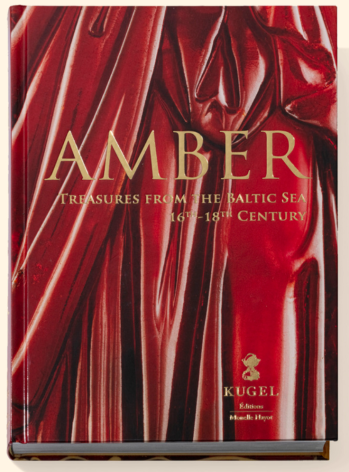 From Roman times to the 18th century, many recognised the inherent value of amber and hypothesised its origin, some assuming it to be whale sperm, others, solidified lynx urine. Its mystery endowed it with medicinal virtues. Amber was recommended as a powder to cure melancholy, toothache, and epilepsy, among other ailments, and as a love filter. The occasional inclusions of insects and small animals found trapped in amber have also made it a symbol of immortality. Pliny the Elder was the first to unveil its nature as the result of plant resin, but it wasn’t until 1757 that the Russian scientist Mikhail Lomonossov determined its true origin.
Amber is a fossilised resin originating, in the case of the objects exhibited, from a prehistoric forest dating back to some 30 to 40 million years, located under the Baltic Sea, between the towns of Danzig (today Gdansk in Poland) and Königsberg (today Kaliningrad in Russia), then, in East Prussia. In the 16th century, Grand Master Albert of Brandenburg-Ansbach (1490–1568) converted to Protestantism and transformed the territories of the Order of the Teutonic Knights in the Duchy of Prussia. This marked the beginning of a tremendous expansion in the trade and production of amber works of art. They became Prussia’s diplomatic gifts par excellence and were sought after to adorn the ‘Kunstkammern’ of Europe’s sovereigns and princes. It took nearly 20 years to collect the fifty pieces on display in this exhibition. Combining sculptures, caskets, tankards, and game boards, the wide variety of objects presented illustrate the fascination for amber through the 16th, 17th, and 18th centuries.
Alexis Kugel and Rahul Kulka, Amber: Treasures from the Baltic Sea, 16th to 18th Century / Ambre: Trésors de la mer Baltique du XVI au XVIIIe siècle (Saint-Remy-en-l’Eau: Éditions Monelle Hayot, 2023), 376 pages, €85. Available in French and English.
Exhibition | Drawing on Blue
Opening in January at The Getty:
Drawing on Blue
Getty Center, Los Angeles, 30 January — 28 April 2024
Curated by Edina Adam and Michelle Sullivan
Made from blue rags, blue paper has fascinated European artists from its earliest use in Renaissance Italy to Enlightenment France and beyond. Through new technical examination of drawings in the Getty’s collection, this exhibition offers fresh insight into the physical properties of blue paper and its unique contribution to artistic practice from the 15th through 18th centuries.
◊ ◊ ◊ ◊ ◊
From Getty Publications:
Edina Adam and Michelle Sullivan, eds., Drawing on Blue: European Drawings on Blue Paper, 1400s–1700s (Los Angeles: J. Paul Getty Museum, 2024), 160 pages, ISBN: 978-1606068670, $35. With contributions by Mari-Tere Álvarez, Thea Burns, Marie-Noelle Grison, Camilla Pietrabissa, and Leila Sauvage.
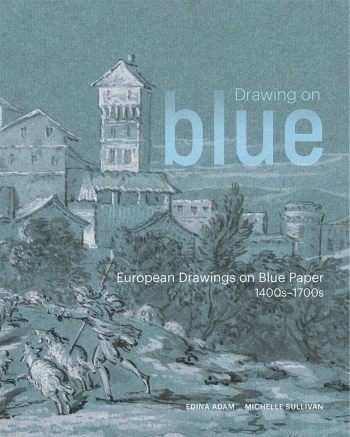 This engaging book highlights the role of blue paper in the history of drawing. The rich history of blue paper, from the late fifteenth to the mid-eighteenth centuries, illuminates themes of transcultural interchange, international trade, and global reach. Through the examination of significant works, this volume investigates considerations of supply, use, economics, and innovative creative practice. How did the materials necessary for the production of blue paper reach artistic centers? How were these materials produced and used in various regions? Why did they appeal to artists, and how did they impact artistic practice and come to be associated with regional artistic identities? How did commercial, political, and cultural relations, and the mobility of artists, enable the dispersion of these materials and related techniques? Bringing together the work of the world’s leading specialists, this striking publication is destined to become essential reading on the history, materials, and techniques of drawings executed on blue paper.
Edina Adam is assistant curator of drawings at the J. Paul Getty Museum. Michelle Sullivan is associate conservator of drawings at the J. Paul Getty Museum.










 Enfilade
leave a comment