New Book | Four Centuries of Blue and White
Published by Paul Holberton and distributed by The University of Chicago Press:
Becky MacGuire, with essays by William Sargent and Angela Howard, Four Centuries of Blue and White: The Frelinghuysen Collection of Chinese and Japanese Export Porcelain (London: Ad Ilissvm, 2023), 432 pages, ISBN: 978-1915401090, £90 / $110.
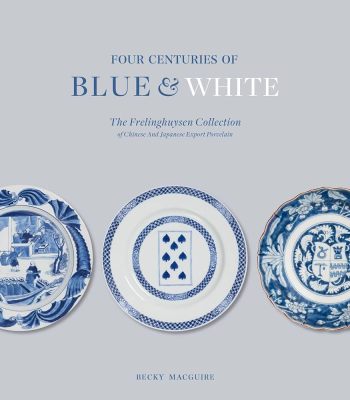 This beautifully illustrated book presents the Frelinghuysen Collection of Chinese and Japanese export porcelain. It is the first major publication to consider Chinese and Japanese blue and white together.
This extraordinary collection, assembled carefully over fifty years, features an exceptionally wide array of Asian blue and white porcelain—the most ubiquitous and influential of all ceramics. Ranging from Chinese pieces specially made for Portuguese traders in the sixteenth century to late nineteenth-century commissions for the Thai royal court, the collection also includes numerous Chinese classics from the era of the European trading companies and a notable selection of Japanese export porcelain. In its vast scope, it speaks of the diverse impulses and historical forces that propelled the trade in Asian porcelain and provides a lens to view the interaction of East and West from the early modern age to the dawn of the twentieth century. More than 300 pieces from the collection are illustrated and discussed in full and another 250 are illustrated in a compendium, all divided into thematic chapters that reflect the many ways Chinese and Japanese porcelain has been traded, collected, and used around the world.
Essays by William R. Sargent, former Curator of Asian Export Art at the Peabody Essex Museum, and noted armorial porcelain authority Angela Howard, precede the thirteen chapters, which include Faith, Identity, For the Table, To European Design, and Made in Japan. Great rarities are featured alongside small, amusing pieces and the many export porcelains made to elevate the practices of daily life.
With its strict adherence to blue and white porcelain, the collection intensifies our focus on forms, patterns, and designs, gathering together wares that are often considered only separately for study while also covering areas of little recent scholarship, such as the Thai market material. The specialized reader will find references to the latest research while the more general reader will appreciate a comprehensive overview of Asian export porcelain. There has not been a significant survey of either Chinese or Japanese blue and white since the 1990s, and they have never been considered together in a major publication.
Becky MacGuire is a graduate of the University of California at Berkeley and the Study Centre for the Fine & Decorative Arts at the Victoria & Albert Museum. She was the longtime Asian export art specialist at international auction house Christie’s.
Lecture | Iris Moon on Queen Mary’s Blue and White Ceramics
This Thursday at Yale’s History of Art Department:
Iris Moon | Blue Milk: Mary II, Porcelain, and the Queen’s Body at the Hampton Court Dairy
Yale University, 2 November 2023, 4pm
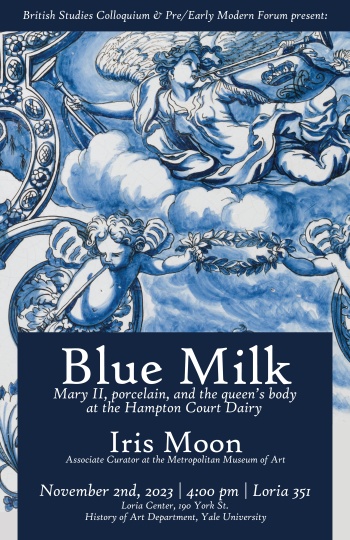 In this talk Iris Moon will explore the porcelain and delftware collection of Mary II (1662–1794) and how these artificial blue and white objects shaped the image of the queen and co-ruler of England with William III. After taking the throne in 1689, Mary II became actively involved in the extensive renovation of Hampton Court, the dilapidated Tudor residence. This included the creation of spaces designed for the queen’s pleasure, in particular the dairy in the Water Gallery, constructed out of the Tudor Watergate, a former royal retreat. Dairies in the early modern period, as the work of Meredith Martin has suggested, were not only gendered retreats of pleasure and privacy, but strategic sites of power. This presentation argues that these sites, premised upon an endless flow of milk and the promise of maternal fecundity and provisioning, also functioned as the architectural means through which female rulers worked through the anxieties of dynastic succession and the pressures to reproduce an heir. Bringing feminist theories of the body to bear upon the rare survivals from Mary II’s now destroyed dairy, such as a blue and white earthenware tile in The Metropolitan Museum of Art, Dr. Moon looks at how Mary’s extensive ceramics collection of Dutch earthenware and Asian export porcelain shaped her public persona after her sudden death in 1694. More than this, it created a surrogate, artificial body of blue and white that became mapped onto memories of the queen.
Iris Moon is an assistant curator in the European Sculpture and Decorative Arts Department at The Metropolitan Museum of Art, where she is responsible for European ceramics and glass. At The Met, she participated in the reinstallation of the British Galleries, and she is currently planning an exhibition on Chinoiserie, women, and the porcelain imaginary that will open in 2025.
Exhibition | Michail Michailov’s Dust to Dust at the Belvedere

Michail Michailov, Dust to Dust, as installed in the Carlone Hall of the Upper Belvedere in 2023.
(Photo by Johannes Stoll)
◊ ◊ ◊ ◊ ◊
From the press release (via Art Daily) for the exhibition:
Michail Michailov: Dust to Dust
Upper Belvedere, Vienna, 19 October 2023 — 14 April 2024
Curated by Stella Rollig with Johanna Hofer
As part of the Belvedere’s Carlone Contemporary series, Michail Michailov presents Dust to Dust, an 18-part trompe l’oeil drawing, previously exhibited at the Bulgarian Pavilion of the 2022 Venice Biennale. The modular work captures incidental, often overlooked vestiges of time, such as dust, hair, imprints, and stains, calling into question the value and existence of things.
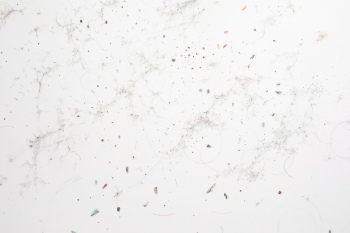
Michail Michailov, Dust to Dust, detail, colored pencil on paper, 2022 (Photograph by Lisa Rastl).
Upon first glance, Dust to Dust may seem like a minimalist installation amid the baroque ambiance of the Carlone Hall. However, upon closer inspection, the display’s space-consuming surface reveals profound poetry. Michailov has meticulously crafted an 18-part series of colored pencil drawings that capture the often unnoticed and incidental vestiges of time. The work is a microcosm touching on fundamental questions of value, transience, and existence with striking simplicity. The realism of Michailov’s trompe l’oeil technique can also be observed above the installation, in the Triumph of Aurora ceiling fresco, which portrays the victory of light over darkness.
Michail Michailov states: “While science explores matter through its composition, I try to understand its meaning through art.”
General Director Stella Rollig states: “Michail Michailov is interested in providing his audience with an experience that only art can make possible. The old master technique of trompe l’oeil that he employs in the Carlone Hall seeks to amaze, amuse, and fascinate. Whether in a large-scale installation or a sheet of paper, Michailov’s work challenges the senses to set the mind in motion.”
Michail Michailov was born in 1978 in Veliko Tarnovo, Bulgaria, where he studied fine arts. Since 2002, he has lived and worked in Vienna, where he completed a degree in art history. His artistic practice moves fluidly between the fields of drawing, installation, film, and performance. The Carlone Contemporary Series showcases contemporary works in the Carlone Hall of the Upper Belvedere. From the frescoed ancient world of the deities Apollo and Diana to the present day, artists bridge the Baroque pictorial program with fresh artistic perspectives.
New Book | Decay and Afterlife
From The University of Chicago Press:
Aleksandra Prica, Decay and Afterlife: Form, Time, and the Textuality of Ruins, 1100 to 1900 (Chicago: The University of Chicago Press, 2022), 304 pages, ISBN: 978-0226811314 (hardcover), $105 / ISBN: 978-0226811598, $35. Also available as a PDF.
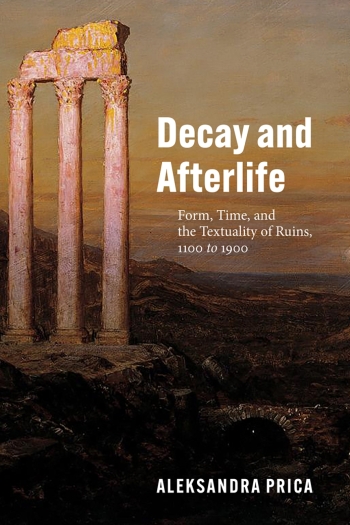 Covering 800 years of intellectual and literary history, Prica considers the textual forms of ruins.
Western ruins have long been understood as objects riddled with temporal contradictions, whether they appear in baroque poetry and drama, Romanticism’s nostalgic view of history, eighteenth-century paintings of classical subjects, or even recent photographic histories of the ruins of postindustrial Detroit. Decay and Afterlife pivots away from our immediate, visual fascination with ruins, focusing instead on the textuality of ruins in works about disintegration and survival. Combining an impressive array of literary, philosophical, and historiographical works both canonical and neglected, and encompassing Latin, Italian, French, German, and English sources, Aleksandra Prica addresses ruins as textual forms, examining them in their extraordinary geographical and temporal breadth, highlighting their variability and reflexivity, and uncovering new lines of aesthetic and intellectual affinity. Through close readings, she traverses eight hundred years of intellectual and literary history, from Seneca and Petrarch to Hegel, Goethe, and Georg Simmel. She tracks European discourses on ruins as they metamorphose over time, identifying surprising resemblances and resonances, ignored contrasts and tensions, as well as the shared apprehensions and ideas that come to light in the excavation of these discourses.
Aleksandra Prica is associate professor of German literature at the University of North Carolina at Chapel Hill.
c o n t e n t s
List of Figures
List of Abbreviations
Introduction
I | Foundations
1 Among Ruins: Martin Heidegger and Sigmund Freud
2 Afterlife: Hans Blumenberg and Walter Benjamin
II | The Propitious Moment
3 Petrarch and the View of Rome
4 Poliphilo and the Dream of Ruins
III | Living On
5 Ferdinand Gregorovius, Hildebert of Lavardin, and the Rupture of Continuity
6 Lucius Annaeus Seneca, Martin Opitz, and the Overcoming of Vanity
IV | The Battleground of Time
7 Johann Jacob Breitinger, Andreas Gryphius, and the Reconsideration of Allegory
8 Thomas Burnet, Georg Wilhelm Friedrich Hegel, and the Realignment of Discourses
V | Futures and Ruins
9 Johann Wolfgang von Goethe, Georg Simmel, and the Provisionality of Forms
Epilogue
Acknowledgments
Bibliography
Index
New Book | Staging ‘The Mysterious Mother’
From Yale UP:
Cynthia Roman, Jill Campbell, and Jonathan Kramnick, eds., Staging ‘The Mysterious Mother’ (New Haven: Yale University Press, 2023), 376 pages, ISBN: 978-0300263657, $65.
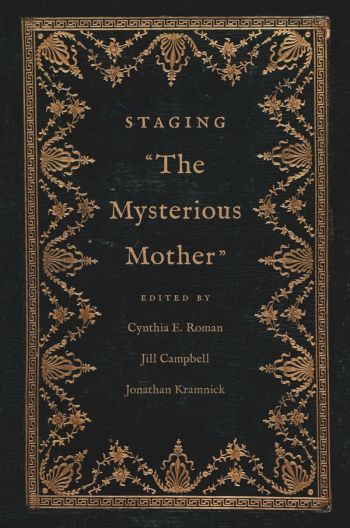 Horace Walpole’s five-act tragedy The Mysterious Mother (1768), a sensational tale of incest and intrigue, was initially circulated only among the author’s friends. Walpole never permitted it to be performed during his lifetime except as a private theatrical. He described his play as a “delicious entertainment for the closet” and claimed that he “did not think it would do for the stage.” Yet the essays in this volume trace a history of private readings, amateur theatricals, and even early public performances, demonstrating that the play was read and performed more than Walpole’s protests suggest. Exploring a wide variety of topics—including the play’s crypto-Catholicism, its treatments of incest, guilt, motherhood, orphans, and scientific spectacle, and the complex relations between print and performance—the essays demonstrate the rich relevance of The Mysterious Mother to current critical discussions. The volume includes the proceedings of a mini-conference hosted at Yale University in 2018 on the occasion of a staged reading of the play. Also included are the director’s reflections, an abridged script, a facsimile of Walpole’s own copy of the full-length play, and reproductions of the illustrations he commissioned from Lady Diana Beauclerk.
Cynthia E. Roman is curator of prints, drawings, and paintings at the Lewis Walpole Library. Jill Campbell is professor of English and affiliated faculty in the Women’s, Gender, and Sexuality Studies Program at Yale University. Jonathan Kramnick is the Maynard Mack Professor of English at Yale University and the director of the Lewis Walpole Library.
Exhibition | Objects of Addiction
Now on view at Harvard Art Musesums:
Objects of Addiction: Opium, Empire, and the Chinese Art Trade
Harvard Art Museums, Cambridge, 15 September 2023 — 14 January 2024
Curated by Sarah Laursen, with contributions from Emily Axelsen, Allison Chang, and Madison Stein
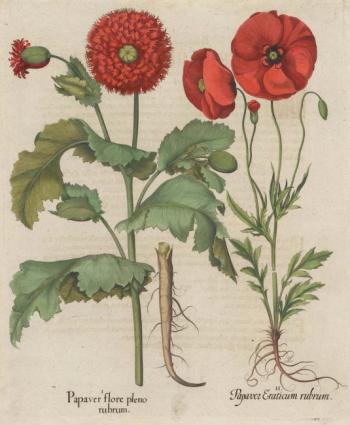
Basilius Besler, Papaver flore pleno rubrum, Papaver eraticum rubrum (plate 290), from Hortus Eystettensis, 1613 or 1713, hand-colored print (Economic Botany Library of Oakes Ames, Harvard University, Julio Mario Santo Domingo Collection, TL42499.1).
How did the sale of opium in China by Massachusetts merchants in the 19th century contribute to a growing appetite for Chinese art at Harvard at the start of the 20th century?
Objects of Addiction explores the entwined histories of the opium trade and the Chinese art market between the late 18th and early 20th centuries. Opium and Chinese art, acquired through both legal and illicit means, had profound effects on the global economy, cultural landscape, and education—and in the case of opium, on public health and immigration—that still reverberate today.
The first section of the exhibition examines the origins of the opium trade, the participation of Massachusetts traders, and opium’s devastating impact on the Qing dynasty (1644–1911) and the Chinese people. Works presented here include smoking paraphernalia, an opium account book, and photographs, along with mass media illustrations critiquing the use and sale of opium.
The second section highlights the history of imperial art collecting in China and demonstrates the growing appetite for Chinese art in Europe and the United States after the Opium Wars (1839–42 and 1856–60). Artworks from Massachusetts-based private and public collections show the shift in taste at this time from export ceramics and paintings to palace treasures and archaeological materials, including ancient bronzes and jades unearthed from tombs and Buddhist sculptures chiseled from cave temple walls. Through the histories of museum directors, professors, and donors, this section looks critically at the sources of Harvard’s Chinese art collection.
A special section of the exhibition investigates parallels between China’s opium crisis and the opioid epidemic in Massachusetts today. We invite visitors to share their thoughts and personal experiences in this space. A range of public programs throughout the fall will encourage community discussion around the opioid crisis, the effects of the Opium Wars on U.S.–China relations, the role of opium in Chinese exclusion in the United States, and art collecting practices. In addition, the artist collective 2nd Act will present a series of substance use prevention workshops, and the Cambridge Public Health Department and Somerville Health and Human Services Department will host trainings on the use of naloxone (Narcan) to reverse opioid overdoses.
This exhibition features works from the collections of the Harvard Art Museums. In addition, loans have been generously provided by the Peabody Museum of Archaeology and Ethnology, Fine Arts Library, Harvard-Yenching Library, Economic Botany Library of Oakes Ames, Houghton Library, and Baker Library (all at Harvard), as well as by the Forbes House Museum, the Ipswich Museum, and Mr. and Mrs. James E. Breece III.
Curated by Sarah Laursen, Alan J. Dworsky Associate Curator of Chinese Art, Harvard Art Museums; with contributions from Harvard students Emily Axelsen (Class of 2023), Allison Chang (Class of 2023), and Madison Stein (Class of 2024), who were instrumental in the early development and planning of this exhibition. We are also grateful to the community members, students, and scholars who lent their time and expertise.
Lecture | Mei Mei Rado on European Tapestries at the Qing Court
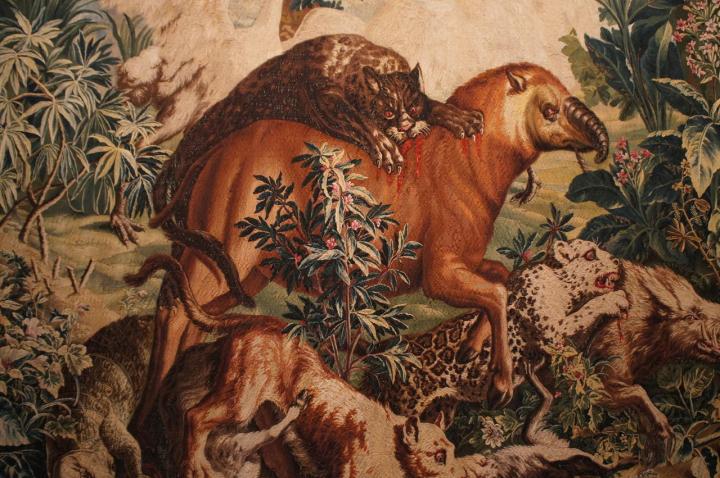
Designed by Jean Jans, the Younger (active 1668–1723), after Albert Eckhout (c. 1610–1666), The Battle of the Animals, detail, Gobelins Manufactory, ca. 1723 (Oxford: Ashmolean Museum, WA1901.1).
◊ ◊ ◊ ◊ ◊
Next week at Harvard:
Mei Mei Rado | European Tapestries at the Qing Court: Global Textiles and a Cross-cultural Medium
Department of History of Art and Architecture, Harvard University, Cambridge, 7 November 2023, 6pm
This presentation draws from Dr. Rado’s forthcoming book The Empire’s New Cloth: Cross-cultural Textiles at the Qing Court (Yale University Press, early 2025). Large-scale pictorial tapestries ranked among the most precious art forms in the early modern period. While their circulations and functions among European courts have been well studied, less known are their journeys to China and subsequent roles in stimulating new developments in Qing imperial arts.
The first part of this talk uncovers the history of French tapestries that entered the Qing court during the eighteenth century as diplomatic gifts and trade goods, including the first and second Tentures chinoises woven by the Beauvais Manufactory and the Tenture des Indes made by the Gobelins Manufactory. Their trajectories reconstructed from both the French and Qing sides offer a window into the complexity of global networks and contingency of cultural encounters. These tapestries’ themes, marked by idealized exoticism compressing distance and time, functioned as a kind of diplomatic lingua franca adaptable to express divergent cultural and political visions. The second part of the presentation examines how European tapestries gave rise to a new type of textile art form in the Qing imperial workshops and an innovative mode for furnishing the palace interiors. The medium’s architectonic tension and interactive visual potential enabled the Qianlong emperor to envision his own physical presence in relation to the tapestry in space and offered him new ways to reenact narratives charged with imperial significance.
Mei Mei Rado is Assistant Professor at the Bard Graduate Center, specializing in textile and dress history, with a focus on China and France from the 18th through early 20th century. Before joining BGC, Dr. Rado was Associate Curator of Costume and Textiles at LACMA, having previously held fellowship positions at The Metropolitan Museum of Art, the Smithsonian’s National Museum of Asian Art, and the Palace Museum in Beijing.
Online Lectures | David Pearson on Cambridge Bookbinding, 1450–1775
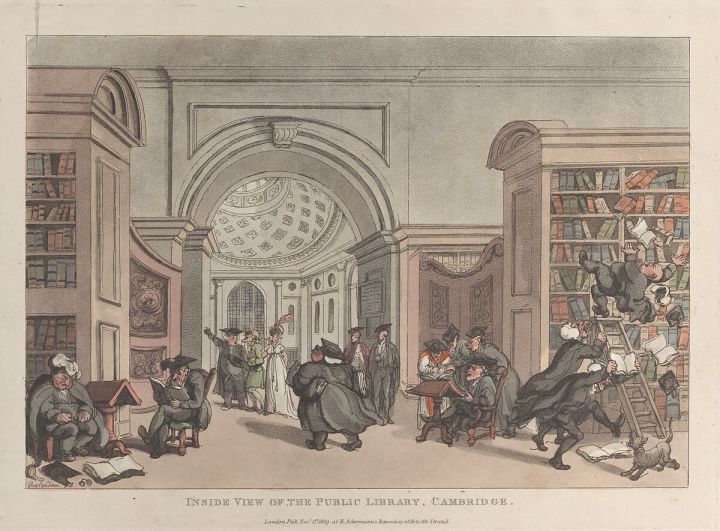
Thomas Rowlandson, Inside View of the Public Library, Cambridge, published in London by Rudolph Ackermann, 9 November 1809, hand-colored etching and aquatint, plate: 23 × 32 cm (New York: The Metropolitan Museum of Art, 59.533.1635).
◊ ◊ ◊ ◊ ◊
As recently announced on the SHARP listserv (Society for the History of Authorship, Reading, and Publishing) . . .
David Pearson | Cambridge Bookbinding, 1450–1775
Online and in-person, Robinson College, Cambridge, 21–23 November 2023
The Sandars Readership in Bibliography is one of the most prestigious honorary posts to which book historians, librarians, and researchers can be appointed. Those elected deliver a series of lectures on their chosen subject. This year’s Reader, Dr David Pearson, will address the topic of Cambridge bindings.
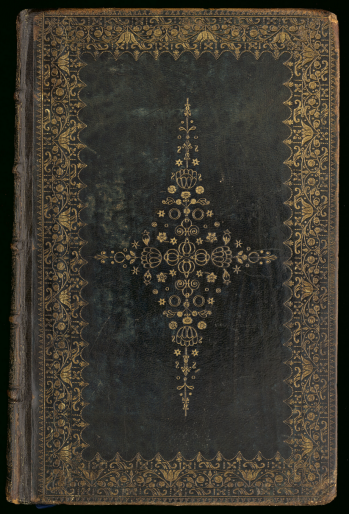
The Book of Common Prayer, and Administration of the Sacraments. . . together with the Psalter (Cambridge: John Baskerville for B. Dod in London, 1761), with gilt-tooled binding from the workshop of Edwin Moore, ca.1761–65 (TC.77.1), pasteboards, covered with black goatskin, gilt-tooled; rebacked, preserving most of the original gilt-tooled spine.
Cambridge has been a leading centre for binding books (as well as for printing and selling them) for many centuries, and books bound in Cambridge are found all over the world. How do we recognise them, and what can they tell us? The 2023 lectures will build on a project aiming, for the first time, to produce a comprehensive overview of Cambridge binding work through the early modern period. They will explore the evolution of the craft in its broader context, and the questions we should ask when we identify books bound in Cambridge. Cambridge Bookbindings 1450–1770, featuring 45 bookbindings in Cambridge during the handpress period using the collections of Cambridge University Library, is available on the Cambridge Digital Library.
The three lectures will be held in-person at Robinson College, live-streamed, and recorded. Click on the lectures below for more information and to register (please register for each lecture you hope to attend).
• Tuesday, 21 November, 5pm, followed by a drinks reception at the University Library
• Wednesday, 22 November, 5pm
• Thursday, 23 November, 5pm
David Pearson was formerly Director of Culture, Heritage, and Libraries for the City of London Corporation. He is a Senior Fellow of the Institute of English Studies at the University of London, was Lyell Reader in Bibliography at Oxford (2017–18), and teaches regularly on the Rare Book Schools in London and Virginia. His books include Provenance Research in Book History (new edition, 2019), English Bookbinding Styles, 1450–1800 (2005), Book Ownership in Stuart England (2021), and Speaking Volumes: Books with Histories (2022). In 2020 he launched the Book Owners Online database.
◊ ◊ ◊ ◊ ◊
Of the binding of The Book of Common Prayer pictured above, Dr Pearson writes,
The name which is most immediately associated with Cambridge bookbinding work of the middle decades of the eighteenth century, and whose workshop produced many handsomely-decorated bindings, is Edwin Moore. . . The ornamental design which became fashionable in England for upmarket binding work, from about 1720, is what has come to be known as ‘Harleian style’, characterised by a large central lozenge-shaped pattern made up of small tools symmetrically arranged, surrounded by a wide border of rolls and/or other tools around the perimeters. Moore’s better quality work conformed very much to this idea, and numerous bindings like this survive, made from the 1740s, 50s and 60s. . .
Exhibition | Portrait Miniatures from the Grantchester Collection
On view at Compton Verney:
Portrait Miniatures: Highlights from the Grantchester Collection
Compton Verney Art Gallery and Park, Warwickshire, 10 September 2022 — 31 December 2023
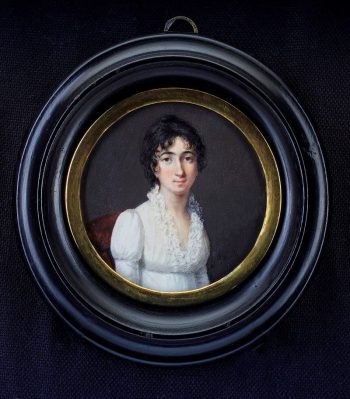
Henriette Rath, Portrait of Madame Argand, 1799, watercolour on ivory, 1799 (Compton Verney Art Gallery and Park, photograph by Jamie Woodle). Together with her sister, Jeanne-Françoise, Henriette founded the Musée Rath in Geneva, the first purpose-built art museum in Switzerland, constructed between 1824 and 1826.
We are excited to present highlights from the Grantchester Miniatures Collection in Compton Verney’s British Portraits gallery. The Grantchester Collection of portrait miniatures was gifted to Compton Verney in 2019. It is a highly personal collection developed by the late Lady Grantchester [Betty Suenson-Taylor], the sister of our founder Sir Peter Moores, who established the Compton Verney House Trust in 1993. Showcasing over 40 exquisite miniatures from the sixteenth, seventeenth, and eighteenth centuries, this will be the first time that many of these works have been shown in public. The collection includes portraits in miniature by Isaac Oliver, Richard Cosway, George Engleheart and John Smart.
A guide to the exhibition is available here»
Exhibition | History in the Making
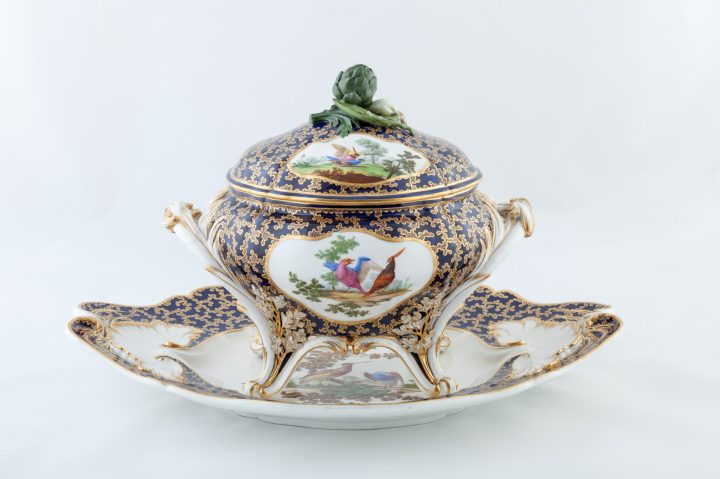
‘Bedford Gift Service’ tureen and stand, Sèvres, decoration by Jean-Pierre Ledoux, 1761–63
(Woburn Abbey Collection)
◊ ◊ ◊ ◊ ◊
From the press release (via Art Daily) for the exhibition at Compton Verney:
History in the Making: Stories of Materials and Makers, 2000BC to Now
Compton Verney Art Gallery and Park, Warwickshire, 21 October 2023 — 11 February 2024
Curated by Oli McCall and Hannah Obee
History in the Making: Stories of Materials and Makers presents the stories of the people and processes behind outstanding examples of historic and contemporary craft by bringing together a treasure-trove of objects in a unique exploration and celebration of materials and making. Installed in both suites of temporary exhibition galleries at Compton Verney, the exhibition presents historic craft masterpieces from Woburn Abbey and Compton Verney alongside contemporary creations by some of the most exciting makers working today, many of which are being loaned for the first time by the Crafts Council, the UK’s national charity for craft.
 Works on display include ancient Chinese ceramics from Compton Verney’s internationally renowned Chinese collection, 18th-century Indian bed textiles from Woburn Abbey, painted silks by award-winning artist and designer Christian Ovonlen, and glazed stoneware vessels by rising star ceramic artist Shawanda Corbett. By displaying the historic in dialogue with the new, the exhibition uncovers the skilful craft processes, technical innovations, and material properties of decorative objects across the ages, while also highlighting the environmental and ethical considerations around the use of natural materials. Each gallery focuses on a different material group—textile, organic, metal, stone, clay, and wood—providing a framework within which contemporary issues such as globalisation and colonial economies, social class and the importance of craft traditions in diverse cultures will be explored.
A highlight of History in the Making is the chance to see one of Woburn Abbey’s newly conserved Mortlake Tapestries. Dating from the 1660s, these huge wall hangings have been painstakingly conserved over a period of five years. Inspired by Raphael’s cartoon for The Miraculous Draught of Fishes (ca. 1515–16, on loan to the V&A from His Majesty The King), originally commissioned by Pope Leo X for the Sistine Chapel, the tapestry shows two boats on the waters of lake Galilee; on the left Christ is seated, with the Apostles Peter and Andrew in astonishment before him, their boat full of miraculous fish. The Mortlake manufactory was established in 1619 in the village of Mortlake, west of London. Under royal patronage, the workshop was able to rival continental centres such as Brussels and Paris for high-quality textiles. The tapestry from Woburn Abbey is being displayed in a gallery with pieces by textile artist and ceramicist Matt Smith, who has reworked vintage tapestries by unpicking and re-stitching elements—often faces—to illustrate how historical narratives are never objective accounts of truth, alluding to the marginalisation of queer people in society. His work often reshapes objects from their original uses to highlight marginalised points of view and hidden stories.
The exhibition includes examples of the Sèvres dinner service given by Louis XV of France to the Duke and Duchess of Bedford in 1763. The Sèvres ceramics have provided an intriguing opportunity for the exhibition’s co-curator Hannah Obee to delve into the iconic French manufacturer’s archives. She notes that “in the 18th century, luxury porcelain was about enhancing the prestige and wealth of nations. The individuals who made it were not part of the narrative, unlike today. However, the Sèvres archives provide a rich resource of information; so, we can now put names and sometimes faces to the objects they created. This is a unique feature of the show at Compton Verney.”
The exhibition also contains a set of bed textiles made in the 1750s in Gujarat, India. “Even now their colours are amazing and so vibrant,” observes Compton Verney senior curator Oli McCall. “The Bedford family had an agent in India who reported back to them about the people making them, who were all women. From these letters we gain valuable insights into the textile trade in the 18th century, anticipating modern globalisation.”
History in the Making also includes objects, once prized, but now seen as problematic, made from natural materials such as coral, tortoiseshell, and ivory. McCall, Obee, and their colleagues decided to include several of these pieces to reflect how makers once saw artistic and creative potential, without questioning the environmental damage that would result from the huge demand for such items. To demonstrate this, History in the Making showcases the work of contemporary makers who are sourcing sustainable materials for their work.
The display of historic silverware such as 18th-century candlesticks and tableware, acts as a reminder of the importance of human migration in the dissemination of craft expertise and techniques and the challenges faced by new arrivals. Huguenot silversmiths, for example, were members of the French Protestant faith who faced persecution in their homeland with over 50,000 Huguenots coming to Britain through the 16th to 18th-centuries. Their work and that of the people who made the Mortlake Tapestries, worked in the Sèvres factory, and produced the Indian bed textiles are just a handful of examples of how Britain connected with the wider world. The exhibition demonstrates and reminds us of this, whilst shining a spotlight on the things that people created for themselves as part of everyday life. Adi Toch’s 2020 print Precious Disposables, on loan from the Crafts Council, depicts a pair of the maker’s latex gloves covered in golden-hued brass dust. Made during the Coronavirus pandemic, the work invites us to think about how what is considered valuable shifts depending on social, political, and environmental concerns.
In the final room, pieces by some of the most exciting young makers working at the forefront of scientific and material innovation are displayed, highlighting the environmental responsibility that has become a focus of contemporary craft practices proposing more planet-friendly materials and methods. Diana Scherer uses plant roots to create ‘living fabrics’, which she fashions into wall hangings and framed works of art. Nicky James, meanwhile, makes garments in wool, but has found a way to make them more resilient by mimicking strong structures found in nature, such as the giant squid beak. Other makers are using cutting-edge innovation to work with ‘leather’ made from mushrooms, and even using silk worm cocoons to create furniture.
Geraldine Collinge, Director of Compton Verney, states: “We are delighted to be able to collaborate with Woburn Abbey and the Crafts Council on this ambitious exhibition, which will give visitors a unique opportunity to explore outstanding examples of craft by many of the leading makers past and present and reflect on the universal importance of materials and making. This exhibition reflects the bringing together of the historic and contemporary to tell stories, which is something we aim to do across our creative programme at Compton Verney. Throughout the winter and into the start of 2024 we will be providing a host of hands-on craft workshops and activities where visitors can get creative and pick up new skills.”










 Enfilade
leave a comment