New Book | American Latium: American Artists and Travelers
From the Accademia Nazionale di San Luca:
Christopher M.S. Johns, Tommaso Manfredi, and Karin Wolfe, eds., American Latium: American Artists and Travelers in and around Rome in the Age of the Grand Tour (Rome: Accademia Nazionale di San Luca, 2023), ISBN: 978-8897610373.
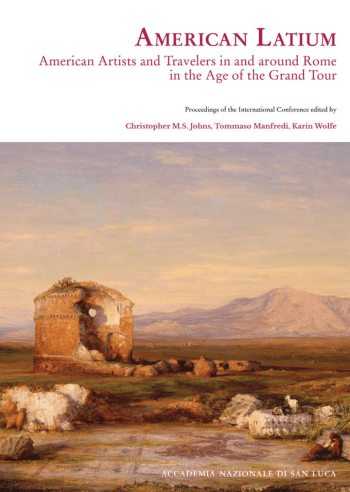 This volume brings together the proceedings of the international conference American Latium: American Artists and Travelers in and around Rome in the Age of the Grand Tour, sponsored by the Accademia Nazionale di San Luca and hosted by the Centro Studi Americani in Rome on the 7–8 June 2018, convened by Christopher M.S. Johns, Tommaso Manfredi, and Karin Wolfe. The conference examined the concept of cultural exchange between America and Rome and its surrounding territory not as a bilateral transfer of culture, but rather as an entangled and reciprocal history of cultural transmission, including the importance of London with its powerful art academies as an intermediate destination for Americans making their way to the continent. Travel to Rome engaged American artists, collectors, scientists, writers, and diplomats in dialogue with a network of European artists, intellectuals, and statesmen. The remarkable degree of cosmopolitanism found in Rome signalled its importance not simply as a cultural destination, but as a place of experiment and creativity for travelers of differing nationalities who gathered there—a place where ancient history and tradition was cross-pollinated with the experience of the modern. American Latium addresses the pioneering origins of the artistic relations between America, Rome, and its environs from the eighteenth century up until 1870. Interdisciplinary in nature, these proceedings present new, and at times unexpected, research on the experience of reciprocal cultural exchange.
C O N T E N T S
Introduction — Karin Wolfe
The American Grand Tour: From Old Masters to the New World
• Copying Old Masters for the New World: American Painters in Eighteenth-Century Rome — Jonny Yarker
• James Bowdoin III and Ward Nicholas Boylston in Italy: American Collectors in the Later Eighteenth Century — Sarah Cantor
• John Singleton Copley in Rome: The Challenge of the Old Masters Accepted — Christopher M.S. Johns
• London Between America and Continental Europe: Art and Academies — Martin Postle
• The Prince and the President: Antonio Canova and Benjamin West at the Royal Academy in London — Francesco Moschini
• John Neal, the Old Masters, and the American Muse — Francesca Orestano
• ‘In the Beginning There Was the Word’: American Writings on Raphael from the Founding Fathers to the Gilded Age — Linda Wolk-Simon
American Latium: Sites and Itineraries in and around Rome
• American Itineraries in Rome and the Campagna — Fabrizio Di Marco
• A Grave in a Foreign Land: Early American Presence at the Protestant Burying-Ground in Rome — Nicholas Stanley-Price
• Thomas Cole and the Aqueducts: Plein Air Painting in the Roman Campagna — Lisa Beaven
• Thomas Cole, Desolation, and the Ruins of Rome — David R. Marshall
• Scenery Found: John Gadsby Chapman and Open- Air Oil Sketching in and around Rome, 1830–1882 — Mary K. McGuigan
• American and European Artists and Intellectuals in Nineteenth-Century Latium: The ‘School of the Castelli Romani’ and the Locanda Martorelli in Ariccia — Francesco Petrucci
• Living and Creating in Antiquity: Roman Residences and Studios of Thomas Gibson Crawford, William Wetmore Story, and Moses Jacob Ezekiel — Pier Paolo Racioppi
Americans and the Artistic Culture of Rome: Toward an American Art
• Americans on the Grand Tour and Angelica Kauffman in Rome — Wendy Wassyng Roworth
• Championing Liberty: The Roman Sculptor Giuseppe Ceracchi in Britain and in America — Karin Wolfe
• The Rome of Charles Bulfinch — Tommaso Manfredi
• Thomas Jefferson: Rome in America — Maria Cristina Loi
• A Painter and Diplomat: The Two Careers of James Edward Freeman and Their Correspondences — John F. McGuigan Jr
• Forgotten Fervor: Paul Akers in Rome — Arlene Palmer
• Undressing America: Nineteenth-Century Expatriate Sculptors in Rome and the Problem of Nudity — Kevin Salatino
Bibliography
In Memoriam and Acknowledgements
Exhibition | Connecting Worlds: Artists and Travel

Carlo Labruzzi, The Colosseum seen from the Palatine Hill, Rome, graphite, pen and brown and grey ink, watercolour.
◊ ◊ ◊ ◊ ◊
On view this summer at the Kupferstich-Kabinett of the SKD:
Connecting Worlds: Artists and Travel / Ferne, so nah: Künstler, Künstlerinnen und ihre Reisen
Kupferstich-Kabinett, Staatliche Kunstsammlungen Dresden, 8 July – 8 October 2023
Artists and travel have for centuries been intertwined where the desire to explore beyond the confines of one’s home has provoked a truly astonishing outpouring of creativity, much of which was captured through drawings and prints. Comprising over 100 such works, Connecting Worlds: Artists & Travel will be the first exhibition to approach the subject through the lens of artists’ experiences of travel from the Renaissance to the nineteenth century. Select works by contemporary artists offer further inspiring perspectives on the topic of travel and connectivity.
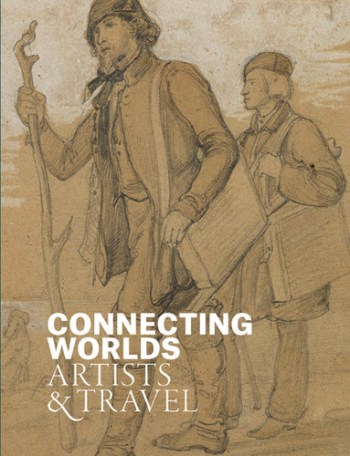 Why did artists travel? What did they take with them? With whom did they travel and meet? How did they record their journey? Addressing such questions, the exhibition invites visitors on their own creative journey by confronting them with works by major artists, amongst them Albrecht Dürer, Hans Holbein the Younger, Pieter Bruegel the Elder, Maria Sibylla Merian, and Angelika Kauffmann, for whom travel expanded their artistic and intellectual horizons and circles of friendship.
Divided into three sections ‘On the Road’, ‘Destination Rome’, and ‘Dresden’, the exhibition begins by exploring artists on the road and what they regarded as important to record in sketchbooks and individual sheets. Primary amongst these are nature studies reflecting a fascination with the outdoors but also architecture and local inhabitants. The main destination was Rome, with its incomparable remains of antiquity and as the seat of the Catholic Church that celebrated its religious and institutional life through processions and public spectacle.
Upon returning to their homelands, artists often used their drawings as the source for prints and paintings, thereby disseminating knowledge of their experience to a wider audience. The exhibition ends with Dresden under Augustus the Strong, a center of glamorous festivities, ambitiously competing with other international courts. This last chapter of the exhibition explores a different kind of travel through images and stories of landscapes, plants, animals, and cultures previously unknown in Europe that were brought back by courtly and military expeditions. The visual recordings of distant worlds in books and prints allowed for imaginary travel and enabled a sense of connectivity with places and people from near and far.
This international exhibition project is a collaboration between the Kupferstich-Kabinett and the Katrin Bellinger Collection, London, and is made possible by the complementary strengths of the two collections: the Kupferstich-Kabinett, with its extensive holdings on the themes of travel and science in the early modern period, and the Katrin Bellinger Collection, with its focus on representations of artists engaged in the creative process. The project is supplemented by prominent loans from national and international collections.
The catalogue is published by Paul Holberton and distributed by The University of Chicago Press:
Anita Viola Sganzerla and Stephanie Buck, eds., Connecting Worlds: Artists and Travel (London: Paul Holberton Publishing, 2023), 274 pages, ISBN: 978-1913645489, £45 / $55.
Exhibition | Refugee Silver: Huguenots in Britain
From The Fitzwilliam:
Refugee Silver: Huguenots in Britain
The Fitzwilliam Museum, Cambridge, 2 August 2022 — 30 July 2023
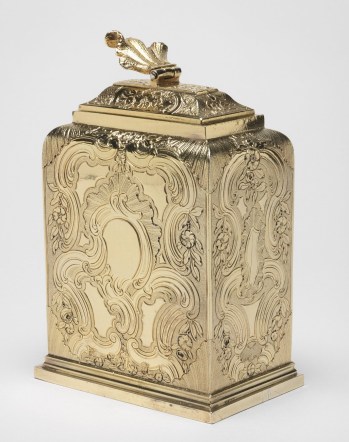
Silver gilt tea caddy, marked London, Aymé Videau, 1745–46 (Cambridge: The Fitzwilliam Museum, given by the estate of the late Olive and Peter Ward).
Escaping persecution in France, Huguenot silversmiths changed the visual arts in Britain and brought with them exciting new ideas and techniques. For more than a century from the late 1600s, these French Protestants made an immeasurable contribution to British cultural life.
Protestants living in Catholic France had long faced religious persecution. Its increase forced them to seek new lives in the Netherlands, Germany, South Africa, and North America. Between 1680 and 1720, more than 50,000 Huguenots sought refuge in Britain, introducing the word ‘refugee’ to the English language.
This display of silver, ceramics, sculpture, and ivories, reframes objects from the Fitzwilliam Museum’s historic collections through the lens of the migration of Huguenot refugees to Britain. Many were skilled craftspeople: metalworkers, sculptors, carvers, weavers, and printers, with the necessary skills to make luxury goods and a knowledge and understanding of French fashions. Huguenot silversmiths sometimes adapted their designs to suit British tastes although it was important that they retained distinctive elements of their modern and fashionable style. The results proved especially attractive to a growing British middle class. The Huguenots’ sophisticated techniques, dynamic forms, and intricate sculptural decoration were so widely imitated that eventually their style became dominant in Britain, transforming forever the appearance of silver and other decorative arts in this country.
Study Day | Huguenot Craftspeople and the Visual Arts in Britain
From The Fitzwilliam:
Huguenot Craftspeople and the Visual Arts in Britain
The Fitzwilliam Museum, Cambridge, Monday, 15 May 2023

Paul de Lamerie, Silver Two-handled Cup and Cover, made in London, 1739–40 (Lent by Clare College, Cambridge).
In celebration of the display Refugee Silver: Huguenots in Britain, join us in person for a study day exploring the contributions of Huguenot craftspeople to the visual arts in Britain. Curators and experts will provide new perspectives on silver, ivories, prints, and portrait miniatures. Refreshments and lunch will be provided, included in the ticket price.
P R O G R A M M E
10.00 Tea and coffee
10.45 Welcome from Neal Spencer (Deputy Director for Collections & Research)
11.00 Session 1
• Women Huguenot Silversmiths and The Goldsmiths’ Company Collection — Frances Parton (Deputy Curator, The Goldsmiths’ Company)
• A New Look at Huguenot Silver — Miriam Hanid (Artist Silversmith)
12.00 Break
12.15 Session 2
• Making One’s Mark: Silver, Sugar, and Tea in 18th-Century Britain and Beyond — Chiedza Mhondoro (Assistant Curator, British Art, Tate)
• Cross-fertilisation: International Huguenot Connections between Goldsmiths and Watchmakers — Tessa Murdoch (Independent Scholar and Trustee of the Huguenot Museum)
13.15 Lunch and a chance to see the display Refugee Silver: Huguenots in Britain
14:15 Session 3
• Huguenot Printmakers in a Closet-Catholic’s Collection? The Prints of Lord Fitzwilliam (1745–1816) — Elenor Ling (Senior Curator, Prints & Drawings, The Fitzwilliam Museum)
• Huguenot Miniaturists: Isaac and Peter Oliver’s Influence on the Development of British Portrait Miniature Painting, 1580–1650, pre-recorded — Sophie Rhodes (PhD candidate, Department of History of Art, University of Cambridge)
• Carving Caricatures in Ivory: Huguenot or Not? — Victoria Avery (Keeper, European Sculpture & Decorative Arts, The Fitzwilliam Museum)
Call for Papers | Questioning the ‘Grand Siècle’
From ArtHist.net:
Grand Siècle? Pour l’histoire critique d’une notion
Université de Genève, Geneva, 16–18 May 2024
Organized by Jan Blanc
Proposals due by 20 May 2023
Que reste-t-il, aujourd’hui, du «Grand Siècle» ? Sans doute une notion, pour commencer, dont la fabrique ne remonte pourtant pas au XVIIe siècle, mais aux premières décennies de la IIIe République. Au sortir de la guerre de 1870, il s’agit de glorifier la France de Louis XIV et de Colbert pour célébrer la grandeur d’un État parfaitement administré, ainsi que l’importance du «génie français» dans l’histoire culturelle européenne. Face aux conceptions transhistoriques et transnationales développées par les historiens de l’art du monde germanique, qui font prévaloir l’Italie sur la France, il convient de montrer que c’est le même «classicisme» qui innerve les œuvres de Corneille, Molière et Racine, de Poussin, Claude et Le Sueur. C’est ainsi, désormais, au «Grand Siècle» qu’un nombre croissant d’expositions et d’ouvrages se consacrent, en se focalisant sur le règne de Louis XIV, décrit comme l’«âge d’or» de l’art français. Dès le premier tiers du XXe siècle, et jusqu’au tricentenaire de la mort de Louis XIV, des voix s’élèvent toutefois pour remettre en cause les «simplifications un peu scolaires» (Baldensperger 1937, cité par Stenzel 2006: 49) qui ont entouré le «Grand Siècle».
Les notions de «classicisme» et d’«absolutisme» sont remises en question, tandis qu’une autre société française est décrite, éprise de sainteté et de liberté autant que de gloire, et où l’ascension des meilleurs peintres et « la richesse de la vie artistique » ne peut plus se «réduire à de simples rapports de domination». Par ailleurs, et même si la notion elle-même est une fabrication tardive, il convient de s’interroger sur ce que le «Grand Siècle» doit à la France du XVIIe siècle. L’historiographie, on le sait, a été comme orientée par les écrits de Jean Desmarets de Saint-Sorlin, Dominique Bouhours, François Blondel, Charles Perrault et Voltaire, qui ont célébré «le siècle de Louis le Grand», puis le «siècle de Louis XIV»: «le “Grand Siècle” est le règne de Louis-le-Grand (sic)», écrit ainsi Bernard Teyssèdre (1964: 9). Cette focalisation est-elle pourtant pertinente ? Tandis que certains se sont intéressés de façon critique au tournant du XVIIIe siècle, trop souvent et facilement assimilé à une «période de transition», d’autres ont souligné l’importance de ce qui a pu être appelé la «naissance» (Pagès & Tapié 1948) et la «formation du Grand Siècle» (Bernhardt 1988: 409), ou encore le «premier Grand Siècle» (Descimon & Jouhaud 1996) — autant de questions qui, chez les historiens et les historiens de l’art, ne reçoivent pas de réponses nécessairement identiques. Le début du règne d’Henri IV (1589) correspond en effet à l’instauration d’un «nouveau style de gouvernement» et à la «reconstruction du royaume», saluée par les contemporains eux-mêmes. On a également souligné le rôle crucial de la régence de Marie de Médicis dans le développement des arts dans la France du XVIIe siècle, jusqu’à inspirer de flatteuses comparaisons avec le «Siècle de Louis le Grand». Ce sont toutefois les ministériats des cardinaux de Richelieu et Jules Mazarin, sous le règne de Louis XIII et du jeune Louis XIV, qui ont suscité l’attention la plus ancienne et la plus soutenue. Dès 1893, Henry Lemonnier affirme que cette période correspond au moment d’émergence du «classicisme» français, partant du «faux classicisme» de Simon Vouet pour aller jusqu’à l’«académisme» de Charles Le Brun. Louis Dimier reprend l’idée de Lemonnier en la nuançant.
Théorisant la notion de «seconde École de Fontainebleau», il lui accorde une place paradoxale : «Fontainebleau allait être le centre du renouveau de l’école effacée». Il situe lui aussi la naissance véritable de «l’école française» entre son «établissement» par Vouet et son «apogée» par Le Brun, mais accorde une importance plus grande au premier, dont le retour de Rome (1627), peu de temps avant celui de François Perrier et de Jacques Blanchard (1629), marque un tournant. Quatre-vingts ans après la mort de François Ier (la «première École de Fontainebleau»), la France d’Henri IV est enfin capable d’attirer à elle ou de conserver chez elle les meilleurs peintres qu’elle a vus naître sur son sol — ou presque, puisque Perrier est franc-comtois —, après avoir continué un temps de capitaliser sur l’héritage artistique de la fin du XVIe siècle (la «seconde École de Fontainebleau»). Un autre tournant est identifié par Dimier autour de l’émergence du « grand style » de Poussin et Lorrain, qui se conjuguera à l’«abondance unie» de Vouet dans l’art d’Eustache Le Sueur. Pour insister sur l’existence de ce «classicisme gallican», Bernard Dorival suggère plus tard d’appliquer la notion rhétorique d’«atticisme» à la peinture produite durant la dernière décennie du ministère de Mazarin, avant que d’autres ne la fassent remonter à la régence d’Anne d’Autriche, voire à la surintendance de François Sublet de Noyers.
Consacré à l’histoire critique de la notion de «Grand Siècle», ce colloque constituera le prologue d’un projet de recherche financé par le Fonds national suisse, Peindre et penser la peinture en France durant le premier XVIIe siècle : discours, artistes, concepts (2023–2027), dirigé par Jan Blanc (Université de Genève), et auquel collaborent Pauline Randonneix (doctorante), Antoine Gallay et Léonie Marquaille (postdoctorants) et Maxime Humeau (ingénieur informatique).
De nature interdisciplinaire, ce colloque propose de réunir des historiens de l’art, mais aussi des historiens, des philosophes, des spécialistes des questions littéraires et théâtrales, religieuses et théoriques, musicales et scientifiques, pour interroger les conditions historiques de genèse de la notion de «Grand Siècle», mais aussi son degré de pertinence dans l’analyse des différentes formes de pratiques intellectuelles et culturelles dans la France du long XVIIe siècle.
Les propositions de présentation devront nous parvenir avant le 20 mai 2023, sous la forme
• d’un titre provisoire
• d’une problématique résumée (500 mots maximum)
• d’une bio-bibliographie
adressées par courriel à jan.blanc@unige.ch
Les participantes et participants au colloque verront leurs frais de séjour et de déplacement remboursés.
B I B L I O G R A P H I E I N D I C A T I V E
BRUNETIERE, Ferdinand (1883). «La critique d’art au XVIIe siècle», Revue des Deux Mondes, LIII/3: 207–20.
LEMONNIER, Henry (1893). L’Art français au temps de Richelieu et de Mazarin (Paris: Hachette).
BREMOND, Henri (1916–1933). Histoire littéraire du sentiment religieux en France depuis la fin des guerres de religion jusqu’à nos jours (Paris: Bloud & Gay), 11 vol.
GAIFFE, Félix (1924). L’Envers du Grand Siècle: étude historique et anecdotique (Paris: Albin Michel).
DIMIER, Louis (1926). Histoire de la peinture française, du retour de Vouet à la mort de Lebrun (1627 à 1690) (Paris: G. van Oest), 2 vol.
BRAY, René (1927). La Formation de la doctrine classique en France (Paris: Hachette).
WEISBACH, Werner (1932). Französische Malerei des XVII. Jahrhunderts im Rahmen von Kultur und Gesellschaft (Berlin: Verlag Heinrich Keller).
BUSSON, Henri (1933). La Pensée religieuse française de Charron à Pascal (Paris: Imprimerie du Montparnasse).
LEROY, Alfred (1935). Histoire de la peinture française au XVIIe siècle (1600–1700): son évolution et ses maîtres (Paris : Albin Michel).
BALDENSPERGER, Fernand (1937). «Pour une “évaluation” littéraire du XVIIe siècle classique», Revue d’histoire littéraire de la France, XLIV/1: 1–15.
MORNET, Daniel (1940). Histoire de la littérature française classique, 1660–1700: ses caractères véritables, ses aspects inconnus (Paris: Armand Colin).
PINTARD, René (1943). Le Libertinage érudit dans la première moitié du XVIIe siècle (Paris: Boivin), 2 vol.
AMOUDRU, Bernard (1946). Le Sens religieux du Grand siècle (Paris: Éditions de la Revue des Jeunes).
PAGES, Georges & TAPIE, Victor-Lucien (1948). Naissance du Grand Siècle: la France de Henri IV à Louis XIV, 1598–1661 (Paris: Hachette).
BLUNT, Anthony (1953) 1983. Art et architecture en France, 1500–1700 (Paris: Macula).
LACLOTTE, Michel, éd. (1958). The Age of Louis XIV (Londres: Royal Academy of Arts).
ISARLO, George (1960). La Peinture en France au XVIIe siècle (Paris: Bibliothèque des Arts).
CHATELET, Albert & THUILLIER, Jacques (1963–1964). La Peinture française (Genève: Skira), 2 vol.
TEYSSEDRE, Bernard (1964). L’Histoire de l’art vue du Grand Siècle: recherches sur l’«Abrégé de la vie des peintres», par Roger de Piles (1699), et ses sources (Paris: Julliard).
PARISET, François-Georges (1965). L’Art classique (Paris: Presses universitaires de France).
GOUBERT, Pierre (1966). Louis XIV et vingt millions de Français (Paris: Fayard).
NIDERST, Alain (1971). «Le sens du mot siècle dans la langue classique», Le Français moderne, XXXIX : 207–19.
JOHNSON, Neil R. (1978). Louis XIV and the Age of the Enlightenment: The Myth of the Sun King from 1715 to 1789 (Oxford: Voltaire Foundation/University of Oxford).
BREJON DE LAVERGNEE, Arnauld & DORIVAL, Bernard (1979). Baroque et classicisme au XVIIe siècle en Italie et en France (Paris: Famot).
WRIGHT, Christopher (1985). The French Painters of the Seventeenth Century (Londres: Orbis).
BOTTINEAU, Yves (1986). L’Art baroque (Paris: Mazenod).
BERNHARDT, Jean (1988). «Compte rendu de la Correspondance du P. Marin Mersenne (Paris: Éd. du CNRS, 1986)», Revue d’histoire des sciences, XLI/3–4 : 409–10.
ARMOGATHE, Jean-Robert, éd. (1989). Le Grand Siècle et la Bible (Paris : Beauchesne).
GOUBERT, Pierre (1966) 1989. Louis XIV et vingt millions de Français (Paris: Fayard).
HENSCHALL, Nicholas (1992). The Myth of Absolutism: Change and Continuity in Early Modern European Monarchy (Londres: Routledge).
THUILLIER, Jacques (1992) 2014. La Peinture française au XVIIe siècle (Dijon: Faton).
HILAIRE, Michel & RAMADE, Patrick, éd. (1993). Grand Siècle : peintures françaises du XVIIe siècle dans les collections publiques françaises (Paris: Réunion des musées nationaux).
MEROT, Alain (1994). La Peinture française au XVIIe siècle (Paris: Gallimard).
DESCIMON, Robert & JOUHAUD, Christian (1996). La France du premier XVIIe siècle, 1594–1661 (Paris: Belin).
BURY, Emmanuel (1998). «Frontières du classicisme», Littératures classiques, XXXIV : 217–36.
CORNETTE, Joël (2000). «L’histoire au travail : le nouveau “Siècle de Louis XIV” : un bilan historiographique depuis vingt ans (1980–2000)», Histoire, économie & société, XIX/4 : 561–605.
COSANDEY, Fanny & DESCIMON, Robert, éd. (2002). L’Absolutisme en France : histoire et historiographie (Paris: Éditions du Seuil).
BELL, David A. (2003). The Cult of the Nation in France: Inventing Nationalism, 1680–1800 (Cambridge: Cambridge University Press).
CHALINE, Olivier (2005). Le Règne de Louis XIV (Paris: Le Grand Livre du Mois).
CHERVEL, André (2006). Histoire de l’enseignement du français du XVIIe au XXe siècle (Paris: Retz).
STENZEL, Hartmut (2006). «Le “classicisme” français et les autres pays européens», in Histoire de la France littéraire: classicismes (XVIIe–XVIIIe siècle), éd. Jean-Charles Darmon & Michel Delon (Paris: Presses universitaires de France): 39–78.
VENTURINO, Diego (2006). «Généalogies du Grand Siècle», in Voltaire et le Grand Siècle, éd. Anne-Sophie Barrovecchio & Jean Dagen (Oxford: Voltaire Foundation) : 3–13.
JOUHAUD, Christian (2007). Sauver le Grand-Siècle ? Présence et transmission du passé (Paris: Éditions du Seuil).
GADY, Bénédicte (2010). L’Ascension de Charles Le Brun : liens sociaux et production artistique (Paris: Éditions de la Maison des sciences de l’homme).
MAZEL, Claire (2013). «Les beaux-arts du siècle de Louis XIV : déconstructions et constructions historiographiques de la seconde moitié du XVIIIe siècle», in Penser l’art dans la seconde moitié du XVIIIe siècle : théorie, critique, philosophie, histoire, éd. Christian Michel & Carl Magnusson (Paris: Somogy): 531–46.
MARAL, Alexandre (2014). Les Derniers jours de Louis XIV (Paris: Perrin).
BONFAIT, Olivier (2015). Poussin et Louis XIV: peinture et monarchie dans la France du Grand siècle (Paris: Hazan).
COJANNOT-LE BLANC, Marianne (2015). «Apprécier les arts du règne de Louis XIV: une gageure pour notre temps ?», Revue de l’Art, XC/4 : 5–8.
CORNETTE, Joël (2015). 1er septembre 1715: la mort de Louis XIV — Apogée et crépuscule de la royauté (Paris: Gallimard).
PETITFILS, Jean-Christian (2015). Le Siècle de Louis XIV (Paris: Perrin).
FUHRING, Peter, MARCHESANO, Louis, MATHIS, Rémi & SELBACH, Vanessa, éd. (2015). Images du Grand Siècle: l’estampe française au temps de Louis XIV, 1660–1715 (Paris : BNF).
SUIRE, Éric (2016). «Le tricentenaire de la mort de Louis XIV: un bilan historiographique fécond ?», XVIIe siècle, CCLXXII/3 : 501–08.
GADY, Bénédicte & TREY, Juliette, éd. (2018). La France vue du Grand Siècle: dessins d’Israël Silvestre, 1621–1691 (Paris: Musée du Louvre).
Call for Papers | Across the Seas: Denmark and the World
From ArtHist.net:
Across the Seas: Denmark and the World in Art and Visual Culture in the Early Modern Period
Übersee: Dänemark und die Welt in der Kunst und visuellen Kultur der frühen Neuzeit
Kunsthistorisches Institut, Christian-Albrechts-Universität zu Kiel, 9–10 June 2023
Organized by Caecilie Weissert, Johannes von Müller, and Benjamin Asmussen
Proposals due by 14 May 2023
Within the scope of European ‘art landscapes’, the Scandinavian countries are located in a periphery. There is a comparatively small number of publications on Scandinavian art in the canon of art historical literature. In relation to traditional art historical centres, Scandinavian art therefore sees itself pushed into a double periphery. Thus, the topography of art history is synonymous with an art-historical evaluation of quality. The tension between centre and periphery, as it is evident in art historiography, is also present in art and visual culture in Denmark in the early modern period. Consequently, they lend themselves as case studies for challenging such narratives. The sea may reveal itself as a particularly significant factor in this context, bot historically and methodologically.
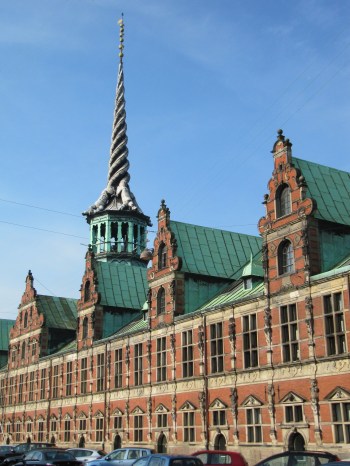
Stock Exchange (Børsen), Copenhagen (Photo: Wikimedia Commons, October 2010). As noted at Wikipedia: the building was designed by Laurens van Steenwinckel and Hans van Steenwinckel and built between 1620 and 1625. The spire is conceived as the interwined tails of four dragons. The building was restored by Nicolai Eigtved in 1745.
Politically, a Danish supremacy in Scandinavia began to erode in the early 16th century with the independence of Sweden. This regional loss of power was answered by a transregional economic expansion overseas, especially in Asia. Projects such as the founding of the Danish East India Company (1616) and the corresponding establishment of Christianshavn as a new trading centre in Copenhagen (1619) are structural expressions of such a development. On the side of art, this corresponds to an increased presence of non-European visual and material cultures on the one hand and the adaptation and transformation of traditions of different regions within Europe on the other. The Børsen, the Copenhagen stock exchange, provides an impressive example of this: begun in 1624 by the Dutch architect Laurens van Steenwinckel, its idiosyncratic tower, visible from afar from the sea, is to be understood as a considerably early form of Chinoiserie.
The workshop Across the Seas: Denmark and the World in Art and Visual Culture in the Early Modern Period, organised in cooperation with the Maritime Museum of Denmark, takes an interdisciplinary perspective, combining art historical questions with a political and economic-historical standpoint in contexts reaching beyond the borders of Europe. By choosing the sea as a backdrop against which early modern Denmark oscillates between center and periphery, the workshop seeks to dislodge the objects to be discussed from a conventional frame of reference that inevitably assigns them a peripheral status. Instead, they shall be addressed as ‘nodes’, making interrelations and itineraries visible and mapping them out; furthermore, they may reveal themselves as factors that contribute to constituting the structures they disclose.
Contributions may cover the following topics but are not limited to them:
• Circulation of artistic traditions and materials by sea between Denmark and regions inside and outside of Europe
• Artistic reflexes to early modern oversea trade in Denmark
• Documents and traces of a perception of non-European cultures in early modern Denmark
• The sea in an inner-European tension between centre and periphery and between Europe and the world
Please send an abstract of no more than 150 words together with a CV to weissert@kunstgeschichte.uni-kiel.de before 14 May 2023.
Workshop Organizers
Prof. Dr. Caecilie Weissert
Dr. Johannes von Müller (Christian-Abrechts-Universität zu Kiel)
Dr. Benjamin Asmussen (Maritime Museum of Denmark, Copenhagen)
The Burlington Magazine, April 2023
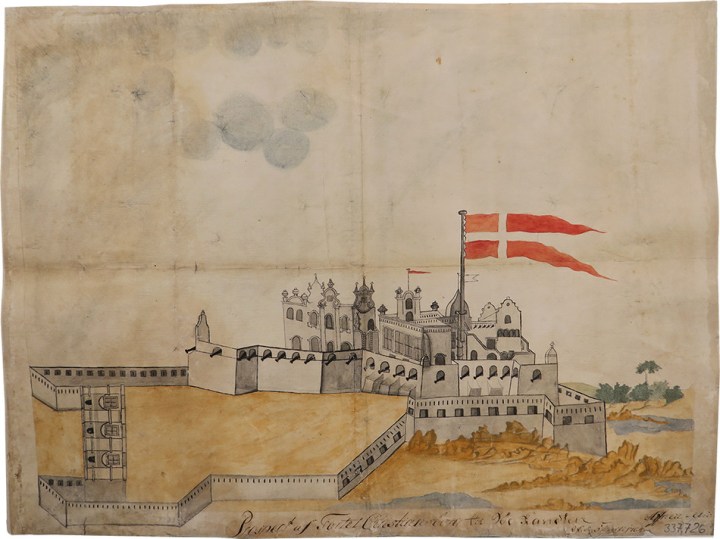
View of Fort Christiansborg [Christiansborg Castle, Osu] from the Shore, March 1764, ink and coloured wash on paper
(Danish National Archives)
◊ ◊ ◊ ◊ ◊
The eighteenth century in the April issue of The Burlington . . .
The Burlington Magazine 165 (April 2023)
A R T I C L E S
• Gauvin Alexander Bailey, “The Design of Cape Coast Castle and Dixcove Fort, Ghana,” pp. 378–93.
The first analysis of the design of two of the principal eighteenth-century British slave castles and forts of the Gold Coast reveals the Western engravings used as prototypes but also acknowledges these buildings’ engagement with African cultures and forms. Identifying the people who built them and assessing the forts’ association with the coastal African community challenges the popular misconception that they were no more than European transplants.
R E V I E W S
 • Morlin Ellis, Review of the exhibition Spain and the Hispanic World: Treasures from the Hispanic Society Museum and Library (Royal Academy of Arts, 2023), pp. 442–45.
• Simon Jervis, Review of the exhibition catalogue, Reinier Baarsen, Process: Design Drawings from the Rijksmuseum 1500–1900 (Rotterdam: 2022), pp. 456–58.
• Philip Ward-Jackson, Review of the exhibition catalogue, Yvette Deseyve, ed., Johann Gottfried Schadow: Embracing Forms (Hirmer Verlag, 2023), pp. 463–66.
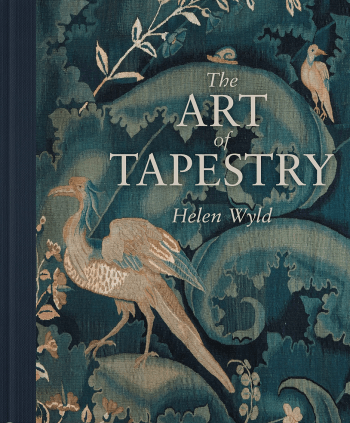
• Thomas P. Campbell, Review of Helen Wyld, The Art of Tapestry (Philip Wilson Publishers, 2022), pp. 472–75.
• Charles Saumarez Smith, Review of András Szántó, Imagining the Future Museum: 21 Dialogues with Architects (Hatje Cantz, 2022), pp. 482–83.
• John Martin Robinson, Review of Dudley Dodd, Stourhead: Henry Hoare’s Paradise Revisited (Head of Zeus, 2021), pp. 484–85.
O B I T U A R I E S
• Christopher Wood, Obituary for Hans Belting (1935–2023), pp. 486–88.
Performance | Mary Berry’s Fashionable Friends
From The Walpole Library:
Mary Berry’s Fashionable Friends
The Lewis Walpole Library, Farmington, Connecticut, 12–13 May 2023
 An entirely new version of the comedy directed and abridged by Laura Engel, Duquesne University
In 1801 Anne Damer, Mary Berry, and Agnes Berry embarked on a remarkable collaboration staging a performance of Berry’s comedy Fashionable Friends as an amateur theatrical production at Horace Walpole’s Strawberry Hill. Damer and Berry starred in the play as the titular fashionable friends; Damer played the seductive and sly Lady Selina and Berry the sentimental and clever Mrs. Lovell.
Featuring
• Christopher Collier
• Sadie Crow
• Amy Dick
• Eric Leslie
Seating is limited and advance registration is required.
Friday, May 12, 2.30pm
Friday, May 12, 4.30pm
Saturday, May 13, 2.00pm
Walpole Library Fellowships and Travel Grants for 2023–24
From The Walpole Library:
The Lewis Walpole Library is delighted to announce the recipients of Fellowships and Travel Grants for the upcoming year 2023–24. This year we awarded twelve four-week Fellowships and nine two-week Travel Grants. The Fellowship year runs from 1 June 2023 until 31 May 2024. We look forward to welcoming these twenty-one researchers to Farmington and the Lewis Walpole Library community of scholars.
Fellowships
• Zoe Beenstock (University of Haifa), Palestine as America and Ireland: Horace Walpole’s Levant Antiquarianism, Joseph Peter Spang III Fellowship
• Tanya Caldwell (Georgia State University), Fashion, Friendship, and the First Lady of Sculpture: Anne Damer and the Imperial Mission
• Jennifer Factor (Brandeis University), Intimate Play: Phillis Wheatley Peters and the Art of the Poem Game, ASECS-LWL Fellowship
• Stephanie Howard-Smith (King’s College London), Collecting Dogs and Constructing ‘Dogmanity’: Horace Walpole, Wilmarth and Annie Lewis, and the Making of the More-than-Human Family
• Nicole Emser Marcel (Temple University), Ordering, Reordering, and Disordering the Land: Visual and Material Strategies of Resistance and Repossession in Contemporary Caribbean Art, George B. Cooper Fellowship
• Joanna Marschner (Historic Royal Palaces), Princess Augusta Saxe Gotha: Negotiating Monarchical Ambition and Celebrity in 18th-Century Britain
• Allison Muri (University of Saskatchewan), Eliza Haywood’s Covent Garden
• Eric Parisot (Flinders University), Inventing Suicide: Representation and Emotion in the Age of Sensibility
• Nicola Parsons (University of Sydney), ‘This Heap of Tautology’: Iterative Character and Descriptive Erotics in Harris’s List of Covent Garden Ladies, 1760–1794, Charles. J. Cole Fellowship
• Anna Roberts (Johns Hopkins University), Snuff and Snuffboxes in Britain, Ireland, and British North America, c. 1640–1830
• Hillary Taylor (University of Cambridge), British Trade, Work, and Travel in Eastern Europe during the Long 18th Century, Roger W. Eddy Fellowship
• Lilith Todd (Columbia University), Tending Another: The Rhetoric and Labor of Nursing in the Long 18th Century
Travel Grants
• Richard Ansell (University of Leicester), Ann Scafe and Other British Servants in Late 18th-Century Continental Europe
• Dominic Bate (Brown University), Pythagorean Visions: Picturing Harmony in British Art, 1719–1753
• Gregory Brown (University of Nevada, Las Vegas), Inventing Enlightenment: The Social and Professional History of ´18th-Century Studies’ in the United States and Europe, 1930–1970
• Alexander Clayton (University of Michigan), The Living Animal: Animating Nature in the Colonial Menagerie, 1750–1890
• David Cowan (University of Cambridge), Horace Walpole, Thomas Gray, and William Mason: Whiggery and the Gothic at Cambridge University
• Marie Ferron-Desautels (Concordia University), Women Amateurs Designing Caricatures in 18th-Century Britain
• Marlis Schweitzer (York University), Decoding the Lecture on Heads: Performing Objects and Satire on the 18th-Century Stage
• Jane Wessel (United States Naval Academy), Theatre and the Extra-Illustrated Book: Participatory Reading and Fandoms in 18th- and 19th-Century England
• Jarred Wiehe (Texas A&M University, Corpus Christi), ‘Deformed the Belle and Beau’: Disability Aesthetics, William Hogarth, and the Optics of Deformity
Getty and NPG Jointly Acquire Reynolds’s Portrait of Mai
From the Getty press release (25 April 2023). . .

Sir Joshua Reynolds, Portrait of Mai (Omai), ca. 1776, oil on canvas, 236 × 146 cm.
The innovative collaboration between the National Portrait Gallery and Getty to jointly acquire Joshua Reynolds’ Portrait of Mai (Omai) has been successful. The National Portrait Gallery has raised £25 million which, thanks in huge part to a grant of £10m from the National Heritage Memorial Fund, an Art Fund grant of £2.5m, together with a matching amount from Getty in the U.S., makes up the £50m needed to acquire the painting.
The National Portrait Gallery and Art Fund’s fundraising campaign has been made possible thanks to an extraordinary collaborative effort, including:
• An exceptional grant of £10m from the National Heritage Memorial Fund, one of its most significant awards for saving a heritage treasure for the UK
• An Art Fund grant of £2.5m, the largest in its history
• Major contributions were also received from The Portrait Fund, the Deborah Loeb Brice Foundation and Julia and Hans Rausing, and support also came from the Idan and Batia Ofer Family Foundation and David & Emma Verey Charitable Trust, as well as many other generous trusts, foundations, and individuals.
• Donations from over 2,000 Art Fund members, National Portrait Gallery supporters and members of the public, giving gifts of all sizes
The shared ownership of the work and strategic partnership between the National Portrait Gallery and Getty is the result of an innovative model of international collaboration that enables and maximizes public access to the work in perpetuity. The two institutions will share the painting for public exhibition, research, and conservation care.
The painting will first be exhibited at the National Portrait Gallery when it reopens on June 22, following a major transformation project and will later will be shown at other institutions across the UK. Mai will travel periodically between the two countries, sharing time equally between them. The first Getty presentation will be in 2026, including the period when Los Angeles hosts the 2028 Olympic Games.
Sir Joshua Reynolds’ spectacular Portrait of Mai (Omai) holds a pivotal place in global art history, depicting the first Polynesian to visit Britain, and is widely regarded as the finest portrait by one of Britain’s greatest artists. Known as ‘Omai’ in England, Mai (ca. 1753–1779) was a native of Raiatea, an island now part of French Polynesia, who traveled from Tahiti to England with Captain James Cook. He spent the years 1774–76 in London, where he was received by royalty and the intellectual elite, and indeed became something of a celebrity. Mai returned to his homeland in 1777 and died there two years later.

Elizabeth Peyton, Omai (Afterlife) after Sir Joshua Reynolds’s Portrait of Omai, 1776, 2023, © Elizabeth Peyton.
The National Portrait Gallery would like to thank the former owners for their co-operation in this process, and Christie’s for their support in the negotiations. Support for the campaign also came from leading artists Sir Antony Gormley, Rebecca Salter and Richard Deacon and historians Simon Schama, David Olusoga, and Simon Sebag-Montefiore. Artist Elizabeth Peyton created a new work, Omai (Afterlife) after Sir Joshua Reynolds’s Portrait of Omai, 1776, 2023, inspired by the portrait.
Dr. Nicholas Cullinan, Director, National Portrait Gallery, said: “Reynolds’ majestic Portrait of Mai is by far the most significant acquisition the National Portrait Gallery has ever made, and the largest acquisition the UK has ever made, along with the Titians acquired by the National Gallery and the National Galleries of Scotland in 2009 and 2012. I would like to thank the 2,000 Art Fund members and National Portrait Gallery supporters across the UK and the National Heritage Memorial Fund and Art Fund for their significant and historic grants as well as the many other generous supporters. This includes major contributions from the Portrait Fund, Deborah Loeb Brice Foundation and Julia and Hans Rausing, and support from the Idan and Batia Ofer Family Foundation and the David and Emma Verey Charitable Trust. Together, you have made such an unprecedented endeavour possible. My thanks also to Getty for having the vision to join us in an innovative strategic partnership to ensure this uniquely important painting enters public ownership for the first time, in Reynolds’ 300th anniversary year, so its beauty can be seen and enjoyed by everyone. Heartfelt thanks too to my wonderful colleagues and everyone who worked night and day to make the impossible possible—they have done something extraordinary for all of us.”
Dr. Timothy Potts, Director of the J. Paul Getty Museum, said: “Joshua Reynolds’ Portrait of Mai is not only one of the greatest masterpieces of British art, but also the most tangible and visually compelling manifestation of Europe’s first encounters with the peoples of the Pacific islands. The opportunity for Getty to partner with the Gallery in acquiring and presenting this work to audiences in Britain and California, and from around the world, represents an innovative model that we hope will encourage others to think creatively about how major works of art can most effectively be shared. The myriad artistic, historical, and cultural issues that Mai’s portrait raises for 21st-century viewers and researchers will be the starting point for a joint research project led by the Gallery and Getty in the years ahead.”
Dr. Simon Thurley CBE, Chair of the National Heritage Memorial Fund (NHMF), said: “I am absolutely delighted that we have reached this pivotal moment in the journey of Mai. It has been an incredible effort of public and private fundraising and I am proud that NHMF has been able to play such a vital role in saving it for the UK thanks to our grant of £10m—40% of the amount that the National Portrait Gallery needed to raise. The grant is one of the most substantial awards we have ever given to save a national treasure, and is befitting of this masterpiece, by one of the UK’s greatest artists, as it embodies such great cultural and historical significance.”
“It is wonderful news that the UK public, as well as a wider international audience thanks to the partnership acquisition, will now be able to enjoy the magnificent work of art, its fascinating story and complex themes. NHMF is a vital source of funding for our most important heritage at risk, so it is incredibly exciting that we are able to support the National Portrait Gallery to acquire Mai, to be on display for all to see. We are also delighted that Mai will later embark on a tour allowing visitors from across the UK to marvel at its greatness and explore its heritage.”
Lord Smith of Finsbury, Chairman, Art Fund, said: “When an exceptional work of art comes up for sale, Art Fund stands ready to help museums in the UK bring the work into a public collection, for everyone to enjoy. Joshua Reynolds’ Portrait of Mai (Omai) is just such a painting, and it’s a tribute to the National Portrait Gallery and Getty’s innovative shared ownership model that the painting will now be publicly accessible, forever. Art Fund is delighted to have awarded a grant of £2.5 million—the largest in our 120 year history—and grateful to the incredible generosity of over 2,000 Art Fund members, National Portrait Gallery supporters, individuals and trusts who swiftly gave to our appeal. We also thank the trustees of the National Heritage Memorial Fund for their significant support towards this acquisition, a powerful statement of the importance of bringing this work of art into public view in the UK. The collective effort to save this painting has been remarkable.”
Lord Parkinson of Whitley Bay, Arts & Heritage Minister, said: “I would like to congratulate the National Portrait Gallery and Getty on their fantastic efforts to make this joint acquisition possible and secure this wonderful painting. Thanks to their work and the export bar process, it will now be able to be enjoyed by people across the country for generations to come.”
Sir Nicholas Serota, Chair of Arts Council England, said: “The Arts Council is proud to have supported the recommendation of the Reviewing Committee that this outstanding work of art should continue to be available to the public in the UK. The collaboration between the National Portrait Gallery and Getty will mean that it will be seen in an international context, while also ensuring that we diversify the national collection and open opportunities for research and learning about our national history and culture.”
Sir John Leighton, Director-General, National Galleries of Scotland, said: “There are many great works of art associated with this country and its history but surely only a small number that can be described as truly extraordinary. The Reynolds Portrait of Mai (Omai) belongs in this category and now, thanks to an inspiring and enlightened partnership between the National Portrait Gallery and Getty, a very wide national and international audience will be able to enjoy this superb painting. This is wonderful news and a cause for real celebration.”
Victoria Pomery, Chief Executive Officer, The Box, Plymouth said: “I am thrilled to hear that Reynolds’ Portrait of Mai (Omai) has been acquired in this the 300th anniversary year of the artist’s birth. Plymouth has a long association with Reynolds who was born in Plympton, now part of the modern city, in 1723. Indeed, Reynolds’ first studio was located in Devonport, Plymouth. We are delighted that this important portrait will be shared to places such as The Box enabling further conversations and discussions on Empire, representation and place and for audiences in the south west and across the country to see and understand more about this painting.”










 Enfilade
leave a comment