New Book | The Moving Statues of Seventeenth-Century Amsterdam
From Penn State UP:
Angela Vanhaelen, The Moving Statues of Seventeenth-Century Amsterdam: Automata, Waxworks, Fountains, Labyrinths (University Park: Penn State University Press, 2022), 236 pages, ISBN: 978-0271091402 (hardcover), $115. Also available as an ebook, with a paperback edition scheduled for release in March 2023.
 This book opens a window onto a fascinating and understudied aspect of the visual, material, intellectual, and cultural history of seventeenth-century Amsterdam: the role played by its inns and taverns, specifically the doolhoven.
Doolhoven were a type of labyrinth unique to early modern Amsterdam. Offering guest lodgings, these licensed public houses also housed remarkable displays of artwork in their gardens and galleries. The main attractions were inventive displays of moving mechanical figures (automata) and a famed set of waxwork portraits of the rulers of Protestant Europe. Publicized as the most innovative artworks on display in Amsterdam, the doolhoven exhibits presented the mercantile city as a global center of artistic and technological advancement. This evocative tour through the doolhoven pub gardens—where drinking, entertainment, and the acquisition of knowledge mingled in encounters with lively displays of animated artifacts—shows that the exhibits had a forceful and transformative impact on visitors, one that moved them toward Protestant reform.
Deeply researched and decidedly original, The Moving Statues of Seventeenth-Century Amsterdam uncovers a wealth of information about these nearly forgotten public pleasure parks, situating them within popular culture, religious controversies, global trade relations, and intellectual debates of the seventeenth century.
Angela Vanhaelen is Professor of Art History at McGill University. She is the author of the award-winning book The Wake of Iconoclasm: Painting the Church in the Dutch Republic, also published by Penn State University Press.
C O N T E N T S
List of Illustrations
Acknowledgements
Introduction
1 The Closed Door: Walking In
Ritual Routes
2 The Courtyard Fountain: Bacchic Rites
3 Into the Labyrinth: Containing the Human Monster
The Moving Statue Strikes
4 Automata: Activating Human Behavior
5 Strange Things for Strangers: Transcultural Automata
Protestant Paganism
6 Wax Portraits: Body Politics
7 Time Machines in the Golden Age: The Kairos of Clockwork
Epilogue: Obsolescence
Notes
Bibliography
Index
Exhibition | Beyond Boundaries
From the introduction of the catalogue, available online, for the show now on view at Robert Simon Fine Art:
Beyond Boundaries: Historical Art by and of People of Color
Robert Simon Fine Art, New York, 27 October — 16 December 2022
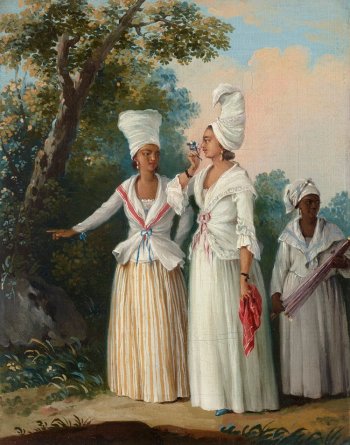 Diversity is a crucial issue in the contemporary art world today. But what of the art of the past? Beyond Boundaries brings to light an array of paintings, sculpture, and other works of art from the 17th to 19th centuries, from Europe and the Americas, that explore subjects and makers often overlooked in traditional art history. But unlike many thematic exhibitions, there is no underlying social or political philosophy. Rather we have attempted to explore diversity simply by exhibiting diverse works of art—each chosen as it in some ways illustrates an aspect of the historical past, some surprising and empowering, others uncomfortable or disturbing.
Agostino Brunias, one of six paintings in a series here identified as Free Men and Women of Dominica and an Indigienous Family of St Vincent, oil on canvas, 12 × 9 inches.
Exhibitions | Stitched in Time / The Art of the Quilter
From the press release (25 October 2022) for the new exhibitions:
Stitched in Time: American Needlework
DeWitt Wallace Decorative Arts Museum, Colonial Williamsburg, 3 December 2022 — 2 January 2025
The Art of the Quilter
Abby Aldrich Rockefeller Folk Art Museum, Colonial Williamsburg, 3 December 2022 — August 2023

Bed Rug, Connecticut, possibly Norwich or New London, 1785 (Colonial Williamsburg, Museum Purchase, Dr. and Mrs. T. Marshall Hahn Jr. Fund, 2014.609.6).
Two new textile exhibitions opening at the Art Museums of Colonial Williamsburg on 3 December 2022 are sure to delight museum visitors. Stitched in Time: American Needlework, an exhibition of nearly 60 examples of bedrugs, whitework, embroidered hand towels, quilted petticoats, samplers, mourning and commemorative needlework, crewelwork, needlework with religious and geographical influences as well as sewing accessories, will remain on view through 2 January 2025 at the DeWitt Wallace Decorative Arts Museum. Additionally, an entirely new rotation of objects in the popular exhibition The Art of the Quilter that opened in 2021 will feature 15 pieces, 12 of which are recent acquisitions that have never before been displayed. This configuration of the exhibition, which will remain on view through August 2023 at the Abby Aldrich Rockefeller Folk Art Museum, will include eleven large quilts, one woven coverlet and three doll-size quilts that tell stories about people from America’s past and the societies in which they lived.
“For decades The Colonial Williamsburg Foundation has collected textiles from a broad and highly diverse array of ethnic, cultural, and regional communities,” said Ronald Hurst, senior vice president for education and historic resources. “These new exhibitions allow us to share these beautiful and story-laden documents of early American society with the visiting public.”
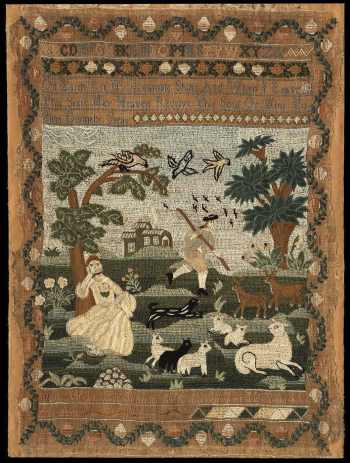
Sampler by Mary Welsh, Massachusetts, ca. 1770 (Colonial Williamsburg, Museum Purchase, 1962-309).
Needlework and sewing were common threads in the lives of most 18th- and 19th-century females across social, economic, and geographical boundaries. Early American women—whether poor, enslaved, indigenous, middle class, or wealthy—contributed to their family’s household furnishings and enriched their homes and clothing by embellishing textiles with decorative stitches. Sewing and mending everyday household textiles, such as bed and table linens and clothing, was another way for women to contribute economically to their family. Stitching needlework projects was not only a creative outlet for many housewives, but was also an educational tool for young schoolgirls. These themes are the basis for Stitched in Time: American Needlework, which will be on view in the Len and Cyndy Alaimo Gallery. The exhibition will also highlight the diversity and regional variations of American needlework that can be traced through the ethnic origins of the makers, trade and migration patterns, influential teachers and artists, current fashions, religious affiliations, geography, and even climate.
“We are excited to share The Colonial Williamsburg Foundation’s regionally and ethnically diverse needlework collection with our museum visitors,” said Kimberly Smith Ivey, senior curator of textiles. “Over 50 textiles for comparison have been selected from regions of New England, the Mid-Atlantic, the South, and the Western Frontier. Highlights of the exhibition include a schoolgirl sampler created by a young Jewish girl who inscribed her work with her hometown of Chicago. Another extraordinary embroidery was created by an Irish immigrant in Frenchtown, Michigan, at the Oblate Sisters of Providence School, which was cofounded by Mother Theresa Maxi Duchermin, a Catholic of color.”
Among the many other highlights of Stitched in Time is a rare bed rug made probably in Norwich, Connecticut, in 1785 by an unknown maker who signed the rug “RD.” The rug relates to a group of embroidered rugs created in the Connecticut River Valley. It was made by darning, or stitching, closely spaced rows of heavy wool yarn through a woolen ground, leaving most of the stitches visible on the surface. The side and bottom borders consist of abstract scalloped and peaked lines similar in appearance to Irish stitch needlework, but worked with darning stitches. This bed rug is especially attractive because of its remarkable condition.
Among the many examples of extraordinary samplers in the exhibition is one made in 1827 by Mary Rees, a student of Elizabeth Robinson (1778-1865), in Montgomery County, Pennsylvania. Robinson, an unmarried woman who lived with her five unmarried sisters in their family homestead left to them by their father, worked as a schoolmistress to help support the family. At least eight samplers or pictures have been identified from Elizabeth Robinson’s school. Mary Rees’ cross-stitched verse and her pictorial composition made of silk and wool embroidery threads on a linen ground are perfectly suited to each other. The verse implores all living things to praise their Maker, while the imagery shows some of the plants and animals requested to pay such tribute. Rees’ careful selection of thread color and the direction and type of stitching makes the scene both decorative and naturalistic. The embroidered scene bordered in black stitches to imitate a reverse painted glass mat and the title, date, and signature worked in bright threads to mimic a more expensive gold leaf inscription are characteristics found on other embroideries worked under the instruction of Elizabeth Robinson.
A highly sophisticated embroidered picture attributed by family history to Orra Sears (1798–1872) of Bloomfield, New York, is another highlight of Stitched in Time. It is believed that Orra created the picture in 1816, when she was a boarding student at the Litchfield Female Academy in Connecticut. School records indicate that Orra attended the school that year; she was one of at least 2,000 girls from nearly every state who attended the academy from 1792 through 1833 when the school operated. Students from out of town, such as Orra, boarded with Litchfield families. American educational goals of the period stressed the proficient duplication in embroidery of idealized themes that were widely recognized and approved of, rather than the development of individual creativity. Needlework compositions were taken from existing illustrations, usually English engravings or other printed images. Here, at least four different prints depicting views of Chiswick, an English country house, were used to create the scene on Orra’s embroidered and painted picture.
In its second year of a three-year exhibition, The Art of the Quilter’s latest rotation in the Foster and Muriel McCarl Gallery promises to continue delighting quilt aficionados with its new selection of quilts from The Colonial Williamsburg Foundation’s heralded collection from the early 19th century to present day. These diverse quilts allowed women to express artistic instincts while also creating a warm and practical bedcover for their loved ones. Making quilts was often a community activity, in which neighbors and relatives enjoyed the pleasures of joint work and socializing.
Ivey said of the exhibition, “We are literally covering America with this exhibition. The bed coverings display a variety of techniques, colors and materials, and demonstrate America’s multicultural society with examples from the Anglo-American, German, Amish and Mennonite communities.” . . .
The full press release is available here»
Last Call for Entries for the 2022 George Clarke Prize

From the Call for Proposals:
2022 George Clarke Prize for Research Proposal Pertinent to Stowe
Proposals due imminently (first week of December 2022)
Applications are invited for the 2022, biennial Prize of £2000, run by the Hall Bequest Trust. The prize is named after George Clarke, who was associated with Stowe for over more than 60 years—not least as historian of the building and temples. As editor of The Stoic for seven years, he published definitive articles on the history of the gardens and its buildings. In 1990, the Bucks Record Society published his edition of the Descriptions of Lord Cobham’s Gardens at Stowe 1700–1750. He established a close working relationship with the Huntington Library, where the 350,000 Stowe papers are. He is a founding trustee and past Chairman of the Hall Bequest Trust, which was established in 1983 with three aims: purchasing and displaying historic and cultural items relevant to Stowe, supporting educational projects, and providing bursaries for pupils at Stowe.
The George Clarke Prize is awarded for the best proposal for original archival research pertinent to Stowe within the fields of architecture, architectural history, and the material arts such as sculpture, collecting, or landscape design. The winner, who applies with evidence of their research record and a relevant and pertinent proposal, undertakes to pursue the research within the year of the award, and to write an article and to give a lecture within six months of completion of the research. Previous winners include Dr Myles Campbell, of the Office of Public Works, Dublin; Rhiannon Clarricoates, wallpaintings conservator at Lincoln University; and William Aslet, PhD candidate at the University of Cambridge.
Please email the prize administrators as soon as possible at amcevoy@stowe.co.uk for full application details.
New Book | Alexandre-Évariste Fragonard (1780–1850)
From Arthena:
Rébecca Duffeix, with a preface by Barthélémy Jobert, Alexandre-Évariste Fragonard (1780–1850) (Paris: Arthena, 2022), 520 pages, ISBN: 978-2903239688, €135.
 Reconnu jusqu’aux années 1830 comme un artiste majeur, Alexandre-Évariste Fragonard (1780–1850) a été injustement éclipsé au profit de son père, le célèbre Jean-Honoré.
Peintre d’Histoire en vogue, artiste ‘troubadour’, Alexandre-Évariste est un créateur au talent éclectique. Précoce—il présente son premier dessin au Salon à treize ans—il n’aura de cesse d’explorer avec succès tous les domaines : peinture, dessin, gravure et sculpture. Si ses scènes d’Histoire nationale—François Ier armé chevalier par Bayard, Jeanne d’Arc sur le bûcher ou La Bataille de Marignan—sont entrées dans notre imaginaire, Fragonard a également fourni de nombreux dessins pour des recueils de gravures, des modèles de formes et de décors pour la manufacture de Sèvres ou pour des costumes de l’Opéra. Fidèle aux leçons de son maître David, ‘Fragonard fils’, nous montre aussi ses dons de coloriste, aux effets de lumière audacieux et maîtrisés, hérités de son père, et ses évocations de Bradamante ou de la statue du commandeur de Dom Juan peuvent être qualifiées de romantiques.
Diplômée en Lettres modernes et docteur en Histoire de l’art à l’université Lumière Lyon 2, où elle a enseigné, Rebecca Duffeix a soutenu sa thèse en 2000 sur la vie et l’oeuvre d’Alexandre-Evariste Fragonard. Spécialiste de cet artiste, elle a notamment été commissaire de deux expositions qui lui ont été consacrées (Grasse en 2017 et Angoulême en 2020–21). Elle est actuellement en charge du centre de documentation et de la bibliothèque des musées Gadagne à Lyon.
New Book | James Gillray: A Revolution in Satire
From Yale UP:
Tim Clayton, James Gillray: A Revolution in Satire (London: Paul Mellon Centre for Studies in British Art, 2022), 408 pages, ISBN: 978-1913107321, £50 / $65.
 A lavishly illustrated biography of James Gillray, inventor of the art of political caricature
James Gillray (1756–1815) was late Georgian Britain’s funniest, most inventive and most celebrated graphic satirist and continues to influence cartoonists today. His exceptional drawing, matched by his flair for clever dialogue and amusing titles, won him unprecedented fame; his sophisticated designs often parodied artists such as William Hogarth, Joshua Reynolds, and Henry Fuseli, while he borrowed and wittily redeployed celebrated passages from William Shakespeare and John Milton to send up politicians in an age—as now—where society was fast changing, anxieties abounded, truth was sometimes scarce, and public opinion mattered.
Tim Clayton’s definitive biography explores Gillray’s life and work through his friends, publishers—the most important being women—and collaborators, aiming to identify those involved in inventing satirical prints and the people who bought them. Clayton thoughtfully explores the tensions between artistic independence, financial necessity, and the conflicting demands of patrons and self-appointed censors in a time of political and social turmoil.
Tim Clayton is a historian and writer. He is a specialist in eighteenth and early nineteenth-century history and culture and a leading authority on the printed images of that period.
Journal18, Fall 2022 — Silver
In the latest issue of J18:
Journal18, Issue #14 (Fall 2022) — Silver
Issue edited by Agnieszka Anna Ficek and Tara Zanardi
I N T R O D U C T I O N
Agnieszka Anna Ficek and Tara Zanardi
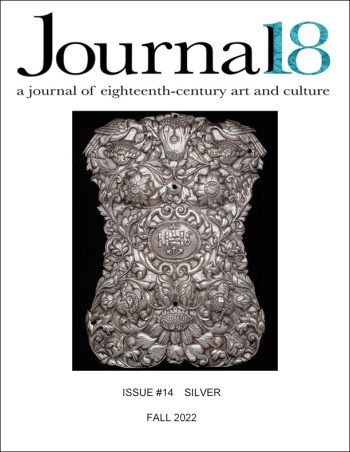
In his 1656 treatise El Paraíso en el Nuevo Mundo, Antonio de León Pinelo contends that the amount of silver extracted from Potosí’s Cerro Rico was enough to build a bridge of silver from the top of the mountain to the doors of Madrid’s Royal Palace: 2,070 leagues long, 14 rods wide, and 4 fingers thick.[1] The vivid imagery of León Pinelo’s account encapsulates the magnitude of silver’s potential as the material foundation for a fantastical building project that could physically scale the earth much like the Spanish Empire did politically, militarily, and financially. Silver’s beauty, mutability, and strength coveted by Spanish colonists led to the production of spectacular objects, such as the ornamental plaque from a Jesuit Mission in the Andean highlands that serves as this issue’s cover image. At once luxurious and symbolic, the plaque’s decoration features tulips and other plants cultivated in Europe, interwoven in a repouséd floral ground with indigenous passion flowers (mburucuyà), nibbled by native birds, to create an image of a harmonious colonial society. Both the imaginary bridge and the ornamental plaque belie the violence the Spanish Crown and the Church exerted in subjugating native populations and instituting a system of forced labor to extract this precious metal.
Within and beyond the Spanish Empire, silver financed wars, upheld dynasties, and cemented political alliances. Forged into currency, silver funded slavery and the institution’s production of goods such as sugar and cacao. Silver was also valued around the globe for its pliability and sheen. From Beijing to Versailles, Mexico City to Lisbon, it furnished grand homes, glittering on dinner tables and dressing tables alike. Skilled artists manipulated silver into opulent objects, capitalizing on its luster to fabricate sinuous forms in small-scale decorative artworks as well as ambitious commissions that communicated wealth and political might.
This issue probes silver’s capacity for metamorphosis—from raw material into objects and currency. Such transformative characteristics made it a valuable medium for artists, a tool for global expansion, and a form of income for rebuilding state treasuries. . . .
A R T I C L E S
• Dani Ezor — ‘White when Polished’: Race, Gender, and the Materiality of Silver at the Toilette
• Christina K. Lindeman — Silver Thread Textiles: Industry, Dynasty, and Political Power in Eighteenth-Century Prussia
• Susan Eberhard — The Asian Silver Chocolatière: The Transpacific World in a Diplomatic Gift
E X P L O R A T I O N S
• James Middleton — An Eighteenth-Century Portrait Miniature on Silver: An Artifact from the Silver Age of Mexico
• José Andrés De Leo Martínez — La distinción del cáliz de Puebla de los Ángeles en el s. XVIII, entre dos Mundos
• Christina Clarke — Reanimating the Goldsmith: An Artisanal Reading of the Archive
Cover image: Ornamental Plaque (mariola or maya), one of a pair, 1725–50, Moxos or Chiquitos missions, Alto Peru (present-day Bolivia), silver, 42 × 31 × 3 cm (Museum of Fine Arts Boston, 1992.346).
◊ ◊ ◊ ◊ ◊
R E C E N T N O T E S & Q U E R I E S
• Jessica L. Fripp — Review of Raphaël Barontini’s show Blue Lewoz (Paris: Mariane Ibrahim Gallery, summer 2022), published in J18 October 2022. Link»
The title Blue Lewoz brings together léwoz, the music and dance created by the enslaved people on Guadaloupe, and indigo blue, a dye that was a staple of the transatlantic slave trade. Barontini writes on his Instagram that Creole Dancer was inspired by a 1950 collage by Matisse of the same name, and a tribute to the “Caribbean women and the place of the dance in the Guadeloupean léwoz tradition.” From this twentieth-century inspired work, viewers quickly moved into an alternative history of fashion and luxury of early modern Europe: collages that incorporate Jean-Marc Nattier’s eighteenth-century dresses, Bronzino’s elaborate fabrics, and Elizabethan ruffs. While Barontini’s appropriation and sources stretch wider than the long eighteenth century, many of the fashions in those portraits were the product of, as Alicia Caticha notes, “Atlantic slave trade and a host of other exploitative global networks.” And, as scholars such as Anne Lafont and Mechtild Fend have shown, portraits were often used to construct and highlight whiteness.[1] Barontini’s work reinvents those portraits and, through collage, tapestries, and textiles, celebrates resistance and Caribbean festivals. . .
• Michelle Sylliboy — “Artist’s Notes: Nm’ultes is an Active Dialogue: I Reclaiming Komqwejwi’kasikl, II An Autobiographical Creative Inquiry, and III forthcoming” published in J18 in three parts, June 2022, October 2022. Link»
Published in three installments, this intervention by L’nu interdisciplinary artist, poet, and scholar Michelle Sylliboy offers an Indigenous perspective on the colonial archive. Sylliboy responds to the dehumanizing accounts of her ancestors in Nouvelle Relation de la Gaspésie (Paris, 1691) and reclaims the komqwejwi’kasikl language from its author, French missionary Chrestien Le Clercq, who culturally appropriated its writing system. Using autobiographical creative inquiry and Nm’ultes theory, Sylliboy addresses the ongoing impact of settler colonialism on her people, the L’nuk. As a survivor of intergenerational trauma, she tells the intersecting stories of healing and reconnecting with the worldview of her ancestors, who have been caretakers of a land that stretches from the Gaspé peninsula to Newfoundland since immemorial times.
New Book | Louis Lagrenée (1725–1805)
From Arthena:
Joseph Assémat-Tessandier, with a preface by Jan Blanc, Louis Lagrenée (1725–1805) (Paris: Arthena, 2022), 472 pages, ISBN: 978-2903239701, €99,
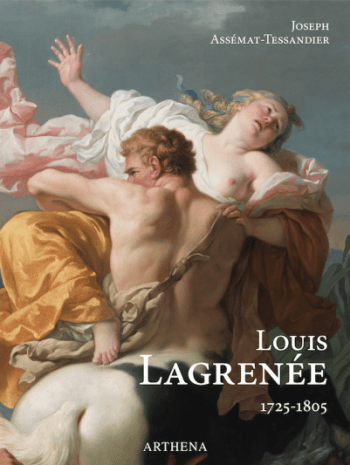 Peintre d’Histoire, à la belle carrière officielle, Louis Lagrenée (1725–1805) présente plus de 150 tableaux au Salon du Louvre de 1755 à 1789. Soulevant à plusieurs reprises l’enthousiasme de Diderot, sa peinture est appréciée des milieux financiers et aristocratiques, jusqu’à la Cour de Russie. Son succès au Salon de 1763 lui donne accès aux commandes pour les demeures royales. Il participe ensuite au programme d’encouragement de la peinture d’Histoire, organisé par le comte d’Angiviller de 1777 à 1789 (La Mort de la femme de Darius ou Les Deux Veuves d’un officier indien). De ses petits tableaux de cabinet (Vierge à l’Enfant, allégories ou scènes mythologiques) aux grands sujets inspirés de l’histoire ancienne (Annibal ayant trouvé le corps de Marcellus), son style épuré et raffiné au coloris délicat lui vaut le surnom d’ ‘Albane français’.
Les découvertes de ces dernières années (carnets de croquis, dessins préparatoires et réapparition d’oeuvres perdues), qui ont permis de doubler le corpus connu de Lagrenee l’aîné, ainsi différencié de son frère Jean-Jacques (1739–1821), apportent un nouvel éclairage sur son art, jalon précieux dans l’évolution de la peinture française vers le néoclassicisme naissant.
Joseph Assémat-Tessandier a soutenu en avril 2020 à l’université de Genève, sa thèse en histoire de l’art sur le peintre Louis Lagrenée. Diplômé de Sciences Po Paris et de l’Insead, il a travaillé auparavant dans des institutions financières américaine et française. Ses recherches se poursuivent à l’heure actuelle sur le peintre Jean-Jacques Lagrenée.
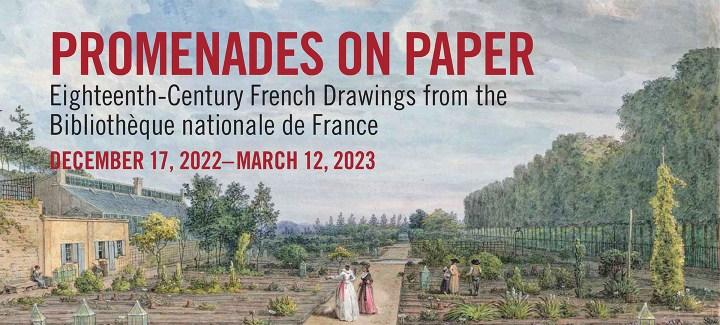
Exhibition | Promenades on Paper: 18th-C. French Drawings
From The Clark:
Promenades on Paper: 18th-Century French Drawings from the Bibliothèque Nationale de France
Promenades de papier: Les collections de dessins du 18e siècle de la BnF
The Clark Art Institute, Williamstown, MA, 17 December 2022 — 12 March 2023
Musée des Beaux-Arts de Tours, 13 May — 28 August 2023
Curated by Esther Bell, Sarah Grandin, Anne Leonard, Corinne Le Bitouzé, Pauline Chougnet, and Chloé Perrot
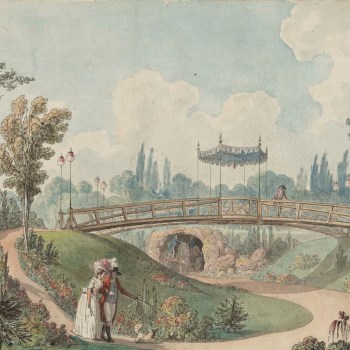
François-Joseph Bélanger, The Garden of Beaumarchais, 1788, watercolor and pen and ink (Bibliothèque nationale de France).
In partnership with the Bibliothèque nationale de France (BnF), the Clark is organizing the first exhibition of the library’s eighteenth-century French drawings. The selection of eighty-six enchanting studies, architectural plans, albums, sketchbooks, prints, and optical devices expands our understanding of drawing as a tool of documentation and creation in the age of Enlightenment, spanning the domains of natural history, current events, theater design, landscape, and portraiture. Displayed together, these objects immerse audiences in the world of eighteenth-century France—a world shaped by invention, erudition, and spectacle. Works by celebrated artists of the period such as François Boucher (1703–1770) and Gabriel de Saint-Aubin (1724–1780) are featured alongside exquisite drawings by lesser-known practitioners, including talented women, royal children, and visionary architects.
Promenades on Paper: Eighteenth-Century French Drawings from the Bibliothèque nationale de France is co-organized by the Clark Art Institute, Williamstown, Massachusetts, and the Bibliothèque nationale de France, Paris. It is curated by Esther Bell, Deputy Director and Robert and Martha Berman Lipp Chief Curator; Sarah Grandin, Clark-Getty Curatorial Fellow; and Anne Leonard, Manton Curator of Prints, Drawings, and Photographs from the Clark, and by Corinne Le Bitouze, Conservateur général; Pauline Chougnet, Conservateur en charge des dessins; and Chloé Perrot, Conservateur des bibliothèques from the Bibliothèque nationale.
This exhibition is made possible by Jessie and Charles Price. Major funding is provided by Elizabeth M. and Jean-Marie Eveillard, the Getty Foundation through its Paper Project initiative, and the Samuel H. Kress Foundation. The exhibition catalogue is made possible by Denise Littlefield Sobel.
Esther Bell, Pauline Chougnet, Sarah Grandin, Charlotte Guichard, Corinne Le Bitouzé, Anne Leonard, and Meredith Martin, Promenades on Paper: Eighteenth-Century French Drawings from the Bibliotheque nationale de France (Williamstown: Clark Art Institute, 2023), 272 pages, ISBN: 978-0300266931, $50.
◊ ◊ ◊ ◊ ◊
Note (added 12 June 2023) — The posting was updated to include the Tours venue.
New Book | La légèreté et le grave
From Passés Composés:
Cécile Berly, La légèreté et le grave: Une histoire du XVIIIe siècle en tableaux (Paris: Passés Composés, 2021), 150 pages, ISBN: 978-2379334009, €24.
 Le XVIIIe siècle s’ouvre avec Le Pèlerinage à l’île de Cythère d’Antoine Watteau et s’achève avec La Mort de Marat de Jacques-Louis David : la naissance de la fête galante versus l’agonie d’un tribun révolutionnaire. Deux chefs-d’œuvre qui illustrent la légèreté et la gravité d’un siècle, deux facettes antagonistes mais complémentaires d’une même époque.
Les dix œuvres ici racontées sont ainsi autant de jalons pour saisir ce siècle passionnant dans ses innombrables contradictions : elles correspondent toutes à un moment du XVIIIe et disent son histoire artistique, culturelle, philosophique, sociale, économique et, bien évidemment, politique. Autant de chefs-d’œuvre qui ont forgé une société nouvelle, éprise de liberté, d’indépendance et de transgressions, au fil d’un siècle qui, sous la plume sensible de Cecile Berly, oscille sans cesse entre une légèreté savamment entretenue et une gravité qui confine au drame.
Historienne, spécialiste du XVIIIe siècle, Cécile Berly a publié plusieurs ouvrages sur Marie-Antoinette. Elle a également présenté et annoté la correspondance de Madame de Pompadour, et est l’auteure des Femmes de Louis XV et de Trois femmes: Madame du Deffand, Madame Roland, Madame Vigée Le Brun.










 Enfilade
leave a comment