In the News | Russia Steals Potemkin’s Bones
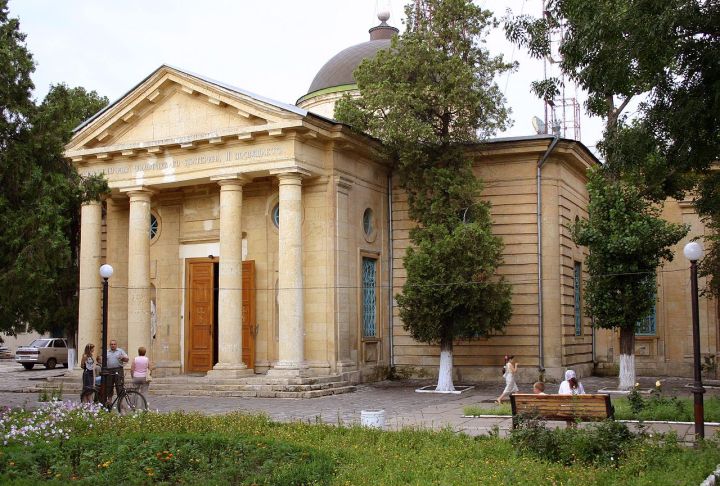
Cathedral of St. Catherine, Kherson, Ukraine, 1781–86. Dedicated to Catherine of Alexandria, the patron saint of the reigning empress, it was one of the earliest churches built in ‘New Russia’ (Photo by Sven Teschke, July 2004, from Wikimedia Commons).
◊ ◊ ◊ ◊ ◊
So many twenty-first stories are also eighteenth-century stories. From The NY Times:
Marc Santora, “Why Russia Stole Potemkin’s Bones From Ukraine,” The New York Times (27 October 2022). The 18th-century military commander and lover of Catherine the Great helped conquer Ukraine and looms large in the version of history the Kremlin uses to justify the war.
With Ukrainian forces bearing down on the occupied port city of Kherson this week, the Kremlin’s puppet rulers dispatched a team to an 18th-century stone cathedral on a special mission—to steal the bones of Prince Grigory Aleksandrovich Potemkin.
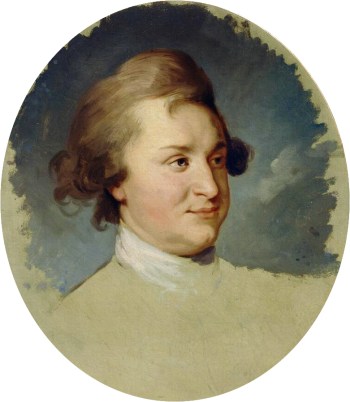
Johann Baptist von Lampi the Elder, Portrait of Russian Fieldmarshal Grigory Potemkin, 1790s (Moscow: State Tretyakov Gallery).
The memory of the 18th-century conqueror is vivid for those in the Kremlin bent on restoring the Russian imperium. It was Potemkin (1739–1791) who persuaded his lover, Catherine the Great, to annex Crimea in 1783. The founder of Kherson and Odesa, he sought the creation of a ‘New Russia’, a dominion that stretched across what is now southern Ukraine along the Black Sea.
When Russian President Vladimir Putin invaded Ukraine in February with the goal of restoring part of a long-lost empire, he invoked Potemkin’s vision. Now, with Putin’s army having failed in its march toward Odesa and threatened with ouster from Kherson, his grand plans are in jeopardy. But among Kremlin loyalists, the belief in what they view as Russia’s rightful empire still runs deep.
So it was that a team descended into a crypt below a solitary white marble gravestone inside St. Catherine’s Cathedral. To reach Potemkin’s remains, they would have opened a trapdoor in the floor and climbed down a narrow passageway, according to people who have visited the crypt. There they would have found a simple wooden coffin on a raised dais, marked with a single cross. Under the lid of the coffin, a small black bag held Potemkin’s skull and bones, carefully numbered.
Kremlin proxies have made no effort to hide the theft—quite the contrary. The Russian-appointed head of the Kherson region, Vladimir Saldo, said that Potemkin’s remains were taken from the city, on the west bank of the Dnieper River, to an undisclosed location east of the Dnieper, as Ukrainian troops edge closer.
“We transported to the left bank the remains of the holy prince that were in St. Catherine’s Cathedral,” Saldo said in an interview broadcast on Russian television. “We transported Potemkin himself.”
Local Ukrainian activists confirmed that the church had been looted and that, along with the bones, statues of venerated Russian heroes had been removed. By the count of historian Simon Sebag Montefiore, author of the book Catherine the Great and Potemkin, it was the ninth time Potemkin’s restful peace had been interrupted. . .
The full article is available here»
Marking the Tercentenary of Wren’s Death in 2023
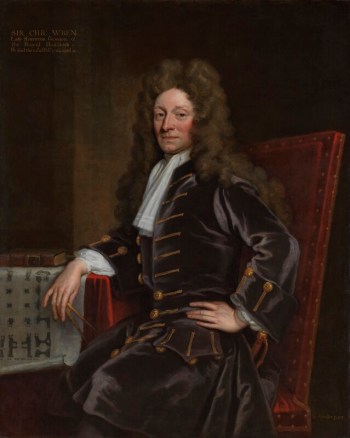
Sir Godfrey Kneller, Portrait of Sir Christopher Wren, 1711, oil on canvas (London: NPG, 113).
2023 marks three hundred years since the death of Sir Christopher Wren (1632–1723)—mathematician, astronomer, physicist, anatomist, and one of the United Kingdom’s greatest architects.
Wren was given responsibility for rebuilding 51 churches in the City of London after the Great Fire in 1666, including what is regarded as his masterpiece, St Paul’s Cathedral, where today he is buried under a gravestone with the Latin inscription which in part translates: “If you seek his memorial, look about you.” From centres of learning in Greenwich, Oxford, and Cambridge, churches, and palaces fit for a king, Wren’s influence spans the centuries.
His tercentenary will be marked in the Square Mile Churches by a year-long education and conservation programme for children and adults which has been awarded a £241,000 grant by The National Lottery Heritage Fund. Throughout 2023, Wren’s remaining churches in The City will host a variety of school and community initiatives, marking the enduring legacy of one of Britain’s most acclaimed polymaths.
With projects including school pupils building a replica of the dome of St Paul’s, and a ‘Wrenathon’ of choirs across The City of London, the Wren300 Square Mile Churches programme offers a range of opportunities to explore the work of Sir Christopher Wren through conservation, heritage, and musical activities.
The Wren300 projects include:
• The Schools’ Programme: Working with the London Diocesan Board of Schools, Temple Bar Trust and the London Fire Brigade Museum, primary school children will have the opportunity to visit Wren churches throughout 2023. The programme will be open to all state schools, with almost 5,000 pupils expected to take part in these trips, focused on London’s most under-privileged areas.
• Conservation Workshop: A series of workshops, talks and events on new construction techniques and sustainable construction materials, inspired by Wren’s work, run by Cliveden Conservation Workshop.
• The ‘Dastardly’ Triple Dome: Taking place during School Science Week in March 2023 and led by Chris Wise, Senior Director of Expedition Engineering, this project will involve 100 secondary school pupils coming together to build a mini dome using foam blocks and bamboo, representing the triple dome of St Paul’s Cathedral.
• A City Full of People: Led by historians, Dr Rebecca Preston and Dr Susan Skedd, this programme will engage and recruit volunteers from diverse communities in researching and understanding the lives of people engaged with Wren’s churches over the centuries, who might previously have been overlooked.
• The Wrenathon: Working with Music in Offices, work-based, community, and intergenerational choirs, drawn from diverse communities, including The Samaritans Choir and Ukrainian Refugees Choir, will come together in Wren churches. to sing music ranging from baroque and classical to contemporary and jazz.
• Exhibitions of fire artists: From September 2023, a number of churches will be hosting exhibitions of fire artists, depicting the destruction and rebuilding of Wren churches.
Alongside a grant from the National Lottery Heritage Fund, Wren300 has also received grants from the Royal Academy of Engineering, The Linbury Trust and the London Fire Brigade Museum.
Commenting on Wren300, the Bishop of London, the Rt Revd and Rt Hon Dame Sarah Mullally, said: “We are very grateful for the funding the Wren300 project has received from the National Lottery Heritage Fund. This will go a long way to helping those from all backgrounds to experience Wren’s churches in The City, encouraging new audiences to feel inspired by the architecture, heritage, arts and music of his time.”
Stuart McLeod, Director England – London & South at The National Lottery Heritage Fund, added: “We are delighted to support this project, which, thanks to money raised by National Lottery players, will enable more people to learn about the fantastic legacy of Sir Christopher Wren. His work is so integrated into the community and bringing this to life through a year-long programme will be a fitting legacy. Heritage has a huge role to play in instilling pride in our communities and through Wren300 more people will be able to get involved with, protect, and learn about the exciting heritage right on their doorstep.”
Annie Hampson, Chair of the Wren300-Square Mile Churches, said: “Wren300 is a celebration of an extraordinary and prolific career that occurred at a changing point in British history and transformed our architecture. The Great Fire of London decimated the City and Wren brought his pragmatism and skill to the rebuilding of the City Churches, providing him with the expertise and knowledge to achieve his greatest masterpiece in the rebuilding of St Paul’s. The Wren300 project provides a range of activities that will ensure these Churches are better known and appreciated, that they are an enriching experience to all who come to them, a learning resource for young people living in and around the City of London and a lasting legacy that will ensure their survival for generations to come.”
Wren300 Square Mile Churches, Honorary Patron, Lord Norman Foster of Thames Bank added “Sir Christopher Wren was one of our greatest ever citizens. I admire him not only as a great architect but also as a surveyor and manager who remarkably came up with a plan for rebuilding the City only days after the Great Fire. What is even more extraordinary is that he succeeded in carrying it out, supervising the rebuilding of 51 churches, including St Paul’s Cathedral, where he used a completely new architectural language not previously seen in England. His influence continues to this day.”
New Book | House and Home in Georgian Ireland
From Four Courts Press:
Conor Lucey, ed., House and Home in Georgian Ireland: Spaces and Cultures of Domestic Life (Dublin: Four Courts Press, 2022), 216 pages, ISBN: 978-1801510264, €50.
 This book explores the everyday character and functions of domestic spaces in Georgian Ireland. Reflecting real as opposed to ideal patterns of living, the topics and themes addressed here range widely from maternity and hospitality to social identity and consumption. Broadening the species of spaces typically considered for this period—embracing country piles and urban mansions, but also merchant houses, lodgings, and rural cabins—this collection of essays expands and deepens our understanding of the meanings of house and home in Ireland in the long eighteenth century.
Conor Lucey is associate professor in architectural history in the School of Art History & Cultural Policy, University College Dublin
C O N T E N T S
• Conor Lucey, Introduction: Species of Domestic Spaces
• Emma O’Toole, Brought to Bed: The Spaces and Material Culture of the Lying-in
• Patricia McCarthy, A Male Domain? The Dining Room Reconsidered
• Melanie Hayes, Fashioning, Fitting-out, and Functionality in the Aristocratic Town House: Private Convenience and Public Concerns
• Aisling Durkan, The Merchant House in Eighteenth-Century Drogheda
• Toby Barnard, ‘Baubles for Boudoirs’ or ‘an Article of Such Universal Consumption’: Ceramics in the Irish Home, 1730–1840
• Claudia Kinmonth, Communality and Privacy in One- or Two-Roomed Homes before 1830
• Judith Hill, Entertaining Royalty after the Union: Space, Decoration, and Performance in Charleville Castle, 1809
• Priscilla Sonnier, ‘A Taste for Building’: Domestic Space in Elite Female Correspondence
• Conor Lucey, Single Lives, Single Houses
Call for Papers | Unlocking the Fagel Collection
From Trinity College Dublin:
Unlocking the Fagel Collection: The Library and its Context
Trinity College Dublin, 22–23 June 2023
Proposals due by 15 December 2022
The Fagel Collection is one of the most important and largest Dutch private libraries of the eighteenth century still surviving today. It was assembled as a working library by several generations of the Fagel family, of whom successive members held high offices in the Dutch Republic throughout the seventeenth and eighteenth centuries. The collection of books, pamphlets, and maps was purchased as a whole for Trinity College Dublin in 1802.
This symposium represents the culmination of the Unlocking the Fagel Collection project (2020–2023), a collaboration between the Library of Trinity College Dublin and the KB National Library of the Netherlands, funded by the Dutch Ministry of Foreign Affairs. We will mark the achievements of the project which has facilitated access to and raised awareness of this unique heritage library through cataloguing of the Dutch imprints in the Short-Title Catalogue Netherlands (STCN). This moment also signals the beginning of a second phase of work, dedicated to enhanced cataloguing of all non-Dutch materials and supporting new research into the collection, notably through extensive digitisation as part of the Virtual Trinity Library.
As such, the symposium represents an opportunity to take a fresh look at the historical context and significance of the collection, and to look forward to future exploration thereof, particularly, it is hoped, through new collaborations and digital integration with collections and projects internationally.
Topics may include
• The history and socio-cultural context of the Fagel library and the Fagel family, e.g. Den Haag book culture, print, and the Dutch States General
• Comparative perspectives with contemporary libraries, cultures of collecting, in the Dutch Republic and elsewhere, e.g. patrician libraries, political libraries, expatriated libraries
• Fagel holdings in relation to overall STCN data and other recorded collections
• Exploration of the collection’s holdings: books, pamphlets, maps, engravings, manuscripts, items no longer in the collection
• Links with complementary collections: the Fagel archives, the (dispersed) art, coin, and plant collections, etc.
• The role and use of the Fagel Collection, then and now, e.g. information politics
• The collection’s organisation and history, in the Netherlands and at Trinity College Dublin
• Materiality of the collection, of individual items, and questions of preservation
• Perspectives on future development and use of the collection, e.g. in digital form
The organisers welcome proposals for papers (c. 250 words) on these and related topics. Proposals should be sent, together with a short bio-bibliographical statement including indication of institutional affiliation, by 15 December 2022. Email to Library.Events@tcd.ie with the subject heading ‘Fagel Symposium’.
Participation and attendance, including meals and refreshments, is free of charge. Travel costs and accommodation are not covered. For further information, please contact Ann-Marie Hansen, project manager of Unlocking the Fagel Collection, at the Library of Trinity College Dublin, anhansen@tcd.ie.
Online Talk | Adrian Johns and Jason Dean on Historia Coelestis (1712)

From the series website:
Adrian Johns and Jason Dean, After Hours with Historia Coelestis (1712)
Zoom, Linda Hall Library of Science, Engineering, and Technology, Kansas City, Missouri, 10 November 2022
On Thursday, November 10, at 7.00pm (CT), the Linda Hall Library of Science, Engineering, and Technology will host the fourth installment of its 2022 After Hours series. The program places Library staff in dialogue with outside scholars, collectors, and other cultural heritage professionals to create wide-ranging conversations about books in the collection.
In the upcoming program, Adrian Johns and Jason Dean will unpack the remarkable story of the 1712 Historiae Coelestis Libri Duo through the material evidence found in the Library’s copy of the 1712 edition, as well as the later, authorized, 1725 edition. Their presentation will also draw on the in-progress work of Emma Louise Hill as she works toward a census of the approximately 15 remaining copies of the 1712 edition. As per usual, the program will be recorded and posted online.
In the spring of 1716, the Astronomer Royal, John Flamsteed, built a pyre on Greenwich Hill near the Royal Observatory. From a safe vantage point, he watched with satisfaction as pages from a book he wrote went up in flames, calling them a good “sacrifice to TRUTH.” This was not done in a fit of frustration with his research, but rather to take back control of work that he felt had been stolen from him. The 1712 edition of Historiae Coelestis, though large, expensive, and beautifully printed, went to press prematurely against Flamsteed’s wishes. The series of events that led to Flamsteed’s furious burning of sections of that edition involved some of the most powerful members of the early Royal Society, including Isaac Newton and Edmond Halley, all embroiled in professional jealousy, intellectual theft, and clandestine printing.
Adrian Johns is Allan Grant Maclear Professor of History at the University of Chicago. Originally educated at Cambridge, he taught at the University of Kent, the California Institute of Technology, and the University of California, San Diego, before arriving in Chicago in 2001. He is the author of The Nature of the Book: Print and Knowledge in the Making (1998), Piracy: The Intellectual Property Wars from Gutenberg to Gates (2009), and Death of a Pirate: British Radio and the Making of the Information Age (2010), as well as dozens of papers on the histories of science, information, and the book. His latest book is The Science of Reading: Information, Media, and Mind in Modern America, forthcoming from the University of Chicago Press. He has been the recipient of awards from the Guggenheim Foundation, the ACLS, the Mellon Foundation, and other bodies, and is currently at work on a history of the policing of information since the Middle Ages.
Jason W. Dean is Vice President for Special Collections at the Linda Hall Library. Prior to coming to the Library, Jason was Director of Special Collections & Archives at Southwestern University. He has previously held positions at the University of Arkansas and Crystal Bridges Museum of American Art. He earned an undergraduate degree in history from Hardin-Simmons University and his MS in Library and Information Science from Syracuse University. He is a member of the Grolier Club, and a past Institute of Library and Museum Services-Rare Book School fellow.
New Book | Marie-Antoinette’s Legacy
From Amsterdam UP:
Susan Taylor-Leduc, Marie-Antoinette’s Legacy: The Politics of French Garden Patronage and Picturesque Design, 1775–1867 (Amsterdam: Amsterdam University Press, 2022), 316 pages, ISBN: 978-9463724241, €124.
 Challenging the established historiography that frames the French picturesque garden movement as an international style, this book contends that the French picturesque gardens from 1775 until 1867 functioned as liminal zones at the epicenter of court patronage systems. Four French consorts—queen Marie-Antoinette and empresses Joséphine Bonaparte, Marie-Louise, and Eugénie—constructed their gardens betwixt and between court ritual and personal agency, where they transgressed sociopolitical boundaries in order to perform gender and identity politics. Each patron endorsed embodied strolling, promoting an awareness of the sentient body in artfully contrived sensoria at the Petit Trianon and Malmaison, transforming these places into spaces of shared affectivity. The gardens became living legacies, where female agency, excluded from the garden history canon, created a forum for spatial politics. Beyond the garden gates, the spatial experience of the picturesque influenced the development of cultural fields dedicated to performances of subjectivity, including landscape design, cultural geography, and the origination of landscape aesthetics in France.
Susan Taylor-Leduc earned both her masters and doctoral degrees from the University of Pennsylvania. Since 1992, she has worked as a teacher, curator, and university administrator in Paris. She is currently affiliated with the Centre des Recherche du Château de Versailles.
C O N T E N T S
Acknowledgements
List of Illustrations
Introduction: Spatial Legacies
Prologue: Consorts & Fashionistas
1 A Gambling Queen: Marie-Antoinette’s Gamescapes, 1775–1789
2 Revolutionary Surprises, 1789–1804
3 A Créole Empress: Joséphine at Malmaison, 1799–1809
4 The Imperial Picturesque: Napoléon, Joséphine and Marie-Louise, 1810–14
5 Empress Eugénie and the Universal Exhibition of 1867
Epilogue
Index
Call for Articles | Women as Builders, Designers, and Critics
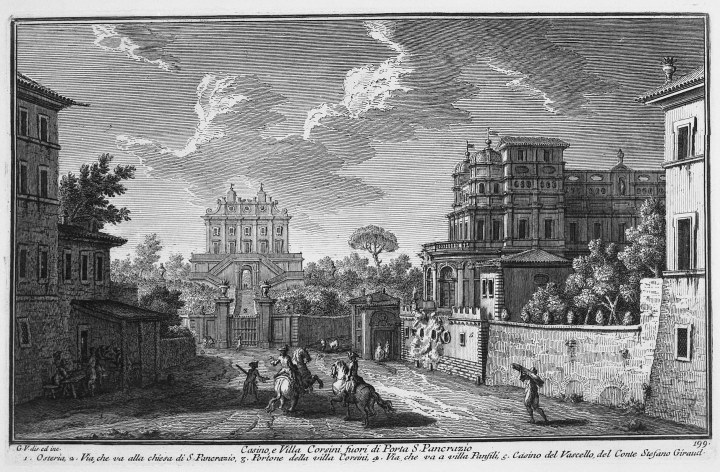
Villa Benedetta, designed by Plautilla Bricci (and completed in 1665) is the large residence to the right of the street in this engraving by Giuseppe Vasi, Casino e Villa Corsini fuori di Porta S. Pancrazio, Plate 199, 1761.
◊ ◊ ◊ ◊ ◊
From the Call for Proposals:
Women as Builders, Designers, and Critics of the Built Environment, 1200–1800
Volume edited by Shelley E. Roff
Proposals due by 1 December 2022; final chapter submissions due by 15 January 2024
Routledge Publishing invites book chapter proposals for a peer-reviewed edited volume that will re-write the history of architecture, urban space, and landscape before the modern age from an alternative, feminist point of view. Women as Builders, Designers and Critics will recover women’s agency within the built environment in the urban and rural setting from the perspective of distinct and often overlapping roles women have played as:
• Builders — manual labourers on constructions sites and in the building trades, building material suppliers, and managers of construction projects
• Designers — amateur designers of architecture, interiors and gardens, artists influencing design through their architectural imagery, patrons directly engaged with design
• Critics — writers, mentors, tutors, and patrons influencing the form of the built environment
Chapter authors should situate the women studied within the context of their social class, time period, and region. Within this context, authors may, if appropriate, choose to theorize about where these women fit within or challenge the canon of architectural history. The geographic scope is open and projects from earlier periods and addressing alternative roles are welcome.
Please send a 500-word abstract and a one-page CV to Shelley E. Roff at shelley.roff@utsa.edu by 1 December 2022. Notification of acceptance of abstracts will be sent by 10 December 2022. If your proposal is accepted, the deadline for a full chapter submission will be 15 January 2024. Chapters should be 5,000–8,000 words in length and must be published in English.
NGA Announces the Sant Fund for Women Artists
From the press release (27 October 2022), which includes links for most works of art referenced in the document:
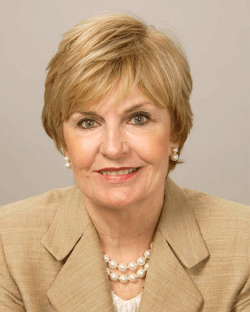
Victoria Sant served as president of the NGA from 2003 to 2014.
The National Gallery of Art in Washington, D.C. announced today a remarkable gift of $10 million from the family of Victoria P. Sant, former president of the National Gallery of Art, to fund the acquisition of work by women. An endowment fund, the Victoria P. Sant Fund for Women Artists, will further the National Gallery’s ongoing priority of acquiring more work by women, from historic works to living artists.
In an ongoing commitment to this work, many acquisitions over the past years expand the holdings of creations by women artists across genre and medium. Two acquisitions of special significance were recently approved at the May 2022 Board of Trustees meeting: a portrait by Bolognese painter Lavinia Fontana (1552–1614), the first painting by an early modern Italian woman artist to enter the collection, and a small sculpture by Luisa Roldán (1652–1706) that is the first work by a woman sculptor created before 1850 to enter the collection.
“The National Gallery of Art and our millions of visitors have benefited tremendously from Vicki’s dedication to serving the American public,” said Kaywin Feldman, director of the National Gallery. “It is exciting that we now have an endowment fund to help us acquire masterpieces by women artists, and one that will carry the name of such an exemplary advocate and leader. We look forward to adding important works by women artists from all eras to the collection and continuing the work which Vicki so passionately championed.”
The Victoria P. Sant Fund for Women Artists will be the cornerstone in the ongoing efforts to address the gap of women artists represented in the collection. Vicki Sant (1939–2018) was the first woman president of the National Gallery and a member of the Board of Trustees for 15 years. Future acquisitions will benefit from the generosity of her family, given in loving memory toward a cause so important to her. The National Gallery intends to use this fund to expand the of acquisitions of work by women as part of its commitment to increase holdings of works by these artists. In the past two years (May 2020 to May 2022), 50.6% of the works acquired by purchase were by artists of color, compared to just 12.6% in the two years prior (a 302% increase). During the same period, works by women artists comprised 35.5% of the total, compared to just 20.3% during the two years prior (a 75% increase).
Lavinia Fontana, Portrait of Lucia Bonasoni Garzoni, ca. 1590
This highly detailed and exquisite portrait depicts the 16th-century musician Lucia Bonasoni Garzoni (b. 1561–at least 1610) by the most productive woman artist of the late 16th century, the Bolognese painter Lavinia Fontana. This portrait is among Fontana’s best preserved and most accomplished surviving works in the genre. A rare depiction of a 16th-century woman musician by a 16th-century woman artist, this painting tells the story of two accomplished women who were able to overcome obstacles in a patriarchal society to succeed in the artistic spheres of painting and music.
Fontana died just before her 62nd birthday after a highly successful career. Trained by her father, Prospero Fontana (1512–1597), in the late mannerist style, and most famous for her portraits of noblewomen, she produced her first dateable works around 1575. In addition to portraits, she painted secular and religious subjects, including altarpieces for churches (a rarity in the period), portraits of scholars, and mythological nudes—a subject that was unheard of for women in the period. In 1577, Fontana married Gian Paolo Zappi (ca. 1555–1615), who acted as her business manager; she supported her family, which included 11 children, with the profits from her painting. Fontana is one of 68 known women artists from Bologna in the early modern period and was a trailblazer for women artists who succeeded her.
Luisa Roldán, Virgin and Child, ca. 1680/1686

Luisa Roldán, Virgin and Child, ca. 1680/1686, painted wood, 56 cm high (Washington, DC: NGA, 2022.39.1).
This small carved wood and painted statue by Luisa Roldán is the first work by a woman sculptor from before ca. 1850 to enter the National Gallery’s collection. Widely accepted as a work by Roldan on stylistic grounds, it shares close similarities with a range of sculptures that are widely acknowledged to be by her.
Born in Seville, Roldán was the daughter of Pedro Roldán, one of the city’s most accomplished sculptors. Her introduction to sculpture most likely came from Pedro, with whom she worked in close partnership. At the age of 19, she left home to marry one of her father’s studio assistants, with whom she set up a workshop and began undertaking commissions. Some of her earliest works, identifiable by style, include various life-size figures in painted wood for altarpieces in Seville and processional floats (paseos) that reflect but differ from her father’s style. In 1688 Roldán and her husband moved to Madrid, likely in expectation of an appointment at the court of King Carlos II. Eventually she was awarded the royal title of escultora de cámara, which did not prove especially lucrative. She turned to specializing in painted terracotta scenes. When Felipe V ascended to the throne in 1701, she was reappointed to the Spanish court. Lauded for her accomplishments as a sculptor, she nevertheless died destitute, unable to pay for a funeral. On the day she died, she received recognition as an “Accademica di merit” from the Accademia di San Luca in Rome.
Other Acquisition Highlights by Women Artists
The National Gallery has continued to represent the work of women artists with notable acquisitions over the last two years in all areas of the museum.
Paintings
Faith Ringgold’s (b. 1930) The American People Series #18: The Flag is Bleeding (1967) is the first painting by a leading figure of contemporary art to enter the collection. This pivotal work exemplifies the artist’s skill in using art as a vehicle to question the social dynamics of race, gender, and power. The National Gallery also acquired two works by Carmen Herrera (1915–2022), one of the leading practitioners of abstract art during the second half of the 20th century: Untitled (2013) and the sculptural relief Untitled Estructura (Yellow) (1966/2016). Associated with non-representational, concrete abstraction in Europe, the United States, and Latin America, Herrera’s art contributed to the cross-pollination of modernist ideas.
Genesis Tramaine’s (b. 1983) Clinging unto the Lord (2021) blends a provocative use of color with an urban-inspired, mixed-media approach that focuses on the shape and definition of the “American Black Face” and uses exaggerated features to capture the spirited emotions of the untapped, underrepresented souls of Black people. Carla Accardi (1924–2014), a prominent figure of postwar Italian art and the Italian feminist movement, painted the wavelike forms of Rossorosa (1966) in red varnish on a sheet of clear Sicofoil suspended in front of pink cardboard. The work exemplifies Accardi’s preference for combinations of maximum-intensity hues and bold patterns to create powerful optical effects. Two quilts by Rosie Lee Tompkins (1936–2006) also entered the collection last year. Tompkins created irregularly shaped quilt tops that she valued for their visual and spiritual qualities, rather than their functionality.
Other painting highlights include SONG OF SOLOMON 5:16 – BE BEEWORLD: BE B BOY B GIRL (after “Emperor Xuanzong and Yang Gueifei playing the same flute” by Utamaro Kitagawa) (2014–16) by artist Rozeal (formerly known as Iona Rozeal Brown, b. 1966); Sarah Cain’s (b. 1979) Self-Portrait (2020), an exuberant, mixed-media abstract painting; and Eko Skyscraper (2019) by Njideka Akunyili Crosby (b. 1983), the first work by this celebrated artist to enter the collection.
Sculptures
Sonia Gomes (b. 1948), a contemporary Afro-Brazilian artist, is known for her mixed-media works made of fabric, wire, and other materials. Correnteza (Current) (2018), a sculpture from her Raízes (Roots) series, brings the aesthetic and the human together in memorable sculptures that are at once traditionally Brazilian and fluently contemporary. Chakaia Booker’s (b. 1953) Egress (ca. 2000), the first sculptural work by her to enter the collection, is created with recycled tires that transform familiar symbols of urban waste and blight into extraordinary compositions of renewal.
A pioneer of second-wave feminist and post-war Black nationalist aesthetics, Betye Saar’s (b. 1926) practice examines African American identity, spirituality, and cross-cultural connectedness. The Trickster (1994) reflects Saar’s continued introspection, her assertion of the aesthetic and conceptual power of African cultural forms, and the belief that art can be made from anything. The first major relief by Louise Nevelson (1899–1988), Untitled (ca. 1975), resembles Nevelson’s classic, earlier work in that it consists largely of found pieces of black-painted wood that fit tightly within boxlike containers.
Prints and Drawings
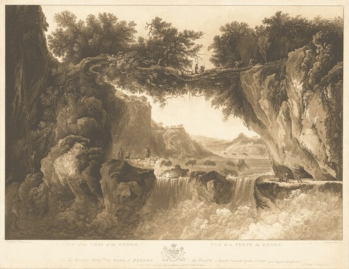
Maria Catharina Prestel, after Louis Bélanger, View of the Loss of the Rhone, 1791, etching and aquatint printed in brown on laid paper, sheet (trimmed to platemark) 56 × 72 cm (Washington, DC: NGA, Ailsa Mellon Bruce Fund, 2021.23.1).
Maria Catharina Prestel (1747–1794) was one of the few prominent female pioneers of aquatint. View of the Loss of the Rhone (1791), depicting a geologic fault in France, exemplifies how Prestel created inventive textures to evoke the tactility of brushwork.
The National Gallery acquired three works by Zarina (1937–2020), one of the most celebrated South Asian artists of the past century, who explores questions of displacement, mobility, loss, memory, migration, and cultural dominance in her work: Homes I Made/A Life in Nine Lines (1997) a portfolio of nine etchings; Corners (1980), made from cast paper; and Untitled (1968), a wood relief print.
Israeli artist Orit Hofshi’s (b. 1959) Time… thou ceaseless lackey to eternity (2018), one of her largest polyptychs, explores the history and founding of Israel and its ongoing conflicts with Palestine using the universal themes of migration, displacement, and the toll that human civilization has taken on the land. Nicole Eisenman (b. 1965) is best known as a painter who skillfully combines art history, queer politics, and popular culture into engaging, often fantastical figurative subjects. Beer Garden (2012–17)—at nearly four feet square—stands out as her most monumental print to date and took five years to complete.
Photographs

Carrie Mae Weems, Echoes for Marian, 2014, chromogenic print, image: 127 × 127 cm (Washington, DC: NGA, 2021.8.1).
Celebrated for her ability to explore issues of race, class, gender, power, and injustice with eloquent insight and passionate conviction, Carrie Mae Weems (b. 1953) often uses the past to shine a light on the present. Weems’s Untitled (1996, printed 2020) consists of seven inkjet prints, each a reproduction of a historic photograph and each framed with sandblasted text on glass inspired by the heroism of the 54th Massachusetts Regiment, one of the first African American regiments formed in the North during the Civil War. In her photograph Echoes for Marian (2014), Weems depicts herself standing in front of the Lincoln Memorial in Washington, DC, paying homage to Marian Anderson, who performed a concert there in 1939 when the Daughters of the American Revolution barred her from singing in Washington’s Constitution Hall. Weems’s photograph shows how architecture can not only exude a sense of power, but also reinforce it.
Other photography highlights include works by Christina Fernandez (b. 1965), a Los Angeles–based Chicana artist who uses photographs and installations to explore her Mexican heritage and themes of identity, migration, labor, and gender. The National Gallery acquired six prints from her Lavanderia series (2002–03), which depicts laundromats in the Boyle Heights neighborhood of LA, an area of the city that was known at the time as a bastion of Chicano culture, as well as her installation piece, Bend (1999–2000, 2020). Two important photographs by JoAnn Verburg, 3 x Three (2019) and WTC (2003), show how Verburg captures extended moments of time in her art, a theme that she has explored since the 1970s.
◊ ◊ ◊ ◊ ◊
Note — 2014 marked the 75th anniversary of Marian Anderson’s performance at the Lincoln Memorial. The same year that Weems produced her photograph honoring Anderson, the Daughters of the American Revolution hosted Of Thee We Sing, a concert in Constitution Hall “to pay tribute to the talent, strength, and courage” of Anderson as a “remarkable and inspiring woman” (as quoted from the organization’s Marian Anderson Statement, available from the DAR website).
The Huntington Acquires Portrait by Vigée Le Brun
From the press release (1 November 2022) . . .

Élisabeth Louise Vigée Le Brun, Portrait of Joseph Hyacinthe François-de-Paule de Rigaud, comte de Vaudreuil, ca. 1784, oil on canvas, 51 × 38 inches (San Marino: The Huntington Library, Art Museum, and Botanical Gardens, Gift of The Ahmanson Foundation).
The Huntington Library, Art Museum, and Botanical Gardens has acquired a major painting by Élisabeth Louise Vigée Le Brun (1755–1842), the most important female artist of 18th-century France. Portrait of Joseph Hyacinthe François-de-Paule de Rigaud, comte de Vaudreuil (ca. 1784) is the second masterpiece to come to The Huntington through a gift from The Ahmanson Foundation.
“We are enormously grateful to The Ahmanson Foundation for making this acquisition possible,” Huntington President Karen Lawrence said. “Adding an important work by Vigée Le Brun helps us achieve one of our goals—adding more works by important women. Once again, The Ahmanson Foundation proves to be an invaluable strategic partner, allowing us to make a masterpiece accessible to Southern California audiences.”
The Vigee Le Brun painting complements The Huntington’s significant collection of 18th-century French decorative art, which was established by Henry and Arabella Huntington in the early 20th century. “This finely painted masterwork will go on display in the Huntington Art Gallery, the building that holds French tapestries and carpets that were once part of the French court’s accoutrements at the Palais du Louvre and Versailles,” said Christina Nielsen, the Hannah and Russel Kully Director of the Art Museum at The Huntington. “It will not only add rich context, but will also shine as a star French painting. While our collection of 18th-century British portraiture is one of the best in the nation, this is our first French portrait of this caliber.”
The painting also has an interesting history. The painter and the subject were both part of the inner circle in the royal court, and they both greatly shaped Parisian salon culture. Their friendship has been celebrated by contemporary writers in poems and verse.
Vigée Le Brun was the daughter of a portraitist and was painting professionally by the time she was in her teens. When she was 28, she was inducted into the French Royal Academy, with the support of Marie Antoinette, and she was one of only four female members. Vaudreuil (1740–1817) was an actor, socialite, and Vigée Le Brun’s primary private patron. In her memoir Souvenirs, Vigée Le Brun reveals her affection for him, calling him “l’Enchanteur” (The Magician).
Painted to commemorate the day when Vaudreuil was made Knight of the Order of the Holy Spirit by King Louis XVI, the seated portrait shows off the sitter as well as the artist’s virtuosity. Vaudreuil is dressed in an ornate brown coat with gold braids, trim, and beads and white silk lining. He wears a sheer lace jabot and cuffs. His shimmering blue sash and the silver badge on his coat represent the knightly Order of the Holy Spirit. The red silk rosette and ribbon are of the royal military order of Saint Louis, which he received from King Louis XVI in 1770. He clasps a fashionable tricorn hat with white plumes under one arm and holds the handle of a ceremonial sword.
Vaudreuil was the son of the governor and commander-general of the French colony Saint-Domingue on the Caribbean island of Hispaniola. In addition to a great inheritance, Vaudreuil’s wealth also derived from his own Saint-Domingue sugar plantations, which were powered by enslaved people. “As with our recently acquired drawings of the Jamaican sugar plantation where the famous ‘Pinkie,’ from our British portraits collection, grew up, the Vaudreuil portrait provides us with an opportunity to shine a brighter light on the history of European colonization,” Nielsen said. “We must, and will, reckon with the lives of the people represented on our walls.”
The painting is slated to be installed in the Huntington Art Gallery in November.
◊ ◊ ◊ ◊ ◊
The painting sold in Paris at Christie’s, Maîtres Anciens: Dessins, Peintures, Sculptures (Sale 21059, Lot 232), on 17 May 2022 for €592,200, over twice its low estimate (€250,000–350,000). Two versions of the painting exist: the other is in the collection of the Virginia Museum of Fine Arts.
Online Course | British Furniture Making and the Globalised Trade
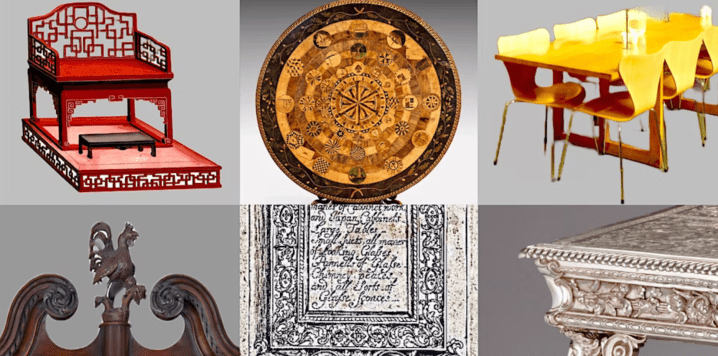
From FHS:
British Furniture Making and the Globalised Trade
Online, BIFMO-FHS, Wednesdays in November 2022
British and Irish Furniture Makers Online (BIFMO), as part of the Furniture History Society (FHS), is offering a course on Zoom every Wednesday throughout November. Each week curators and historians will consider how methods and ideas about furniture making have been transmitted between countries from the 17th to the 20th century. Some speakers will consider how methods and designs in Britain were influenced by immigration to this country, while others will look at the impact of British furniture makers who emigrated to other countries such as the United States. These presentations will include a wide variety of fine examples of craftsmanship from 17th-century silver furniture, to Ralph Turnbull working in 19th-century Jamaica, through to the impact of Danish furniture importers and Arne Jacobsen in the 20th century.
Each week’s session will start at 16.30 and conclude at 19.30 (GMT). Please note that for the first week, our US participants on the East Coast will be only four hours behind the UK. Weeks 2 to 5 will revert to the usual five-hour difference. Most of the presentations will be 30 minutes in length followed by a short Q&A session. The programme on Week 4 varies slightly and will include five speakers instead of four, but the total length of the session will be the same (three hours). There will be a 15-minute comfort break approximately halfway through each weekly programme.
It is possible to book individual weeks, but you will benefit from a discount if you book all five sessions together. FHS members benefit from a further discount on all tickets. Tickets are available through Eventbrite here. Don’t worry if you are unable to attend a live event, as most of the presentations will be recorded and every ticket-holder will receive a link to the relevant recording. Please click here for further information about the speakers and the presentations. If you have any questions, please email Ann Davies at bifmo@furniturehistorysociety.org.
◊ ◊ ◊ ◊ ◊
Week 1 | November 2
The Impact of Immigration on the Furniture Trade in the 17th Century
• Grinling Gibbons — David Luard
• Furniture Made for the Court and the City — Adriana Turpin
• Upholsterers, Mercers, and Lace Men at the Late Stuart Court: Patronage, Networks, and International Influences — Olivia Fryman
• ‘Such Massey Pieces of Plate’: Silver Furniture in England, 1660–1702 — Matthew Winterbottom
Week 2 | November 9
Furniture Making in London and Europe
• Huguenots Furniture Makers in the Long 18th Century — Tessa Murdoch
• Following a Thread: How Mr Potter’s Designs Travelled — Sarah Medlam
• ‘Gorgeous Pieces of Inlaid Work with Figures’: Notes on Johann Gottlieb Fiedler, Berlin’s Early Classicist Ebeniste — Achim Stiegel
• British Models for Italian Furniture Makers — Enrico Colle
Week 3 | November 16
Global Networks and Furniture Making in the 18th Century
• The Aesthetic and Cultural Hybridity of Cantonese Trade Furniture — Karina Corrigan
• A Furniture Trade Adapting to the Benefits of Empire — John Cross
• Patterns, Templates, and Publications: British and Irish Émigré Cabinetmakers in America — Alexandra Kirtley
• English Influences in the Southern States of America — Tom Savage
Week 4 | November 23
Immigration and Emigration of Furniture Makers in the 19th Century
• Johann Martin Levien: Master Cabinetmaker of Prussia, New Zealand, and England — Serena Newmark
• Anecdotes on the Immigrant Furniture Making Community in the Tottenham Court Road Area, London, 1850–1900 — Clarissa Ward
• 19th-Century Specimen Furniture in Jamaica and the British Empire — Catherine Ducette
• The Crace Firm and French Influences — Megan Aldrich
• The Relationship between Britain and the US at the Great Exhibitions of the 19th century — David Tiedemann
Week 5 | November 30
Making the Modern World: Global Connections into the 20th Century
• ‘Princely but Peaceful Splendor’: Cottier & Co. in New York — Max Donnelly
• The Furniture Export Trade between Australia and Britain in the 19th Century — Clive Edwards
• Immigrant Furniture Workers in the East End of London including a Case Study of the Hille Firm — Pat Kirkham
• Denmark in Britain: The Work and Influence of the Danish Furniture Importers and Wholesalers in London — Bruce Peter










 Enfilade
leave a comment