Exhibition | Painted Cloth: Fashion and Ritual in Colonial Latin America

From the press release for the exhibition:
Painted Cloth: Fashion and Ritual in Colonial Latin America
Blanton Museum of Art, The University of Texas at Austin, 14 August 2022 — 8 January 2023
The Blanton Museum of Art at The University of Texas at Austin is pleased to present Painted Cloth: Fashion and Ritual in Colonial Latin America, an ambitious and timely show that explores the production, meaning, and representation of fabric and garments as they were experienced in civil and religious settings across Latin America during the 1700s. Painted Cloth features over 70 objects produced in five countries from the Blanton’s growing collection of art of the Spanish Americas, alongside key loans from distinguished institutions and private collections around the world.

Our Lady of Bethlehem with a Donor, Cusco, 18th century, oil with gold leaf on canvas, 105 × 73 inches (Collection of Carl and Marilynn Thoma)
“With the opening of Painted Cloth, we’re thrilled to finally unveil the extraordinary exhibition made possible by our longstanding partnership with the Thoma Foundation, whose investment and belief in the Blanton over the years has strengthened our commitment to the study of art of the Spanish and Portuguese Americas,” said Blanton director Simone Wicha. “Thanks to their support, the work of Rosario I. Granados, the first Marilynn Thoma Associate Curator, Art of the Spanish Americas, has advanced significant scholarship in this still underrepresented era of art history. The elaborate fabrics, fashion, and other richly textured works in this show are not only a feast for the eyes, they also will give our audiences a good look into everyday life during an era of dynamic cultural exchange and show how clothing—then as now—is so intertwined with our identities. Equally beautiful as it is insightful, Painted Cloth is sure to inspire conversations about race and colonialism’s complex legacies and offer a greater understanding of this period in Latin America’s history.”
An unquestionable marker of identity, clothing distills complex relationships between race, gender, religion, and class. Painted Cloth reflects on the social roles of textiles and their visual representations, emphasizing how aesthetic traditions of Indigenous and European origin wove themselves into civil, religious, and artistic life at a time when the Spanish monarchy imposed their rule in the region.
As the title references, the exhibition foregrounds not only beautifully crafted garments and textiles, but also explores how the practice of depicting textiles in paintings, sculptures, prints, and furnishings created a visual artifice that captured their aesthetic, ritual, and commercial value. This interplay between objects and images courses through five visually striking sections: Cloth Making, Wearing Social Status, Dressing the Sacred, The Holiness of Cloth, and Ritual Garments.
“Collectively, these groupings address how cloth and their representation in other media articulated narratives of social privilege and survival of cultural traditions, while also highlighting the mixed identity of colonial Latin America,” said Granados. “Garments are a lens by which we can recognize the many inequalities and societal contradictions that characterized the social fabric of this contested era, which altered the lives of so many Indigenous communities, but also the beauty of the Spanish America’s artistic production and thereby the diverse cultures of its peoples.”

José Joaquin Magón, Two Casta Paintings, ca. 1770.
Cloth Making
Painted Cloth begins with the manufacture and artistry of textiles in the 1700s. Works in the first section on Cloth Making underscore how various kinds of European and Indigenous garments were manufactured, emphasizing the role persons of different social status played in the industry. Included are works from the only series of casta paintings (a Mexican artistic genre that documents mixed-race couples and their children according to a caste system defined by Spanish elites) to prominently showcase women as integral to the production of textile arts, from spinning and weaving wool to their work as seamstress and tailor’s aids. In one example of this series by Mexican painter José Joaquín Magón, a woman makes bobbin lace, a costly material that was commonly imported from Europe and adopted in local attire.
The interlacing of foreign materials and traditions with local practices is also present in a set of silk swatches from Mexico. Sent with official reports to the King of Spain, these rare fabric samples show the production of block-print patterns inspired by textiles from India that signal the presence of highly skilled silk weavers in the New Spanish (Mexican) capital. The Cuzqueña painting Virgen de los Sastres (Virgin of Tailors) gives evidence that tailors, many of whom were of mixed-race descent, produced liturgical vestments made from imported European silks and brocades—examples of which are seen in the last section of the exhibition.
Many of the works in this section also address how Indigenous and Christian notions of the sacred were combined. Christian missionaries in the Andes popularized iconography that linked spiritual devotion with the labor involved in manufacturing cloth, circulating paintings that depicted the Virgin Mary or Holy Family undertaking artistic or industrious activities. By depicting Mary embroidering and spinning, the two paintings La Casa de Nazareth (The House of Nazareth) and La Virgen niña hilando (The Child Mary Spinning) make a connection between Christianity and the Indigenous cultures’ regard for the sacred nature of textiles.
Wearing Social Status

Miguel Cabrera, Doña María de la Luz Padilla y Gómez de Cervantes, ca. 1760, oil on canvas, 43 × 33 inches (Brooklyn Museum).
The second and largest section of the exhibition, Wearing Social Status, explores how fashion codes determined social interactions and collective identities in terms of gender, race, and class. This is particularly visible in Mexican casta paintings and a unique series of Peruvian mestizaje paintings, on view in the U.S. for the first time, as well as in commissioned portraits—an increasingly popular genre in this period. Since few garments from the era have survived, such paintings, although ripe with artifices, serve as an invaluable source for the study of fashion and its social significance.
One of the most memorable features of this section is the pairing of painted garments in portraits with actual garments. Paintings of well-dressed Latin American sitters by Miguel Cabrera, one of the most celebrated and prolific artists of the period, demonstrate a desired social prestige, as evident in the great attention paid to the subject’s dress. These costly dresses and elegant three-piece suits are in dialogue with similar European costumes, illustrating the influence of global trade as well as French fashion.
Clothing is also relevant in the portraits Indigenous elite commissioned to assert noble ancestry. The figure in Inca Noblewoman, notably dressed in an intricate anuca, or women’s dress, resembles the first queen of the Inca dynasty, Mama Occllo. Such motifs and codes of dress establish the sitter’s connection to Inca royalty and, as the inscription makes clear, her status as the first Christian Inca woman. In conversation with this portrait is a late 17th-century camelid wool anacu embroidered with mermaids, Inca queens, and traditional Andean geometric patterns, accompanied by a silver fastening pin known as a ttipqui or tupo incised with the imperial double-headed eagle. These artifacts offer examples of fusing Incan and European motifs to negotiate identity in a colonial environment.
Dressing the Sacred
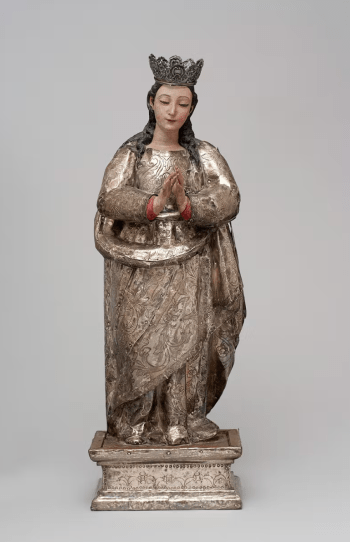
Inmaculada Concepción (Immaculate Conception), Guatemala, ca. 1740–80, silver and oil on wood, 34 inches high (Blanton Museum of Art, The University of Texas at Austin, 2019).
The exhibition’s third section exemplifies how religious material culture enhanced the experience of the holy for all social sectors. The use of fine materials in sacred objects amplified an object’s visual appearance, and with it, its sacred aura, thereby facilitating conversion and enhancing devotional practice. This is particularly true of the fabrics placed on imágenes de vestir, or ‘dress images’. These simple wooden structures were explicitly made to be clothed in rich fabrics, like the satin mantle on view, embroidered in gold and silver threads for a statue of the Virgin Mary.
In other instances, real fabrics were imitated by modeled silver, as in an example of a devotional sculpture from Guatemala, a practice that continues in the Central American country today. Fabrication of reality was likewise achieved by replicating golden embroideries and brocade fabrics using estofado, a technique that involves applying gold leaf to wooden surfaces. In two paintings from the so-called Cusco School, respectively depicting St. Lawrence and St. Jerome, gilded details emphasize the richness of saintly garments.
Brimming with golden brocades, the large painting Nuestra Señora de Belén con un donante (Our Lady of Bethlehem with a Donor) bookends this section. The work, a brilliant example of a verdadero retrato, or ‘true portrait’, depicts the 16th-century cult statue of Our Lady of Bethlehem of Cusco placed on a processional platform. Displayed in a dimly lit gallery that alludes to the painting’s original display, viewers can get a sense of the effect such objects were intended to evoke.

Presentation of the Virgin Mary at the Temple, Cusco, 18th century, oil and gold on canvas, 38 × 52 inches
(Collection of Carl and Marilynn Thoma)
Holiness of Cloth
The fourth section, Holiness of Cloth, illuminates how the actual depiction of fabric was central to images that were believed to be of miraculous nature. Cloth could provide material substance to help elucidate abstract notions of the divine, as in examples from the Cusco School of painting, which introduced Andean renditions of Catholic subjects.
The painting Virgen del Carmen salvando a las almas del Purgatorio (Virgin of Carmel Saving Souls in Purgatory) depicts the Virgin Mary with an open cloak—a familiar iconography across the Spanish Americas that symbolized protection. In a disparate work that renders the iconographic Presentation of the Virgin Mary at the Temple, tunics and mantles are gilded with brocateado, elaborate gold-brocade decoration, a technique characteristic of the Indigenous artistic production of Cusco.
In some cases, cloth becomes the divine itself, such as in Mexican painter José de Alzibar’s two works, united and on display together for the first time in history. The first, a representation of Our Lady of Guadalupe, the national patron of Mexico, depicts the cloak of an Indigenous man where the sacred image was thought to have been miraculously imprinted. The second, La Verónica, depicts the Veil of Veronica, one of the most recognizable images in which cloth is represented as a vehicle for the holy.
Ritual Garments
The final section focuses on the use of fabric in church interiors and ritual ceremonies as well as in the formation of clerical identities. Since much of the material used was extraordinarily delicate, prone to damage and decay, paintings of the era help reconstruct an understanding of the use of cloth.
The hierarchical position of Catholic clergy could be recognized by distinct, standardized liturgical clothing. A small glass painting from Bolivia details the repertoire of garments and accessories worn by priests, bishops, cardinals, and the pope, whereby the particular use of colors functioned as a key signifier of rank. In the case of the chasuble, the outermost vestment worn during the celebration of the Eucharist, four seasonal colors were used to represent the passage of time in the liturgical calendar. Although the chasuble was worn by the lowest rank of priest, the artifact on view from Mexico is crafted in fancy silks and embroidered with silken threads covered in silver and gold.
In the context of the Catholic church, the altar is an important ritual site; in the Spanish Americas it was lavishly decorated, as visual depictions like Misa frente al Cristo de los Temblores (Masses before Christ of the Earthquakes) convey. Like many works that depicted ideal Masses, this painting was created for a private home and painted from the view of a churchgoer to direct focus to the fine textiles and silverware covering the altar. On occasion, a less costly ‘painted cloth’ instead decorated the altar—exemplified by a canvas altar cloth with floral designs that mimic actual textiles. In contrast, a Guatemalan processional banner created entirely from silver emphasizes the use of even valuable materials to imitate cloth and create visual artifice.
 “Painted Cloth rejoices in the artifice of the visual arts to uncover the complexities of human nature,” concluded Granados. “Together, I hope these stunning artworks and artifacts encourage reflection on values of the past and shed new light on the factors that have shaped contemporary Latin American experience.”
The exhibition includes works from the Blanton’s collection, including from the recently acquired Huber Collection, and loans from: Benson Latin American Collection, The University of Texas at Austin; Brooklyn Museum of Art, New York; Carl & Marilynn Thoma Collection, Chicago and Santa Fe, NM; Colección Andrés Blaisten, Mexico City; Colección Barbosa Stern, Lima; Denver Art Museum; Hispanic Society of America, New York; Museo Franz Mayer, Mexico City; Museo de Arte de Lima; Museo Pedro de Osma, Lima; Museo de América, Madrid; Museo Nacional de Antropología, Madrid; Los Angeles County Museum of Art; San Antonio Museum of Art; Witte Museum, San Antonio.
Rosario Inés Granados, ed., Painted Cloth: Fashion and Ritual in Colonial Latin America (Austin: University of Texas Press, 2022), 248 pages, ISBN: 978-1477323977, $45. With contributions by Granados, Ana Paulina Gámez Martínez, Julia McHugh, Ricardo Kusunoki Rodríguez, Patricia Díaz Cayeros, and Maya Stanfield-Mazzi.
Symposium | The Fabric of the Spanish Americas

Domestic Landscape from Quito, in Jorge Juan and Antonio de Ulloa’s Relación histórica del viage a la América Meridional (Madrid: A. Marin, 1748). Benson Latin American Collection, LLILAS Benson Latin American Studies and Collections, The University of Texas at Austin.
◊ ◊ ◊ ◊ ◊
From the Blanton Museum of Art:
The Fabric of the Spanish Americas
Online, Friday, 21 October 2022
Organized in conjunction with the exhibition Painted Cloth: Fashion and Ritual in Colonial Latin America, on view at the Blanton Museum of Art at The University of Texas at Austin, this symposium will bring together scholars from Colombia, Mexico, the United Kingdom, and the United States to further explore the social role of textile arts in colonial Latin America. The keynote will be delivered by Dr. Elena Phipps, and speakers include historians Tamara Walker and Meha Priyadarshini, along with fashion historian James Middleton. The round table discussion will feature art historians Laura Beltrán-Rubio, Martha Sandoval, and Leslie Todd. Registration is available here.
P R O G R A M M E
Central Time
9.00 Keynote
• Elena Phipps (Independent Scholar), Garments and Identity: Textile Traditions in the Global World of Colonial Latin America
10.00 Morning Panel
• Tamara Walker (Barnard College), Fashioning Whiteness in Colonial Latin American Art
• James Middleton (Independent Scholar), They All Greatly Affect Fine Clothes: Textiles in Eighteenth-Century Lima-School Painting
• Meha Priyadarshini (University of Edinburgh), Global Trade, Local Fashion: The rebozo, piña and mantón de Manila
11.30 Q&A
12.00 Intermission
1.30 Round Table Discussion: Artifice in Fashion, Painting and Sculpture
• Laura Beltrán-Rubio (Universidad de los Andes), The Artifice of Fashion: Creating and Performing Identities through Clothing in Colonial Spanish America
• Martha Sandoval-Villegas (Instituto Tecnológico de Estudios Superiores de Occidente, ITESO), Habit Makes the Man… and the Woman: Portrait and New Spain Social ‘Fabric’
• Leslie Todd (Sewanee: The University of the South), The Brilliance and Brocateado of Eighteenth-Century Sculpture in Quito
Exhibition | Canova: Sketching in Clay
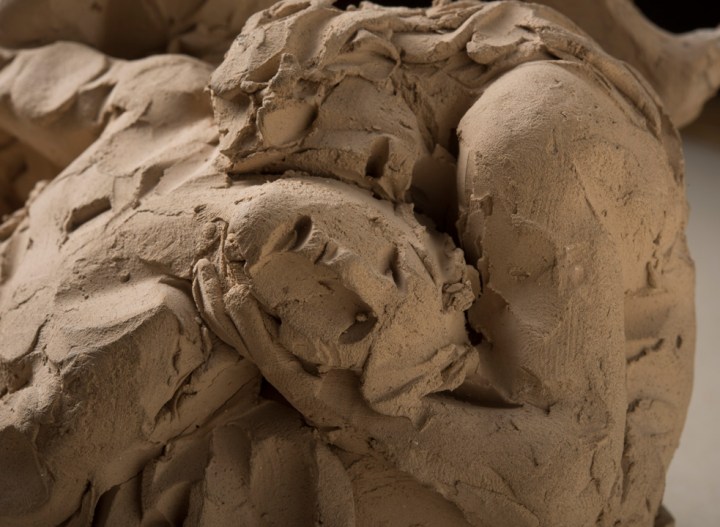
Antonio Canova, Adam and Eve Mourning the Dead Abel, detail of Eve and Abel, ca. 1818–22, terracotta
(Possagno: Museo Gypsotheca Antonio Canova; photograph by Tony Sigel)
◊ ◊ ◊ ◊ ◊
Antonio Canova, at age 64, died on this day (13 October) 200 years ago; his clay models are the subject of a major exhibition opening in June. From the NGA:
Canova: Sketching in Clay
National Gallery of Art, Washington, DC, 11 June — 9 October 2023
Art Institute of Chicago, 19 November 2023 — 18 March 2024
Curated by C. D. Dickerson and Emerson Bowyer
How does a sculptor turn an initial idea into a finished work of marble? For Antonio Canova (1757–1822), the most famous artist of Europe’s revolutionary period, the answer was with clay. Working with his hands and small tools, Canova produced dazzling sketch models in clay, which helped him plan his designs for his large statues in marble. Imprinted with the fire of his imagination, these sketches were boldly executed in mere minutes. Canova also made more finished models, sensuous in their details, that he showed to patrons or used as guides for carving. Approximately 40 of the some 60 of his surviving models reveal the artist’s extraordinary working process—a process that led to the creation of some of the most iconic works in the history of sculpture.
Canova: Sketching in Clay is organized by the National Gallery of Art, Washington and The Art Institute of Chicago. The exhibition is curated by C. D. Dickerson, curator and head of sculpture and decorative arts, National Gallery of Art, and Emerson Bowyer, Searle Curator, Painting and Sculpture of Europe, The Art Institute of Chicago.
C. D. Dickerson and Emerson Bowyer, with contributions by Anthony Sigel and Elyse Nelson, Canova: Sketching in Clay (New Haven: Yale University Press, 2023), 280 pages, ISBN: 978-0300269758, $65.
◊ ◊ ◊ ◊ ◊
Note (added 12 June 2023) — The original posting was updated to include information on the catalogue, which was published 6 June 2023.
Call for Papers | Evoking the Incommensurable: Painting the Sublime
From ArtHist.net:
Evoking the Incommensurable — Painting the Sublime
Friedrich Schiller University, Jena, 26–28 July 2023
Organized by Johannes Grave, Sonja Scherbaum, and Arno Schubbach
Proposals due by 15 December 2022
In the 18th century, the concept of the sublime constitutes a genuine novelty and a driving force for advancements in philosophy, theoretical reflection on the arts, and painterly practice. From its beginnings, this novelty was not limited to one country alone, but covered the whole of Europe. A first step was Nicolas Boileau’s French translation of Pseudo-Longinus’ Traité sur le sublime in 1674. Further decisive steps were Edmund Burke’s A Philosophical Inquiry into the Origin of Our Ideas of the Sublime and Beautiful from 1757 and Immanuel Kant’s Critique of the Power of Judgment from 1790. Thus, a discourse concerning the sublime could develop that extended across European languages and traditions, a discourse which, at least at first glance, is characterized much more strongly by its diversity than by a common conceptual basis or homogeneous philosophical framework.
Moreover, the sublime was not merely the subject of philosophical discourse; it was also embraced by the theoretical reflection on the arts, such as literature and painting. In this context, the sublime constitutes a challenge not only due to the fact that Burke and Kant distinguished it sharply from the beautiful, i.e., the traditional organizing subject of treatises on painting and literature. The sublime also raises questions because, according to Burke and Kant, the sublime breaks with classical standards of pictorial or literary representation; its excessive strain on the senses, its incommensurability with any measure, and its irreducibility to any bounded shape serve as a harsh contrast to the beautiful and the aesthetic values associated therewith. The attempt to incorporate this concept into aesthetic reflection not only gave rise to tensions but also offered an opportunity to establish new approaches. It is therefore no coincidence that the concept of the sublime was readily taken up by treatises on landscape painting in order to foster this newly reappraised pictorial genre.
Finally, the sublime was also a challenge to artistic practice. Theoretical discourse concerning the sublime often referred much more directly to our experience of nature than to our experience of artistic works. Particularly in the case of Kant, it was not evident that the arts are at all able to evoke anything sublime. Furthermore, the specific characteristics of the sublime do not make it seem to be a suitable subject for painting. It was by no means evident that it would be possible to represent the boundless greatness of sublime nature within the limited frame of a picture. Nevertheless, various attempts to paint the sublime can be seen in the genre of landscape painting and its many European varieties. And there are good reasons to assume that such attempts can also be found in other genres, whether in figurative representations, in ruin paintings and architectural representations, or even in book illustrations. The sublime challenged artists to push the limits of painting and to explore its capabilities anew. To evoke the incommensurable and paint the sublime requires, we would suggest, purposefully exploring and exploiting these capabilities in relation to the reception of the painting and, above all, the limits of the viewer’s perceptual capacities.
The international conference Evoking the Incommensurable — Painting the Sublime thus discusses the conception of the sublime as an innovative force on a Europe-wide scale, both in respect to the formation of the aesthetic discourses pertaining to it and in reference to the practice of painting and its exploration of the capability of pictures to evoke the incommensurable in their reception. The conference will be held in English. Conference presentations should be 30 minutes long. We will reimburse travel and accommodation costs.
We warmly welcome papers from doctoral, postdoctoral, and senior scholars. Please submit your abstract (250 words) along with a short biography, in English, to paintingthesublime@uni-jena.de by 15 December 2022. Speakers will be notified by 31 January 2023.
Seminar Session | Clémence Fort on ‘Porcelaines des Sauvages’
This month’s session from the GRHS series on the circulation of knowledge, with information on other GRHS seminar series available here:
Clémence Fort | ‘Porcelaines des Sauvages’
Circulation, appropriation et représentation d’un objet emblème en France au XVIIIe siècle
Diffusion, circulation et appropriation des savoirs – Séminaire du Groupe de Recherche en Histoire des Sociabilités
In-person and online, Université du Québec, Montréal, 21 October 2022, 12.30pm
Avec l’essor du projet colonial en Amérique du Nord au 18e siècle, les « porcelaines des Sauvages » en provenance de Nouvelle-France et issues de la collecte apparaissent dans les collections françaises. Leur circulation engendre des représentations qui documentent les nombreux imprimés de cette époque allant des récits de voyages aux atlas historiques. Naturalistes et amateurs s’intéressent aussi à la manière dont les objets sont fabriqués et imités. Ils les incluent alors dans une culture visuelle scientifique et esthétique nouvelle. Cette présentation examinera la manière dont « les porcelaines des Sauvages » invitent à repenser la géopolitique du collectionnisme à partir des enjeux artistiques, scientifiques et économiques. Nous étudierons la façon dont les « porcelaines des Sauvages » participent à la diffusion esthétique, historique et scientifique de l’entreprise coloniale de la Nouvelle-France au 18e siècle.
Le séminaire privilégiera les circuits et les transmissions de l’imprimé sous toutes ses formes, sans pour autant exclure les autres productions (et marchandises) de la connaissance. Les séances se tiendront en comodal, au local R-4215 à l’UQAM et par visioconférence.
Clémence Fort est actuellement doctorante contractuelle en deuxième année au sein de l’université PSL (ENS) à Paris. Sa thèse intitulée : « Collecter les Americana : la Nouvelle-France dans les cultures visuelles et l’art des Lumières (v. 1700–1763) » est dirigée par Charlotte Guichard. Les recherches de Clémence s’inscrivent au croisement d’une histoire de l’art renouvelée par l’histoire de la collecte, des collections et des cultures visuelles et matérielles.
Seminar Session | Ersy Contogouris on Vigée-LeBrun’s Self-Portraits
This month’s session from the GRHS series on women’s self-portraits, with information on other GRHS seminar series available here:
Ersy Contogouris | Les autoportraits d’Élisabeth Vigée-LeBrun au Salon de 1787
Autoportraits au féminin (XVIe–XVIIIe siècle) –Séminaire du Groupe de Recherche en Histoire des Sociabilités
Université du Québec, Montréal, Thursday, 13 October 2022, 2.00pm
Cette conférence étudiera l’autoportrait qu’Élisabeth Vigée-LeBrun expose au Salon de 1787. Vigée-LeBrun avait été admise à l’Académie royale de peinture et de sculpture en 1783 aux côtés d’Adélaïde Labille-Guiard, portant ainsi à quatre le nombre de femmes membres de l’Académie pour la première fois depuis sa fondation en 1648, et à quinze le nombre total de femmes y ayant été admises. Cette présence féminine à l’Académie n’étant pas appréciée de tous, les années 1780 et les Salons bisannuels de 1783, 1785 et 1787 furent marqué·es par de nombreux débats portant sur la place des femmes dans le plus important espace artistique français. L’autoportrait de Vigée-LeBrun, dans lequel elle se représente avec sa fille Julie, sera mis en dialogue avec les autres œuvres présentées par Vigée-LeBrun à ce Salon afin de réfléchir à ce groupe de tableaux comme une sorte d’autoreprésentation de l’artiste en 1787.
Symposium | Richard Castle

From Russborough House:
Richard Castle Symposium
Russborough House, Blessington, County Wicklow, 4 November 2022
Richard Castle was the pre-eminent architect and landscape designer in Ireland from 1733 until his death in 1750. Yet there is still much to learn about his origins, training, office practice, and engagement with craft practitioners. His commissions included the principal town and country houses of the period and public buildings in the capital and the provinces. His surviving domestic works include Powerscourt, Hazelwood, Iveagh House, Tyrone House, Westport House, Carton, Leinster House, Newman House (85 St Stephen’s Green), Belvedere House, and Russborough, together with public projects such as Knockbreda Church and the Rotunda Hospital.
This one-day symposium draws together new and existing scholarship on Castle’s output and considers his legacy in terms of architecture, decoration, and landscape. The first such event dedicated to Richard Castle, it includes speakers from Ireland, Europe, and Britain and takes place in one of the architect’s finest and best-preserved buildings, Russborough House in County Wicklow. Tickets can be purchased here: €55 / €25 Student (includes lunch and refreshments).
P R O G R A M M E
9.30 Registration
10.00 Morning Session
• Christine Casey (Trinity College Dublin) — Richard Castle, Architect: What We Know and What We Need to Know
• Barbara Freitag (Dublin City University) — The Troubled Life of Richard Castle
• Simon Lincoln (Irish Architectural Archive) — Drawings by Richard Castle at the Irish Architectural Archive
• Nele Luttmann (Trinity College Dublin) — Richard Castle and 18th-Century Woodworking Crafts
• Andrew Tierney (Trinity College Dublin) — Staircases and Stair Halls in the Work of Richard Castle: A Study in 18th-Century Craftsmanship
1.00 Lunch
2.00 Afternoon Session
• Melanie Hayes (Trinity College Dublin) — Craft Practice in Richard Castle’s Early Country Houses
• Steven Brindle (English Heritage) — Richard Castle in the Context of British 18th-Century Architecture
• Finola O’Kane Crimmins (University College Dublin) — Richard Castle’s Landscapes: Design Challenges and Opportunities
• Christopher Gallagher (Historic landscape consultant) — Richard Castle and the Early Designed Landscape at Russborough
New Book | Dublin Castle: From Fortress to Palace
From Wordwell Books:
Seán Duffy, John Montague, Kevin Mulligan, and Michael O’Neill, Dublin Castle: From Fortress to Palace, Volume 1: Vikings to Victorians, A History of Dublin Castle to 1850 (Dublin: Wordwell Books, 2022), 320 pages, ISBN: 978-1446880715, €50 / $70.
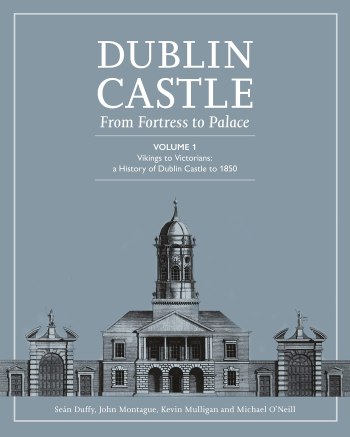 This is the first of a three-volume series dedicated to Dublin Castle and the archaeological excavations carried out there. Volume 1 presents a history of Dublin Castle, covering the period from the first Viking settlement in the ninth century to 1850. The castle was the centre of English (and later British) royal government in Ireland from the 1170s until it was handed over to the Provisional Government of Ireland in 1922. A large early thirteenth-century castle, built on the orders of King John, stood on the site until it was gradually replaced between the 1680s and the 1770s by the present quadrangle of palatial buildings. The only intact portion of the medieval castle to survive this rebuilding is the large, circular south-east corner tower, known today as the Record Tower. It is the first substantial history of the castle to be published and is intended to provide a comprehensive historical background to the results of archaeological excavations undertaken between 1961 and 1987.
Conference | Rereading Constable
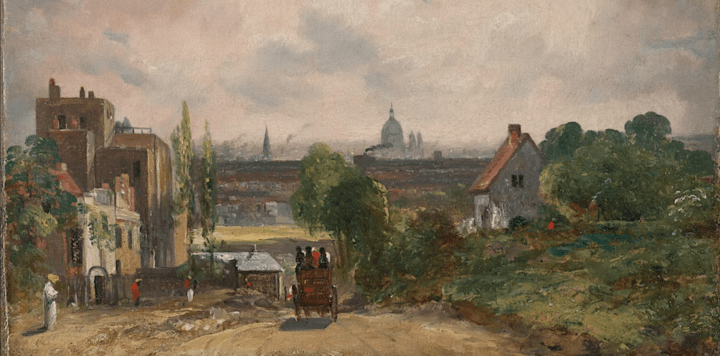
John Constable, Sir Richard Steele’s Cottage, Hampstead, 1831–32, oil on canvas, 21 × 29 cm
(New Haven: Yale Center for British Art, Paul Mellon Collection, B2001.2.25)
◊ ◊ ◊ ◊ ◊
From PMC:
Rereading Constable: Letters, Life, and Art
In-person and online, Paul Mellon Centre, London, 2 December 2022
Organized by Stephen Daniels and Mark Hallett
How do artists’ letters articulate professional and personal affiliations, embody networks, and forge allegiances? What role has letter writing played in artistic self-fashioning? In what ways do letters serve as a form of art-historical evidence, and help us understand works of art themselves?
R.B. Beckett’s multi-volume edition of Constable’s correspondence, published in six volumes by the Suffolk Records Society (1962–68), has long been recognised as an invaluable source for scholars working on the artist, and for all those interested in British art and culture in the late Georgian period. The published correspondence shows the painter to have been a shrewd, skilled writer, versed in a variety of literary, scientific, and biblical texts. His correspondents were, in turn, often highly articulate writers, including many family members, and many more with very different characters and backgrounds. Often utilised by art historians, the correspondence has more recently attracted the interest of scholars interested in the literary character and rhetorical conventions of nineteenth-century correspondence, who have subjected Constable’s letters to new kinds of critical scrutiny. This event will build on this important work, exploring Romantic art, culture, and society through the prism provided by the landscape painter’s correspondence.
The central structuring concept of this interdisciplinary conference is that speakers will focus on a single letter written by the artist, his correspondents, or other contemporary figures whose work, life, or letters can be understood in productive relation to Constable himself. These individual letters will be used to open up new questions and arguments about Constable’s life, practice, and identity as a painter, and about the wider artistic, literary, religious, and political cultures of his era.
Rereading Constable: Letters, Life, and Art has been organised as part of the PMC’s Generation Landscape research project. The conference is being convened by Stephen Daniels and Mark Hallett. Book tickets here.
We are offering up to five bursaries to support individuals who may not otherwise be able to attend the conference. Bursaries will cover the ticket price, travel, and some expenses, including childcare. If you would like to be considered for a bursary please email events@paul-mellon-centre.ac.uk with Rereading Constable Bursary in the subject field, outlining your request for a supported place by 10am, Friday, 4 November 2022.
P R O G R A M M E
9.30 Introduction by Mark Hallett (Paul Mellon Centre) and Stephen Daniels (University of Nottingham)
10.00 Session 1 | Chair: Stephen Daniels
• Alexandra Harris (University of Birmingham), New Friends, New Scenes: Constable in the Arun Valley
• Amy Concannon (University of York and Tate Britain), Strengthening Ties and Gaining Esteem: Constable Writes to Wordsworth, 15 June 1836
11.00 Tea and Coffee Break
11.30 Session 2 | Chair: Martin Postle (Paul Mellon Centre)
• Emma Roodhouse (Art Curator and Researcher), An Evening’s Amusement: Portraits, Writing, and Other Oddments from the Mason Family Album
• Sarah Cove (The Constable Research Project), A Regency ‘Nip-and-Tuck’: Constable’s Treslove Portraits Rediscovered
12.30 Lunch (provided by PMC)
Constable material available to view in the Public Study Room
1.30 Session 3 | Chair: Mark Hallett
• Morna O’Neill (Wake Forest University), John Constable, David Lucas, and Artistic Identity
• Katharine Martin (V&A and the University of Sussex), Translations and Fraught Relations: English Landscape and the Language of Collaboration
2.30 Break
2.45 Session 4 | Chair: Sarah Victoria Turner (Paul Mellon Centre)
• Gillian Forrester (Independent Scholar), ‘Solemnity, Not Gaiety’: Language and the Production of Meaning in Constable’s English Landscape Scenery
• Elenor Ling (The Fitzwilliam Museum), The ‘Definition of our Book’: John Constable, David Lucas, and their English Landscape
3.45 Tea and Coffee Break
4.15 Session 5 | Chair: Sria Chatterjee (Paul Mellon Centre)
• Rhian Addison McCreanor (University of York and Tate Britain), Repairing the House with a Thorough Painting: Reimagining 63 Charlotte Street
• Nicholas Robbins (University College London), The Life Academy and the Origins of Landscape
5.15 Panel Discussion
Stephen Daniels (University of Nottingham), Martin Myrone (Paul Mellon Centre), Trev Broughton (University of York), and Timothy Wilcox (Independent Scholar)
5.55 Closing Remarks by Mark Hallett
6.00 Drinks Reception
Exhibition | Maria Hadfield Cosway
Now on view at the Fondazione Maria Cosway in Lodi, in the nineteenth-century rooms of the Collegio delle Grazie, the girls’ school that Cosway founded in 1812 (with additional information available here) . . .
Maria Hadfield Cosway
Fondazione Maria Cosway, Lodi, 23 September — 27 November 2022
Curated by Monja Faraoni and Laura Facchin with Massimiliano Ferrario and Maria Cristina Loi
 Oltre cinquanta opere tra dipinti, lettere, spartititi musicali e sculture che ripercorrono la vita di Maria Hadfield Cosway (1760–1838) sono esposti a Lodi nella mostra a lei dedicata visitabile fino al 27 novembre.
Il visitatore sarà accompagnato nel percorso da pannelli esplicativi e didascalie che mettono in luce le fasi essenziali della biografia dell’artista e filantropa, nonché i personaggi e gli eventi della “Grande Storia” che segnarono le diverse fasi della sua vita. L’artista e donna di cultura è molto nota sia a Londra che negli Stati Uniti d’America per la sua amicizia con Thomas Jefferson, terzo Presidente USA. Un periodo della sua vita lo trascorse anche a Lodi, dove morì nel 1838.
La sua profonda convinzione nell’importanza dell’educazione per i giovani portò Maria Cosway ad aprire proprio a Lodi, nella sede dell’ex convento dei padri Minimi, il collegio della Beata Vergine Maria delle Grazie, destinato alle bambine dai 6 ai 12 anni, che ospiterà anche Vittoria Manzoni.
La mostra è stata organizzata dalla Fondazione Maria Cosway e vede la collaborazione di diverse realtà locali tra cui due istituti lodigiani, il liceo artistico Callisto Piazza e la Fondazione Luigi Clerici. Studenti ed insegnanti sono stati coinvolti nella creazione del catalogo e dell’allestimento delle diverse tappe dell’esposizione, visitabile presso la sede della Fondazione di via Paolo Gorini 10.
Monja Faraoni, Laura Facchin, Massimiliano Ferrario, and Maria Cristina Loi, eds., Maria Hadfield Cosway (Lodi: Fondazione Maria Cosway, 2022), 444 pages, ISBN: 979-1280950208.
S O M M A R I O
Presentazioni istituizionali
Maria Cosway tra Firenze, Londra, Parigi e Lodi: Le Ragioni della Mostra
• L’educazione in età napoleonica — Mario Riberi
• Maria Cosway in London, 1780–1790 and 1794–1801 — Stephen Lloyd
• ‘I am susceptible and everything that surrounds me has great power to magnetise me’: Maria Cosway e l’ambiente romantico — Massimiliano Ferrario
• Maria Cosway et l’ambiente artistico-letterario femminile fra la fine dell’Antico Regime e la Restaurazione — Laura Facchin
• Maria Cosway, Leonardo e Giuseppe Bossi: fra teorie artistiche e appunti figurativi — Rosalba Antonelli
• La musica nella vita e nel progetto educativo di Maria Cosway — Patrizia Fiorio
• Una storia ancora da raccontare: la biblioteca della Fondazione Maria Cosway — Francesco Laghezza e Beatrice Porchera
• La moda nella Parigi et nella Milano di Maria Cosway — Silvia Mira
• La vita di Blevio — Laura Facchin e Massimiliano Ferrario
• Un titolo nobitare per Maria Cosway — Luca Marcarini
• Gaetano Manfredini: ‘volente scultore pei quale l’ingiusta sorte non ha benigni sorris!’ e l’eterno volto di Maria Cosway — Beatrice Bolandrini
Catalogolo delle opere
Maria Cosway et gli Stati Uniti, a cura di Maria Cristina Loi
• ‘But that immense sea, makes it a great distance’: note sui carteggio Maria Cosway–Thomas Jefferson — Maria Cristina Loi
• Thomas Jefferson and Maria Cosway in Paris: art and affection — Susan R. Stein
Catalogo delle opere
L’allestimento della mostra Maria Hadfield Cosway — Elena Amoriello, Luca Armigero, Annalisa Aversa, Maria Teresa Carossa, Chiara Lupi, Susanna Marinoni e Angela Mento
Bibliografia
Indice dei nomi
Credit fotografici










 Enfilade
leave a comment