Online Database | Shakespeare in the Royal Collection

The Shakespeare in the Royal Collection (ShaRC) project is delighted to announce its fully searchable database of Shakespeare-related objects is now available online, at https://sharc.kcl.ac.uk/objects
The database comprises nearly 1,800 prints, drawings, photographs, paintings, books, decorative art objects, and Shakespeare-themed miscellanea, along with a range of digitised archival materials from the Royal Archives (including letters, diary entries, bills, and inventories, amongst others). It can be searched by a number of filters, including date and method of acquisition, as well as through a free-text field. Objects are accompanied by a short catalogue entry, written from an inter-disciplinary perspective, covering their history, their relationship to Shakespeare and to the historical royal family and, where known, the circumstances of their acquisition.
Shakespeare in the Royal Collection is a three-year AHRC-funded research project led by King’s College London, in collaboration with Birkbeck University of London and The Royal Collection Trust. It investigates the Shakespeare-related holdings in the Royal Collection and Royal Archives, 1714–1945, and provides new information about a broad range of objects created, collected, and displayed by generations of members of the royal family.
Online Workshop | Insects and Colours between Art and Natural History
From ArtHist.net:
Insects and Colours between Art and Natural History
Online, 29–30 November 2021
Organized by V. E. Mandrij and Giulia Simonini
This two-day online workshop addresses the issue of recording colours in entomology during the 17th and 18th centuries. Because of the bewildering variety of insect colours, artists and naturalists had difficulty describing and reproducing them with pigments. Some early modern scholars disapproved of using colours to depict insects in entomological illustrations. Other naturalists instead collaborated with artists to document the colours and shapes of insects.
Centuries later, this cooperation continues. Although irrelevant for the study of their anatomy, colour was significant for the identification of different species. However, artists and naturalists had different ways of tackling the problem of recording the appearances and names of the chromatic variety that exists in the insect world. Despite the variety of approaches and techniques used or proposed to record the colors of insects, this issue has not received the scholarly attention it deserves.
This workshop investigates the relationship between colours and insect images and aims to answer questions such as: Why in entomology, more than in any other discipline, were so many different approaches developed to address the problem of recording colours? Why did painters and scholars not agree on one unique method? To what extent did their subjectivity play a role in their choice of approach?
Speakers from several fields will discuss the topic of recording the colours of insects in art and natural history. They will touch on topics such as the significance of entomology in the development of color standardization practices, new artistic techniques (such as lepidochromy) and optical theories.
To attend the online workshop and receive the zoom-link, please register by emailing the organisers Giulia Simonini (giulia.simonini[at]tu-berlin.de) and V.E. Mandrij (v.e.mandrij[at]uni-konstanz.de). The maximum number of participants is 40. Listed times correspond with Central European Time (CET).
M O N D A Y , 2 9 N O V E M B E R 2 0 2 1
14.00 Zoom room opens
14.15 Introduction
Giulia Simonini (she) and V. E. Mandrij (they), Translating Natural Colours of Insects
15.00 Break
15.10 Depicting Insects and Colouring Practices
Panellist: Florike Egmond
• Erma Hermens, Painting Insects in 17th-Century Netherlands: Written Instruction and Practice
• Giulia Simonini, Painting by Numbers and Entomology
• Beth Tobin, Colouring Drawings of Insects at Home and Abroad
17.10 Break
17.20 Colours of Insects
Panellist: Hanneke Grootenboer
• Kay Etheridge, The Biology of Colour
18.00 Break
18.10 Aperitivo
T U E S D A Y , 3 0 N O V E M B E R 2 0 2 1
14.00 Zoom room opens
14.05 Entomologists and Colours
Panellist: Friedrich Steinle
• Katharina Schmidt-Loske, Observation and Depiction: Maria Sibylla Merian’s Individual Style of Drawing Insects and Plants
• Stefanie Jovanovic-Kruspel, The Somber and Opaque Colors of Butterflies: Schiffermüller and His Attempt of a Colour System
15.25 Break
15.35 Lepidochromy
Panellist: Karin Leonhard
• V.E. Mandrij, ‘Butterflies Truer-to-nature than Paintings’: Colours in Lepidochromy Technique
• Grace Touzel, Lepidochromy at the Natural History Museum (London): Butterfly Wings as a Printing Medium
16.55 Break
17.05 Colours of Insects
Panellist: Hossein Rajaei
• Brian Ogilvie, Catching the Rainbow: Iridescent Insects Before Iridescence
17.45 Break
18.00 Final Discussion with Dominik Hünniger
Resource | Price Guide for Period Frames
From the press relase (via Art Daily) . . .
 Eli Wilner & Company has announced that the Price Guide for American and European Period Frames will be made available as a free download. The decision was reached in response to tremendous interest being shown by collectors in donating their antique frames to nonprofit cultural institutions, and in response to requests from numerous art insurance brokers for the Price Guide to be more widely available. The book is a unique reference tool, with particular value to collectors, museum professionals, academic scholars, and appraisers.
Formerly priced at $795, the current edition of the Price Guide for American and European Period Frames was released in late 2020, and constitutes a completely updated and revised version of Wilner’s first edition published in 1995 by Avon Books. The book includes a new collection of over 100 period frame images, along with descriptions and retail pricing. The prices are based on retail frame sales by Eli Wilner & Company, with a sample paid invoice featured at the beginning of each section of the book. The increasing rarity of period frames of the quality showcased here, is reflected in the high prices that these objects can fetch in a retail market. The finest examples of period frames have been sold in the marketplace for hundreds of thousands of dollars. One collector is known to have spent nearly $10 million forming a period frame collection.
As a specialist in period framing for nearly 40 years, Eli Wilner has completed over 15,000 framing projects for private collectors as well as more than 100 institutions. The Wilner gallery is held in high regard by both institutions and private collectors for our expertise, extensive inventory, and superior quality of craftsmanship. This regard and confidence is evidenced by clients such as The White House, The Metropolitan Museum of Art, the Detroit Institute of Arts, Yale University Art Gallery, and many private individuals. In 2019, Eli Wilner & Company was honored by the Historic Charleston Foundation with the Samuel Gaillard Stoney Conservation Craftsmanship Award, for their work in historic picture frame conservation.
The Price Guide for American and European Period Frames is available for download as a PDF file here»
At Christie’s | Paintings and Drawings from the Marcille Collection

Lot 7: Jean-Siméon Chardin, La Fontaine (Water Urn), detail, ca. 1730s, oil on canvas, 50 × 43 cm (estimate €5–8million).
◊ ◊ ◊ ◊ ◊
From the press release (via Art Daily) for the auction:
De Chardin à Prud’hon, Tableaux et Dessins Provenant des Collections Marcille, Sale 20722
Christie’s Paris, 22 November 2021
Christie’s France—in collaboration with the auction house Tajan—presents an important group of paintings and drawings from the Marcille Collection, one of the most far-sighted collections of 18-century French art assembled in the 19th century. Initiated by François Marcille (1790–1856), and continued by his two sons Camille (1816–1875) and Eudoxe (1814–1890), the collection came to include some 4,600 paintings and other works. Although the collection was dispersed by inheritance within the family, collectors will now be able to acquire 27 works, including several masterpieces from major artists of the 18th and early 19th centuries, artists such as Jean-Siméon Chardin, Maurice-Quentin de la Tour, Théodore Gericault, Charles Coypel, and Pierre-Paul Prud’hon. The sale is estimated at between €5.7 million and €9.1 million.
Pierre Etienne, Director of the Department of Old Master Paintings: “There are names of collectors that are true stamps, labels of quality. The name Marcille evokes the excellence of the French 18th century, and even more vigorously for Chardin, La Tour, and Prud’hon.”
The Goncourts said of Camille Marcille that one should “study Chardin [at his home] to do full justice to the painter.” In 1979, at the time of the monographic exhibition of Chardin at the Grand Palais, the Marcille family loaned 22 of his paintings, including a superb genre scene representing a Woman at the Water Urn (estimate €5,000,000–8,000,000)—a work that entered the Marcille collection in 1848 and contributed to the rediscovery of Chardin in the 19th century through its inclusion in the first French exhibition devoted to the artist in 1860. Théophile Gautier was impressed by this very original work and wrote that it showed “what no one had ever talked about.” Chardin, not included in the canon of his time, preferred poetic scenes of everyday life to the more frivolous portraits of the century and came to be described as the ‘French Vermeer’. Chardin’s genre scenes were the most sought after and extremely rare on the market. Fontaine is one of the very first genre scenes in which Chardin fully reveals himself. Several museums have versions of the painting, including the first one, (on panel) from the Salon of 1737, at Stockholm’s Nationalmuseum and a version at the Toledo Museum of Art. The one from the Marcille Collection is the last in private hands and has not appeared on the market since 1848.

Lot 8: Jean-Siméon Chardin, L’hiver, à l’imitation de bas-relief d’après Edmé Bouchardon, 1776, oil on canvas, 55 × 88 cm (€80,000–120,000)
◊ ◊ ◊ ◊ ◊
Another painting by Chardin, Winter, in Imitation of Bas-relief after Edmé Bouchardon (estimate €80,000–120,000), will also be part of the sale. It attests to the Marcille family’s passion for the painter as well as to Chardin’s mastery of trompe l’oeil. The sale also features works acquired by Camille and Eudoxe Marcille—both of whom worked as curators, of the Chartres and Orléans museums respectively—in particular, an animated landscape by Hubert Robert (Lot 4: Waterfall Landscape with a Bridge, estimate €30,000–50,000) and two portraits by Nattier’s brilliant pupil, Louis Tocqué.
 A fine group of ten sheets by Pierre-Paul Prud’hon is included in the drawings section of the sale. The Marcilles had a particular passion for this neoclassical artist who gave drawing a prominent place in his work, typically combining black and white chalk on blue-grey paper. The ensemble illustrates the diversity and iconographic richness of the artist’s drawings. Among the highlights are portraits, including that of Baroness Alexandre de Talleyrand at the Age of Seven (estimate €25,000–35,000) and a Head of Napoleon in a Medallion, which was later engraved by Alexandre Tardieu (€20,000–30,000). Finally, Prud’hon’s commitment to the Empire is reflected in the collection by a Design for the Cradle of Roi de Rome (estimate €25,000–35,000), later created by Philippe Thomire and Odiot and now in the Schatzkammer in Vienna, along with a Design for a Chair for Empress Marie-Louise (estimate €12,000–18,000).
New Book | The Oxford Handbook of History and Material Culture
From Oxford UP:
Ivan Gaskell and Sarah Anne Carter, eds., The Oxford Handbook of History and Material Culture (Oxford: Oxford University Press, 2020), 680 pages, ISBN: 978-0199341764, $150.
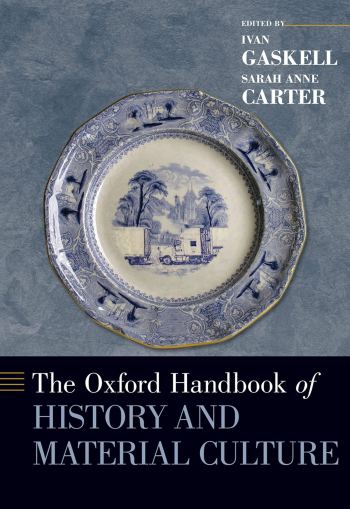 The past has left a huge variety of traces in material form. If historians could figure out how to make use of them to create accounts of the past, a far greater range of histories would be available than if historians were to rely on written sources alone. People who do not appear in writings could come into focus; as could the concerns of people that have escaped writing but whose material things belie their desires and actions. This book explores various ways in which aspects of the past of peoples in many times and places otherwise inaccessible can come alive to the material culture historian. It is divided into five thematic sections that address history, material culture, and—respectively—cognition, technology, symbolism, social distinction, and memory. It does so by means of six individually authored case studies in each section that range from pins to pearls, Paleolithic to Punk.
Ivan Gaskell is Professor of Cultural History and Museum Studies at Bard Graduate Center, New York City. Sarah Anne Carter is Visiting Executive Director of the Center for Design and Material Culture, and Visiting Assistant Professor in Design Studies at the University of Wisconsin-Madison.
C O N T E N T S
List of Contributors
Acknowledgments
Introduction: Why History and Material Culture?
I History, Material Culture, and Cognition
• Words or Things in American History? — Steven Conn
• Artifacts and Their Functions — A. W. Eaton
• Mastery, Artifice, and the Natural Order: A Jewel from the Early Modern Pearl Industry — Mónica Domínguez Torres
• Food and Cognition: Henry Norwood’s A Voyage to Virginia — Bernard L. Herman
• On Pins and Needles: Straight Pins, Safety Pins, and Spectacularity — Amber Jamilla Musser
• Mind, Time, and Material Engagement — Lambros Malafouris and Chris Gosden
II History, Material Culture, and Technology
• Material Time — John Robb
• Remaking the Kitchen, 1800–1850 — J. Ritchie Garrison
• Boston Electric: Science by ‘Mail Order’ and Bricolage at Colonial Harvard — Sara J. Schechner
• Making Knowledge Claims in the Eighteenth-Century British Museum — Ivan Gaskell
• The Ever-Changing Technology and Significance of Silk on the Silk Road — Zhao Feng
• Science, Play, and the Material Culture of Twentieth-Century American Boyhood — Rebecca Onion
III History, Material Culture, and the Symbolic
• The Sensory Web of Vision: Enchantment and Agency in Religious Material Culture — David Morgan
• Sensiotics, or the Study of the Senses in Material Culture and History in Africa and Beyond — Henry John Drewal
• The Numinous Body and the Symbolism of Human Remains — Christopher Allison
• Symbolic Things and Social Performance: Christmas Nativity Scenes in Late Nineteenth-Century Santiago de Chile — Olaya Sanfuentes
• Heritage Religion and the Mormons — Colleen McDannell
• From Confiscation to Collection: The Objects of China’s Cultural Revolution — Denise Y. Ho
IV History, Material Culture, and Social Distinction
• Persons and Things in Marseille and Lucca, 1300–1450 — Daniel Lord Smail
• Cloth and the Rituals of Encounter in La Florida: Weaving and Unraveling the Code — Laura Johnson
• Street ‘Luxuries’: Food Hawking in Early Modern Rome — Melissa Calaresu
• Ebony and Ivory: Pianos, People, Property, and Freedom on the Plantation, 1861–1870 — Dana E. Byrd
• The Material Culture of Furniture Production in the British Colonies — Edward S. Cooke Jr.
• Material Culture, Museums, and the Creation of Multiple Meanings — Neil G. W. Curtis
V History, Material Culture, and Memory
• Chronology and Time: Northern European Coastal Settlements and Societies, c. 500–1050 — Christopher Loveluck
• Materialities in the Making of World Histories: South Asia and the South Pacific — Sujit Sivasundaram
• Mapping History in Clay and Skin: Strategies for Remembrance among Ga’ anda of Northeastern Nigeria — Marla C. Berns
• Remember Me: Sensibility and the Sacred in Early Mormonism — Laurel Thatcher Ulrich
• Housing History: The Colonial Revival as Consumer Culture — Thomas Denenberg
• Collecting as Historical Practice and the Conundrum of the Unmoored Object — Catherine L. Whalen
Conclusion: The Meaning of Things
Index
Exhibition | Julie Green: The Last Supper
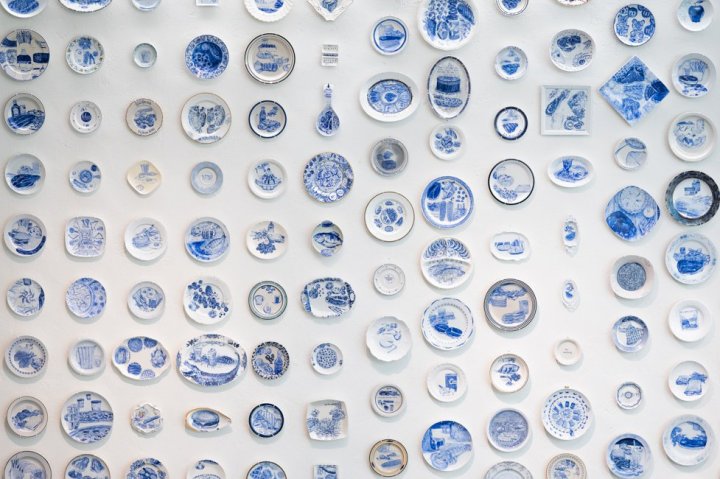
Installation view of Julie Green’s Last Supper exhibition, Bellevue Arts Museum.
◊ ◊ ◊ ◊ ◊
As noted by many news outlets—including The Art Newspaper, The Washington Post, the Smithsonian Magazine, The New York Times, and NPR (with an editorial by Scott Simon)—the artist Julie Green (1961–2021) died on October 12 at age 60, after battling ovarian cancer. An exhibition of 800 plates by Green is currently installed in Bellevue, Washington. While the ‘content’ of the project (the catalogue of inmates’ last meals) understandably receives the bulk of the attention, I imagine it’s impossible for most dixhuitièmistes not to see the long tradition of blue-and-white ware adaptation; and once a viewer goes there, the plates provide an indicting reminder of the historical origins of the inequities of the American criminal justice system, inequities in many cases derived from seventeenth- and eighteenth-century institutions. –CH
Julie Green: The Last Supper
Bellevue Arts Museum, 4 September 2020 — 23 January 2022
800 Plates Illustrating Final Meals of US Death Row Inmates
Growing up, I admired quilts and ceramics in our Iowa home, as well as the larger-than-life historical figures and 20’ American flag made with ears of colored corn in a neighbor’s yard. Appreciation for homemade and handmade led me to paint blue food. I once shared my family’s support of Nixon and capital punishment. Now I don’t.
Oklahoma has higher per capita executions than Texas. I taught there, and that is how I came to read final meal requests in the morning paper. The Last Supper illustrates the meal requests of U.S. death row inmates. Cobalt blue mineral paint is applied to second-hand ceramic plates, then kiln-fired to 1,400 degrees by technical advisors Toni Acock and Sandy Houtman.
Of the 1,521 US executions to date, 570 occurred in Texas, the only state that doesn’t allow a final meal selection. In Texas, inmates are served the standard prison meal of the day. In states that allow a choice, traditions and restrictions vary. There is no alcohol allowed anywhere. Cigarettes are officially banned but sometimes granted. Most selections are modest. This is not surprising, as many are limited to what is in the prison kitchen. Others provide meals from local venues. Pizza Hut, Wendy’s, and Long John Silver’s are frequently selected in Oklahoma, where their fifteen-dollar allowance is down from twenty in the late 1990s. California allows restaurant take-out up to fifty dollars. Historical menus from Folsom prison, shared by April Moore, point to the 733 inmates on death row today in California. State and date of execution are listed for each plate.
While looking for a permanent home for the project, unless capital punishment ends soon, I will continue until there are 1,000 plates. For me, a final meal request humanizes death row. Menus provide clues on region, race, and economic background. A family history becomes apparent when Indiana Department of Corrections adds, “He told us he never had a birthday cake so we ordered a birthday cake for him.”
Art can be a meditation. Why do we have this tradition of final meals, I wondered, after seeing a 1999 request for six tacos, six glazed donuts, and a cherry Coke. Twenty-one years later, I still wonder.
Julie Green
8 August 2020
The Snite Receives Long-Term Loans of Spanish Colonial Art
From the press release (26 October 2021) . . .

Unidentified artist, Virgin of the Immaculate Conception with Saints, Angels, and Indigenous Donor, 18th century, oil and gold on canvas (Carl & Marilynn Thoma Art Foundation; photo by Jamie Stukenberg).
The Snite Museum of Art at the University of Notre Dame installed recent loans from the internationally renowned Carl & Marilynn Thoma Art Foundation. Three paintings dating from the seventeenth and eighteenth centuries, drawn from the Foundation’s extraordinary holdings, complement the Museum’s existing collection of Spanish Colonial works to expand our understanding of the period.
This new loan follows an earlier one from the Thoma Foundation of thirteen works that were shown in the 2020 exhibition Divine Illusions: Statue Paintings from Spanish Colonial Peru, organized by Professor Michael Schreffler of the University of Notre Dame’s Department of Art, Art History & Design. In 2023 When the new Raclin Murphy Museum of Art debuts in 2023, the University will receive five different works from the Foundation to replace the three currently exhibited. Those loans are slated to extend through 2026.
“The Thoma family have become very good, trusted friends of the Museum. It is an honor to host masterpieces from their extensive collection that can be appreciated, studied, and nourish us all,” said Joseph Antenucci Becherer, director of the Snite Museum of Art.
“The paintings on loan from the Thoma Art Foundation are windows into a fascinating world of social interaction and Christian devotion in Spanish Colonial South America. Our students and all visitors to the Snite will benefit from the unique opportunity to study and reflect on these visually compelling works of religious art” notes Michael Schreffler, Professor of Art History at the University of Notre Dame.
Most paintings from colonial South America are unsigned. However, a few artists did sign their works, enabling experts to attribute unsigned works to their hands. One such known artist is Gregorio Vásquez de Arce y Ceballos (1638–1711), whose oeuvre is considerable. His Allegory of the Eucharist, which was probably based on an engraving, portrays the Catholic doctrine of transubstantiation in which the bread and wine of the Eucharist is transformed into the body and blood of Christ.
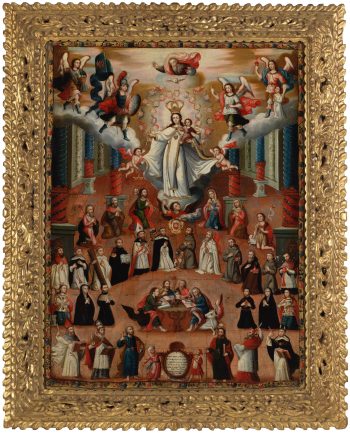
Cipriano de Toledo y Gutiérrez, Our Lady of Mercy with Saints, 1764, oil and gold on canvas (Carl & Marilynn Thoma Art Foundation; photo by Jamie Stukenberg).
This painting of the Virgin of the Immaculate Conception (depicted above) follows the traditional iconography of the central figure by showing the Virgin clothed in a white tunic covered by a blue mantle. Satan, as a serpent with a human face, lies vanquished on the ground. At the top of the canvas are the four Evangelists—Saints Matthew, Mark, Luke, and John—shown holding ribbons inscribed with four of the symbols of the Virgin’s immaculacy: the Tower of David, the Temple of Solomon, the City of God, and the Spotless Mirror. She is accompanied by a variety of saints. At lower right is a portrait of the donor, an indigenous woman who must have been a member of an important clan.
In 1997, the Thoma Foundation acquired a version of this subject, Our Lady of Mercy with Saints, that was dated 1771, but bore no signature. More recently, another version of the subject from 1764 was acquired by the Foundation. That painting, like yet another painting in a French private collection, is signed by Cipriano de Toledo y Gutiérrez. The existence of the three nearly identical paintings—with others possibly extant—tell us a great deal about the workshop practices of Cuzco painters. Although much has been written about works created for the art market, two of these three works were clearly commissioned by devotees of Our Lady of Mercy and the Mercedarian order. This multifigured composition may well have been based on an engraving.
Exhibition | The Way Sisters: Miniaturists of the Early Republic

Attributed to Mary Way, Dressed miniature portraits of a husband and wife of the Deshon family, ca. 1800, mixed media with fabrics and painted paper (Lyman Allyn Art Museum: Gift of Ursula and Gertrude Grosvenor, 1949.122 a & b).
◊ ◊ ◊ ◊ ◊
From the press release (28 October 2021) for the exhibition:
The Way Sisters: Miniaturists of the Early Republic
Lyman Allyn Art Museum, New London, Connecticut, 30 October 2021 — 23 January 2022
Curated by Tanya Pohrt with Brian Ehrlich
The Lyman Allyn Art Museum is pleased to mount a major new exhibition that presents the story and art of May Way (1769–1833) and Elizabeth (Way) Champlain (1771–1825), two sisters and artists from New London, Connecticut. The sisters were among the earliest professional women artists working in the United States. Opening 30 October 2021, The Way Sisters: Miniaturists of the Early Republic will be on view until 23 January 2022.
“This is the first museum exhibition to focus on the Way sisters, and it includes objects that have never been publicly exhibited,” said Dr. Tanya Pohrt, the exhibition’s curator. “These two women made important and lasting contributions to the art and history of Connecticut and a young nation. Their work deepens our understanding of early American art with objects and stories from the past that still resonate today.”
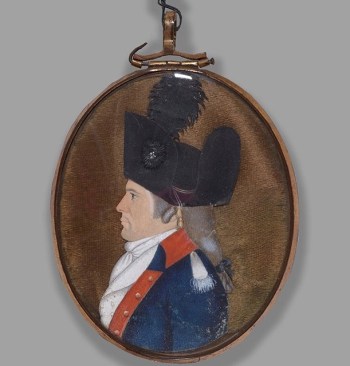
Mary Way, Portrait of Charles Holt (1772–1852), 1800, signed on verso, watercolor and fabric on paper applied to fabric (Private Collection, courtesy of Nathan Liverant & Son, LLC).
The women adapted their schoolgirl training in textiles to create collaged and painted portraits that pushed the boundaries of miniatures as an art form, while serving to expand gender roles for women. Mary Way began her career as a miniaturist around 1789 or 1790, producing painted and unique ’dressed’ portrait miniatures in profile with sewn and adhered fabric clothing that were unlike anything else made in America at the time.
Evidence suggests that Elizabeth (Way) Champlain, known as Betsey, also produced dressed and painted miniatures in roughly the same period. She remained in New London throughout her life and was active as a miniaturist until her sudden illness and death in 1825. Mary Way, who never married, moved to New York City in 1811, seeking new patrons and hoping to expand her artistic sphere. Facing stiff competition, she managed to eke out a living until she went blind in 1820 and was forced to return to New London, where her family supported her until her death in 1833.
Over the course of their careers, the Way sisters portrayed friends, relatives, and acquaintances, as well as a larger network of the mercantile elite from southeastern Connecticut. Telling a story of struggle and accomplishment, this exhibition traces what is known of the sisters’ artistic production, celebrating their stylistic and material innovations. It also examines the identities of their sitters, exploring New London’s history in the decades following the American Revolution.
On November 10, Pohrt and Brian Ehrlich, M.D., advisor to the exhibition, will give an in-person gallery talk. The lecture and reception begin at 5.30. The exhibition is made possible with support from Connecticut Humanities; the Department of Economic and Community Development, Office of the Arts; and an anonymous foundation.
The Lyman Allyn Art Museum welcomes visitors from New London, southeastern Connecticut, and all over the world. Established in 1926 by a gift from Harriet Allyn in memory of her seafaring father, the Museum opened the doors of its beautiful neo-classical building surrounded by 12 acres of green space in 1932. Today, it presents a number of changing exhibitions each year and houses a fascinating collection of over 17,000 objects from ancient times to the present: artworks from Africa, Asia, the Americas, and Europe, with particularly strong collections of American paintings, decorative arts, and Victorian toys and doll houses.
Brian Ehrlich, Catherine Kelly, D. Samuel Quigley, and Elle Shushan, The Way Sisters: Miniaturists of the Early Republic (New London: Lyman Allyn Art Museum, 2021), 100 pages, ISBN: 978-1878541086.
Exhibition | La Ménagerie de Chantilly
Now on view at the Château de Chantilly:
La Ménagerie de Chantilly
Château de Chantilly, 8 September 2021 — 3 January 2022
Curated by Florent Picouleau
 Archive material, books, plans, prints, and drawings provide a glimpse into a less well-known aspect of the history of the Château de Chantilly. The remarkable menagerie at Chantilly, with its collection of exotic animals, was one of the largest of its kind in the 17th and 18th centuries, rivaled only by that of Versailles.
À partir du Moyen Âge, posséder des animaux étrangers est un marqueur de richesse auquel prétendent, dès la Renaissance, les seigneurs de Chantilly. De la fin du XVIe siècle à celle du XVIIIe, le domaine appartient aux familles des Montmorency et des Bourbon-Condé. Pour se divertir et satisfaire leur curiosité, ils introduisent, d’abord dans le parc du château, puis dans l’une des plus extraordinaires ménageries du royaume, des animaux exotiques ou autochtones qui embellissent les jardins et valorisent l’image des propriétaires.
Les cheptels s’accroissent à tel point qu’à la fin du XVIIe siècle il apparaît indispensable de leur construire un lieu spécifique, une ménagerie au moins digne de celle de Louis XIV à Versailles. Point de convergence de la zoologie, de l’architecture animalière, de l’art, de la curiosité scientifique, elle s’inscrit pleinement, jusqu’à sa disparition amorcée en 1792, dans la vie culturelle et mondaine des XVIIe et XVIIIe siècles.
Dans le prolongement de l’exposition sur l’Orangerie de Chantilly proposée en 2017, le service des archives ressuscite désormais, au croisement de l’histoire, de l’histoire naturelle et de l’architecture, une autre partie du parc qui a, elle aussi, grandement contribué à la renommée du château et de ses propriétaires du XVIe au XVIIIe siècle.
Les visiteurs découvrent ainsi des documents rares ou inédits issus des archives et de la bibliothèque de Chantilly, du musée Condé, ou prêtés par la Bibliothèque de l’Institut de France et le Muséum national d’histoire naturelle. L’exposition leur dévoile les multiples sources du travail historique et la difficulté de la reconstitution.
Commissariat
Florent Picouleau, Chargé d’archives au musée Condé
The press packet (in French) is available as a PDF file here»
Florent Picouleau, La Ménagerie de Chantilly, XVIe–XIXe siècles (Dijon: Éditions Faton, 2021), 160 pages, ISBN: 978-2878443059, €35.
Exhibition | The King’s Animals

Now on view at Versailles:
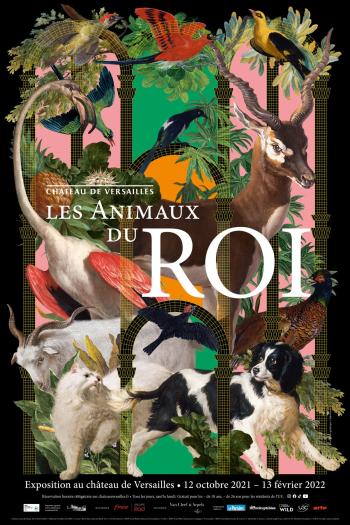
Les Animaux du Roi / The King’s Animals
Château de Versailles, 12 October 2021 — 13 February 2022
Curated by Alexandre Maral and Nicolas Milovanovic
From its location in the heart of a vast forest in the Île-de-France region, the Palace of Versailles has always fostered a dynamic relationship with the animal kingdom. From animals as objects to be studied or collected to those used as political attributes and symbols of power, the exhibition explores the bond between the court of Versailles and animals—whether ‘companion animals’ (primarily dogs, cats, and birds), exotic beasts, or ‘wild’ creatures. It also brings two long-lost areas of the estate back to life: the Royal Menagerie and the Maze. Once the pride and joy of Louis XIV’s gardens, they can still be admired today in drawings, paintings and testimonies from the period.
 The Royal Menagerie, which the Sun King had installed close to the Grand Canal, was home to the rarest and most exotic animals—from coatis to quaggas, cassowaries to black-crowned cranes (nicknamed the ‘royal bird’)—constituting an extraordinary collection in which the king took ever greater pride. The animals in the menagerie were also a great source of inspiration for the artists of the time: they helped Claude Perrault with his Histoire naturelle, as well as serving the Royal Academy of Sciences as subjects for dissections and, later, Louis XV and Louis XVI, in their naturalism pursuits.
In addition to decorative items from the interior of the menagerie—particularly the paintings by Nicasius Bernaerts—on display are well-known garden sculptures, such as those in the Latona Fountain and the Maze. The latter comprised no fewer than 300 animals made from lead, arranged into a scene from Aesop’s fables and depicting a vision of the world in which animals make political, often moralising, always educational, pronouncements. In all, 37 sculptures recovered from the erstwhile grove will be on display.
More information about the Labyrinth (in French) is available here»
As well as the actual animals that were collected and studied, animal symbolism was used to represent power. The exhibition illustrates the link between the establishment of Versailles as a seat of power—from the construction of the palace itself on the site of Louis XIII’s old hunting lodge—and animal symbolism. Part of the exhibition is devoted to the daily hunt—a key activity pursued by warrior kings in times of peace as a form of training and demonstration of power. The hunt, consequently, features prominently in royal iconography.
 The animals themselves will return in droves to Versailles, because they never disappeared completely. They live on in the work of the king’s top painters; from Bernaerts, Boel and Le Brun, to Desportes and Oudry, many artists produced portraits of these exotic, wild and more familiar animals. As well as paintings, on view are portraits woven by the Gobelins Manufactory plus animals that were dissected, engraved, then preserved at the Academy of Sciences and in the King’s Garden, which is now the National Museum of Natural History. The exhibition also includes the skin of the Asian elephant gifted to Louis XV, which was donated to the Pavia Museum by Napoleon, and the skeleton of the very first elephant at Versailles, which was presented to Louis XIV by the king of Portugal and lived at Versailles for 13 years.
Finally, the exhibition addresses the role at court of companion animals for both the royal family and courtiers. As is evident from many portraits, companion animals were present everywhere, enlivening the royal apartments and brightening up the daily lives of children and adults alike. Many of the sovereigns, such as Marie Lesczcynska, wife of Louis XV, chose to surround themselves with their favourite animals. The court’s interest in the animal world led to greater sensitivity towards animals, in direct contrast to the Cartesian theory of animal-machines. Madame Palatine and, later, Madame de Pompadour, were particularly passionate about them.
Exhibition Curators
• Alexandre Maral, Curator General, Head of the Sculpture Department of the Musée National des Châteaux de Versailles et de Trianon
• Nicolas Milovanovic, Head Curator of the Paintings Department of the Louvre Museum
Alexandre Maral and Nicolas Milovanovic, eds., Les Animaux du Roi (Paris: Lienart éditions / musée national des châteaux de Versailles et de Trianon, 2021), 464 pages, ISBN: 978-2359063455, 49€.










 Enfilade
leave a comment