New Book | Facing Georgetown’s History
From Georgetown UP:
Adam Rothman and Elsa Barraza Mendoza, eds., with a foreword by Lauret Savoy, Facing Georgetown’s History: A Reader on Slavery, Memory, and Reconciliation (Georgetown: Georgetown University Press, 2021), 368 pages, ISBN: 978-1647120962, $30.
 A microcosm of the history of American slavery in a collection of the most important primary and secondary readings on slavery at Georgetown University and among the Maryland Jesuits
Georgetown University’s early history, closely tied to that of the Society of Jesus in Maryland, is a microcosm of the history of American slavery: the entrenchment of chattel slavery in the tobacco economy of the Chesapeake in the seventeenth and eighteenth centuries; the contradictions of liberty and slavery at the founding of the United States; the rise of the domestic slave trade to the cotton and sugar kingdoms of the Deep South in the nineteenth century; the political conflict over slavery and its overthrow amid civil war; and slavery’s persistent legacies of racism and inequality. It is also emblematic of the complex entanglement of American higher education and religious institutions with slavery.
Important primary sources drawn from the university’s and the Maryland Jesuits’ archives document Georgetown’s tangled history with slavery, down to the sizes of shoes distributed to enslaved people on the Jesuit plantations that subsidized the school. The volume also includes scholarship on Jesuit slaveholding in Maryland and at Georgetown, news coverage of the university’s relationship with slavery, and reflections from descendants of the people owned and sold by the Maryland Jesuits.
These essays, articles, and documents introduce readers to the history of Georgetown’s involvement in slavery and recent efforts to confront this troubling past. Current efforts at recovery, repair, and reconciliation are part of a broader contemporary moment of reckoning with American history and its legacies. This reader traces Georgetown’s “Slavery, Memory, and Reconciliation Initiative” and the role of universities, which are uniquely situated to conduct that reckoning in a constructive way through research, teaching, and modeling thoughtful, informed discussion.
Adam Rothman is a professor in Georgetown University’s Department of History. He is the author of Beyond Freedom’s Reach: A Kidnapping in the Twilight of Slavery, which was named the Humanities Book of the Year by the Louisiana Endowment for the Humanities and received the American Civil War Museum’s book award. He is also the author of Slave Country: American Expansion and the Origins of the Deep South and the coauthor of Major Problems in Atlantic History. He served on Georgetown’s Working Group on Slavery, Memory, and Reconciliation in 2015-16, and is currently the principal curator of the Georgetown Slavery Archive. He was a Distinguished Visiting Scholar at the John W. Kluge Center at the Library of Congress in 2018, where he created the podcast African-American Passages: Black Lives in the 19th Century.
Elsa Barraza Mendoza is a PhD candidate in history at Georgetown University and the assistant curator of the Georgetown Slavery Archive. She is a former Fulbright-Garcia Robles fellow. Her research has been supported by the Cushwa Center for the Study of American Catholicism and the Omohundro Institute of Early American History and Culture. She is currently writing her dissertation on the history of slavery on Georgetown’s campus.
Lauret Savoy is the David B. Truman Professor of environmental studies at Mount Holyoke College, where she explores the marks of history on the land. The author of Trace: Memory, History, Race, and the American Landscape, she also descends from people enslaved by Jesuits.
C O N T E N T S
Acknowledgments
Editors’ Note
Foreword, Lauret Savoy
Introduction, Adam Rothman
Part 1 | History
Essays
1 Craig Steven Wilder, War and Priests: Catholic Colleges and Slavery in the Age of Revolution
2 Robert Emmet Curran, ‘Splendid Poverty’: Jesuit Slaveholding in Maryland, 1805–38
3 Elsa Barraza Mendoza, Catholic Slave Owners and the Development of Georgetown University’s Slave Hiring System, 1792–1862
4 James O’Toole, Passing: Race, Religion, and the Healy Family, 1820–1920
Documents
5 Enslaved People Named in a Deed, 1717
6 A Sermon on the Treatment of Slaves, 1749
7 Edward Queen Petitions for Freedom, 1791
8 Isaac Runs Away from Georgetown College, 1814
9 A Jesuit Overseer Calculates the Cost of Slave Labor, 1815
10 Baptism of Sylvester Greenleaf at Newtown, 1819
11 Fr. James Ryder, SJ, Criticizes Abolitionism, 1835
12 The Society of Jesus Sets Conditions on the Sale of the Maryland Slaves, 1836
13 Articles of Agreement between Thomas Mulledy, Henry Johnson, and Jesse Batey, 1838
14 A Jesuit Priest Witnesses Anguish at Newtown, 1838
15 Bill of Sale for Len, 1843
16 A Jesuit Priest Reports on the Fate of the Ex-Jesuit Enslaved Community in Louisiana, 1848
17 Aaron Edmonson, the Last Enslaved Worker at Georgetown, 1859–62
18 Labor Contract at West Oak Plantation, Iberville Parish, Louisiana, 1865
19 Photograph of Frank Campbell, ca. 1900
Part 2 | Memory and Reconciliation
Essays
20 Ira Berlin, American Slavery in History and Memory and the Search for Social Justice
21 Ta-Nehisi Coates, The Case for Reparations
22 Alondra Nelson, The Social Life of DNA: Racial Reconciliation and Institutional Morality after the Genome
The Working Group
23 Matthew Quallen, Slavery’s Remnants, Buried and Overlooked
24 Toby Hung, Student Activists Sit in outside DeGioia’s Office
25 Report of the Georgetown University Working Group on Slavery, Memory, and Reconciliation, to the President of Georgetown University
26 James Martin, SJ, How Georgetown is Coming to Terms with Slavery in Its Past
The GU272 Descendants
27 Rachel L. Swarns, 272 Slaves Were Sold to Save Georgetown. What Does It Owe Their Descendants?
28 Rachel L. Swarns and Sona Patel, ‘A Million Questions’ from Descendants of Slaves Sold to Aid Georgetown
29 Terry L. Jones, Louisiana Families Dig into Their History, Find They Are Descendants of Slaves Sold by Georgetown University
30 Cheryllyn Branche, My Family’s Story in Georgetown’s Slave Past
31 Rick Boyd, Many in Slave Sale Cited by Georgetown Toiled in Southern Maryland
Reconciliation and Reparation
32 Remarks of Sandra Green Thomas at Georgetown University’s Liturgy of Remembrance, Contrition, and Hope
33 Remarks of Fr. Timothy Kesicki, SJ, at Georgetown University’s Liturgy of Remembrance, Contrition, and Hope
34 Terrence McCoy, Her Ancestors Were Georgetown’s Slaves. Now, at Age 63, She’s Enrolled There-as a College Freshman
35 Marc Parry, A New Path to Atonement
36 Jesús A. Rodríguez, This Could Be the First Slavery Reparations Policy in America
37 Javon Price, Changing Perceptions on the GU272 Referendum
Epilogue, Elsa Barraza Mendoza
Timeline
Further Reading
Index
Emma’s Songbooks: Rediscovered Music for Nelson

Songbook once owned by Lady Hamilton, which has a cantata composed by G.G. Ferrari and dedicated to Lord Nelson
(Museum of London, 31.17/2)
◊ ◊ ◊ ◊ ◊
From the Museum of London:
Emma’s Songbooks: Rediscovered Music for Nelson
Online, Museum of London Docklands, recording available 21 December 2021 — 11 January 2022
In partnership with the Guildhall School of Music & Drama, the Museum of London Docklands brings to life songs dedicated to Horatio Nelson’s naval victories, recently rediscovered in Emma Hamilton’s songbooks by Museum of London librarian Lluis Tembleque Terés. Terés kicks off the event with a presentation on his finds and their historical context, after which Christopher Suckling, Head of Historical Performance at the Guildhall School of Music & Drama, will give an insight onto the music world at the beginning of the 19th century. Following the talks, performers from the School will play the four rediscovered pieces, along with a number of other relevant scores. Finally, Terés will show items from the Museum collections connected to Lady Hamilton and Lord Nelson—all in the immersive surroundings of the Museum of London Docklands.
Please note that this will be a recording of the live event, which took place on December 11. You will have seven days to access the recording from the date you select as part of the ticket purchase process.

Songbook once owned by Emma Hamilton, here shown by Museum of London librarian Lluis Tembleque Terés
(Museum of London, 31.17/2; photo by John Chase)
◊ ◊ ◊ ◊ ◊
From the press release (via Art Daily) . . .
A recording of an old sea song, one of four recently rediscovered pieces of music paying tribute to Nelson, has been released today by the Museum of London. Brought to life by musicians from Guildhall School of Music & Drama, it marks the first performance of the piece in over 200 years. The extraordinary discovery was made last year by Museum of London librarian Lluis Tembleque Teres who discovered it amongst songbooks belonging to Nelson’s lover, the actress and model Emma Hamilton.
It is thought the song was sung after the battle of Cape St Vincent (1797) and transcribed by Nelson after hearing it chanted by his crew. The lyrics have been known about since a letter from Nelson to William Douglas, 4th Duke of Queensberry, was sold at auction in 2013—the only other known reference to the song. The new discovery points to the addition of new music and a chorus by the Duke, a notorious society figure, whose reputation for gambling and horse racing has long overshadowed his musical ability. A personal friend of Emma Hamilton, his authorship of the piece is recorded in Emma’s own hand.
Lluis Tembleque Teres, librarian, Museum of London, said, “The song was written by Nelson’s crew in one of his early victories. It is fascinating how, some four years later and already a national hero, he recovers the lyrics and sends them to the Duke of Queensberry, almost as if showing off his early successes. The Duke then adds music and a chorus, and gifts the manuscript to Emma Hamilton, thus allowing us exactly 220 years later to relive Nelson’s fame while performing it.”
Dr Christopher Suckling, Head of Historical Performance at the Guildhall School of Music & Drama, said, “Equally as extraordinary is that a man of the Duke of Queensberry’s position should take the time and take the effort to compose at least two pieces of music in Nelson’s honour. That he should choose to express himself through this least gentlemanly of arts speaks to both his strength of feeling for Nelson and his sensibility towards the Admiral’s relationship with Emma Hamilton.”
The original manuscripts reflect the different manner in which music was experienced at the turn of the nineteenth century, its empty staves typical of a time when music could be played by any combination of available musicians. Amongst the upper classes, the function of domestic music was largely seen as a way to kill time and despite some contemporaries considering social music making to be the embodiment of morality, playing and composing was not held in high regard.
The release follows a special one-off live performance of all four songs at the Museum of London Docklands on 11th December, which will be available to watch in full as an online event starting Tuesday, 21 December 2021.
A free copy of the sea song is available for download here»
New Book | The Power of Pastiche
From Clemson UP, with distribution by Liverpool UP and OUP:
Alison DeSimone, The Power of Pastiche: Musical Miscellany and Cultural Identity in Early Eighteenth-Century England (Clemson: Clemson University Press, 2021), 336 pages, ISBN: 978-1942954774, $120 / £90.
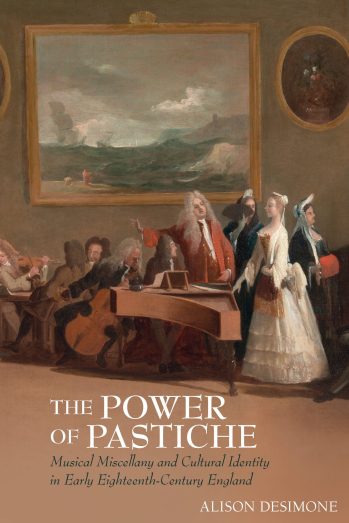 In eighteenth-century England, ‘variety’ became a prized aesthetic in musical culture. Not only was variety—of counterpoint, harmony, melody, and orchestration—expected for good composition, but it also manifested in cultural mediums such as songbook anthologies, which compiled miscellaneous songs and styles in single volumes; pasticcio operas, which were cobbled together from excerpts from other operas; and public concerts, which offered a hodgepodge assortment of different types and styles of performance. I call this trend of producing music through the collection, assemblage, and juxtaposition of various smaller pieces as musical miscellany; like a jigsaw puzzle (also invented in the eighteenth century), the urge to construct a whole out of smaller, different parts reflected a growing desire to appeal to a quickly diversifying England. This book explores the phenomenon of musical miscellany in early eighteenth-century England both in performance culture and as an aesthetic. Musical miscellany, in its many forms, juxtaposed foreign and homegrown musical practices and styles in order to stimulate discourse surrounding English musical culture during a time of cosmopolitan transformation.
Alison DeSimone is Assistant Professor of Musicology at the University of Missouri-Kansas City. She co-edited, with Matthew Gardner, Music and the Benefit Performance in Eighteenth-Century Britain (Cambridge University Press, 2019). She has published articles in the A-R Online Anthology, Händel-Jahrbuch, and Early Modern Women. Her article “‘Equally Charming, Equally Too Great’: Female Rivalry, Politics, and Opera in Early Eighteenth-Century London” won the 2018 Ruth Solie Prize for an Outstanding Article on British Music from the North American British Music Studies Association. She is currently an associate editor of The Eighteenth Century: Theory and Interpretation.
C O N T E N T S
Acknowledgments
List of Figures
List of Musical Examples
List of Tables
Introduction
1 The Performance of Miscellany in Variety Concerts, 1700–1711
2 ‘An Assemblage of Every Kind’: The Pasticcio Opera Tradition as Miscellany
3 Shaping English Identity in the Songbook iscellany
4 Composition, Cosmopolitanism, and Musical Miscellany
5 Variety in Criticism and Aesthetics in Eighteenth-Century England
Notes
Index
New Book | Echo’s Chambers: Architecture and the Idea of Acoustic Space
From the University of Pittsburgh Press:
Joseph Clarke, Echo’s Chambers: Architecture and the Idea of Acoustic Space (Pittsburgh: University of Pittsburgh Press, 2021), 320 pages, ISBN: 978-0822946571, $60.
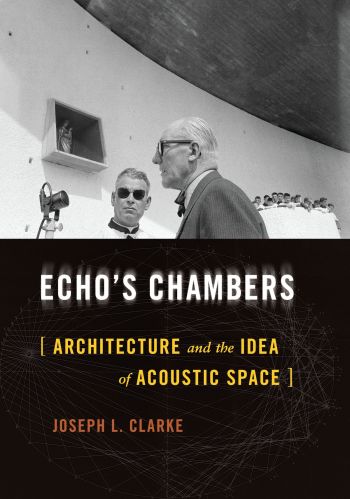 A room’s acoustic character seems at once the most technical and the most mystical of concerns. Since the early Enlightenment, European architects have systematically endeavored to represent and control the propagation of sound in large interior spaces. Their work has been informed by the science of sound but has also been entangled with debates on style, visualization techniques, performance practices, and the expansion of the listening public. Echo’s Chambers explores how architectural experimentation from the seventeenth through the mid-twentieth centuries laid the groundwork for concepts of acoustic space that are widely embraced in contemporary culture. It focuses on the role of echo and reverberation in the architecture of Pierre Patte, Claude-Nicolas Ledoux, Carl Ferdinand Langhans, and Le Corbusier, as well as the influential acoustic ideas of Athanasius Kircher, Richard Wagner, and Marshall McLuhan. Drawing on interdisciplinary theories of media and auditory culture, Joseph L. Clarke reveals how architecture has impacted the ways we continue to listen to, talk about, and creatively manipulate sound in the physical environment.
Joseph L. Clarke is assistant professor of art history at the University of Toronto and a licensed architect. His scholarship explores how modern architecture has defined itself as a discipline through particular techniques, theories, and representational conventions.
C O N T E N T S
Acknowledgments
Note on Translations
Introduction: ‘The Night Shall Be Filled with Music’
1 Domesticating Echo: Clamors in Print
2 Spaces Heard and Seen: Constructing Acoustic Naturalism
3 The Catacoustic Imagination: Enchantment by Immersion
4 Redeeming the Senses: The Acoustics of Total Art
5 Listening Out of Place: Modern Architecture and acoustique électronique
Conclusion: On Further Reflection
Notes
Bibliography
Index
New Book | Inessential Colors: Architecture on Paper
From Princeton UP:
Basile Baudez, Inessential Colors: Architecture on Paper in Early Modern Europe (Princeton: Princeton University Press, 2021), 288 pages, ISBN: 978-0691213569, $65.
 The first comprehensive account of how and why architects learned to communicate through color
Architectural drawings of the Italian Renaissance were largely devoid of color, but from the seventeenth century through the nineteenth, polychromy in architectural representation grew and flourished. Basile Baudez argues that colors appeared on paper when architects adapted the pictorial tools of imitation, cartographers’ natural signs, military engineers’ conventions, and, finally, painters’ affective goals in an attempt to communicate with a broad public.
Inessential Colors traces the use of color in European architectural drawings and prints, revealing how this phenomenon reflected the professional anxieties of an emerging professional practice that was simultaneously art and science. Traversing national borders, the book addresses color as a key player in the long history of rivalry and exchange between European traditions in architectural representation and practice.
Featuring a wealth of previously unpublished drawings, Inessential Colors challenges the long-standing misreading of architectural drawings as illustrations rather than representations, pointing instead to their inherent qualities as independent objects whose beauty paved the way for the visual system architects use today.
Basile Baudez is assistant professor of architectural history in the Department of Art and Archaeology at Princeton University. His books include Architecture et tradition académique and A Civic Utopia: Architecture and the City in France, 1765–1837.
C O N T E N T S
Introduction
Prologue: Architectures in Black and White
1 Imitative Colors
2 Conventional Colors
3 Affective Colors
Conclusion: The Anxiety of the Architect
Appendix: The Draftsman’s Tools
Acknowledgments
Notes
Bibliography
Index
Image Credits
Journal18, Fall 2021 — The ‘Long’ 18th Century?
From J18:
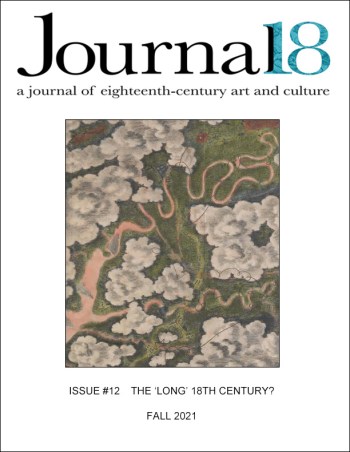
Journal18, Issue #12 (Fall 2021) — The ‘Long’ 18th Century?
Edited by Sarah Betzer and Dipti Khera
 A R T I C L E S
• Architectural ‘Worlding’: Fischer von Erlach and the Eighteenth-Century Fabrication of a History of Architecture — Sussan Babaie
• Enlightenment as Thought Made Public: Joshua Reynolds’s Portrait of a Black Man — Andrei Pop
• Britain, Empire, and Execution in the Long Eighteenth Century — Meredith Gamer
• Maritime Media in the Long Eighteenth Century — Maggie M. Cao
• Poq’s Temporal Sovereignty and the Innuit Printing of Colonial History — Bart Pushaw
C O N V E R S A T I O N S
• The Mughals, the Marathas, and the Refracted Long Eighteenth Century, A Dialogue — Chanchal Dadlani and Holly Shaffer
• Teaching the ‘Long’ Eighteenth Century, A Conversation and Resources — Eleanore Neumann, with Anna Arabindan-Kesson, Nebahat Avcıoğlu, Emma Barker, Sarah Betzer, Ananda Cohen-Aponte, Dipti Khera, Prita Meier, Nancy Um, and Stephen Whiteman
Issue Editors
Sarah Betzer, University of Virginia
Dipti Khera, New York University and Institute of Fine Arts
Cover image: Thomas Baldwin, Detail from A Balloon Prospect from Above the Clouds. Engraving, Plate III, from Airopaidia: Containing the Narrative of a Balloon Excursion (London,1786).
Exhibition | Les Adam: La Sculpture en Héritage
Now on view at the Musée des Beaux-Arts de Nancy:
Les Adam: La Sculpture en Héritage
Musée des Beaux-Arts de Nancy, 18 September 2021 — 9 January 2022
Curated by Pierre-Hippolyte Pénet and Guilhem Scherf
 Originally from Nancy, the Adam family is the largest dynasty of French sculptors of the 18th century. Over three generations, its members worked in Rome, Paris, Versailles, and Berlin in the service of the Pope and European monarchs such as Louis XV, Louis XVI, Frederick II of Prussia, and Catherine II of Russia. This the first retrospective devoted to them brings together one hundred masterpieces from national and international institutions as well as from private collections, bearing witness to the Adam family’s virtuosity at the heart of Europe during the Enlightenment.
Originaire de Nancy, la famille Adam est la plus grande dynastie de sculpteurs français du XVIIIe siècle. Sur trois générations, ses membres déploient leurs talents auprès des plus grands mécènes et participent à plusieurs chantiers majeurs. Formés en Lorraine dans le contexte d’essor artistique des règnes des ducs Léopold et Stanislas, Jacob Sigisbert Adam, ses trois fils Lambert Sigisbert, Nicolas Sébastien et François Gaspard ainsi que leurs neveux Sigisbert François, Pierre Joseph et Claude Michel dit Clodion, œuvrent à Rome, Paris, Versailles ou Berlin au service du pape et des monarques européens comme Louis XV, Louis XVI, Frédéric II de Prusse ou Catherine II de Russie. Première rétrospective à leur être consacrée, l’exposition réunit cent chefs-d’œuvre issus d’institutions nationales, internationales mais aussi de collections particulières. Permettant de dévoiler plusieurs sculptures prestigieuses inédites qui témoignent de la virtuosité de la famille Adam au cœur de l’Europe des Lumières, elle est accompagnée d’un catalogue de référence sur le sujet.
Commissariat: Pierre-Hippolyte Pénet, conservateur du patrimoine chargé des collections du XVe au XVIIIe siècle, palais des ducs de Lorraine – Musée lorrain, et Guilhem Scherf, conservateur général du patrimoine, adjoint au directeur du département des Sculptures, musée du Louvre.
The full press packet is available here»
Pierre-Hippolyte Pénet and Guilhem Scherf, eds., Les Adam: La Sculpture en Héritage (Paris: Snoeck Édition, 2021), 343 pages, ISBN: 978-9461616234 35€.
New Book | Enduring Presence: William Hogarth’s Afterlives
From Peter Lang:
Caroline Patey, Cynthia Roman, and Georges Letissier, Enduring Presence: William Hogarth’s British and European Afterlives, 2 vols. (Bern: Peter Lang, 2021), 674 pages, ISBN: 978-1800791558, £60 / $91.
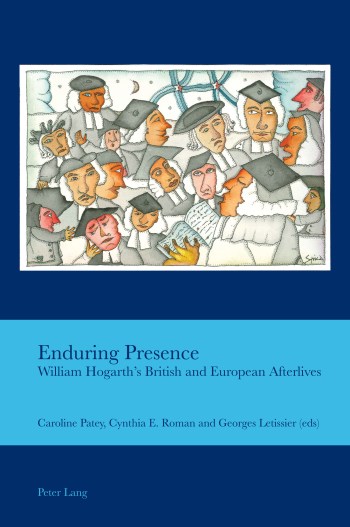 Long after his death in 1764, William Hogarth is still our contemporary. Far from leading a secluded existence in museums and academies, his legacy of vibrant images and provocative ideas remains a powerful source of inventiveness and inspiration for the artists of today, as once for those of yesterday, be it on page, stage, canvas, or digital formats.
After approaching the artist by way of his challenging aesthetic philosophy and his resistance to normative categories, this two-book set considers Hogarth’s pioneering sense of performativity, which has long made him the treasured interlocutor of actors and playwrights, from David Garrick to Bertolt Brecht, or Nick Dear. His work has permeated film, television, the graphic novel, art, and narrative, which all bear witness to his versatile and powerful use of images and its resonance in the modern and contemporary age. Brimming as it is with energy, plenty, affliction, entropy, and empathy, Hogarth’s contradictory universe of chaos and beauty is in tune with ours and resonates vividly with contemporary passions and struggles. The twenty-eight essays in this collection chart the teeming legacies of William Hogarth and explore the ways in which his works and ideas were and are revisited and appropriated in the UK and across Europe. For the eighteenth-century artist lives on as an unforgotten presence, whose invigorating and challenging memory energizes multiple expressive forms, including drama, visual arts, literature, film, graphic novels, and TV serials.
Caroline Patey is Professor of English Literature at the Università degli Studi in Milan, Italy. Her research interests include Renaissance culture, late Victorian literature, Modernism, and the interactions between art, museums, and literature. Cynthia E. Roman is Curator of Prints, Drawings, and Paintings at the Lewis Walpole Library, Yale University. Her research interests include the production, circulation, and collecting history of prints in eighteenth-century Britain. Georges Letissier is Emeritus Professor of English Literature at Nantes University, France. His field of speciality is nineteenth-century literature (Charles Dickens, George Eliot) and contemporary British fiction (Will Self, Graham Swift, Sarah Waters, and Jeanette Winterson).
British Art Studies, November 2021
The latest issue of BAS:
British Art Studies 21 (November 2021)
Redefining the British Decorative Arts, Guest Edited by Iris Moon

Michelle Erickson, Cauldron, from the series Ply-MYTH, 2019, wheel thrown with lifecast shell and industrial artifacts, made from indigenous North Carolina woodfired stoneware with copper wash, 16 × 19.5 inches (Collection of the artist). Additional information is available here»
“Decorative arts place pressure upon the hierarchies inherent in British aesthetics, and by extension British culture, from the enlightenment to the present day. The specters of history and the possibilities of the future haunt in equal measure this special issue of British Art Studies, which challenges readers to rethink the British decorative arts. Through a series of thought-provoking articles by artists, curators, scholars, and a scientist, the issue asks readers to question their assumptions about the decorative arts, and by extension, the notions of belonging, possession, and home that such arts have helped to shape in British culture. Issues of race and identity, empire and nation, and collective and subjective desires, far from being alien aspects of the decorative arts, have long gestated within the discourses of taste and aesthetics that emerged in tandem with Britain’s rise as a center of capitalism. Many of the articles have as their touchstone the eighteenth century, when London became the finance capital of the world . . . ” (from Iris Moon’s introductory article).
A R T I C L E S
• Unhomely: Redefining the British Decorative Arts, by Iris Moon
• England Am I? Elizabethan Clothing, Gender, and Crisis in Virginia Woolf’s Between the Acts, by Sarah Bochicchio
• Microorganisms, Microscopes, and Victorian Design Theories, by Ariane Varela Braga
• Tarnished Silver: Interpreting the Material Culture of the Atlantic Slave Trade Negotiations of 1715, by Max Bryant
• Cherokee Unaker, British Ceramics, and Productions of Whiteness in Eighteenth-Century Atlantic Worlds, by R. Ruthie Dibble and Joseph Zordan
• Defining a New Femininity? Josiah Wedgwood’s Portrait Medallions of Sarah Siddons and his Femmes Célèbres by Patricia F. Ferguson
• Classical Histories, Colonial Objects: The Specimen Table Across Time and Space, by Freya Gowrley
• Serving as Ornament: The Representation of African People in Early Modern British Interiors and Gardens, by Hannah Lee
• Ruth Ellis’s Suit, by Lynda Nead
• Colonial Trash to Island Treasure: The Chaney of St. Croix, by Jessica Priebe
• In the Flesh at the Heart of Empire: Life-Likeness in Wax Representations of the 1762 Cherokee Delegation in London, by Ianna Recco
F E A T U R E S
• The Chelsea Porcelain Case, British Galleries, The Metropolitan Museum of Art, convened by Iris Moon
• Unpacking Wedgwood: An Interview with Roberto Visani, by Caitlin Meehye Beach
• Wild Porcelain, cover collaboration with Michelle Erickson
• What’s in a Label? Revising Narratives of the Decorative Arts in Museum Displays, convened by Iris Moon
• Another Crossing: Artists Revisit the Mayflower Voyage, by Glenn Adamson
• In Sparkling Company: Presenting Eighteenth-Century Britain in Western New York State, by Christopher Maxwell
Iris Moon is an assistant curator of European ceramics and glass in the European Sculpture and Decorative Arts Department at the Metropolitan Museum of Art, where she recently participated in the reinstallation of the British Galleries. She has taught at Pratt Institute and The Cooper Union and her research on European decorative arts and architecture has been supported by fellowships from the Metropolitan Museum of Art, the Clark Art Institute, and the Getty Research Institute. Her new book, Luxury after the Terror, will be published in spring 2022 by Penn State Press.
West 86th, Spring–Summer 2021
From West 86th:
West 86th: A Journal of Decorative Arts, Design History, and Material Culture 28.1 (Spring–Summer 2021)
Aaron M. Hyman and Dana Leibsohn, “Lost and Found at Sea, or a Shipwreck’s Art History”
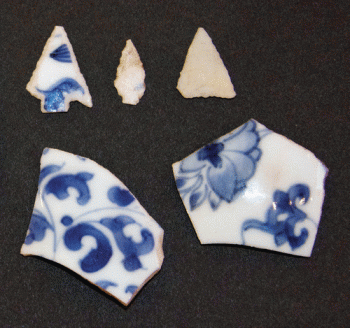
Makers’ names no longer known, arrowheads, 18th or 19th century, porcelain (Tillamook, Oregon: Tillamook County Pioneer Museum).
Abstract: To be lost and found at sea: What kinds of thinking does the shipwreck prompt? This essay pursues this question by centering fragmented remains—large beeswax blocks and Chinese porcelain ware—from the Santo Cristo de Burgos, a Spanish galleon lost while traveling from Manila to Acapulco at the end of the seventeenth century. By considering how durable commodities were recovered and reimagined, primarily by Indigenous inhabitants of the Oregon coast, this essay reflects upon the kinds of histories that can be written around and because of wrecked ships. Tacking between past and present, we use the Santo Cristo de Burgos to draw out the lineaments of a shipwreck’s art history, bringing into focus three interrelated themes, each critical to the material histories of wrecks: the interpretive recalcitrance of cargo, the reframing of value through recovery, and the production of material surplus in the watery depths.










leave a comment