New Book | Closed on Mondays
From Lund Humphries:
Dinah Casson, with a foreword by Christopher Frayling, Closed on Mondays: Behind the Scenes at the Museum (London: Lund Humphries: 2020), 208 pages, ISBN: 978-1848224346, £30 / $40.
 Dinah Casson, co-founder of Casson Mann, museum and exhibition designers for over 30 years, guides the inquisitive museum visitor through a series of questions and problems which confront museum curators, and their designers, behind closed doors.
The transformation of museums from the ‘dreary, dusty places’ they used to be to places that people want to be in, alongside objects they want to be near and ideas they want to understand and then share has been extraordinary. During the last twenty-five years, millions of pounds have been poured into our national museums in the UK: as a result, they are certainly brighter and fuller. It is against this background that Dinah Casson has opened the service entrance of the museum a little.
This book is not an explanation of what an exhibition designer does or how to do it. Instead, by means of a series of essays punctuated with comments from collaborators and visitors, it explores exhibition design and alerts the visitor’s eye to this invisible craft. It explores questions such as: why are most paintings in carved, gilded frames, regardless of artist, period or subject matter? Why do so few contemporary art galleries have windows? If a label text irritates us, what should it say instead? Why do facsimiles make some people so uncomfortable? Why do we keep all this stuff? What is it that visitors want from our museums? In doing so, it offers enjoyable insights, which will add depth to our future visits through the front door (which is usually closed on Mondays) and will make us question what is shown, why it’s shown where (and how) it is, what’s written about it and how the interaction between museums and their designers has encouraged each to change.
Since creating Casson Mann in 1984, Dinah Casson, together with her partner Roger Mann, been involved in some of the most interesting and complex of recent museum installations both in the UK and overseas; from the British Galleries at the V&A in London to the new facsimile at Lascaux in Perigueaux, the work of the award-winning practice has been widely published and it is recognized as one of the leading companies in the field.
Exhibition | In Sparkling Company: Glass and Social Life

Pair of covered green vases, ca. 1765 and a pair of vases, 1750–75, probably from the workshop of James Giles, London, gilded copper-green lead glass (Corning, New York: Corning Museum of Glass, 2003.2.4 A-B, 54.2.4 A-B).
◊ ◊ ◊ ◊ ◊
Notice of the exhibition appeared here in February 2020, but I note it again since the show is scheduled to open (with new dates) later this month. –CH
Press release (30 October 2019) for the exhibition:
In Sparkling Company: Glass and the Costs of Social Life in Britain during the 1700s
Corning Museum of Glass, Corning, New York, 22 May 2021 — 2 January 2022
Curated by Christopher Maxwell
The Museum’s spring exhibition, In Sparkling Company: Glass and Social Life in Britain during the 1700s, will open May 9, 2020. With exhibition design by Selldorf Architects, In Sparkling Company will present the glittering costume and jewelry, elaborate tableware, polished mirrors, and dazzling lighting devices that delighted the British elite, and helped define social rituals and cultural values of the period. Through a lens of glass, this exhibition will show visitors what it meant to be ‘modern’ in the 1700s, and what it cost.
The exhibition will also include a specially created virtual reality reconstruction of the remarkable and innovative spangled-glass drawing room completed in 1775 for Hugh Percy, 1st Duke of Northumberland (1714–1786), and designed by Robert Adam (1728–1792), one of the leading architects and designers in Britain at the time. An original section of the room (which was dismantled in the 1870s), on loan from the Victoria and Albert Museum in London, will be on view in North America for the first time as part of the exhibition. It will be accompanied by Adam’s original colored design drawings for the interior, on loan from the Sir John Soane’s Museum, London.
“One medium that is often overlooked in scholarly discussions of 18th-century art, design, and material culture is glass,” said Christopher L. Maxwell, Curator of European Glass at CMoG, who has organized the exhibition. “In Britain, developments in glass formulas and manufacturing techniques resulted in new and better types of glass, from windowpanes and mirrors to heavy, clear ‘crystal’ tableware, perfectly suited to the tastes and needs of Britain’s growing urban elite whose wealth derived from new enterprises in finance, manufacture, international trade and colonial expansion. In Sparkling Company will demonstrate the many functions and meanings of glass in the exuberant social life of the 1700s.”
The smooth, ‘polished’ and reflective properties of glass perfectly embodied 18th-century ideals of sociability, in what is considered by many as the ‘age of politeness.’ As urban centers grew in size and prosperity, sociability became ever more sophisticated. The terms ‘polite’ and ‘polished’ were often used interchangeably in the numerous etiquette manuals eagerly read by those wishing to take their place in the polite world. Examples of such literature will be displayed alongside fashionable glass of the period, including embroidered costume, mirrors, a chandelier, cut glass lighting and tableware, and paste jewelry that accessorized and defined the lives of the ‘polished’ elite.
In the 1700s Britain was a prosperous and commercial nation. Its growing cities were hubs of industry, scientific advancement, trade and finance, and its colonies were expanding. British merchants navigated the globe carrying a multitude of cargoes: consumable, material, and human. Underpinning Britain’s prosperity was a far-reaching economy of enslavement, the profits of which funded the pleasures and innovations of the fashionable world, among them luxury glass. Alongside the beauty and innovation of glass during this period, the exhibition will consider the role of the material as a witness to colonization and slavery. Using artifacts and documents relating to the slave trade, it will reveal a connection that permeated all levels of British society.
From glittering costume and elaborately presented confectionery, to polished mirrors and dazzling chandeliers, glass helped define the social rituals and cultural values of the period. While it delighted the eyes of the wealthy, glass also bore witness to the horrors of slavery. Glass beads were traded for human lives while elegant glass dishes, baskets and bowls held sweet delicacies made with sugar produced by enslaved labor.
In Sparkling Company: Glass and Social Life in Britain during the 1700s will include important examples of 18th-century British glass, including:
• Glass embroidered costume: a spectacular men’s coat intricately decorated with glass ‘jewels’ made around 1780; a pair of women’s shoes covered in glass beads; shoe buckles set with glass paste jewels; jewelry and other accessories.
• Cut glass lighting and tableware, all made possible through the perfection of British lead ‘crystal’ in the late 1600s and exported throughout Europe and the British colonies in America and beyond.
• A number of large mirrors, which became the tell-tale sign of a fashionable interior, and reverse-painted glass meticulously decorated in China for the British luxury market.
• Opulent glass dressing room accessories, including a magnificent gilded silver dressing table set, with a looking glass as its centerpiece, made in about 1700 for the 1st Countess of Portland; perfume bottles, patch boxes, a dazzling cut glass washing basin and pitcher and an exquisite blue glass casket richly mounted in gilded metal, used in the ‘toilette’ a semi-public ritual of dressing which was adopted from France for men and women alike and became a feature of British aristocratic life in the 18th century.

Robert Adam, Design for the end wall of the drawing room at Northumberland House, 1770–73, pen, pencil, and colored washes, including pink, verdigris, and Indian yellow on laid paper, 52 × 102 cm (London: Sir John Soane’s Museum, SM Adam, volume 39/7; photo by Ardon Bar Hama).
◊ ◊ ◊ ◊ ◊
Glass Drawing Room for the Duke of Northumberland
Over the course of the 18th century, domestic interiors were transformed by the increasing presence of clear and smooth plate glass. A remarkable example is the lavish drawing room designed by the celebrated British architect Robert Adam for Hugh Percy, 1st Duke of Northumberland (1714–1786) and his wife, the Duchess Elizabeth Percy (1716–1776), and completed in 1775. This unique room, measuring 36 by 22 feet, was paneled between dado rail and architrave with red glass panels sprinkled on the reverse with flakes of metal foil, like large-scale glitter. Similarly spangled green glass pilasters, large French looking glasses, and intricate neo-classical ornament in gilded lead completed the dazzling scheme. The room was altered in the 1820s and finally dismantled in the 1870s, when Northumberland House was demolished. Many of the panels were acquired by the V&A Museum in the 1950s, but their poor condition meant that they could only be partially displayed. The panels on display at The Corning Museum of Glass incorporate newly-conserved elements from the V&A’s stores.
In Sparkling Company will feature a virtual reality reconstruction of the drawing room, created by Irish production house Noho. Visitors to the exhibition will be transported into the interior, experiencing the original design scheme—last seen almost 200 years ago. This will be the first virtual-reality experience ever offered at CMoG. Visitors will also be able to see Robert Adam’s design drawings, on loan from the Sir John Soane’s Museum, London, and a section of the original Northumberland House Glass Drawing Room on loan from the V&A Museum, which has never been on view in North America.
In Sparkling Company: Glass and Social Life in Britain during the 1700s will include loans from the Victoria and Albert Museum; Sir John Soane’s Museum; the Museum of London; the Fashion Museum, Bath; Royal Museums Greenwich; Los Angeles County Museum of Art (LACMA); Penn State University Library; Cleveland Museum of Art; and The Museum of Fine Arts in Boston.
The exhibition is accompanied by a catalogue, In Sparkling Company: Reflections on Glass in the 18th-Century British World (The Corning Museum of Glass, 2020). Publication contributors include Marvin Bolt, Kimberly Chrisman Campbell, Jennifer Chuong, Melanie Doderer Winkler, Christopher Maxwell, Anna Moran, Marcia Pointon, and Kerry Sinanan.
◊ ◊ ◊ ◊ ◊
Note (added 16 September 2021) — The posting has been updated to include the revised title; the original title was In Sparkling Company: Glass and Social Life in Britain during the 1700s.
2019 Dissertation Listings from CAA
Very belated congratulations! I would expect the 2020 listing to be available in June or July. –CH
Each year, CAA publishes titles of dissertations in-progress and completed during the previous academic year by students at American and Canadian institutions.
The index for 2019 lists four ‘eighteenth-century art’ dissertations completed:
• Katherine Calvin, “Antiquity and Empire: The Construction of History in Western European Representations of the Ottoman Empire, 1650–1830” (The University of North Carolina at Chapel Hill, M. Sheriff and C. Johns)
• Bart Pushaw, “The Global Invention of Art: Race and Visual Sovereignity in the Colonial Baltic, 1860–1915” (University of Maryland, College Park, S. Mansbach)
• Leslie E. Todd, “Reconciling Colonial Contradictions: The Multiple Roles of Sculpture in Eighteenth-Century Quito” (University of Florida, M. Stanfield-Mazzi)
• Hye-shim Yi, “Art, Materiality, and Intermediality: The Multimedia Writing Practice of Chen Hongshou (1768–1822)” (UCLA, H. Lee)
◊ ◊ ◊ ◊ ◊
and fifteen ‘eighteenth-century art’ dissertations in progress, including:
• Jacob Leveton, “William Blake’s Radical Ecology” (Northwestern University, S. Eisenman)
• Kelsey Martin, “Graveuses en taille-douce: French Women Engravers from the Ancien Regime to the Napoleonic Empire (1660–1815)” (University of North Carolina, Chapel Hill, M. Hyde)
• Saylor, Miranda, “Sor María de Ágreda and Sacred Art in Eighteenth-Century Mexico” (UCLA, C. Villaseñor-Black)
2018 Dissertation Listings from CAA
Each year, CAA publishes titles of dissertations in-progress and completed during the previous academic year by students at American and Canadian institutions.
The index for 2018 lists six ‘eighteenth-century art’ dissertations completed:
• Alissa Adams, “French Depictions of Napoleon I’s Resurrection, 1821–1848” (The University of Iowa, D. Johnson)
• Kelsey Brosnan, ““Seductive Surfaces: The Still Life Paintings of Anne Vallayer-Coster (1744–1818)” (Rutgers University, S. Sidlauskas)
• Monica Hahn, “Go-Between Portraits and the Imperial Imagination, circa 1800” (Temple University, E. Pauwels)
• Laurel O. Peterson, “Making Spaces: Art and Politics in the Whig Country House, 1688–1745” (Yale University, T. Barringer)
• Mei Rado, “The Empire’s New Cloth: Western Textiles and Imperial Identity at the Eighteenth-Century Qing Court” (Bard Graduate Center, F. Louis)
• Sarah Sylvester Williams, “After Watteau: Nicolas Lancret and the Creation of the Hunt Luncheon” (University of Missouri, M. Yonan)
◊ ◊ ◊ ◊ ◊
and forty-five ‘eighteenth-century art’ dissertations in progress, including:
• Wenjie Su, “Machines of Time, Towers of Knowledge: Miniature Architectural Spaces and the Design of Timepieces in Sino-European Encounters, Seventeenth and Eighteenth Centuries” (Princeton, T. DaCosta Kaufmann)
• Emily K. Thames, “Enlightenment, Reform, and Identity in Late Eighteenth-Century Puerto Rico: The Art of José Campeche (1751–1809)” (Florida State University, P. Niell)
2017 Dissertation Listings from CAA
Each year, CAA publishes titles of dissertations in-progress and completed during the previous academic year by students at American and Canadian institutions.
The index for 2017 lists nine ‘eighteenth-century art’ dissertations completed:
• Kasie Alt, “Culture of Illusion: Landscape Gardens, Fabricated Ruins, and the Diorama, ca. 1750–1850” (University of Texas at Austin, M. Charlesworth)
• Emily Casey, “Waterscapes: Representing the Sea in the American Imagination, 1750–1800” (University of Delaware, W. Bellion)
• Kathryn Desplanque, “Art, Commerce, and Caricature: Satirical Images of Artistic Life in Paris, 1750–1850” (Duke University, N. McWilliam)
• Lauren Kellogg DiSalvo, “Micromosaics: Souvenirs, Collective Memory, and the Reception of Antiquity on the Grand Tour” (University of Missouri, K. Slane and M. Yonan)
• Alexandra Helprin, “The Sheremetevs and the Argunovs: Art, Serfdom, and Enlightenment in Eighteenth-Century Russia” (Columbia University, A. Higonnet)
• Barbara M. Laux, “Claude III Audran, Modern Ornemaniste of the Rococo Style” (Graduate Center, CUNY, P. Mainardi)
• Tamar Mayer, “Consequences of Drawing: Self and History in Jacques-Louis David’s Preparatory Practices” (University of Chicago, R. Ubl, M. Ward)
• Kelly Presutti, “Terroir after the Terror: Landscape and Representation in Nineteenth-Century France” (MIT, K. Smentek)
• Michael Traver Ridlen, “Prud’hon’s Evolving Classicism” (The University of Iowa, D. Johnson)
◊ ◊ ◊ ◊ ◊
and thirty-one ‘eighteenth-century art’ dissertations in progress, including:
• Lilit Sadoyan, “Meuble and Mobility: Furniture in Long-Eighteenth-Century France” (University of California, Santa Barbara, E. B. Robertson and M. Meadow)
• Luciano Vanni, “The Renovation of the Habsburg-Lorraine Residences: Eighteenth-Century Imperial and Archducal Palaces in Prague, Brussels, and Florence” (Princeton, T. DaCosta Kaufmann)
Online Lecture and Conference | Piranesi @300

Base of the Antonine Column from Piranesi’s Campo Marzio (Rome, 1762)
(British School at Rome Library)
◊ ◊ ◊ ◊ ◊
Clare Hornsby, Piranesi at the BSR: Thomas Ashby’s Curious Campo Marzio
Online Lecture, 6 May 2021, 18.00–19.30 CET
Piranesi @300
Online Conference, 19–21 May 2021
Giovanni Battista Piranesi (Venice 1720 – Rome 1778) was one of the leading figures in 18th-century Italian and European culture. An artist, engraver, architect, merchant, intellectual, and polemicist, he was essential in the formation of modern aesthetic sensibility, for the birth of modern archaeology, for the theories of architecture and urbanism. His influence has been enduring, from Romanticism to the avant-garde movements of the 20th century, up to the present day.
The third centenary of Piranesi’s birth struggled to achieve resonance in 2020 due to the pandemic. Initiatives to celebrate the great artist’s work will resume in Rome in May 2021, accessible online internationally.
◊ ◊ ◊ ◊ ◊
On Thursday, May 6, the British School at Rome, will host an online lecture exploring Piranesi’s book Campo Marzio di Antica Roma of 1762, its magnificent map, and some of the curiosities of the copy of the volume held in the rare books collections of the library at BSR. This lecture by Clare Hornsby in collaboration with Valerie Scott BSR librarian will feature the recently launched initiative of BSR Library and Archive, the Digital Collections website, of which the Piranesi Campo Marzio volume will be a highlight.
◊ ◊ ◊ ◊ ◊
On 19, 20, and 21 May a group of Roman institutions—the Biblioteca Nazionale Centrale, British School at Rome, Villa Médicis-Académie de France, and the Centro di Studi sulla Cultura e l’Immagine di Roma—have organised an online conference, Piranesi@300, bringing together more than 20 Italian and foreign scholars (from Brazil, the United States, Japan, Germany, France, England, Spain, etc.) to present new research and new analyses of some of the many aspects of Piranesi’s extraordinary personality and creativity.
During the week of the conference, further presentations will be made available via video recording; a highlight is The Digital Piranesi presented by a team from the University of South Carolina. Additionally, the YouTube channel of the Biblioteca Nazionale Centrale will host contributions from a number of Piranesi experts, including the Director of the Vatican Museums Barbara Jatta and the restoration team which brought the church of Santa Maria del Priorato on the Aventine hill in Rome, Piranesi’s architectural masterpiece, back to its original beauty.
1 8 – 2 4 M A Y 2 0 2 1
Pre-recorded sessions (available all week)
Hosted on the website of the University of South Carolina
• Jeannie Britton, From Page to Screen: A New Look at Piranesi’s Annotated Images
• Zoe Langer, The Digital Piranesi: New Approaches to Translating the Opere
• Jason Porter, The Virtual Piranesi: New Methods of Immersive Literacy
• Michael Gavin, Piranesi’s Diagrammatic Sublime
Hosted on the YouTube channel of the Biblioteca Nazionale Centrale, Rome
• Barbara Jatta (Direttore, Musei Vaticani), Piranesi in Vaticano
• Daniela Porro (Soprintendente Speciale archeologia, belle arti e paesaggio di Roma) Restauri della Soprintendenza alla piazza di S. Maria del Priorato
• Alessandro Mascherucci (Soprintendenza Speciale archeologia, belle arti e paesaggio di Roma), Problematiche tecniche del restauro al complesso piranesiano
• Giorgio Ferreri (Sovrano Militare Ordine di Malta), S. Maria del Priorato, i restauri
• John Wilton-Ely (Professor Emeritus, Hull University), Soane’s Attitude towards Piranesi
• Maria Cristina Misiti (Ministero della Cultura) and José Maria Luzon Nogué (Real Academia de Bellas Artes de San Fernando, Madrid), Piranesi dal libro cartaceo all’opera multimediale
• Sergei Tchoban (Tchoban Voss architects, Berlin), Imprint of the Future: Destiny of Piranesi‘s City
• Pierluigi Panza (Politecnico di Milano), Piranesi alla Scala
W E D N E S D A Y , 1 9 M A Y 2 0 2 1
Hosted by Biblioteca Nazionale Centrale, Roma
9.45 Welcome by Andrea De Pasquale (Direttore, Biblioteca Nazionale Centrale, Roma) and Marcello Fagiolo (Presidente, Centro di Studi sulla Cultura e l’Immagine di Roma)
10.00 Piranesi’s Techniques: Drawing, Etching
Chairs: Mario (Bevilacqua (Università di Firenze / Centro di Studi sulla Cultura e l’Immagine di Roma) and Simonetta Prosperi Valenti Rodinò (Roma)
• Andrea De Pasquale (Biblioteca Nazionale Centrale, Roma), Piranesi e il suo torchio
• Giovanna Scaloni (Istituto Centrale per la Grafica, Roma), L’Istituto centrale per la grafica per Piranesi
• Lucia Ghedin (Istituto Centrale per la Grafica, Roma) and Sofia Menconero (Sapienza – Università di Roma), La tecnica di reflectance transformation imaging (RTI) applicata alle matrici calcografiche: una sperimentazione sulla serie delle Carceri piranesiane
• Ginevra Mariani (Roma), Progetto Piranesi: il catalogo generale delle matrici di Piranesi, 2010–2020. Nuovi dati e future prospettive sull’opera incisa di Giambattista Piranesi
• Stefan Morét (Staatliche Kunsthalle Karlsruhe), The Role of Drawn Copies after Antique Ornaments in Piranesi’s Workshop
• Bénédicte Maronnie (Università della Svizzera Italiana, Mendrisio), Pratiques graphiques dans l’atelier de Giovanni Battista Piranesi à l’exemple d’un dessin inédit conservé à Zurich
13.30 Lunch Break
14.30 Piranesi and European 18th-Century Collections
Chairs: Mario Bevilacqua (Università di Firenze / Centro di Studi sulla Cultura e l’Immagine di Roma) and Barbara Jatta (Vatican Museum)
• Ebe Antetomaso (Biblioteca Corsiniana e dei Lincei, Roma), Materiali piranesiani nella collezione Corsini: appunti dai bibliotecari
• Charleen Rethmeyer and Georg Schelbert (Humboldt-Universität zu Berlin), Piranesi in Prussia: Spotlights on a Variable Relationship
• Gudula Metze (Staatliche Kunstsammlungen Dresden), 1720–1778: Piranesi and the Kupferstich-Kabinett Dresden
16.45 Break
17.00 Keynote Address
• Delfin Rodriguez Ruiz (Universidad Complutense, Madrid), Piranesi e la Spagna
T H U R S D A Y , 2 0 M A Y 2 0 2 1
Hosted by the British School at Rome
9.45 Welcome by Chris Wickham (Director, British School at Rome)
10.00 Piranesi: Architect, Antiquarian, and Theorist
Chairs: Clare Hornsby (BSR) and Caroline Barron (Birkbeck)
• Maria Grazia D’Amelio Università di Roma ‘Tor Vergata’) and Fabrizio De Cesaris Sapienza – Università di Roma), Giovan Battista Piranesi e l’architettura pratica
• Lola Kantor-Kazovsky (The Hebrew University of Jerusalem), Piranesi’s Carceri, Cartesian ‘Dream Argument’ and Scientific Interests in Early 18th-Century Venice
• Silvia Gavuzzo Stewart (Roma), La dedica di Piranesi a Lord Charlemont nella Tavola II delle Antichità Romane
• Paolo Pastres (Deputazione di Storia Patria per il Friuli), Fantasia al potere: Piranesi, Algarotti e la lezione di Antonio Conti
• Cristina Ruggero (Berliner-Brandenburgische Akademie der Wissenschaften, Berlin), ‘Onde per riguardo della Pianta… non resta che l’indice ad incidersi’: Piranesi e Villa Adriana
• Eleonora Pistis (Columbia University, New York), Piranesi without Images: The Thinkability of Architecture
13.45 Lunch Break
14.30 From Venice to Rome: Piranesi as Artist, Dealer, and Entrepreneur
Chair: Harriet O’Neill (British School at Rome / Royal Holloway University of London)
• Enrico Lucchese (Univerza v Ljubljani), Pulcinella e poveri Cristi: Per Giambattista Piranesi disegnatore e i suoi rapporti con Giandomenico Tiepolo
• Francesco Nevola (Atene), Piranesi: Peritissimo in tutte le Arti Liberali
15.30 Keynote Address
• Heather Hyde Minor (University of Notre Dame, South Bend, Indiana), Piranesi’s Epistolic Art
F R I D A Y , 2 1 M A Y 2 0 2 1
Hosted by the Villa Médicis-Académie de France à Rome
9.45 Welcome by Sam Stourdzé (Direttore, Accademia di Francia a Roma)
10.00 Piranesi’s Influence: Europe and Beyond
Chair: Heather Hyde Minor (University of Notre Dame)
• Olga Medvedkova (Centre National de la Recherche Scientifique, Paris), ‘La Dévideuse italienne’ ou habiter la ruine
• Valeria Mirra (Roma), Dalla fortuna di Giovanni Battista Piranesi in Francia allo stabilimento dei ‘Piranesi frères’ a Parigi
• Helena Perez Gallardo (Universidad Complutense, Madrid), Sotto il cielo di Parigi: Piranesi negli incisori e fotografi francesi nel 1850
• Angela Rosch Rodrigues (Universidade de São Paulo, Brasil), G. B. Piranesi at the Brazilian National Library: A Trajectory of the rovine parlanti from Rome to Rio de Janeiro
• Hiromasa Kanayama (Keio University, Tokyo), La raccolta piranesiana nel Giappone dell’Ottocento: le vicende della collezione Kamei
13.15 Lunch Break
14.30 Piranesi in the 20th Century
Chair: Francesca Alberti (Académie de France à Rome)
• Giacomo Pala (Universität Innsbruck) Piranesi: Posthumous Architect
• Angelo Marletta (Università degli Studi di Catania), Forma Urbis forma architecturae: Piranesi, Kahn e i frammenti di Roma
• Victor Plahte Tschudi (Oslo School of Architecture and Design), Alfred H. Barr and the Reinvention of Carceri as Modern Art
16.30 Break
17.00 Keynote Address
• Alain Schnapp, Piranèse, ruine des ruines
Call for Articles | Picturing Sensory Experiences
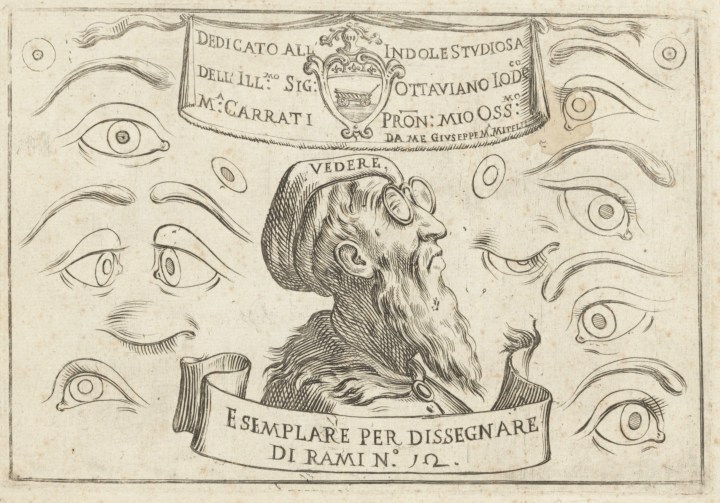
Giuseppe Maria Mitelli after Augostino Mitelli, Vedere (Sight), ca. 1700, etching, 21 × 29 cm
(Amsterdam: Rijksmuseum, RP-P-2013-27-1)
◊ ◊ ◊ ◊ ◊
From the Call for Articles:
Picturing Sensory Experiences / Figurations du sentir / Figurazioni del sentire
Special Issue of Images Re-vues, edited by Marta Battisti, Viktoria von Hoffmann, and Érika Wicky
Proposals due by 30 June 2021, with finished articles due by 1 February 2022
This special issue of the journal Images Re-vues explores various approaches to picturing sensory experiences. The aim is to interrogate both the visual representations of sensory perceptions and the sensory experiences shaped by the creation and reception of such images. The proposed contributions will build on the vibrant interdisciplinary research carried out in sensory studies in recent decades.
 The history of the senses and the history of visual cultures both emerged in the 1980s, with the latter examining both the history of sight and works meant to be apprehended visually. Crossing these approaches, several works—building on the seminal research from the medievalist Carl Nordenfalk (1976)—have been devoted to the iconography of the five senses, thus including images among the materials of histories of sensory cultures. These pioneering studies, which include the catalogue of the exhibition Immagini del sentire: i cinque sensi nell’arte (Ferino-Pagden, 1996), have identified the allegories and symbols associated with the senses in visual cultures. For example, representations of the—most often Aristotelian—sensorium can be seen in Floris and Cort (The Five Senses, 1561), Brueghel the Elder and Rubens (Allegories of the Five Senses, 1617), and vast Renaissance collections of emblems. In these and other images, it is frequent to find sight pictured by a mirror, hearing represented in the form of a deer or a musical instrument, whereas flowers were a known symbol of smell, in the same way that monkeys and food symbolised taste. Touch could be alluded to by the depiction of contact with fabric, for example, and its finesse was characteristically suggested by the figure of the spider. Previous studies that have explored these issues have also highlighted the functions attributed to each sense and provided descriptions relating to the functioning of sensory organs.
Drawing on these works as well as more recent developments in the field inspired by the fruitful dialogue between sensory history and the history of emotions (Bodicce and Smith, 2020), this special issue proposes to study practices of picturing the senses as a window into the sensory experiences of the past. Rather than exploring the symbols representing the senses, we wish to consider how visual depictions of sensory perception intersect with the sensory experiences that come into play during the creation and reception of artistic and scientific imagery. Analysing how sensory perception, an invisible practice experienced in the present, could manifest in visual depictions will lead us to pay attention to bodily gestures and technological devices (such as the acoustic horn or the eyeglass) connected with sensory experience and its depiction. This perspective could also be enriched by considerations of sensory deprivation stemming from disability studies.
We will also consider the interplay between practices of creation—the senses of the maker—and the sensory experience depicted in the image, attempting to capture the resonances from one to the other. Likewise, the reception (and reactions of disgust, laughter, pleasure) by the viewer of the image will also be examined to evaluate the mobilisation, at the imaginative level, of the viewer’s senses. Considering the visual representations of the senses as sensory experiences of the world will lead us to discuss the implicit intersensory nature of visual representations of the senses, as we will consider both the production and consumption of images. In a word: our collective inquiry will question the esthesic dimension (< aesthesis, sensation) of picturing sensory experiences (Boutaud, 2012).
A global approach to the visual depictions of sensory perception will provide a fresh understanding of practices and knowledge related to sensory experience and the sensory models that have governed human relationships with the surrounding world. The consideration of different visual artistic media (e.g., paintings, engravings, drawings, sculptures) and of a wide variety of cultural fields (e.g., arts, natural sciences, medicine, gastronomy, music, religion) will help us interrogate the functions of these representations and their contribution to an aestheticisation, objectivation, or reflection about the nature of sensory experience. The absence of chronological and geographical boundaries will allow us to explore the diversity of answers to these questions and perhaps to develop a comparative approach interrogating multiple ways of picturing the senses.
Avenues of research that can be explored include but are not limited to:
• The artistic, religious, economic, philosophical, and political contexts informing the representations of sensory perceptions, as well as issues connected with the social, gendered, and racialised characterisation of the subjects of these representations.
• The intersection between hierarchies of the senses and the arts. Sample questions include whether the lower senses were natural subjects for artistic genres considered inferior, such as caricature? Alternately, did such representations require an allegorical detour?
• Which visual strategies could be employed to depict the intensity or deprivation of sensory perceptions?
• The visual representations of sensory imaginaries beyond the five senses of the sensorium defined by Aristotle. Pre-Hispanic (Cruz Riviera, 2019) and medieval Islamic art (Le Maguer, 2013) invite other examples and analyses of sensory experiences.
• The commonplace sensory imagination in a given culture and period, such as, for example, representations of anatomical dissections and banquets in the Renaissance, or the end-of-century representations of young girls dreamily smelling a flower.
• Visual depictions of sensory experiences offered by different conventional systems escaping the usual representational codes shaping the visual arts, like sensory maps and visualisations of brain activity.
Proposals for articles (750 words maximum) in French, English, or Italian describing the research questions and the corpus of sources should be sent to Marta Battisti, Viktoria von Hoffmann and Érika Wicky by June 30th, 2021. Articles (30,000–60,000 characters) will be expected by February 1st, 2022. Per journal policies, each article will be subject to a double-blind peer review by the editorial committee and the scientific committee of Images Re-vues.
Bibliography
• P. Beusen, S. Ebert-Schifferer, and E. Mai, eds., L’Art Gourmand (Brussels: Crédit Communal, 1996).
• Rob Boddice and Mark Smith, Emotion, Sense, Experience (Cambridge: Cambridge University Press, 2020).
• R. Bösel, M. G. Di Monte, Michele Di Monte, S. Ebert-Schifferer, eds., L’arte e i linguaggi della percezione: L’eredità di Sir Ernst H. Gombrich (Milan: Electa, 2004).
• Jean-Jacques Boutaud, « L’esthésique et l’esthétique: La figuration de la saveur comme artification du culinaire », Sociétés & Représentations 34 (2012): 85–97.
• Mark Bradley, « The Artistry of Bodies, Stages, and Cities in the Greco-Roman World », A Cultural History of the Senses in Antiquity (London: Bloomsbury, 2018).
• Christina Bradstreet, Scented Visions: Smell in Nineteenth-Century Art (University Park: Penn State University Press, 2021).
• Constance Classen, The Color of Angels: Cosmology, Gender, and the Aesthetic Imagination (London: Routledge, 1998).
• Sarah Cohen, « Experiencing the Arts in the Age of Sensibility », A Cultural History of the Senses in the Age of Enlightenment (London: Bloomsbury, 2018).
• Riviera Cruz and Amelia Sandra, « La representación y función dinámica del sonido en los mitos mesoamericanos », La dimensión sensorial de la cultura: Diez contribuciones al estudio de los sentidos en México (Mexico City: Universidad Autónoma Metropolitana, 2019), 145–72.
• Julia Csergo and Frédérique Desbuissons, eds., Le cuisinier et l’art: Art du cuisinier et cuisine d’artiste, XVIe–XXIe siècle (Paris: Les Éditions de l’institut national d’histoire de l’art / Menu Fretin, 2018).
• Henri De Riedmatten, Nicolas Galley, Jean-François Corpataux, and Valentin Nussbaum, eds., Senses of Sight: Towards a Multisensorial Approach of the Image: Essays in Honour of Victor Stoichita (Rome: L’Erma di Bretschneider, 2015).
• Sylvia Ferino-Pagden, ed., Immagini del sentire: i cinque sensi nell’arte (Milan: Leonardo Arte, 1996)
• Caroline Fowler, Drawing and the Senses: An Early Modern History (Turnhout: Brepols, 2016).
• Florence Gétreau, Voir la musique (Paris: Citadelles & Mazenod, 2017).
• Adeline Grand-Clément, Anne-Caroline Rendu Loisel, and Fritz Blakolmer, eds., Les traces du sensible: pour une histoire des sens dans les sociétés anciennes, Trivium, 27 (2017).
• Martial Guédron, Temenuzhka Dimova, and Mylène Mistre-Schaal, eds., L’emprise des sens: de la fin du Moyen Âge à nos jours (Paris: Hazan, 2016).
• Sterenn Le Maguer, « De l’autel à encens au brûle-parfum: héritage des formes, évolution des usages », Archéo.doct 5 (2013): 183–200.
• Wolfgang Neiser, Audition in der Kunst der italienischen Renaissance (Regensburg: Schnell & Steiner, 2015).
• Mylène Mistre-Schaal, « Sniffing: The Figuration of Olfactory Attraction in Eighteenth-Century European Art», De Achttiende Eeuw 48 (2016): 127–43.
• Carl Nordenfalk, « Les cinq sens dans l’art du Moyen-Âge », Revue de l’art 34 (1976): 17–28.
• Eric Palazzo, L’invention chrétienne des cinq sens dans la liturgie et l’art au Moyen Âge (Paris: Les Éditions du Cerf, 2014).
• François Quiviger, The Sensory World of Italian Renaissance Art (London: Reaktion Books, 2010).
• Denys Riout, « Art et olfaction: des évocations visuelles à une présence réelle », Cahiers du MNAM 116 (été 2011): 84–109.
• Alice Sanger and Sive Tove Kulbrandstad Walker, eds., Sense and the Senses in Early Modern Art and Cultural Practice (Farnham: Ashgate, 2012).
• David Summers, The Judgement of Sense: Renaissance Naturalism and the Rise of Aesthetics (Cambridge: Cambridge University Press, 1987).
New Book | The Ephemeral Eighteenth Century
From Cambridge UP:
Gillian Russell, The Ephemeral Eighteenth Century: Print, Sociability, and the Cultures of Collecting (Cambridge: Cambridge University Press, 2020),
 Often regarded as trivial and disposable, printed ephemera, such as tickets, playbills and handbills, was essential in the development of eighteenth-century culture. In this original study, richly illustrated with examples from across the period, Gillian Russell examines the emergence of the cultural category of printed ephemera, its relationship with forms of sociability, the history of the book, and ideas of what constituted the boundaries of literature and literary value. Russell explores the role of contemporary collectors such as Sarah Sophia Banks in preserving such material, arguing for ‘ephemerology’ as a distinctive strand of popular antiquarianism. Multi-disciplinary in scope, The Ephemeral Eighteenth Century reveals new perspectives on the history of theatre, the fiction of Maria Edgeworth and Jane Austen, and on the history of bibliography, as well as highlighting the continuing relevance of the concept of ephemerality to how we connect through social media today.
Gillian Russell is Professor of English at the University of York. A Fellow of the Australian Academy of the Humanities, she is internationally renowned for her innovative interdisciplinary research that began with The Theatres of War: Performance, Culture, and Society, 1793–1815 (1995). She has pioneered field-changing new directions in scholarship—on war and theatre and on the study of sociability. Her books include Romantic Sociability: Social Networks and Literary Culture, 1770–1840 (Cambridge, 2002), co-edited with Clara Tuite; Women, Sociability, and Theatre in Georgian London (Cambridge, 2007); and Tracing War in British Enlightenment and Romantic Culture, co-edited with Neil Ramsey (2015).
C O N T E N T S
Figures
Acknowledgements
Introduction: All the Ephemera of Our Lives
1 Accidental Readings and Diurnal Historiographies: The Invention of Ephemera
2 Making Collections: Enlightenment Ephemerology
3 The Natural History of Sociability: Sarah Sophia Banks and Her Ephemera Collections
4 Sarah Sophia Banks’s ‘Magic Encyclopedia’
5 ‘Announcing Each Day the Performance’: Playbills as Theatre/Media History
6 Transacting Hospitality: The Novel Networks of the Visiting Card
7 England in 1814: Frost Fairs, Peace, and Persuasion
Conclusion
Bibliography
Index
Call for Papers | Networks and Practices of Connoisseurship
From the Call for Papers:
Networks and Practices of Connoisseurship in the Global Eighteenth Century
Warburg-Haus, Hamburg, 2–4 June 2022
Organized by Valérie Kobi and Kristel Smentek
Proposals due by 30 June 2021
A collaboration between faculty from the Art History Department at Universität Hamburg and the History, Theory, and Criticism Program of the Department of Architecture at Massachusetts Institute of Technology, Cambridge, MA
The eighteenth century was the age of the connoisseur, the disciplined interpreter and assessor of artworks whose authority, like that of the natural philosopher, was founded on his (more rarely her) extensive and sustained visual analysis of physical things. An era of accelerating trade and imperial conquest, the eighteenth century was also a period of an expanding global consciousness. The concept that brings these two themes together—the emergence of the connoisseur and an increasing Enlightenment engagement with difference—is the network: the constellation of practices of communication and exchange that made knowledge possible. As the history of science has, for example, already articulated for the circulation of botanical knowledge, there was barely a discovery made in the eighteenth century that was not embedded in a network of international information and specimen exchange. Yet, little has been written on the connoisseurial networks of the Enlightenment period and a broader reflection on the encounter they allowed with artistic practices from different regions of the globe has still to appear. Studies of connoisseurship have—to date—tended to stay local, focusing, for instance, on an individual and his (or her) web of social ties or on Western European art to the exclusion of works from unfamiliar artistic traditions to which eighteenth-century art experts, collectors, and colonial administrators were increasingly exposed.
This international conference intends to foster a better understanding of the intricate transactions through which connoisseurial knowledge of art was generated during the long eighteenth century. Questions we are interested in pursuing include: how are social, institutional and commercial networks built and how do they evolve over time? What were the channels through which encounters with art from afar were made possible? Is there a difference of purpose between local, national, and international networks? Are some regions over- or underrepresented in these connoisseurial networks and what do these asymmetries reveal about the artistic geographies of the time? What methods were used to analyze and categorize art from other parts of the globe? And how might a recognition of the conventionality of artmaking have shaped local definitions of art and artistic quality in such regions as Asia, the colonial Americas, and Europe?
To move forward with our investigation, four axes of reflection will structure the conference:
1) Networks: This first panel will concentrate on the practical aspects of international networks and on the very structures that made the connoisseurial exchange within and between continents possible. It will address such questions as the construction and implementation of communication channels, the postal system that governed the pace of eighteenth-century correspondence, the gendering of connoisseurial networks, or the constellation of commercial and political institutions that facilitated their development.
2) Transmission: The second panel will focus on the practices that enabled communication and knowledge transfer between connoisseurs, across often considerable geographic distances and extended periods of time. The circulation of things and production of knowledge within connoisseurial networks occasioned a multifaceted apparatus of instruments and techniques, including the production of written texts, prints, copies, and, occasionally fakes, that were meant to facilitate scientific exchange, and test expert knowledge.
3) Practices: The third panel will analyze the concrete actions that shaped individual connoisseurial judgments. It will explore the private practice enabled by the network, once the connoisseur was in possession of information and the art objects that he (or more rarely she) needed. The observation and handling of artworks from various regions of the globe but also the circumstances in which they were examined and exhibited will here be at the core of this session’s concerns.
4) Appropriation: The final panel will exam the rhetoric used to formulate connoisseurial judgment on art from distant places and time periods. General questions of style and national traditions will be considered, but the intersection between art from diverse geographies will be a key point of interest.
Proposals that introduce new interdisciplinary and methodological approaches will especially be encouraged. Please send a 300-word proposal and a short (2-page) CV to Valérie Kobi (valerie.kobi@uni-hamburg.de) and Kristel Smentek (smentek@mit.edu) by 30 June 2021.
New Book | Planting the World
From Harper Collins:
Jordan Goodman, Planting the World, Joseph Banks and his Collectors: An Adventurous History of Botany (New York: William Collins, 2021), 560 pages, ISBN : 978-0007578832, $33.
 A bold new history of how botany and global plant collecting—centred at Kew Gardens and driven by Joseph Banks—transformed the earth.
Botany was the darling and the powerhouse of the eighteenth century. As European ships ventured across the Atlantic, Indian and Pacific oceans, discovery bloomed. Bounties of new plants were brought back, and their arrival meant much more than improved flowerbeds—it offered a new scientific frontier that would transform Europe’s industry, medicine, eating and drinking habits, and even fashion. Joseph Banks was the dynamo for this momentous change. As botanist for James Cook’s great voyage to the South Pacific on the Endeavour, Banks collected plants on a vast scale, armed with the vision—as a child of the Enlightenment—that to travel physically was to advance intellectually. His thinking was as intrepid as Cook’s seafaring: he commissioned radically influential and physically daring expeditions such as those of Francis Masson to the Cape Colony, George Staunton to China, George Caley to Australia, William Bligh to Tahiti and Jamaica, among many others.
Jordan Goodman’s epic history follows these high seas adventurers and their influence in Europe, as well as taking us back to the early years of Kew Gardens, which Banks developed devotedly across the course of his life, transforming it into one of the world’s largest and most diverse botanical gardens. In a rip-roaring global expedition, based on original sources in many languages, Goodman gives a momentous history of how the discoveries made by Banks and his collectors advanced scientific understanding around the world.
Jordan Goodman is Honorary Research Associate in the Department of Science and Technology Studies at University College London. He is the author of The Rattlesnake: A Voyage of Discovery to the Coral Sea, The Devil and Mr Casement, and Paul Robeson: A Watched Man. He has published extensively on the history of medicine and science, and cultural and economic history.










 Enfilade
leave a comment