Online Conference | Country House Gardens and Landscapes
From the conference flyer:
Razored Hedgerows, Planted Trees, and Natural Delights: Country House Gardens and Landscapes
Online, Centre for the Study of Historic Irish Houses and Estates, Maynooth University, 11 May 2021
 After the disappointing cancellation of the annual conference in 2020, the Centre for the Study of Historic Irish Houses and Estates is pleased to announce the 19th annual Historic Houses Conference, which will be held online (via Zoom) at Maynooth University on 11 May 2021.
Country houses sit in the middle of designed landscapes. Their backdrop, large or small, might be a combination of parkland, pasture, woods, and waterways, as well as formal gardens blazoned with horticultural delights. These natural features complement the built heritage and often share similar stories about their creation, improvement, loss, or recovery. The acres surrounding a mansion house may have shrunk over the centuries, but the terrain itself remains even if in different ownership and used for other purposes today.
This one-day online conference will include papers on a number of houses and gardens, examining their history, survival, and changing fortunes, with papers on Emo Court, Annes Grove, Doneraile, Glin Castle, Brodsworth Hall, Vaux-le-Vicomte, Lambay Castle, Illnacullin, Johnstown Castle, Newbridge, and the Glebe Churchill; as well as presentations on glasshouses, plant collections, and the art of landscape design. The day will conclude with an online forum on the subject of gardens and well-being in the twenty-first century.
Speakers include Sarah Couch, Michael O’Sullivan, Catherine Fitzgerald, Neil Porteous, Hugh Carrigan, Anne O’Donoghue, Kim Wilkie, Alexandre de Vogue, Matthew Jebb, Chris O’Neill, Cathal Dowd Smith, Eleanor Matthews, and Adrian Kelly.
Attendance is free, but places are limited; for details on how to register please contact cshihe@mu.ie.
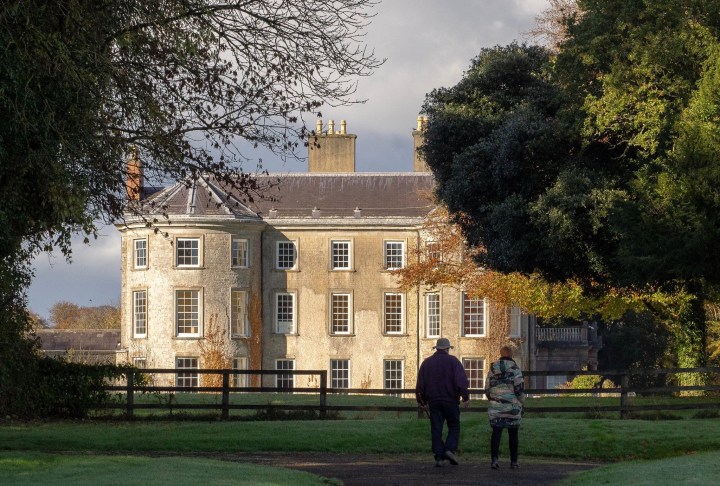
Doneraile Court (side of the house), near the town of Doneraile in County Cork, Ireland; most of the house dates to the early eighteenth century. After an extensive renovation by the Office of Public Works, the house opened to the public in 2019. The 400 acres of walled parkland are laid out in the style of Capability Brown (Office of Public Works).
Online Symposium | Speculative Minds in Georgian Ireland
From the conference programme:
Speculative Minds: Commerce, Experiment, Innovation, and the Arts in Georgian Ireland
Online, Thursday, 27 May 2021
Organized by Toby Barnard and Alison FitzGerald
 Maynooth University and the Irish Georgian Society are partnering to deliver a live online symposium, Speculative Minds: Commerce, Experiment, Innovation & the Arts in Georgian Ireland on Thursday, 27th May 2021. The symposium has been convened by Dr Toby Barnard, Emeritus Fellow of Hertford College, Oxford University, and Dr Alison FitzGerald, Associate Professor, Maynooth University. The symposium will appeal to both a specialist audience of academics and the general public. Bookings can be made online through the Irish Georgian Society’s website. Price: €40; full-time students are free (to register for a student place please email emmeline.henderson@igs.ie with a photo of your student ID).
The period between 1750 and 1837 saw a striking increase in the introduction of new materials, new manufacturing processes, and new products. ‘Novelty’ was at a premium: touted in newspaper advertisements, puffed in trade catalogues and pattern books, and encouraged by energetic individuals and learned groups. These initiatives were driven by simple curiosity, focused experimentation, patriotic and humanitarian ideals, and the quest for profit. Homes, small workshops, and large manufactories all felt the impact of these ‘polite and commercial’ impulses and the resulting artefacts; they spread beyond the peerage and landed elite through the professional and middling sorts. Arguably it was the latter who spread these developments most widely, thereby drawing Ireland deeper into the ambit, attitudes and fashions of Britain, continental Europe and the North Atlantic world. British artists, artificers, and entrepreneurs were quick to exploit the Irish market, feeding the appetite for what was new; as the potter Josiah Wedgwood wrote to his business partner in 1773, “Will not the people of Ireland like these things better that come from London?” This symposium investigates the intellectual, cultural, and mercenary forces behind these phenomena, looking closely at specific cases. It aims to clarify the nexus between art, commerce, and science in Georgian Ireland, especially in towns, most notably in Dublin, Britain’s ‘second city’.
Speculative Minds has been made possible through sponsorship from Sara Moorhead and Ecclesiastical Insurance. The symposium forms an action of the Irish Georgian Society’s Conservation Education Programme, overseen by Emmeline Henderson, IGS Assistant Director and Conservation Manager. The IGS’s Conservation Education Programme is supported by the Department of Housing, Local Government and Heritage and The Heritage Council and Merrion Property Group.
P R O G R A M M E
9.45 Welcome by David Fleming (Senior Lecturer, University of Limerick)
10.00 Toby Barnard, MRIA (Hon.) (Emeritus Fellow of Hertford College, Oxford University), A Taste for Pastes: Dr Henry Quin, James Tassie, and the Empress of Russia
10.30 Alison, FitzGerald (Associate Professor, Department of History, Maynooth University), Classicism and Commerce: Josiah Wedgwood and His ‘Seed[s] of Consequence’
11.00 Coffee Break
11.30 James Kelly, MRIA (Professor of History, and Head of the School of History and Geography, Dublin City University), The Impact of the English Visual Caricature Tradition on the Product of Single-sheet Caricature in Ireland, 1780–1830
12.00 Questions & Answers
12.30 Lunch Break
1.30 Leonie Hannan (Senior Lecturer, Department of History, Queen’s University Belfast), A Culture of Curiosity: Scientific Enquiry in the Eighteenth-Century Home
2.00 Finola O’Kane, MRIA (Professor, School of Architecture, Planning and Environmental Policy, University College Dublin), Dublin’s Sugar Landscapes in the Eighteenth Century
2.30 Jonathan Wright (Lecturer, Department of History, Maynooth University), The Merchant, the Quaker, and the Enslaved Boy: A Story of Slavery in Mid-Eighteenth-Century Ulster
3.00 Questions & Answers
Abstracts of papers and speakers’ biographies are available here»
Image: Detail from John Rocque’s Exact Survey of Dublin (1756).
PEM Names Lynda Roscoe Hartigan Executive Director and CEO
Press release (22 April 2021) from the museum:
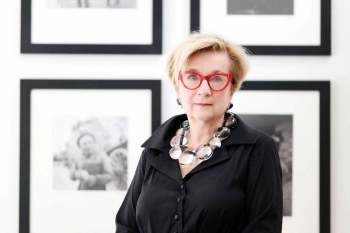
The Peabody Essex Museum today announces that Lynda Roscoe Hartigan will become PEM’s next Rose-Marie and Eijk van Otterloo Executive Director and CEO. Hartigan will assume her role on August 23, 2021 and become the first woman director of the nation’s oldest continuously operating museum.
Currently the Deputy Director for Collections & Research and Chief Innovation Officer at Canada’s largest and most visited museum, the Royal Ontario Museum in Toronto, Hartigan brings unparalleled organizational experience, a track record of excellence, and a progressive vision to advance PEM as a vital and positive force in people’s lives.
“We are thrilled to have Lynda at the helm, leading PEM boldly into the future,” said Stuart W. Pratt, Chair of PEM’s Board of Trustees. “As the Museum emerges from the pandemic and what has been the most extraordinary chapter in its 221-year history, Lynda’s leadership will provide a collaborative, confident spirit and an expansive vision for our staff, supporters, and community at large.”
Appointed as PEM’s first Chief Curator in 2003 and rising to Deputy Director in 2016, Hartigan led an ambitious, award-winning curatorial and exhibition program and reimagined the museum’s exhibition, publishing, and collection strategies. She oversaw the interpretation and reinstallation of PEM’s 40,000-square-foot wing that opened in 2019 and was integral to developing and advancing the museum’s collection stewardship, fundraising, education, digital, and global leadership initiatives.
“It is a tremendous honor to lead PEM, an organization whose focus on the potential of creativity, cultural understanding, and innovation are more relevant and needed than ever,” says Hartigan. “This is a pivotal moment for museums to stimulate conversation and connection with empathy and courage. I am passionate about ensuring that PEM welcomes all people to explore our shared humanity through the power of the arts and cultural expression.”
The leading scholar on American artist Joseph Cornell, Hartigan specializes in American art, especially modern, folk, and Black artists, yielding numerous widely recognized exhibitions and publications. Prior to joining PEM, Hartigan was Chief Curator of the Smithsonian American Art Museum in Washington, D.C., where she built internationally recognized collections by American Black and folk artists and led a major acquisitions initiative for modern and contemporary art.
Hartigan holds a B.A. in art history from Bucknell University and an M.A. in art history from George Washington University; she also attended the Getty Leadership Institute. Currently, she is a board member of the Association of Art Museum Curators.
Photo of Hartigan by Alex Paul, courtesy of the Peabody Essex Museum.
Call for Papers | UAAC/AAUC 2021, Online

From UAAC/AAUC:
Universities Art Association of Canada / l’association d’art des universités du Canada
Online, 20–23 October 2021
Proposals due by 16 May 2021
Every fall, UAAC-AAUC hosts Canada’s professional conference for visual arts-based research by art historians, professors, artists, curators, and cultural workers. The sessions and panels address issues and subjects in art history, theory, and practice from various methodological approaches.
We invite paper proposals for the UAAC-AAUC Conference 2021 Congrès. We offer a range of panels and roundtables that reflect the UAAC’s diverse constituents in terms of membership and scholarship. Submit proposals by using the Call for Papers Proposal Form PDF. Proposals are sent directly to the chair(s) of the session. The deadline for submission is 16 May 2021.
A selection of sessions potentially related to the eighteenth century, including the HECAA panel, is provided below. A full list of panels is available as a PDF file here.
◊ ◊ ◊ ◊ ◊
Historians of Eighteenth-Century Art and Architecture (HECAA) Open Panel
Chair: Ersy Contogouris (Université de Montréal), ersy.contogouris@umontreal.ca
HECAA works to stimulate, foster, and disseminate knowledge of all aspects of visual culture in the long eighteenth century. This open session welcomes papers that examine any aspect of art and visual culture from the 1680s to the 1830s. Special consideration will be given to proposals that demonstrate innovation in theoretical and/or methodological approaches.
Le but de HECAA est de stimuler, favoriser et diffuser la connaissance de tous les aspects de la culture visuelle du long XVIIIe siècle. Cette séance ouverte accueille des présentations qui examinent tous les aspects de l’art et de la culture visuelle des années 1680 aux années 1830. Une attention particulière sera accordée aux propositions qui démontrent une innovation dans les approches théoriques et / ou méthodologiques.
◊ ◊ ◊ ◊ ◊
Ibero-American Art, Identity, and Resistance
Chairs: Tatiane de Oliveira Elias (UFSM, Brazil), tatianeeliasufsm@gmail.com; and Patricia Branco Cornish (Concordia University), patricia.cornish@mail.concordia.ca
This panel aims to examine works by Ibero-American artists from the colonial period to contemporary times that debate migration and people’s movements across geographies. We seek to debate how artists interpret a new reality with constrained people movement in a pandemic. We seek contributions from a wide range of disciplines that engage with artistic practices in an Ibero-American context, including painting, performance, multimedia, art installation, and virtual reality (VR). We encourage submissions that debate how Ibero-American artists portray in their work the political and social aspects of cultural transfers resulting from people’s migration. We seek to discuss issues affecting minority populations and cultural transfers discourses in the context of immigration. We seek to debate how these works by Ibero-American artists demand from their makers a reconfiguration of thought and practices in current realities. We explore the importance of maintaining the Latin American historical memory and raising questions about preserving Latinxs identity and diversity. How politics influenced the Latin America art scene? How does the cultural flow happen in a new geographical location? How can arts promote cultural identity? How do artists negotiate their migrant identity in new geographies? How can artistic practices be reimagined in a new context in which we have limited physical interactions with others?
◊ ◊ ◊ ◊ ◊
Latin American and Caribbean Art (s): From Where? From Whom?
Chairs: Analays Alvarez Hernandez (Université de Montréal), analays.alvarez@umontreal.ca; and Alena Robin (Western University), arobin82@uwo.ca
This open session invites scholars, curators, and artists to share their current research on Latin American and Caribbean art (s). The goal is to create dialogue and exchange on the state of those fields. We welcome both contemporary and historical perspectives (from the pre-Columbian period to the present day) and the exploration of a variety of media (painting, sculpture, installation, photography, performance, socially engaged practices, new media, architecture, etc.). We are interested in examining the historical and contemporary presence of Latin American and Caribbean art(s)/artists beyond their traditional geopolitical borders; the inherent intersectionality of those concepts, and also their transmutation in light of past and current migratory and activist movements, technological advances, and sanitary crises; any other topic on art and artists in Latin America and the Caribbean delving into, for instance, the Caribbean’s complex relationship to Latin American. We accept proposals in French and English | Nous acceptons les propositions en français et en anglais.
◊ ◊ ◊ ◊ ◊
Mining the Connection(s) between Industry and the Arts
Chair: Jessica Mace (University of Toronto), jessica.mace@utoronto.ca
While industry and the arts may initially seem poles apart, the two fields are in fact closely entwined. Over time, visual and material culture has served to drive industrial development, for example through survey photography or the construction of company towns), and has responded to industrial production in myriad ways, from documentation to artistic interpretation. In recent years, the arts have also dealt with the effects and material legacies of deindustrialization, for instance through heritage, urban exploration, and adaptive reuse. This session, then, seeks to explore these varied connections and to bring to light these often-overlooked topics. We invite scholars at all stages of their careers to discuss their work in any medium or period of time as it relates to industry and/or industrial production.
◊ ◊ ◊ ◊ ◊
Research-Creation Caucus: How to be Artist-Scholars In and Outside of the Academy [Roundtable]
Chair: Stéfy McKnight (Carleton University), stefy.mcknight@carleton.ca
Can research-creation happen outside of academic institutions? This year, the Research-Creation Caucus will address current questions related to the methodology of research-creation and its connection to academic institutions. More specifically, how these institutions define research- creationists, and who may practice research-creation. There are opposing positions from artists- scholars that see research-creation as primarily an academic and institutional practice, while others argue that creative knowledges can happen outside of academia, and perhaps have done this before the formalization of research-creation in Canada. We as a collective will speak to the following questions: can research-creation disrupt traditional academic knowledge mobilizations, if research- creation being produced and defined by academic institutions? What happens to artist-scholars who change their career trajectories to work outside of academia? How does research-creation in institutions uphold and participate in colonial structures of knowledge production and dissemination? This session invites artist-scholars, curators, independent artists and producers to share their work, and give perspective on these competing debates.
◊ ◊ ◊ ◊ ◊
Graduate Student Lightning Talks | Exposés éclairs des étudiants diplômés
For the first time UAAC/AAUC is proud to feature Graduate Student Lightning Talks. This full session is composed of 5-minute presentations that provide graduate students the opportunity to present their current research or other area of interest. Participants may choose to present their work in the form of a focused summation, a case study, or a methodological approach. This is a great opportunity for graduate students to talk about topics that they are studying, practice presenting these topics and to engage with the broader academic community.
Pour la première fois, l’UAAC/AAUC est fière de présenter des exposés éclair d’étudiants diplômés. Cette session est composée de présentations de 5 minutes et donne aux étudiants diplômés l’occasion de présenter leurs recherches actuelles ou autres domaines d’intérêt. Les participants peuvent choisir de présenter leurs travaux sous la forme d’un résumé focalisé, d’une étude de cas, ou d’une approche méthodologique. Il s’agit d’une excellente occasion pour les étudiants diplômés de parler des sujets qu’ils étudient, de s’entraîner à les présenter, et de s’engager auprès de la communauté universitaire au sens large.
Call for Articles | Féminismes en Europe, 1789–1820
From the Call for Papers:
Féminismes en Europe, 1789–1820
Speical Issue of Annales historiques de la Révolution française, 2023
Proposals due by 15 September 2021
Dans le cadre d’un numéro spécial des Annales historiques de la Révolution française, nous sollicitons des contributions sur le thème suivant: « Féminismes en Europe »
Si le terme « féminisme(s) » n’est pas encore en vigueur à l’époque, la période allant de 1789 aux années 1820 est témoin de nombreuses prises de position en faveur des droits des femmes, appelant notamment à leur émancipation et/ou à leur intégration dans les conceptions de la citoyenneté qui s’imposent alors. On peut y inclure les discours sur l’éducation, sur la domination des hommes, sur l’égalité des sexualités, sur les moyens de remédier à la dépendance économique des femmes, sur la critique du mariage, c’est-à-dire le militantisme sous ses différentes formes mais aussi les prises de position contre-révolutionnaires ou anti-modernes dès lors qu’elles sont reliées, par les auteurs et autrices, à la question de l’émancipation des femmes. Malgré une historiographie abondante et en constante évolution sur le sujet depuis les années 1990, nous pensons qu’il est nécessaire de dresser un nouvel état des lieux de la question, en décalant notre regard de la seule scène française afin d’inclure les échanges et influences étrangères au sein du monde transatlantique (incluant l’Europe, ses colonies et ex-colonies).
Le fait est que si l’on documente et identifie bien, désormais, les prises de position des grandes figures qui, en France, ont pris la défense des femmes pour réclamer l’égalité des droits civils ou politiques — telles que Condorcet, Olympe de Gouges, Romme ou Guyomar ; si l’on commence à s’intéresser à des voix égalitaristes plus mineures comme, toujours en France, celle de Pons de Verdun (Lumbroso, 2021) ; si l’on connaît grâce aux travaux de Dominique Godineau (1989), Suzanne Desan (2002), Martine Lapied (2006) ou encore Laura Talamante (2017), l’engagement politique des « citoyennes tricoteuses » et « Amazones » dans le processus de démocratisation populaire, que ce soit à Paris ou à Marseille ; si l’on sait le rôle joué par certaines figures féminines comme Théroigne de Méricourt (Desan, 2020) ou Mary Wollstonecraft dans la diffusion et la réception des idées favorables à l’émancipation des femmes (Bour, 2013 par exemple) ; si l’on a mesuré l’importance des pétitions de femmes dans le processus de démocratisation de la société française à l’époque de la Révolution (Fauré, 2006) ; si le débat fut vif autour des raisons qui ont exclu (ou pas inclus) les femmes du droit de vote (Verjus, 2014) ; si on a commencé à s’intéresser avec sérieux à l’action politique des femmes engagées dans la contre-révolution (Mabo, 2017) ; enfin, si l’on connaît le niveau d’éducation extrêmement sophistiqué, parfois directement inspiré des écrits de Wollstonecraft, que certains hommes politiques américains ont fait donner à leur fille (par exemple, Theodosia fille d’Aaron Burr) ; si l’on a, par conséquent, amplement répondu à la question que posait Perrot en 1984 : une histoire des femmes est-elle possible ?, en la prolongeant d’interrogations menées à partir du point de vue plus englobant et conceptuel qu’adoptent les études de genre, plus rares sont les tentatives de dégager des visions d’ensemble des réseaux et des circulations d’idées sur la situation et l’émancipation des femmes au niveau européen dans les années 1790–1820, de l’ordre de celle qu’avait esquissée Margaret McFadden (1999) pour tout le XIXe, ou de celle qu’ont plus récemment tentée les coordinatrices de Transatlantic Feminisms in the Age of Revolutions (2012). S’il convient donc d’interroger l’engagement « féministe » des auteurs et autrices européens, à la suite, par exemple, des travaux consacrés aux Allemand·es Hippel (Gray, 1990) ou Sophie von La Roche (Joeres, 1986), aux Anglais comme Lawrence (Verjus, 2019), Holcroft (Binhammer, 2011), ou Godwin (Philp, 2020), ou encore aux Polonaises engagées dans les débats de la « Grande Diète » (Wisniewska, 2021), nous retiendrons aussi les nouvelles perspectives historiographiques sur des figures, des échanges, ou des mouvements moins connus. Nous accueillerons aussi les propositions qui se concentrent sur les réseaux comme, par exemple, les travaux sur le rôle des cercles masculins dans la construction d’un féminisme anglais dans les années 1790, dans la lignée de ce qu’a fait Chernock (2009). L’effort remarquable engagé par l’EHNE en faveur d’une histoire européenne n’oublie jamais, lorsqu’il s’agit d’interroger la source des féminismes du XIXème siècle, de mentionner la Révolution française ou les quelques noms qui ont fait la pensée émancipatrice hors des frontières de la France. Nous voudrions, dans la lignée et suivant l’exemple de cette approche résolument européenne, nous pencher sur ce qui a constitué l’armature de la pensée en faveur d’une émancipation des femmes à l’aube du XIXème siècle.
Vos propositions d’articles, d’une longueur maximale de 50 000 signes en français et 40 000 en anglais devront nous être adressées avant le 15 septembre 2021 à heuer@history.umass.edu, francoise.orazi@univ-lyon2.fr et anne.verjus@ens-lyon.fr. Idéalement, nous souhaiterions organiser une rencontre entre les autrices et auteurs retenu.es, aux alentours du printemps 2022. En présentiel si possible, en distanciel s’il le faut (ou les deux si c’est préférable). Le numéro paraîtra dans le troisième numéro de l’année 2023. Il sera d’abord publié entièrement en français, mais nous nous réservons la possibilité d’en avoir une version entièrement en anglais en ligne. Vos propositions, acceptées en français et en anglais, seront traduites par nos soins, sous votre contrôle.
Références citées dans le texte
• Binhammer, Katherine. « The Political Novel and the Seduction Plot: Thomas Holcroft’s Anna St. Ives ». Eighteenth-Century Fiction 11.2 (1999): 205–22.
• Bour, Isabelle. « A New Wollstonecraft: The Reception of the Vindication of the Rights of Woman and of The Wrongs of Woman in Revolutionary France ». Journal for Eighteenth-Century Studies 36.4 (2013): 575–87.
• Chernock, Arianne. Men and the Making of Modern British Feminism. Stanford: Stanford University Press, 2009.
• Desan, Suzanne. « Théroigne de Méricourt, Gender, and International Politics in Revolutionary Europe ». Journal of Modern History 92.2 (2020): 274–310.
• Desan, Suzanne. « Constitutional Amazons: Jacobin Women’s Clubs in the French Revolution » in B. T. Ragan Jr. and E. A. Williams (eds.), Re-Creating Authority in Revolutionary France (1992): 11–35.
• Fauré, Christine. « Doléances, déclarations et pétitions, trois formes de la parole publique des femmes sous la Révolution ». Annales historiques de la Révolution française 344 (1 juin 2006): 5–25.
• Godineau, Dominique. Citoyennes tricoteuses : les femmes du peuple à Paris pendant la Révolution française. Aix-en-Provence: Alinéa, 1988.
• Gray, Marion W. « Radical Feminism and a Changing Concept of Marriage : Prussia’s Theodor Gottlieb Von Hippel ». In Donald Horward and John Horgan (eds.), The Consortium on Revolutionary Europe, 1750–1850: Proceedings, 1989 to Commemorate the Bicentennial of the French Revolution, 807–14. Tallahassee: Institute on Napoleon and the French Revolution, Florida State University, 1990.
• Joeres, Ruth Ellen B. « “That girl is an entirely different character!” Yes, but is she a feminist? Observations on Sophia von La Roche’s Geschichte des Fräulein von Sternheim ». In German Women in the Eighteenth and Nineteenth Centuries: A Social and Literary History, par Ruth-Ellen B. Joeres et Mary Jo Maynes, 137–56. Bloomington: Indiana University Press, 1986.
• Lapied, Martine. « Parole publique des femmes et conflictualité pendant la Révolution, dans le Sud-Est de la France ». Annales historiques de la Révolution française 344 (1 juin 2006): 47–62.
• Lumbroso, Nicolas. « Pons de Verdun et l’égalité des droits en faveur des femmes. L’aspiration d’un Conventionnel à une plus grande égalité des sexes ». Annales historiques de la Révolution française, (2021, à paraître).
• Mabo, Solenn. « Femmes engagées dans la chouannerie : motivations, modalités d’actions et processus de reconnaissance (1794–1830) ». Genre & Histoire 19 (25 août 2017).
• McFadden, Margaret. Golden Cables of Sympathy: The Transatlantic Sources of Nineteenth-Century Feminism. Lexington: The University Press of Kentucky, 1999.
• Philp, Mark. Radical Conduct: History of Ideas and Intellectual History. Oxford: Oxford University Press, 2020.
• Talamante, Laura. « Political Divisions, Gender, and Politics: The Case of Revolutionary Marseille ». French History 31.1 (2017): 63–84.
• Verjus, Anne. « La citoyenneté politique au prisme du genre. Droits et représentation des individus entre famille et classe de sexe (XVIIIème–XXIème siècles) ». HDR, Ecole Normale Supérieure de Paris – ENS Paris, 2014.
• Verjus, Anne. « Une Société sans Pères Peut-Elle Être Féministe ? L’empire Des Nairs de James H. Lawrence ». French Historical Studies 42.3 (2019): 359–89.
• Wiśniewska, Dorota. « In the Shadow of a Mild Revolution: Polish Women’s Political Attitudes during the Great Sejm (1788−1792) ». Gender & History 33.1 (2021): 75–93.
Cecilia Zhou, Nattier Makeup Tutorial
From the Instagram account of the Metropolitan Museum of Art’s European Paintings Department:
Cecilia Zhou, Nattier Makeup Tutorial
21 April 2021
 Get your powder and rouge ready—we’re thrilled to introduce Cecilia Zhou’s makeup tutorial for Jean Marc Nattier’s Portrait of a Woman! In this tutorial, Cecilia provides us with an opportunity for close looking through the application of makeup, as she calls it, ”a kind of painterly reverse engineering.”
Jean Marc Nattier had enormous success portraying French aristocratic women: his innumerable portraits represent contrasting powdered skin and bright blush set against warm landscapes. Follow along as Cecilia explores the relationship between makeup, identity, and beauty in 18th-century France.
Jean Marc Nattier, Portrait of a Woman, 1753, oil on canvas (New York: The Metropolitan Museum of Art, 1982.60.42). More information on the painting is available here»
The Burlington Magazine, March 2021
The eighteenth century in The Burlington (I’m catching up, gradually!) . . . –CH
The Burlington Magazine 163 (March 2021)
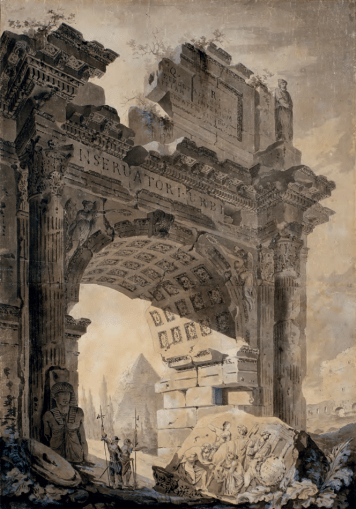
Hubert Robert, Arch of Septimius Severus, 1756; pen with grey and beige washes, 73 × 52 cm (Musée de Valence).
A R T I C L E S
• Pedro Luengo, “Spatial Rhetoric: Echoes of Madrid’s Alcázar in Palaces Overseas,” pp. 236–43.
Several key features of the Alcazar in Madrid—including the twin-courtyard plan, double staircase, and layout of the royal chapel—were replicated in royal palaces in Spain and elsewhere and in the viceregal palaces in Spain’s American empire as part of a desire to project a unified imperial image.
• Yuriko Jackall and Kari Rayner, “Becoming Hubert Robert: Some New Suggestions,” pp. 244–53.
The thin documentation of Hubert Robert’s early years makes it difficult to understand how the largely untrained student who went to Rome in 1754 emerged as a leading talent in Paris in the mid 1760s. Close examination of his art suggests that his rapid development was due to a rigorous course of study of perspective and life drawing, probably in response to criticisms of his abilities by the secretary of the Académie Royale, Charles-Nicolas Cochin.
R E V I E W S
 • Michael Hall, Review of Matthew Reeve, Gothic Architecture and Sexuality in the Circle of Horace Walpole (Pennsylvania State University Press, 2020), pp. 264–69.
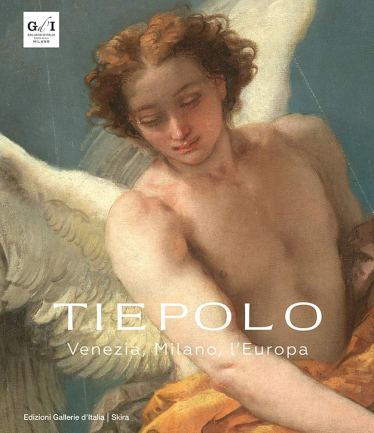
• Antonio Mazzotta, Review of the exhibition Tiepolo: Venezia, Milano, l’Europa (Milan: Gallerie d’Italia, 2020–21), pp. 273–75.
• Christoph Stiegemann, Review of the exhibition Passion, Leidenschaft: Die Kunst der großen Gefühle (Münster: LWL-Museum für Kunst und Kultur, 2020–21), pp. 275–78.
• Stephen Leach, Review of Matthew Craske, Joseph Wright of Derby: Painter of Darkness (Paul Mellon Centre for Studies in British Art, 2020), pp. 297–98.
• Philippe Malgouyres, Review of Suzanne Higgott, ‘The Most Fortunate Man of his Day’: Sir Richard Wallace: Connoisseur, Collector, and Philanthropist (Wallace Collection, 2018), pp. 298–99.
• Elena Almirall Arnal, Review of Carolina Naya Franco, El joyero de la Virgen del Pilar: Historia de una colección de alhajas europeas y americanas (Institución Fernando El Católico, 2019), pp. 302–03.
• Gauvin Alexander Bailey, Review of Laura Windisch, Kunst, Macht, Image: Anna Maria Luisa de’ Medici (1667–1743) im Spiegel ihrer Bildnisse und Herrschaftsräume (Böhlau Verlag, 2019), p. 303.
O B I T U A R I E S
• Peter Cherry, Obituary of Carmen Garrido (1947–2020), pp. 305–06.
Director of the Gabinete de Documentación Técnica at the Prado for thirty years, Carmen Garrido made major contributions to the technical study of Spanish painting, in particular with her publications on Diego Velázquez.
• Ger Luijten, Obituary of David Scrase (1949–2020), pp. 306–08.
In a career spent almost entirely at the Fitzwilliam Museum, Cambridge, David Scrase was responsible for numerous significant acquisitions and exhibitions. His magnum opus his his catalogue for the museum’s Italian drawings, published in 2011.
Panel Discussion | Enduring Versailles

Adam Perelle, Veue et Perspective du Chasteau de Versailles, avec le parterre d’eau du costé du Jardin, detail, 1680s.
◊ ◊ ◊ ◊ ◊
From Eventbrite:
Panel Discussion: Enduring Versailles
Online, Wednesday, 28 April 2021, 18.30–20.00 (EST)
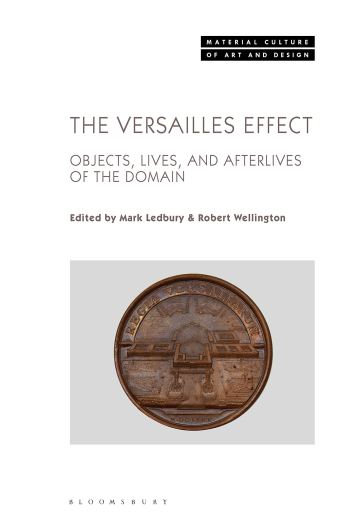
To celebrate the launch of the new book edited by Mark Ledbury and Robert Wellington, The Versailles Effect: Objects, Lives, and Afterlives of the Domaine (Bloomsbury Academic, 2020), we invite you to join us for a panel discussion on the place of the château de Versailles, the Trianons, and the domaine in the history of art today. As symbol, system and ecology, the Château and Domain of Versailles has long held a central but complex place in the history of Western art and in the global imaginary. The panel—hosted by the Historians of Eighteenth-Century Art & Architecture— will discuss how and why Versailles still remains at the center of long-eighteenth-century studies today. How does the monument to the Bourbon regime fare in the era of recuperative histories of gender, race, and class? Why bother with Versailles?
This is an online event; a Zoom link will be sent, one day prior, to those who have registered (via Eventbrite).
 Conveners
• Mark Ledbury—Power Professor of Art and Visual Culture, The University of Sydney
• Robert Wellington—Senior Lecturer, Centre for Art History and Art Theory, Australian National University
Panellists
• Basile Baudez—Assistant Professor in Architectural History, Department of Art and Archeology, Princeton
• Sarah Grandin—The Clark-Getty Paper Project Curatorial Fellow, Clark Art Institute
• Junko Takeda—Professor of History, Maxwell School of Citizenship and Public Affairs, Syracuse University
• Aaron Wile—Associate Curator, Department of French Paintings, National Gallery of Art, Washington, D.C.
US/UK/France
Wednesday, 28 April 2021
15.30–17.00 (PDT)
18.30–20.00 (EST)
23.30–01.00 (GMT)
00.30–02.00 (CEST)
Australia/New Zealand
Thursday, 29 April 2021
08.30–10.00 (AEST)
10.30–12.00 (NZST)
Should you wish to order a copy of The Versailles Effect, we invite you to take advantage of a 30% discount by entering the code AAH21 at the Bloomsbury website.
New Book | Surroundings
From the 1790s to today (Earth Day); from The University of Chicago Press:
Etienne Benson, Surroundings: A History of Environments and Environmentalisms (Chicago: The University of Chicago Press, 2020), 296 pages, ISBN: 978-0226706153 (hardcover), $83 / ISBN: 978-0226706290 (paperback), $28.
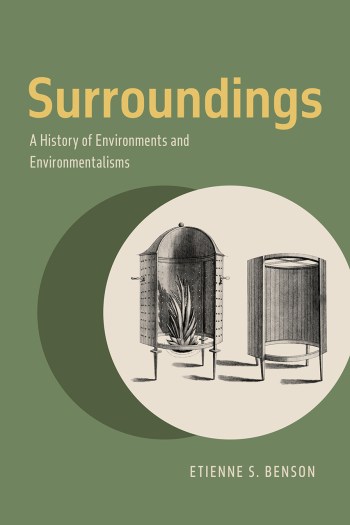 Given the ubiquity of environmental rhetoric in the modern world, it’s easy to think that the meaning of the terms environment and environmentalism are and always have been self-evident. But in Surroundings, we learn that the environmental past is much more complex than it seems at first glance. In this wide-ranging history of the concept, Etienne S. Benson uncovers the diversity of forms that environmentalism has taken over the last two centuries and opens our eyes to the promising new varieties of environmentalism that are emerging today. Through a series of richly contextualized case studies, Benson shows us how and why particular groups of people—from naturalists in Napoleonic France in the 1790s to global climate change activists today—adopted the concept of environment and adapted it to their specific needs and challenges. Bold and deeply researched, Surroundings challenges much of what we think we know about what an environment is, why we should care about it, and how we can protect it.
Etienne S. Benson is associate professor in the Department of History and Sociology of Science at the University of Pennsylvania. He is the author of Wired Wilderness: Technologies of Tracking and the Making of Modern Wildlife.
C O N T E N T S
Introduction: What Was an Environment?
1 The World in the Museum: Natural History and the Invention of Organisms and Environments in Post-Revolutionary Paris
2 Environments of Empire: Disease, Race, and Statistics in the British Caribbean
3 The Urban Milieu: Evolutionary Theory and Social Reform in Progressive Chicago
4 The Biosphere as Battlefield: Strategic Materials and Systems Theories in a World at War
5 The Evolution of Risk: Toxicology, Consumption, and the US Environmental Movement
6 The Human Planet: Globalization, Climate Change, and the Future of Civilization on Earth
Conclusion: What Might the Environment Become?
Acknowledgments
Notes
Index
New Book | The Usufructuary Ethos: Power, Politics, and Environment
Forthcoming from the University of Virginia Press:
Erin Drew, The Usufructuary Ethos: Power, Politics, and Environment in the Long Eighteenth Century (2021), 232 pages, ISBN: 978-0813945798 (cloth), $85 / ISBN: 978-0813945804 (paper), $40 / ISBN: 978-0813945811 (ebook), $30.
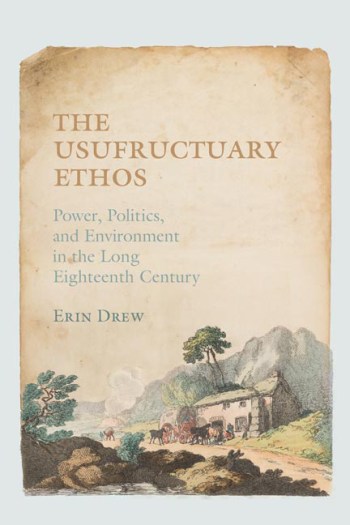 Who has the right to decide how nature is used, and in what ways? Recovering an overlooked thread of seventeenth- and eighteenth-century environmental thought, Erin Drew shows that English writers of the period commonly believed that human beings had only the ‘usufruct’ of the earth—the ‘right of temporary possession, use, or enjoyment of the advantages of property belonging to another, so far as may be had without causing damage or prejudice’. The belief that human beings had only temporary and accountable possession of the world, which Drew labels the ‘usufructuary ethos’, had profound ethical implications for the ways in which the English conceived of the ethics of power and use. Drew’s book traces the usufructuary ethos from the religious and legal writings of the seventeenth century through mid-eighteenth-century poems of colonial commerce, attending to the particular political, economic, and environmental pressures that shaped, transformed, and ultimately sidelined it. Although a study of past ideas, The Usufructuary Ethos resonates with contemporary debates about our human responsibilities to the natural world in the face of climate change and mass extinction.
Erin Drew is Associate Professor of English at the University of Mississippi.










 Enfilade
leave a comment