Online Talk | Helen Jacobsen on the Château de Bagatelle

François-Joseph Bélanger, Château de Bagatelle, 1777, Bois de Boulogne, Paris.
◊ ◊ ◊ ◊ ◊
This upcoming talk is the final installment of the Attingham Trust Spring Lecture Series. Annabel Westman—after more than 40 years of being involved with Attingham—recently announced that she is retiring from her position as executive director, to be succeeded by Helen Jacobsen. (You’re able to stage a virtual passing of the baton by watching a recording of Annabel’s March 8 talk for the lecture series— “What tone is salmon-coloured? Interpreting documentation in historic textile furnishing schemes” —just before you tune in for Helen’s.)
Helen Jacobsen, The Château of Bagatelle: The Story of a Remarkable House and Its Collections
Online, Wednesday, 28 April 2021, 6pm (BST)
Helen Jacobsen, the Director of the Attingham French Eighteenth-Century Studies course, looks at the absorbing story of the Château of Bagatelle, the former hunting lodge in the Bois de Boulogne that was transformed into a jewel of French neoclassicism as the result of a bet between Marie-Antoinette and her brother-in-law, the Comte d’Artois. Much more than a plaything, Bagatelle survived the Revolution and became the much-loved home of two more of the greatest patrons of French art, the 4th Marquess of Hertford and Sir Richard Wallace. Helen, who is also the Curator of French 18th-century decorative art at the Wallace Collection, will chart the life of the house under all three owners, and investigate the continuing connections between Bagatelle and Hertford House.
Call for Papers | Palaces for Rent: Real Estate in 18th-Century Lisbon

Palacio dos Condes de Aveiro, ca. 1742
(Lisbon: Biblioteca Nacional de Portugal)
◊ ◊ ◊ ◊ ◊
From the Call for Papers (which includes the Spanish version):
3rd International Conference Palaces for Rent: Real Estate in 18th-Century Lisbon
Palacios en alquiler: Patrimonio inmobiliario en la Lisboa del siglo XVIII
Universidad Nacional de Educación a Distancia, Madrid, 15 November 2021*
Proposals due by 30 June 2021
This conference is the third in a series dedicated to palaces in eighteenth-century European cities. Following the first conference focused on Rome (UNED, 2019) and the second on Madrid (UNED, 2020), the third and last edition is dedicated to the palatial heritage of the city of Lisbon. We seek to explore the particular case of Lisbon during the eighteenth century, including the cataclysmic earthquake of 1755, which effectively presents us with two cities: Lisbon before and Lisbon after the earthquake. This third conference aims to gather specialists with different areas of expertise in order to delve into the uses and practices of housing in Lisbon during the period, taking into account the social and urban transformations of the city and the changes in the uses of domestic space in palaces, introduced either by long-term residents (the nobility, bourgeoisie, or higher public state officials) or by short-term residents during diplomatic, political, and economic missions (diplomats, travellers, businessmen, agents, etc.).
Potential topics for discussion could include but are not limited to:
• Joanine Palaces versus post 1755 palaces, architectural and artistic aspects
• Internal organization of palaces, spaces and etiquette, from theory to practice
• The palace as the place of courtly sociability and courtly society
• Supply and demand in the housing market, sales, or rentals
• Decoration and interior design of noble residences
• Structure of noble households in Lisbon, servants, duties, etc.
• Ambassadors, legates, cardinals and other representatives and their Madrid residences
• Topographies of noble and diplomatic power
We invite scholars at all stages of their careers to propose 20-minute presentations in any of the main European languages. Candidates are invited to submit their proposals by 30 June 2021 to both scientific directors Pilar Diez del Corral Corredoira (diezdelcorral@geo.uned.es) and Milton Pedro Dias Pacheco (miltonpacheco@fcsh.unl.pt), and they should include title, an abstract (up to 500 words), and a brief CV (max. 1 page). Unfortunately, it will not be possible to cover travel and accommodation costs for participants. Applicants will be notified of the final selection by 15 July 2021.
Scientific direction
• Pilar Diez del Corral Corredoira | UNED | Madrid
• Milton Pacheco, CHAM | Lisboa
Scientific committee
• Alexandra Gago da Câmara | Universidade Aberta | Lisboa
• António Filipe Pimentel | Fundação Calouste Gulbenkian | Lisboa
• Nuno Senos | Universidade Nova de Lisboa | Lisboa
• Pilar Diez del Corral Corredoira | UNED | Madrid
• Milton Pedro Dias Pacheco | CHAM | Lisboa
* The date could be subject to change in the following months due to COVID-19 crisis and the subsequent health regulations. In the event of travel restrictions, conference organizers would provide adequate solutions to allow speakers to present remotely.
Call for Papers | SECAC 2021, Lexington
Noted below are several sessions at this year’s SECAC conference that might of be of interest to Enfilade readers; from the Call for Papers:
SECAC 2021
Hilton Lexington, Kentucky, 10–13 November 2021
Proposals due by 4 May 2021
The School of Art and Visual Studies at the University of Kentucky is pleased to be hosting the 77th annual meeting of SECAC (formerly the Southeastern College Art Conference) in Lexington, KY, November 10–13, 2021. As its theme, the conference will engage in conversations centered around the social responsibilities of artists, designers, and academics in higher education. We hope the conference addresses at many levels the struggle against racism. We want to promote scholarship and artistic practices that work toward a more just and ethical world. In addition to a return to what we hope will be a normal in-person conference, with panels, round-table sessions, exhibitions, and so on, conference attendees will be able to take advantage of the conference hotel’s central location in a vital downtown Lexington, which is also just a ten-minute walk from the UK campus.
All proposals and supporting documentation must be submitted through the secure submission platform. Proposals sent to session chairs directly will not be considered for inclusion in the conference program. You may submit up to two paper proposals, though please note that you may present only one paper. If two proposals from one applicant are selected, then the session chairs, in consultation with the Conference Director and his committee, will decide which proposal will be accepted and presented at the conference. You may chair one session in addition to giving one paper in your own session or in another session. All proposals must be submitted by 11:59 pm EDT on 4 May 2021. If selected to participate in the annual conference, current SECAC membership and conference registration are required for all presenters. Notifications will be made to applicants on or about 24 June 2021. Questions may be directed to 2021 Conference Director Rob Jensen (secac2021@uky.edu). For logistical assistance, contact SECAC Administrator Christine Tate (admin@secac.org).
◊ ◊ ◊ ◊ ◊
Gender and the Visual Arts in the Long Eighteenth Century
Chairs: Laura Winn (Jacksonville University) and Amanda Strasik (Eastern Kentucky University)
This session seeks papers that explore themes and issues related to the intersection of the visual arts and gender during the long eighteenth century (1688–1815) in an effort to support new approaches and scholarship in what remains an understudied field of art history and visual studies. The session is intended to offer a forum for papers that consider global perspectives, critical approaches to identity, patronage, and representation or occlusion to highlight the multifaceted relationships between gender, the visual arts, and systems of power during the Enlightenment.
◊ ◊ ◊ ◊ ◊
Plants, Gardens, and (Un)Natural Visions
Chairs: Alice Christ (University of Kentucky) and Judy Bullington (Watkins College of Art, Belmont University)
Gardens and the plants they sustain and display have served a wide range of cultural purposes in human civilization, rarely if ever limited to simple subsistence horticulture. People have collected, transplanted, represented, classified and actually genetically modified plants themselves in cultivation. Gardens too are a human manipulation of natural materials, perhaps intended as improvements on, escapes from, appropriations of, or substitutions for natural landscapes or ecosystems. Gardens and plants have been used, for example, to reproduce specific places, to construct utopias, or to manifest images of a supernatural world. Analysis of plants, gardens and their representations can illuminate ideologies of divine and human creation, uncultivated nature and civilization, the native and the exotic implicated, for example, in the colonial enterprise. This session presents studies of any aspect of historical manipulation and representation of plants or design of gardens as symbolic spaces or places revealing social, political or religious values of the cultures that produced them. We invite topics anywhere from ‘botanical decolonization’ in ‘native plants’ gardening today to Marie Antoinette’s potato flower hair ornaments to Zen gardens of stone; the milpa as cosmogram to the medieval closed garden; Persian paradise to Victorian plant prospecting, among a host of possibilities.
◊ ◊ ◊ ◊ ◊
Eighteenth-Century Art: Looking Ahead
Chair: Boris Zakić (Georgetown College)
This open session calls for papers on eighteenth-century art. From the latest newswire of the Dresden’s Green Vault heist of the eighteenth-century state treasures to the Hamilton-mania in the US to the premiere of the Céline Sciamma’s Portrait of a Lady on Fire in Cannes, France, the elements of the late baroque find their way into our cultural values (and politics) in innumerable ways. This session aims at reviving issues that may prove instructive to our moment.
◊ ◊ ◊ ◊ ◊
Undergraduate Art History Session
Chair: Amy Frederick (Centre College)
This session welcomes papers on any subject in the fine arts and art history by undergraduate students. The student’s proposal must be accompanied by a faculty member’s letter of support attesting to the validity of the research and also stating the faculty member’s willingness to assist the student in preparing the paper for presentation. Please email faculty support letter and résumé to amy.frederick@centre.edu.
New Collection of Essays | The Classical Vase Transformed
From Oxford University Press:
Alexia Petsalis-Diomidis with Edith Hall, eds., The Classical Vase Transformed: Consumption, Reproduction, and Class in Eighteenth- and Nineteenth-Century Britain, special issue of Bulletin of the Institute of Classical Studies 63.1 (June 2020).
The Classical Vase Transformed: Consumption, Reproduction, and Class in Eighteenth- and Nineteenth-Century Britain explores hitherto marginalized working-class and middle-class engagements with ancient Greek vases. Its origins lie in a symposium which took place in May 2016 at King’s College London, Ancient Greek Pots and Class in Britain, 1798–1939. This themed issue of BICS has three principal aims. First, to sharpen our awareness of the range of engagements with classical culture experienced at the lower end of the social spectrum, in the context of a scholarly focus on elites. Second, to help redress the balance within Classical Reception Studies, which is heavily skewed towards receptions of classical literature rather than classical material culture. And third, to increase the prominence of humble ceramics as compared to grand monumental sculpture, which remains the focus of studies on the reception of classical material culture. . . .
While a small but vocal minority of classicists remain unconvinced of the value of Classical Reception Studies, seeing ‘reception’ as an extraneous layer that needs to be ‘peeled off’ in order to access the ancient world ‘directly’, the theoretical basis of Classical Reception Studies continues to be a subject of scholarly debate (4). . . .
The reception of classical sculpture has fared relatively well within the disciplines of Art History, Eighteenth-Century Studies, and even Classical Archaeology. Areas of particular interest are collecting and the Grand Tour, and the nationalist use of sculptural archaeological remains in the nineteenth and twentieth centuries (9). But the reception of Greek vases, including the history of scholarship, collecting, creative responses, and influence on the production of later painting, has only recently started to be explored in depth. This state of affairs gives rise to the third aim of the issue: to put the reception of Greek vases in the spotlight in the context of the dominance of monumental stone sculpture in studies of receptions of classical material culture. . . .
The full introduction (including notes) is available here»
C O N T E N T S
 Acknowledgements
Contributors
List of Figures
• Alexia Petsalis-Diomidis, “Introduction,” pp. 8–14.
The Classical Vase Produced and Consumed in New Ceramic Forms
• Edith Hall, “How Much Did Pottery Workers Know about Classical Art and Civilisation?,” pp. 17–33.
• Alexia Petsalis-Diomidis, “Pottery Workers, ‘the Ladies’, and ‘the Middling Class of People’: Production and Marketing of ‘Etruscan and Grecian Vases’ at Wedgwood c.1760–1820,” pp. 34–53.
• Janett Morgan, “A Greek Tragedy? Why ‘Dillwyn’s Etruscan Ware’ Failed,” pp. 54–71.
• Paul Lewis, “Archaeology in the Home: Neoclassical Ceramics for New Audiences in Mid-Nineteenth-Century Britain,” pp. 72–88.
The Classical Vase Constrained in the Museum Cabinet and Transfigured in the Body
• Caspar Meyer, “Ancient Vases in Modern Vitrines: The Sensory Dynamics and Social Implications of Museum Display,” pp. 91–109.
• Helen Slaney, “Pots in Performance: Emma Hamilton’s Attitudes,” pp. 110–22.
• Abigail Baker, Myths of the Odyssey in the British Museum (and beyond): Jane Ellen Harrison’s Museum Talks and Their Audience,” pp. 123–37.
Response
• Katherine Harloe, “Classics Transformed? Ancient Figured Vases as a Test-Case for the Preoccupations of Classical Reception Studies,” pp. 138–42.
New Book | Classical Caledonia
From Edinburgh UP:
Alan Montgomery, Classical Caledonia: Roman History and Myth in Eighteenth-Century Scotland (Edinburgh: Edinburgh University Press, 2020), 232 pages, ISBN: 978-1474445641, £75 / $100 (also available in ebook and PDF formats).
 Explores early modern interpretations of Roman Scotland
• Examines an important aspect of the development of Scottish identity, a subject being brought to the fore again in recent debates surrounding Scottish independence
• Offers an in-depth study of a largely overlooked aspect of Scottish historiography
• Makes extensive use of archival and manuscript material, much of it previously unpublished
• Takes a broad, multidisciplinary approach
• Examines the influence of the Scottish Enlightenment, James Macpherson’s Ossianic poems, and the rise of Romanticism
This book focuses on early modern attitudes towards Scotland’s ancient past and looks in particular at the ways in which this past was not only misunderstood, but also manipulated in attempts to create a patriotic history for the nation. Adding a new perspective on the formation of Scotland’s national identity, the book documents a century-long, often heated debate regarding the extent of Roman influence north of Hadrian’s Wall. By exploring the lives and writings of antiquarians, poets, and Enlightenment thinkers, it aims to uncover the political, patriotic, and intellectual influences which fuelled this debate. Classical Caledonia casts light on a rarely discussed aspect of Scotland’s historiography, one which played a vital role in establishing early modern notions of ‘Scottishness’ at a time when Scotland was coming to terms with radical and traumatic changes to its position within Britain and the wider world.
Alan Montgomery received his PhD at the Birkbeck, University of London in 2016 and published several papers in key journals, including The Journal of British Identities and The Proceedings of the Society of Antiquaries of Scotland. Montgomery was elected a Fellow of the Society of Antiquaries of Scotland in 2019.
C O N T E N T S
Introduction
1 Imagining a Classical Caledonia: Sir Robert Sibbald’s Vision of Scotland’s Roman Past
2 Walled Out of Humanity: Sir John Clerk and his Circle
3 Resisting the ‘Conquerors of the Universe’: Celebrating the Caledonian Rejection of Rome
4 ‘Beyond the Vallum’: English Interpretations of Scottish History
5 ‘Monuments and Delights of the Arts’: Rediscovering the Material Remains of Rome in Scotland
6 Reconquering the Highlands: Hanoverian Interpretations of Roman Scotland
7 The Age of ‘Agricolamania’: Early Modern Uses and Abuses of Tacitus’ Agricola
8 Forging a Nation: The Spurious Histories of Charles Bertram and James Macpherson
9 After Ossian: Changing Interpretations of Roman Scotland
Conclusion
New Book | The Architecture of Scotland, 1660–1750
From Edinburgh UP:
Louisa Humm, John Lowrey, Aonghus MacKechnie, eds., The Architecture of Scotland, 1660–1750 (Edinburgh: Edinburgh University Press, 2020), 672 pages, ISBN: 978-1474455268, £150 / $195 (also available in ebook and PDF formats).
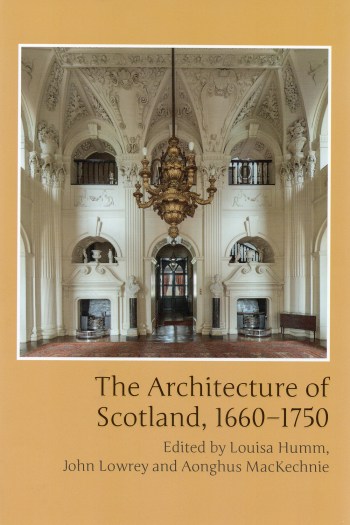 A rich, revisionist overview of Scotland’s early classical architecture
• Steps decisively away from the ‘Scottish castle’ genre of architecture
• Contextualises the work of Scotland’s first well-documented grouping of major architects—including Sir William Bruce, Mr James Smith, James Gibbs, and the Adam dynasty
• Documents the architectural developments of a transformational period in Scottish history
• Beautifully illustrated throughout with 300 colour illustrations
This architectural survey covers one of Scotland’s most important periods of political and architectural change when mainstream European classicism became embedded as the cultural norm. Interposed between the decline of ‘the Scottish castle’ and its revival as Scotch Baronial architecture, the contributors consider both private and public/civic architecture. They showcase the architectural reflections of a Scotland finding its new elites by providing new research, analysing paradigms such as Holyrood and Hamilton Palace, as well as external reference points such as Paris tenements, Roman precedents, and English parallels. Typologically, the book is broad in scope, covering the architecture and design of country estate and also the urban scene in the era before Edinburgh New Town.
Louisa Humm works at Historic Environment Scotland as Senior Casework Officer responsible for listed building consent work in Glasgow and other parts of South-West Scotland. Her interests include early eighteenth century gardens and designed landscapes, railway station architecture, and waterworks (particularly the Loch Katrine Scheme).
John Lowrey is a senior lecturer in architectural history in the School of Architecture and Landscape Architecture at Edinburgh University. He is also Dean of Undergraduate Studies in the College of Humanities and Social Science. His research interests are mainly Scottish and mainly in the long eighteenth century, with a special interest and wide range of publications in the architecture and urban design of the Enlightenment period, the early classical country house of the late seventeenth and early eighteenth century, and the designed landscape of Scotland.
Aonghus MacKechnie is Professor of Architecture at the University of Strathclyde, Glasgow; he also teaches at the Scottish Centre for Conservation Studies at the University of Edinburgh. He has researched and published on Renaissance-early modern architecture, culture, and Romanticism in Scotland, and also on the history and culture of the Highlands, in particular as author of Carragh-chuimhne, Two Islay Monuments and Two Islay People: Hector Maclean and John Francis Campbell (Ileach, 2004). His most recent book is his co-authored Scotch Baronial: Architecture and National Identity (Bloomsbury, 2019). Currently, he is a contributor to the forthcoming The Buildings of Scotland: Lothian (Yale University Press).
C O N T E N T S
Setting the Scene
Introduction — Aonghus MacKechnie
1 Political Economy and the Shaping of Early Modern Scotland — Allan Macinnes
Classicism and the Castle
2 The Paired Columned Entrance of Holyroodhouse as a Solomonic Signifier — Ian Campbell
3 Exiting Europe? The Royal Works in the Age of 1689 Revolution and 1707 Union — Aonghus MacKechnie
4 Sir William Bruce: Classicism and the Castle — John Lowrey
5 A Classic Looks at the Gothic: Sir John Clerk, Ruins, and Romance — Iain Gordon Brown
The Business of Building: Trades, Materials, and Pattern Books
6 Scottish Ironwork, 1660–1730 — Ali Davey and Aonghus MacKechnie
7 The Roof Structure of George Heriot’s Hospital Chapel and Roof Design in Scotland during the Seventeenth and Eighteenth Centuries — Anna Serafini and Cristina González-Longo
8 Thomas Albourn, William Bruce’s Plasterer: An Englishman and the Best Plaisterer That Was Ever Yet in Scotland — William Napier
9 Colen Campbell, James Gibbs and Sir John Vanbrugh: Rethinking the Origins of the British Architectural Plate Book — James Legard
The Country House
10 The Architectural Innovations of Mr James Smith of Whitehill (c. 1645–1731) within the European Context — Cristina González-Longo
11 From England to Scotland in 1701: The Duchess of Buccleuch Returns to Dalkeith Palace — Sally Jeffery
12 Women Patrons and Designers in Early Eighteenth-Century Scotland: Lady Panmure and Lady Nairne — Clarisse Godard Desmarest
13 Architectural Works by Andrew Fletcher of Saltoun — Rory Lamb
14 Mannerism in the Work of John Douglas in Eighteenth-Century Scotland — Dimitris Theodossopoulos
Gardens
15 ‘The Inexpressible Need of Enclosing and Planting’: Country House Policies in Scotland, 1660–1750 — Christopher Dingwall
16 The Terraced Garden in Scotland in the Seventeenth Century — Marilyn Brown
17 Alexander Edward’s European Tour — John Lowrey
18 William Adam and Formal Landscape Design in Scotland, 1720–1745 — Louisa Humm
19 Adam and Antiquity: An Arcadian Retreat at Arniston? — Nick Haynes
Urban Architecture
20 Town Housing and Planning: McGill, Gibbs, and Dreghorn in Early Georgian Glasgow — Anthony Lewis
21 Interpretation of European Classicism: Three Eighteenth-Century University Libraries — Deborah Mays
22 Edinburgh and Venice: Comparing the Evolution in Communal Living in Geographically Challenged Mercantile Communities — Giovanna Guidicini
23 Living Horizontally: The Origin of the Tenement in Paris and Edinburgh — Clarisse Godard Desmarest
24 William Adam’s Public Buildings — David W. Walker
Conclusion
25 Was Scotland a ‘Narrow Place’? — Ranald MacInnes
Abbreviations
End Notes
Index
Exhibition | American Weathervanes
This summer at the American Folk Art Museum (with the catalogue already available from Rizzoli). . .
American Weathervanes: The Art of the Winds
American Folk Art Museum, New York, 23 June 2021 — 2 January 2022
Organized by Robert Shaw and Emelie Gevalt
 American Weathervanes: The Art of the Winds is the first exhibition in more than four decades to highlight the beauty, historical significance, and technical virtuosity of American vanes fashioned between the late seventeenth and early twentieth centuries. The exhibition includes the graceful figure of Fame blowing a trumpet and standing en pointe like a celestial ballerina, attributed to well-known manufactory E.G. Washburne & Co. in New York City; a Dove of Peace designed by George Washington for his home in Mount Vernon; and an eagle possibly made in the foundry of revolutionary patrior Paul Revere. In addition to weathervanes, the exhibition will also include beautifully articulated wood sculptures by Harry Leach that functioned as patterns for weathevane molds for the Cushing & White and L.W. & Sons manufactories in Waltham, MA., watercolors of historic weathervanes painted for the Index of American Design, and rare archival materials that illuminate the development of the weathervane in the United States of America.
Robert Shaw is a critically acclaimed author, curator, and art historian who has written and lectured extensively on many aspects of American folk art. He has curated exhibitions at the Dallas Museum of Natural History, the Fenimore Art Museum, the National Gallery of Art, and the Shelburne Museum, where he served as curator from 1981 to 1994.
Robert Shaw, American Weathervanes: The Art of the Winds (New York: Rizzoli Electa, 2021), 256 pages, ISBN: 978-0847863907, $75.
New Book | Enlightened Animals in Eighteenth-Century Art
From Bloomsbury:
Sarah Cohen, Enlightened Animals in Eighteenth-Century Art: Sensation, Matter, and Knowledge (London: Bloomsbury Visual Arts, 2021), 264 pages, ISBN: 978-1350203587, $170 (also available in ebook and PDF formats).
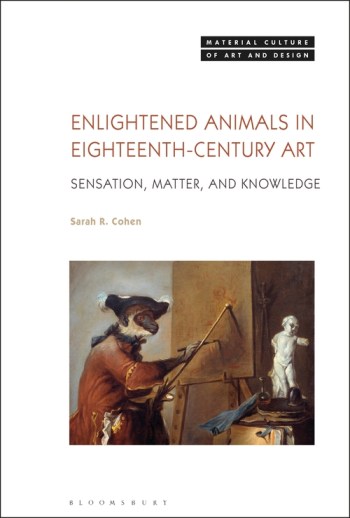 How do our senses help us to understand the world? This question, which preoccupied Enlightenment thinkers, also emerged as a key theme in depictions of animals in eighteenth-century art. This book examines the ways in which painters such as Chardin, as well as sculptors, porcelain modelers, and other decorative designers portrayed animals as sensing subjects who physically confirmed the value of material experience.
The sensual style known today as the Rococo encouraged the proliferation of animals as exemplars of empirical inquiry, ranging from the popular subject of the monkey artist to the alchemical wonders of the life-sized porcelain animals created for the Saxon court. Examining writings on sensory knowledge by La Mettrie, Condillac, Diderot and other philosophers side by side with depictions of the animal in art, Cohen argues that artists promoted the animal as a sensory subject while also validating the material basis of their own professional practice.
Sarah Cohen is Professor of Art History and Women’s Studies at the University at Albany, SUNY, USA. She has published extensively on representations of the body, both human and animal. Her first book Art, Dance and the Body in French Culture the Ancien Régime was published in 2000.
C O N T E N T S
Introduction
1 The Social Animal
2 The Sensitive Animal
3 Monkey Artists
4 The Language of Brutes
5 Animating Porcelain
6 The Soul of Matter
Conclusion
Bibliography
Index
Online Talks | HECAA Emerging Scholars Showcase
HECAA Emerging Scholars Showcase
Online, Saturday, 17 April 2021, 2:00–3:30pm (EST)
Our next HECAA Emerging Scholars Showcase is on Saturday, April 17, 2–3:30pm EST. Please join us via zoom to hear our final seven emerging scholars present their research. Each participant will present for 3–5 minutes, and after the presentations, we will host a question-and-answer session. If you have any questions or concerns, please contact Dani Ezor (dezor@smu.edu).
Best regards,
HECAA Board
◊ ◊ ◊ ◊ ◊
Zoom: https://smu.zoom.us/j/96125021098
• Carla Hermann (Rio de Janeiro State University), Robert Barker’s Panoramas and Virtual Images of Places
• Chih-En Chen (SOAS, University of London), Trompe l’Oeil Porcelain and Feminine Space in High Qing China
• Jed Surio (Tulane University), A Kingdom of Curious Beasts: Charles Le Brun’s Drawings from the Royal Menagerie
• Megan Baker (University of Delaware), Crayon Rebellion: The Politics of Pastel Portraits in Colonial North America
• Tori Champion (University of Washington), Pinceau à la main: The Intertwined Lives and Careers of Madeleine Françoise Basseporte and Marie-Thérèse Reboul Vien
• Kaitlin Grimes (University of Missouri-Columbia), The Material Politics of Ivory in Early Modern Europe
• Aleksander Musiał (Princeton University), Immersion: Classical Reception and Eastern-European Transformations of Hygiene Architecture, 1680–1830
Exhibition | À Table!
This summer at the National Museum of Ceramics at Sèvres, with an online version available here:
À Table! Le repas, tout un art / The Meal, a Whole Art
Sèvres — Manufacture et Musée Nationaux, 18 November 2020 — 16 May 2021 [original dates to be extended]
Organized by Anaïs Boucher and Viviane Mesqui
 The exhibition À Table! Le repas, tout un art explores the historical and cultural aspects of the art of the table and the art of French gastronomy. It reveals how the opulent and elegant banquets of the Ancien Régime became part of French culture by constituting an ideal of happiness and by transforming everyday lunches and dinners into extraordinary social occasions.
With a chronological approach, the exhibition explains the origins of popular French delicacies and how dining etiquette has evolved from antiquity to today. The selection of a variety of plates, forks, and other objects—functional or of pure fantasy—narrates the amazing stories behind familiar food customs. Sèvres porcelain is in the spotlight as it plays an important role in setting exquisite tables. This feast of Sèvres cups, plates, and glacières is our way to celebrate the 280th anniversary of the Sèvres Manufacture.
Anaïs Boucher and Viviane Mesqui, À Table! Le repas, tout un art (Montreuil: Gourcuff Gradenigo, 2020), 240 pages, ISBN: 978-2353403257, €39.










 Enfilade
leave a comment