New Book | The Enlightenment: The Pursuit of Happiness, 1680–1790
(The cover for the British edition, from Allen Lane, looks much ‘happier’ to me.–CH). From Harper Collins:
Ritchie Robertson, The Enlightenment: The Pursuit of Happiness, 1680–1790 (New York: Harper, 2021), 1008 pages, ISBN: 978-0062410658, £40 / $45.
 A magisterial history that recasts the Enlightenment as a period not solely consumed with rationale and reason, but rather as a pursuit of practical means to achieve greater human happiness.
One of the formative periods of European and world history, the Enlightenment is the fountainhead of modern secular Western values: religious tolerance, freedom of thought, speech and the press, of rationality and evidence-based argument. Yet why, over three hundred years after it began, is the Enlightenment so profoundly misunderstood as controversial, the expression of soulless calculation? The answer may be that, to an extraordinary extent, we have accepted the account of the Enlightenment given by its conservative enemies: that enlightenment necessarily implied hostility to religion or support for an unfettered free market, or that this was ‘the best of all possible worlds’. Ritchie Robertson goes back into the ‘long eighteenth century’, from approximately 1680 to 1790, to reveal what this much-debated period was really about.
Robertson returns to the era’s original texts to show that above all, the Enlightenment was really about increasing human happiness—in this world rather than the next—by promoting scientific inquiry and reasoned argument. In so doing Robertson chronicles the campaigns mounted by some Enlightened figures against evils like capital punishment, judicial torture, serfdom and witchcraft trials, featuring the experiences of major figures like Voltaire and Diderot alongside ordinary people who lived through this extraordinary moment.
 In answering the question ‘What is Enlightenment?’ in 1784, Kant famously urged men and women above all to “have the courage to use your own intellect.” Robertson shows how the thinkers of the Enlightenment did just that, seeking a well-rounded understanding of humanity in which reason was balanced with emotion and sensibility. Drawing on philosophy, theology, historiography, and literature across the major western European languages, The Enlightenment is a master-class in big picture history about the foundational epoch of modern times.
Ritchie Robertson is Professor of German at Oxford University, a fellow of the British Academy, and a lead reviewer for The Times Literary Supplement.
Call for Papers | Buying Art and Antiquities in Eighteenth-Century Italy
From the Call for Papers, which also includes the Spanish version:
Buying Art and Antiquities in Eighteenth-Century Italy
La compra de arte y antigüedades en la Italia del siglo XVIII
Online and/or Universidad Nacional de Educación a Distancia (UNED), Madrid, 4–5 November 2021
Proposals due by 31 May 2021

Jean-François Sablet, In the Antiquities Shop, Rome, 1788 (Private Collection)
The third meeting of the international conference series Transnational Relations and the Arts will address the issue of art and antiquities markets in eighteenth century. With the Grand Tour at its peak, men from all over Europe and beyond flooded into the cities of Italy, mainly Rome but also Naples, Venice, and Florence. These grand tourists fed an already flourishing art market and were also active agents of the spread of ancient marbles and vases, Old Master paintings, ancient coins, and medals back to their homelands, not to mention the diffusion of an international ‘buon gusto’ among the middling and upper classes.
We are interested in proposals that address any aspect related to this phenomenon. Especially welcome are cross-disciplinary contributions, proposals that deal with different cases studies in a comparative way, or studies focused in a city/country, as well as discussions around a particular period acquired at that period.
Topics may include, but are not limited to:
• Commercial hubs
• Agents: merchants, clients, antiquarians, dealers, etc.
• Logistics of buying art in the eighteenth century
• Forgeries and fakes of antiquities
• Copies of Old Masters for profit
• Classical art collections in the eighteenth-century (from the individual object to the whole collection)
Scientific coordination
Pilar Diez del Corral Corredoira (Eighteenth Century), diezdelcorral@geo.uned.es
David Ojeda Nogales (Classical Antiquity), dojeda@geo.uned.es
Please submit your proposal and an abbreviated CV to both organizers by 31 May 2021. And do not hesitate to write with any questions you have related to your proposal; we will be happy to discuss the details with you. Depending upon health conditions, the conference may take place online, but we will try our best to host it in Madrid. In the event that the conference will proceed online, we will assist with any technical support you may need in order to give the paper as easily as possible. There are plans for publishing the outcomes as a volume of selected papers in a prestigious print and the contributions will go through a peer-review system.
Online Lecture | Wendy Wassyng Roworth on Angelica Kauffman
Dr. Roworth’s talk, originally slated for last spring in St. Louis, has been rescheduled for later this month; from the Saint Louis Art Museum:
Wendy Wassyng Roworth, Angelica Kauffman: An Enterprising Artist in 18th-Century Britain
Mary Strauss Women in the Arts Lecture, Saint Louis Art Museum
Online, 25 March 2021, noon–1 pm (CDT)
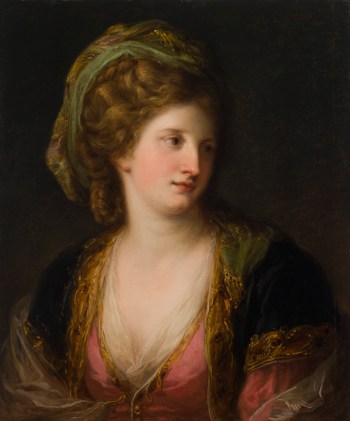
Angelica Kauffman, Woman in Turkish Dress, 1767, oil on canvas, 25 × 20 inches (Saint Louis Art Museum, Funds given by Dr. E. Robert and Carol Sue Schultz 704.2018).
Angelica Kauffman (1741–1807) was an Austrian-Swiss artist who began her career in Italy, where her clients included British tourists who encouraged the young painter to pursue her profession in England. Over the 15 years she worked in London, Kauffman achieved fame and fortune and returned to Italy as an international celebrity. This lecture celebrates a portrait recently acquired by the Museum. Wendy Wassyng Roworth will discuss Kauffman’s life and work in England as a fashionable painter and member of the Royal Academy of Arts, a rare distinction for a woman, and how the artist used her talents to her advantage.
Wendy Wassyng Roworth is Professor Emerita of Art History, University of Rhode Island.
This free, virtual program will take place on Thursday, 25 March 2021, via Zoom, and will include opportunities for participants to ask questions with the Q&A feature. Attendees’ mics and cameras will not be activated. Attendees must register to receive the Zoom link. Capacity for the live program is limited. A closed-captioned recording of the program will become available on the Museum’s YouTube channel in the weeks following. This program is supported by the Mary Strauss Women in the Arts Endowment.
4th Annual Ricciardi Prize from Master Drawings
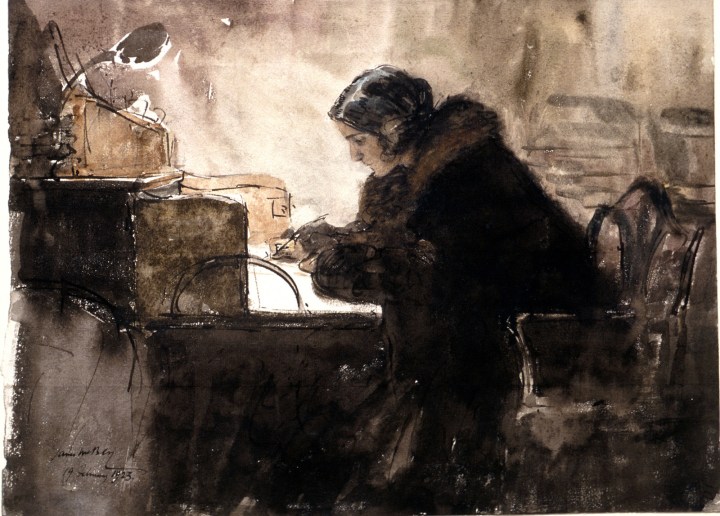
James Mcbey, Girl Writing A Letter, watercolor and pencil on paper (The Clark Art Institute, MA).
◊ ◊ ◊ ◊ ◊
From Master Drawings:
Fourth Annual Ricciardi Prize from Master Drawings
Submissions due by 15 November 2021
Master Drawings is seeking submissions by scholars under the age of 40 for our Fourth Annual Ricciardi Prize! The winning submission will be awarded $5,000, with a publication date in 2022. This year’s deadline is November 15, 2021. Remember, only essays on drawings topics will be considered. Finalists are also recognized with a prize and publication in the journal. You can read this year’s winning article in the June 2021 issue of Master Drawings. More information on how to apply is available here.
Reading Unopened Letters via X-ray Microtomography

An unopened letter, dated 31 July 1697, from Jacques Sennacques to his cousin Pierre Le Pers, virtually unfolded and read for the first time
(Photograph: Unlocking History Research Group)
◊ ◊ ◊ ◊ ◊
The latest from the Unlocking History Research Group, as published in Nature Communications:
Jana Dambrogio, Amanda Ghassaei, Daniel Starza Smith, Holly Jackson, Martin L. Demaine, Graham Davis, David Mills, Rebekah Ahrendt, Nadine Akkerman, David van der Linden, and Erik D. Demaine, “Unlocking History through Automated Virtual Unfolding of Sealed Documents Imaged by X-ray Microtomography,” Nature Communications 12 (2 March 2021), article number 1184.
Abstract: Computational flattening algorithms have been successfully applied to X-ray microtomography scans of damaged historical documents, but have so far been limited to scrolls, books, and documents with one or two folds. The challenge tackled here is to reconstruct the intricate folds, tucks, and slits of unopened letters secured shut with ‘letterlocking’, a practice—systematized in this paper—which underpinned global communications security for centuries before modern envelopes. We present a fully automatic computational approach for reconstructing and virtually unfolding volumetric scans of a locked letter with complex internal folding, producing legible images of the letter’s contents and crease pattern while preserving letterlocking evidence. We demonstrate our method on four letterpackets from Renaissance Europe, reading the contents of one unopened letter for the first time. Using the results of virtual unfolding, we situate our findings within a novel letterlocking categorization chart based on our study of 250,000 historical letters.
◊ ◊ ◊ ◊ ◊
New outlets—including The Art Newspaper, CNN, and The New York Times—have taken up the story. Here’s coverage from The Guardian:
In a world first for the study of historic documents, an unopened letter written in 1697 has been read by researchers without breaking the seal. The letter, dated 31 July 1697 and sent from French merchant Jacques Sennacques in Lille to his cousin Pierre Le Pers in The Hague, had been closed using ‘letterlocking‘, a process in which the letter is folded to become its own envelope, in effect locking it to keep it private. It is part of a collection of some 2,600 undelivered letters sent from all over Europe to The Hague between 1689 and 1706, 600 of which have never been opened.
The international team of researchers from universities including MIT, King’s College London, Queen Mary University London, Utrecht and Leiden, worked with X-ray microtomography scans of the letter, which use X-rays to see inside the document, slice by slice, and create a 3D image. They applied computational flattening algorithms to the scans to enable them to virtually unfold the letter without ever opening it, and discovered that Sennacques had been asking his cousin for a certified copy of a death notice of one Daniel Le Pers.
“It has been a few weeks since I wrote to you in order to ask you to have drawn up for me a legalised excerpt of the death of sieur Daniel Le Pers, which took place in The Hague in the month of December 1695, without hearing from you,” runs the letter. “I am writing to you a second time in order to remind you of the pains that I took on your behalf. It is important to me to have this extract & you will do me a great pleasure to procure it for me & to send me at the same time news of your health & of all the family.” . . . [as translated by the research team.]
The full article, by Alison Flood (2 March 2021), is available here»
Online Talk | Fortune and Folly in 1720
Wednesday evening on Zoom, from the BGC:
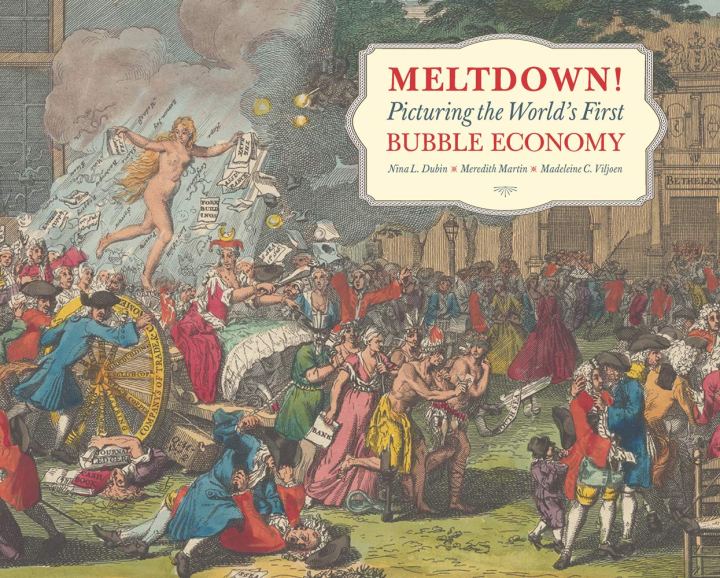
Nina Dubin, Meredith Martin, and Madeleine Viljoen | Fortune and Folly in 1720: Picturing the World’s First Bubble Economy
Françoise and Georges Selz Lectures on Eighteenth- and Nineteenth-Century French Decorative Arts and Culture
Online, Bard Graduate Center, New York, 3 March 2021, 6.00pm
This talk will explore The New York Public Library’s upcoming exhibition Fortune and Folly in 1720 (Fall 2021) and its accompanying publication Meltdown! Picturing the World’s First Bubble Economy (Harvey Miller/Brepols, 2020). Co-curated and co-authored by Dubin, Martin, and Viljoen, they tell two parallel stories: one of the spectacular rise and fall of the first bubble economy, and another of the enterprising art industry that chronicled its collapse. The Mississippi and South Sea Bubbles, spawning the invention of French banknotes as well as joint-stock companies built on fantasies of New World trade, imposed on everyday Europeans a crash course in new financial products. In turn, a bubbling print market relentlessly caricatured the meltdown of 1720, offering viewers an entertaining primer on the otherwise bewildering realities of modern economic life. Three hundred years later, our current moment offers a uniquely fitting vantage point from which to reconsider the significance of the bubbles and of the artworks that channeled the fears and desires they unleashed.
The event will be live with automatic captions. It will be held via Zoom; a link will be circulated to registrants by 3pm on the day of the event.
Nina L. Dubin is an associate professor of Art History at the University of Illinois at Chicago. Specializing in European art since 1700, she has published widely on the production of art within an economy of risk.
Meredith Martin is an associate professor of Art History at New York University and the Institute of Fine Arts. Specializing in European art of the long eighteenth century, she has published widely on gender and architectural patronage as well as maritime art, mobility, and exchange in the early modern world.
Madeleine C. Viljoen is Curator of Prints and the Spencer Collection at The New York Public Library. Responsible for the Library’s collection of prints and rare illustrated books, she has published widely on early modern printed images, with special attention to the goldsmith-engraver, the reproductive print, and ornament.
Exhibition | History in Motion: Tom Judd’s Subway Mural
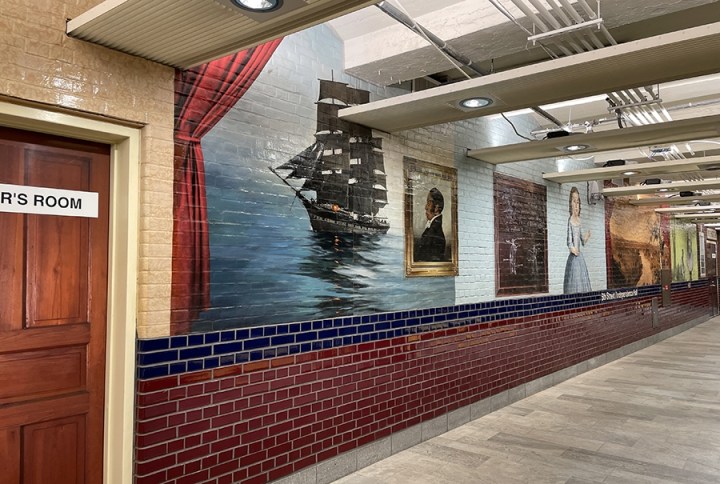
Installation photo of Tom Judd’s Portal to Discovery mural, 2020, produced for Philadelphia’s 5th Street-Independence Hall Station on the Market-Frankford Line.
◊ ◊ ◊ ◊ ◊
The Woodmere Art Museum hosts a virtual opening reception with the artist this evening (Tuesday) at 7pm, ET:
History in Motion: Tom Judd’s Subway Mural
Woodmere Art Museum, Philadelphia, 27 February — 13 June 2021
In connection with the reconstruction of Philadelphia’s 5th Street-Independence Hall Station on the Market-Frankford Line, and as part of SEPTA’s Art in Transit program, artist Tom Judd was selected to create a permanent installation for the station. Titled Portal to Discovery, Judd’s mural on the eastbound and westbound platforms presents figures who contributed to the founding of the United States as well as those who fought for “life, liberty, and the pursuit of happiness” for all. The mural includes portraits of eighteenth- and nineteenth-century Philadelphians such as Frances E. W. Harper, one of the first African American women to be published in the United States, and Absalom Jones, an African American abolitionist and clergyman who founded the Free African Society with Richard Allen in 1787. Juxtaposed with these figures are familiar landscape views of Philadelphia, windows, doors, and other architectural elements of the city. The experience is one of a great historical dreamscape that poses questions and promotes civic dialogue.
 The Museum’s exhibition includes preparatory studies for the mural as well as in-process photographs of the installation; the panels were fabricated by Ben Volta Studios and the installation was managed by James Shuster. The project was realized with help from graphic designer Wenlu Bao; David W. Seltzer, transit consultant and catalog producer; SEPTA; Burns Engineering, Inc.; Converse Winkler Architecture; and Marsha Moss, public art curator and consultant. The mural is an important addition to Philadelphia’s rich landscape of public art.
Judd grew up in Salt Lake City and attended the University of Utah from 1970 to 1972. He received his bachelor of fine arts degree in painting from the Philadelphia College of Art (now the University of the Arts). His work has been exhibited in museums and galleries across the United States, and is in the collections of numerous museums, including the Philadelphia Museum of Art, the Pennsylvania Academy of the Fine Arts, the Birmingham Museum of Art, and Woodmere Art Museum. Judd works in a variety of media, including painting, collage, photography, and installation.
Exhibition | Treasures from the Gilbert Collection

Oval green snuffbox associated with Frederick the Great, ca. 1765, Berlin; chrysoprase, gold, hardstones, and foiled diamonds
(London: V&A, The Rosalinde and Arthur Gilbert Collection)
◊ ◊ ◊ ◊ ◊
Opening this week at Antwerp’s DIVA museum for diamonds, jewellery, and silver:
Masterpieces in Miniature: Treasures from the Rosalinde and Arthur Gilbert Collection
DIVA, Antwerp, 5 March — 15 August 2021
Additional international venues to be announced
Curated by Alice Minter and Jessica Eddie
From March 5th to August 15th 2021, DIVA will host the touring exhibition Masterpieces in Miniature: Treasures from the Rosalinde and Arthur Gilbert Collection, organised by the Victoria and Albert Museum (V&A) in London. This is the first time items from all categories of the Gilbert Collection will go on display on the European continent. Some objects, such as the sixteenth-century partridge cup, are exclusive to the Antwerp exhibition. Masterpieces in Miniature is an ode to Rosalinde and Arthur Gilbert’s impressive legacy and a chance for the public to admire these treasures up close.
Visitors will make the acquaintance of Rosalinde and Arthur Gilbert and come to understand their collecting habits, traveling with them in search of exceptional craftsmanship and beauty and encountering famous historical figures such as Catharine the Great, Napoleon Bonaparte, and Queen Victoria. The showpieces include a snuffbox belonging to Frederick the Great of Prussia, made of chrysoprase, a rare gemstone mined in Silesia and set with hardstones and diamonds, the latter coloured by placing them over pale-pink, green, and lemon-coloured metal foils.
The Rosalinde and Arthur Gilbert Collection is a homage to exquisitely crafted objects, many in precious metals and often small in scale. The Gilberts spent over forty years amassing their collection of nearly 1000 items of fine silverware, gold (snuff)boxes, enamels, and mosaics made in Europe between the sixteenth and twentieth centuries. Their passion for craftsmanship and beauty resulted in a collection that is unparalleled today.
Arthur (1913–2001) and Rosalinde Gilbert (1913–1995) made their first fortune in the fashion industry in London in the 1930s. They swapped London for their newly designed villa in Beverly Hills and set up a successful property development business in America. A second success story soon followed. Their search for ‘beautiful things’ to decorate their home soon developed into a passion for collecting. The couple travelled the world looking for mosaics and the very best gold, silver, and enamel objects.
The desire to share their collection with others by putting it on public display was of real importance to the couple. In the 1970s the collection went to the Los Angeles County Museum of Art, before being transferred to Somerset House in London in 2000 and from there to its current home at the V&A. This is the first time items from all categories of the Gilbert Collection will go on display on the European continent. The collection will travel on from here to America and Asia.
Dries Otten (°1978) has been commissioned to design the set for Masterpieces in Miniature. The Antwerp-based interior architect, furniture and set designer is famous for his playful use of colour with historical references. He has already designed exhibition sets for the TextielMuseum, Bozar, and Texture.
Curators
Alice Minter, Curator of the Rosalinde and Arthur Gilbert Collection, V&A
Jessica Eddie, Assistant Curator of the Rosalinde and Arthur Gilbert Collection, V&A
Williamsburg Bray School Initiative Launched
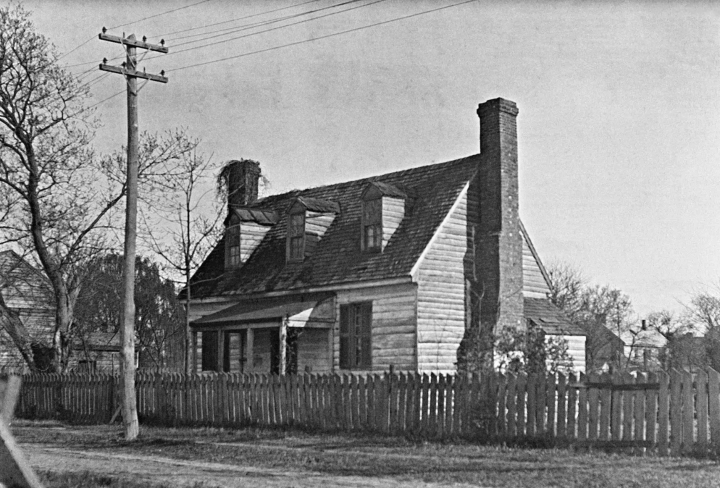
Established in 1760, the Bray School educated enslaved and free Black children in Williamsburg, Virginia. This 1921 photo shows the front elevation of the building, subsequently the Dudley Digges House, in its original location on Prince George Street. The school operated in the building from 1760 until 1765. It is likely the oldest extant building in the United States dedicated to the education of Black children. (Earl Gregg Swem/2010 The Colonial Williamsburg Foundation).
◊ ◊ ◊ ◊ ◊
Press release from Colonial Williamsburg:
A small, white building tucked away on the William & Mary campus once housed the Williamsburg Bray School, an 18th-century institution dedicated to the education of enslaved and free Black children, researchers have determined. Now, the university and Colonial Williamsburg are working together to ensure current and future generations learn about the complex history of what is likely the oldest extant building in the United States dedicated to the education of Black children—and the stories of those who were part of it. The new partnership calls for relocation of the Bray-Digges House to Colonial Williamsburg’s Historic Area, where it would become the 89th original structure restored by the foundation. It also establishes the Williamsburg Bray School Initiative, a joint venture of the university and foundation to use the site as a focal point for research, scholarship, and dialogue regarding the complicated story of race, religion, and education in Williamsburg and in America.
Dendrochronology analysis of the building’s wood framing in 2020 by Colonial Williamsburg researchers confirms that the structure at 524 Prince George St. once housed Williamsburg’s Bray School, an institution that educated many of the town’s Black children from 1760 to 1774. Suggested for establishment in Williamsburg by Benjamin Franklin, the Bray School’s mission was to impart Christian education to Black children and for students to accept enslavement as divinely ordained.
Virginia Governor Ralph Northam was scheduled to join the Williamsburg community for a special event at 5pm Thursday commemorating the history of the Bray School, its rediscovery, and plans for site and interpretation. Due to COVID-19 guidelines, the event was not open to the general public to attend in person but was available virtually via live stream.
“It is hard to overstate the importance of this discovery, of the robust history that will be uncovered through this partnership between William & Mary and Colonial Williamsburg” said William & Mary President Katherine A. Rowe. “So much of our history as a nation has gone unrecorded—the history of African Americans, their oppression, and resistance. By studying the legacy of the Bray School students, we will uncover and illuminate some of the most important impacts of education in the story of America.”
Colonial Williamsburg’s initial work to restore and interpret the Bray School’s historic structure is possible in part thanks to a grant of $400,000 from the Gladys and Franklin Clark Foundation. Cliff Fleet, president and CEO of Colonial Williamsburg, said the project is a critical step toward fostering a broader understanding of Americans’ shared history. The grant from the Clark Foundation will allow Colonial Williamsburg to relocate the structure to the Historic Area, and additional funds will be raised to complete the restoration and interpretive work.
“Colonial Williamsburg and William & Mary’s partnership to research, restore, and interpret the original structure of the Bray School is critical to our ongoing work to uncover our common past and expand our understanding of America’s founding,” Fleet said. “We’re very grateful to the Clark Foundation, whose generous support makes this effort possible. We invite guests, the community, and the nation to join us as we continue to pursue and present a more complete story of all who lived in Williamsburg during the Revolutionary era.”
A Virginia Department of Historic Resources marker commemorating the school’s 18th-century location was unveiled at Brown Hall, a William & Mary residence hall, in early 2019, and Rowe noted that the new joint venture aligns with other William & Mary initiatives that address the institution’s historical involvement with slavery. Construction is to begin this year on Hearth: Memorial to the Enslaved, a monument dedicated to the enslaved individuals who labored at William & Mary, while the Lemon Project is a scholarly and educational initiative that investigates slavery and its legacies— and particularly William & Mary’s involvement in the practice. The Lemon Project takes its name from Lemon, an enslaved worker at William & Mary.
Jody Allen, the Robert Francis Engs Director of the Lemon Project, explained that the Bray School legacy has long been a part of the Lemon Project’s programming. Identification and engagement of descendants of Bray School scholars are among the priorities of the Williamsburg Bray School Initiative. Allen was recently appointed by Governor Northam to Virginia’s Commission to Study Slavery and Subsequent De Jure and De Facto Racial and Economic Discrimination. She said she expects the Bray School Initiative to allow scholars to follow more closely the intriguing line of evidence of a Bray School education having influence that is deep and wide among Williamsburg’s Black population.
“When we talk about the history of slavery and the history of the African American experience at William & Mary, we include the Bray School,” Allen said. “We believe the Bray School not only impacted the children who actually attended the school, but it impacted their descendants. We believe very strongly that they went on to share their knowledge with brothers, sisters, neighbors.”
William & Mary and Colonial Williamsburg are both neighbors, and frequent collaborators. The Bray School has been the object of numerous research initiatives focusing on archival as well as material-culture sources aimed at expanding the collective understanding of history, including the joint archaeological excavation of the historic Bray-Digges House site at Prince George and Boundary streets. Currently, the university and foundation are partners in work led by the city’s Historic First Baptist Church to research and interpret its first permanent site on South Nassau Street. The Bray School partnership will facilitate continued research and interpretation, and a deeper examination of a number of aspects of history through the lens of the Bray School, including perspectives from families whose children attended the school and the motivations of white slaveowners who sent them there.
“Our knowledge of history is not static; it continues to reveal itself through critical work like the investigation of the Bray-Digges House,” said Stephen Seals, a Colonial Williamsburg interpreter, program development manager and community liaison. “The Bray School represents another complex chapter in our nation’s story, and its restoration and interpretation will be critical to our community’s work to foster a more complete understanding of our shared history.”
Nicole Brown, an actor-interpreter and scholar who portrays Colonial Williamsburg Nation Builder Ann Wager, the white teacher at the Williamsburg Bray School, is also a graduate student in William & Mary’s American Studies Program. Currently, Brown is studying the history and impact of the Bray Schools in Williamsburg and beyond. Her work has taken her to Oxford’s Weston Library, where she dove into some 8,000 pages of records of the Associates of Dr. Bray, the London organization that established or tried to establish Bray Schools throughout the New World in Philadelphia, Nova Scotia, and the Bahamas. Brown’s work with Colonial Williamsburg is supported by the Mary and Donald Gonzales Field Experience Fund.
“This research gave me a great deal of insight into Ann Wager and her students. You can learn a great deal about the school based on the books she used at the school,” Brown said. “Quite frankly, you learn a lot about the pro-slavery ideology of the school when you see how many of the books are extremely rooted in systemic racism.”
Julie Richter, a lecturer in William & Mary’s Department of History and the director of the National Institute of American History & Democracy (NIAHD), itself a partnership of William & Mary and Colonial Williamsburg, said there are surviving student lists from only three years: 1762, 1765, and 1769.
“I’m eternally optimistic that there will be a few more lists that someone will find in time,” Richter said. “But right now, we have these three slices in time to try to tease out what students were at the school and who sent them.”
Brown and Richter said slaveowners had varied motivations for enrolling enslaved children. Literacy and math skill increased the auction value of any enslaved individual, while Brown pointed out that a Bray School education increased a person’s usefulness to the slaveowner, in particular one who operated a commercial establishment. Students likely also had varying intentions for use of their education, often in direct contradiction with their owners’, Brown noted.
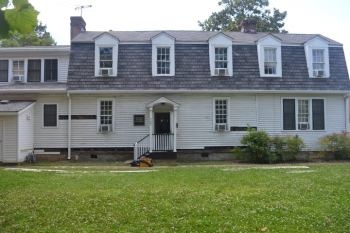 The first dots establishing the Bray-Digges link were unearthed and connected by Terry Meyers, Chancellor Professor of English, Emeritus, at William & Mary. Meyers was reading a memoir by a local resident when he came across a reference to an 18th-century cottage that in 1930 had been moved down Prince George Street from the corner of Prince George and North Boundary streets. He visited Colonial Williamsburg’s John D. Rockefeller Jr. Library, where there was a file on the building.
“From that, I was able to go back and look at what is now 524 Prince George St.,” Meyers said. “And I realized that if you look at that structure and erase the two additions on the right and the left and change the roofline from a Dutch colonial roof to a proper cottage roof, you actually do have an 18th-century cottage.”
Researchers led by Matt Webster, Colonial Williamsburg’s executive director of architectural preservation and research, discovered the reconfigured roof line that Meyers had noticed and a window sash that dates to the original construction date.
“Our analysis of the structure’s oldest elements conclusively places the timber’s harvest between the winter of 1759–60 and the spring of 1760, with the establishment of the Williamsburg Bray School in 1760,” Webster said. “That, combined with existing evidence of the Bray School’s historical location on Prince George Street, makes a compelling case that this is the original structure, and the building still has a great deal more to teach us.”
Meyers found that the Bray School operated in the Digges building from its 1760 founding until 1765, when the school was moved, possibly out to Capitol Landing Road.
Meyers noted that “education is almost invariably subversive.” Like Allen, he said there is evidence that students at the Bray School took their literacy skills back home and spread them around.
“If you are taught to read the Bible,” Meyers said. “you will be able to read other things. Once you educate people, they are better equipped to think critically.”
The timeframe for relocation of the Bray-Digges building is yet to be determined, and Colonial Williamsburg and William & Mary are considering a number of potential sites. The building most recently housed offices for William & Mary’s Department of Military Science and has been known as Prince George House.
Exhibition | Signed in Silk

From the press release (27 January 2021) for the exhibition:
Signed in Silk: Introducing a Sacred Jewish Textile
Saint Louis Art Museum, 19 March — 3 October 2021
Curated by Genevieve Cortinovis
The Saint Louis Art Museum presents Signed in Silk: Introducing a Sacred Jewish Textile, an exhibition highlighting an extraordinary 2019 acquisition, an 18th-century Italian Torah Ark Curtain, or parokhet. In 1755, in the port city of Ancona on the Adriatic coast, artist Simhah Viterbo (1739–1779) embroidered a dedicatory inscription across the lower edge of this magnificent textile. About 15 at the time, Viterbo was continuing in a long tradition of Italian Jewish women who created sumptuous textiles for their synagogues. Drawing upon the Museum’s rich collection of 17th- and 18th-century sacred and secular textiles, the exhibition considers how Viterbo created an object that reflected not only her Jewish heritage but also her own place and time, at the center of a major trading crossroads during an era of increasing cultural connectivity.
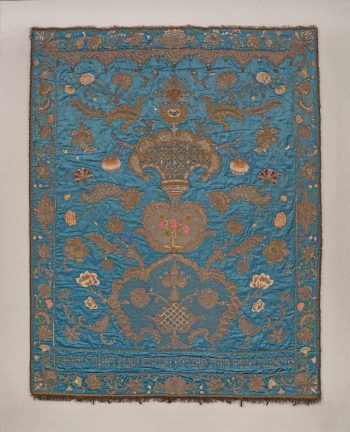
Simhah Viterbo, Torah Ark Curtain (Parokhet), 1755; silk, silk and metallic thread, vellum, metal paillettes, cotton thread, velvet, metallic fringe, linen backing; 87 × 66 inches (Saint Louis Art Museum, The Deane and Paul Shatz Endowment Fund for Judaica 2:2019).
In the 18th century, Ancona was a bustling port, home to many, including a prosperous and cosmopolitan community of Jewish traders. It was also a Papal State that since 1555 systematically had oppressed the Jewish residents, most of whom were forced into a few low-skill trades, and isolated them in ghettos, the term then used for prison neighborhoods. Paradoxically, this segregation of culturally diverse Jewish communities coincided with a flowering of Jewish ceremonial art, and this Torah Ark Curtain exemplifies the lavish sacred textiles made by Italian Jews during this period.
The prevailing decoration of 18th-century Italian Jewish textiles was floral; however, Viterbo’s design is unusual in its oversized, symmetrical central motif and narrow enclosed border. Its metal embroidery—scrolls, shells and diapered baskets—was consistent with the ornate Late Baroque and early Rococo ornament that embellished fashionable European dress, textiles and silver of the same moment. Yet the overall composition of the parokhet has more in common with a group of embroidered curtains made within the vast Ottoman Empire, which at that time included parts of the Balkans, North Africa and the Middle East.
Rare Hebrew books, printed in Venice and borrowed from Washington University’s Shimeon Brisman Collection, join with splendid examples of Italian, Greek, Ottoman, and Indian textiles to make Signed in Silk a celebration of Viterbo’s skill in having synthesized a range of decorative motifs, techniques, and forms. The exhibition explores how influences from Baroque garden design, Christian ecclesiastical embroidery, botanical naturalism, Ottoman prayer rugs, and Renaissance pattern books coalesced in the handwork of a young woman confined to a ghetto. Viterbo’s accomplished work nevertheless reveals her connection—through textiles—to networks of trade from London to the Levant.
Signed in Silk is curated by Genevieve Cortinovis, the Andrew W. Mellon Foundation Assistant Curator of Decorative Arts and Design.










 Enfilade
leave a comment