Sweden Nationalmuseum Acquires Two Portraits by J. E. Alphen
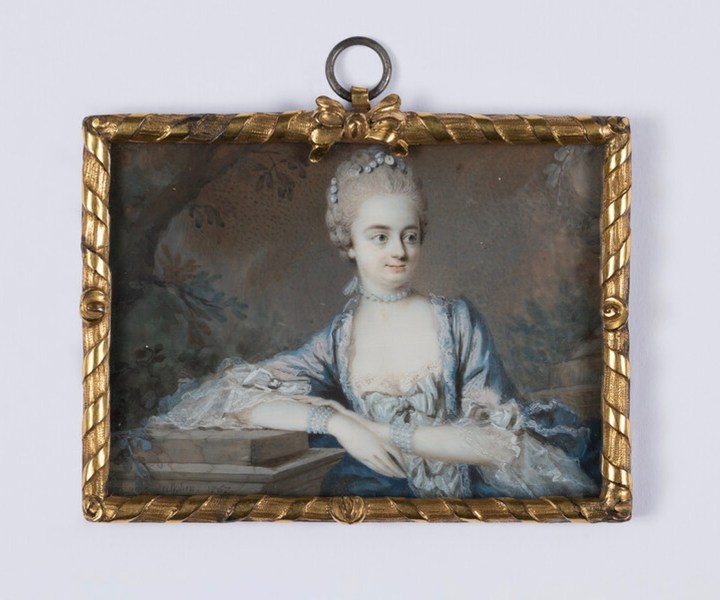
Johann Eusebius Alphen, Portrait of a Lady in a Blue Dress, 1767, watercolour and gouache on ivory
(Stockholm: Nationalmuseum, photo by Anna Danielsson)
◊ ◊ ◊ ◊ ◊
Press release (2 June 2021) from Sweden’s Nationalmuseum in Stockholm:
Nationalmuseum has acquired two portraits of women created by the Austrian court miniaturist Johann Eusebius Alphen in 1767. The portrayals of the models are unusually vivid, and the artist has even been carefully rendering the setting. The two portraits are unique because few signed works by Alphen have survived, as the artist was just 31 years old when he died.
In the mid-18th century, if a young artist wanted to further educate himself in miniature painting, Paris was one of the most interesting places to be. The city’s leading name was Jean-Baptiste Massé, a member of the academy and royal court painter. He revitalised miniature painting with his loose and unconventional brush technique. By this time Massé was no longer active as an artist, because he had started to have problems with his eyesight around 1740 and therefore declined to take on any more royal commissions.
Although Massé had essentially ceased painting, he would continue to play an important role as a teacher. In February 1764, the Austrian Johann Eusebius Alphen (1741–1772) came to Paris and was introduced to the French miniaturist. Yet Alphen was not the only student who quickly rose to favour. That same year, he faced competition from the Dane Cornelius Høyer, who also became a lodger with Massé until the master’s death in 1767. The two young artists, who were even the same age, each acquired the same technique of using loose brushwork. Alphen in particular became a virtuoso, as evidenced by the two recently acquired portraits of women. On their faces, he has combined a refined line and dot technique with a fluid brushstroke to depict clothing and other accessories. White highlights reinforce the sense of materiality and illusionism. This approach is reminiscent of pastel painting, in which Alphen was also skilled. As with his teacher Massé, the red and yellow dyes have faded into carnation, contributing to the unusually bright, powdered look of the faces. Only blue and grey halftones remain.
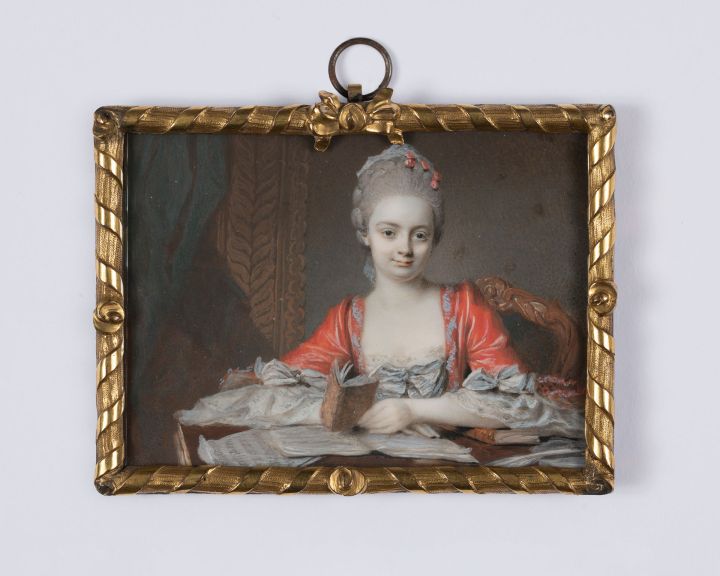
Johann Eusebius Alphen, Portrait of Countess van Lebel, 1767, watercolour and gouache on ivory
(Stockholm: Nationalmuseum, photo by Anna Danielsson)
◊ ◊ ◊ ◊ ◊
Both portraits are signed and dated “Peint par Alphen 1767.” It is unclear whether they were painted while the artist was still in Paris or recently after his arrival in Vienna. The younger lady, dressed in red, sits at a table with notes and a pen in front of her, as well as a book in one hand. The Canadian Mozart specialist Cliff Eisen of King’s College London has floated the theory that this young woman is Wolfgang Amadeus Mozart’s sister Maria Anna, nicknamed Nannerl, who was five years older than the composer. Alphen’s portrait has a direct counterpart in a Swiss private collection. This preliminary study purportedly has ownership-related links to other Mozart portraits. Even if this were not the case, Alphen met the Mozart family on several occasions. The first time was in Brussels in 1763, then three years later in Paris, and finally in Vienna in 1767–68. Their last encounter was in Milan in 1771, where Alphen had a one-on-one rendezvous with Mozart, who mentions their meeting in a letter to his sister Nannerl.
So who is this young woman in red? It is undoubtedly the same model as in the sketch, but is she Maria Anna Mozart? The portrait acquired by Nationalmuseum bears the signature “Comtesse von Lebel.” No countess with this name is known to have lived, but could the name could be a euphemism for the Baroness Berchtold von Sonnenburg, the real Nannerl? In truth, this woman bears little resemblance to other famous representations of Mozart’s sister from around the same time. While this little mystery may never be answered, we can still appreciate the fact that Alphen’s two portraits are unusual examples of the artist’s great virtuosity as a miniaturist.
Nationalmuseum receives no public funding for the acquisition of artworks but relies on donations and gifts from private individuals and foundations to enrich its collections. The acquisition has been made possible by generous contributions from Hjalmar and Anna Wicander’s donation funds.
Print Quarterly, June 2021
The eighteenth century in the latest issue of Print Quarterly:
Print Quarterly 38.2 (June 2021)

Jeanne-Elisabeth Chaudet, Portrait of a Young Girl, traditionally Identified as Madame Villot, née Barbier, Carrying Her Father’s Sabre, oil on canvas, likely shown at the Salon in 1817 (Private Collection).
A R T I C L E S
Claire Brisby, “Orthodox Prints in the Samokov Painter’s Archive”
Addressing the distinctive category of religious prints produced for the Orthodox Christian market from 1698 to 1864, Brisby’s article focuses on prints that once formed the image archive of the painter Christo Dimitrov and his son and other family members in Samokov, Bulgaria—prints that have received limited scholarly attention. The article discusses various sites of print production and explores the use of prints in workshops as models for frescoes and paintings.
N O T E S
F. Carlo Schmid, “Prints after the Antique up to 1869”
The exhibition catalogue Phönix aus der Asche: Bildwerdung der Antike – Druckgrafiken bis 1869 / L’Araba Fenice: L’Antico Visualizzato nella Grafica a Stampa fino al 1869, reviewed here by F. Carlo Schmid, explores the development of printed images concerning architecture, sculpture, and objects of everyday life of classical antiquity. The prints date from the fifteenth to the second half of the nineteenth century and relate to works from, but not limited to, Egypt, Greece, and the Roman Empire. Of particular interest to eighteenth-century scholars, Schmid highlights that the original project out of which the exhibition and catalogue grew concerned Hadrian’s Villa at Tivoli as a “space of artistic interaction” in the eighteenth and nineteenth centuries.
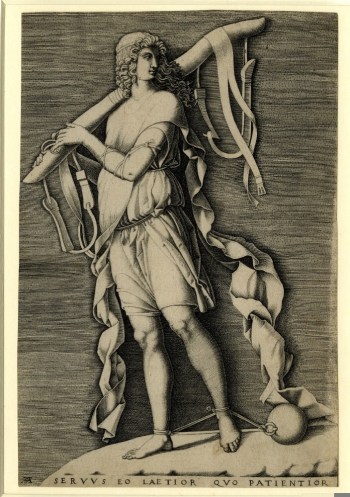
Adamo Scultori (Ghisi), Young Prisoner, 1566–80, engraving.
Francisco J. R. Chaparro, “Spanish Drawing Books”
A note on the exhibition catalogue El Maestro de Papel reviewed here by Francisco J. R. Chaparro, presents a comprehensive review of the scholarly attention directed towards Spanish drawing books. Chaparro makes reference to the Matías de Irala 1731 work and mentions the poor survival of the books. Chaparro tracks the appearance and reappearance of Jusepe Ribera’s etchings dated 1622 to highlight the further issue of cross-reference in these works. The note provides a critique of the exhibition while firmly situating it as a cornerstone for further research on the field of Spanish prints and drawings.
Ellis Tinios, “Surimono from the Virginia Shawan Drosten and Patrick Kenadjian Collection”
A laudatory note by Ellis Tinios on the catalogue The Private World of Surimino presents a brief analysis of surimono prints and notes, for instance, the importance of adequate lighting in revealing the complexities of blind printing and reflective inks.
David Ekserdijan, “A Portrait by Jeanne-Elisabeth Chaudet and Its Source”
David Ekserdijan presents the unusual artistic inspiration behind Jeanne-Elisabeth Chaudet’s painting A Portrait of a Young Girl of 1817, which sold in a 2006 Sotheby’s auction. The note features a side-by-side comparison with Adamo Scultori’s Young Prisoner or An Allegory of Servitude of 1566–80.
At Auction | Vase Designed by Thomas Hope

Gilt bronze-mounted patinated copper two-handled vase (detail) by Alexis Decaix, designed by Thomas Hope for his Duchess Street Mansion in London, ca. 1802–03, 26 × 13 × 12 inches (65 × 34 × 31 cm). Heritage Auctions, 18 June 2021, Sale 8046, Lot #61046, estimate: $40,000 to $60,000.
◊ ◊ ◊ ◊ ◊
From the press release, via Art Daily:
An extraordinarily rare and important early 19th-century urn, thought lost to history, was recently discovered by Heritage Auctions and is set to go to auction June 18 in Dallas, Texas (Sale 8046, Lot 61046). Designed by Thomas Hope, the urn was found in Tulsa, Oklahoma, in the collection of David D. Denham, where it had been modified into a side table. Heritage has set a conservative pre-auction estimate of $40,000 to $60,000 on the rare bronze. According to research, the urn’s mate resides in London’s Victoria and Albert Museum (M.33-1983), the world’s largest museum of applied and decorative arts and design.
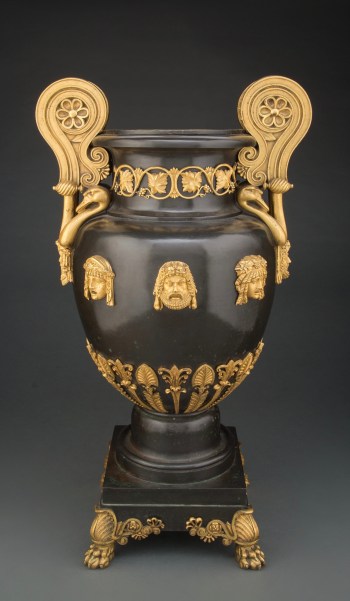
Gilt bronze-mounted patinated copper two-handled vase by Alexis Decaix, designed by Thomas Hope for his Duchess Street Mansion in London, ca. 1802–03.
“This important discovery was a remarkable surprise,” said Karen Rigdon, Director of Fine & Decorative Art at Heritage Auctions. “No one knew where the urn was for decades until we recognized it during a house call.”
Hope commissioned the vase, decorated with ormolu (gilt-bronze) mounts, for the dining room of his mansion located on Duchess Street in London. It was made by acclaimed French artist Alexis Decaix based on Hope’s design, which mirrored a classical volute krater (an ancient Greek vase with two handles which was used for mixing wine and water). Hope likely commissioned the one-of-a-kind pair of bronze urns directly from Decaix. Experts working with Heritage matched the urn’s historical background with telltale details confirming the vase is the pair to the one at the V&A. The newly-discovered vase’s specific placement of the mask mounts at the obverse and reverse matched the vase in the museum’s collection, as does the placement of specific notches and scratches made to each vase.
Hope, the scion of a wealthy banking family, made his London home into an outstanding example of Neo-classical design. In 1807, Hope published in London an illustrated account of the house and its furnishings in a book titled Household Furniture and Interior Decoration. The book had a considerable influence on other architects and designers working in the Greek Revival style.
“The appearance of this second example confirms Hope clearly took great care to ensure the vases would be displayed in perfect harmony, which supports what is known about his incredibly meticulous nature and approach to collecting,” according to Hope experts Philip Hewat-Jaboor and William Iselin, who worked with Heritage to confirm the vase’s authenticity.
Heritage experts discovered the urn in Tulsa in the collection of the late David Denham. “Denham was a well-known social figure in the area and admired for his collector’s eye and meticulous attention to detail,” Rigdon said. “The estate is unsure when the vase first entered Denham’s collection or when it was made into a side table,” she added. “But its discovery closes a chapter on the unknown history of this important artwork.”
FPS Online Symposium | The Art of the Dealer
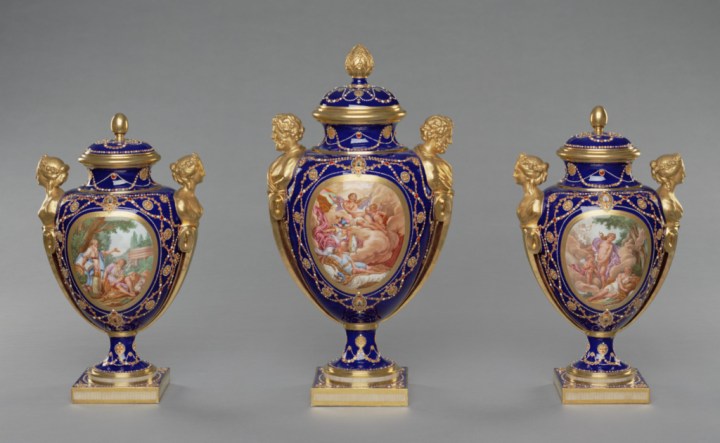
Garniture of Three Vases (vases des âges), Sèvres, 1781
(Los Angeles: J. Paul Getty Museum, 84.DE.718).
◊ ◊ ◊ ◊ ◊
From the FPS:
The Art of the Dealer: Selling Antique Ceramics, 1850 to 2000
Online, 12–13 June 2021
The French Porcelain Society is delighted to announce a two-day webinar on selling antique ceramics in the pre-digital age from 1850 to 2000.
The first day will focus on the dealer in the long nineteenth century, emerging from his chrysalis as a seller of ‘curiosities’ and ‘Old Sèvres porcelain’ to modern scholar-dealer, trading on an international stage, selling to museums through antiques fairs, themed exhibitions, lectures, specialist monographs, and catalogues devoted to ceramics. Papers will consider the Parisian dealer Beurdeley, the furnishing of J. Pierpont Morgan’s London home and the dealers who supplied him, and the rising market for oriental ceramics popularised by Edgar Gorer.
On day two, speakers will consider the legacy and change that characterised porcelain dealing in the twentieth century with papers on Marjorie Merriweather Post and French & Company in the United States, the activities of Hanns Weinberg in the 1950s for the Antique Porcelain Company, and finally Robert Williams at Winifred Williams Antiques. Each day will conclude with a panel discussion.
Zoom link for both days on our website soon. The full programme, with abstracts, is available here. Registration in advance is required. This symposium is free and open to all, but donations (here) are appreciated.
The programme is made possible with the generous support of Richard Baron Cohen.
All times are BST/UK
S A T U R D A Y , 1 2 J U N E 2 0 2 1
17.00 Session 1
• Caroline McCaffrey-Howarth (Visiting Research Fellow, History of Art and Museum Studies, University of Leeds and Curator, 17th- and 18th-Century Ceramics and Glass, V&A Museum), Marks, Monographs, and Mediators: The Long Nineteenth Century
• Camille Mestdagh (Associate Researcher, LARHRA), The Importance of Porcelain in the Business of a Parisian Curiosity Dealer: The Beurdeley Dynasty, a Case Study
17.50 Break
17.55 Session 2
• Linda H. Roth (Director of Special Projects/Curatorial and Charles C. and Eleanor Lamont Cunningham Curator of European Decorative Arts, Wadsworth Atheneum Museum of Art, Hartford, Connecticut), Mr. Morgan’s London House
• Nick Pearce (Richmond Chair of Fine Art, School of Culture & Creative Arts, University of Glasgow), ‘Sheer Cleverness and Courage’: Edgar Gorer (1872–1915) and the Rise of the Specialist Dealer in Chinese Art
19.00 Panel discussion and Q&A
S U N D A Y , 1 3 J U N E 2 0 2 1
17.00 Session 3
• Diana Davis (Independent researcher), The Twentieth Century: Legacy and Change
• Rebecca Tilles (Associate Curator of 18th-Century French and Western European Fine and Decorative Arts, Hillwood Estate, Museum and Gardens) Marjorie Merriweather Post and the Role and Influence of French & Company
17.50 Break
17.55 Session 4
• John Whitehead, FSA (Antique dealer and author), The Antique Porcelain Company: Porcelain Dealing in the Post-war Period
• Errol Manners, FSA (Antique dealer and author), Robert Williams of Winifred Williams Antiques
19.00 Panel discussion and Q&A
Online Conference | Finding Shakespeare in the Royal Collection
Begun in September 2018, ‘Shakespeare in the Royal Collection’ is a three-year AHRC funded project, focusing primarily on the period 1714–1945. From the project website:
Finding Shakespeare in the Royal Collection
Online, 17–19 June 2021
The Royal Collection contains Shakespeare-related items collected by generations of British monarchs, stretching back as far as Charles I, though principally concentrated in the eighteenth and nineteenth centuries. Including paintings, rare books, prints, watercolours, furniture, decorative objects, and photographs, these items tell a fascinating and overlapping set of stories about Shakespeare’s afterlife, the history of collecting, the histories of royalty and empire, and the histories of elite and popular culture. This conference brings together an international group of experts from fields including Shakespeare studies, history of art, collection studies, Romantic literature, and royal history.
Participants are invited to attend live online panels, or to view recorded panels for a limited time afterwards. We have speakers from Singapore to Texas, and the panels are timed across the day to maximise the possibility of attendance worldwide. A full conference programme, including abstracts and speaker bios, can be downloaded here.
The online conference platform is Zoom webinar, registered attendees will be emailed details of how to join the day before the event. To join, simply click on the join link in the email, your web browser will open up and you may be prompted to open Zoom. For further details of how to join Zoom meetings, see the company’s webpage. Live panels will be recorded, by attending you consent to the filming of the event and to being filmed yourself should you ask questions and in any other way participate live.
The conference is free to attend, but registration is essential. Tickets are available from Eventbrite. By registering, you agree to abide by the conference’s Code of Conduct. Participants violating the Code of Conduct will be removed from the event and will not be able to rejoin. For further information please email sharc@kcl.ac.uk.
All times are BST/ UTC+1 and subject to confirmation
T H U R S D A Y , 1 7 J U N E 2 0 2 1
Panel 1 | Exhibiting Shakespeare 10.00–11.30am
Chair: Gordon McMullan
• Michael Dobson (Shakespeare Institute), Hamlet Disowned: Kemble, Lawrence, and Royal Legitimacy
• Kate Retford (Birkbeck University of London), ‘A Wild and Unruly Youth’: Princes of Wales and The Harry the Fifth Club
• Shormishtha Panja (University of Delhi), ‘Moral Painting’: Nathaniel Dance Holland’s Timon of Athens, c. 1765–70
• Rosie Dias (University of Warwick), Personalising Public Art: Royal Narratives in Boydell’s Shakespeare Prints
Panel 2 | Shakespearean Relics 1.00–2.30pm
Chair: Kirsten Tambling
• Anna Myers (University of Edinburgh), David Garrick and the President’s Chair: Embodying Shakespeare through Intermedial Adaptation
• Mark Westgarth (University of Leeds), ‘Well-authenticated Blocks’: Materiality and the Market for Shakespearean ‘Mulberry Tree’ Relics in the Late Eighteenth and Early Nineteenth Centuries
• Simon Spier (University of Leeds), For Leisure or Learning?: An As You Like It Make-up Box by Hester Marian Wagstaff
Panel 3 | Shakespearean Reputations 4.00–5.30pm
Chair: Elizabeth Eger
• Kate Heard (Royal Collection Trust), ‘Pistol’s a Cuckold – or Adultery in Fashion’: Following a Print from Performance to Portfolio
• Arthur Burns (King’s College London), George III and the Other ‘Mad King’
• Essaka Joshua (University of Notre Dame), ‘I Only Change When I Die’: Gainsborough’s Portrait of Mary Robinson and Mutable Spectatorship
• Fiona Ritchie (McGill University), Fake and Authentic Shakespeare in the Diaries of Joseph Farington
F R I D A Y , 1 8 J U N E 2 0 2 1
Panel 4 | Shakespearean Books 10.00–11.30am
Chair: Sally Barnden
• Emma Stuart (Royal Collection Trust), Why did George IV Own a First Folio?
• Gordon McMullan (King’s College London), The ‘Disappointment’ of Charles I’s Second Folio
• Eleine Ng-Gagneux (National University of Singapore), Crossing Straits with Shakespeare Translation
‘Shakespeare in the Royal Collection’ Project Overview 12.00–1.00pm
Gordon McMullan, Kate Retford, Kirsten Tambling, Sally Barnden, and Felicity Roberts
Panel 5 | Shakespearean Interiors 2.00–3.30pm
Chair: Gail Marshall
• Elizabeth Clark Ashby (Royal Collection Trust), Shakespeare in Miniature: Shakespeare, Queen Mary, and Books for Dolls
• Kirsten Tambling (King’s College London), ‘All England in Warm Sepia’: Queen Mary and the Church of the Holy Trinity
• Morna O’Neill (Wake Forest University), Much Ado about Tapestry: Shakespeare, the Royal Family, and National Identity
S A T U R D A Y , 1 9 J U N E 2 0 2 1
Panel 6 | Mementoes of Performance 3.00–4.30pm
Chair: Richard Schoch
• Karen Harker (Shakespeare Institute), Remediation and Memory: Egron Sellif Lundgren’s Watercolours of The Winter’s Tale in Queen Victoria’s Theatrical Album
• Sally Barnden (King’s College London), Monument and Montage: Horatio Saker’s Visual History of the Stage
• Éilís Smyth (King’s College London), The Politics of Shakespeare at Windsor Castle in Louis Haghe’s The Performance of Macbeth in the Rubens Room
• Martin Blazeby (Blazebuild), Visualising Shakespearean Spaces and Stages of Performance at Windsor Castle
Panel 7 | Education and Performance 6.00–7.30pm
Chair: Kate Retford
• Lynne Vallone (Rutgers University), Princess Victoria and the Cult of Celebrity
• Gail Marshall (University of Reading), Puck and the Prince of Wales
• Vijeta Saini (Northeastern University), Disappearances and the Durbar: The Hidden Colonial Legacy of Queen Victoria’s Shakespearean Tableaux Vivants
• Kathryn Vomero Santos (Trinity University), ‘In Shakespeare’s Land’: Education, Cultural (Dis)inheritance, and the Decline of Empire in and around The Prince’s Choice
Call for Papers | New Approaches to Piranesi
The first installment of HECAA’s Zoom Event Series will feature a roundtable on Piranesi studies, moderated by Jeanne Britton and Zoe Langer, both affiliated with the Digital Piranesi Project at the University of South Carolina.
New Approaches to Piranesi: A Virtual Roundtable
Online, 16 July 2021
Organized by Jeanne Britton and Zoe Langer
Proposals due by 16 June 2021
We are seeking proposals for a virtual roundtable of lightning talks on interdisciplinary approaches to the works of Giovanni Battista Piranesi (1720–1778). Recent scholarship by Heather Hyde Minor, Carolyn Yerkes, and Susan Dixon, as well as the current bestselling novel Piranesi by Susanna Clarke, have started to open the field of Piranesi Studies to new avenues of research and potentially wider audiences. This roundtable will consist of short presentations of 5–7 minutes followed by ample time for discussion. We hope the proposed format will encourage lively conversation and prompt new critical perspectives that will continue to broaden the interpretation of Piranesi’s works. We welcome topics that include but are not limited to eclecticism, globalism, reception, book history, biographical studies, cartography, collecting, translation, digital humanities, theater, fashion, music, archaeology, and the history of science. We are especially interested in hearing from graduate students, early-career scholars, and professionals engaged in a wide range of disciplinary fields and methods.
Please send an abstract of 150 words, a brief biography, and current contact information. Submissions should be sent to digitalpiranesi@gmail.com by Wednesday, 16 June 2021. Decisions will be sent on Friday, 18 June.
Sponsored by HECAA (Historians of Eighteenth-Century Art & Architecture)
Story of Yanxi Palace

Still from Story of Yanxi Palace (2018), with the empress wearing a replica of a fengguan (phoenix crown) now in the Palace Museum, Beijing.
◊ ◊ ◊ ◊ ◊
I’m at least two years overdue with this posting—the series appeared in 2018—but I learned of it only recently thanks to Isabella Smith’s essay in the May issue of Apollo. I’m just three episodes in, but totally entranced. –CH
Isabella Smith, “An Audience with the Qianlong Emperor, via the Small Screen,” Apollo Magazine (May 2021).
It’s like Game of Thrones, but with art instead of sex. I’ve found myself repeating that summary frequently while evangelising about Story of Yanxi Palace (2018), a Chinese period drama loosely based on historic figures in the Qing dynasty court of the Qianlong Emperor (1711–1799)—and one of my lockdown obsessions. The tale begins in 1741, when our Cinderella-like heroine Wei Yingluo (Wu Jinyan) enters the Forbidden City, ostensibly to work as an embroidery maid at the palaces, but with a secret mission: to uncover the perpetrator behind her beloved sister’s rape and murder. It’s a suitably knotty start to a narrative as labyrinthine as it is long; the series comprises 70 episodes at 45 minutes apiece.
Besides the intricacies of its intrigues, what has kept me enthralled is the sheer spectacle of the thing. From its heavily embroidered robes and carved jade to lavish lacquerwork and pottery, Story of Yanxi Palace is a feast for the eyes. In 2018, the show was streamed more than 15 billion times on the Chinese video platform iQiyi, before falling foul of government censors and being pulled from TV screens. The charge? Its ‘negative influence on society’, promoting admiration for imperial China and its luxurious lifestyles, an argument initially set out in Theory Weekly (a magazine affiliated with the Chinese Communist Party’s newspaper, the Beijing Daily).
What sets Story of Yanxi Palace apart from similar historical dramas—and China boasts a rich roster of such shows—is its devotion to the decorative arts. . . .
The full essay is available here»
For the wider media context of the series in China, see Jiayang Fan’s essay, “In China, Shows Like ‘Story of Yanxi Palace’ Go Viral, and the Party Is Not Amused,” The New Yorker (23 April 2019).
New Book | Dandy Style
The related exhibition is scheduled to open later at the Manchester Art Gallery, but the publication, from Yale UP, is available now:
Shaun Cole and Miles Lambert, Dandy Style: 250 Years of British Men’s Fashion (New Have: Yale University Press, 2021), 168 pages, ISBN: 978-0300254136, $35.
 Celebrating 250 years of male self-expression, investigating the portraiture and wardrobe of the fashionable British man
The style of the dandy is elegant but bold—dedicated to the perfection of taste. This meticulously choreographed look has a vibrant history; the legacy of Beau Brummell, the original dandy of Regency England, can be traced in the clothing of urban dandies today. Dandy Style celebrates 250 years of male self-expression, investigating the portraiture and wardrobe of the fashionable British man. Combining fashion, art, and photography, the historic and the contemporary, the provocative and the respectable, it considers key themes in the development of male style and identity, including elegance, uniformity, and spectacle. Various types of dandy are represented by iconic figures such as Oscar Wilde, Edward VIII as Prince of Wales, and Gilbert & George. They appear alongside the seminal designs of Vivienne Westwood, Ozwald Boateng, and Alexander McQueen; and portraits by Thomas Gainsborough and David Hockney.
Shaun Cole is associate professor in fashion at Winchester School of Art, University of Southampton. Miles Lambert is curator of costume at Manchester Art Gallery.
C O N T E N T S
Christopher Breward — Foreword: Dandy Style
Alistair Hudson — Director’s Preface
Shaun Cole and Miles Lambert — Introduction
1 Miles Lambert — Creative Collecting: How Museums Acquire Men’s Fashion
2 Ben Whyman — The Life Stories of Men’s Clothes
3 Joshua M. Bluteau — The Devil Is in the Detail: Why Men Still Wear Suits
4 Shaun Cole, Miles Lambert, and Rebecca Milner — Painting Men’s Style: Portraying an Image
5 Kate Dorney — Performing the Dandy
6 Miles Lambert — Extravagance and Flamboyance: Decorated Men’s Fashion
7 Shaun Cole — Casual Subversion
8 Jay McCauley Bowstead — Contemporary British Menswear: Hybridity, Flux, and Globalisation
Notes
Select Bibliography
Index
Acknowledgments
List of Contributors
New Book | Material Lives: Women Makers and Consumer Culture
From Bloomsbury:
Serena Dyer, Material Lives: Women Makers and Consumer Culture in the 18th Century (London: Bloomsbury Visual Arts, 2021), 272 pages, ISBN: 978-1350126978 (hardcover), £80 / ISBN: 978-1350126961 (paperback), £27.
 Eighteenth-century women told their life stories through making. With its compelling stories of women’s material experiences and practices, Material Lives offers a new perspective on eighteenth-century production and consumption. Genteel women’s making has traditionally been seen as decorative, trivial and superficial. Yet their material archives, forged through fabric samples, watercolours, dressed prints and dolls’ garments, reveal how women used the material culture of making to record and navigate their lives.
Material Lives positions women as ‘makers’ in a consumer society. Through fragments of fabric and paper, Dyer explores an innovative way of accessing the lives of otherwise obscured women. For researchers and students of material culture, dress history, consumption, gender and women’s history, it offers a rich resource to illuminate the power of needles, paintbrushes and scissors.
Serena Dyer is Lecturer in History of Design and Material Culture at De Montfort University. She has taught at the University of Warwick and the University of Hertfordshire, and was Postdoctoral Fellow at the Paul Mellon Centre for Studies in British Art. She was previously Curator of the Museum of Domestic Design and Architecture. She has published on albums, wallpaper, consumer culture, and childhood in the eighteenth century.
C O N T E N T S
List of Illustrations
List of Charts and Tables
Acknowledgements
List of Abbreviations
1 Introduction: Making Material Lives
• Material Life Writing
• The Consumer Culture of Making
• Four Material Lives
2 Material Accounting: A Sartorial Account Book
• Barbara Johnson (1738–1825)
• Educating Barbara Johnson
• Accounting for Herself
• Material Literacy
• A Chronicle of Fashion
3 Dress of the Year: Watercolours
• Ann Frankland Lewis (1757–1842)
• Sartorial Timekeeping and the Fashion Plate
• Accomplishment and Creative Practice
• Society and Fashionable Display
• Selfhood, Emotion, and the Mourning Watercolours
4 Adorned in Silk: Dressed Prints
• Sabine Winn (1734–1798)
• Paper Textiles, Dress and the Dressed Print
• Sabine Winn’s Dressed Prints
• Print and Making at Nostell
5 Fashions in Miniature: Dolls
• Laetitia Powell (1741–1801)
• The Powell Dolls
• Mimetic Dolls and Miniature Selves
• Dolls as Sartorial Social Narrators
6 Conclusion: Material Afterlives
Glossary
Bibliography
Index
New Book | Dress Codes
From Simon & Schuster:
Richard Thompson Ford, Dress Codes: How the Laws of Fashion Made History (New York: Simon & Schuster, 2021), 464 pages, ISBN: 978-1501180064, $30.
 Dress codes are as old as clothing itself. For centuries, clothing has been a wearable status symbol; fashion, a weapon in struggles for social change; and dress codes, a way to maintain political control. Merchants who dressed like princes and butchers’ wives wearing gem-encrusted crowns were public enemies in medieval societies structured by social hierarchy and defined by spectacle. In Tudor England, silk, velvet, and fur were reserved for the nobility and ballooning pants called “trunk hose” could be considered a menace to good order. The Renaissance era Florentine patriarch Cosimo de Medici captured the power of fashion and dress codes when he remarked, “One can make a gentleman from two yards of red cloth.” Dress codes evolved along with the social and political ideals of the day, but they always reflected struggles for power and status. In the 1700s, South Carolina’s “Negro Act” made it illegal for Black people to dress “above their condition.” In the 1920s, the bobbed hair and form-fitting dresses worn by free-spirited flappers were banned in workplaces throughout the United States and in the 1940s the baggy zoot suits favored by Black and Latino men caused riots in cities from coast to coast.
Even in today’s more informal world, dress codes still determine what we wear, when we wear it—and what our clothing means. People lose their jobs for wearing braided hair, long fingernails, large earrings, beards, and tattoos or refusing to wear a suit and tie or make-up and high heels. In some cities, wearing sagging pants is a crime. And even when there are no written rules, implicit dress codes still influence opportunities and social mobility. Silicon Valley CEOs wear t-shirts and flip flops, setting the tone for an entire industry: women wearing fashionable dresses or high heels face ridicule in the tech world, and some venture capitalists refuse to invest in any company run by someone wearing a suit.
In Dress Codes, law professor and cultural critic Richard Thompson Ford presents an insightful and entertaining history of the laws of fashion from the middle ages to the present day, a walk down history’s red carpet to uncover and examine the canons, mores, and customs of clothing—rules that we often take for granted.
Richard Thompson Ford is a Professor at Stanford Law School. He has written about law, social and cultural issues, and race relations for The New York Times, The Washington Post, San Francisco Chronicle, and Slate, and has appeared on The Colbert Report and The Rachel Maddow Show. He is the author of The New York Times notable books The Race Card and Rights Gone Wrong: How Law Corrupts the Struggle for Equality. He lives in San Francisco.










leave a comment