Online Discussion | Advancing Equity in & through Academic Footnotes
Information on The Italian Art Society, which is dedicated to the study of Italian art and architecture from prehistory to the present day, is available here:
Citing Truth to Power: Advancing Equity in & through Academic Footnotes
The Emerging Scholars Committee of The Italian Art Society
Online, 2 June 2021, 12pm (CST)
 Footnotes are the fundamental building blocks of academic arguments. They not only validate new ideas, they also situate us scholars within larger academic conversations and serve as a roadmap for how those conversations have developed over time. But this relationship is reciprocal. When appealing to the authority of these previous scholars, our footnotes also amplify their voices and argue implicitly for what conversations are worth being had, and by whom. As a result, footnotes often serve to reinforce the dominance of a narrow range of (usually European and American, white, fully-able, male) academics, limiting both the kinds of conversations that can be had within a field as well as who can have them. For this reason, we invite you to our virtual open forum. By bringing scholars of Italian Art History and related art historical and humanities fields into conversation with each other, we hope to interrogate what is at stake in both our footnotes and the citational process.
Allison Levy is Digital Scholarship Editor for Brown University Library’s Digital Publications Initiative. She has authored or edited five books on early modern Italian visual culture and is co-chair of the College Art Association’s Committee on Research and Scholarship.
Julia DeLancey is Professor of Art History at the University of Mary Washington. She specializes in the visual culture of early modern Venice and, most recently, works on questions related to disability, art, and visual culture.
Robert Clines is Assistant Professor of History and International Studies at Western Carolina University. His first book A Jewish Jesuit in the Eastern Mediterranean appeared in 2019. He’s currently writing a book tentatively entitled Ancient Others: Essays on Race, Empire, and the Mediterranean in Italian Renaissance Humanism.
Excavating James Madison’s Montpelier

Transferware ceramics, Bride of Lammermoor pattern, after 1819, when Sir Walter Scott’s novel was published.
◊ ◊ ◊ ◊ ◊
From the most recent issue of Preservation Magazine:
Meghan Drueding, “Ceramic Fragments Provide Clues to an Enslaved Community’s Past,” Preservation Magazine (Spring 2021), p. 16.
What does a one-inch-square scrap of an old ceramic teacup mean? Plenty, when it’s found during an archaeological dig at James Madison’s Montpelier, a National Trust Historic Site in Orange County, Virginia.
The dig took place over a four-year period ending in 2016, and focused on the South Yard, which contained housing for many of the people enslaved by the Madison family. It yielded thousands of ceramic pieces from hundreds of china patterns. Their existence revealed that members of Montpelier’s enslaved community often purchased their own ceramics using money they earned through activities like raising livestock, growing vegetables, or sewing—on top of the unpaid work the Madisons required of them.
“The ledger books survive from at least one nearby store,” says Mary Furlong Minkoff, curator of archaeological collections. “We have records of people we know were enslaved at Montpelier buying things for themselves.” . . .
The full article is available here»
New Book | Irish Country Furniture and Furnishings, 1700–2000
From Cork UP:
Claudia Kinmonth, Irish Country Furniture and Furnishings, 1700–2000 (Cork University Press, 2020), 576 pages, ISBN: 978-1782054054, €39 / $45.
 This major illustrated study investigates farmhouse and cabin furniture from all over the island of Ireland. It discusses the origins and evolution of useful objects, what materials were used and why, and how furniture made for small spaces, often with renewable elements, was innate and expected. Encompassing three centuries, it illuminates a way of life that has almost vanished. It contributes as much to our knowledge of Ireland’s cultural history as to its history of furniture.
This is a is a substantially different book from Kinmonth’s Irish Country Furniture, 1700–1950, published by Yale UP in 1993 and reprinted several times. The new book incorporates the findings of a lot of recent research. Nearly all the black and white pictures in the 1993 book are now in colour, or have been changed for the better, and now include different examples (except archive pictures). Many of the author’s fieldwork photographs from the late 1980s, have been digitised and will now be published for the first time. The extent has almost doubled; there are an extra 120 illustrations; the main text has been fully updated and revised; there is a new chapter ‘Small Furnishings and Utensils’, and there is a new preface by Louis Cullen. Reflecting the considerable addition of new material, the time scale is also broadened to include discussions of objects and interiors up to 2000.
The book looks at influences such as traditional architecture, shortage of timber, why and how furniture was painted, and the characteristics of designs made by a range of furniture makers. The incorporation of natural materials such as bog oak, turf, driftwood, straw, recycled tyres or packing cases is viewed in terms of use and durability. Chapters individually examine stools, chairs and then settles in all their ingenious and multi-purpose forms. How dressers were authentically arranged, with displays varying minutely according to time and place, reveal how some had indoor coops to encourage hens to lay through winter. Some people ate communally or slept in outshot beds, in the coldest north-west—all this is illustrated through art as well as surviving objects.
Claudia Kinmonth is Research Curator (Domestic Life), Ulster Folk Museum and a Visiting Research Fellow, Moore Institute, NUI Galway. She is the author of Irish Rural Interiors in Art (Yale UP).
New Book | Building the Irish Courthouse and Prison
From Cork UP:
Richard Butler, Building the Irish Courthouse and Prison: A Political History, 1750–1850 (Cork: Cork University Press, 2020), 652 pages, ISBN: 978-1782053699, €39 / $45.
 This book is the first national history of the building of some of Ireland’s most important historic public buildings. Focusing on the former assize courthouses and county gaols, it tells a political history of how they were built, who paid for them, and the effects they had on urban development in Ireland.
Using extensive archival sources, it delves in unprecedented detail into the politics and personalities of county grand jurors, Protestant landed society, government prison inspectors, charities, architects, and engineers, who together oversaw a wave of courthouse and prison construction in Ireland in an era of turbulent domestic and international change. It investigates the extent to which these buildings can be seen as the legacy of the British or imperial state, especially after the Act of Union, and thus contributes to ongoing debates within post-colonial studies regarding the built environment. Richly illustrated with over 300 historic drawings, photographs, and maps, Building the Irish Courthouse and Prison analyses how and why these historic buildings came to exist. It discusses crime, violence, and political and agrarian unrest in Ireland during the years when Protestant elites commissioned such extensive new public architecture. The book will be of interest to academic and popular audiences curious to learn more about Irish politics, culture, society, and especially its rich architectural heritage.
Richard J. Butler is a Lecturer in the Historic Built Environment, Centre for Urban History, University of Leicester.
Call for Applications | HECAA Pandemic Relief Grant
HECAA Pandemic Relief Grant
Applications due by 21 May 2021
HECAA announces a relief program to support new and existing members during the ongoing coronavirus pandemic. Working with funds raised during our recent Pandemic Relief campaign, HECAA will distribute up to six grants of $250 each to assist recipients suffering from financial hardship. The grants may be used to cover a variety of specific costs, including research, publication subventions, equipment purchases, digital subscriptions, and more. HECAA is also sensitive to the ways in which the pandemic has curtailed employment opportunities and other forms of institutional support more broadly. While the grants cannot fully replace this funding, they can be used to cover expenses for those who have experienced furloughs, layoffs, and/or the cancellation of internships, fellowships, or other institutional funding.
Preference will be given to contingent scholars, graduate students, and other early career scholars (within five years of PhD). All recipients must be HECAA members in good standing. If you are not yet a member, but would like to join, please contact us at hecaamembers@gmail.com. Reduced rate memberships are available for those with demonstrated need.
Application Requirements
• Short CV (2 pages)
• Brief description of how the pandemic has adversely affected your work (1 paragraph)
• Summary of how you intend to spend the funds (1 paragraph)
Please submit your applications by 21 May 2021 to hecaamembers@gmail.com. Applicants will be notified of funding distributions by 1 June 2021.
Symposium | Georgian London Revisited
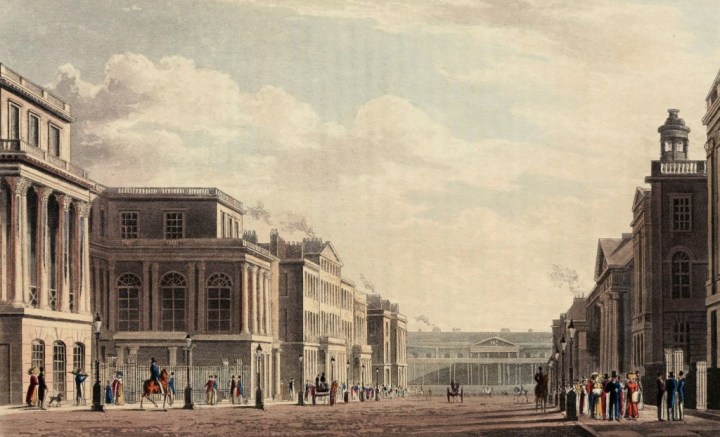
Regent Street, Looking toward Carlton House, ca.1822, from The Repository of Arts, Literature, Commerce, Manufactures, Fashions and Politics.
◊ ◊ ◊ ◊ ◊
From The Georgian Group:
2021 Georgian Group Symposium: Georgian London Revisited
Online, 22–23 May 2021
Following the successful conferences run by the Georgian Group in previous years on Women and Architecture, on The Architecture of James Gibbs, and on The Work of the Adam Brothers, our symposium for 2021 will highlight changing perspectives and new research on the architecture of London undertaken since the publication of the latest edition of Sir John Summerson’s Georgian London (1988, reissued 2003). A series of short papers by both established and younger scholars will cover aspects of housing and estate development, public and commercial architecture, places of entertainment, and related topics.
This year’s symposium will take place online over Saturday 22nd and Sunday 23rd May. Joining details for the symposium will be sent to ticket holders on Friday 21st May. Tickets are £25; students can purchase a discounted ticket (£15) by clicking here.
The symposium will be recorded and the recording will be available to all those who have purchased a ticket for a limited period of time after the event takes place. Please read our Terms and Conditions before booking.
S A T U R D A Y , 2 2 M A Y 2 0 2 1
9.30 Welcome
9.40 Keynote Talk
• Elizabeth McKellar — Georgian London after Summerson
10.10 Session 1 | The Restoration and After
• Frank Kelsall — Nicholas Barbon in Holborn
• India Wright — The Redevelopment of Middle Temple in the Late Seventeenth Century
• Charlotte Davis — Restoration London Reconsidered: Edward Pearce and Carved Ornament
• Helen Lawrence-Beaton — The Remodelling of Monmouth House, Soho Square by Thomas Archer
11.25 Break
11.40 Session 2 | Eighteenth-Century Town Houses and Estate Development
• Juliet Learmouth — Living amidst the Ruins: Eighteenth-Century Whitehall and the Bentinck Family
• Melanie Hayes — A Cultural Exchange: The Anglo-Irish in Hanoverian London
• Rory Lamb — Scottish Property in Georgian London: George Steuart and the Duke of Buccleuch’s Urban Estates
• Sarah Milne — Merchants’ Houses of Goodman’s Fields Whitechapel
12.55 Closing Remarks
S U N D A Y , 2 3 M A Y 2 0 2 1
10.30 Welcome
10.35 Session 3 | The Early Nineteenth Century
• Todd Longstaffe-Gowan — Charlotte Girdlestone’s Early Nineteenth-Century Panorama of Regent’s Park
• Geoffrey Tyack — Beyond the Park: John Nash, the Park Village, and Cumberland Market
• Amy Spencer — Architectural Competition and Its Values at the London University, 1825–26
11.35 Break
11.50 Session 4 | Miscellany
• Michael Burdon — A ‘Vile and Absurd Edifice of Brick’: London’s Opera House in the Haymarket
• Gillian Williamson — Life in Lodgings in Georgian London
• Caroline Stanford — ‘The Resurrection Is upon Us!’ The Role of Sculpture in Georgian London
12.50 Closing Remarks
Online Conference | Sensory Experience in 18th-Century Art Exhibitions
From the conference programme:
The Sensory Experience in 18th-Century Art Exhibitions: From Emotion to Sensation
L’expérience sensorielle dans les expositions d’art au XVIIIe siècle
Online, 10–11 June 2021
Organized by Gaëtane Maës, Isabelle Pichet, and Dorit Kluge
Registration due by 4 June 2021
The conference The Sensory Experience in 18th Century Art Exhibitions is the final part of a research project funded by the Social Sciences and Humanities Research Council of Canada (2018–2020) and led by Isabelle Pichet (UQTR, Canada), Gaëtane Maës (University of Lille, France) and Dorit Kluge (VICTORIA International University, Germany) on the question of the sensory body. The aim of the project is to define the way in which the experience of the visitor’s sensory body is shaped during the visit of temporary art exhibitions at a time when these are emerging and establishing themselves in Europe as a new social practice. This knowledge should provide a better understanding of the trajectory and inherent sensory experiences of museum and gallery visitors through the centuries up to the present day.
 The 18th century, in fact, saw the birth of art exhibitions, which were part of a new field of social activities that the European population was able to enjoy from the 1730s onwards. For visitors, attending these exhibitions became a new and unique experience that challenged each of their senses. This simple observation leads us to the research fields on senses and sensibility in which the colloquium is a new research path for the history of art exhibitions in the 18th century.
Conceived as a laboratory for exchange, the conference will bring together participants from three continents and diverse backgrounds. It will be organised around two sessions: the first one initially planned at the Louvre-Lens museum will take place on 10–11 June 2021 in total distance mode via Zoom, and the second one will take place at the Vivant-Denon centre of the Louvre museum in Paris on 18–19 November 2021. The first session will focus on the experience of the work of art, from emotion to sensation, while the second will examine the question of the experience of the visit, from spectator to critic.
Registration is mandatory before 4th June 2021: irhis-recherche@univ-lille.fr.
T H U R S D A Y , 1 0 J U N E 2 0 2 1
12.45 Accueil
13.00 Ouverture du colloque, mot de bienvenue
• Marie Lavandier, Musée du Louvre-Lens
• Charles Meriaux, IRHiS – CNRS UMR 8529 – U Lille
13.30 Introduction par les organisatrices du colloque
14.00 La sensorialité du spectateur
• Emma Barker (Open University), Viewing Blindness at the Paris Salon
• Laura Giudici (Curatrice indépendante, Berne), Prière de toucher: La réception de la statue de l’Hermaphrodite endormi aux XVIIe et XVIIIe siècles
• Friederike Vosskamp (Université de Heildelberg), Exprimant le froid: La représentation des sensations et leur perception par le public à l’exemple de ‘L’Eté’ et de ‘L’Hiver’ de Jean-Antoine Houdon
• Markus Castor (Centre allemand d’histoire de l’art, Paris), Le langage du corps entre affection, discussion et contemplation des arts au XVIIIe siècle – Les images du spectateur et ses expressions des passions entre changement épistémologique et mentalités politiques: Gestes, mots, pas, grâce, nature et religion
17.00 Pause
17.30 Voir et sentir à l’anglaise
• Frédéric Ogee (Université Paris Diderot), L’expérience du sensible: Nature et vérité dans le premier portrait anglais, de William Hogarth à Thomas Lawrence
• Sarah Gould (Université Paris 1 – Panthéon Sorbonne), The Texture of Thomas Gainsborough’s Paintings: A Site of Tension at London Art Exhibitions
F R I D A Y , 1 1 J U N E 2 0 2 1
11.45 Accueil
12.00 Femmes sous le regard des spectateurs I
• Gaëtane Maës (Université de Lille – IRHiS – UMR 8529), Représenter l’identité ou l’émotion ? Les actrices Clairon et Dumesnil au Salon du Louvre
• Jan Blanc (Université de Genève), Les plaisirs du public: l’érotisation du regard dans les expositions de la Royal Academy au XVIIIe siècle
13.15 Pause
13.45 Percevoir le temps : entre passion et politique
• Mark Ledbury (University of Sydney), Untimely History Painting
• Aaron Wile (National Gallery of Art, Washington, DC), Antoine Coypel’s Galerie d’Enée: Sensibility, Passion, and Politics in Regency France
15.00 Pause
15.30 Femmes sous le regard des spectateurs II
• Bénédicte Prot (University of Oxford), Nus de marbre et filles en émoi dans ‘Le Nouveau Paris’ de Louis-Sébastien Mercier
• Kim de Beaumont (Hunter College, City University of New York), Le corps et l’esprit des femmes dans les vues du Salon de Gabriel de Saint-Aubin
• Mathias Blanc (UMR 8529 – IRHiS – Université de Lille), Parcours contemporains du regard sur des œuvres du XVIIIe siècle
(restitution du projet de médiation EXART réalisé au Louvre-Lens en collaboration avec Gaëtane Maës, et avec l’aide de Laurine Delmas et de Victoria Martinez, étudiantes en Master 2 Recherche en Histoire de l’Art à l’Université de Lille)
New Book | Venetian Drawings
On this day (12 May) in 1797, Ludovico Manin, the last doge of Venice—in response to Napoleonic aggression—formally abolished La Serenissima after 1,100 years of existence. Notice of this SMK catalogue seems like a fine way to mark the anniversary. I didn’t provide a posting here at Enfilade when it was initially published in 2018, but copies are still available. Thomas Dalla Costa’s review of it appears in the current issue of Master Drawings (2021, volume 59, issue 1); it also was reviewed by Jörg Zutter for The Burlington in December 2019. –CH
Chris Fischer, Venetian Drawings: The Royal Collection of Graphic Art (Copenhagen: Statens Museum for Kunst, 2018), 339 pages, ISBN 978-8775510719, 300 Danish Kroner (DKK), or about $50.
 This catalogue is the first publication of all the Venetian drawings in the Royal Collection of Graphic Art at the National Gallery of Denmark (Statens Museum for Kunst). Few of these drawings have ever been published, and only a handful has been shown to the public within living memory. Research in connection with this catalogue has revealed that not only is the number of drawings from this geographic area surprisingly high, but the quality of the drawings is stupendous, counting some of the most beautiful sheets in the collection. Furthermore, the comprehensiveness of this part of the collection has proved extraordinary with very even coverage of the development of draughtsmanship in Venice and the Venetian mainland from the 1480s, when sketching on paper became common, through the lesser-known 17th century to the fall of the Venetian republic in 1797. The catalogue presents more than 200 fine drawings by Vittore Carpaccio, Moretto da Brescia, Domenico Campagnola, Jacopo Bassano, Paolo Farinati and Paolo Veronese, large groups of studies by Palma Giovane and Antonio Vassilacchi called Aliense, as well as sheets by 18th-century draughtsmen such as Giovanni Antonio Pellegrini, Gaspare Diziani, Giovanni Battista Tiepolo and his son Domenico, Francesco Fontebasso, Francesco Guardi, and Giovanni Battista Piranesi.
It is available at the SMK Shop, and can be ordered in Danish bookstores and webshops such as Academic Books, Bog & Idé, Bogreolen, Buuks, Gucca, I Music, Plusbog og Saxo.
Online Workshop | Viewing Topography Across the Globe, Indigeneity
From The Lewis Walpole Library:
Viewing Topography Across the Globe Series, Workshop II: Indigeneity
Online, The Lewis Walpole Library, 13–14 May 2021
Organized by Cynthia Roman and Holly Schaffer
Topography, from topos, is the practice of describing place through language, the features of the land, the inhabitants, and the accumulation of history. Specific to locality and the perspective of the person delineating, describing, or collecting materials, topography counters the worldliness of geography while also offering a potential tool to multiply singular approaches.
In this second workshop in the series Viewing Topography Across the Globe, we will consider approaches to place from Indigenous and European perspectives and interrogate the frame of ‘topography’ in global contexts (the first workshop was held at Brown on 11 December 2019). In two half-day virtual sessions, we will focus on topographical practices in the Americas as well as South and Southeast Asia and the Pacific Ocean as well as how the materials of art-making both locate and disrupt notions of place. We will hear from artists and academics, work with colonial-era paintings, Indigenous objects, mapping, and literature, and consider Indigenous pedagogy.
The workshop, which will take place via Zoom, has been organized by Cynthia Roman (The Lewis Walpole Library, Yale University) and Holly Schaffer (Brown University). Details, including abstracts for each talk, are available as a PDF file here. Please note that registration is required for each day’s sessions (links are available below).
Keynote Speakers
• Cannupa Hanska Luger
• Douglas Fordham
◊ ◊ ◊ ◊ ◊
T H U R S D A Y , 1 3 M A Y 2 0 2 1
Register here»
10.00 Panel 1: The Americas
• Barbara E. Mundy (Fordham University), Indigenous Bodies and Topographical Imagination
• Emmanuel Ortega (University of Illinois at Chicago), Local vs. Universal Knowledge: Locating Place in von Humboldt’s Picturesque
• Robbie Richardson (Princeton University), Sucker-fish Writings: Indigenous Inscription and the History of Written Language in the 18th Century
• Heather V. Vermeulen (Wesleyan University), Sybil / Spider / Sibyl: On Anancy*ness, Archives, and Spider Space
12.00 Lunchtime Keynote Talk
Moderated by Marina Tyquiengco (Boston Museum of Fine Arts)
• Cannupa Hanska Luger (Artist), Artist as Social Engineer
F R I D A Y , 1 4 M A Y 2 0 2 1
Register here»
10.00 Panel 2: South, Southeast Asia, and the Pacific Ocean
• Jinah Kim (Harvard University), Beyond Human Vision: Knowing Angkor Wat through Topography, from a Watercolor Map to LIDAR Capture
• Dipti Khera (New York University) and Debra Diamond (Freer Gallery of Art and Arthur M. Sackler Gallery, Smithsonian Institution), Unexplored Terrains: Topography, Temporality, and Emotion in 18th-Century Udaipur
• Kailani Polzak (University of California, Santa Cruz), Rising from the Ocean: Perspectives of Land and Watercraft during Cook’s Third Voyage
• Ayesha Ramachandran (Yale University), Topographies of Battle: The National War Memorial, New Delhi
• Garima Gupta (Artist and Researcher) and Chitra Ramalingam (Yale Center for British Art), Anxieties of a Bazaar: Making of Commodities in Colonial South and Southeast Asia
12.00 Lunchtime Keynote Talk
Moderated by Tim Barringer (Yale University)
• Douglas Fordham (University of Virginia), Techniques of the Imperial Observer: How Aquatint Travel Books Taught Britons to See
Napoleon Two Centuries Later

Two centuries after his death (the anniversary of which arrived last week on May 5), Napoleon’s legacy remains combustible. From the Musée de l’Armée:
Napoléon n’est plus / Napoleon Is No Nore
Musée de l’Armée Invalides, Paris, 31 March — 31 October 2021
The death of Napoleon I on 5 May 1821—although it went relatively unnoticed in the eyes of the world—was extremely well documented by his companions in exile. Despite the abundance of memories, letters, sketches, relics, and stories, this history nevertheless includes grey areas, uncertainties, contradictions. In this exhibition, we examine the major themes surrounding the death of Napoleon by changing the perspectives. By calling in new scientific disciplines (archaeology, medicine, chemistry) in order to complete already known historical sources and material evidence of this history, the musée de l’Armée provides visitors with all the necessary elements to enable them to conduct the investigation by themselves.
This exhibition is part of the 2021 Napoleon Season organised to celebrate the bicentenary of the Emperor’s death. The musée de l’Armée will present a rich and varied cultural offering evoking the end of Napoleon’s personal adventure, while opening up to the topicality and the current reality of his legacy to the world. . . .
Napoléon n’est plus (Paris: Gallimard, 2021), 296 pages, ISBN: 978-2072931604, 35€.
From the Musée de l’Armée:
Napoleon? Encore!
Musée de l’Armée Invalides, Paris, 7 May 2021 — 13 February 2022
Curated by Éric de Chassey and Julien Voinot
This contemporary art tour evokes the figure of Napoleon as well as his legacy. Thirty contemporary artists received carte blanche to question this symbolic and historical figure.
Echoing the commemorations of the bicentenary of the death of the Emperor, the musée de l’Armée is presenting, for the first time in its history, a contemporary art tour at Les Invalides. The presentation of pre-existing works and specially commissioned orders entrusted to renowned or emerging artists, from France and abroad, evokes the figure of Napoleon as well as the impact of his action in today’s world. Presented in conjunction with the exhibition Napoleon Is No More, the curation of this contemporary tour was entrusted to Éric de Chassey, Director of the Institut National d’Histoire de l’Art, and Julien Voinot, Collections Manager in the Department of 19th-Century and Symbolic Art of the musée de l’Armée.
◊ ◊ ◊ ◊ ◊
From The New York Times:
Roger Cohen, “France Battles over Whether to Cancel or Celebrate Napoleon,” The New York Times (5 May 2021). President Emmanuel Macron laid a wreath at the emperor’s tomb on the 200th anniversary of his death, stepping into a national debate over the legacy of Napoleon.
Jacques Chirac couldn’t stand him. Nicolas Sarkozy kept his distance. François Hollande shunned him. But on the 200th anniversary this week of Napoleon Bonaparte’s death, Emmanuel Macron has chosen to do what most recent presidents of France have avoided: honor the man who in 1799 destroyed the nascent French Republic in a putsch.
By choosing to lay a wreath Wednesday at Napoleon’s tomb under the golden dome of Les Invalides, Mr. Macron stepped into the heart of France’s culture wars. Napoleon, always a contested figure, has become a Rorschach test for the French at a moment of tense cultural confrontation.
Was Napoleon a modernizing reformer whose legal code, lycée school system, central bank and centralized administrative framework laid the basis for post-revolutionary France? Or was he a retrograde racist, imperialist, and misogynist?
By paying his respects to Napoleon, Mr. Macron will please a restive French right dreaming of lost glory and of a moment when, under its turbulent emperor, France stood at the center of the world. The French obsession with the romantic epic of Napoleon’s rise and fall is undying, as countless magazine covers and talk shows have underscored in recent weeks. But in the current zeitgeist, Napoleon’s decisive role as founder of the modern French state tends to pale beside his record as colonizer, warmonger and enslaver. . . .
The full article is available here»
◊ ◊ ◊ ◊ ◊

Rendering from Pascal Convert of his Memento Marengo as envisioned at Les Invalides in Paris.
◊ ◊ ◊ ◊ ◊
From Apollo Magazine:
Laura O’Brien, “The Celebrity Horse That’s Putting Napoleon in the Shade,” Apollo Magazine (6 May 2021).
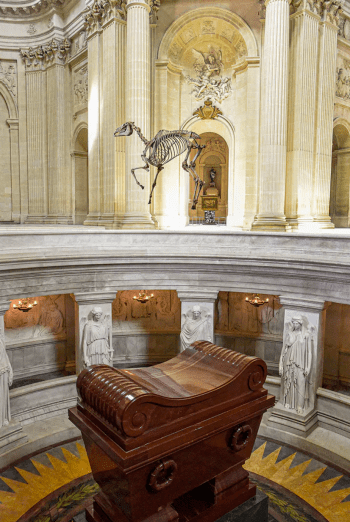 On a cold December day in 1840, Napoleon Bonaparte’s body made its final journey through the streets of Paris for reburial at the Dôme church at Les Invalides. Nineteen years after his death on Saint Helena, on 5 May 1821, the former emperor’s remains had been repatriated to France. The procession to Les Invalides included a lone, riderless white horse. In the emotionally charged atmosphere of that day, some witnesses even believed for a moment that this was the emperor’s most famous mount: Marengo.
Now, 200 years after Napoleon’s death, Bonaparte and Marengo are to be reunited, albeit temporarily. As part of Napoleon? Encore!, an exhibition of contemporary art responding to Napoleon’s image and complex legacies [on view from 7 May 2021 to 13 February 2022], the French multimedia artist Pascal Convert has created Memento Marengo: a life-sized, 3D-printed copy of the skeleton of the Arab horse said to have been Napoleon’s favourite—or one of his favourites, at least. Convert had originally hoped to use the real skeleton, which is usually on display at London’s National Army Museum, but its fragility made this impossible. Memento Marengo will hang from the ceiling of the Dôme church, the equine skeleton suspended a few metres above the enormous red quartzite tomb of its ex-master. On 5 May, President Emmanuel Macron placed a wreath of red, white, and blue flowers at the foot of the tomb, as part of the official commemorations—not celebrations, as the Élysée Palace has carefully insisted—of Napoleon’s death. Memento Marengo was not in place during the solemn ceremonies at Les Invalides, but with these now completed, the artwork can be installed ahead of the planned reopening of the museum later this month. . . .
The full article is available here»










leave a comment