New Book | Carmontelle’s Garden at Monceau
From Yale UP:
Carmontelle, Garden at Monceau, edited by Elizabeth Barlow Rogers and Joseph Disponzio, translated by Andrew Ayers, with an introductory essay by Laurence Chatel de Brancion and contributions from Joseph Disponzio, Florence Gétreau, David L. Hays, Elizabeth Hyde, Susan Taylor-Leduc, Caroline Weber, and Gabriel Wick (New Haven: Yale University Press, 2020), 196 pages, ISBN: 978-0300254686, $75.
 Carmontelle’s landmark publication, Garden at Monceau, beautifully reproduced to show the Parisian garden’s artistic and cultural importance before the French Revolution.
Originally published in 1779, Garden at Monceau is a richly illustrated presentation of the garden Louis Carrogis, known as Carmontelle, designed on the eve of the French Revolution for Louis-Philippe-Joseph d’Orléans, duc de Chartres. With its array of architectural follies intended to surprise and amaze the visitor, the garden was a setting for ancien régime social life. Carmontelle’s portrayal of his work in Garden at Monceau therefore serves as an expression of a key moment in the history of European landscape design, garden architecture, and social history. This facsimile edition, with its English-language text and reproductions of the original engravings, is accompanied by essays that interpret the landscape design and examine Carmontelle’s larger career as a painter and theater producer.
Elizabeth Barlow Rogers is the president of the Foundation for Landscape Studies, New York. Joseph Disponzio is a landscape architect with the New York City Department of Parks and Recreation.
Exhibition | Carmontelle (1717–1806)

Carmontelle, Self-Portrait, ca. 1762; graphite, watercolor, red chalk, and gouache on paper
(Chantilly: Musée Condé)
◊ ◊ ◊ ◊ ◊
From the Domaine de Chantilly:
Carmontelle (1717–1806), ou la Douceur de Vivre / And the Age of Pleasures
Musée Condé, Château de Chantilly, 5 September 2020 — 28 March 2021
Curated by Nicole Garnier
A playwright, draughtsman, and landscape architect, Louis Carrogis— known as Carmontelle—was a brilliant connoisseur whose many talents reflect the cultivated and cosmopolitan world in which he lived. The organizer of festivities for the Duke of Orléans, famous for his portraits and improvised comedies called Proverbes, Carmontelle designed the Parc Monceau in Paris for the Duke of Chartres and perfected transparencies or long rolls of paper depicting delightful landscapes.
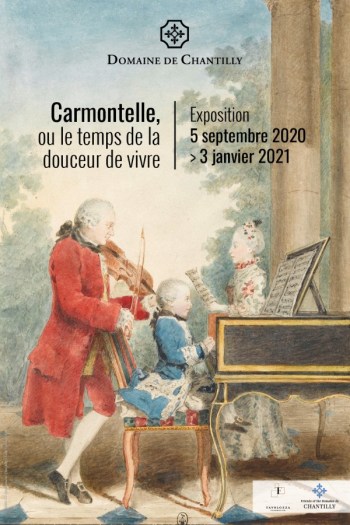 With sitters ranging from Mozart to Buffon, from Rameau to Baron Grimm, Carmontelle created a faithful portrait of mid-18th century Parisian society: princes of the blood, writers, philosophers, musicians, scientists, and elegant beauties of the ‘age of pleasures’—words coined by Talleyrand to describe the Ancien Régime. Thanks to Henri d’Orléans, Duke of Aumale (1822–1897), descendant of the Orléans who acquired the majority of this ensemble, the Condé museum at Chantilly has the best collection in the world of Carmontelle’s works with 484 drawn portraits and one transparency.
The son of a master cobbler, Louis Carrogis took the name ‘Carmontelle’ in 1744 after studying geometry. A topographer during the Seven Years’ War (1756–1763), he spent his spare time making portraits of the officers and organizing improvised comedies. In 1759, he entered the service of the Duke of Orleans as tutor to the young Duke of Chartres (1747–1793), the next Duke of Orléans and future Philippe Egalité; and from 1755 to 1784, he created ‘bad but accurate likenesses’ (Grimm) in gouache and watercolour of the entire court of the Orléans family at the Palais-Royal, Saint-Cloud, and Villers-Cotterêts. As an amateur draughtsman, Carmontelle preferred profile portraits for their ease of execution.
Nicole Garnier-Pelle, Carmontelle (1717–1806) ou le Temps de la Douceur de Vivre: Collection les Carnets de Chantilly n11 (Dijon: Éditions Faton, 2020), 96 pages, ISBN: 978-2878442779, €20.
Note: The exhibition, originally scheduled to close in January, has been extended until the end of March.
Mary D. Sheriff Travel and Research Award
Mary D. Sheriff Travel and Research Award
Applications due by 15 February 2021
Supporting feminist topics in eighteenth-century art history and visual culture
Award Amount: $2000
Eligibility: Doctoral candidates, early career scholars, and contingent faculty who are current members of the American Society for Eighteenth-Century Studies (ASECS) and the Historians of Eighteenth-Century Art and Architecture (HECAA).
Submission Materials: A 750-word description of the proposed project, a CV, and a budget (as a PDF file or MS Word doc). Please send submissions to MarySheriffAward@gmail.com.
New Book | The Versailles Effect
From Bloomsbury:
Mark Ledbury and Robert Wellington, eds., The Versailles Effect: Objects, Lives, and Afterlives of the Domaine (London: Bloomsbury, 2020), 320 pages, ISBN: 978-1501357787, $120.
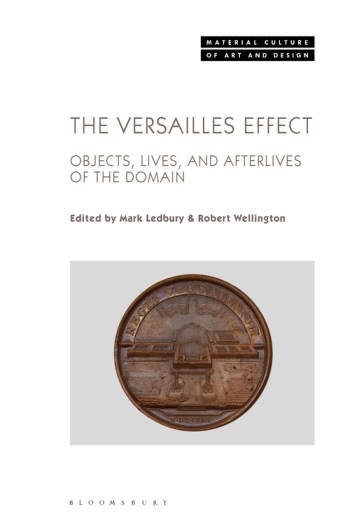 The essays in this volume show that Versailles was not the static creation of one man, but a hugely complex cultural space: a centre of power, but also of life, love, anxiety, creation, and an enduring palimpsest of aspirations, desires, and ruptures. The splendour of the Château and the masterpieces of art and design that it contains mask a more complex and sometimes more sordid history of human struggle and achievement. The case studies presented by the contributors to this book cannot provide a comprehensive account of the Palace of Versailles and its domains, the life within its walls, its visitors, and the art and architecture that it has inspired from the seventeenth century to the present day. However, this innovative collection will reshape—or even radically redefine—our understanding of the palace of Versailles and its posterity.
Mark Ledbury is Power Professor of Art History & Visual Culture and Director of the Power Institute at the University of Sydney. He is the author of James Northcote, History Painting, and the Fables (2014) and Sedaine, Greuze, and the Boundaries of Genre (2000). He is also the editor of three books, including Fictions of Art History (2013).
Robert Wellington is Senior Lecturer in Art History & Art Theory at the Australian National University. He is the Book Placement Editor for Early Modern Art History Studies (1500–1800) for H-France and serves on the advisory board for Bloomsbury’s Material Culture of Art & Design book series. His monograph Antiquarianism and the Visual Histories of Louis XIV: Artifacts for a Future Past was published in 2015.
C O N T E N T S
Enduring Versailles — Robert Wellington and Mark Ledbury
Part I. Making the Palace
1 The Other Palace: Versailles and the Louvre — Hannah Williams (Queen Mary University)
2 The Grands Décors of Charles Le Brun: Between Plan and Serendipity — Bénédicte Gady (Musée des Arts Décoratifs)
3 Artisans du Roi: Collaboration at the Gobelins, Louvre and the Académie Royale de Peinture et de Sculpture under the Influence of the Petite Académie — Florian Knothe (University of Hong Kong)
4 Rough Surfaces: Etching Louis XIV’s Grotto at Versailles — Louis Marchesano (Philadelphia Museum of Art)
Part II. Versailles Life
5 Porcelain and Power: The Meaning of Sèvres Porcelain in Ancien Regime France — Matthew Martin (National Gallery of Victoria)
6 Hair, Politics, and Power at the Court of Versailles — Kimberly Chrisman Campbell (Independent scholar, USA)
7 The Politics of Attachment: Visualizing Young Louis XV and His Governess — Mimi Hellman (Skidmore College)
8 Courting Favour: The Apartments of the Princesse de Lamballe at Versailles, 1767–1789 — Sarah Grant (Victoria and Albert Museum)
Part III. Outsiders
9 Enslaved Muslims at the Sun King’s Court — Meredith Martin (New York University) and Gillian Weiss (Case Western Reserve University)
10 A Turk in the Hall of Mirrors — David Maskill (University of Wellington)
11 Cornelis Hop (1685–1762), Dutch Ambassador to the Court of Louis XV — Daniëlle Kisluk-Grosheide (The Metropolitan Museum of Art)
Part IV. Versailles Now
12 Melancholy, Nostalgia, Dreams: Adventures in the Grand Cimetière Magique — Mark Ledbury (University of Sydney)
13 American Versailles: From the Gilded Age to Generation Wealth — Robert Wellington (Australian National University)
Bibliography
List of Contributors
Index
New Book | Jean-Henri Riesener
From Bloomsbury:
Helen Jacobsen, Rufus Bird, and Mia Jackson, eds., Jean-Henri Riesener: Cabinetmaker to Louis XVI and Marie Antoinette (London: Philip Wilson Publishers, 2021), 304 pages, ISBN: 978-1781300909, £50 / $100.
 Jean-Henri Riesener (1734–1806) was one of the greatest French cabinetmakers of all time. From humble beginnings as a German immigrant in Paris, he found fame through the delivery of a magnificent roll-top desk to Louis XV in 1769 and went on to become Marie-Antoinette’s favourite cabinetmaker, supplying the queen and the court of Louis XVI with sumptuous furniture of superb quality. Renowned for his exquisite marquetry and refined designs, his pieces were ornamented with spectacular gilt-bronze mounts made by some of the greatest metalworkers in Paris. In the nineteenth century, Riesener’s name became associated with the very best of Louis XVI-period French furniture; his pieces continue to be highly sought after and are found in major museums worldwide.
This first major monograph on Riesener traces his life and career, bringing new insights into his business practice, his designs, and construction techniques. Based on the extensive collections of Riesener furniture in the Wallace Collection, Waddesdon Manor, and the Royal Collection, the authors examine the objects and their history and highlight the changing tastes of the nineteenth-century collectors who acquired so many former French royal pieces. The new illustrations and visual glossary add another important resource for art historians, decorative arts enthusiasts, and furniture lovers.
Helen Jacobsen is Senior Curator and Curator of French Eighteenth-Century Decorative Arts at the Wallace Collection. Rufus Bird is Surveyor of The Queen’s Works of Art. Mia Jackson is Curator of Decorative Arts at Waddesdon Manor.
C O N T E N T S
The Cabinetmaker
• Christian Baulez, Jean-Henri Riesener: A Portrait Sketch
• Laura Langelüddecke, A German in Paris
• Carolyn Sargentson, Jean-Henri Riesener and the Business of Furniture-Making
• Lindsay Macnaughton, A Question of Language: The Royal Furniture Administration’s Accounts
• Mia Jackson, ‘Executed in the Taste of Painting’: Riesener’s Marquetry Designs
• Juliet Carey, Jean-Henri Riesener: The Portraits
The Collectors
• Rufus Bird, From Versailles to Windsor Castle: George IV and Riesener
• Helen Jacobsen, Alteration and Appropriation: The 4th Marquess of Hertford and the Taste for Riesener
• Ulrich Leben, Riesener and the Rothschilds at Waddesdon Manor
• Daniëlle Kisluk-Grosheide, Buying from Britain: The Development of a New Market
The Furniture
• Works in the Wallace Collection, the Royal Collection, and Waddesdon Manor
The Materials and Techniques
• Jürgen Huber, Materials and Techniques
• Alexander Collins, Visual Glossary
The Decorative Arts Trust Announces Four Failey Grants

Hunter House, ca. 1748. Courtesy the Preservation Society of Newport County.
◊ ◊ ◊ ◊ ◊
Press release from The Decorative Arts Trust (11 December 2020). . .
The Decorative Arts Trust congratulates the New-York Historical Society, the Preservation Society of Newport County, and authors Adrienne Childs and Iris Moon on receiving Failey Grants. The Failey Grant program provides support for noteworthy research, exhibition, publication, and conservation projects through the Dean F. Failey Fund, named in honor of the Trust’s late Governor. Preference is given to projects that employ or are led by emerging professionals in the museum field. The Trust increased the amount of funding available this cycle to $25,000 in recognition of the acute need for resources to underwrite important endeavors.
• New-York Historical Society will open the groundbreaking exhibition Black Dolls in 2022.
• The Preservation Society of Newport County in RI is planning a comprehensive reinterpretation of Hunter House.
• Adrienne Childs is finalizing the manuscript of Ornamental Blackness, to be published by Yale University Press in 2023.
• Iris Moon is concluding an analysis of the decorative arts of the French Revolution that will result in the publication of Luxury of Terror by the Pennsylvania State Press in 2022.

Topsy-turvy Doll, United States, 1890–1905, textile and paint (New-York Historical Society, Gift of Katharine Prentis Murphy, 1961).
In 2022, the New-York Historical Society will open the groundbreaking exhibition Black Dolls, which examines handmade Black dolls as both artistic expressions and windows into critical issues of race, gender, identity, and the legacy of slavery. Drawing from the collection of Deborah Neff, the show will present more than 100 home-made cloth dolls created largely by African American women between 1850 and 1940. Co-curated by Margaret K. Hofer, Vice President and Museum Director, and Dominique Jean-Louis, Project Historian, the exhibition will immerse visitors into the world of dolls, doll play, and doll making.
The Preservation Society of Newport County in Rhode Island is planning a comprehensive reinterpretation of Hunter House, the oldest property in the Society’s collection and long a landmark of Newport’s 18th-century prominence. The project aims to expand the public’s knowledge of the house through an overhauled interpretive presentation for onsite and online visitors. The investigation is led by research fellows Catherine Doucette and MaryKate Smolenski under the guidance of Leslie B. Jones, Director of Museum Affairs and Chief Curator. The team will address the ethics, scholarship, and restoration of histories and voices missing from the historic site. The new visitor experience will present an inclusive story that details Newport’s complex role in the economies of slavery and colonialism.

Clock Case, Paris, ca. 1785 (Washington, DC: Hillwood Estate, Museum and Gardens, Bequest of Marjorie Merriweather Post, 1973).
Adrienne Childs is finalizing the manuscript of Ornamental Blackness, to be published by Yale University Press in 2023. The book examines the long and complex tradition of the ornamental Black figure in European art and will create a framework for understanding how the decorative arts figure into the larger discourse of representing Blacks in European visual culture. Scant critical attention has been paid to this material, and the publication will have great value to museums, historic houses, and academia. Childs is an Associate of the W.E.B. Du Bois Research Institute at the Hutchins Center for African and African American Research at Harvard University.
Iris Moon, Assistant Curator of European ceramics and glass at The Metropolitan Museum of Art, is concluding an analysis of the decorative arts of the French Revolution that will result in the publication of Luxury of Terror by the Pennsylvania State Press in 2022. Moon’s research explores the production and circulation of French luxury after the death of Louis XVI and Marie Antoinette and how makers with strong ties to the monarchy found ways to survive the Terror, the most radical and violent phase of the Revolution. The publication will expand the study of French decorative arts by drawing attention to the creative and experimental forms of luxury that emerged during a turbulent period of history.
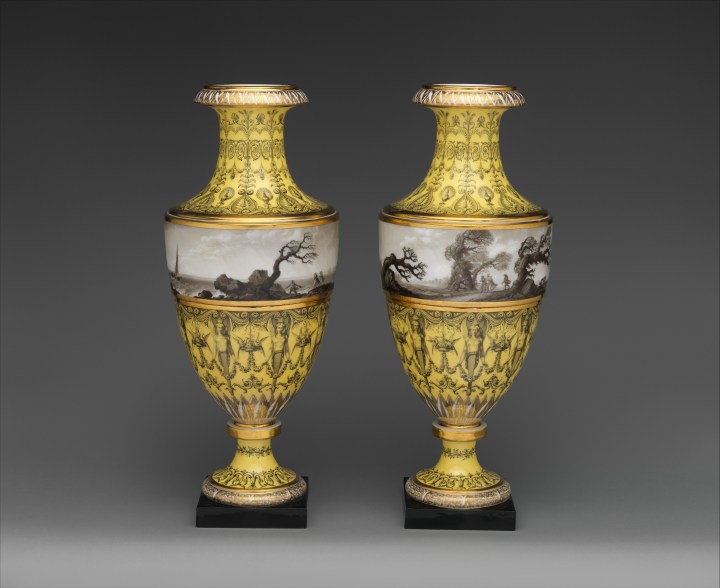
Dihl et Guérhard, possibly painted by Jean-Baptiste Coste, Pair of Vases with Landscapes at Sea and on Land, Paris, ca. 1797–98, hard-paste porcelain with enamel decoration and gilding (New York: The Metropolitan Museum of Art, Wrightsman Fund, 2014).
◊ ◊ ◊ ◊ ◊
The Decorative Arts Trust is a non-profit organization that promotes and fosters the appreciation and study of the decorative arts through: exchanging information through domestic and international programming; collaborating and partnering with museums and preservation organizations; and underwriting internships, research grants, and scholarships for graduate students and young professionals. Learn more about the Trust at decorativeartstrust.org or by contacting thetrust@decorativeartstrust.org.
Print Quarterly, December 2020

Meissen bowl with leopard licking its paw, after engraving with six leopards (see below), part of Hanbury Williams service, ca. 1745, porcelain, diameter 340 mm.
◊ ◊ ◊ ◊ ◊
The eighteenth century in the latest issue of Print Quarterly:
Print Quarterly 38.4 (December 2020)
A R T I C L E S
Malcolm Jones, “Early Modern English Prints in the Joseph Ames Album at the Morgan Library,” pp. 411–31.
This article publishes, for the first time, some of the contents of an album in the Morgan Library and Museum, New York, entitled Emblematical and Satirical Prints in Persons and Professions. Compiled around 1750 by Joseph Ames (1689–1759) and containing 237 miscellaneous European prints. About 125 are catalogued as English; 33 of these are unique or exceedingly rare examples and are discussed in detail throughout the article. The remaining English prints in the album are described in an appendix.
N O T E S A N D R EV I E W S

Anonymous artist, Six Leopards, from album with prints of animals published by Joos de Bosscher, 1581–1600, engraving, 125 x 177 mm (Amsterdam, Rijksmuseum).
Maureen Cassidy-Geiger, Review of Raffinesse im Akkord: Meissener Porzellanmalerei und ihre grafischen Vorlagen (2018), pp. 465–69.
This note reviews a two-volume publication about print sources for imagery on eighteenth-century Meissen porcelain. Where possible, the catalogue of 475 entries presents the names of the artists, engravers or publishers of Dutch, French, German, and Italian print sources used.
Tom Young, Review of Douglas Fordham, Aquatint Worlds: Travel, Print, and Empire, 1770–1820 (2019), pp. 470–74.
This note, and the book it reviews, emphasises the close ties the medium of aquatint has with British exploration and imperialism. Using J.R. Abbey’s (1894–1969) collection of aquatint travel books, today held by the Yale Center for British Art, the case studies show how aquatint’s advantages in colour and detail helped to convey antiquarian details with meticulous accuracy, but that it also had a broader impact on developing a community of taste dependent on travel and the recognition of difference.
Call for Papers | BU Graduate Symposium, Crowd Control
From Boston University:
Crowd Control
The 37th Annual Boston University Graduate Symposium in the History of Art & Architecture
(Online) 23–24 April 2021
Proposals due by 15 December 2020
Crowd control—as both an idea and an act—raises questions about agency, authority, and influence. From ancient Rome to Boston City Hall, state-sponsored architecture has policed the body and shaped the ideal of a citizen.Yet subtler forces such as painting, prints, and photographs also exert powerful influence. The events of this past year have heightened our awareness of both the power of the people and the contours of the systems which surround them. We have seen the wide array of structures that seek to order, pacify, neutralize, inspire, repress, or control the collective. The 37th Annual Boston University Graduate Symposium in the History of Art & Architecture invites submissions examining images, objects, and structures that engage with the regulation and redirection of peoples and their social behaviors.
Possible subjects include, but are not limited to, the following: architecture, urbanism, and the organization of private and public spaces; monuments, memory, and civic structures; masquerade, carnival, and festivals; ceremonies and processions; exhibitions and viewing conditions; pilgrimage and religious institutions; protest, policing, the carceral system, and surveillance; population control, eugenics, urban growth and decline; collective and mass culture; conquest, colonialism, coloniality, xenophobia; caste, race, and social hierarchies.
We welcome submissions from graduate students at all stages of study, from any area of study. Papers must be original and previously unpublished. Please send an abstract (300 words or fewer), a paper title, and a CV to bugraduatesymposiumhaa@gmail.com. The deadline for submissions is December 15, 2020. Selected speakers will be notified by early February. Papers should be 15 minutes in length and will be followed by a question and answer session. The symposium will be held virtually on Friday, 23 April, and Saturday, 24 April 2021, with a keynote lecture by Dr. Paul Farber, Director of Monument Lab and Senior Research Scholar at the Center for Public Art & Space at the University of Pennsylvania Weitzman School of Design.
This event is generously sponsored by the Boston University Center for the Humanities; the Boston University Department of History of Art & Architecture; and the Boston University Graduate Student History of Art & Architecture Association.
Call for Papers | Art and Nature
From ArtHist.net:
Art and Nature: 6th Conference for Doctoral and Post-Doctoral Students in Humanities and Social Sciences
Online / Center for Iconographic Studes, Rijeka, 8 October 2021
Proposals due by 15 May 2021
This conference will address how the natural world has been presented, reflected or interacted by visual artists through centuries. Papers from PhD students and recent PhD graduates will debate on various topics from the pragmatic view of the natural world, existed simply to serve society, through the idea of natural phenomena, animals, plants etc. as allegories and symbols utilized to draw morality tales or aesthetic principles, which were viewed with as much importance as scientific information, to nature as a source of inspiration for new ideas and movements reflected in the fields of arts. Specific focus is put on the modern technologies and media, as well as the artists’ addressing social and political issues relating to the natural environment.
Topics of the conference include, but are not limited to:
• Art as mirror of nature: interpretation of nature in various historical periods, artistic contexts and individual artistic opuses
• Art and nature: allegoric and symbolic representations, illustrations in the books of nature (botanical and zoological studies), flora and fauna in emblems, design and applied arts;
• Art and natural context: landscape painting, Animalists, Wanderers Art Movement, Land Art, Earth Art, Environmental Art
• Art and new technologies: biotechnological arts (BioArt), Genetic art, Evolutionary art, ethical problems considering using modern technologies and bio materials in art etc.
• Art and contemporary aspects and dilemmas: climate changes, environmental problems, ecological awareness represented through visual arts (EcoArt, Crop art, Sustainable art)
Proposals should be sent to phd.conference2020.lj@gmail.com by 15 May 2021 and should include an abstract of maximum 400 words and a short CV. More information is available here.
New Book | Old Masters Worldwide
From Bloomsbury:
Susanna Avery-Quash and Barbara Pezzini, eds., Old Masters Worldwide: Markets, Movements and Museums, 1789–1939 (London: Bloomsbury, 2020), 320 pages, ISBN: 978-1501348143, $130.
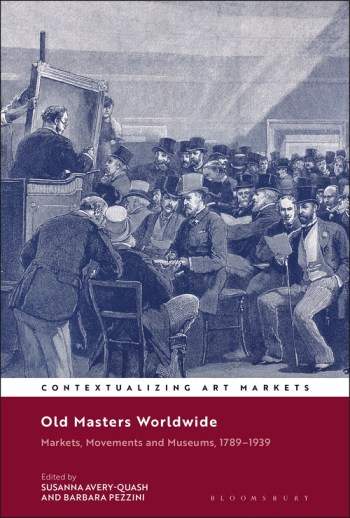 As a result of the Napoleonic wars, vast numbers of Old Master paintings were released on to the market from public and private collections across continental Europe. The knock-on effect was the growth of the market for Old Masters from the 1790s up to the early 1930s, when the Great Depression put an end to its expansion. This book explores the global movement of Old Master paintings and investigates some of the changes in the art market that took place as a result of this new interest. Arguably, the most important phenomenon was the diminishing of the traditional figure of the art agent and the rise of more visible, increasingly professional, dealerships; firms such as Colnaghi and Agnew’s in Britain, Goupil in France, and Knoedler in the USA, came into existence. Old Masters Worldwide explores the ways in which the pioneering practices of such businesses contributed to shape a changing market.
Susanna Avery-Quash is Senior Research Curator (History of Collecting) at The National Gallery London. Barbara Pezzini is a prolific writer on European Old Masters and British art of the period 1830–1970; she has previously worked in curatorial, research, and archival projects for The National Gallery, National Trust, and The Burlington Magazine.
C O N T E N T S
List of Figures
Series Editor’s Introduction, Kathryn Brown
Foreword, Gabriele Finaldi
Acknowledgements
List of Abbreviations
Introduction, Susanna Avery-Quash and Barbara Pezzini
Part I: Developing European Networks, 1780–1894
1 The European Market for Italian Old Masters after Napoleon — Robert Skwirblies (Technische Universität Berlin)
2 Old Masters from Rome to London: Alexander Day and Pietro Camuccini — Pier Ludovico Puddu (Palacký University, Czech Republic)
3 Selling Old Masters in Britain, France, and the Netherlands: The Networking Strategies of John Smith — Julia Armstrong-Totten (Independent Scholar, USA)
4 A Web of Agents: Buying Old Masters for the National Gallery, London — Susanna Avery-Quash (National Gallery, UK)
Part II: Gaining International Visibility and Expertise, 1850–1909
5 Old Masters versus Modern Art in Parisian Auctions — Léa Saint-Raymond (Université Paris Nanterre)
6 Agnew’s from Modern Art to the Old Masters — Barbara Pezzini (Independent Scholar, UK)
7 Taste or Opportunity? Durand-Ruel and Spanish Old Masters — Véronique Gerard Powell (Independent Scholar, France)
8 Authority and Expertise in the Old Master Market: Bode and Duveen — Catherine Scallen (Case Western Reserve University)
9 Scholar, Dealer, and Museum Man: Robert Langton Douglas in the International Old Master Market — Imogen Tedbury (Royal Holloway, University of London)
Part III: Casting a Wider Web, 1900–1939
10 A Missed Opportunity? Goupil and the Old Masters — Agnès Penot (Independent Scholar, USA)
11 Knoedler and Old Masters in America — Inge Reist (The Frick Collection)
12 Trust, Friendship, and Politics in the Old Master Market: Duveen and the State Art Collection of the Kingdom of Yugoslavia — Jelena Todorovic (Faculty of Fine Arts, Serbia)
13 Negotiating Old Masters for the Melbourne National Gallery — Monique Webber (The University of Melbourne and Monash University Art Design and Architecture)
14 The Distant Old Masters of South Africa — Jillian Carman (University of the Witwatersrand, South Africa)
Select Bibliography
Author Biographies
Index










 Enfilade
leave a comment