New Book | Lectures on Art: Selected Conférences, 1667–1772
From Getty Publications:
Christian Michel and Jacqueline Lichtenstein, eds., Lectures on Art: Selected Conférences from the Académie Royale de Peinture et de Sculpture, 1667–1772, translated by Chris Miller (Los Angeles: Getty Publishing, 2020), 488 pages, ISBN 978-1606066461, $75.
 Between 1667 and 1792, the artists and amateurs of the Académie Royale de Peinture et de Sculpture in Paris lectured on the Académie’s conférences, foundational documents in the theory and practice of art. These texts and the principles they embody guided artistic practice and art theory in France and throughout Europe for two centuries.
In the 1800s, the Académie’s influence waned, and few of the 388 Académie lectures were translated into English. Eminent scholars Christian Michel and Jacqueline Lichtenstein have selected and annotated forty-two of the most representative lectures, creating the first authoritative collection of the conférences for readers of English. Essential to understanding French art of the seventeenth and eighteenth centuries, these lectures reveal what leading French artists looked for in a painting or sculpture, the problems they sought to resolve in their works, and how they viewed their own and others’ artistic practice.
Christian Michel is a professor of art history at the Université de Lausanne, a leading scholar of artistic production in seventeenth- and eighteenth-century Europe, and the author of many essays, articles, and books. Jacqueline Lichtenstein was a philosopher and art historian specializing in the history and criticism of art and aesthetics. She taught at the University of Paris-IV-Sorbonne, the University of Paris- X Nanterre, the École du Louvre, and the University of California, Berkeley. Lichtenstein died in 2019. Chris Miller is a widely published critic and translator, co-founder of the Oxford Amnesty Lectures, and author of Forms of Transcendence: The Art of Roger Wagner (2009).
The Huntington Acquires Newly Discovered Copley Painting
Press release (23 September 2020) from The Huntington:
The Huntington Library, Art Museum, and Botanical Gardens announced today that it has acquired a newly discovered painting by John Singleton Copley (1738–1815) depicting celebrated 18th-century British actress Mary Robinson, as well as works by British artists Alice Mary Chambers (ca. 1855–1920) and Madeline Green (1884–1947) and a set of screen prints by R.B. Kitaj (1932–2007), who, like Copley, was born in America and worked in England. The acquisitions were funded by The Huntington’s Art Collectors’ Council at its annual meeting last month. In addition, longtime council members Hannah and Russel Kully purchased as a promised gift for The Huntington a painting by the 19th-century British artist and designer Edward Burne-Jones (1833–1898). The painting, a portrait of the artist’s daughter, had been kept in the family since it was painted around 1888.
“This year we cover 200 years of British art history and bridge the Atlantic, celebrating the interconnected web of American and British art,” said Christina Nielsen, Hannah and Russel Kully Director of the Art Museum at The Huntington. “In this group are masterpieces, rarities, works by underrecognized female artists, and works that tie together different collection areas at The Huntington in intriguing ways. Together, they amplify our collection’s strengths and further its reach into the 20th century, all thanks to the generosity of our Art Collectors’ Council. To the Kullys—words fail to express the depth of our gratitude for their indefatigable commitment to The Huntington’s art collections. With this Burne-Jones portrait, we will be able to share with visitors a rare and arresting work that expands our great William Morris collection to reveal a very personal look at his artistic partner.”
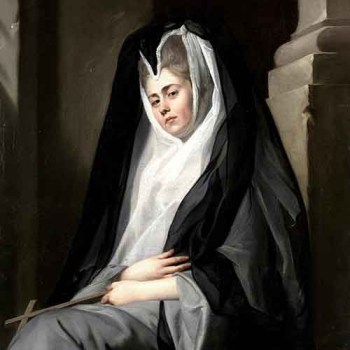
John Singleton Copley, Mrs. Mary Robinson in the Character of a Nun, ca. 1780, oil on canvas (San Marino: The Huntington Library, Art Museum, and Botanical Gardens).
Mrs. Mary Robinson in the Character of a Nun (ca. 1780) is a cabinet portrait, perhaps commissioned by an admirer, of one of Britain’s most famous actresses of the late 18th century. Lost for generations until it was sold in 1999 at auction as a French painting of an unknown sitter, the newly identified work portrays Robinson in her role as Oriana in George Farquhar’s comedy The Inconstant; or The Way to Win Him, which she performed on the London stage in the spring of 1780. In the course of the play, Robinson’s character engages in a series of ruses—dressing as a nun, feigning madness, and finally disguising herself as a pageboy—to win the heart of her love interest. The portrait was painted just a few years after Copley, who had already established himself as a leading portraitist in colonial America, moved from Boston to London to test his skills at the Royal Academy, and at the height of Robinson’s career. Around the same time, she sat for four of Copley’s professional rivals—Sir Joshua Reynolds, Thomas Gainsborough, George Romney, and John Hoppner.
In the painting, Copley’s talent for rendering likeness and dress is on full view, with the darks of the nun’s habit set off by the painter’s incomparable use of gauzy whites. A beam of light through the window illuminates the fine features of the sitter’s face, highlighting her hands and the wooden cross lying across her lap.
Acclaimed by many to be one of the most beautiful actresses in England, Robinson was also a popular poet, novelist, playwright, feminist thinker, fashion trendsetter, and, most famously, mistress of the Prince of Wales, later George IV. The Huntington’s Library holds a renowned collection of materials related to the history of London theater and British literature that includes many of Robinson’s published and unpublished poems, novels, plays, and her posthumously published autobiography. The painting also serves as a complement to The Huntington’s American-made Copley, a portrait of Sarah Jackson (ca. 1765), and a later work from his British period, The Western Brothers (1783), both displayed in the Virginia Steele Scott Galleries of American Art. The Robinson portrait will go on view in the Huntington Art Gallery, among The Huntington’s rich collection of British portraiture.
Burne-Jones was among the most influential artists of his day. A friend and collaborator of William Morris, he was a designer of stained glass, decorated furniture, and textiles. Hundreds of working drawings relating to his design accomplishments are held at The Huntington, as well as one of the most popular installations in the Huntington Art Gallery, a two-story-high stained glass window, the David Healey Memorial Window, which he designed for the Unitarian Chapel, Heywood, Lancashire, around 1898.
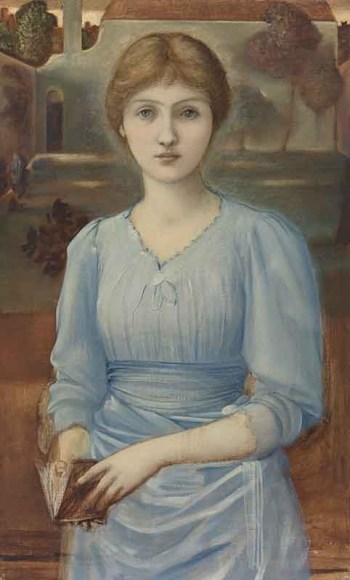
Sir Edward Coley Burne-Jones, Portrait of Margaret Mackail, the Artist’s Daughter, ca. 1888, oil on canvas (San Marino: The Huntington Library, Art Museum, and Botanical Gardens).
Burne-Jones was also a painter, associated with both the Pre-Raphaelites and the Aesthetic Movement. His oil paintings often explore themes of faith, chivalry, and love through the lens of medieval or Renaissance art and are marked by a dreamy, otherworldly quality. With its restrained composition and harmonious palette, Portrait of Margaret Mackail, which depicts Burne-Jones’s beloved daughter, is typical of his style. Last owned by the sitter’s great-granddaughter, the painting has never been exhibited or published. It will go on view in the Huntington Art Gallery alongside other works from the British Design Reform period.
Though she was well connected among London’s Pre-Raphaelite and Arts and Crafts artists, and regularly exhibited her work at the Royal Academy, Alice Mary Chambers was a Victorian-era artist who only recently is emerging from obscurity thanks to the recent definitive identification of the monogram with which she signed her work and a 2018 scholarly article on her life and career.
Chambers was a friend of infamous art dealer Charles Howell, and correspondent of James McNeill Whistler; and her interest in the work of William Morris, Edward Burne-Jones, and Dante Gabriel Rossetti (co-founder of the Pre-Raphaelite Brotherhood) is evident in Portrait of a Young Woman. Worked in sumptuous strokes of red chalk, the delicate figure looks up from under heavily shaded brows in an expression that lends her a dreamy quality typical of Burne-Jones’s work. The leafy background of the portrait is reminiscent of Morris’s wallpaper designs, and Chambers consciously modeled her monogram in the lower left on that of Rossetti. The portrait adds a rare example of a female artist’s work to the collection of more than 12,000 British drawings at The Huntington.
Joseph Duveen, the famous art dealer who helped Henry and Arabella Huntington acquire the works that became the core of The Huntington’s art collections, championed Madeline Green, acquiring her painting The Future (1925) in 1927 and giving it to the Manchester Art Gallery that year. Green also won awards at the Royal Academy and exhibited at the Paris Salon and Venice Biennale. But her work is practically unknown today, and only recently reemerging through a new publication and recent exhibition at Gunnersbury Park and Museum in London.
With the self-portrait Miss Brown, Green playfully puns on her last name to present herself in the guise of another. Throughout her career, Green played with the concept of portraiture and self-portraiture, depicting herself as a mother, a wife, a dancer, an actress—alternately fierce, timid, provocative, but always appearing intelligent and with a pronounced independence. Miss Brown is dressed as a costermonger (fruit and vegetable seller) with apron and checkered scarf. (In other paintings, Green depicts herself dressed as a male costermonger.) Green’s technique involves rich layers on the canvas, with some areas so thinly painted as if to evoke watercolor, and others thick with impasto. Green explained how she accomplished the unique depth and texture of her painting, saying she worked “in body colour [opaque watercolor] underneath and glazed with pure colour and oil. I always paint in this way and although it takes rather a time, I don’t think the same effect can be obtained otherwise.”
Kitaj , an American, was one of the most prominent figures of the London art scene during the 1960s and ‘70s. As a young man, he took advantage of the G.I. Bill to study art in the U.K., and ended up staying there for nearly 30 years, only occasionally returning to the U.S. for short periods to teach.
Kitaj is credited with coining the phrase “School of London” to describe his circle of figurative painters that included famous names such as Francis Bacon, Lucian Freud, and David Hockney. In addition to painting, printmaking was a major part of Kitaj’s practice since 1962, when he was introduced to master screen printer Chris Prater at London’s Kelpra Studio. For Kitaj, printmaking, with its serial generation of imagery, had an immediacy that did not exist in oil painting. He called the practice “as close to spontaneity as I’ve ever managed to come.”
A portfolio of 50 prints, In Our Time: Covers for a Small Library After the Life for the Most Part, produced at Kelpra, reflects the interconnection of art and literature that is a major hallmark of his work. It reproduces the covers of books the artist had collected. As he recalled, “I combed bookshops and libraries, my own and those of friends, over a few years for memorable covers, for the look of them, their associations, variety, color, reverberations, titles, etc.” The acquisition includes an additional three prints representing book covers not part of the original edition.
In Our Time complements The Huntington’s growing holdings in the field of later 20th-century graphic and pop art, which include the work of Romare Bearden, Henry Moore, and Andy Warhol.
Online Conference | Palaces in Eighteenth-Century Madrid
From the conference programme:
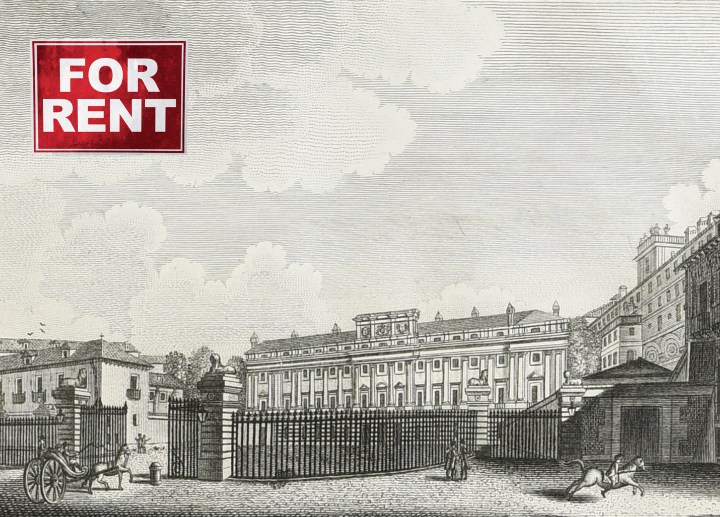
Palaces for Rent: Real Estate in Madrid in the Eighteenth Century / Palacios en alquiler: Patrimonio inmobiliario en el Madrid del siglo XVIII
Online, Universidad Nacional de Educación a Distancia (UNED), Madrid, 12 November 2020
Lugar de celebración
Sala virtual de conferencias
https://zoom.us/j/97638995759?pwd=b1l3Qko3WkFpNzVkdjc1eExPQ20wZz09
Acceso libre hasta completar el aforo de sala. Las sesiones estarán posteriormente disponibles en el portal de Canal UNED.
Destinatarios
Estudiantes de Máster y Doctorado en las áreas de historia, historia del arte, historia de la arquitectura, estudios urbanos, estudios sobre la nobleza, historia de la vida cotidiana, estudios de cultura visual y material, etc.
Se facilitará certificado de asistencia a los estudiantes interesados previa petición por correo.
Más información
palacesforrent@gmail.com
Dirección científica
Dra. Pilar Diez del Corral Corredoira, UNED.
Dr. Álvaro Molina Martín, UNED.
Dra. Miriam Cera Brea, Universidad Autónoma de Madrid.
Comité científico
Dra. Natalia González Heras, Universidad Complutense de Madrid.
Dra. Giada Lepri, La Sapienza, Roma.
Dr. Carlos Sambricio, Universidad Politécnica de Madrid.
Dra. Mercedes Simal, Universidad de Jaén.
Dr. José Antonio Vigara Zafra, UNED.
P R O G R A M A
9:30 BIENVENIDA Y PRESENTACIÓN
Consuelo Gómez López (Directora del Departamento de Historia del Arte, UNED)
Pilar Diez del Corral Corredoira y Álvaro Molina Martín (UNED), Miriam Cera Brea (UAM)
10:00 RESIDIR Y ALOJARSE EN MADRID: MÁS ALLÁ DE LA VILLA Y CORTE
Modera: Álvaro Molina Martín
• Natalia González Heras (Universidad Complutense de Madrid), El alquiler yRegalía de Aposento: Tipologías de ocupación residencial en la Corte del siglo XVIII
• José Antonio Vigara Zafra (UNED), La problemática entre el centro y la periferia en las residencias palaciegas de las élites nobiliarias españolas del siglo XVIII
• Magdalena Merlos Romero (Archivo Municipal de Aranjuez), Palacios y alojamientos del siglo XVIII en un real sitio: previsión urbana de Aranjuez para días de primavera
12:00 DESCANSO
12:15 PENSAR Y DISEÑAR EL PALACIO: LA CONFORMACIÓN DE UNA CULTURA ARQUITECTÓNICA
Modera: Miriam Cera Brea
• Juan Luis Blanco Mozo (Universidad Autónoma de Madrid), La maqueta de Filippo Juvarra para el palacio real nuevo de Madrid. Historia en su contexto
• Adrián Fernández Almoguera (Sorbonne-Université – École française de Rome), Jorge Durán y el palacio del conde de Tepa: ¿un caso de “italomanía” en el Madrid de finales de la Ilustración?
• José Riello (Universidad Autónoma de Madrid), Cárceles doradas del arte: cultura de la ostentación en el Museo de Antonio Palomino
14:15 DESCANSO
16:00 VESTIR EL PALACIO: USOS, PRÁCTICAS Y SÍMBOLOS EN TORNO AL ADORNO DOMÉSTICO
Modera: Pilar Diez del Corral Corredoira
• Álvaro Molina (UNED), Hacia una cartografía del adorno en las residencias palaciegas de la corte de Carlos IV
• Milton Pacheco (Universidade Nova de Lisboa), Cenários de Himeneu: A residência madrilena do embaixador extraordinário português, o IIImarquês de Louriçal, por ocasião das festividades dos duplos matrimónios reais celebradas em 1785
• Mirella Romero Recio (Universidad Carlos III), Pompeya y la Antigüedad en las decoraciones pictóricas de los palacios de Godoy en Madrid
• Sandra Antúnez López (Universidad Autónoma de Madrid), El Real Guardarropa y las nuevas modas en la corte de Carlos IV y María Luisa de Parma (1789–1808)
18:30 CLAUSURA
New Book | Freemasonry and the Visual Arts
From Routledge:
Reva Wolf and Alisa Luxenberg, eds., Freemasonry and the Visual Arts from the Eighteenth Century Forward: Historical and Global Perspectives (London: Bloomsbury Visual Arts, 2020), 304 pages, ISBN: 978-1501337963 (hardback), $120 / ISBN: 978-1501366925 (paperback), $35.
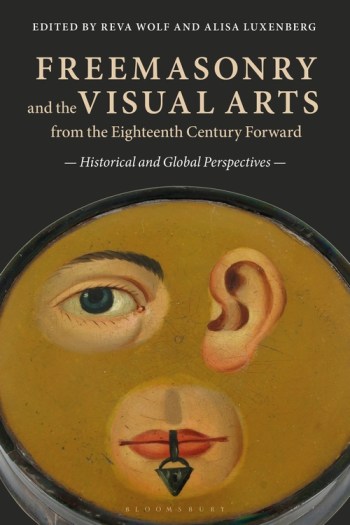 With the dramatic rise of Freemasonry in the eighteenth century, art played a fundamental role in its practice, rhetoric, and global dissemination, while Freemasonry, in turn, directly influenced developments in art. This mutually enhancing relationship has only recently begun to receive its due. The vilification of Masons, and their own secretive practices, have hampered critical study and interpretation. As perceptions change, and as masonic archives and institutions begin opening to the public, the time is ripe for a fresh consideration of the interconnections between Freemasonry and the visual arts. This volume offers diverse approaches, and explores the challenges inherent to the subject, through a series of eye-opening case studies that reveal new dimensions of well-known artists such as Francisco de Goya and John Singleton Copley, and important collectors and entrepreneurs, including Arturo Alfonso Schomburg and Baron Taylor. Individual essays take readers to various countries within Europe and to America, Iran, India, and Haiti. The kinds of art analyzed are remarkably wide-ranging-porcelain, architecture, posters, prints, photography, painting, sculpture, metalwork, and more-and offer a clear picture of the international scope of the relationships between Freemasonry and art and their significance for the history of modern social life, politics, and spiritual practices. In examining this topic broadly yet deeply, Freemasonry and the Visual Arts sets a standard for serious study of the subject and suggests new avenues of investigation in this fascinating emerging field.
Reva Wolf is Professor of Art History, State University of New York at New Paltz. Alisa Luxenberg is Professor of Art History, University of Georgia.
C O N T E N T S
Acknowledgments
List of illustrations
Reva Wolf and Alisa Luxenberg, Introduction: The Mystery of Masonry Brought to Light
1 David Martín López, Freemasonry in Eighteenth-Century Portugal and the Architectural Projects of the Marquis of Pombal
2 Cordula Bischoff, The Order of the Pug and Meissen Porcelain: Myth and History
3 Reva Wolf, Goya and Freemasonry: Travels, Letters, Friends
4 David Bjelajac, Freemasonry’s ‘Living Stones’ and the Boston Portraiture of John Singleton Copley
5 Nan Wolverton, The Visual Arts of Freemasonry as Practiced ‘Within the Compass of Good Citizens’ by Paul Revere
6 Alisa Luxenberg, Building Codes for Masonic Viewers in Baron Taylor’s Voyages pittoresques et romantiques dans l’ancienne France
7 Talinn Grigor, Freemasonry and the Architecture of the Persian Revival, 1843–1933
8 William D. Moore, Solomon’s Temple in America: Masonic Architecture, Biblical Imagery, and Popular Culture, 1865–1930
9 Martin Cherry, Freemasonry and the Art Workers’ Guild: The Arts Lodge No. 2751, 1899–1935
10 Cheryl Finley and Deborah Willis, Picturing Black Freemasons from Emancipation to the 1990s
11 Katherine Smith, Saint Jean Baptiste, Haitian Vodou, and the Masonic Imaginary
Selected Bibliography
Index
New Book | Humphry Repton: Landscape Design in an Age of Revolution
From Reaktion Books and the University of Chicago Press:
Tom Williamson, Humphry Repton: Landscape Design in an Age of Revolution (London: Reaktion Books, 2020), 352 pages, ISBN: 978-1789142990, £35 / $50.
 Humphry Repton (1752–1818) remains one of England’s most interesting and prolific garden and landscape designers. Renowned for his innovative design proposals and distinctive before-and-after images, captured in his famous ‘Red Books’, Repton’s astonishing career represents the link between the simple parklands of his predecessor Capability Brown and the more elaborate, structured, and formal landscapes of the Victorian age. This lavishly illustrated book, based on a wealth of new research, reinterprets Repton’s life, working methods, and designs, and examines why they proved so popular in a rapidly changing world.
Tom Williamson is professor of landscape history at the University of East Anglia.
C O N T E N T S
Introducing Humphry Repton
1 Before Repton
2 The Shape of a Career
3 Repton in Business: Working Methods
4 The Public Landscape: ‘Character’ and ‘Appropriation’
5 Domesticity and ‘Cheerfulness’
6 Shaping Style: Influences, Contemporaries, Social Change
Epilogue: Repton’s Legacy
References
Bibliography
Acknowledgements
Photo Acknowledgements
Index
Call for Papers | AAH 2021, Online (addendum)
Last week, a Call for Papers for AAH 2021 appeared here at Enfilade. I’m sorry that I failed to include the following session on Race and Representation in the French Colonial Empire; the posting has been updated, though I’m glad also to draw readers’ attention to the panel here. –CH
Association for Art History (AAH) Conference
Online (University of Birmingham), 4–17 April 2021
Proposals due by 2 November 2020
Race and Representation in the French Colonial Empire
Susannah Blair (Columbia University), seb2210@columbia.edu
Stephanie O’Rourke (University of St Andrews), so38@st-andrews.ac.uk
This session will consolidate new research on the visual culture of race in France and its colonies during the 18th century and into the 19th century. It will be oriented around two key terms, ‘representation’ and ‘possession’, and their many resonances—artistic, political, legal and relational. Papers will be invited to explore how art objects articulated, contested and disseminated changing notions of racial identity and citizenship in France and its global networks.
Over the past several years, scholars have examined the role of pictorial representation in shaping ideas of race, identity, indigeneity and slavery in the context of the British Empire. Bringing together new scholarship that builds upon these precedents, we aim to address a deliberately expansive geographical notion of French visual culture, one that includes the Caribbean, New France, North Africa, Canada and the Indian Ocean in addition to sites within the ‘metropole’ such as Paris and Nantes. Fostering a dialogue between art history, indigenous studies and critical race theory, our panel will provide a crucial scholarly platform for research that can inform pedagogy, curatorial practice and future scholarship.
Online Panel | Race and the Boundaries of the Book

I’m especially excited about the prerecorded videos (most 6–8 minutes); it’s an interesting way to maximize the potential of this RBS online session and also extend the value of the event well beyond the confines of the original session. –CH
Race and the Boundaries of the Book: Seven Early American Perspectives
Rare Book School Online, 20 October 2020, 5–6pm (ET)
A 45-minute panel discussion followed by 15 minutes of Q&A scheduled for Tuesday, 20 October 2020, 5–6pm ET, via Zoom. Owing to Zoom’s restrictions, this event is limited to the first 300 people who register. The event will be recorded and made available for viewing on the RBS YouTube channel.
 Through video presentations of individual case studies, seven early Americanists zoom in on a range of bookish artifacts and employ critical bibliography to recover overlooked narratives about race from the historical record. Specifically, they examine how racialized and marginalized early American subjects speak through bibliographical concepts and formats. What can the materialities of textual artifacts tell us about the elaboration of racial identities? How does specific attention to African American and Indigenous readers and writers in early American literature and culture—a field that has traditionally privileged white subjects—gain traction by looking at formats, bindings, and paper surfaces on which writing and printing occur? Formats, the panelists argue, are everything but neutral containers. Following a chronological order, the video presentations examine the boundaries of “the book” and the complex richness of small and overlooked forms for recovering dismissed and erased readers, writers, and print artisans.
Rather than a traditional academic conference panel, the participants intend to create an engaging conversation by incorporating an innovative blend of pre-recorded video, focused analysis of specific material texts, and a live-streamed panel discussion of how their work engages with larger questions raised by the fields of early American literature and book history.
The panelists are Tara A. Bynum (University of Iowa), Alan Corbiere (York University), Michael Galban (Seneca Art & Cultural Center, Ganondagan State Historic Site), John H. Pollack (University of Pennsylvania), Phillip Round (University of Iowa), Michaël Roy (Université Paris Nanterre), and Derrick Spires (Cornell University). Steffi Dippold (Kansas State University) and John J. Garcia (Florida State University) are moderating the session.
The panelists have pre-recorded BiblioVideos in preparation for the panel discussion, which can be accessed here or by clicking on the titles below. They plan to summarize the argument during the panel, but the audience should watch the BiblioVideos in advance to prepare for their discussion. The videos are listed in the recommended viewing order below:
- “Early Indigenous Bookmaking: The Indian Primer (1669),” Steffi Dippold and Michael Galban
- “Cesar Lyndon: A Sundry Account Book,” Tara A. Bynum
- “Runaways: African American Papermakers During the American Revolution,” John J. Garcia
- “Ephemeral Caskets,” Michaël Roy
- “Jarena Lee’s Life and Religious Experience (1836),” Derrick R. Spires
- “Indigenizing Print,” Alan Corbiere and Phillip Round
- “Proclaiming Emancipation,” John H. Pollack
Everyone is welcome to attend. To ensure the security of the event, advance registration is required; to register, click here. Registration closes at 8am ET the day of the event. Your registration will be automatically accepted. You will receive an email reminder the day before the event. The day of the event, we will send you the Zoom URL and password. Please direct any questions to RBS Programs at rbs-events@virginia.edu.
Follow the conversation on social media using hashtags #RBSOnline and #RBSEarlyAmBookHistory.
Conference | Collectionner: acteurs, lieux et valeur(s),
From ArtHist.net:
Collectionner: Acteurs, Lieux et Valeur(s), 1750–1815
Online, 26–27 October 2020
Le colloque aura lieu sur Zoom. Veillez à vous inscrire au préalable, afin de recevoir les informations nécessaire, aux adresses suivants : collection.seminaire@gmail.com / asso.grham@gmail.com.
2 6 O C T O B R E 2 0 2 0
9.00 Accueil — Introduction
9.15 Ouverture
• O. Bonfait (Université de Bourgogne), La culture de la collection au XVIIIe siècle. État de la question
10.00 Session 1: L’objet privé
Présidence: Patrick Michel
• L. Jouvet (Université de Bourgogne), Les médailles de Jean Warin (1604–1672) et leur réception au XVIIIe siècle
• N. Shoory (Durham University), (Re)considering the ‘Gender’ of Collecting, Collections, and Consumption in Eighteenth-Century France
• A. Ottazzi (Université de Turin/HiCSA Paris 1), Le recueil de collection comme outil pour l’étude de la réception
• C. Pietrabissa (IUAV Université de Venise), Collecting landscape drawings in eighteenth-century Paris : delectare and docere
• M. Vandewalle (École du Louvre), Antiques et culture d’un amateur et financier parisien de la seconde moitié du XVIIIe siècle : le salon et la bibliothèque d’Haranc de Presle (1710–1802)
12.45 Pause déjeuner
14.30 Session 2: L’objet entre privé et public
Présidence: Olivier Bonfait
• B. Lopez (École du Louvre), La peinture caravagesque à Aix-en-Provence, des collections particulières à la constitution d’un musée municipal
• M. Napolitani (ENS Paris), « Né avec le goût des sciences et des arts » : les pratiques de la collection du minéralogiste B.G. Sage (1740–1824), entre cabinet privé et musée au tournant révolutionnaire
• L. Zicavo (Université de Paris), Une collection anglaise perdue du Conservatoire des arts et métiers
16.00 Pause
16.15 Keynote
• P. Michel (Université de Lille), Présenter, ordonner, classer : les espaces de la collection et le mobilier de collectionneur au XVIIIe siècle
2 7 O C T O B R E 2 0 2 0
9.00 Accueil
9.15 Session 3: Identités collectives
Présidence: Charlotte Guichard
• E. Kong (chercheur indépendant), La pratique de la collection chez le financier de la seconde moitié du XVIIIe siècle
• C. Godfroy-Gallardo (chercheur indépendant), La restitution des biens étrangers sous le Consulat : politique et finance relatives à deux tableaux de Claude Lorrain
• D. Davis (chercheur indépendant), Le Goût des Anglais pour le Mobilier Français : Collectors, Dealers and the Market, 1785–1815
10.45 Pause
11.00 Session 4: Stratégies individuelles
Présidence: Natacha Coquery
• L. Davy (École Nationale des Chartes), Redécouverte d’une collection particulière parisienne du XVIIIe siècle : le cabinet de Louis Petit de Bachaumont
• C. Rousset (Université de Lille), Le collectionneur numismate du siècle des Lumières : entre érudition, prestige et sociabilité savante
• O. Boubakeur (École du Louvre), Perfide Albion ! Douce Angleterre ? Approche franco-anglaise du collectionnisme en temps de rivalité napoléonienne à travers l’exemple croisé de Lord Elgin et du comte de Choiseul-Gouffier
New Book | Goya: A Portrait of the Artist
From Princeton UP:
Janis Tomlinson, Goya: A Portrait of the Artist (Princeton: Princeton University Press, 2020), 448 pages, ISBN: 978-0691192048, $35 / £30.
 The life of Francisco Goya (1746–1828) coincided with an age of transformation in Spanish history that brought upheavals in the country’s politics and at the court which Goya served, changes in society, the devastation of the Iberian Peninsula in the war against Napoleon, and an ensuing period of political instability. In this revelatory biography, Janis Tomlinson draws on a wide range of documents—including letters, court papers, and a sketchbook used by Goya in the early years of his career—to provide a nuanced portrait of a complex and multifaceted painter and printmaker, whose art is synonymous with compelling images of the people, events, and social revolution that defined his life and era.
Tomlinson challenges the popular image of the artist as an isolated figure obsessed with darkness and death, showing how Goya’s likeability and ambition contributed to his success at court, and offering new perspectives on his youth, rich family life, extensive travels, and lifelong friendships. She explores the full breadth of his imagery—from scenes inspired by life in Madrid to visions of worlds without reason, from royal portraits to the atrocities of war. She sheds light on the artist’s personal trials, including the deaths of six children and the onset of deafness in middle age, but also reconsiders the conventional interpretation of Goya’s late years as a period of disillusion, viewing them instead as years of liberated artistic invention, most famously in the murals on the walls of his country house, popularly known as the ‘black’ paintings.
A monumental achievement, Goya: A Portrait of the Artist is the definitive biography of an artist whose faith in his art and his genius inspired paintings, drawings, prints, and frescoes that continue to captivate, challenge, and surprise us two centuries later.
Janis A. Tomlinson has written and lectured extensively on the art of Goya. Her books include Goya: Order and Disorder, Goya: Images of Women, Goya in the Twilight of Enlightenment, and Francisco Goya: The Tapestry Cartoons and Early Career at the Court of Madrid.
Exhibition | The Torlonia Marbles
Notice of the exhibition appeared here at Enfilade last November; here’s the updated information; the catalogue is published by Electa.
The Torlonia Marbles: Collecting Masterpieces
I Marmi Torlonia: Collezionare Capolavori
Musei Capitolini at Palazzo Caffarelli, Rome, 14 October 2020 — 29 June 2021
Curated by Carlo Gasparri and Salvatore Settis
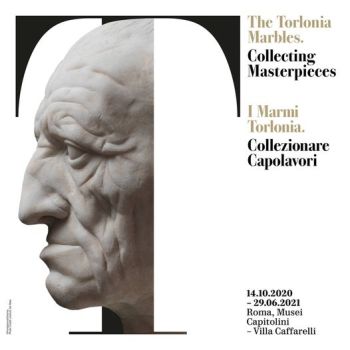 The Torlonia Marbles: Collecting Masterpieces presents 96 works selected from the 620 cataloged marbles belonging to the Torlonia Collection, the prestigious private collection of ancient sculptures, significant for the history of art, excavations, restoration, taste, museography, and archaeological studies. The exhibition is organized in five sections, telling the story of the collecting of ancient Greek and Roman marbles in reverse chronology beginning with the founding of the Torlonia Museum in 1875 by Prince Alexander Torlonia. The second section brings together the nineteenth-century finds of antiquity in the Torlonia properties. The next section addresses eighteenth-century collecting, with sculptures from the acquisitions of Villa Albani and the collection of the sculptor and restorer Bartolomeo Cavaceppi. A selection of sculptures owned by Vincenzo Giustiniani, one of the most sophisticated Roman collectors of the seventeenth century then follows, with the final section presenting pieces from collections of aristocratic families of the fifteenth and sixteenth centuries.










 Enfilade
leave a comment