Print Quarterly, March 2020
The eighteenth century in the current issue of Print Quarterly:
Print Quarterly 37.1 (March 2020)

Antoine Trouvain and Pierre Lepautre after Bon Boullogne, Thesis Print of François Bourgarel for Mathematics, 1695, engraving, top 336 x 540 mm, bottom 462 x 540 mm (Paris, Bibliothèque Nationale de France).
N O T E S A N D R E V I E W S
• John Roger Paas, Review of Simon Turner, ed., The New Hollstein German Engravings, Etchings, and Woodcuts, 1400–1700: Johann Stridbeck the Elder and the Younger, compiled by Dieter Beaujean and based on the research material of Josef H. Biller, parts 1–4 (Ouderkerk aan den IJssel: Sound & Vision Publishers, 2018), pp. 72–73.
The fact that artists are prolific and find a market in their lifetime is no guarantee that their work will enjoy critical acclaim in the long run or be avidly sought after by collectors. Such is the case of the Stridbecks, Johann the Elder (1641–1716) and Johann the Younger (1666–1714), Augsburg printmakers active from the late seventeenth century to the second decade of the eighteenth. . . . [But] their prints help to give us a deeper understanding of the print market and of public taste at the time, and we are fortunate that the more than a thousand prints of the Stridbecks have now been carefully collected and catalogued.
• Louis Marchesano, Review of Véronique Meyer, Pour la plus grand gloire du roi: Louis XIV en theses (Rennes: Presses Universitaires de Rennes, 2017), pp. 73–75.
This book provides an insightful account of the thesis print phenomenon by focusing on prints dedicated to the French king. It explores the function of these prints in the candidate’s life at university and outside, the production, reception and diffusion of the sheets and analyses the king’s image and its evolution in the period from his birth in 1638 to his death in 1715.
• Niklas Leverenz, “Isidore-Stanislas Helman and J. Pélicier,” pp. 75–76.
This short note focuses on a recently discovered signature of J. Pélicier on the proof state of a 1787 print previously attributed to Isidore-Stanislas Helman (1742–1809). This evidence suggests that Helman must have relied on a team of etchers for his large body of work, unusually allowing some of them to put their name on the plates.
P U B L I C A T I O N S R E C E I V E D
• Who is Who Chez les Colbert? La collection d’estampes de Joseph de Colbert, exhibition catalogue (Sceaux: Musée du Domaine départemental de Sceaux / Ghent: Éditions Snoeck, 2019), p. 96.
• Sandra Pisot, ed., Goya, Fragonard, Tiepolo: Die Freiheit der Malerei, exhibition catalogue (Hamburg: Hamburger Kunsthalle / Munich: Hirmer Verlag, 2019), p. 96.
• Laurent Baridon, Jean-Philippe Garric, and Martial Guédron, eds., Jean-Jacques Lequeu: Bâtisseur des Fantasmes, exhibition catalogue (Paris: Petit Palais, Bibliothèque Nationale de France / Éditions Norma, 2018), p. 97.

J. Pélicier, Emperor Qianlong Welcoming the Elderly Citizens of his Empire for a Celebration in their Honour, 1787, etching, 303 x 428 mm (Private Collection).
Book Launch | The Art of the Jewish Family
This month at BGC:
Book Launch—Laura Leibman, The Art of the Jewish Family
Bard Graduate Center, New York, 23 March 2020, 6:00–7:30pm
Author Laura Leibman in conversation with Jonathan Sarna and Barbara Kirshenblatt-Gimblett, moderated by Dean Peter N. Miller, to celebrate the publication of The Art of the Jewish Family: A History of Women in Early New York in Five Objects.
Laura Arnold Leibman, The Art of the Jewish Family: A History of Women in Early New York in Five Objects (Chicago: The University of Chicago Press, 2020), 350 pages, ISBN: 978-1941792209, $35.
 In order to rethink early Jewish American women’s lives, The Art of the Jewish Family examines five objects owned by Jewish women who lived at least a portion of their lives in early New York between 1750 and 1850. Each chapter creates a biography of a single woman through her object, but also uses her story to shed light on larger changes in Jewish American women’s lives. The women Leibman discusses are diverse: some rich, some poor; some Sephardi, some Ashkenazi; some born enslaved, and some who were slave owners themselves. In creating these biographies, Leibman proposes a new methodology for early American Jewish women’s history, one which could be applied to other areas in Jewish history for which records on women are sparse. This method looks at both material objects and fragmentation as important evidence for understanding the past. What social and religious structures, Leibman asks, caused early Jewish women to disappear from the archives?
The objects she considers span the 1750s through the 1850s. They are (1) a letter written in 1761 by an impoverished Hannah Louzada requesting assistance from Congregation Shearith Israel; (2) a famous set of silver cups owned by Reyna Levy Moses (1753–1824); (3) a beautiful ivory miniature of Sarah Brandon Moses (1798–1829), who was born enslaved in Barbados but became one of the wealthiest Jewish women in New York; (4) a commonplace book created by Sarah Ann Hays Mordecai (1805–1894); and (5) a family silhouette of Rebbetzin Jane Symons Isaacs (1823–1884) and her young brood.
Looking past texts to material culture, Leibman expands our ability to understand early Jewish American women’s lives and restores some of their agency as creators of Jewish identity. While the vast majority of early American texts about Jewish women were written by men with men as the primary intended audience, objects made for and by Jewish women help us consider women as consumers and creators of identity. Everyday objects provide windows into those women’s daily lives, highlighting what they themselves valued, how they wanted their contemporaries to see and understand them, and how they passed identity on to their children and grandchildren.
Laura Arnold Leibman is professor of English and humanities at Reed College.
Art of the Jewish Family is published in Cultural Histories of the Material World, a series dedicated to publishing monographs, works in translation, and collective project volumes that mark out the frontiers of BGC’s knowledge map. All books derived from the Leon Levy Foundation lectures in Jewish Material Culture will be published in this series.
Workshop | Nobility without Limits? Prussian Identities, 1525 –1795

Johann Hennenberger: Stemmata genealogica praecipuarum in Prussia Familiarum Nobilium, Ende 16. Jh., Seite der Familie Dohna (Detail), public domain: http://kpbc.umk.pl/dlibra/doccontent?id=3096
◊ ◊ ◊ ◊ ◊
From the posting at ArtHist.net, which includes the Polish:
Adel ohne Grenzen? Identitäten und Repräsentation zwischen Königlichem Preußen und Herzogtum Preußen //
Szlachta bez granic? Tożsamości i reprezentacje w Prusach Królewskich i Książęcych
Deutsches Historisches Institut, Warsaw, 26–27 March 2020
Organized by Sabine Jagodzinski and Rahul Kulka
In dem Workshop werden vor allem kunsthistorische Fragen zum Adel in den beiden Teilen Preußens und dessen künstlerischen Repräsentationen, den Visualisierungen und dem materiellen Ausdruck von regionalen oder überregionalen Identifikationen und Loyalitäten zu den Höfen diskutiert. Außerdem interessiert die künstlerisch-architektonische Prägung seiner Handlungsräume. Im Zentrum der Betrachtung stehen die Entwicklungen nach dem Zweiten Frieden von Thorn 1466, insbesondere im Zeitraum von der Schaffung des Herzogtums Preußen (1525) über die Lubliner Union (1569) bis zu den Teilungen Polen-Litauens 1772/1793/1795.
Die Beiträge und Diskussionen werden simultan ins Polnische bzw. Deutsche übersetzt. Anmeldungen zum Workshop werden bis zum 16. März 2020 erbeten an: dhi@dhi.waw.pl.
Konzeption und Organisation
Dr. Sabine Jagodzinski (DHI Warschau)
Rahul Kulka, Ph.D. Candidate (Harvard University / ZI München)
Kontakt
Deutsches Historisches Institut / Niemiecki Instytut Historyczny
Pałac Karnickich
Aleje Ujazdowskie 39
00-540 Warszawa
D O N N E R S T A G , 2 6 M Ä R Z 2 0 2 0
17.00 Ankunft der Teilnehmerinnen und Teilnehmer
17.15 Begrüßung und Einführung, Sabine Jagodzinski (Warszawa), Rahul Kulka (Cambridge, MA / München)
18.00 Keynote
Moderation: Miloš Řezník (Warszawa)
• Karin Friedrich (Aberdeen) – Zwischen Republik und Dynastie. Adelswelten und adelige Identitäten zwischen Preußen Königlichen Anteils und Herzogtum Preußen, 1569–1772
F R E I T A G , 2 7 M Ä R Z 2 0 2 0
10.00 Kirchenraum und Konfession
Moderation: Dorota Piramidowicz (Warszawa)
• Franciszek Skibiński (Toruń) – Adelige Stiftungen des 17. und 18. Jh. in Kirchen Thorns und anderen preußischen Städten im Kontext von Religion, Gesellschaft und Politik. Ein Problemaufriss
• Piotr Birecki (Toruń) – Der Innenraum evangelischer Kirchen als Ausdruck gesellschaftlichen Konservatismus im Herzogtum Preußen
11.00 Kaffeepause
11.15 Kult und Liturgie
Moderation / Prowadzenie: Agnieszka Gąsior (Leipzig)
• Michał F. Woźniak (Toruń) – Stiftungen der katholischen Geistlichkeit im Königlichen Preußen im Bereich der liturgischen Ausstattung
• Sabine Jagodzinski (Warszawa) – Heiligenverehrung des katholischen Adels im Königlichen Preußen. Zu Schnittmengen regionaler und überregionaler Identitäten
12.15 Mittagspause
13.30 Bildnis und Symbol
Moderation: Magdalena Górska (Warszawa)
• Rahul Kulka (Cambridge, MA / München) – Die Stemmata genealogica des Königsberger Hofmalers Johann Hennenberger. Heraldik und Genealogie als Medien adeliger Repräsentation um 1600
• Agnieszka Gąsior (Leipzig): Geprägte Identität. Medaillenkunst und die Elitennetzwerke des frühen 17. Jahrhunderts
14.30 Kaffeepause
14.45 Residenzen und Landgüter
Moderation: Konrad Morawski (Warszawa)
• Anna Oleńska (Warszawa) – Versailles im Herzen der Rzeczpospolita. Repräsentationsstrategien und Struktur der künstlerischen Vorhaben Jan Klemens Branickis (1689–1771)
• Wulf D. Wagner (Palermo) – Ein Handbuch ostpreußischer Güter als Quellengrundlage weiterer Forschungen
New Book | The Pocket: A Hidden History of Women’s Lives
The book appeared last summer in hardback and is already sold out; a paperback is scheduled for release in the coming months from Yale UP.
Barbara Burman and Ariane Fennetaux, The Pocket: A Hidden History of Women’s Lives, 1660–1900 (New Haven: Yale University Press, 2020), 264 pages, ISBN: 978-0300253740 (paperback), $25.
 Pencils, a sketchbook, cake, yards of stolen ribbon, thimbles, snuff boxes, a picture of a lover, two live ducks: these are just some of the fascinating things carried by women and girls in their tie-on pockets, an essential accessory throughout the 18th and 19th centuries.
This first book-length study of the tie-on pocket combines materiality and gender to provide new insight into the social history of women’s everyday lives—from duchesses and country gentry to prostitutes and washerwomen—and explore their consumption practices, work, sociability, mobility, privacy, and identity. The authors draw on an unprecedented study of surviving pockets in museums and private collections to identify their materials, techniques, and decoration; their use is investigated through sources as diverse as criminal trials, letters, diaries, inventories, novels, and advertisements. Richly illustrated with paintings, satirical prints, and photographs of artifacts in detail, this innovative book reveals the unexpected story of these deeply evocative and personal objects.
Barbara Burman is an independent scholar, and Ariane Fennetaux is associate professor of 18th-century British history at the Université Paris Diderot.
Lecture | Wendy Wassyng Roworth on Angelica Kauffman
At SLAM (and conveniently enough, coinciding with ASECS) . . .
Wendy Wassyng Roworth, Angelica Kauffman: An Enterprising Artist in 18th-Century Britain
Saint Louis Art Museum, 20 March 2020
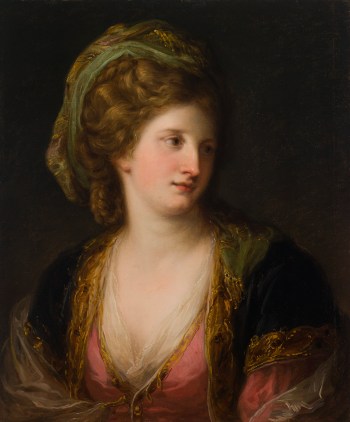
Angelica Kauffman, Woman in Turkish Dress, 1767, oil on canvas, 25 × 20 inches (Saint Louis Art Museum, Funds given by Dr. E. Robert and Carol Sue Schultz 704.2018).
Angelica Kauffman (1741–1807), an Austrian-Swiss artist, began her career in Italy, where her clients included British tourists who encouraged the young painter to pursue her profession in England. Over the fifteen years she worked in London, Kauffman achieved fame and fortune and returned to Italy as an international celebrity. Celebrating a portrait recently acquired by the Museum, this lecture will discuss Kauffman’s life and work in England as a fashionable painter and member of the Royal Academy of Arts, a rare distinction for a woman, and how she used her talents to advantage.
Friday, 20 March 2020, 7pm, Farrell Auditorium at the Saint Louis Art Museum. The lecture is offered free of charge, thanks to the Mary Strauss Women in the Arts Endowment. Tickets are, however, required. Advance tickets are recommended and may be reserved in person at the Museum’s Information Centers or through MetroTix, 314.534.1111 (all tickets reserved through MetroTix incur a service charge).
Wendy Wassyng Roworth is Professor Emerita of Art History, University of Rhode Island.
Journal for Eighteenth-Century Studies, March 2020
In the latest issue of the Journal for Eighteenth-Century Studies:
Journal for Eighteenth-Century Studies 43.1 (March 2020).
 A R T I C L E S
• Amanda Vickery, “Branding Angelica: Reputation Management in Late Eighteenth‐Century England,” 3–24.
• Alberto del Campo Tejedor, “The Barber of Enlightened Spain: On the Politics and Practice of Grooming a Modern Nation,” pp. 25–42.
• Ana Sáez‐Hidalgo, “Anglo‐Spanish Enlightenment: Joseph Shepherd, an English ‘ilustrado’ in Valladolid,” pp. 46–60.
• Robert W. Jones, “Elizabeth Sheridan’s Post‐Celebrity,” pp. 61–78.
• Jonathan Taylor, “‘Who Bravely Fights, and Like Achilles Bleeds’: The Ideal of the Front‐Line Soldier during the Long Eighteenth Century,” pp. 79–100.
E D I T E D M A N U S C R I P T S
• Jessica Wen Hui Lim, “Barbauld’s Lessons: The Conversational Primer in Late Eighteenth‐Century British Children’s Literature,” 101–20.
R E V I E W S
• Madeleine Pelling, Review of Susanna Avery‐Quash and Kate Retford, eds., The Georgian London Town House: Building, Collecting and Display, pp. 121–22.
• Megan Kitching, Review of Keith Michael Baker and Jenna Gibbs, eds., Life Forms in the Thinking of the Long Eighteenth Century, pp. 122–24.
• Charlotte Fletcher, Review of Barbara Burman and Ariane Fennetaux, The Pocket: A Hidden History of Women’s Lives, 1660–1900, pp. 124–25.
• Hannah Hutchings‐Georgiou, Review of Andrew Carpenter, ed., The Poems of Olivia Elder, pp. 125–26.
• Thomas Lalevée, Review of Gabriel Galice and Christophe Miqueu, eds., Rousseau, la république, la paix: actes du colloque du GIPRI (Grand‐Saconnex, 2012), pp. 126–28.
• Helen Metcalfe, Review of Sally Holloway, The Game of Love in Georgian England: Courtship, Emotions, and Material Culture, pp. 128–29.
• Olive Baldwin Thelma Wilson, Review of Berta Joncus, Kitty Clive, or The Fair Songster, pp. 129–31.
• Joachim Whaley, Review of Claudia Keller, Lebendiger Abglanz: Goethes Italien‐Projekt als Kulturanalyse, pp. 131–32.
• Ben Wilkinson‐Turnbull, Review of A. C. Elias, John Irwin Fischer, and Panthea Reid, eds., Jonathan Swift’s Word‐Book: A Vocabulary Compiled for Esther Johnson and Copied in Her Own Hand, pp. 132–33.
• Max Skjönsberg, Review of Margaret Watkins, The Philosophical Progress of Hume’s Essays, pp. 133–35.
Exhibition | Angelica Kauffman
Now on view at the Kunstpalast and coming to London’s RA in June:
Angelica Kauffman: Artist, Superwoman, Influencer
Kunstpalast, Düsseldorf, 30 January — 24 May 2020
Royal Academy of Arts, London, 28 June — 20 September 2020
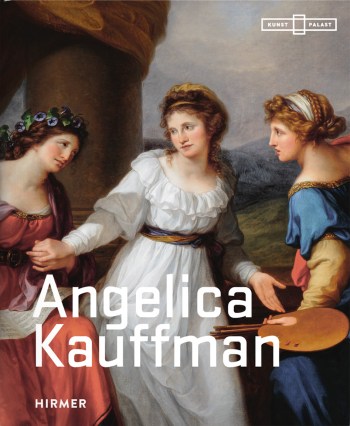 Angelica Kauffman was a founding member of the Royal Academy and an artist who defied convention. In this major exhibition we trace her trajectory from child prodigy to one of the most sought-after painters of her time. Born in Switzerland in 1741, Angelica Kauffman (1741–1807) was quickly recognised as a child prodigy, before receiving further artistic training in Italy. Arriving in London in 1766, she enjoyed an unprecedented career as a history painter and portraitist before moving to Rome in 1782, where her studio became a hub of the city’s cultural life. Kauffman’s career was unusual for a female artist in the late 18th and early 19th century. A highly acclaimed portraitist, she identified herself primarily as a history painter, working for patrons across Britain and the continent, including Catherine the Great amongst others. This exhibition will focus on Kauffman’s work at the height of her career, tracing the life and work of this celebrated artist.
The catalogue is published by Hirmer and distributed in North America by The University of Chicago Press:
Bettina Baumgärtel, ed., with contributions by B. Baumgärtel, I. M. Holubec, J. Myssok, and H. Valentine, Angelica Kauffman (Munich: Hirmer Publishers, 2020), 208 pages, ISBN: 978-3777434629, £35 / $45.
Call for Papers | Angelica Kauffman Study Day
From ArtHist.net:
Angelica Kauffman Study Day
Royal Academy of Arts, London, 16 September 2020
Proposals due by 15 April 2020
On the occasion of the retrospective dedicated to Angelica Kauffman taking place in Düsseldorf and London in 2020, the Royal Academy of Arts is organising a study day on the artist on Wednesday, 16 September 2020.
A child prodigy and a respected painter famous all over Europe in her own lifetime, Angelica Kauffman (1741–1807) transcended many boundaries and conventions linked to eighteenth-century social norms. She embraced many facets of the Enlightenment beliefs, pursued a career to become a history painter following the neoclassical ideals, and worked for some of the most prominent patrons of the time. She was also one of the two female founding members of the Royal Academy of Arts in London in 1768. At her death, her sculpted bust was placed next to Raphael’s in the Pantheon in Rome thereby underlining her place in the artistic canon.
We welcome papers exploring the rich and versatile career of Angelica Kauffman with a fresh contextualisation in the broader artistic, cultural, social, and economic fabric of the eighteenth century. Topics should draw on Kauffman’s production and career and may include, but are not necessarily limited to:
• Fashion and costume
• The business of art (showroom, records, book-keeping, and clientele)
• Cosmopolitan networks
• International career
• Women patrons
• Royal patrons
• Women artists and their careers
• Artistic/Intellectual friendships and their impact on creativity
• Multiples (prints, designs for decorative arts)
• Female self-portrait and self-representation
• Display in 18th-century European art
Please send an abstract of 300 words and a short biography of 200 words to: Marie.Tavinor@royalacademy.org.uk and Will.Iron@royalacademy.org.uk. We are sorry that we cannot offer any travel bursaries on this occasion.
Call for Papers | Revivals in the Decorative Arts
From ArtHist.net:
Revivals in the Decorative Arts — Annual ICOM / ICDAD Conference
National Palace of Ajuda, Lisbon, 14–16 October 2020
Proposals due by 15 April 2020
The 2020 Annual Conference and General Assembly of ICOM International Committee for Museums and Collections of Decorative Arts and Design will take place at the National Palace of Ajuda in Lisbon, Portugal, from October 14 to 16—plus two days (17–18 October) for the post conference tour to Coimbra and Porto.
Revivals—as a socio-cultural phenomenon recurrent throughout history—seek to rescue principles and traditions of times gone by. In this conference we approach revivals with regard to decorative arts and design. Decorative arts and design are to be interpreted as any domestic or public furnishings including but not limited to textiles, silverware, furniture, wallpaper, tableware, interior decoration as a whole, graphic design, as well as personal accessories (excluding fashion). We also welcome presentations on revivals within decorative and applied art traditions (ceramics, lacquer, metalwork, textiles, woodwork, etc.) made for utilitarian or connoisseurial purposes. Hence we encourage papers proposals on a wide variety of topics including a broad array of Asian, European, or North and South American revival styles. We also include the retro design styles of the 20th and 21st centuries, referring to the resurgence of old yet relatively recent styles.
It is fascinating how heritage is being used and valued, reconsidered both from the positions of a curator, artist, or a designer. We are interested in the examples, phenomena, and notions that reflect upon the relation to the past, treating it with both unsentimental and sentimental nostalgia, introducing ways of dealing with the recent past from different periods in history.
15-minute presentations (in English) will comprise the conference sessions. Please send an abstract of 250–300 words, including your name, title, institution, and ICOM membership number to Maria José Gaivão Tavares, Curator of the Furniture Collection at National Palace of Ajuda and ICDAD Secretary, icdad.secretariat@gmail.com. Additional information is available here.
AGO Acquires Portrait of a Lady Holding an Orange Blossom
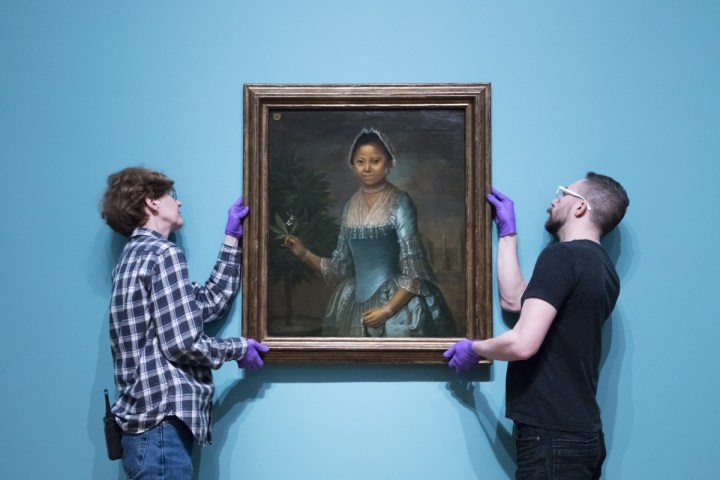
Unknown artist, Portrait of a Lady, Three Quarter Length, Holding an Orange Tree Flower, mid-18th century, oil on canvas, 80 × 56 cm
(Toronto: Art Gallery of Ontario, purchase, 2020, 2019/2437)
◊ ◊ ◊ ◊ ◊
Press release (25 February), from Toronto’s Art Gallery of Ontario:
If you’ve read about the AGO’s recent acquisitions, then you know it’s a top priority of ours to acquire dynamic and captivating works that will both strengthen and diversify our collection. With this in mind, we jumped at the opportunity to purchase the beauty you see pictured above. And what’s even more exciting is that it comes to us with a fascinating mystery to uncover.
Portrait of a Lady Holding an Orange Blossom is a striking and mysterious portrait that commands your attention. Its central figure is a young woman wearing a luxurious blue silk gown, woven with intricate lace trim. Around her neck and wrists are elegant pearls, which complement her bejewelled drop earrings. She is aware of her own radiance, smizing with piercing brown eyes and regal posture, clasping the front of her gown while presenting an orange tree blossom.
Though the subject’s presence is arresting and undeniable, her identity, as well as that of the artist who painted her, are currently unknown. Scholars agree that Portrait of a Lady is from the mid-1700s, painted by a male artist who was born and trained in Europe. With so many unanswered questions, we are left wondering: Who was this painter? What is the location of this painting and what brought him there? Who was his stunning subject?
Very few portraits of Black people by European artists survive from this time period. The painting raises important questions about the subject’s status within the transatlantic slave trade. While her opulent clothing and the mere existence of the portrait suggest that she was a free woman, her ancestors and even one of her parents may have been enslaved.
We continue to do research to find out more about her story. In the meantime, the presence of this figure in the European galleries reminds us that history is complex and diverse, composed of countless stories told from many perspectives. For the AGO, this acquisition is an important step toward acknowledging the rich and vital presence of people of colour in the history of Europe and its art. Portrait of a Lady Holding an Orange Blossom is currently on view on Level 1 in Frank P. Wood Gallery (Gallery 123).










 Enfilade
leave a comment