Call for Papers | Jewish Topographies
From ArtHist.net:
Jewish Topographies: 5th International Congress on Jewish Architecture
Technische Universität Braunschweig, 21–23 September 2020
Proposals due by 27 February 2020
Bet Tfila—Research Unit for Jewish Architecture in Europe will organize the conference Jewish Topographies: 5th International Congress on Jewish Architecture at the Technische Universität Braunschweig. The conference will focus on the meaning of the term ‘Jewish topography’ (jüdische Topographie) and also on how historical phenomena can be categorized both socially and culturally. Jewish residential areas and settlements, facilities of Jewish communities (such as synagogues, cemeteries, schools, or hospitals), or locations of companies and shops can form significant topographical networks in cities and landscapes. Jewish topographies stand in a spatial and social context with corresponding places of the non-Jewish population, in which different cultural, religious, or ethnic groups find their own spaces. Conflicts and cooperations, exclusions and limitations emerge in the spatial relationships between these locations and their respective urban and architectural design reflect the possibilities and expectations of the respective and related groups.
The conference aims at examining different levels of Jewish topographies: the spectrum of possible contributions ranges from macro studies to cross-region networks of Jewish communities or Jewish institutions and people (e. g., commercial networks, Verbandsfriedhöfe (association cemeteries)), to locations and facilities of the individual communities (e. g., Judengassen (Jews Lanes), eruv, DP-Camps), to micro studies of residential areas or individual facilities and buildings. Topographies of forced housing (such as ghettos, concentration camps, and Judenhäuser (Jewish houses) may also be discussed. Religious and profane places and objects will be viewed; synchronous and diachronic perspectives will also be welcomed. The focus of the conference is on developments after the Middle Ages. However, comparative studies on earlier epochs are as welcome as general theoretical and systematic studies, e. g., on symbolic, religious, and literary topographies. Ideas on how Jewish topographies can be appropriately researched, represented, and later conveyed may also be further subjects of discussion. The conference will be held in English.
Please send your abstract (max. 2400 characters) and your CV (max. 1200 characters) including your academic affiliation by 27 February 2020, to Dipl.-Ing. Mirko Przystawik (m.przystawik@tu-bs.de).
The academic board and the organizers will decide on acceptance by 12 March 2020. The publication of selected articles in the Bet Tfila’s Series of Publications is planned. The organizers endeavor to cover travel and accommodation costs for the speakers; this depends, however, on the approval of corresponding funding applications.
For any questions, please contact
Dipl.-Ing. Mirko Przystawik, m.przystawik@tu-bs.de
Dr.-Ing. Ulrich Knufinke, u-j.knufinke@tu-bs.de
Exhibition | Ukiyo-e Prints from the Mary Ainsworth Collection

Katsushika Hokusai (Japanese, 1760–1849), Fuji in Clear Weather (Red Fuji), from the series Thirty-six Views of Mt. Fuji, early 1830s
(Allen Memorial Art Museum, Oberlin College, Ainsworth Bequest, 1950.711)
◊ ◊ ◊ ◊ ◊
Press release for the exhibition (via Art Daily). . .
Ukiyo-e Prints from the Mary Ainsworth Collection
Chiba City Museum of Art, 13 April — 26 May 2019
Shizuoka City Museum of Art, 8 June — 28 July 2019
Osaka City Museum of Fine Arts, 10 August to 29 September 2019
Allen Memorial Art Museum, Oberlin College, Ohio, 14 January — 14 June 2020
Curated by Kevin Greenwood
In 1950, the Allen Memorial Art Museum received a surprise gift of more than 1,500 Japanese woodblock prints featuring actors, courtesans, and landscapes of the ‘floating world’ of 17th- to 19th-century Japan. This bequest became a cornerstone of the Allen’s renowned Asian art collection, and 200 of the works traveled back to Japan last year for a tour of museums in Chiba (near Tokyo), Shizuoka, and Osaka. Now more than 100 of these prints are on view in Ukiyo-e Prints from the Mary Ainsworth Collection, an Oberlin exhibition that runs through June 14, 2020.
Mary Andrews Ainsworth (1867–1950) graduated from Oberlin College in 1889 and made her first sea voyage to Japan in 1906. The country had recently emerged from centuries of isolation and was beginning a period of rapid industrial development. Ainsworth, however, was attracted to an earlier Japan: that of the Edo period (1603–1868). In this more peaceful era, a world of entertainment arose—ephemeral pursuits made even more popular through the wide distribution of color woodblock prints known as ukiyo-e, or ‘pictures of the floating world’.
“The Ainsworth collection represents the history and evolution of Japanese woodblock printmaking, with high-quality examples of the major subjects, styles, and artists of ukiyo-e. Together, they convey much of the richness and complexity of Japan’s print tradition,” said Kevin R. E. Greenwood, the Allen’s Joan L. Danforth Curator of Asian Art. “We were approached by one of Japan’s leading ukiyo-e scholars to do this exhibition, which confirms the importance of Ainsworth’s collection,” he said. “In the process of working together, we discovered some impressions not known in any other collections.”
Ukiyo-e Prints from the Mary Ainsworth Collection is presented in four sections that span the history of the medium. Early prints (1680–1770) were monochrome, often with hand-coloring added; the carbon-black ink was made from pine soot. Around 1745, with the invention of a way to register, or align, wooden blocks, artists such as Ishikawa Toyonobu began printing in two colors: red and green. These benizuri-e prints, or ‘crimson-printed pictures’, sometimes included a third color, yellow, brown, or indigo. In the 1760s, Suzuki Harunobu was the first major producer of prints using more than three blocks.
The second part of the show, Beauties and Actors (1770–1800), includes works by Kitagawa Utamaro, Chobunsai Eishi, and other artists who helped to popularize the many theaters, tea houses, and celebrities of the pleasure district in Edo (now Tokyo). Ukiyo-e artists not only made prints for sale to Japan’s growing merchant class, but also were hired to produce posters and advertisements for theatrical performances.
The third section, Hokusai and Kuniyoshi (1780–1850), highlights the rise of landscapes in Japanese printmaking, which was due in part to the introduction of a chemical pigment called Prussian blue. Six prints from Katsushika Hokusai’s series Thirty-six Views of Mt. Fuji are included, along with Utagawa Kuniyoshi’s prints of bridges, ferries, and heroes from history and legend.
The final section (1830–1858) is devoted to prints by Utagawa Hiroshige I. Works by this prolific artist comprise more than half of the Ainsworth collection. The exhibition presents thirty-six works by Hiroshige I, including nine from his 1830s series Fifty-three Stations of the Tōkaidō and thirteen from his 1857 series One Hundred Famous Views of Edo—prime examples of some of the finest woodblock prints ever produced in Japan.
“This extensive exhibition and its accompanying catalogue have been years in coming to fruition,” said Andria Derstine, John G. W. Cowles Director of the Allen. “We are thrilled to present, for the first time in decades, such a large portion of our Ainsworth collection, both at the Allen and to enthusiastic audiences in Japan.”
Organized by Kevin R. E. Greenwood, Joan L. Danforth Curator of Asian Art, with Masako Tanabe and Marie Matsuoka, Chiba City Museum of Art; Saori Oishi, Shizuoka City Museum of Art; Eri Yoshida, Weikado Bunko Art Museum; Tatsuya Akita and Yasuko Kikuchi, Osaka City Museum of Fine Arts; Hiromi Sone, Mangosteen, Inc.; and Luoying Sheng ’20, AMAM curatorial assistant in Asian art education.
Call for Papers | Museum Networks and Museum History
From the Museums and Galleries History Group:
Museum Networks and Museum History
Royal Botanic Gardens, Kew, 16–17 July 2020
Proposals due by 6 March 2020
Networks have become an increasingly important part of the analytical toolkit used by historians of museums and collections. As scholars have moved away from narrative institutional histories, they have embraced the study of social and material networks as approaches which expand understandings of museums. In Chris Gosden and Frances Larson’s words, museums can then be seen as “innumerable sets of connections between people and objects …[which] extend over time and through space.” Such approaches have themselves been fuelled by the growth of similar ideas such as Actor Network Theory and object biographies.
These new approaches have been especially useful in recovering forms of agency beyond those of powerful institutional actors, especially curators, and have highlighted the contributions of, for example, object creators and mediators, informants and collecting assistants, as well as, sometimes, of objects themselves. They have drawn attention to the formation of new social identities and forms of expertise; have shown the extent of material flows around the world in relation to museums; revealed the role of affect and the relational in museum history; and encouraged closer attention to the different physical properties of things. There have, though, been some differences of emphasis on whether networks in museum history are a useful metaphor, a set of statistical analyses, or a theoretical model.
This conference seeks to take critical stock of the role of networks in understanding the history of museums and collections. It welcomes proposals which use networks of various sorts as tools of analysis, or which engage with the methodological/theoretical issues raised by networks and/or the rejection of network approaches. It is keen to see proposals which interrogate approaches from other disciplines. Contributions may respond to (but are not limited to):
• Networks of museum donors and makers
• Networks and empire; networks and power
• Professional networks and modern identities
• Global and transnational networks
• Networks and the role of indigenous knowledge
• Affect and the role of materiality
• Actor Network Theory and museum/collection history
• Networks of museums, collections, people, objects
• Museum practice and museum networks
• The limits of networks as analytical tools
Submissions may be for individual papers, panels of three papers, or posters. Paper proposals should be for papers of twenty minutes’ length. Proposals should be 250 words maximum and include a title as well as the name, contact details and affiliation (if applicable) of the speaker. Panel proposals should consist of a panel title, proposals for three papers, along with a rationale for the panel theme, and contact details and affiliations (if applicable) of all participants. Please indicate whether you will provide a chair for your session or not (it does not matter which). Poster proposals are also welcomed. Please follow proposal guidelines for papers while indicating clearly that a poster is proposed. All the above proposals should be sent to contact@mghg.info by 6 March 2020. Please note all speakers and poster presenters will be expected to pay the conference registration fee, but we aim to keep the fee as low as possible.
New Book | Christopher Wren: In Search of Eastern Antiquity
From Yale UP:
Vaughan Hart, Christopher Wren: In Search of Eastern Antiquity (London: Paul Mellon Centre for Studies in British Art, 2020), 240 pages, ISBN: 978-1913107079, £45 / $60.
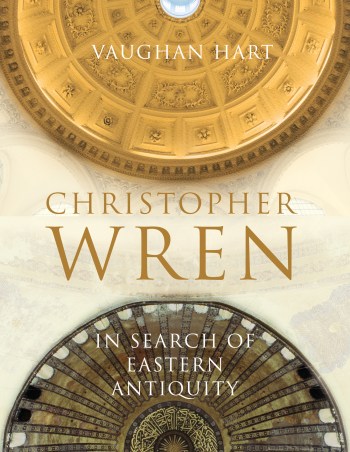 In this revelatory study of one of the great architects in British history, Vaughan Hart considers Christopher Wren’s (1632–1723) interest in Eastern antiquity and Ottoman architecture, an interest that would animate much of his theory and practice. As the early modern understanding of antiquity broadened to include new discoveries at Palmyra and Persepolis, Wren disputed common assumptions about the European origins of Classical and Gothic architecture, tracing these building traditions not to the Greeks or Germans but to the stonemasons of the biblical East. In a deft analysis, Hart contextualizes Wren’s use of classical elements—columns, domes, and cross plans—within his enthusiasm for the East and the broader Anglican interest in the Eastern church. A careful study of diary records reappraises Wren’s working relationship with Robert Hooke (1635–1703), who shared in many of Wren’s theoretical commitments. The result is a new, deepened understanding of Wren’s work.
Vaughan Hart is a professor of architecture at the University of Bath.
New Book | The Tile Book
From Thames & Hudson:
Here Design, with an introduction by Terry Bloxham, The Tile Book: History, Pattern, Design (London: Thames & Hudson, 2019), 304 pages, ISBN: 9780500480250, £20 / $30.
 This striking book gathers together an extensive collection of ceramic tiles from around the world and explores their rich history, purpose, and decorative qualities. For centuries, tiles have been used for both functional and aesthetic purposes on the façades and interiors of buildings. Found in a multitude of shapes, sizes, colors, and designs—ranging from complex geometrical Islamic patterns to figurative seventeenth-century delftware—tiles are among the most varied ceramic products. This luxurious source book, curated by the award-winning studio Here Design, is organized chronologically and features tiles in every variety of shape, displaying each individual tile type and its overall laid pattern in vivid color. Tiles are also shown in situ around the world and at different periods in their remarkable history. The Tile Book is a dazzling mosaic, with colors and patterns that will uplift and inspire.
Here Design is a multiaward-winning design studio in London. Their books include An Anarchy of Chilies, Herbarium, The Grammar of Spice, and Spectrum: Heritage Patterns and Colors.
Terry Bloxham is Assistant Curator of Ceramics and Glass at the Victoria and Albert Museum.
Call for Articles | Special Issue of ‘Quart’ on Travelling and Art
From ArtHist.net:
Travelling and Art in Europe in the 17th and 18th Centuries
Quart, The Quarterly of the Institute of Art History at the University of Wrocław 56 (June 2020)
Articles due by 1 March 2020
Europe in the 17th and 18th century was an area without sealed national borders and passports, which facilitated free movement of people, transfers of works of art, and the exchange of artistic ideas. Travellers were artists and art lovers, military and clerical, merchants and pilgrims; various works of art were transported across the borders, and thanks to the medium of printmaking, the latest trends and artistic novelties quickly spread across Europe. This dynamic circulation in the 17th and 18th centuries caused so many interesting artistic phenomena to take place in this area, which can today be of interest to researchers. Issue 56 of Quart—guest edited by Andrzej Kozieł—will therefore focus on art-related aspects of travel. Proposed topics of interest include:
• migrations and educational journeys of artists
• transfers of works of art and artistic ideas
• pilgrimage and art
• works of art in travellers’ accounts
• media disseminating works of art
Papers—from 20,000 to 40,000 characters, in Polish or English, with up to 7 illustrations—should be submitted in format specified in the guidelines to quart@uwr.edu.pl by 1 March 2020. The editors reserve the right to select given papers. All the submitted papers will be subject to a double-blind review, in line with COPE guidelines. Quart is a regularly published quarterly journal by the Institute of Art History of the University of Wroclaw. It is indexed in ERIH+, CEJSH and BazHum databases. It was awarded a grant under the ‘Support for 500 Scientific Journals’ Programme of the Ministry of Science and Higher Education. It is included in the list of scientific journals of the Ministry of Science and Higher Education as of 31.07.2019 with 20 points. The current number can be purchased in EMPiK chain stores. Archival issues are available in libraries and in a digitalized form at the Polona website.
Call for Papers | The Prospect of Improvement
From ArtHist.net:
The Prospect of Improvement: A Bluestocking Landscape
Hagley Hall, Worcester, 8–9 September 2020
Proposals due by 14 February 2020
A two-day conference at Hagley Hall, Worcestershire including a tour of the house and grounds supported by Elizabeth Montagu Correspondence Online [EMCO] and Paul Mellon Centre for Studies in British Art.
The Prospect of Improvement: A Bluestocking Landscape puts centre stage the patriotism and patronage of George Lyttelton first baron Lyttelton (1709–1773), a strangely shadowy figure yet a fascinating eminence grise behind the art and politics of his age. We will discuss the motivation behind his extensive remodelling of his grounds and the commissioning of local architect Sanderson Miller (1716–1780) in designing a new Hagley Hall. How can the ideas of other architects and landscape reformers from the midlands such as Sir Roger Newdigate (1719–1806), Sir Uvedale Price (1747-1829), and William Shenstone (1714-1763) be brought into dialogue with Miller’s project?
As EMCO is editing the correspondence of Lord Lyttelton’s friend and literary collaborator, critic Elizabeth Montagu (1718–1800), we will equally focus on eighteenth-century women’s management of estates, commissioning of art and architecture and writing associating rural retirement with moral improvement.
Plenary speakers
• Stephen Bending (University of Southampton), author of Green Retreats: Women, Gardens, and Eighteenth-Century Culture (2013)
• Markman Ellis (Queen Mary, University of London), author of The Coffee House: A Cultural History (2005)
• Joe Hawkins (Head of Landscape at Hagley)
• Steve Hindle (Huntington Library, California), W. M. Keck Foundation Director of Research
We invite delegates to participate in three panels on the following themes:
• Concepts of reform and improvement in architecture and rural life
• Female management of the country estate
• The symbolism of the garden in eighteenth-century art and literature
We also welcome papers on:
• Whig perceptions of the country and the city
• Portraiture, representations of the country house, and landscape painting
• Domesticating the picturesque: creating the grotto, the wilderness, and the waterfall
• Bluestocking crafts and collecting
• Botany, gardening, and girls’ education
• Agricultural reform and the rural poor
• The Lunar Society, provincial salons, and correspondence networks
• The politics of patronage
• Philanthropy and the religious revival
A selection of delegates will be invited to extend their papers into scholarly articles for a book-length special issue of the journal Eighteenth-Century Life, to be edited by Professor Markman Ellis.
Please send proposals for papers (no longer than 350 words) and requests for bursary application forms by 14th February 2020 to Jack Orchard by email: j.t.g.orchard@swansea.ac.uk or by post to: Dr. Jack Orchard, Department of English Literature and Creative Writing, Swansea University, Singleton Park, Swansea, SA2 8PP.
Registration
Conference Registration with Accommodation: £130
Conference Registration: £70
Accommodation will be arranged by EMCO at a local hotel, and both registration fees include two lunches at the conference and the conference banquet.
We reach out especially to early career researchers by offering six bursaries funded by the Paul Mellon Centre for British Art to doctoral students and unwaged ECRs with promising proposals for papers relevant to the conference theme. Each bursary holder is invited to review two panel sessions for a report on the conference to be published online at Elizabeth Montagu Letters and the Bluestocking Circle. Bursaries covering the conference fee and accommodation are available to six postgraduate students and unwaged early career researchers, who have papers accepted for presentation at the conference. ‘Unwaged’ scholars may be retired, unemployed, or unable to access institutional support for conference attendance. They are invited to make a personal statement in support of their application. Students’ bursary application forms must be accompanied by a statement from a supervisor which is signed on university headed paper and accompanied by the university stamp. The bursary award will be paid as a refund following attendance at the conference.
Symposium | The Archaeology of Free African Americans
Upcoming at BGC:
Revealing Communities: The Archaeology of Free African Americans in the Nineteenth Century
Bard Graduate Center, New York, 7 February 2020
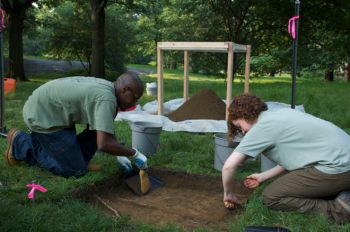
Archaeology students excavating in the area of the Wilson family house, Seneca Village, Central Park, NYC, 2011 (Institute for the Exploration of Seneca Village History; photograph by Herbert Seignoret).
This symposium will bring together scholars who have worked on nineteenth-century free African American communities. Speakers will discuss how they have approached studying these communities, many of which were bulwarks in the abolition and early civil rights movements and places where residents formed positive social connections both within and across racial lines. Yet, these important communities have been largely left out of mainstream history. Presenters will explain what their research reveals about these communities and will collectively discuss what these communities, in turn, might reveal to us about living in our own divided time. The symposium is free; registration information is available here.
S C H E D U L E
Each talk is scheduled for twenty minutes; each session will conclude with Q&A and discussion.
9.00 Peter N. Miller (Bard Graduate Center), Welcome
9.05 Meredith B. Linn (Bard Graduate Center), Introduction
9.20 First Morning Session
• Michael J. Gall (Richard Grubb and Associates, Inc.), Public and Private: Identity Construction and Free African American Life in Central Delaware, 1770s–1820s
• Christopher N. Matthews (Montclair State University), A Creole Synthesis: Archaeology of the Mixed Heritage Silas Tobias Site in Setauket, New York
• Christopher Lindner (Bard College), Germantown’s Parsonage: Centering Spirituality in a Nineteenth-Century African American Community
10.40 Coffee Break
11.00 Second Morning Session
• Joan H. Geismar (Archaeological Consultant), Skunk Hollow and Weeksville: Comparing Two Nineteenth-Century African American Communities
• Rebecca Yamin (Commonwealth Heritage Group, Inc.), The Lives and Times of Josiah and Joshua Eddy, Barbers and AME Church Ministers in Mid-Nineteenth-Century Philadelphia
• Meredith B. Linn (Bard Graduate Center), Nan A. Rothschild (Barnard College and Columbia University), Diana diZerega Wall (City College and the City University of New York), Seneca Village: New Insights about a Forgotten Nineteenth-Century African American Community
12.20 Response by Whitney Battle-Baptiste (University of Massachusetts Amherst)
12.40 Lunch Break
1.40 First Afternoon Session
• Nedra K. Lee (University of Massachusetts Boston), Hiding in Plain Sight: Critical Race Theory and the Use of Space at the Ransom and Sarah Williams Farmstead, Manchaca, Texas
• Christopher Fennell (University of Illinois, Urbana-Champaign), Resilience and Racism in a Nineteenth-Century American Heartland: New Philadelphia and the Vagaries of Prejudice
• Christopher P. Barton (Francis Marion University), ‘Stretching the Soup with a Little Water’: Race, Class, and Improvisation at the Black Community of Timbuctoo, New Jersey
3.00 Coffee Break
3.20 Second Afternoon Session
• Allison McGovern (VHB Engineering, Surveying, Landscape Architecture, and Geology, PC), ‘We Know Who We Are’: The Politics of Heritage and Preservation in East Hampton’s ‘Historically Black’ Communities
• Paul R. Mullins (Indiana University-Purdue University Indianapolis), Civility and Citizenship: Narrating Free Black Heritage and Materiality
• Matthew M. Palus (The Ottery Group and the University of Maryland), Cultural Resource Management Perspectives on African American Struggle with Heritage in Metropolitan Washington, DC
4.40 Response by Alexandra Jones (Archaeology in the Community)
5.00 Reception
This event will be livestreamed. Please check back to the BGC page on the day of the event for a link to the video. To watch videos of past events please visit our YouTube page.
HBA 2020 Book Prizes Announced
From the most recent issue of the HBA Newsletter, edited by Caitlin Silberman. Congratulations to this year’s winners! –CH
The Historians of British Art Book Prize Committee for 2020 is pleased to announce the Book Award winners for publications from 2018. The winners were chosen from a nominating list of seventy books from thirty different presses. Awards are granted in four different categories. This year’s committee of readers consisted of Matthew Reeve, Stacey Sloboda, Eric Stryker, and Alison Syme.
 Before 1600
• John Blair, Building Anglo-Saxon England (Princeton: Princeton University Press, 2018).
Before 1600 (highly commended)
• Sonja Drimmer, The Art of Allusion: Illuminators and the Making of English Literature, 1403–1476 (Philadelphia: University of Pennsylvania Press, 2018).
Between 1600 and 1800
• Cheryl Finley, Committed to Memory: The Art of the Slave Ship Icon (Princeton: Princeton University Press, 2018).
After 1800
• Deborah Sugg Ryan, Ideal Homes, 1918–39: Domestic Design and Suburban Modernism (Manchester: Manchester University Press, 2018).
Multi-Authored Book
• Steven Brindle, et al., Windsor Castle: A Thousand Years of a Royal Palace (London: Royal Collection Trust, 2018).
Short List for the Period between 1600 and 1800
• Jocelyn Anderson, Touring and Publicizing England’s Country Houses in the Long Eighteenth Century (London: Bloomsbury, 2018).
• Jill Francis, Gardens and Gardening in Early Modern England and Wales (New Haven and London: Paul Mellon Centre for Studies in British Art for Yale University Press, 2018).
• Conor Lucey, Building Reputations: Architecture and the Artisan, 1750–1830 (Manchester: Manchester University Press, 2018).
• Clare Taylor, The Design, Production, and Reception of Eighteenth-Century Wallpaper in Britain (London: Routledge, 2018).
Getty Acquires Wright’s ‘Two Boys with a Bladder’
Press release (17 January 2020) from The Getty, following the announcement of its intentions last June:

Joseph Wright of Derby, Two Boys with a Bladder, ca.1769–70 (Los Angeles: J. Paul Getty Museum).
The J. Paul Getty Museum announced today that the acquisition of Two Boys with a Bladder will proceed, following the granting of an export license by the Arts Council of England.
“We are very pleased that an export license for Two Boys with a Bladder by Joseph Wright of Derby has been granted. This important work has not been on public view since the 18th century and is therefore virtually unknown to scholars,” said Timothy Potts, director of the J. Paul Getty Museum. “We look forward to sharing this spectacular painting with our visitors and scholars in the context of our other 18th-century collections. Two Boys with a Bladder counts among Joseph Wright of Derby’s most accomplished nocturnal subjects and reflects the experimental interest of artists and scientists of the Enlightenment. It joins two other works by the artist at the Getty.”
The recently rediscovered painting depicts two young boys, boldly lit by a concealed candle, inflating a pig’s bladder. In the 18th century, animal bladders served as toys, either inflated and tossed like balloons or filled with dried peas and shaken like rattles. While bladders appeared frequently in 17th-century Dutch painting they were depicted less frequently in 18th-century Britain. It was a motif that Wright made his own; the elaborate costumes that the boys wear are of the artist’s own invention, in the style of British ‘fancy pictures’. The dramatic pictorial effect created by the concentrated candle light within a dark interior setting was in vogue in much of Europe in the late 16th and 17th centuries, but it was not until the 18th century that English artists picked up the theme, Wright being among the first to do so.
The previously unpublished masterpiece is Wright’s earliest known treatment of the subject. Unseen in public since the 18th century, the painting forms part of a sequence of dramatic nocturnal paintings that includes The Experiment on a Bird in the Air Pump (1768, National Gallery, London) and An Academy by Lamplight (1770, Yale Center for British Art, New Haven). It was painted as a pendant to Two Girls Dressing a Kitten by Candlelight, which is now at Kenwood House in London.
“Two Boys with a Bladder is a remarkable discovery that sheds new light on Wright’s work at the most important moment of his career,” said Davide Gasparotto, senior curator of paintings at the Getty Museum. “It is a compelling example from his most important and successful genre, candlelight paintings. Moreover, Wright’s innovative experimentation with the use of metal foil embodies a sense of technical and scientific exploration that typifies the intellectual milieu of the midlands on the eve of the industrial revolution. It is a major addition to the Getty’s holdings of art from the English golden age.”
◊ ◊ ◊ ◊ ◊
Note (added 22 January 2020, and slightly modified 23 January) — Another relevant painting by Wright not mentioned in the the announcement is The Huntington’s Two Boys by Candlelight, Blowing a Bladder, just twenty-five miles away. –CH










 Enfilade
leave a comment