Exhibition | Goya: Avant-Garde Genius, the Master and His School

Francisco José de Goya y Lucientes, Woman with a Fan, detail, ca. 1805–10
(Paris: Musée du Louvre)
◊ ◊ ◊ ◊ ◊
Now on view in Agen, as described in the press kit:
Goya: Avant-Garde Genius, the Master and His School
Musée des Beaux-Arts, Agen, 8 November 2019 — 10 February 2020
Curated by Adrien Enfedaque, Juliet Wilson-Bareau, and Bruno Mottin
The City of Agen and its Fine Arts Museum, located between Bordeaux and Toulouse in the southwest of France, will present, over the winter of 2019–2020, an outstanding exhibition with a fresh and unexpected view on Francisco de Goya y Lucientes (1746–1828) and his work. Through a selection of works in several media (paintings, drawings, engravings), the exhibition will demonstrate the essential characteristics that remain constant in Goya’s work and reveal the role played by his collaborators in his studio.
The Museum’s scientific team is assisted in this project by one of the specialists of Goya’s work Juliet Wilson-Bareau and the event has received personal support from the French Minister of Culture. Nearly 90 works loaned by museums and private collections around the world (France, Germany, Hungary, Spain, Switzerland, UK, USA) will be on display in the Jacobins’ Church (Église des Jacobins), an Agen architectural jewel and an emblematic place for the Museum’s temporary exhibitions.
 In the late nineteenth-century, Count Damase de Chaudordy (1826–1889) bequeathed a substantial collection to his birthplace Agen. As French ambassador to the court of Madrid, he bought many works, such as five of six paintings by Goya from the private collection of Federico de Madrazo, former first painter of the queen and director of the Prado Museum. These paintings had already been catalogued by Charles Yriarte in 1867 and came directly from the collections of Goya’s son Don Xavier (1784–1854) and grandson Don Mariano (1806–1874) Marquis of Espinar.
This ambitious project is reminiscent of the blockbuster exhibition organized in 1993 From Fortuny to Picasso, which attracted more than 25,000 visitors. It was the first major exhibition at the Jacobins’ church and the result of a collaboration with the Prado Museum in Madrid. It has been the origin of precursory research on Spanish painters of the 19th century. The curator at the time, Yannick Lintz, now Head of the Department of Islamic Arts at the Louvre museum, keeps a benevolent eye on Agen’s projects and supports this exhibition.
As part of the Catalog of Desires, a device set up by the Ministry of Culture to facilitate the circulation in France of iconic works of national collections, the Agen Museum has been designated as a pilot museum. It has the honour to present to the public Woman with a Fan, a famous painting by Goya which has been on loan from the Louvre since April 27, 2019. In the picture, the artist depicts a buxom young woman with great subtlety. The minimalist shades of gray, celadon greens, and whites are remarkable, especially in the delicate work of the long mittens. The identity of the young woman remains uncertain today. The painting is original in its intimate approach focusing on the character’s psychology.
Goya: Avant-Garde Genius, the Master and His School is based on research from the Louvre and the Research and Restoration Centre of the Museums of France (C2RMF). The exhibition benefits from the technical and scientific advice of this latter institution, where two paintings of Goya’s followers (Goyesques) from the Museum of Agen are currently being studied and restored for the exhibition. It is a new approach to Goya’s work that will be proposed to better underline the singularity of his art and his way of working, from drawing to painting. This project could, in the long term, better define the artistic approach of Goya and the implication of the collaborators in his workshop. The aim of the exhibition is to provide both the large public and the painting connoisseurs with a unique opportunity to enjoy and admire many masterpieces that will also be analyzed in detail (through documentation and technical analysis).
General Commission
Adrien Enfedaque (Curator of the Museum of Fine Arts)
Scientific Advisers
Juliet Wilson-Bareau (Art Historian, London)
Bruno Mottin (Chief Curator of Heritage, Research and Restoration Centre of the Museums of France)
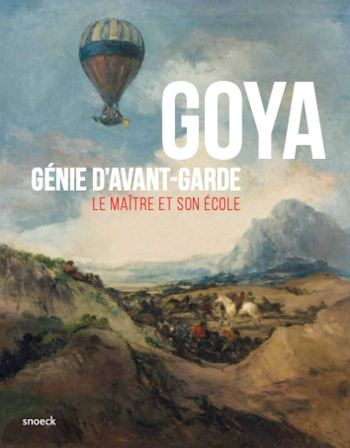
Goya: Génie d’avant-garde, le maître et son école (Paris: Snoeck Édition, 2020), 224 pages, ISBN: 978-9461615602, 25€.
For additional coverage, see Dalya Alberge’s article from The Observer (28 December 2019), available here»
Exhibition | A Grand Tour: Images of Italy from the Jundt Art Museum
From the Jundt Art Museum:
A Grand Tour: Images of Italy from the Permanent Collection of the Jundt Art Museum
Jundt Art Museum, Gonzaga University, Spokane, Washington, 18 January — 9 May 2020
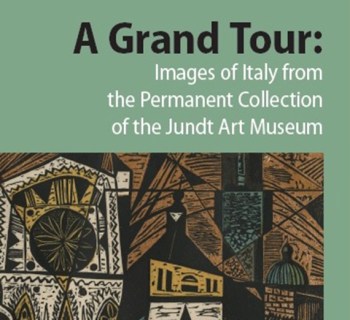 In his book Italian Hours, Henry James often commented on the tourist sites of urban Italy. In 1882, he noted, “The only way to care for Venice as she deserves it is to give her a chance to touch you often—to linger and remain and return.” James and other late-nineteenth-century Americans were continuing the British tradition of the Grand Tour in Italy, centered on its most important cultural cities and historic sites. This exhibition functions as a visual travelogue of the Italian peninsula using works of art from the collection of the Jundt Art Museum at Gonzaga University.
Both the exhibition and an accompanying book begin with sixteenth-, seventeenth-, and eighteenth-century European prints, byproducts of artists’ visits mostly to the urban centers of Rome and Florence, and conclude with twenty-first-century images. Significant portions of the objects in this exhibition result from the Bolker Collection and from the Fredrick and Genevieve Schlatter Endowed Print Fund. A Grand Tour utilizes the Jundt Art Museum’s collection to present artistic imagery of the canals of Venice, the Renaissance architecture of Florence, and the classical remains of Rome, but also sites in Milan, Pisa, Assisi, Naples, and Palermo as well as other cities and towns. We hope that this selection of 76 images of Italy will give pleasure as one introduction to a wide-ranging and astonishing topic and as an opportunity, as James writes, “to linger and remain and return.”
Exhibition | Master, Pupil, Follower

Pietro Giacomo Palmieri (1737–1804), Two Figures in a Landscape, red chalk on cream paper, 18 × 24 inches
(Collection of Jeffrey E. Horvitz, Boston, inv. no. D-I-43)
◊ ◊ ◊ ◊ ◊
From the Georgia Museum of Art:
Master, Pupil, Follower: 16th- to 18th-Century Italian Works on Paper
Georgia Museum of Art, University of Georgia, Athens, 21 December 2019 — 8 March 2020
Curated by Randy Coleman, Nelda Damiano, and Benedetta Spadaccini

Circle of the Gandolfi, Standing Academic Male Nude, Seen from the Rear, ca. 1775, charcoal on white paper with some foxing and repairs, 17 × 12 inches (Athens: Georgia Museum of Art, University of Georgia; extended loan from the collection of Giuliano Ceseri. GMOA 1995.184E).
This exhibition showcases approximately 30 drawings and prints dating from the 16th to the 18th centuries and drawn from the collections of Giuliano Ceseri of Lafayette, Louisiana, the Georgia Museum of Art, and the Jeffrey Horvitz Collection. Curators selected drawings and prints to represent specific artistic styles and Italian regional schools. An examination of the drawings has revealed some previously erroneous assumptions. In a few cases, new attributions have resulted; in others, authorship remains unresolved. The museum will publish a fully illustrated exhibition catalogue containing this scholarship and publishing important drawings by Giulio Romano, Claudio Ridolfi, Palma il Giovane, and Guercino for the first time. Other artists include Giulio Benso, Giovanni Battista Tiepolo, Giovanni Benedetto Castiglione, Salvatore Rosa, and followers of Veronese and Tintoretto. The exhibition is curated by Robert Randolf Coleman, professor emeritus, Renaissance and Baroque art history, University of Notre Dame; Nelda Damiano, Pierre Daura Curator of European Art, Georgia Museum of Art; and Benedetta Spadaccini, Biblioteca Ambrosiana, Milano.
◊ ◊ ◊ ◊ ◊
Robert Randolf Coleman, Nelda Damiano, Benedetta Spadaccini, William Eiland, Master, Pupil, Follower: 16th- to 18th-Century Italian Works on Paper (Athens: Georgia Museum of Art, University of Georgia, 2020), 138 pages, ISBN: 978-0915977185.
This catalogue accompanied the exhibition on view at and the Georgia Museum of Art at the University of Georgia from 21 December 2019 to 8 March 2020. Co-curators Robert Randolf Coleman (professor emeritus of Renaissance and baroque art history, University of Notre Dame), Nelda Damiano (Pierre Daura Curator of European Art, Georgia Museum of Art), and Benedetta Spadaccini (Biblioteca Ambrosiana, Milano) contributed entries on each of the 32 works in the exhibition, all of which are illustrated in color. Coleman also provided an introductory essay, and museum director William Underwood Eiland wrote a preface and a brief essay on collector Giuliano Ceseri, from whose collection many of these works come. Curators selected drawings and prints by artists including Giulio Benso, Giovanni Battista Tiepolo, Giovanni Benedetto Castiglione, Salvatore Rosa, and followers of Veronese and Tintoretto to represent specific artistic styles and Italian regional schools. The catalogue is organized by region. An examination of the drawings revealed some previously erroneous assumptions, resulting in new attributions in some cases. Drawings by Giulio Romano, Claudio Ridolfi, Palma il Giovane, and Guercino are published here for the first time.
◊ ◊ ◊ ◊ ◊
Note (added 16 August 2023) — The posting was updated to include information on the catalogue.
Exhibition | Classic Black: The Basalt Sculpture of Wedgwood
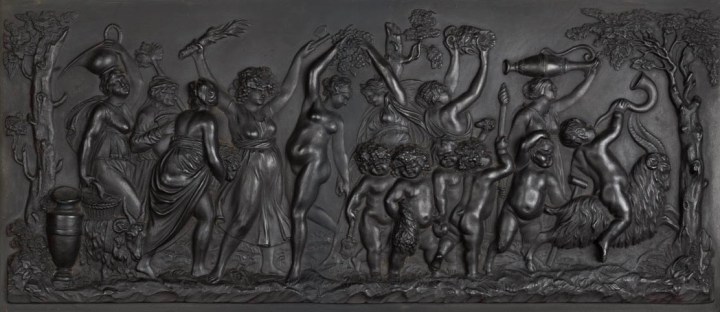
Bacchanalian Triumph, Wedgwood black basalt rectangular plaque, late eighteenth or early nineteenth century. Copied from a bas-relief by Claude Michel Clodion (1738–1814).
◊ ◊ ◊ ◊ ◊
From The Mint:
Classic Black: The Basalt Sculpture of Wedgwood and His Contemporaries
The Mint Museum Randolph, Charlotte, North Carolina, 8 February — 30 August 2020
Featuring more than 100 ceramic objects, with loans from notable public and private collections in the United States and England, this exhibition is the first to focus exclusively on the black basalt sculpture made by Josiah Wedgwood and other Staffordshire potters in late eighteenth-century England. The works of art on view include life-size portrait busts, statues, vases, and other fully three-dimensional, ornamental forms, as well as works in low relief, such as large plaques, portrait medallions, and medals.
 Among the ceramic bodies produced in great numbers in Staffordshire, England in the late eighteenth century was black basalt. Josiah Wedgwood perfected this fine-grained stoneware in 1768, creating its dark color by adding manganese and carr, a slurry rich-with-iron oxide obtained from coal mines, to the clay body. Basalt was soon produced by many other Staffordshire potters as well. Although Wedgwood and the other potters used black basalt to create so-called ‘useful wares’, such as teapots and bowls, this exhibition showcases basalt sculpture, especially works with classically inspired themes or ornament.
Many of the basalt objects on view in the galleries were copied directly from works of art made in ancient Greece and Rome, such as busts of Homer and Socrates, gems and statues depicting gods and other mythological creatures, and coins with portraits of Julius Caesar and his successors. Other basalt pieces derived from works made much later. Among the many artists represented in the exhibition by basalt versions of their creations are Michelangelo from the sixteenth century, Gian Lorenzo Bernini from the seventeenth century, and sculptor Louis François Roubiliac from the eighteenth. The Staffordshire potteries also hired modelers and other craftsmen to create new designs for their basalt wares.
Whatever the design source, the basalt sculpture made by Wedgwood and his contemporaries was well-crafted, refined, and perfectly suited for the neoclassical interiors so popular among style-conscious consumers, both in England and beyond, in the last few decades of the eighteenth century. Classic Black proudly highlights this fascinating chapter in the history of ceramics.
The catalogue is published by Giles:
Brian Gallagher, ed., with contributions by Gaye Blake-Roberts, Robin Emmerson, M.G. Sullivan, and Nancy Ramage, Classic Black: The Basalt Sculpture of Wedgwood and His Contemporaries (London: D. Giles, Ltd., 2020), 248 pages, ISBN: 978-1911282358, £45 / $60.
Classic Black explores classically inspired sculpture and other ornamental wares in black basalt. This famous stoneware was perfected by Josiah Wedgwood in 1768 and then went on to be produced by other prominent Staffordshire potters. Wedgwood, with prescience, said of his new creation, “Black is Sterling and will last forever.” This volume presents approximately 120 examples of ornamental black basalt, including portrait busts, statues, and vases, ewers and other fully three-dimensional, ornamental forms. It also features works in low relief including tablets, plaques, medallions and cameos. Essays by renowned subject specialists enhance the fully illustrated catalogue entries, which are grouped into three chapters. These each focus on an era of the design sources used by Wedgwood and his contemporaries to create their basalt wares: Classical Antiquity, the 16th and 17th centuries, and the 18th century.
Brian Gallagher is the curator of Decorative Arts at The Mint Museum. His recent projects include the publication, British Ceramics 1675–1825: The Mint Museum, which highlights over 225 examples from the Mint’s renowned British ceramics collection, and the reinstallation of that collection in a long-term display called Portals to the Past: British Ceramics 1675–1825.
Gaye Blake-Roberts is curator of the Wedgwood Museum, Barlaston.
Robin Emmerson is the former curator of Decorative Arts, National Museums, Liverpool.
Nancy H. Ramage is the Charles A. Dana Professor of the Humanities and Arts Emerita, Ithaca College.
M.G. Sullivan is an independent scholar, York University.
C O N T E N T S
Foreword by Todd Herman, President and CEO, The Mint Museum
Acknowledgments
Preface
Essays
Robin Emmerson, Classicism and the Design Business
Gaye Blake-Roberts, Wedgwood’s Customers for Ornamental Black Basalt
M.G. Sullivan, Wedgwood’s Basalt and the Sculpture Market
Catalogue by Brian Gallagher
I. Works Based on Sources from Classical Antiquity
Rome and Pompeii: Fountains of Inspiration
Introduction by Nancy Ramage
II. Works Based on 16th- and 17th-Century Sources
From Renaissance Italy to the Golden Age of the Dutch Republic and Restoration England
III. Works Based on 18th-Century Sources
Enlightened Thinkers, Contemporary Events, and New Interpretations of the Classical Past
Concordance (by Object Type)
Selected Bibliography
Index
Photography Credits
Exhibition | La Chine rêvée de François Boucher

Press release (via Art Daily) for the exhibition:
A Province of the Rococo: François Boucher’s Idealised China
Musée des beaux-arts et d’archéologie de Besançon, 9 November 2019 — 2 March 2020
Besançon’s Museum of Fine Art and Archaeology presents Une des provinces du Rococo: La Chine rêvée de François Boucher (One of the Provinces of the Rococo: François Boucher’s Idealised China), an exhibition that embarks the visitor on an enchanting voyage of discovery.

The Chinese Garden, 1742, oil on canvas (Musée des Beaux-Arts et d’Archéologie de Besançon).
The illustrious François Boucher (1703–1770) was one of the key figures of eighteenth-century painting along with Watteau and Fragonard, and was one of the artists displaying the greatest talent in his efforts to renew the decorative arts. At a time when China, an ancient and distant civilisation, was drawing closer to France thanks to the trade in objets d’art, Boucher offered a window into this fascinating world, creating numerous Chinese subjects that were almost instantly adopted as part of Parisian decorative schemes and print collections and, inevitably, in the decorative arts: porcelain, furniture, and particularly tapestries.
The Museum of Fine Art and Archaeology in Besançon—which for the last two centuries has been home to the sketches produced in 1742 for the Beauvais Manufactory, a producer of tapestries—presents an ambitious exhibition with one hundred and thirty international loaned items, offering a poetic take on a theme never before presented to the public: the creative process of an artist who successfully created an exotic and original repertoire through his outstanding curiosity and creativity and who, in the words of the Goncourts Brothers, “made China one of the provinces of the Rococo.”
Tipsy Boats
One of the exhibition’s objectives is to help the visitor understand Francois Boucher’s keen artistic eye, finely honed during his visits to Parisian traders dealing in exotic items, a trade which was booming at the time. The exhibition begins with a series of items sold by marchands-merciers around 1730–1740 (lacquered screens, wallpaper, porcelain, etc.), presented in a specially laid out scene resembling the interior of a shop.
Produced for a pair of exotic item enthusiasts, the Chinese décor created by Antoine Watteau around 1710 at the Muette hunting lodge on the edge of the Bois de Boulogne also decisively influenced the way Boucher came to view Chinese subjects as ornamental features. He was among the artists who visited the site in 1731, to etch the subjects. Dismantled in the eighteenth century, this decor is represented by twelve prints produced by Boucher and by the two surviving paintings by Watteau.
Taste’s Hidden Surprises
The research conducted for the exhibition confirms that Boucher was one of the most ambitious collectors of Asian items in his day. His collection, which was dispersed in 1771 after his death, included around 700 Asian items. It stood out from contemporary collections thanks to its size and above all its virtually boundless diversity. A selection of some fifty items matching descriptions of this collection are presented with a view to presenting its richness and variety, while at the same time giving visitors some idea of the proportions of the different categories of items and forms involved including statuettes, mounted porcelain items, lacquered butterfly-shaped boxes, locks, and musical instruments from China, etc. Very early on, Boucher used this collection as a visual meaning but also as a means of getting himself better known as an artist but also as an enthusiast. He arranged for Gabriel Huquier, the famous print merchant who went on to become his business partner in the field of chinoiseries, to publish a collection of figures drawn by himself based on items from his collection. In the exhibition, these etched prints are compared with Asian models to highlight the changes of form through which the artist succeeded in bringing his collection to life.
China in Silk
His mastery of the vocabulary of forms, something which he alone managed so effortlessly, inevitably saw Boucher emerge as the artist of choice for the tapestry cartoons from the second Chinese series. An initial series had been woven at the Beauvais Manufactory in the late seventeenth century, but the cartoons gradually became worn and their subjects outdated. Boucher was therefore asked by Oudry, the Manufactory’s manager, to supply new models. He created ten ‘mini-cartons’ converted into larger works by the painter Dumons, for the weavers in the low-warp workshops. Eight of these cartons were presented at the 1742 exhibition and six were finally used for the series. The series became one of the greatest successes in the French tapestry industry of the eighteenth century with ten follow-up works being woven between 1743 and 1775. For the first time since the eighteenth century, the exhibition brings together the six tapestry items, forming a set which is truly spectacular in terms of its size and the exotic yet lively nature of its subjects.
China’s Gallantry
Presented in an elegant and intimate atmosphere resembling an art enthusiast’s lounge, this section examines Boucher’s Chinese paintings. The artist produced no easel paintings in this register although he was perfectly able to do so. China was simply a ‘sideline’ in his painted work but a side-line of outstanding quality. It can be seen firstly through the insistent representation of Asian objets d’art like those he had the opportunity to see and collect at first hand, in four interior scenes or ‘fashion pictures’ produced in the late 1730s and put together for this exhibition. These paintings, produced in small sizes for an impeccable result, demonstrate the artist’s great familiarity with the Parisian luxury goods market, which was undergoing profound change at the time, and of which these pictures were part. Three lintel pieces also reveal another function of painting, this time a decorative one. Two of these paintings, delicate blue-and-white monochromes, are seen near the chest of drawers and corners of the Comtesse de Mailly’s blue apartment at the Château de Choisy as research suggests that they came from this same sumptuous decor designed as an outstanding blue and white symphony.
Copyright Boucher
 Even more so than through painting, Boucher’s creativity in the Chinese register is also expressed through paper: the artist is the author of almost a hundred print models, mostly distributed by the printmaker and merchant Gabriel Huquier. They both developed a significant repertoire of subjects inspired by Chinese models and adapted to European tastes, which were then reused by craftsmen for screens and for decorating porcelain or furniture. The number of prints featuring Chinese subjects produced by Boucher is extremely impressive for someone who was not a professional ornamentalist and their influence on the decorative arts in France and elsewhere was immense. The drawings and prints exhibited here therefore allow for a better understanding of the transition from one technique to the other, along with several luxury items produced by the manufactory of Vincennes Sèvres and by the best Parisian cabinetmakers, demonstrating their adaptation and use in the decoration of European objets d’art.
One hundred and thirty European and Asian works loaned by numerous museums and private collections also feature in the exhibition, as part of a poetic exhibition experience highlighting a unique approach, one which encompasses the history of art and the history of taste. Objets d’art, drawings, prints, paintings and tapestries, including some never before seen, make it possible to appreciate François Boucher’s keen eye and to demonstrate his central decisive contribution to the growing enthusiasm for China which developed in France back in his day. The manner in which this artist, collector, and enthusiast incorporates the exotic items he knows so well in his paintings and drawings suggests a link with the transformation and re-creation methods used at the same time by the marchands-merciers. We should consequently consider Boucher as an inventor and even as an entrepreneur with a highly developed awareness of the social and artistic challenges of his time, looking beyond the all too convenient label of painter or draughtsman. His idyllic China marks an incredibly creative ten-year interlude in an immense career, the effects of which left their mark on the age of Enlightenment.
The catalogue is published by In Fine éditions d’art:
Nicolas Surlapierre, Yohan Rimaud, Alastair Laing, and Lisa Mucciarelli, eds., Une des Provinces du Rococo: La Chine Rêvée de François Boucher (Paris: In Fine éditions d’art, 2019), 288 pages, ISBN: 978-2902302291, 29€. Contributors include Nicolas Surlapierre, Pierre Rosenberg, Vincent Bastien, Maël Bellec, Adrien Bossard, Stéphane Castelluccio, Claire Délery, Guillaume Faroult, John Finlay, Anne Forray-Carlier, Françoise Joulie, Alastair Laing, Lisa Mucciarelli, Jamie Mulherron, David Pullins, Béatrice Quette, Yohan Rimaud, Marie-Laure de Rochebrune, Kristel Smentek, Perrin Stein, Jean Vittet, and Sylvia Vriz.
More information on the catalogue, including the full table of contents, is available as a PDF file here»
New Book | Mrs Delany: A Life
From Yale UP:
Clarissa Campbell Orr, Mrs Delany: A Life (New Haven: Yale University Press, 2019), 448 pages, ISBN: 978-0300161137, $38.
 The first comprehensive biography of Mary Granville Delany—the artist and court insider whose flower collages, in particular, continue to inspire widespread admiration
Mrs Delany is best remembered for her captivating paper collages of flowers, but her artistic flourishing came late in life. This nuanced, deeply researched biography pulls back the lens to place Delany’s art in the broader context of her family life, relationships with royalty, and her endeavor to live as an independent woman. Clarissa Campbell Orr, a noted authority on the eighteenth-century court, charts Mary Delany’s development from a young woman at the heart of elite circles to beloved godmother and celebrated collagist. Orr traces the varied connections Mary Delany fostered throughout her life and which influenced her intellectual and artistic development: she was friends with prominent figures such as Methodist leader, John Wesley, composer G. F. Handel, the writer Jonathan Swift, and England’s leading patron of science, Margaret Bentinck, Duchess of Portland. Mrs Delany reveals its subject to be far more than a widow befriended by George III and Queen Charlotte; she is, instead, restored to her proper place in the era’s aristocratic society—and as a ground-breaking artist.
Clarissa Campbell Orr is the author of, or editor and contributor to, numerous essays and anthologies, including Queenship in Europe 1650–1789 and Queenship in Britain 1660–1837. She was a Visiting Research Fellow at St Mary’s University Twickenham from 2016 to 2018 after a long career at Anglia Ruskin University, Cambridge.
Exhibition | Jean-Antoine Houdon’s Portraits of Americans
Now on view at the DIA:
Jean-Antoine Houdon’s Portraits of Americans in the Age of Enlightenment
Detroit Institute of Arts, 6 October 2019 — 3 May 2020

Jean-Antoine Houdon, Busts of Benjamin Franklin (left), 1778, and George Washington (right), 1786, terracotta (Paris: Musée du Louvre).
The Detroit Institute of Arts presents a dossier exhibition featuring two masterworks of French eighteenth-century portrait sculpture lent from the Musée du Louvre. Created by the greatest sculptor of the Enlightenment, Jean-Antoine Houdon (1741–1828), the portraits depict two of America’s most iconic founders, Benjamin Franklin and George Washington. As ‘Guests of Honor’, the busts are displayed in the company of selected works that similarly depict Franklin, Washington, and Robert Fulton, another early American icon, as among the first to reach celebrity status as enlightened leaders of a new nation. Drawing from the DIA’s own holdings and the important loans from the Louvre, the exhibition gives audiences a unique opportunity to explore and compare images of these very familiar personae through art in a variety of media. Presented in our gallery dedicated to the early American republic, the exhibition sets Houdon’s masterful terracotta portraits alongside painting, sculpture, textile, and work on paper, with significant examples of furniture and decorative arts already on view in the gallery providing a greater context of visual culture in the early American republic.
At Christie’s | Americana Week 2020

Joshua Johnson (ca.1763–after 1824), A Pair of Portraits: Boy with Squirrel and Girl with Dog, oil on canvas, 30 × 24 inches. Lot 219: estimate, 100,000–150,000. Related paintings by Johnson date from around 1800 to 1805.
◊ ◊ ◊ ◊ ◊
From the press release, via Art Daily (22 December 2019) . . .
Christie’s announces Americana Week 2020, a series of auctions, viewings, and events, to be held January 11–24. The week of sales is comprised of Outsider Art on January 17; Chinese Export Art Featuring the Tibor Collection, Part II on January 23; and Important American Furniture, Folk Art, and Silver on January 24.
 Object highlights across the week include a majestic composition by Edward Hicks Peaceable Kingdom ($1,500,000–3,500,000), The Gould Family Queen Anne Carved Walnut High Chest-of-Drawers, Newport, 1750–70 ($300,000–400,000), Bill Traylor’s Man on White, Woman on Red / Man with Black Dog (double-sided) ($200,000–400,000) from the Collection of Alice Walker, a double-sided work by Henry Darger Untitled (188/189), double sided ($400,000–600,000), and notable Outsider Art works from The William Louis-Dreyfus Foundation. Works of rarity and fine craftsmanship include a pair of Chinese export porcelain ‘soldier’ vases and covers, early Qianlong Period, ca. 1740 ($100,000–150,000) and an important American silver, gold, and enamel vase by Louis Comfort Tiffany from 1915 ($100,000–150,000).
Americana Week 2020 will offer over a curation of more than 560 lots across the three live auctions. Viewings begin with the Outsider Art sale opening on 11 January at our Rockefeller Center galleries with the remaining two auctions, Chinese Export Art and Important American Furniture, Folk Art, and Silver opening on 15 January. In conjunction with the sales, Christie’s will host the annual Eric M. Wunsch Award for Excellence in the American Arts on Wednesday, January 22 at 6pm honoring Laura Beach, Lita Solis-Cohen, and Mira Nakashima, as well as a Christie’s Lates event on Wednesday, January 15 combining a preview of the auctions, music, and specialist talks.
Outsider Art (Sale 17860)
Christie’s New York, 17 January 2020
On January 17 Christie’s will offer 130 lots of Outsider Art featuring rare and important masterpieces from the category’s top artists, including Bill Traylor, William Edmonson, Henry Darger, Thornton Dial and Martin Ramirez, among others.
Chinese Export Art Featuring the Tibor Collection, Part II, (Sale 18087)
Christie’s New York, 23 January 2020
Chinese Export Art Featuring the Tibor Collection, Part II, taking place in New York on January 24th, presents 166 lots of porcelain and paintings made for the great commerce between China and the West in the 17th, 18th and 19th centuries. The variety on offer includes blue and white, famille verte, famille rose, armorial pieces, and rare European subjects. The sale is led by a rich assortment from the Tibor Collection, which encompasses every category of Chinese export porcelain—from small, charming teawares to massive pairs of important jars—gathered from Latin America, Europe, and the U.S. The collector was drawn to figure and animal models, including lifelike Chinese porcelain birds, pairs of pups to mythical beasts, and amusing packs of blanc de chine foo lions.
Important American Furniture, Folk Art, and Silver (Sale 17810)
Christie’s New York, 24 January 2020
 The Important American Furniture, Folk Art, and Silver sale on January 24 includes an exceptional selection of 267 lots. The top lot of American Week is a magnificent Peaceable Kingdom by Edward Hicks ($1,500,000–3,500,000), a ‘Late Kingdom’ masterpiece made at the height of the artist’s career and one of the most successful examples of his famous subject. This example differs in minor details to an example now at Colonial Williamsburg and was described by Hicks as “one of the best I ever done.” The significant selection of Folk Art includes a pair of vividly colored and exquisitely detailed portraits by Joshua Johnson: Boy with Squirrel and Girl with Dog (Lot 219, $100,000–150,000); an exquisite painting of two steamers by James Bard, The San Rafael ($50,000–80,000); and an iconic portrait of George Washington by Gilbert Stuart (Lot 291, $200,000–300,000). A group of 11 cigar store figures from the collection of Gary Herman Dubnoff is led by a carved and polychrome paint-decorated Cigar Store Figure Of ‘Punch’ possibly from the workshop of Samuel Anderson Robb (1851–1928), New York, late 19th century ($70,000–90,000).
Important furniture highlights from distinguished collections include the Gould Family Queen Anne Carved Walnut Chest-of Drawers, Newport, 1750–70, from The Wunsch Americana Foundation, Inc. (Lot 296, $300,000–400,000); and from the collection of Ralph E. Carpenter, Jr. is a Queen Anne Walnut Tall-Case Clock, ca. 1740, with a dial signed by William Claggett ($30,000–50,000), and the Tillinghast Family Pair of Queen Anne Walnut Side Chairs, possibly by John Goddard, Newport, 1760–70 (two pairs presented in two lots, each estimated at $15,000–$25,000).
The sale features an impressive group of American silver with early works by Paul Revere II and iconic creations by Tiffany & Co. including a silver, gold, and enamel vase by Louis Comfort Tiffany, which was exhibited at the 1915 Panama-Pacific Exposition in San Francisco ($100,000–150,000), and parcel-gilt silver and enamel musical carousel designed by Gene Moore, ca. 1990 ($50,000–80,000). Additional highlights include a pair of Martele silver vases by Gorham Mfg. Co. for the 1900 Paris Exposition Universelle ($10,000–15,000) and an important silver caudle cup, by Jurian Blanck Jr., New York, ca. 1680 ($20,000–30,000).
Exhibition | Divine Illusions: Statue Paintings
Opening next month at the Snite:
Divine Illusions: Statue Paintings from Colonial South America
Snite Museum of Art, University of Notre Dame, 18 January — 16 May 2020
Curated by Michael Schreffler
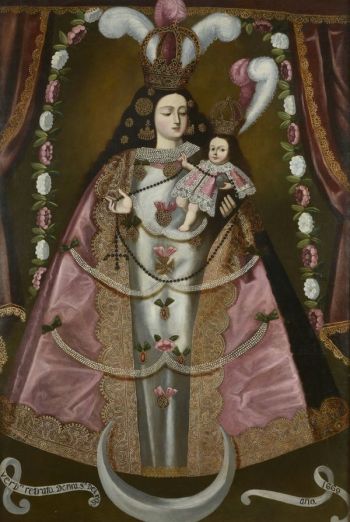
Unidentified artist, Our Lady of the Rosary of Pomata, 1669, oil on canvas (Carl & Marilynn Thoma Art Foundation, photo by Jamie Stukenberg).
In eighteenth-century Spanish America, sculpted images of the Virgin Mary were frequent subjects of paintings. Some of these ‘statue paintings’ depicted sculptures famed for miraculous intercession in medieval Spain. Others captured the likenesses of statues originating in the Americas and similarly celebrated for their divine intervention. Like the statues they portrayed, the paintings, too, were understood to be imbued with sacredness and were objects of devotion in their own right.
Drawn from the extraordinary holdings of the internationally renowned Carl & Marilynn Thoma Art Foundation, this exhibition focuses on statue paintings of the Virgin from the Viceroyalty of Peru, a part of the Spanish Empire encompassing much of Andean South America. It centers particularly on works produced in Cuzco (Peru) and artistic centers in the vicinity of Lake Titicaca and explores the European and American dimensions of the phenomenon, iconographic variations in the genre, and what these works of art reveal about sacred imagery and its operation in Spanish colonial South America. The identities of the painters and patrons of these works remain largely unknown, but certainly some of them were native Andeans.
The paintings in the exhibition cohere not only in their subject matter and place of production, but also in the painters’ meticulous treatment of the lavish dresses, mantles, jewels, and crowns that adorned the sculpted images. These details enhance their illusionistic effects, simulating the presence of the dressed statue itself. By making divine images from distant places present in colonial Peru and positioning them—through painting—in the company of sacred sculptures from the Americas, works in this genre traced a transatlantic spiritual geography conceived in eighteenth-century Spanish America and extending from the Andes to the Pyrenees and beyond.
In addition to the paintings on display, this exhibition will be supplemented with carefully selected archival and didactic materials. This landmark exhibition is curated by Michael Schreffler, Ph.D., of the University of Notre Dame’s Department of Art, Art History and Design.
Call for Panels | NEASECS 2020, New York — Traffic
From the Northeast American Society for Eighteenth Century Studies:
NEASECS 2020 — Traffic in the Global Eighteenth Century
Fordham University, Lincoln Center Campus, New York, 25–27 September 2020
Panel and roundtable proposals are due 30 January 2020 (the call for papers will be posted by 15 February 2020, with a March 30 due date).
It would be difficult to imagine New York City without traffic, but traffic should not be understood merely as the polluting congestion of its highly frequented streets and waterways, an issue already present in New Amsterdam. Traffic also underlines the commerce, or the passing through different hands as the Encyclopédie’s “Trafiqué” underlines, both legal and illicit, of goods, bodies, books, artworks, monies, services, and ideas that is as central to New York City today as it was to the global eighteenth century.
For this 43 edition of NEASECS, we invite panels, papers, and other interventions on the topic of traffic in the global eighteenth century: be it book smuggling, human trafficking, drugs & arms smuggling, import/export, transnational and/or colonial exchanges, or money traders and currency converters; the traffic of ideas as well as objects of knowledge and aesthetic beauty (art objects, fashion…); the infrastructure (or lack there of) that facilitated the movements of such a global and local traffic; and/or the effects and affects of traffic/trafficking including the sonic. All disciplines from the history of science, history of the book, history of religion, architecture, art history, music history, and history, to literary studies, anthropology, and sociology are encouraged to participate. Round tables are also highly encouraged.
Of course, in the long tradition of NEASECS, panels on topics different from the theme of the conference are also welcome.
Panels will be 1 hour and 30 minutes. Panels should not have more than 4 presenters and should allow for at least 20 minutes of discussion.
For the very first time, and perhaps inspired by the controlled chaos of traffic itself and the vibrant, diverse democracy of New York City, we will also be hosting an open forum or town hall on human trafficking in the global eighteenth century. Anyone who wishes to participate can, and this can be in lieu of a paper. Although if you wish to participate in this session in addition to a panel or roundtable that is also welcome. The two-hour session will have parliamentary style format with lively free interventions to any individual who stands up to speak. Those with disabilities that prevent them from standing will be given a flag to raise. All you must do is register. All those who register for this event will be listed as participants in the session in the program.
Proposals for panels and roundtables are due 30 January 2020.
The call for papers will be posted by 15 February 2020.
Submission to panels and roundtables (individual contributions) will be due 30 March 2020.
Early registration at a discounted price must be completed by 30 May 2020.
Registration at the full price must be completed by 1 August 2020.
Please submit your proposals directly to neasecs@gmail.com. Thank you.
Click here to register and submit your proposals.










 Enfilade
leave a comment