Call for Papers | Baroque Stucco Marble Altars
From ArtHist.net:
Baroque Stucco Marble Altars: Materials, Conservation, and Meaning
National Gallery of Slovenia, Ljubljana, 15–16 September 2026
Proposals due by 15 April 2026
The Restoration Centre – Institute for the Protection of Cultural Heritage of Slovenia, in collaboration with the Faculty of Arts, University of Ljubljana, the Academy of Fine Arts and Design, University of Ljubljana, and the Faculty of Chemistry and Chemical Technology, University of Ljubljana, invites proposals for the international conference Baroque Stucco Marble Altars: Materials, Conservation and Meaning.
The conference will explore the complex phenomenon of Baroque stucco marble altars as both material and cultural artefacts. By bringing together experts from various disciplines, the event aims to encourage a comprehensive discussion on the artistic, technical, and historical significance of these works of art. Special attention will be given to questions of materiality, workshop practices, artistic exchanges, and the conservation and restoration of stucco marble. The conference seeks to highlight not only the aesthetic and symbolic meaning of these altars but also the diverse methods and approaches used to study, preserve, and interpret them today. We welcome contributions from conservators, restorers, art historians, and scientists investigating stucco marble from any perspective. The working language of the conference is English.
Please submit your proposal for a 20-minute paper (complete with a title, a 250-word abstract, and a short biography of no more than 100 words) to stuccomarble2026@gmail.com by 15 April 2026. Further practical information regarding the conference programme will be provided after the selection of papers.
Organisers
Restoration Centre – Institute for the Protection of Cultural Heritage of Slovenia
Faculty of Arts, University of Ljubljana
Academy of Fine Arts and Design, University of Ljubljana
Faculty of Chemistry and Chemical Technology, University of Ljubljana
Co-organisers
Slovenian Research and Innovation Agency (ARIS)
Slovenian Society for Conservation-Restoration (DRS)
National Gallery of Slovenia
Call for Papers | Creating the Sacred at Court, 1300–1800
From ArtHist.net:
Creating the Sacred at Court:
Sensorial Practices and Experiences in Europe, 1300–1800
Slovak University of Technology, Bratislava, 21–23 September 2026
Proposals due by 15 May 2026
How does the sacred come into being? Art history, architectural history, and religious studies have long demonstrated that the sacred is not merely an inherent property of spaces, objects, or images, but is constituted in part through (worldly) staging. Light regimes, overwhelming chromatic effects, dense olfactory atmospheres, architectural materials, and spatial structures capable of producing resonances, all contribute to the sensorial construction of the holy. Yet sacred space is never purely environmental. Singing and speaking, moving and sometimes even dancing participants and audiences are integral to the performative creation of the sacred as well as to its perception.
But how can we approach such past sensorial enactments and experiences today? How can we model the historical sensory dimensions of ceremonies and devotional acts on the basis of surviving spaces, furnishings, or liturgical and courtly sources? And how might contemporary cognitive science alongside digital, virtual, and AI-based methods enable new forms of analysis, simulation, and interpretation? These questions lie at the centre of the working group ‘Sacred Spaces’ within COST Action 24164: Sensing Europe’s Court Spaces at the Crossroads of Past, Present and Future (SENSES). ‘Court Space(s)’ should be understood here as the spatial and material environment of medieval and early modern courts in Europe (1300–1800), seen as playing a significant role in shaping social structures, behaviours, and ways of life. The Action explores the full gamut of sensory experiences linked with the court residence and its life throughout history until today to build a better understanding of this complex cultural phenomenon, to support its survival as European heritage, and to contribute actively to its role as shaper of a collective identity for the future.
Sacred space at court should be understood as a multiple ranging from the smallest scale to the largest. Architecturally speaking, it comprises the court chapel, or as the case may be, the church, even an entire monastery (e.g. the convent palaces of the Hispanic world, such as the Escorial and the Descalzas Reales in Madrid, Spain, but also the monastery at Brou, France, built by the widowed regent of the Habsburg Low Countries). As part of the private apartments, the oratories constitute another component, one which serves as connection. But sacred space at court includes much more, the courtly organization behind the chapel’s service frequently taking care of worldly matters such as the prince’s valuables, for instance; the great hall adjacent to the smaller chapel actually serving as auditorium of the Mass for the lower ranks at court, and so on. On a larger scale, courts established religious networks extending across their lands, such as the Habsburg archdukes serving as regents establishing seven Marian shrines in strategic sites of the Low Countries around 1600.
Focusing on courtly contexts from 1300 to 1800, the conference intends to explore the inter-sensorial performances and experiences within religious spaces of European court residences. It is explicitly conceived as forward-looking, aiming to open future avenues of research and foster shared methodological standards across disciplines.
We especially welcome contributions that
• explore inter-sensorial experience from an interdisciplinary perspective
• address the performative and embodied dimensions of sacred space at court in all its forms (such as court chapels, churches, monasteries, oratories)
• reflect epistemological questions of approaching past perception
• present proof-of-concept projects using digital, virtual, or AI-based methods
We encourage participation from art and architecture historians, scholars in cognitive sciences and historical cognition studies, olfactory heritage studies, digital humanities researchers, heritage specialists and curators, as well as digital designers and simulation experts. Early career researchers are strongly encouraged to apply.
Please submit an abstract (max 300 words) and a short CV (max one page) by 15 May 2026 to krista.dejonge@kuleuven.be and joanna.olchawa@lmu.de. Participants must register with COST (free of charge). Travel and accommodation costs of accepted speakers will be reimbursed according to COST rules. Early career researchers may also apply for Short-Term Scientific Missions. More information is available here and here.
Organisation
Andrea Vargová (Slovak U. of Technology, Bratislava)
Monika Rychtáriková (KU Leuven / Slovak U. of Technology, Bratislava)
Magdaléna Kvasnicová (Slovak U. of Technology, Bratislava)
Vojtech Chmelík (Slovak U. of Technology, Bratislava)
Scientific Committee
Krista De Jonge (KU Leuven), Chair
Monika Rychtáriková (KU Leuven)
Andrea Vargová (Slovak U. of Technology, Bratislava)
Joanna Olchawa (Ludwig-Maximilians-Universität München)
Dubravka Botica (U. of Zagreb)
Jiří Kubeš (U. of Pardubice)
Philippe Vendrix (Tours, RicercarLab, Centre d’Études supérieures de la renaissance)
Pedro Luengo Gutiérrez (U. of Seville)
Mona Hess (Otto-Friedrich-Universität Bamberg)
José Eloy Hortal Muñoz (U. Juan Carlos, Madrid)
Call for Applications | Debenedetti Prize for 18th-C. Art History
From the Call for Applications:
The Elisa Debenedetti Prize for Research Writing in the
History of 18th-Century Art — Inaugural Award 2026
Sapienza Università di Roma, the Centro di Studi sulla
Cultura e l’Immagine di Roma, and the Fondazione Ernesta Besso
Applications due by 31 October 2026
Elisa Debenedetti (1933–2024), professor of art history at Sapienza Università di Roma, promoted the study and research of 18th-century arts for decades. Author of important contributions, essays, and monographs, she founded and edited the journals Studi sul Neoclassico (1973–80) and Studi sul Settecento Romano (since 1985), essential points of reference and discussion for researchers and scholars.
The Debenedetti family, in agreement with the Department of History, Anthropology, Religions, Art, and Entertainment at Sapienza Università di Roma, the Centro di Studi sulla Cultura e l’Immagine di Roma and the Fondazione Ernesta Besso, have established a biennial prize for an unpublished long-form study on the arts of the eighteenth century, focused, though not exclusively so, on Roman culture. The prize is open to young scholars of any nationality who are under 40 years of age on the closing date of the call for applications, for independent, research-based, long-form writing (i.e. degree theses, specialisation theses, doctoral theses, etc.) written in Italian, English, French, or Spanish. The prize consists of publication as a monograph by L’ Erma di Bretschneider in Rome, in the series Inchiostri di Storia dell’arte e dell’architettura.
Each application must contain, in PDF format:
• Text and images (low resolution)
• Abstract (maximum 900 words)
• Brief curriculum vitae et studiorum
Applications must be received by 31 October 2026 at the email address premioelisadebenedetti@gmail.com. Confirmation of receipt of applications will be sent.
The jury is composed of a representative of the Debenedetti family, the director of the Centro di Studi sulla Cultura e l’Immagine di Roma, two representatives of Sapienza Università di Roma (SARAS and DSDRA Departments), two representatives of the Fondazione Ernesta Besso, and a representative of a foreign research institution. The jury’s decision is final. The winner will be announced by 30 November 2026. The prize ceremony will take place in Rome in December 2026, and the publication will be released within the following year.
Premio Elisa Debenedetti per uno studio di Storia delle arti del Settecento
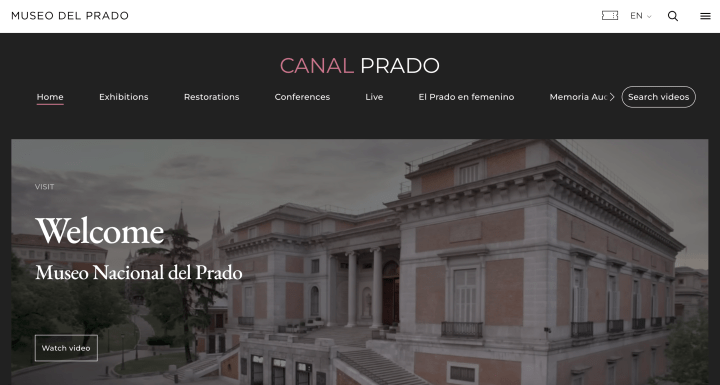
The Prado Launches New Online Platform
◊ ◊ ◊ ◊ ◊
From the press release for the new platform Canal Prado. The social media clip with Michael Yonan is a perfect example of content that will now be easier to find!
The Museo Nacional del Prado has unveiled Canal Prado, a new online platform designed to gather and organize the institution’s growing library of audiovisual content. Accessible through the museum’s website, the channel brings together everything from interviews and lectures to educational videos and documentary-style features, offering visitors a new way to explore the Prado beyond the gallery walls. The launch represents a significant step in the museum’s digital strategy. For years, the Prado has produced a wide range of videos tied to exhibitions, research, and public programs. Canal Prado now places all of that material in one curated space, making it easier for audiences around the world to discover, revisit, and explore the museum’s knowledge resources. The platform emphasizes content that remains relevant over time—conversations about art, scholarship, and the enduring questions that paintings and artists continue to raise.
One of the highlights of the launch is “Thinking the Prado,” a new series created and presented by art historian Alejandro Vergara, who invites viewers to consider some of the fundamental questions that surround works of art. Why do we value certain paintings? What kind of knowledge can art offer us? How have artistic judgments changed over the centuries? And, in practical terms, how long does it actually take to paint a masterpiece? Rather than presenting quick answers, the series takes a reflective approach, encouraging viewers to think about art as historians and curators do. The goal is not to promote the museum’s latest exhibition, but to create a thoughtful, lasting resource for anyone curious about art history. Vergara, who has worked at the Prado since 1999, has played a key role in shaping the museum’s understanding of Flemish painting and Northern European schools, and has curated numerous exhibitions during his career. He holds a doctorate in art history from the Institute of Fine Arts at New York University and has taught at institutions including Columbia University and Universidad Carlos III in Madrid.
The new platform also integrates “Stories of Art,” the extensive audiovisual archive created by the Fundación Amigos del Museo del Prado. The archive includes more than 1,300 videos and audio recordings, documenting decades of lectures, courses, and cultural programming dedicated to the study of art. Many of these materials were originally produced for members and participants in the foundation’s educational initiatives.
Now, through Canal Prado, the public can explore collections such as:
• Courses on art history
• “Sundays at the Prado” lecture programs
• Educational series like “Art Lessons”
Together, these recordings represent more than forty years of intellectual life connected to the Prado, turning the platform into an evolving archive of art scholarship. To make such a large body of material easier to explore, Canal Prado organizes videos into clear thematic categories. Visitors can browse content based on their interests—whether that means restoration projects, exhibition insights, behind-the-scenes stories, or expert conversations. The platform will also highlight special thematic selections throughout the year. In March, for example, the focus is on material related to women connected to the Prado, from artists to scholars and historical figures. The museum plans to continue expanding the channel with new episodes, interviews, and original series, gradually building a rich audiovisual archive.
The launch of Canal Prado coincides with a broader update to the museum’s website through the Plataforma Prado digital initiative. Among the most notable improvements is a new semantic search engine that allows users to explore the museum’s information system more intuitively. Instead of searching only by titles or keywords, visitors can now navigate by connections such as:
• artists
• techniques
• themes
• places
• historical figures depicted in artworks
The redesign also includes improved mobile navigation, updated menus, and newly structured pages that make the site easier to use on smartphones and tablets. Another new feature allows visitors to revisit exhibition itineraries even after exhibitions have closed, preserving the educational value of past shows. With Canal Prado, the Prado continues expanding its presence beyond Madrid, transforming decades of lectures, scholarship, and research into a resource accessible worldwide. For art lovers, students, and researchers alike, the platform offers something rare: direct access to the voices and ideas that shape one of the world’s great museums.
Symposium | (In)Visible Faces
From Syracuse University:
(In)Visible Faces: The Politics of Portraiture and Social Change, 1700–the Present
Online and in-person, Syracuse University, 26–27 March 2026
The 2025–2026 Ray Smith Symposium features a two-day conference that focuses on portraiture, the British empire, and the visual legacies of imperial portraiture in our current times. Building on a recently discovered 18th-century portrait of a Mrs. Seaforth painted by Sir Joshua Reynolds, the first president of the Royal Academy in London, the symposium will analyze portraiture, textile trade, and the East India Company on the first day, before shifting to print culture, photography, media, and social justice on the second day. Bringing together curators from the Syracuse University Art Museum (in whose collections Reynolds’s ‘lost’ painting was found) and Special Collections Research Center, as well as art historians, historians, curators, art and textile conservators, and communication scholars, the symposium will feature keynote lectures by acclaimed art historian Tim Barringer (Yale University) and renowned social psychologist Nilanjana (Buju) Dasgupta (University of Massachusetts Amherst).
Co-sponsored by Art and Music Histories. Chemistry. CODE^SHIFT. English. Goldring Arts, Style and Culture Journalism. History. Lender Center for Social Justice. Light Work. Premodern Global Studies. Ray Smith Symposium. South Asia Center. Syracuse University Art Museum. Syracuse University Humanities Center. Syracuse University Libraries. The Alexia at Newhouse. Women’s and Gender Studies. Psychology. The Rubin Family Foundation.
t h u r s d a y , 2 6 m a r c h
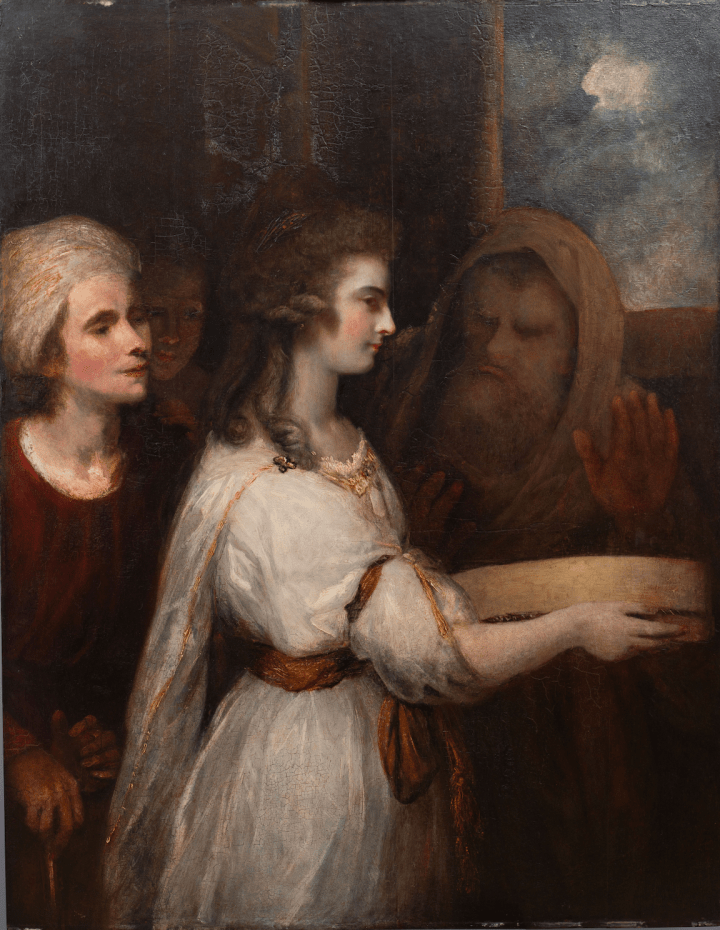
Joshua Reynolds, Tuccia, The Vestal Virgin, 1786, oil on panel (Syracuse University Art Museum, gift of Theodore Newhouse, 1968.329).
11.30 Welcome
11.45 Session 1
Moderator: Radha Kumar
• Robert Travers (Cornell University) — The Return of the Nabob: Richard Barwell and Warren Hastings in 1780s Britain
• Melinda Watt (Art Institute of Chicago) — The Lore and Allure of Woven Air
12.35 Session 2
Moderator: Irina Savinetskaya
• Debarati Sarkar (CUNY Graduate Center) — ‘My Black Servant Juba’: Sir Joshua Reynolds’s Earliest South Asian Ayah Portrait in 18th-Century Britain
• Jennifer Germann (Independent Scholar and Affiliated Scholar, Institute for European Studies, Cornell University) — Dressing up Dido: Constructions of Gender, Race, and Social Rank in the Portrait of Dido Elizabeth Belle and Lady Elizabeth Murray
1.30 Lunch Break
2.40 Session 3
Moderator: Jeffrey Mayer
• Amelia Rauser (Franklin and Marshall College) — Veritable Athenians: How Artistic Dress Became Neoclassical Fashion
• Joanna Marschner (Historic Royal Palaces) — Muslin in Western Fashion in the Later 18th Century: Lady Rockingham’s Muslin Sack-Back Dress c.1775, A Case-Study
3.30 Session 4
Moderator: Kate Holohan
• Raphael Shea (Westlake Art Conservation Center) — A Considered Approach to the Conservation Treatment of Reynolds’s Tuccia, The Vestal Virgin
• Kirsten Schoonmaker (Syracuse University) — Muslin, Magnified: Material Evidence in Local Collections
4.20 Tea and Coffee Break
5.00 Keynote Lecture
Moderator: Junko Takeda
• Tim Barringer (Paul Mellon Professor of the History of Art, Yale University) — A Suitable Ornament: Reynolds, the Royal Academy, and the British Empire
f r i d a y , 2 7 m a r c h
10.00 Welcome
10.10 Session 5 — virtual
Moderator: Durba Ghosh
• Adam Eaker (The Metropolitan Museum of Art) — Two New Indian Portraits for the Met
• Alice Insley (Tate Britain) — TBA
11.00 Session 6
Moderator: Romita Ray
• Melissa Yuen (Syracuse University Art Museum) — ‘And every body may know her’: The Display and Circulation of Mrs. Seaforth’s Image as Tuccia, the Vestal Virgin
• Elizabeth Mitchell (McNay Art Museum) — Anatomy of an Exhibition: From Reynolds to Warhol and Back Again
11.50 Lunch Break
2.15 Keynote Lecture
Moderator: Srividya ‘Srivi’ Ramasubramanian
• Nilanjana ‘Buju’ Dasgupta (Provost Professor and Inaugural Director, Institute of Diversity Sciences, University of Massachusetts Amherst) — How ‘Wallpaper’ Creates Inequality: A Science-Driven Approach to Change It
3.30 Closing Remarks
3.35 Tea, Coffee, Conversation
Exhibition | Revealing the Feminine: Fashion and Appearances
Opening soon at the Cognacq-Jay:
Révéler le Féminin: Mode et Apparences au XVIIIe Siècle
Musée Cognacq-Jay, Paris, 25 March — 20 September 2026
Curated by Pascale Gorguet Ballesteros, Adeline Collange-Perugi, and Saskia Ooms
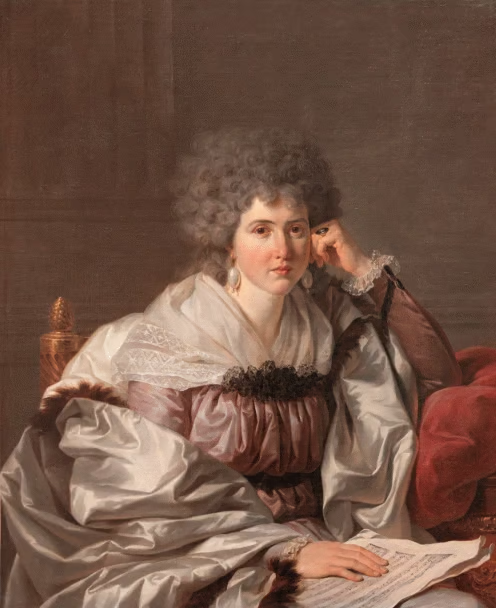
Jean-Charles Nicaise Perrin, Portait of Madame Perrin, 1791 (Musée des Arts et de l’Archéologie de Valenciennes; photo by Thomas Douvry).
Présentée au musée Cognacq-Jay en collaboration avec le Palais Galliera, l’exposition Révéler le féminin: Mode et Apparences au XVIIIe siècle propose une immersion dans l’univers fascinant des féminités au siècle des Lumières.
Portraits, scènes galantes et pièces textiles historiques dialoguent pour explorer la diversité des représentations de la féminité telles qu’elles se déploient dans les mises en scène du XVIIIe siècle. L’exposition souligne l’essor d’un style français dont l’élégance séduit alors les cours et l’aristocratie européennes, révélant une histoire du costume à la fois ancrée dans une réalité matérielle et nourrie par l’imaginaire.
Au cœur de cette époque, la France s’impose comme le théâtre incontournable du raffinement et du prestige. Les artistes tels que Maurice Quentin de La Tour, Jean-Marc Nattier, Adélaïde Labille-Guiard, ou encore Élisabeth Vigée Le Brun excellent à traduire l’éclat des étoffes comme la profondeur des âmes, offrant à leurs modèles une aura de grâce et de pouvoir. Le parcours de l’exposition, qui met en lumière ces œuvres virtuoses, s’enrichit de portraits marqués par une dimension psychologique nouvelle, où l’intimité et le naturel prennent une place centrale, sous l’influence anglaise. En parallèle, les pastorales de François Boucher et les fêtes galantes d’Antoine Watteau façonnent une féminité idéalisée et poétique.
Enfin, des photographies contemporaines de Steven Meisel, Esther Ségal, ou encore Valérie Belin, ainsi qu’une création Chanel par Karl Lagerfeld, suggèrent en contrepoint une réflexion sur la persistance des codes et l’héritage du XVIIIe siècle dans la mode actuelle, entre exigence sociale et imaginaire de la beauté.
Commissariat
• Pascale Gorguet Ballesteros, conservateur général du patrimoine, responsable des départements mode XVIIIe et Poupées au Palais Galliera
• Adeline Collange-Perugi, conservatrice du patrimoine et responsable de la collection art ancien, Musée d’arts de Nantes
• Saskia Ooms, attachée de conservation au musée Cognacq-Jay
Révéler le Féminin: Mode et Apparences au XVIIIe Siècle (Paris: Paris Musées, 2026), 112 pages, ISBN: 978-2759606382, €25.
Exhibition | Fashion in the 18th Century: A Fantasized Legacy
Opening soon at the Palais Galliera:
Fashion in the 18th Century: A Fantasized Legacy
La Mode du 18e Siècle: Un Héritage Fantasmé
Palais Galliera, Paris, 14 March — 12 July 2026
Curated by Émilie Hammen, with Pascale Gorguet-Ballesteros and Alice Freudiger

Polish-style Dress and Skirt, ca. 1770–75 (Palais Galliera / Paris Musées).
Fashion in the 18th Century: A Fantasized Legacy looks at the characteristics of women’s fashion during the Age of Enlightenment and its numerous reinterpretations throughout fashion history up until the present day. Marked by an unprecedented creative energy, the eighteenth century may be characterized by its diverse silhouettes, rich fabrics, and exuberant accessories and hairstyles. It also marked the end of a model of women’s dress inherited from previous centuries, thus paving the way for a new conception of the body and the appearance.
From the Second Empire onwards, women’s fashion drew largely on the aesthetics of the Enlightenment as a plentiful source of inspiration. In a context of political and social upheaval, the eighteenth century appeared as the epitome of elegance and a lost paradise that evoked a strong sense of nostalgia. After the Second World War, French couture, seeking legitimacy in order to establish itself on the international market, once again turned to the techniques and expertise developed in the eighteenth century by the luxury industry. The massive and widespread circulation of images through the press, cinema, and entertainment transformed this heritage into a visual code that was immediately embraced by popular culture. Gradually, eighteenth-century fashion became more than just a historical reference but a distinct aesthetic in its own right. This exhibition offers a reflection on how fashion and collective memory shape, transform, and project this past, creating a still-vibrant aesthetic, cultural, and symbolic narrative. Constantly reinvented and idealized, the eighteenth century resonates with the aspirations of each new epoch. Today, this aesthetic flirts with the world of the kitsch, camp, and queer.
Bringing together over seventy silhouettes, accompanied by fashion accessories, textiles, graphic arts, and photographs, the exhibition highlights masterpieces like Queen Marie Antoinette’s corset. Visitors can compare the silhouettes of the eighteenth-century with those of later centuries, through a selection of iconic contemporary pieces from the collections of Chanel, Christian Dior, Louis Vuitton, Christian Lacroix, Vivienne Westwood, Dries van Noten… Surveying three centuries of creation, the Palais Galliera examines how eighteenth-century fashion has been reinterpreted—between historical heritage, aesthetic fantasy, and creative freedom.
General curator
Émilie Hammen, director of the Palais Galliera
Commissariat scientifique
Pascale Gorguet-Ballesteros, Head of collections, Clothes from the 17th and 18th century and dolls, assisted by Alice Freudiger
Lecture | Ana Lucia Araujo on the Work of Black Artists in the Americas
From The Institute of Fine Arts:
Ana Lucia Araujo | The Power of Art: The World Black Artists Made in the Americas
Daniel H. Silberberg Lecture Series
Online and in-person, The Institute of Fine Arts, New York University, 30 March 2026, 6pm
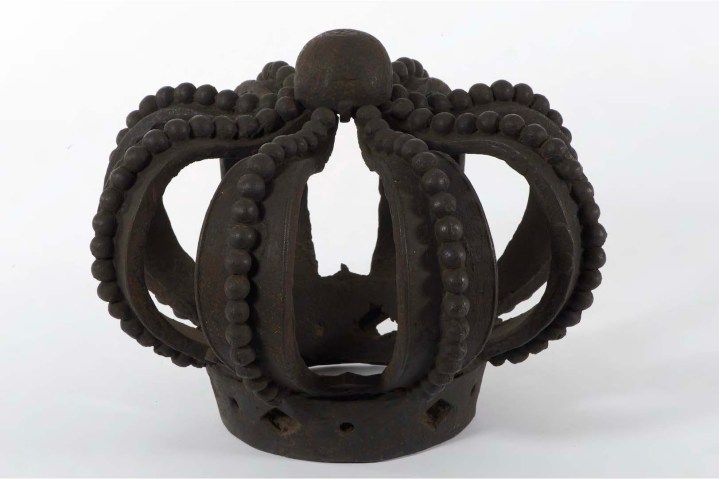
Iron crown, 34 × 45 cm, Real Fábrica de Ferro São João do Ipanema (Museu Paulista, Universidade de São Paulo, Brazil).
Throughout human history, men and women have used artistic expression to overcome the most horrible atrocities. Africans and their descendants also embraced artistic creation to survive the horrors of the Atlantic slave trade and slavery in the Americas, and to soothe their physical and spiritual wounds. Drawing on written and visual primary sources, artifacts, and artworks housed in archives and museums in the United States, Brazil, the United Kingdom, France, and the Netherlands, my book The Power of Art: The World Black Artists Made in the Americas combines history, art history, and art to tell the story of enslaved artists and examine the works they created in the Americas during the eighteenth and nineteenth centuries. I argue that Black creators drew on the long and powerful heritage of African arts and knowledge, which they combined with European and Native American artistic traditions, to design artworks and objects that asserted a defying world of their own.
Many enslaved and freed artists modeled clay objects, forged magnificent iron pieces, wove textiles, mats, and baskets, carved wood and stone sculptures. These artists embraced the knowledge transmitted to them by their African ancestors, while also introducing innovations learned from European and indigenous creators. Drawing on these rich economic and cultural exchanges, African artists and their descendants in the Americas adapted and developed new techniques and combinations of forms and colors. When creating new artworks, these artists also embraced new materials to which they assigned new uses and meanings. I contend that artistic creation offered bondspeople relief and hope, and sometimes also opened to them a path to emancipation. Ultimately, by shedding new light on the works of enslaved Africans and their descendants, which still remain largely invisible in most museum collections, The Power of Art illuminates their long-lasting contributions to the development of visual arts in the Americas.
Registration is available here»
Ana Lucia Araujo is a historian of slavery, the transatlantic slave trade and the global African diaspora. Trained as a historian and as an art historian, she has explored the legacies of slavery, including the history of calls for reparations, memory, heritage, material, and visual culture of slavery. Her recent books are Humans in Shackles: An Atlantic History of Slavery (University of Chicago Press, 2024), The Gift: How Objects of Prestige Shaped the Atlantic Slave Trade and Colonialism (Cambridge University Press, 2024), and Reparations for Slavery and the Slave Trade: A Transnational and Comparative History (Bloomsbury, 2017, 2023). A John Solomon Guggenheim Fellow (2025), her work has also been supported by the American Council of Learned Societies, the Getty Research Institute, the Institute of Advanced Study (Princeton, NJ), the Bonn Center for Dependency and Slavery Studies at Universität Bonn (Germany), the Clark Art Institute, and the American Philosophical Society.
New Book | Classical Taste, Architecture, and Thomas Jefferson
From Bloomsbury:
Alley Marie Jordan, Classical Taste in the Architectural World of Thomas Jefferson (London: Bloomsbury Publishing, 2025), 224 pages, ISBN: 978-1350428508, $115.
 Reaching beyond politics and law, this book focuses on Thomas Jefferson as an aesthetic classicist.
Jefferson embraced the influence of antiquity through his adoption of classical architecture in his Virginia residences, in order to establish Rome as an ancestor to America. In a time of significant political and cultural change, he aligned himself with a Greco-Romano legacy that represented knowledge, power and art. Alley Marie Jordan studies the architectural and landscape spaces of Jefferson’s classical taste, which include the villas of Monticello and Poplar Forest, as well as the University of Virginia. An examination of these places exposes his deeply entrenched views of the importance of classics in Virginia, and reveals them as expressions of admiration of classical antiquity.
Seeking to uncover an underexplored side of his character, Jordan deconstructs his identity through a classical lens and illustrates his influence on American culture, as well as his desire to reform it via the classics. By dislodging Jefferson from American politics, this study redefines his worldview and motivations for inventing an American virtue based on Horace’s utile dulci. Although his participation in acquiring classical taste was not unique for his time, he did accomplish a unique aim with classicism: the blending of the American landscape with classical culture to create a ‘new’ American virtue.
Alley Marie Jordan is a garden historian with a PhD in Classics from the University of Edinburgh.
c o n t e n t s
List of Illustrations
‘A Sublime Luxury’: An Introduction to Eighteenth-Century Classical Taste, Aesthetics, and Architecture
1 Jefferson in Context
2 Thomas Jefferson the Epicurean: Exploring Jefferson’s Classical Philosophy
3 The Genius Loci at Thomas Jefferson’s Classical Villas: Monticello and Poplar Forest
4 The Politician in a Landscape
5 ‘The Land of Dreams’: Thomas Jefferson’s Classical University
6 Classical Curiosities, a Conclusion
Notes
Bibliography
Index
Exhibition | Colonial Williamsburg: The First 100 Years
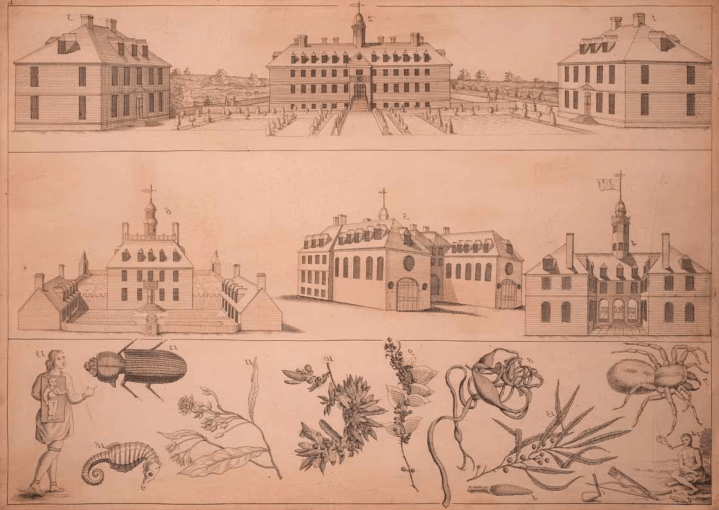
Illustration of Williamsburg Buildings, Flora, and Fauna, ca. 1740, copper plate 10 × 13.5 inches, possibly commissioned by William Byrd II
(Colonial Williamsburg, gift of the Bodleian Library, No. 1938-196)
◊ ◊ ◊ ◊ ◊
From the press release (12 February 2026) for the exhibition:
Colonial Williamsburg: The First 100 Years
Weldon Gallery, Colonial Williamsburg, 28 February — 31 December 2026
Developed by Margaret Pritchard, Neal Hurst, and Katie McKinney
As the nation observes its semiquincentennial in 2026, The Colonial Williamsburg Foundation is also celebrating its own 100-year history —a story that reflects a century of change in America itself. A new exhibition at the Art Museums of Colonial Williamsburg, entitled Colonial Williamsburg: The First 100 Years, explores the origins, evolution, and impact of this unique organization that today operates the world’s largest U.S. history museum.
From its groundbreaking preservation efforts to its evolving interpretations of America’s rich shared history and founding ideals, Colonial Williamsburg has often mirrored—and sometimes led—national conversations. One constant has driven the Foundation throughout its history: Everything it produces is grounded in ongoing research. Colonial Williamsburg: The First 100 Years explores the Foundation’s journey through that same lens using primary documents, objects and archival imagery to bring Colonial Williamsburg’s own history to life.
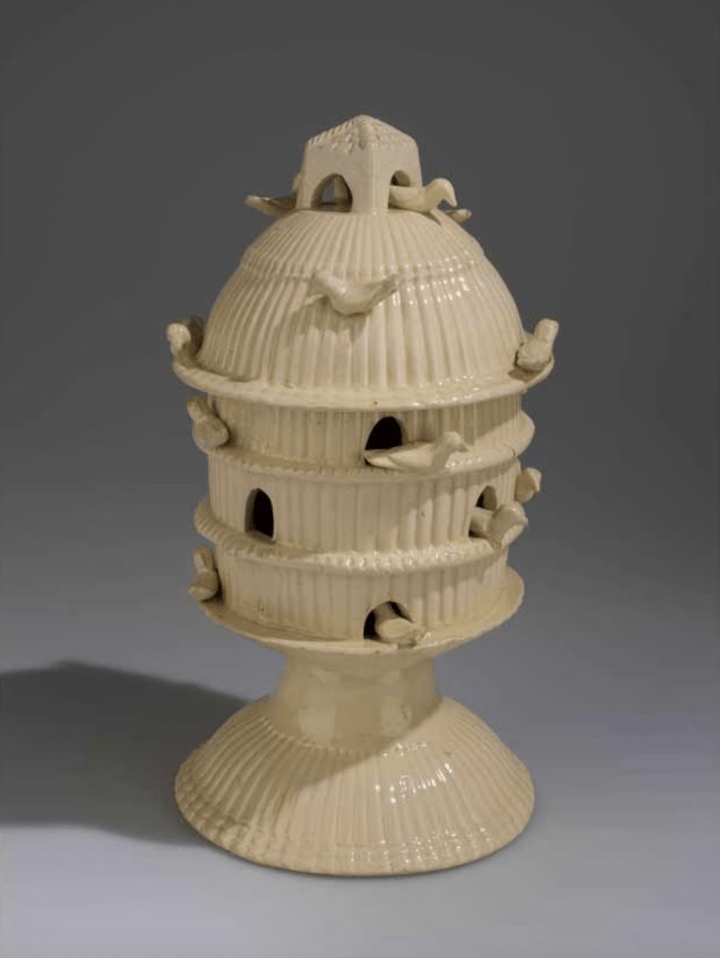
Dovecote, ca. 1770, made in England, Staffordshire or Yorkshire, lead-glazed earthenware (cream-colored earthenware / creamware), 8.5 inches high (Colonial Williamsburg, museum purchase, No. 1936-628).
The exhibition opens in the Art Museums’ 2500-square-foot Weldon Gallery on 28 February 2026, and will showcase more than 200 objects including decorative art, folk art, and archival material. Highlighting 100 years of history in one exhibition took Neal Hurst, curator of textiles and historic dress, and Katie McKinney, the Margaret Beck Pritchard Curator of Maps, several years. They took over the project, which former Deputy Chief Curator Margaret Pritchard began in 2021, continuing work on the exhibition after Pritchard’s retirement in 2024.
“It has been a joy to research, seek out objects, rediscover Colonial Williamsburg’s history, and talk to people who have worked for the Foundation, all of which culminates in this exhibition. Like any exhibit, space is always limited, but visitors will walk away with an understanding of The Colonial Williamsburg Foundation’s impact on public history, as well as its influence on preservation, collecting and education around the world,” Hurst said.
Added McKinney, “After 100 years, Colonial Williamsburg has become historic in its own right. Our colleagues across the Foundation, past and present, made this exhibition a reality. They shared their stories, expertise and lent objects. We were fascinated by how we continue to build upon the foundations laid out by the work of our predecessors. Time and again we were reminded of our motto: ‘That the future may learn from the past.’ Ultimately, the exhibition is about the people who have nurtured and built upon the Rev. Dr. W.A.R. Goodwin’s dream for the past century.”
Designed to be experienced chronologically, the exhibition begins with a look at communities and institutions who called Williamsburg home after Virginia’s capital was moved to Richmond in 1780. It offers a look at what inspired the Rev. Dr. W.A.R. Goodwin to envision Williamsburg’s restoration to its 18th-century appearance and John D. Rockefeller Jr.’s decision to support the project. Beginning with Rockefeller’s initial purchase of the Ludwell-Paradise house in 1926, the exhibition traces Colonial Williamsburg’s evolution from a patriotic preservation project to its current iteration as a premier educational organization that operates the world’s largest U.S. history museum. The exhibition explores Colonial Williamsburg’s research in interpretation, trades, preservation techniques and other aspects of the Foundation’s work over the decades. Each section includes maps, prints, and photographs from Colonial Williamsburg’s extensive archival collection, including aerial images of Williamsburg during the early years of the restoration and pictures of the men and women who restored and reconstructed the colonial capital city.
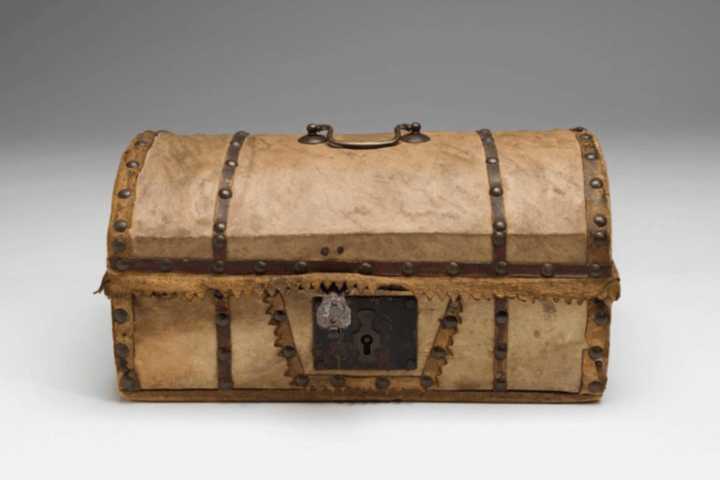
Document Box, ca. 1843, basswood (Tilia, Spp. by micro id), calfskin, leather, brass, iron, paper, textile, and paint, 6 × 7 × 12 inches (Colonial Williamsburg, gift of Catherine H. Latane, No, 2011-26). Owned by a formerly enslaved woman in Williamsburg at the end of the 19th century who lived with the Edwin and Isabel Beale family on Duke of Gloucester Street (on the site of the Orlando Jones House), where the family operated a hardware store.
◊ ◊ ◊ ◊ ◊
Curators sourced objects from archaeological, architectural, and museum collections, as well as ordinary objects from across the Foundation. Among those featured is the Bodleian Plate, known as ‘the cornerstone of the restoration’, which was discovered in England in the 1920s and helped guide the reconstruction of the Capitol and Governor’s Palace; Dr. Goodwin’s cane; George III’s coat of arms, which was once displayed in the Governor’s Palace; a document box that once held the treasured possessions of a formerly enslaved resident of Williamsburg; and a window sash removed during the preservation of the Williamsburg Bray School.
Other notable items on display:
• Ceramic objects from the collection that were buried in sand inside barrels for their safekeeping during WWII
• A mid-20th-century brick mold used to manufacture bricks in support of the restoration
• A paint chip board displaying Colonial Williamsburg’s signature colors that was originally installed in the Foundation’s paint shop in 1950
• An exhibit that explores the evolution of the interiors of the Governor’s Palace supper room, including samples of Chinese-painted wallpaper and ornate furnishings that had a major influence on American interior design
• A view of the Ludwell-Paradise House, where in 1935 an exhibition of American folk art loaned by Abby Aldrich Rockefeller went on view, including Washington and Lafayette at the Battle of Yorktown
• A vignette from the Anderson House Archaeological Exhibit (1975–83), which was designed to demystify the relatively new field of historical archaeology championed by the Colonial Williamsburg Foundation
The exhibition also includes several captioned videos and a touchscreen that allows guests to access short segments of several films produced by the Foundation to showcase its work in the digital space. Visitors familiar with Colonial Williamsburg’s history will recognize props from the film Story of a Patriot; Felicity Merriman, the American Girl doll whose story is set in 18th-century Williamsburg; and several of the Foundation’s numerous Emmy Awards won for its educational video productions.
“The Foundation has led the field of public history for a century, and Colonial Williamsburg: The First 100 Years traces that journey. As we celebrate America’s 250th anniversary and Colonial Williamsburg’s 100th, we welcome the nation—and the world—to join us throughout 2026 in honoring the past, engaging the present, and inspiring the future,” said Ron Hurst, chief mission officer for the Foundation and chief curator for the Art Museums of Colonial Williamsburg.










 Enfilade
leave a comment