New Book | Crowning Glories
From the University of Toronto Press:
Harriet Stone, Crowning Glories: Netherlandish Realism and the French Imagination during the Reign of Louis XIV (Toronto: University of Toronto Press, 2019), 312 pages, ISBN 978-1487504427, $70.
 Crowning Glories integrates Louis XIV’s propaganda campaigns, the transmission of Northern art into France, and the rise of empiricism in the eighteenth century—three historical touchstones—to examine what it would have meant for France’s elite to experience the arts in France simultaneously with Netherlandish realist painting. In an expansive study of cultural life under the Sun King, Harriet Stone considers the monarchy’s elaborate palace decors, the court’s official records, and the classical theatre alongside Northern images of daily life in private homes, urban markets, and country fields.
Stone argues that Netherlandish art assumes an unobtrusive yet, for the history of ideas, surprisingly dramatic role within the flourishing of the arts, both visual and textual, in France during Louis XIV’s reign. Netherlandish realist art represented thinking about knowledge that challenged the monarchy’s hold on the French imagination, and its efforts to impose the king’s portrait as an ideal and proof of his authority. As objects appreciated for their aesthetic and market value, Northern realist paintings assumed an uncontroversial place in French royal and elite collections. Flemish and Dutch still lifes, genre paintings, and cityscapes, however, were not merely accoutrements of power, acquisitions made by those with influence and money. Crowning Glories reveals how the empirical orientation of Netherlandish realism exposed French court society to a radically different mode of thought, one that would gain full expression in the Encyclopédie of Diderot and d’Alembert.
Harriet Stone is Professor of French and Comparative Literature at Washington University in St. Louis.
C O N T E N T S
Acknowledgments
List of Images
Introduction: Hiding in Plain Sight
Part I: Divergent Patterns
1 Two Models in Context: Northern Realist Art in France
2 France at the Intersection: Configuring the French Response to Northern Realism
Part II: Transformations
3 Fractured Spaces: Staging the King’s Portrait
4 In Death as in Life
Part III: Patterns of Change
5 The Great Reveal
6 Legacies
Coda: Trompe l’oeil Illusions and the Thoughts They Inspire
Notes
Works Cited
Exhibition | Slavery
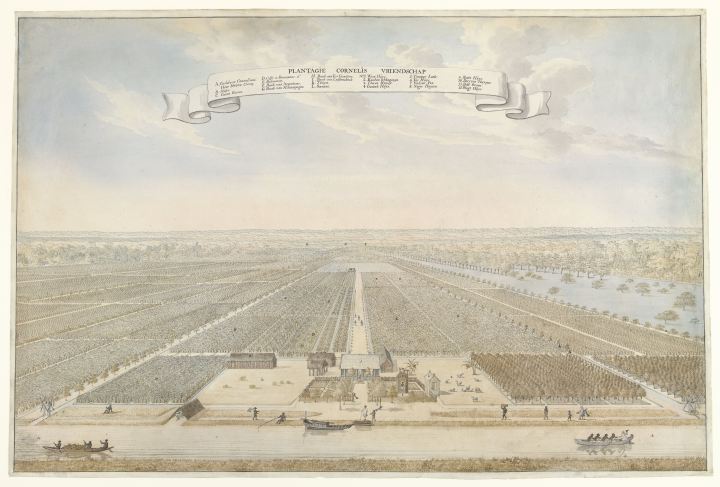
View of the Plantation Cornelis Friendship in Suriname (‘Plantagie Cornelis Vriendschap’), eighteenth century, watercolor, 43 × 64 cm
(Amsterdam: Rijksmuseum, RP-T-1959-120)
◊ ◊ ◊ ◊ ◊
The exhibition opens this time next year at the Rijksmuseum:
Slavery, An Exhibition
Rijksmuseum, Amsterdam, 25 September 2020 — 17 January 2021; dates extended to summer 2021
This exhibition testifies to the fact that slavery is an integral part of our history, not a dark page that can be simply turned and forgotten about. And that history is more recent than many people realize: going back just four or five generations you will find enslaved people and their enslavers. For the very first time, in 2020 the Rijksmuseum will hold an exhibition devoted entirely to this subject. Slavery is found in many cultures, places and times, but this exhibition focuses on slavery in the Dutch colonial period, spanning from the 17th to the 19th century.
Why the Rijksmuseum is holding this exhibition
The Rijksmuseum is the Dutch national museum for art and history. Slavery is an integral part of that history, and one that affects us all. Delving into the history of slavery will lead to a better understanding of contemporary Dutch society. The plans for this exhibition are part of a museum-wide effort to increase the attention given to colonial history, from diverse perspectives. Academic research, recent acquisitions, and a critical reappraisal of the existing collection are all aspects of this policy. Others include the multimedia guided tour entitled ‘Colonial Past’ and the Country Series of eight books that each focus on a nation with which the Netherlands had a relationship during the colonial period.
What the exhibition is about
In the days of Dutch colonial slavery, millions of people were reduced to the status of personal ‘property’. It has proven to be difficult to trace the stories of these people. The exhibition at the Rijksmuseum will center on ten individuals, some of them well-known, others less so. This emphasis on the personal will enable the museum to give a ‘face’ to slavery and make the universal and perpetual relevance of this history tangible. This exhibition does not attempt to offer a complete overview of the history of Dutch slavery. By taking a biographical approach, the museum wants to encourage museum visitors to reflect and to ask questions: How did enslaved people cope with their situation? Were there any voices of dissent? What did people in the Netherlands know about slavery? The exhibition will shed light on the trading triangle linking Europe, Africa and the Americas; on the Indian Ocean region; on southern Africa; and on enslaved people who were brought to the Netherlands.
The people involved in building this exhibition
The Rijksmuseum has assembled a team of specialist curators with wide-ranging academic networks, including Eveline Sint Nicolaas, Valika Smeulders, Maria Holtrop, Stephanie Archangel, and Saida Si Amer. The team will receive support from a think-tank that will convene on four occasions, as well as an international advisory council.
In the run-up to the exhibition, the Rijksmuseum will hold a number of meetings and events focusing on contributions and discourse from society at large. On 18 May 2018, for example, a discussion took place that focused on the part that Wikipedia can play in increasing the accessibility of our collection. And did you know that if you go to our online Rijksstudio, you can already start putting together your own collection of Rijksmuseum objects relating to slavery?
New Book | Epic Landscapes: Latrobe and the Art of Watercolor
From The University of Virginia Press:
Julia A. Sienkewicz, Epic Landscapes: Benjamin Henry Latrobe and the Art of Watercolor (Charlottesville: The University of Virginia Press, 2019), 288 pages, ISBN 978-1644531594, $65.
 Epic Landscapes is the first study devoted to architect Benjamin Henry Latrobe’s substantial artistic oeuvre from 1795, when he set sail from Britain to Virginia, to late 1798, when he relocated to Pennsylvania. Thus, this book offers the only extended consideration of Latrobe’s Virginian watercolors, including a series of complex trompe l’oeil studies and three significant illustrated manuscripts. Though Latrobe’s architecture is well known, his watercolors have received little critical attention. Epic Landscapes rediscovers Latrobe’s watercolors as an ambitious body of work and reconsiders the close relationship between the visual and spatial sensibility of these images and his architectural designs. It also offers a fresh analysis of Latrobe within the context of creative practice in the Atlantic world at the end of the eighteenth century as he explored contemporary ideas concerning the form of art for Republican society and the social impacts of revolution.
Julia Sienkewicz is Assistant Professor of Art History at Roanoke College.
Conference | Fürstliche Feste
From Art-Hist.net (11 September 2019) . . .
Fürstliche Feste
Schloss Sondershausen, 25–26 October 2019
Höfisches Feiern diente der Manifestation von Herrschaftsbeziehungen. Offizielle Feste waren und sind ein wichtiges Medium der Repräsentation gesellschaftlicher und politischer Ordnung, aber auch ihrer spielerischen Reflexion. Die Inszenierung von Festen forderte insbesondere im Zeitalter des Barock das ganze Aufgebot der Künste von der Architektur über die bildende Kunst und das Kunsthandwerk bis zu Musik und Theater. Nicht umsonst betrauten Herrscher oft ihre Hofkünstler mit der Regie dieser Gesamtkunstwerke, die häufig in Wort und Bild dokumentiert und mit großem Interesse weit über den Teilnehmerkreis hinaus rezipiert wurden. Neben dem kulturhistorischen Schwerpunkt schlägt die Tagung den Bogen in die Gegenwart.
Wir bitten um Anmeldung mit Antwortbogen (Download Interneseite) oder unter veranstaltungen@thueringerschloesser.de und Überweisung der Tagungsgebühr bis 14. Oktober 2019 unter Angabe des Namens auf das Konto der Stiftung bei der Kreissparkasse Saalfeld-Rudolstadt:
IBAN: DE03 8305 0303 0000 0001 24
BIC: HELADEF1SAR
Damit gilt die Anmeldung als verbindlich. Bei Absage der Teilnahme ist eine Rückerstattung nicht möglich.
Tagungsgebühr für die Vortragsreihe an beiden Tagen: 65€ inkl. Kaffeepausen (ermäßigt 35€ für Arbeitslose, Schwerbeschädigte, Schüler und Studenten); Tageskarte Freitag 40€ (ermäßigt 20€); Tageskarte Samstag 25€ (ermäßigt 15€)
Veranstalter
Stiftung Thüringer Schlösser und Gärten
Schloßbezirk 1 07407 Rudolstadt
T 0 36 72 – 4 47 0 F 0 36 72 – 44 71 19
stiftung@thueringerschloesser.de
gemeinsam mit
Prof. Dr. Michael Maurer
Friedrich-Schiller-Universität Jena, Seminar für Volks-
kunde/Kulturgeschichte, Professur für Kulturgeschichte
Zwätzengasse 3 07743 Jena
vkkg-sekretariat@uni-jena.de
F R E I T A G , 2 5 O K T O B E R 2 0 1 9
10.00 Begrüßung und Einführung, Doris Fischer
10.30 Michael Maurer (Friedrich-Schiller-Universität Jena), Welche Funktionen erfüllen höfische Feste? Ein Überblick aus kultur- und sozialgeschichtlicher Perspektive
11.00 Jörn Steigerwald (Universität Paderborn), Das Fest der Feste – Die Plaisirs de l’Île Enchantée oder Versailles als Maßstab
11.30 Andrea Sommer-Mathis (Österreichische Akademie der Wissenschaften, Wien), Feste im Machtzentrum des Heiligen Römischen Reichs – der Wiener Hof
12.00 Diskussion
12.15 Mittagspause mit Gelegenheit zu Führungen
14.00 Ines Elsner (Berlin), Zwischen Alltagsphänomen und Ausnahmezustand: Feste am Berliner Hof Friedrichs III./I. von Brandenburg-Preußen, 1688–1713
14.30 Christian Quaeitzsch (Bayerische Verwaltung der Staatlichen Schlösser, Gärten und Seen, München), Reflexionen französischer Festkultur am Hof der Wittelsbacher
15.00 Harriet Rudolph (Universität Regensburg), Fest und Status. Feste als Medium fürstlicher Repräsentation in der Hierarchie des Heiligen Römischen Reichs
15.30 Diskussion
15.45 Kaffeepause
16.15 Susan Baumert (Friedrich-Schiller-Universität Jena), Dynastie und Individuum – Lebensfeste am Weimarer Hof
16.45 Hendrik Bärnighausen (Dresden), Festkultur am Hof der Fürsten von Schwarzburg-Sondershausen
17.15 Hendrik Ziegler (Philipps-Universität Marburg), „Alla Turca“ – Der Osmane als Bezwungener oder als Bezwinger im höfischen Fest des Barock
17.45 Diskussion
18.15 Enrico Brissa (Leiter des Protokolls beim Deutschen Bundestag), Manieren und Protokoll. Zur Fernwirkung höfischer Kultur. Enrico Brissa liest aus seinem Buch „Auf dem Parkett. Kleines Handbuch des weltläufigen Benehmens“
S A M S T A G , 2 6 O K T O B E R 2 0 1 9
9.30 Hildegard Wiewelhove (Museum Huelsmann, Bielefeld), Feste im Garten und Gärten im Fest. Gartenfeste im Spiegel ihrer medialen Verbreitung
10.00 Marc Jumpers M.A. (Bayerisches Landesamt für Denkmalpflege, München), Weltliche und sakrale Festinszenierungen der geistlichen Wittelsbacherprinzen im Nordwesten des Alten Reiches
10.30 Tobias C. Weißmann (Johannes-Gutenberg-Universität Mainz), Vom Entwurf zum Ereignis. Der Künstler als Festregisseur und die Festindustrie im barocken Rom
11.00 Kaffeepause
11.30 Sebastian Werr (Bayerische Staatsbibliothek München), Klangstrategien. Musik bei Münchner Hoffesten
12.00 Franz Nagel (Stiftung Thüringer Schlösser und Gärten, Rudolstadt), Feste in Stuck und Farbe. Hauptsäle in Thüringen
12.30 Abschlussdiskussion
13.00 bis 17.00 Tag der offenen Tür im Schlossmuseum mit Sonderführungen, musikalischer Umrahmung und künstlerischen Darbietungen
Lecture | Menno Fitski, On a Japanese Lacquer Chest
Next Thursday at Columbia:
Menno Fitski, Genji Meets Yoritomo
Burke Center, Columbia University, New York, 26 September 2019
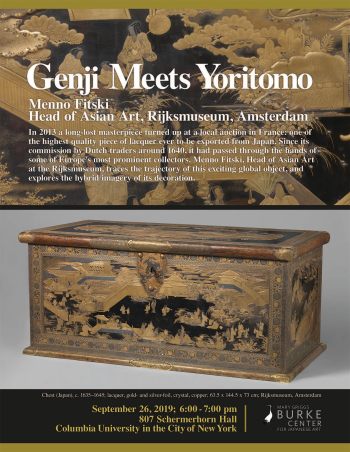 Menno Fitski, head of Asian Art at the Rijksmuseum, will lecture on an astonishing mid-seventeenth century Japanese lacquer chest acquired by the museum in 2013. Hitherto known only through a poor World War II-era photograph published by his mentor (and father-in-law), the late Oliver Impey, the RM chest must be counted as one of the finest examples of Japanese lacquer ever to have been exported to the West. It forms part of what Impey described as the Fine Group—comprised of three other, similarly large, richly lacquered chests, in the the Victoria and Albert Museum; the State Historical Museum, Moscow; and one believed to have been sawn up. The recovery of the RM chest was rightfully heralded in the 2015 exhibition Asia in Amsterdam.
The RM and V&A chests are believed to have passed from the directors of the Dutch East India company in Japan who first acquired them to Cardinal Mazarin whose descendants preserved them throughout the eighteenth century. Around 1800, they were acquired by the renowned English collector William Beckford and subsequently sold in the estate sale of his son-in-law, the 10th Duke of Hamilton in 1882. At this point, their paths diverged—one to the V&A and the RM example into the collection of Sir Trevor Lawrence. At some point thereafter, the RM chest dropped off the map, only to remerge in a house near Paris six years ago.
But the odyssey through trade and European princely ownership is only part of their story as the quality and themes of these lacquers are in every sense exceptional (if only for what we now view as having been made expressly for export, i.e, Namban wares). Of a quality more generally identified with the most refined domestic taste (akin to those collected by Maria Theresa and Marie Antoinette), the panels of the chest illustrate scenes from the eleventh century Tale of Genji.
The lecture is scheduled for Thursday, 26 September 2019 at 6:00pm.
Call for Papers | Seventh Feminist Art History Conference
From Amart-l (9 September 2019) . . .
The Seventh Feminist Art History Conference
American University, Washington, D.C., 25–27 September 2020
Proposals due by 1 December 2019
The Feminist Art History Conference was established in 2010 to celebrate and build on the legacy of feminist art-historical scholarship and pedagogy originated by Norma Broude and Mary D. Garrard at American University in Washington, D.C. In September 2020 this international conference will convene for the seventh time. The core principles of a feminist art history have long included the goals of reclaiming the place of women artists and patrons within the history of art and visual culture, and of describing and elaborating how gendered ideologies have framed the structure of both artistic practice and the writing of art history over the centuries. In recent years feminist art history has also become increasingly intersectional and interdisciplinary, dialoguing with race, class, geography, and environmental and architectural issues, to name but a few.
In the spirit of bringing together the diverse strands of thought and practice that feminist art history now embraces, this conference will feature papers spanning a wide range of chronological, geographic, intersectional, and interdisciplinary topics. These may include (but are not limited to) artists, movements, and works of art and architecture; cultural institutions and critical discourses; practices of collecting, patronage, and display; the gendering of objects, spaces, and media; the reception of images; and issues of power, agency, gender, and sexuality within visual and material cultures. At this year’s conference, underrepresented art-historical periods (ancient, medieval, Renaissance), cultures and traditions beyond the Western world, and issues of race and ethnicity are especially encouraged. We welcome submissions from established and emerging scholars of art history as well as advanced graduate students.
To be considered for participation, please provide a single document in Microsoft Word. It should consist of a one-page, single-spaced proposal of unpublished work up to 500 words for a 20-minute presentation, followed by a curriculum vitae of no more than two pages. Please name the document “[last name]-proposal” and submit with the subject line “[last name]-proposal” to feminist.ahconference@gmail.com.
Invitations to participate will be sent by 1 February 2020.
Keynote Speaker
Kellie Jones, Professor in Art History and Archaeology and the Institute for Research in Aftrian American Studies (IRAAS), Columbia University
Organizing Committee
Joanne Allen, Jordan Amirkhani, Juliet Bellow, Norma Broude, Kim Butler Wingfield, Nika Elder, Mary D. Garrard, Andrea Pearson, Ying-chen Peng and Anne Nellis Richter (coordinator)
Sponsored by the Art History Program in the Department of Art, College of Arts and Sciences, American University, with the generous support of Robin D’Alessandro and Dr. Jane Fortune
Call for Papers | Emblemata Baltica
From ArtHist.net (10 September 2019) . . .
Emblemata Baltica — Representing Human Nature in the Baltic: The Visual Culture of Emblems and Allegories in Northern Germany, Southern Sweden, and Denmark, 16th–18th Centuries
Hamburg, 13-14 November 2019
Organized by Iris Wenderholm and Isabella Augart
Proposals due by 20 September 2019
A new research network aims at exploring the role of emblem books and the visual culture of emblems and allegories in the formation of a joined transnational community of cultural ideas and norms in the western Baltic region throughout the 16th–18th century. Given its liminal status of connected (coastal) towns, The Baltic region is a particularly interesting research area concerning questions of transnational cultural norms. Commercial contacts and shared religious beliefs helped to foster vivid zones of exchange and resulted in a jointed visual culture. Exploring the visual culture of emblems and allegories from the perspective of political iconography, the network wants to highlight that moral and political norms were transregionally transmitted and transformed in various political contexts throughout the Early Modern age. Tracing the transformation of moral, ethical, theological and scientific knowledge in various connects and functions, the new transnational and interdisciplinary network will explore the formation of political and social norms through (multilingual) emblem books, Mirrors for Princes, and the visual culture of emblems and allegories. We invite proposals for papers (10/20 minutes) and a short CV to be sent to the organizers by September 20, 2019: iris.wenderholm@uni-hamburg.de.
Call for Essays | Oxford Art Journal Essay Prize 2019
From ArtHist.net (9 September 2019) . . .
Oxford Art Journal Essay Prize 2019
Submissions due by 1 December 2019
The Oxford Art Journal Essay Prize for Early Career Researchers is now open for submissions until 1st December 2019. The annual Essay Prize seeks to further enhance Oxford Art Journal’s international reputation for publishing innovative scholarship, and can be on any topic relevant to art history. Submissions are encouraged from British and international doctoral students, as well as early career researchers who are within five years of gaining their PhD.
The winner will receive:
• Publication of the winning essay in Oxford Art Journal
• £500 worth of Oxford University Press books
• A year’s free subscription to Oxford Art Journal
Find out more by visiting the journal’s website.
New Book | Teaching Representations of the French Revolution
From MLA:
Julia Douthwaite Viglione, Antoinette Sol, and Catriona Seth, eds., Teaching Representations of the French Revolution (New York: MLA, 2019), 268 pages, ISBN: 978-1603294652 (cloth), $65 / ISBN: 978-1603294003 (paper), $34.
 In many ways the French Revolution—a series of revolutions, in fact, whose end has arguably not yet arrived—is modernity in action. Beginning in reform, it blossomed into wholesale attempts to remake society, uprooting the clergy and aristocracy, valorizing mass movements, and setting secular ideologies, including nationalism, in motion. Unusually manifold and complicated, the revolution affords many teaching opportunities and challenges. This volume helps instructors seeking to connect developments today—terrorism, propaganda, extremism—with the events that began in 1789, contextualizing for students a world that seems always unmoored and in crisis.
The volume supports the teaching of the revolution’s ongoing project across geographic areas (from Haiti, Latin America, and New Orleans to Spain, Germany, and Greece), governing ideologies (human rights, secularism, liberty), and literatures (from well-known to newly rediscovered texts). Interdisciplinary, intercultural, and insurgent, the volume has an energy that reflects its subject.
C O N T E N T S
Acknowledgments
• Julia Douthwaite Viglione, Antoinette Sol, and Catriona Seth — Introduction
Part I: Historical Contexts
• Julia Douthwaite Viglione, Antoinette Sol, and Catriona Seth — A Narrative Chronology of Events in Revolutionary France
• Lauren Pinzka — Teaching the French Revolution as Myth and Memory
• Christopher Tozzi — Teaching the Revolution through a Military Lens
• Séverine Rebourcet — Liberté, Egalité, Fraternité, and Laïcité: Frenchness, Islam, and French Hip-Hop
Part II: Rhetoric, Rights, and Revolution
• Jeffrey Champlin — Rights, Revolution, Representation: Thinking through the Language of the French Revolution
• Pratima Prasad — Human Rights and Human Wrongs: Slavery and Colonialism in a Time of Revolution
• Habiba Boumlik and Robin Kietlinski — Teaching the French Revolution at a Community College: Challenges and Benefits
• Melanie Conroy — Teaching Republican Culture through Caricature: The Scandal of Charlie Hebdo
Part III: Writing the Revolution
• Julia Douthwaite Viglione, Antoinette Sol, and Catriona Seth — Editors’ Choice: Essential Texts of the French Revolution
• Logan J. Connors — Teaching the Revolution’s Theater as Cultural History
• Amir Minsky — The French Revolution and the German Chimera: Theatricality, Emotions, and the Untransferability of Revolution in J. H. Campe’s Briefe aus Paris
• Erin A. Myers — The Sans-culottides: Learning Revolutionary-Era French Culture through Celebration and a Reading of Hugo’s Quatrevingt-treize
• Jennifer Gipson — Rethinking History: The ‘Marseillaise Noire’ and Legacies of the Revolution in Creole New Orleans
• Matthew Lau — Writing to Appreciate the Enigmas of Danton’s Death and Monsieur Toussaint at the Community College
Part IV: The Revolution in Art and Mass Media
• Beth S. Wright — ‘Speaking to All the Senses at Once’: The French Revolution through the Visual Arts
• Amaya Martin and José A. Martin-Pereda — The French Revolution and the Beginning of Modern Communications
• Giulia Pacini — Ideas on the Table: Teaching with the Faïences Révolutionnaires
• Melissa A. Deininger — The French Revolution and Modern Propaganda
• Dominica Chang — French Revolutionary Women: A Century of Media Representation
• Katherine Astbury — Engaging Students in Research: Stop-Motion Videos, Strip Cartoons, and the Waddesdon Manor Collection of Prints
Part V: Global Reverberations
• J. B. Mertz — Teaching the Revolution Debate: Edmund Burke, His Radical Respondents, and William Blake
• Ronan Y. Chalmin — How Should an Invisible Event Be Taught? The Haitian Revolution as Pedagogical Case Study
• Marlene L. Daut — Teaching Perspective: The Relation between the Haitian and French Revolutions
• Ourida Mostefai — Exile, Displacement, and Citizenship: Émigrés from the French Revolution to the Twenty-First Century
• Rosa Mucignat and Sanja Perovic — The French Revolution Effect: France, Italy, Germany, Greece
• John Pizer — Teaching the French Revolution in Late-Eighteenth- and Early-Nineteenth-Century German Literature Classes
• Yvonne Fuentes — The French Revolution’s Echo in Spain through Literary and Satirical Representations
• Amy E. Wright — From Transnational Political Thought to Popular National Iconography: Latin America’s Cult of Liberté in the Age of Revolution
Part VI: Resources
• Melissa A. Deininger — French Revolution: Dates and People
• Christopher Tozzi — Major Battles of the Revolutionary Period
• Julia Douthwaite Viglione, Dominica Chang, Melanie Conroy, and Melissa A. Deininger — Filmography
• Beth S. Wright — Revolutionary Artwork
Notes on Contributors
Index
Exhibition | Cut and Paste
◊ ◊ ◊ ◊ ◊
Now on view at Edinburgh’s Modern Two; for the earlier period, see the catalogue essay by Freya Gowrley:
Cut and Paste: 400 Years of Collage
Scottish National Gallery Of Modern Art (Modern Two), Edinburgh, 29 June — 27 October 2019
 A huge range of approaches is on show, from sixteenth-century anatomical ‘flap prints’, to computer-based images; work by amateur, professional and unknown artists; collages by children and revolutionary cubist masterpieces by Pablo Picasso and Juan Gris; from nineteenth-century do-it-yourself collage kits to collage films of the 1960s. Highlights include a three-metre-long folding collage screen, purportedly made in part by Charles Dickens; a major group of Dada and Surrealist collages, by artists such as Kurt Schwitters, Joan Miró, Hannah Höch, and Max Ernst; and major postwar works by Henri Matisse, Robert Rauschenberg, and Peter Blake, including the only surviving original source photographs for Blake’s and Jann Haworth’s iconic, collaged cover for the Beatles’ album Sergeant Pepper’s Lonely Hearts Club Band.
The importance of collage as a form of protest in the 1960s and 70s will be shown in the work of feminist artists such as Carolee Schneemann, Linder, and Hannah Wilke; Punk artists, such as Jamie Reid, whose original collages for the Sex Pistols’ album and posters will feature; and the famously subversive collages of Monty Python founder Terry Gilliam. The exhibition also features the legendary library book covers which the playwright Joe Orton and his lover Kenneth Halliwell doctored with collages, and put back on Islington Library’s shelves—a move which landed them in prison for six months. In addition, the exhibition also demonstrates how collage remains important for the practice of many artists working today. Owing to the fragility of much of the work, the exhibition will not tour: it can only be seen at the Scottish National Gallery of Modern Art in Edinburgh.
Patrick Elliott, ed., with essays by Freya Gowrley and Yuval Etgar, Cut and Paste: 400 Years of Collage (Edinburgh: National Galleries of Scotland, 2019), 184 pages, ISBN: 978-1911054313, £25.










 Enfilade
leave a comment