NGA Announces New Curatorial Staff
Press release (2 September 2019) from the NGA:
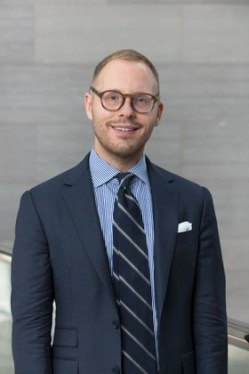
Aaron Wile began in June at the National Gallery of Art as associate curator of French paintings.
The National Gallery of Art announced today new additions to the curatorial staff: Betsy Wieseman, Shelley Langdale, Brooks Rich, and Aaron Wile.
Betsy Wieseman will join the museum as curator and head of the department of northern European paintings. Wieseman is currently chair of European art from classical antiquity to 1800 and curator of European paintings and sculpture 1500–1800 at the Cleveland Museum of Art. She begins her tenure in Washington on November 25, 2019. Shelley Langdale, Brooks Rich, and Aaron Wile joined the Gallery over the course of the summer. Shelley Langdale began her Gallery tenure in May as curator and head of the department of modern prints and drawings. Brooks Rich also joined the Gallery in May as associate curator of old master prints. Aaron Wile arrived at the Gallery in June as associate curator of French paintings.
“We are thrilled to welcome so many talented new staff to the Gallery—their curatorial experience is extraordinary,” said Franklin Kelly, chief curator, National Gallery of Art, Washington. “I look forward to working with them as they engage with our renowned collections with fresh eyes. Their ideas and subsequent projects will energize the museum community and inspire visitors, scholars, and staff for years to come.”
Betsy Wieseman, Curator and Head of Northern European Paintings
Marjorie E. ‘Betsy’ Wieseman is currently chair of European art from classical antiquity to 1800 and curator of European paintings and sculpture 1500–1800 at the Cleveland Museum of Art. Wieseman is a renowned specialist in 17th-century Netherlandish art with an emphasis on Dutch portraiture and genre painting and the work of Peter Paul Rubens. She has also written about portrait miniatures, the technical examination of paintings, and the history of collecting, among other subjects. She previously held curatorial positions at the Museum of Fine Arts, Boston, the Allen Memorial Art Museum, Oberlin College, and the Cincinnati Art Museum. For 11 years she was employed at the National Gallery, London, as curator of Dutch painting 1600–1800 (2006–2012) and as curator of Dutch and Flemish painting 1600–1800 (2012–2017).
As curator and head of northern European paintings—a new position at the Gallery that merges the former curator of northern baroque painting and curator of northern Renaissance painting positions—Wieseman will oversee one of the most important collections in this area outside the Netherlands. Wieseman holds a PhD from Columbia University and an MA and BA from the University of Delaware.
Shelley Langdale, Curator and Head of Modern Prints and Drawings
Shelley Langdale refined her curatorial expertise while working with some of the nation’s foremost collections of works on paper: first the Museum of Fine Arts, Boston, then the Cleveland Museum of Art, and, for the past 17 years, the Philadelphia Museum of Art. While her primary focus has been modern and contemporary works on paper, Langdale has organized or collaborated on an unusual range of projects, from an exemplary study and exhibition of Pollaiuolo’s 15th-century engravings in Cleveland to an exhibition of Yoshitoshi’s magnificent color woodcuts in Philadelphia. Widely admired for her professional activity and generosity, she successfully mentored a long line of curatorial fellows and interns at the Philadelphia Museum of Art and was deeply involved with the city’s artists and art organizations. She is also the current president of the Print Council of America, the national professional organization of curators of works on paper.
As the head of modern prints and drawings at the Gallery, Langdale oversees approximately 60,000 prints, watercolors, drawings, and multimedia works on paper. Her initial projects at the gallery include participation in an upcoming set of installations celebrating women artists and donors for the 100th anniversary of the ratification of the 19th Amendment; addressing the storage and documentation needs of the Gallery’s growing collections of workshop and artist archives (Gemini G.E.L., Crown Point Press, and the prints of Jasper Johns, among others); and an exhibition drawn from the Gallery’s collection of modern works on paper. Langdale holds an MA from Williams College and a BA from Bowdoin College.
Brooks Rich, Associate Curator of Old Master Prints
Brooks Rich recently completed his PhD in early 16th-century Netherlandish engraving at the University of Pennsylvania, where he wrote his dissertation “The Mystery of the Monogram AC at the Margins of Early European Printmaking.” Rich has an impressive range of curatorial experience in the departments of prints, drawings, and photographs at several leading institutions, including curatorial fellowships at the Rijksmuseum and the Philadelphia Museum of Art, where he organized the exhibition Rockwell Kent–Voyager: An Artist’s Journey in Prints, Drawings, and Illustrated Books (2012). Rich has also worked at the Clark Art Institute, Williamstown, MA, and the Museum of Fine Arts, Boston.
In his new role at the Gallery, Rich will balance the demands of cataloging, researching, caring for, and organizing exhibitions about the Gallery’s collection of prints and illustrated books dated before 1900. In addition to his PhD, Rich holds an MA from Williams College and a BA from Bowdoin College.
Aaron Wile, Associate Curator of French Paintings
Aaron Wile received his PhD from Harvard University, with a specialization in 17th- and 18th-century French painting. Most recently he was at the University of Southern California (USC) as a postdoctoral fellow in the Society of Fellows in the Humanities. Prior to this academic post, he was a Chester Dale Fellow at the Metropolitan Museum of Art and an Anne L. Poulet Curatorial Fellow at The Frick Collection, where he organized the critically acclaimed exhibition Watteau’s Soldiers: Scenes of Military Life in Eighteenth-Century France (2016), the first exhibition devoted to Watteau’s military works. His exhibition catalog essay won an award for excellence from the Association of Art Museum Curators. He is also the recipient of the 2015–2016 James L. Clifford Prize for best article from the American Society for Eighteenth-Century Studies.
Wile will take part in the exhibition, research, and acquisition projects related to the Gallery’s French painting collection, with particular attention given to the 17th- and 18th-century works. In addition to his PhD, Wile holds an MA from Harvard University and a BA from Haverford College.
Carlo Dolci’s Saint Agatha Returns to Osterley
From the press release (15 August 2019) . . .

Carlo Dolci, Saint Agatha, oil on canvas, ca. 1665–70 (Osterley, National Trust 2900293).
The return of Saint Agatha to Osterley has provided the opportunity to stage a special winter exhibition for visitors, beginning in November, which will explore the rise to fame and fortune of the Child family who acquired the painting and showcase the art and design that they commissioned and collected from around the globe.
The Child family were goldsmiths and bankers who patronised the fine and decorative arts. The wealth they acquired was used to create the luxurious Robert Adam interiors still seen at Osterley today, and which were filled with Old Master paintings, lacquer furniture, Indian fabrics, and East Asian ceramics. The painting of Saint Agatha, purchased by art lover Sir Robert Child (1674–1721) at the beginning of the 18th century, became one of the works in a great picture collection at Osterley and was recorded in a 1782 inventory. However, it was later sold along with other family heirlooms in the 1930s.
Saint Agatha is a dramatic depiction of Agatha of Sicily, a Christian martyr, who suffered dreadful torture at the hands of the Romans. It is an example of the work of the Baroque master Carlo Dolci (1616–1687), a leading figure of 17th-century Florentine art, whose passionate depictions of holy figures aimed to inspire reverence and empathy for the divine. It captures the miraculous moment when Saint Peter the Apostle appeared to Saint Agatha in a vision and healed her wounds.
John Chu, National Trust Assistant Curator of Pictures and Sculpture explains: “Although an extraordinary number of original furnishings remain at Osterley, its once-famous picture collection has been almost completely dispersed or destroyed. We are lucky to have a number of paintings on loan from the Jersey family, but it is fantastic when a rare opportunity arises to purchase one for the property, especially one as moving and profound as this. The homecoming of Saint Agatha provides the chance to look more closely at the importance of pictures to the story of the house. She will be the highlight of our exhibition exploring the Child family’s meteoric rise and what these precious objects meant to them at a remarkable moment in British history. Saint Agatha will be displayed alongside other European and Asian works of art and design, including furniture and ceramics, bought by the family. We also want to give our visitors a sense of the special meaning that each object held for the people and cultures that created them. Dolci’s Saint Agatha, for instance, held powerful spiritual resonances for its Roman Catholic maker and his first Florentine patrons, but it was seen in a much more secular light when it entered the collection at Osterley and was displayed alongside family portraits. We are very grateful to Art Fund and our other generous donors and supporters for enabling us to acquire Saint Agatha and hope the exhibition will inspire all those who enjoy discovering examples of the highest quality art and design.”
Saint Agatha was purchased for £248,750 at the Christie’s Old Masters Evening Sale [Lot 39] in London on 5 July 2018 thanks to a grant of £85,000 from Art Fund, support from private donors, Trust members, and visitors to Osterley Park, along with support from a fund set up by the late Simon Sainsbury to support acquisitions for the historic houses of the National Trust.
Since the acquisition, the painting has undergone two phases of conservation treatment.
Eleanor McGrath, Head of Grants at Art Fund, said: “It is wonderful to see this striking work return to its home at Osterley Park and House where it will be the highlight of the exhibition, helping visitors imagine the wider historic collections and life of the Child family.”
Treasures of Osterley: Rise of a Banking Family runs from 4 November 2019 until 23 February 2020.
CAA Professional Committees
A note from Julia Sienkewicz; Assistant Professor of Art History, Roanoke College; Vice President for Committees, Board of Directors, CAA
Two New Committees of the College Art Association
Applications due by 1 October 2019
Even as the new school year begins, please consider putting together an application to join one of CAA’s two new professional committees: the Committee on Research and Scholarship and the Services to Historians of Visual Arts Committee. These committees, which were approved by the Board of Directors in May, were formed largely in response to conversations and concerns within the art historical community. We hope the committees will be able to advance substantial good work for our professions. The call for applications can be found here. Because these committees are new, we have assigned a slightly extended deadline of October 1 for these applications. Committee charges are included below.
Should you have questions about the application process, please email Vanessa Jalet (vjalet@collegeart.org). For other inquiries concerning the two new committees, please reach out to me. Of course, I also encourage you to review the other standing Professional Committees. All are accepting applications (until 18 September). Announcing these new committees is an exciting moment for me in my work with CAA’s professional committees. I look forward to working with some of you to get these important new teams up and running!
Sincerely,
Julia Sienkewicz
Committee on Research and Scholarship
The Committee on Research and Scholarship is charged with gathering information, assessing trends, and proposing organizational advocacy for CAA on matters concerning the advancement of research and scholarship in visual arts and design, encompassing all facets of research regarding history, education, and practice. Recognizing that professionals must navigate a rapidly-transforming field of options for conducting research and disseminating the results thereof, the committee is responsible for assisting the organization in engaging with current issues and serving its membership in this important facet of their professional life.
Services to Historians of Visual Arts Committee
The Services to Historians of Visual Arts Committee identifies and addresses concerns facing historians of art, architecture, design, material culture, and visual culture. It creates and implements programs and events at the conference and beyond. It offers a forum for the discussion of issues of mutual interest across the discipline’s many diverse fields and methodologies. In a climate of great threat to the survival of history of art and history of visual arts programs, this committee provides a locus for advocacy issues particular to historians in these areas of interest. The committee lends support and mentorship for both seasoned and emerging professionals. It is also charged with maintaining dialog with other professional organizations and affiliated societies focused on the history of art, architecture, design, material culture, and visual culture.
Print Quarterly, September 2019

James Gillray, New Morality; – or – The Promis’d Installment of the High-Priest of the Theophilanthropes, with the Homage of Leviathan and his Suite, 1798, hand-colored etching, 8 × 24 inches (New Haven: Yale Center for British Art, Paul Mellon Collection, B1981.25.1001).
◊ ◊ ◊ ◊ ◊
The eighteenth century in the current issue of Print Quarterly:
Print Quarterly 36.3 (September 2019)
A R T I C L E S
Allison M. Stagg, “William Cobbett, James Gillray and the Market for Caricatures in 1790s Philadelphia,” pp. 263–74.
In the decades immediate following the American Revolution (1775–83), caricature prints were imported from London to cities along the east coast of North America. Evidence of a transatlantic transfer of British satirical imagery can be found in the numerous advertisements published in American newspapers from this period. Despite the frequency with which caricatures are mentioned in newspapers, few details can readily be discerned from them. The advertisements primarily reference the general arrival of collections of British caricature prints, usually as an addendum to other imported items such as books, stationery and even clocks, and provide little to no mention as to what specific caricatures crossed the Atlantic (263) . . . Details found in documents dating from the last decade of the eighteenth century, however, allow for a more thorough examination of the availability of and interest in imported and American caricatures in Philadelphia in the late 1790s. The primary source is an account book in the collection of the American Antiquarian Society in Worcester, MA, of the famous British radical, polemicist and publisher William Cobbett (1763–1835), who took refuge in American in 1793 (264).
N O T E S A N D R E V I E W S
 Truusje Goedings, Review of Wolf Eiermann, Claudia Steinhardt-Hirsch and Eckhard Leuschner, Prachtvoll illuminirt: Das Handkolorit in der Druckgrafik, 1493–1870 (Hirmer Verlag, 2018), pp. 304–06.
Neglected for a long time, the hand-colouring of prints, book illustrations and maps has been the subject of serious research during the last three decades, resulting in major exhibitions with comprehensive catalogues. . . [The present] catalogue, edited by Wolf Eiermann . . . is another effort to make the picture of 400 year of handcolouring more complete . . . The Sammlung Frank, a private collection in Stuttgart focused on German art and formed in the previous century, served as the main source, supplying about 110 of the 134 catalogued items (304) . . . The period from c. 1760 to 1880 is well represented with about one hundred items, mainly topographical, but also on costumes and natural history, including a rare example of Christian Gottlieb Ludwig’s Ectypa vegetabilium . . . / Nach der Nature verfertigte Abdrucke der Gewachse (nature-printed prints of plants; Halle and Leipzig, 1760–64) with 200 nature prints in contemporary colouring” (306).
Peter Fuhring, Review of Thomas Wilke, Innendekoration: Graphische Vorlagen und theoretische Vorgaben für die wandfeste Dekoration von Appartements im 17. und 18. Jahrhundert in Frankreich, 2 volumes (Scaneg Verlag, 2016), pp. 308–10.
The study of prints related to the decoration of secular interiors in France from the seventeenth and eighteenth centuries, in association with theoretical guidelines, . . . reveals an ambition that is difficult to fulfill. . . So far not a single catalogue or study encompasses the entire French print production of wall decorations, mantelpieces and ceilings made during both centuries. . . Further research is necessary to complete the still lacunar state of our knowledge. This is what Wilkie strives to do. His study is composed of two parts: the first volume offers a presentation of the issues as set out in the title, while the second consists of a catalogue of prints that form the basis of the author’s demonstration (308).
Véronique Meyer, Review of Katie Scott, Becoming Property: Art, Theory, and Law in Early Modern France (Yale University Press, 2018), pp. 313–15.
[Scott’s] recent book . . . examines the relationship between intellectual property and the visual arts in France from the sixteenth century to the beginning of the nineteenth . . . It traces the history of this relationship, highlighting key moments with exemplary case studies as well as citing regulations and legal texts, (313) and examines the role of the parties involved, including booksellers, publishers, engravers, draughtsmen and authors. Although the sixteenth and seventeenth centuries occupy and important place in the book, which shows how the definition of privilege and copyright evolved over the years, it is above all France of the Enlightenment and Revolution that lies at the heart of this study (314). . . [It] is a must for all who are interested in the history of printmaking, the decorative arts and artistic theories and institutions such as the Académie Royale (315).
David Bindman, Review of Cynthia Roman, ed., Hogarth’s Legacy (Yale University Press, 2016), pp. 315–16.
Hogarth’s enormous and long-lasting influence on art and popular imagery is the subject of a series of essays, largely by scholars of eighteenth-century art, including . . . Douglas Fordham, Dominic Hardy, Brian Maidment, Patricia Mainardi, Ronald Paulson, Mark Salber Philips, and Michael Printy. . . Collections of essays inevitably fall somewhere on the spectrum between the tightly focused, based on a close conversation between the authors, and the loose and baggy, in which the connections between the essays are more informal. Although the quality of the essays is uniformly excellent, this volume tends more toward the baggy . . . The main and entirely commendable purpose of the volume seems to have been to make scholarly use and draw further attention to the relatively little-known and underused, and in some areas quite spectacular, collections of Hogarth engravings and late eighteenth-century caricature in the Walpole Library (315).
Roger Paas, Review of Josef Biller, Calendaria Bambergensia: Bamberger Einblattkalender des 15. bis 19. Jahrhunderts von der Inkunabelzeit bis zur Säkularisation, 2 volumes (Anton H. Konrad Verlag, 2018), pp. 317–19.
Biller has dedicated over four decades to the collecting and studying of broadside (316) calendars published for the bishopric of Bamberg, and the results of his in-depth research have now been published in a detailed and richly illustrated two-volume catalogue (318).
Daniel Godfrey, Review of Anke Fröhlich-Schauseil, Schenau (1737–1806): Monografie und Werkverzeichnis der Gemälde, Handzeichnungen und Druckgrafik von Johann Eleazar Zeißig, gen. Schenau (Michael Imhof Verlag, 2018), pp. 319–23.
The son of a damask weaver from Großschönau in Saxony, Schenau fled the outbreak of the Seven Years’ War in 1756 to Paris. There he Frenchified his name and established a reputation as an artist of ‘society paintings’ focused on liaisons between the sexes, coiffure and the texture of material. The mentorship of Johann Georg Wille (1715–1808), engraver, print publisher and art dealer, must have motivated Schenau to execute a set of twelve etchings in 1765, six of children acting as adults and six of heads . . . These were to remain Schenau’s only autograph prints (319) . . . Yet, Schenau’s career developed in symbiosis with the print.
Mark Bills, Review of John Ford, Rudolph Ackermann and the Regency World (Warnham Books, 2018), pp. 323–25.
Although Ackermann belongs to and epitomizes the Regency Period (1788–1830), one cannot help but think that he would be a very useful figure in the art and design world of today (323) . . . John Ford has absorbed an enormous body of material and given us a fascinating chronological account of Ackermann as well as adding important new research and insights (324).
P U B L I C A T I O N S R E C E I V E D
• Joachim Jacoby, Guillaume Jean Constantin (1755–1816): A Drawings Dealer in Paris (Ad Ilissum for the Fondation Custodia, 2018), p. 339.
• Peter Stoll, Französische Buchillustration des 18. Jahrhunderts in der Oettingen-Wallersteinschen Bibliothek (Universität Augsburg Bibliothek, 2018), p. 339.
• Thora Brylowe, Romantic Art in Practice: Cultural Work and the Sister Arts, 1760–1820 (Cambridge University Press, 2019), p. 339.
• Helen Rosslyn, A Buyer’s Guide to Prints (The Royal Academy of Arts in association with the London Original Print Fair, 2018), p. 342.
New Book | Gainsborough’s Blue Boy
From Routledge:
Valerie Hedquist, Class, Gender, and Sexuality in Thomas Gainsborough’s Blue Boy (New York, Routledge, 2019), 202 pages, ISBN: 978-1138543423, $150.
 The reception of Thomas Gainsborough’s Blue Boy from its origins to its appearances in contemporary visual culture reveals how its popularity was achieved and maintained by diverse audiences and in varied venues. Performative manifestations resulted in contradictory characterizations of the painted youth as an aristocrat or a ‘regular fellow’, as masculine or feminine, or as heterosexual or gay. In private and public spaces where viewers saw the actual painting and where living and rendered replicas circulated, Gainsborough’s painting was often the centerpiece where dominant and subordinate classes met, gender identities were enacted, and sexuality was implicitly or overtly expressed.
Valerie Hedquist is Professor of Art History at the University of Montana.
C O N T E N T S
List of Figures
List of Plates
Acknowledgments
Introduction
1 Private Beginnings, Public Performances
2 The Blue Boy from Gainsborough’s Showroom to Grosvenor’s Picture Gallery
3 Public Recognition
4 Reproducing The Blue Boy
5 Farewell to England
6 Welcome to America
7 Changing Roles for The Blue Boy
Conclusion
Bibliography
Index
Exhibition | Lansyer, Canaletto, & Piranesi
Now on view at the Lansyer House Museum:
Lansyer, Canaletto, and Piranesi: Images of Italy
Maison-Musée Lansyer, Loches, 1 May — 11 November 2019
 Après plus d’un an de travaux, la Maison-Musée Lansyer de Loches redevient le théâtre d’une exposition d’envergure mettant en évidence les richesses de ses collections. Du 1er mai au 11 novembre 2019, l‘exposition Lansyer, Canaletto & Piranèse : images d’Italie invite le visiteur au voyage en Italie, à Rome et à Venise, dans les pas du peintre paysagiste Emmanuel Lansyer (1835–1893). Ce circuit au temps du chemin de fer conduit sur les lieux de travail de l’artiste, dans la Rome Éternelle et au cœur de la Sérénissime Venise. Lansyer livre ses impressions sur ces deux villes, mais aussi les difficultés qu’il rencontre pour les représenter. Ainsi, les toiles de l’artiste font visiter la campagne romaine et les quartiers de Venise.
« Portraitiste de ville », Lansyer s’inscrit dans les pas de deux maîtres italiens du siècle précédent : Piranèse et Canaletto. Lansyer acquiert des séries exceptionnelles de gravures à l’eau-forte de ces grands védutistes qui célèbrent la grandeur de Rome et de Venise. Cette collection lochoise constitue l’un des ensembles les plus complets à l’échelle mondiale. Ces œuvres sont le résultat d’un travail artistique d’une extrême précision, dont on pourra admirer les détails, du tracé architectural de Piranèse au geste léger de Canaletto.
Enfin, Lansyer convie à un voyage au temps de la photographie naissante. Cet art en plein essor offre une autre image d’Italie, celle de son peuple et de ses richesses patrimoniales. Les photographies de Rome donnent à voir de très beaux points de vue sur la basilique Saint-Pierre et le forum romain. Celles de Venise s’intéressent aux lieux les plus emblématiques de la reine de la lagune : la place Saint-Marc, le Grand Canal et ses palais. On chemine également à travers des ruelles étroites et autour des puits dans lesquels s’approvisionnent Vénitiens et Vénitiennes en habits traditionnels. Autant de souvenirs de voyage et d’outils de travail pour l’artiste.Au total, une centaine d’œuvres, tableaux, photographies et gravures de la collection d’Emmanuel Lansyer, sont dévoilés au public de manière inédite. Une collection d’une richesse exceptionnelle, léguée à la Ville de Loches par l’artiste, pour l’agrément de tous. Guide de voyage en poche, montez dans le train et devenez un touriste du XIXe siècle le temps de la visite de l’exposition…
The catalogue is available from In Fine éditions d’art:
Lansyer, Canaletto & Piranèse : Images d’Italie (Paris: In Fine éditions d’art, 2019), 112 pages, ISBN: 978-2902302192, 18€.
Sous la direction de Véronique Lourme, responsable du Service Patrimoine de la Ville de Loches; Gilles Bertrand, professeur d’histoire moderne à l’Université de Grenoble; Manuel Royo, professeur d’archéologie et d’histoire de l’art à l’Université François-Rabelais de Tours; Annie Gilet, conservateur en chef honoraire du patrimoine; et Benjamin Bulte, étudiant en histoire de l’art, Université François-Rabelais de Tours.
S O M M A I R E
• Emmanuel Lansyer : un peintre paysagiste en Italie
Le Voyage en Italie au XIXe Siècle
• Lansyer et la tradition du voyage en Italie
• Les conditions et le temps du voyage
Le Voyage à Rome
• Lansyer à Rome ou l’histoire d’une déception
• Les vues de Rome par Piranèse
Le Voyage à Venise
• Le regard de Lansyer sur la Sérénissime
• Canaletto, graveur à l’eau-forte
Le Portrait de Ville
• Résonances entre Canaletto, Piranèse et Lansyer : trois portraitistes de villes
• La photographie : un nouvel outil de travail pour le portrait de ville
• Un voyage dans le temps, dans les pas d’un artiste collectionneur
Catalogue des Oeuvres
• La collection de peintures
• La collection de gravures
• La collection de photographies
Bibliographie
New Book | Handbook on the Reception of Classical Architecture
From Routledge:
Nicholas Temple, Andrzej Piotrowski, and Juan Manuel Heredia, eds., The Routledge Handbook on the Reception of Classical Architecture (London: Routledge, 2019), 592 pages, ISBN: 978-1138047112, $220.
 This is the first comprehensive study of the reception of classical architecture in different regions of the world. Exploring the impact of colonialism, trade, slavery, religious missions, political ideology, and intellectual/artistic exchange, the authors demonstrate how classical principles and ideas were disseminated and received across the globe. By addressing a number of contentious or unresolved issues highlighted in some historical surveys of architecture, the chapters presented in this volume question long-held assumptions about the notion of a universally accepted ‘classical tradition’ and its broadly Euro-centric perspective.
Featuring thirty-two chapters written by international scholars from China, Europe, Turkey, North America, Mexico, Australia, and New Zealand, the book is divided into four sections: 1) Transmission and Re-conceptualisation of Classical Architecture; 2) Classical Influence through Colonialism, Political Ideology and Religious Conversion; 3) Historiographical Surveys of Geographical Regions; and 4) Visual and Textual Discourses. This fourfold arrangement of chapters provides a coherent structure to accommodate different perspectives of classical reception across the world, and their geographical, ethnographic, ideological, symbolic, social, and cultural contexts. Essays cover a wide geography and include studies in Italy, France, England, Scotland, the Nordic countries, Greece, Austria, Portugal, Romania, Germany, Poland, India, Singapore, China, USA, Mexico, Brazil, New Zealand, and Australia. Other essays in the volume focus on thematic issues or topics pertaining to classical architecture, such as ornament, spolia, humanism, nature, moderation, decorum, heresy, and taste.
Nicholas Temple is an architect, Professor of Architecture and Director of the Centre for Urban Design, Architecture and Sustainability (CUDAS) at the University of Huddersfield. A graduate of Cambridge University, he previously served as head of the School of Architecture at the University of Lincoln and was an assistant professor of architecture at the University of Pennsylvania. Temple was a Rome Scholar in Architecture at the British School at Rome, a Paul Mellon Rome Fellow and Bogliasco Fellow and has collaborated on research projects on the history and theory of architecture and urbanism in Europe and China. His most recent research is a British Academy funded project with Professor Cecilia Panti on Lorenzo Ghiberti’s 3rd Commentary. He was shortlisted for the International CICA Bruno Zevi Book Award in 2014 for his book Renovatio Urbis: Architecture, Urbanism and Ceremony in the Rome of Julius II (Routledge, 2011) and is chief editor of the Routledge Research in Architectural History series and co-editor of the Journal of Architecture.
Andrzej Piotrowski, an architect educated in Poland and Professor of Architecture at the University of Minnesota, USA, combines in his scholarship theory and history of architecture. His Jeffrey Cook Award-winning research focuses on the epistemology of design. Covering global issues of architecture, religion, politics, and culture, his findings have been presented in many architectural and cross-disciplinary conferences. Author of Architecture of Thought (University of Minnesota Press, 2011) and co-editor with J. Williams Robinson of The Discipline of Architecture (University of Minnesota Press, 2001), he currently serves as an associate editor of the Traditional Dwellings and Settlements Review.
Juan Manuel Heredia is Associate Professor of Architecture at Portland State University, having completed a PhD and Master of Architecture at the University of Pennsylvania. He also holds a Diploma of Philosophy from Universidad Iberoamericana/Mexico City. Heredia studied and practised architecture in Mexico before moving to the United States in 1999 to pursue graduate studies. His research focuses on architectural theory and history, especially of the 20th century. His work has been published in Arquine and Bitacora (Mexico), On-Site Review (Canada) and Arkitekten (Denmark). In 2009 he co-organised the Second International Architecture and Phenomenology Conference held in Kyoto, Japan. His current writing focuses on 20th-century architecture in Mexico and Latin America.
C O N T E N T S
1. Introduction: A ‘World’ Reception of Classical Architecture Nicholas Temple, Andrzej Piotrowski and Juan Manuel Heredia
Part I: Transmission and Re-Conceptualisation of Classical Architecture
2 The Fates of Fornix Juan Manuel Heredia
3 Architects, Architecture, and the City: Some Themes on the Continuity of Classical Ideas Relating to the Latin Middle Ages Christian Frost
4 Rethinking Ornament in Classical Architecture: Spolia and Architecture as institutio Clare E. L. Guest
5 The Persistence of Natura Naturans from Classical Architecture John Hendrix
6 On Moderation: The Ancient Virtue and its Reception in Architectural Theory Esra Sahin Burat
7 Classical Columns, Mannerism, and the Other Antiquity Andrzej Piotrowski
8 Neoclassical Taste and Antiquarian Scholarship: The Royal Academy of the Three Noble Arts of San Carlos in Mexico, Alexander von Humboldt and Pedro José Márquez Oscar Humberto Flores
9 Eighteenth- and Nineteenth-Century Classicism in England: John Soane’s Language and Imagination Yue Zhuang
Part II: Classical Influences through Colonialism, Political Ideology, and Religious Conversion
10 Honour and the Classical Tradition in Architecture: The Matter of Slavery Charles Burroughs
11 Dismemberment of the Orders and their Reassembly across Portuguese Overseas Settlements Pedro Guedes
12 The Reception and Involution of Classical Architecture in Jesuit Missions in China, 1583–1759 Xiao Jing
13 The Gods That Came from the Sea: The Classical Tradition in New Spain Santiago de Orduña
14 Indo-Portuguese Architecture in Kerala during the Sixteenth and Seventeenth Centuries Helder Carita
15 Neo-classical Architecture in the Straits Settlements: Singapore’s Civic Square, 1819–1936 Raymond Quek
16 Herbert Baker, New Delhi, and the Reception of the Classical Tradition Soumyen Bandyopadhyay and Sagar Chauhan
Part III: Historiographical Surveys of Geographical Regions
17 Scotland’s Enduring Eclectic Classicism Ian Campbell
18 From Fischer von Erlach to Adolf Loos: The Classical in Austria Ross Jenner
19 Avatars of the Classical Tradition in Romanian Architecture Ana Maria Zahariade and Horia Moldovan
20 China (Sixteenth to Eighteenth Centuries): Renaissance Humanism and Chinese Architecture Hui Zou
21 Revising the Classical in Australian Architecture: Colonial New South Wales and Victoria Peter Kohane and Mark Stiles
22 ‘Pretty True Reflection of Our Civilisation’: Classical Architecture in Nineteenth-Century New Zealand Robin Skinner
23 Nordic Visions of a Classical World, 1901–1966 Harry Charrington
Part IV: Visual and Textual Discourses
24 (Re)Invoking Humanism in Modernity: Architecture and Spectacle in Fascist Italy Nicholas Temple and Eleni Tracada
25 Unclassical Forms of Late Roman Architecture and the Roman Baroque: Francesco Borromini and the New Classical Tradition Giuseppe Bonaccorso
26 Power, Patronage and Politics: Giovanni Niccolò Servandoni and the Reception of Neoclassicism in France Louise Pelletier
27 The Reception of European Renaissance Urban Theory in New Spain Juan Luis Burke
28 Thomas Jefferson: The American Landscape and the Architecture Carol William Westfall
29 The Revival of Classical Architecture in Athens, 1830–1860: Educational Institutions in Athens by Christian Hansen, Lysandros Kaftantzoglou and Stamatios Kleanthis Nikolaos Karydis
30 Modernism and Classicism in Brazil: Foundational Myths and Other Stories Daniela Sandler
31 Greek Temple Design and the Kathedrale des erotishen Elends Matthew Mindrup
32 The Underbelly of the Architect: Reproducing Classical Idioms of Power and Culture in Rome Renée Tobe and Tracey Eve Winton
Selected Bibliography
Index
Exhibition | Spain: Highlights from The Bowes Museum
This fall at the Meadows Museum (a variation of the exhibition on view at The Wallace two years ago). . .
El Greco, Goya, and a Taste for Spain: Highlights from The Bowes Museum
Meadows Museum, SMU, Dallas, 15 September 2019 — 12 January 2020

Francisco José de Goya y Lucientes, Interior of a Prison, 1793–94, oil on tin plate, (County Durham: The Bowes Museum, B.M.29).
The Bowes Museum in County Durham, UK, is home to the largest collection of Spanish painting in the British Isles. The collection represents the life-work of John and Joséphine Bowes, who, through key connections with dealers in Paris, amassed a collection noted for its depth and breadth, quality and quantity during the second half of the nineteenth century. Their museum opened to the public in 1892, and continues to serve the people of northern England with an engaging series of exhibitions and public programs. This focused exhibition—it consists of just under a dozen works—showcases the finest of the Bowes’s collection of Spanish painting. The exhibition will feature artists such as Juan de Borgoña (c. 1470–1536), El Greco (1541–1614), and Francisco de Goya (1746–1828), and paintings on panel and canvas ranging from the early sixteenth to late eighteenth centuries. This was a crucial period in the history and development of Spanish art as artists transitioned from producing large, gold-encrusted retable panels of saints to intimate portraits and scenes taken from life, as is the case with Goya’s harrowing Interior of a Prison (1793–94). It is an exhibition of three centuries of saints and sinners, secular and sacred likenesses meant to inspire devotion, admiration, and at times discomfort. El Greco, Goya, and a Taste for Spain: Highlights from The Bowes Museum will explore these and other issues within the context of the history of art while also taking a closer look at John and Joséphine Bowes’s role in the history of the collection and display of Spanish art outside of Spain.
Exhibition | Goya’s Visions in Ink
Now on view at the Meadows Museum, at Southern Methodist University:
Goya’s Visions in Ink: The Centerpiece of the Meadows Drawings Collection
Meadows Museum, SMU, Dallas, 30 April — 3 November 2019

Francisco José de Goya y Lucientes, Visions, ca. 1819-23; brush and black and gray ink with scraping on paper, 24 × 15 cm (Dallas: Meadows Museum, SMU; museum purchase with funds from The Meadows Foundation, with additional support from Cyrena Nolan, MM.2019.01).
This exhibition highlights the Meadows’s recent acquisition of Francisco de Goya’s exceptional ink drawing Visions (c. 1819–23) from his “Witches and Old Women” album. This important acquisition is the first drawing by Goya to enter the museum’s collection, which already includes key paintings and prints by the Spanish master. The Meadows Museum now joins only a handful of institutions worldwide that can boast such significant holdings of the artist’s work across media.
The very personal, technically accomplished drawing will be featured alongside a selection of Goya’s prints containing related subject matter from the Disparates series, completed ca. 1815–23, nearly simultaneously to the drawing itself. Didactic materials will offer insight into the singular technical qualities of the drawing’s creation and its fascinating provenance. Additional examples from the museum’s collection of works on paper will serve to highlight the uniquely intimate nature of drawings, as well as offer supporting insight into the multifaceted ways in which artists have employed the medium. The exhibition will demonstrate Goya’s achievements as a draftsman and situate Visions as a noteworthy central point of the museum’s collection of drawings.
Meadows Museum Announces Four New Acquisitions
Press release (14 August 2019) from SMU’s Meadows Museum:
The Meadows Museum, SMU, announced that it has acquired four works that reflect the richness and depth of Spanish art across period, style, and mode of production. Among the new acquisitions is Our Lady of Solitude (1769) by Manuel Ramírez de Arellano, which represents both a critical expansion of scholarly knowledge on the artist’s creative output and an important enhancement of the Meadow’s holdings of terracotta sculpture, building on other acquisitions in that medium over the last several years. Further, following the Meadows’s 2018 exhibition Dalí: Poetics of the Small, 1929–1936, which focused on Salvador Dalí’s small-scale paintings, the museum has been given Venus de Milo with Drawers (1936, cast 1971), the first sculptural work by Dalí to enter the museum’s collections. Also among the new acquisitions are a drawing by renowned artist Ignacio Zuloaga, Portrait of Margaret Kahn (1923), which provides new insights into the artist’s process and highlights his success as a portraitist among American audiences, as well as the painting Orchard in Seville (c. 1880), by Emilio Sánchez Perrier, a rare example of the artist’s work at a large scale, produced early in his career.
Together, the new acquisitions underscore the Meadows’s commitment to collecting works that encapsulate significant developments in the trajectory of Spanish art and to establishing essential touchstones within its collection that spur new research, exhibitions, and publications. Of the new acquisitions, Mark A. Roglán, the Linda P. and William A. Custard Director of the Meadows Museum, said, “As we continue to acquire works, we are focused on furthering the established dialogues between and among objects in our collection, while also creating new connections that enhance both scholarly understanding of Spanish art and public enjoyment of it. We are particularly excited to bring these four works into the museum’s holdings because they represent important developments within each artist’s career as well as essential enhancements to our collection. We look forward to displaying these works in the coming months, and to furthering knowledge about each of these artist’s practices.”
Manuel Ramírez de Arellano (1721/22–1789)
Our Lady of Solitude, 1769
Polychromed terracotta
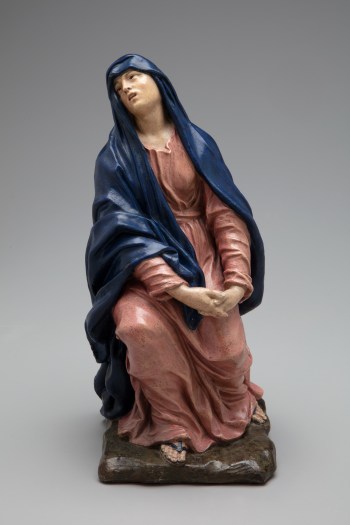
Manuel Ramírez de Arellano, Our Lady of Solitude, 1769, polychromed terracotta, 26 cm high (Dallas: Meadows Museum, SMU; museum purchase with funds from Barbara Wright McKenzie ’74 and Mike McKenzie, MM.2019.04).
Manuel Ramírez de Arellano was born into a prominent artistic family in Zaragoza. Despite the documentation around his family’s workshops and his father’s involvement in the establishment of one of Spain’s earliest art academies, the Academia del Dibujo (Academy of Drawing), very little is known about Ramírez’s life and the full arc of his artistic career. Ramírez is most widely recognized for three major commissions that he completed for the Cartuja de Aula Dei, a Carthusian monastery just outside of Zaragoza. These included the creation of an elaborate decorative door frame (c. 1750), the high altarpiece representing the Assumption of the Virgin (c. 1762), and a series of life-sized statues that line the church’s nave (c. 1772). The last of the commissions represents an historically significant collaboration with Francisco de Goya y Lucientes, who was concurrently commissioned to paint frescos for the nave.
Our Lady of Solitude is exceptionally rare for what it teaches us about the scope and depth of Ramírez’s practice and in the information it yields regarding the work’s making. Specifically, while there is some archival evidence that Ramírez produced small-scale terracotta sculptures for personal devotion, Our Lady of Solitude proves this aspect of his artistic output. Furthermore, the detailed inscription on the statue’s bottom, which reads in English translation, “On January 8th, 1769, in Madrid. Made by Manuel Ramírez,” firmly attributes the work to Ramírez’s hand. This is particularly remarkable as most sculptures of the time were produced by workshops, making individual attributions difficult to identify. It also locates Ramírez in Madrid during a decade in which details about his life were previously unknown.
Despite the Meadows’s extensive sculpture collection, Our Lady of Solitude, which captures the Virgin Mary in a quiet moment of mourning, is the first sculpture of Marian devotion to enter the museum’s collection, filling an important gap within its holdings. Further, the acquisition, which has been made by the Meadows through purchase with funds from Barbara Wright McKenzie and Mike McKenzie, builds on other recent important acquisitions of polychromed terracotta works, enhancing the diversity of objects of this medium in the museum’s collection.
Salvador Dalí (1904–1989)
Venus de Milo with Drawers, 1936, cast 1971, Edition 37/150
White paint on bronze
Salvador Dalí first produced a version of the Musée du Louvre’s well-known 2nd-century BCE Venus de Milo marble in 1936, adding his own Surrealist twist to the iconic work by incorporating six drawers at the statue’s forehead, breasts, stomach, abdomen, and left knee. The motif of a female figure comprised of drawers was one of particular fascination and exploration for Dalí, as it appears in the related painting The Anthropomorphic Cabinet and the drawing City of Drawers—both also produced in 1936. The imagery also reappeared decades later in prints that Dalí created in the 1960s. While never expressed directly by Dalí himself, it has been suggested that the incorporation of drawers within the female torso represented a linguistic examination or play on the English phrase “chest of drawers.”
Dalí’s 1936 plaster version of the Venus de Milo went largely unnoticed until the 1960s, at which point it began to be reproduced in myriad editions that included wide variations of the sculpture’s patina and height. The version acquired by the Meadows Museum—a bronze painted white to mimic the original marble inspiration—closely matches Dalí’s first plaster in all but its small scale. The acquisition of Venus de Milo with Drawers follows the Meadows’s 2018 exhibition Dalí: Poetics of the Small, 1929–1936, which highlighted small-scale painting as another aspect of the artist’s incredible artistic range and captured the ongoing popularity of the artist’s work. The acquisition also represents the first sculptural object by Dalí to enter the Meadows’s collection, providing new dimension to the museum’s holdings of paintings and prints by the artist. Venus de Milo with Drawers enters the Meadows’s collection as a gift to the museum by collector Daniel Malingue, who collaborated with the museum on its recent Dalí exhibition.
Ignacio Zuloaga (1870–1945)
Portrait of Margaret Kahn, 1923
Charcoal and graphite on paper
Ignacio Zuloaga is recognized as one of the most celebrated Spanish painters of the early 20th century. Born to a family of artisans in the Basque city of Eibar, Zuloaga first trained as a metalworker. After viewing the works of Spanish masters such as El Greco, Velázquez, and Goya at the Museo Nacional del Prado in 1887, however, he began his pursuit of painting, studying and working in Rome, Paris, and throughout Spain. By 1900, he was exhibiting his paintings widely, and receiving widespread acclaim for his rich use of color and dramatic landscapes and atmospheres. Although Zuloaga is well known for his depictions of Spanish culture and identity, he gained the widest popularity as a portraitist.
While most of Zuloaga’s portrait commissions resulted in paintings, his drawings reveal many of the same formal qualities. With the acquisition of Portrait of Margaret Kahn, which was given to the Meadows Museum by Zuloaga’s grandson Rafael de Zuloaga y Suárez, the museum is adding an important representation of Zuloaga’s artistic process and technique. Portrait of Margaret Kahn also marks the first drawing by the artist to enter the Meadows’s collection, joining three important paintings within the museum’s holdings: The Bullfighter ‘El Segovianito’ (1912); View of Alquézar (c. 1915–20); and Portrait of the Duchess of Arión, Marchioness of Bay (1918).
Embraced in his home country and across Europe, Zuloaga also became a favorite of American audiences who expressed a particular keenness for having their likenesses painted by him. Portrait of Margaret Kahn captures the relationship Zuloaga developed with America’s elite; the drawing depicts an heir to a New York financial fortune. While it is not known how Kahn came into contact with Zuloaga, it is likely she became aware of his work during his 1916 New York exhibition at the Duveen Gallery, which launched his prominence among American audiences.
Emilio Sánchez Perrier (1855–1907)
Orchard in Seville, c. 1880
Oil on panel
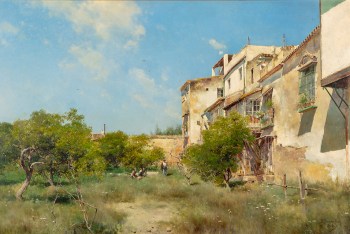
Emilio Sánchez Perrier, Orchard in Seville, ca. 1880, oil on panel, 47 × 71 cm (Dallas: Meadows Museum, SMU; museum purchase with funds from Linda P. and William A. Custard, Gwen and Richard Irwin, and friends of the Meadows Museum, MM.2019.05; photo by Kevin Todora).
Emilio Sánchez Perrier was a popular and widely collected landscape painter—both in Spain and the United States—during and after his lifetime. A member of a group of Sevillian painters sometimes called the school of Alcalá de Guadaíra, Sánchez Perrier exemplifies through his work the evolution of landscape painting during the late 19th century, as the interests of both artists and collectors shifted from the idealized perspectives of the Romantic tradition to a realist, plein air approach that emphasized the direct observation of nature.
The Meadows’s acquisition of Sánchez Perrier’s Orchard in Seville recognizes the artist’s historical prominence, as well as the value of this work within the context of the museum’s existing collection. The Meadows currently holds Sánchez Perrier’s painting River Landscape (Villennes-sur-Seine) (c. 1895)—a work completed significantly later in the artist’s life. The new acquisition dates to early in his career and is larger than River Landscape (Villennes-sur-Seine). Orchard in Seville also complements a number of other works in the collection, including the painting Ladies and Gentlemen Visiting a Patio of the Alcázar of Seville (1857), by Joaquín Domínguez Bécquer, one of Sánchez Perrier’s early teachers in Seville, and the museum’s recent acquisition, Beach at Portici (1874), by Sánchez Perrier’s famous contemporary Mariano Fortuny y Marsal.
Orchard in Seville depicts a public garden adjacent to the Real Alcázar de Sevilla that was known as the Huerta del Retiro, and the work is part of a group of paintings of Seville and its many historical buildings and gardens. However, the work is distinguished by two characteristics. First is the artist’s precise technique, which conveys the play of light on the trees and tall grass of the garden, as well as the walls of the buildings that enclose it. The second is its size: significantly larger than the artist’s other known works, it was painted at a time when Sánchez Perrier’s reputation was growing, and he was increasingly seeking opportunities to show outside of Seville and, especially, in Paris. The work enters the collection through the museum’s purchase, with funds from Linda P. and William A. Custard, Gwen and Richard Irwin, and friends of the Meadows Museum.










 Enfilade
leave a comment