Introducing Katherine Iselin, HECAA’s Social Media Manager
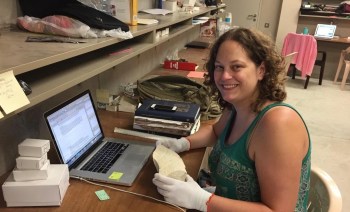 I’m Katherine Iselin, the new social media manager for HECAA. I’m a PhD candidate at the University of Missouri in Art History and Archaeology, focusing on Greek and Roman art and architecture with a minor in eighteenth-century European art. My dissertation, “Historia Spintriae: The Pleasures of Collecting Ancient Erotica,” focuses on the role of Roman erotic art in the collecting culture and creation of pornography during the early modern period.
I look forward to expanding HECAA’s online profile. I see HECAA’s social media presence as a way to connect professional historians to those outside the academic world in a fun and informative manner. These platforms will also be used to highlight some of the art that is frequently omitted from the art historical canon. If you have an idea about an underrepresented topic you would like to see featured in HECAA’s social media, please get in touch with me. Most posts will spotlight select works from the long eighteenth century, but I also plan to do a #MicroMonday feature! These posts will include ‘close up’ details of an unknown work and ask followers to try and identify it.
I welcome comments from members with other new ideas for creative posts! If you are going to a conference, please contact me about potentially doing some guest posts, either by direct messaging on the platforms or email me at iselinkatherine@gmail.com. You can also use #HECAA so I can share your posts.
Please follow HECAA on these platforms:
Instagram: @HECAA_c18arthistorians
Twitter: @HECAA2
Facebook: HECAA – Historians of Eighteenth-Century Art and Architecture (or username: @HECAAonline)
Looking forward to what lies ahead!
Katie
Conference | Red Chalk Drawings
From the conference programme, to be held at NIKI:
Red Chalk Drawings: Sources, Techniques, and Styles, 1500–1800
Nederlands Interuniversitair Kunsthistorisch Instituut, Florence, 18–19 September 2019
Organized by Michael Kwakkelstein and Luca Fiorentino
The Dutch University Institute for Art History in Florence (NIKI) and the Scientific Committee of Avere Disegno are pleased to host an international conference devoted to one of the most fascinating graphic media: red chalk. Red chalk has an expressive power with vibrant and noticeable traits and artists were quick to explore its tonal possibilities, stretching its limits with rubbing and washing. This conference, the first of its kind in Italy, invites scholars to study this medium from a variety of angles. By taking a multi-disciplinary approach, the papers in the conference encourage an interweaving of technical and scientific findings with the insights yielded by the analysis of an artist’s different uses of the medium and its impact on style or of the interplay with other graphic media. On occasion of this conference, a selection of privately-owned drawings in red chalk will be on display in the rooms of the Dutch Institute between 17 and 22 September. The conference proceedings will be published in the Edifir series Avere Disegno. The conference is open to the public with no charge. Pre-registration is required to guarantee seating: niki@nikiflorence.org.
W E D N E S D A Y , 1 8 S E P T E M B E R 2 0 1 9
8.45 Coffee and tea
9.15 Michael W. Kwakkelstein, Director’s Welcome
9:20 Luca Fiorentino, Introduction
9.45 Session 1
Chair: Annalisa Perissa Torrini, già direttore del GDS Gallerie dell’Accademia, Venezia
• Birgit Reissland (Cultural Heritage Agency of the Netherlands, Amsterdam), Natural Red Chalk for Drawing: Revealing Origin, Availability, and Unique Properties through the Centuries
• Rita Bernini (Istituto Nazionale per la Grafica, Roma), Esempi di disegni a pietra rossa nel Gabinetto Disegni e Stampe dell’ING
• Letizia Montalbano (Direttore Scuola Alta Formazione e di Studio OPD, Firenze), Red on Red: un uso particolare della pietra rossa in Leonardo e nella sua cerchia
11.00 Coffee and tea
11.30 Session 2
Chair: Marzia Faietti (Gallerie degli Uffizi/Kunsthistorisches Istitut, Firenze)
• Claudia Echinger-Maurach (Professor of Art History at University of Münster), Michelangelo’s Use of Red Chalk
• Annalisa Perissa Torrini (già direttore del Gabinetto dei Disegni delle Gallerie dell’Accademia, Venezia), Disegni a pietra rossa di Leonardo e allievi, ora alle Gallerie dell’Accademia di Venezia
• Juliette Trey (Deputy Director for Studies and Research, INHA, Paris), Collecting Red Chalk Counterproofs in the 18th Century
12.45 Lunch
14.10 Session 3
Chair: Rita Bernini (Istituto Nazionale per la Grafica, Roma)
• Marzia Faietti (Gallerie degli Uffizi/Kunsthistorisches Istitut, Firenze), La pietra rossa in Andrea del Sarto, Correggio e Parmigianino: Convergenze e divergenze
• Alexa McCarthy (PhD Student, University of St Andrews, Scotland), Carletto Caliari Head’s Studies: A Unification of Disegno e colorito
• Luca Fiorentino (Curatore scientifico Avere Disegno/Independent scholar, Siena), Gian Lorenzo Bernini: i disegni a pietra rossa
15.20 Coffee and tea
15.45 Session 4
Chair: Letizia Montalbano (Direttore Scuola Alta Formazione e di Studio OPD, Firenze)
• Paola Biocca (Borsista di ricerca, Laboratori di Chimica, ICRCPAL, Roma), Le sanguigne di Leonardo alla Biblioteca Reale di Torino
• Luca Baroni (PhD Student, Scuola Normale di Pisa), I disegni a pietra rossa di Federico Barocci
• Margherita Melani (Fondazione Rossana e Carlo Pedretti, Lamporecchio), Pietra rossa per scrivere e per disegnare: dai disegni ‘rosso su rosso’ come ‘nero su nero’ al Manoscritto G di Leonardo
17.30 Reception
T H U R S D A Y , 1 9 S E P T E M B E R 2 0 1 9
9.00 Coffee and tea
9.30 Session 5
Chair: Gert Jan van der Sman (Istituto Universitario Olandese di Storia dell’Arte, Firenze)
• Christien Melzer (Klassik Stiftung Weimar), Red Chalk as a Medium of Transfer in Dutch and Flemish Drawings
• Valentina Frascarolo (Pandolfini Auction House, Firenze), I disegni dei naturalisti genovesi di primo Seicento
• Stefan Moret (Staatliche Kunsthalle, Karlsruhe), Drawing Antique Ornaments in Piranesi’s Workshop
10.45 Coffee and tea
11.00 Session 6
Chair: Luca Fiorentino (Curatore scientifico Avere Disegno/Independent scholar)
• Gabriele Fattorini (Ricercatore Università Messina), Domenico Beccafumi e la sanguigna
• Federica Mancini (Département des Arts Graphiques, Musée du Louvre, Paris), The Taste of the Connoisseur: The Red Chalk Drawings from Filippo Baldinucci’s Collection at the Louvre Museum
• Benedetta Spadaccini (Assistant Curator, Veneranda Biblioteca Ambrosiana, Milano), La pietra rossa nelle stampe che imitano i disegni
12.15 Discussion and concluding remarks
New Book | The Place of the Viewer
From Brill:
Kerr Houston, The Place of the Viewer: The Embodied Beholder in the History of Art, 1764–1968 (Leiden: Brill, 2019), 270 pages, ISBN: 978-9004400238 , €112 / $135.
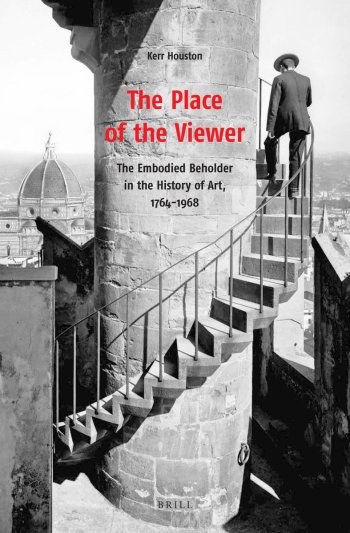 In recent decades, art historians and critics have occasionally emphasized a dynamic, embodied mode of looking, accenting the role of the viewer and the complex interplay between beholders and works of art. In The Place of the Viewer, Kerr Houston shows that an attention to the position and physical experiences of beholders has in fact long informed art historical analyses—and that close study of the theme can lead to a fuller understanding of the discipline, the act of viewership and individual works of art. Simultaneously attentive to historical ideas and contemporary scholarship, this book identifies a vein of thought that has been generally overlooked, and proposes new ways of seeing familiar works and traditions.
Kerr Houston (PhD, Yale, 2001) has taught art history and criticism at The Maryland Institute College of Art since 2002. He is the author of An Introduction to Art Criticism (2013) and numerous articles and reviews.
C O N T E N T S
Acknowledgements
Figures
Introduction
The Communicative Viewpoint: Photography, Frontality, and Multiplicity in the 1800s
The Beholder in Motion: Kinetic Viewership
The Body Physical, the Body Politic: Incorporated Viewership in the 1960s
Art History and the Place of the Viewer since 1968
Bibliography
Index
Exhibition | 2000 Years of Organ Building and Playing
Press release (via Art Daily) for the exhibition now on view at MK&G:
Manufacturing Sound: 2000 Years of Organ Building and Organ Playing
Manufaktur des Klangs: 2000 Jahre Orgelbau und Orgelspiel
Museum für Kunst und Gewerbe, Hamburg, 5 July — 3 November 2019

Johannes Rusch (1728‒1791) / Hermann Seyffarth (1846–1933), Positive Organ, 1777 / 1898 (Musikinstrumentenmuseum der Universität Leipzig; photo by Christina Körte).
With over 300 organs, Hamburg is home to a unique and widely varied organ landscape. In addition to those in the city’s churches, there are numerous other instruments located in schools, in the Elbphilharmonie, in the studio of the NDR public broadcasting station, in the State Opera House, at the University, and even in the prisons. To mark the 300th anniversary of the death of Arp Schnitger (1648–1719), one of the world’s most famous organ builders, the city of Hamburg has declared 2019 the Year of the Organ, with the motto ‘Hamburg Pulls Out All the Stops’. Concerts and events through-out the city, along with a major exhibition at the Museum für Kunst und Gewerbe Hamburg, are arousing public curiosity about this impressive instrument and its history. The exhibition Manufacturing Sound: 2000 Years of Organ Building and Organ Playing invites visitors to learn more about the design, construction, and technical finesse of the marvellous invention that is the organ. The show is centred around organ construction and organ music, which UNESCO added to its List of the Intangible Cultural Heritage of Humanity in 2017. Over 30 exhibits, including 14 historic instruments and reconstructions, allow visitors to immerse themselves interactively into the cosmos of the organ. How does an organ actually work? Where does the ‘organ wind’ come from? What are stops? What do the different organ pipes sound like? The exhibition answers these and many other questions by means of models, interactive displays, media presentations, and films that make the mysterious technology of the instrument visible. Using a model constructed especially for the exhibition, guests can try out the interplay of bellows, windchest, and pipes and produce sounds for themselves. An organ simulator allows them to operate organ keys and pedals and experiment with ‘registration’ techniques. Using photographs of spectacular organ constructions as inspiration, visitors can even design their own unique organs with the help of virtual reality glasses.
Gladiator Battles and Court Ceremonies
Over 2000 years ago, the Greek mathematician Ctesibius invented a vertically adjustable mirror for his father’s barber shop in ancient Alexandria. Its technical highlight was a pressure pump. This stroke of genius was the precursor to the construction of an instrument called the organon hydraulikon, which was capable of producing sounds. As part of the exhibition, a reconstruction of an ancient water organ (hydraulis) from the third century demonstrates how this hydraulic pump system worked. At a height of up to 2 metres, the organs of this period were comparatively small and transportable. Historical sources and archaeological findings from antiquity attest to the instrument’s great popularity. Whereas in ancient Greece, this often took the form of musical organ-playing competitions, in ancient Rome, the organ more often served as musical accompaniment to sports events—such as the famous gladiator fights—and was heard in the villas of wealthy Romans at social receptions and banquets. After the fall of the Roman Empire in the fifth century, knowledge of organ construction was preserved in the Byzantine Empire. There, instruments such as the double organ—a replica of which can be seen in the exhibition—accompanied public events such as horse races and was played at court ceremonies.
The Move to the Cathedrals
Only in the Middle Ages, thanks to the influence of educated clergy, did organs enter into Christian cathedrals, where they were put to use for the musical elaboration of the liturgical programme. The still relatively small, movable organs of this period were transportable instruments—so-called ‘positive’, or even smaller ‘portative’ organs which players could hold on their knees or hang around their shoulders with a strap. The exhibition demonstrates what such a portative organ might have looked like with a reconstructed portativ organetto, built according to plans written by the polymath Arnaut de Zwolle (ca. 1400–1460). For the reconstruction, the Dutch organ builder Winold van der Putten also referred to depictions in paintings by Flemish masters such as Jan Van Eyck (1390–1441), and Hans Memling (1433–1494). The pipes of medieval organs were generally all equal in diameter. Another reconstructed organ in the exhibition, which followed a ‘pigeon’s egg scale’, illustrates a type of objects that were used to measure them at that time.
The Organ as Status Symbol
During the baroque period, large-scale organ-building projects served as demonstrations of wealth and power, even within the church. Increasingly lavish and imposing instruments were constructed. In Europe, regional building styles also emerged during this period. In addition to the monumental church organs, smaller types of organs continued to spread in popularity. They were prized by the nobility and the bourgeoisie as prestigious additions to their homes. Examples of these from the exhibition include a processional organ, which ranks among the most valuable transportable organs of the Italian baroque period, and a cabinet organ from the workshop of Johannes Stephanus Strümphler (1736–1807) in Amsterdam. A truly eye-catching piece from the rococo period is a positive organ adorned with gilded carvings, built by the Bohemian instrument-maker Johann Rusch (1728‒1791). Rare historical sources document the development of organ construction during this period. On display are the Spiegel der Orgelmacher und Organisten, a treatise on organ building and organ playing by Arnolt Schlick (before 1460–after 1521), of which only a few copies exist worldwide; the baroque-era book on music theory and instruments, Syntagma musicum, by Michael Praetorius (1571‒1621); the comprehensive work on music theory, Musurgia universalis, by the polymath Athanasius Kircher (1602–1680); and the standard eighteenth-century text on organ construction, L’Art du facteur d’orgues, by Dom François Bedos de Celles (1709–1779), illustrated with detailed engravings.
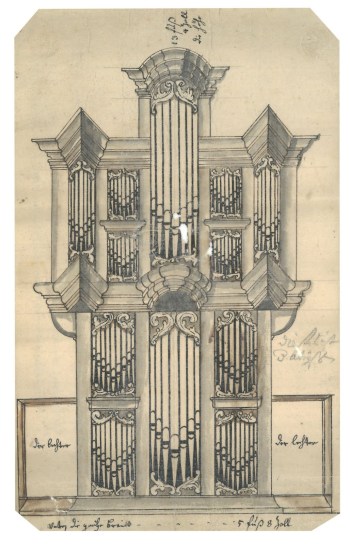
Arp Schnitger (1648–1719), Design of an Organ for the Reformed Church in Altona, ca. 1686, watercolour and pen drawing (Staatsarchiv Hamburg).
Arp Schnitger and North German Organ Building
It was in this period that Hamburg grew to be one of the most important organ-building cities in Europe. Wealthy merchants commissioned the best organ builders and treated themselves to veritable luxury organs. With his sophisticated, tonally powerful instruments, Arp Schnitger represented the zenith of the baroque North German organ-building tradition. His workshop produced a total of 170 organs, of which 47 survive to this day. At its completion in 1687, his organ in Hamburg’s St. Nikolai Church—with 67 stops and more than 4000 pipes—was the largest in the world and made Schnitger famous well beyond his home region. The organ was destroyed in a fire that swept the city in 1842. Today, the organ in Hamburg’s St. Jacobi church, completed in 1693 and restored multiple times, is the largest functioning baroque organ of the North German type, with 43 stops. An early console, whose stop knobs are decorated with carved portraits of famous organ lovers of the period, bears witness to part of its eventful history.
Hans Henny Jahnn and the ‘German Organ Movement’
Prior to the First World War, Albert Schweitzer (1875–1965), who was a trained organist, campaigned for a re-orientation in organ building, and in the 1920s, Hamburg became the centre of an effort at reform that later became known as the ‘German Organ Movement’. The head of this movement was the Hamburg author Hans Henny Jahnn (1894–1959), who also designed several organs and who successfully campaigned for the preservation of the Schnitger organ in Hamburg’s St. Jacobi Church. For Jahnn, this baroque organ, with its ‘honest’, clear tone, was the counter-design to the ‘symphonic’ organ type that predominated at the time, and whose romantic sound he perceived as excessively ornate, dark and opulent. Thanks to a film produced expressly for the exhibition, an organ designed by Jahnn—located at the Heinrich-Hertz School in Hamburg-Winterhude—can be heard playing in the MKG.
The Allure of Organ Design
To this day, the organ has lost none of its fascination: all over the world, organ builders, architects, and designers continue to create spectacular instruments. A photo wall in the exhibition presents selected organ constructions of the past and present which illustrate the close relationship between the craft of organ building and the disciplines of design and architecture. The best-known example of this may be the thrilling design by star architect Frank Gehry (b. 1929) for the organ in the Walt Disney Concert Hall in Los Angeles, which was completed in 2004. Whether they are traditional or futuristic, the varying methods of construction serve as inspiration to exhibition visitors, who are invited to try their hand at building their own organs with the help of virtual reality glasses. The fact that nearly every organ is one of a kind—conceived for a specific space as part of its unique architecture—means that there are (almost) no limits to what present-day organ builders can do. Proof of this can be seen in the spectacular organ constructions of the recent past—such as the organ built for Hamburg’s Elbphilharmonie (opened in 2016) with its approximately 5000 pipes. A media presentation allows exhibition visitors to discover the fascinating instrument in Hamburg’s most famous concert hall.
The exhibition is a collaboration between the MKG and the Hochschule für Musik und Theater Hamburg, in cooperation with Orgelstadt Hamburg e. V. and the Musikfest Bremen. The project receives additional support through the close cooperation with Rudolf von Beckerath Orgelbau, Hamburg; Johannes Klais Orgelbau GmbH & Co. KG, Bonn; the MultiMediaKontor Hamburg GmbH; and the Evangelisch-Lutherischen Kirche in Norddeutschland.
Lenders to the exhibition: Catalina Vicens, Basel | Staatsbibliothek zu Berlin, Preußischer Kulturbesitz, Berlin | Johannes Klais Orgelbau GmbH & Co. KG, Bonn | Marienbibliothek Halle, Halle an der Saale | Staatsarchiv der Freien und Hansestadt Hamburg | Elbphilharmonie Hamburg | Hans Henny Jahnn Verein e. V., Hamburg | Hauptkirche St. Jacobi Hamburg | Orgelstadt Hamburg e. V. | Römerkastell Saalburg, Bad Homburg | Georg Ott, Kirchensittenbach | Musikinstrumentenmuseum der Universität Leipzig | Römisch-Germanisches Zentralmuseum, Leibniz-Forschungsinstitut für Archäologie, Mainz | Evangelisch-Lutherische Kirche in Norddeutschland | Aug. Laukhuff GmbH & Co. KG, Weikersheim | Winold van der Putten, Winschoten
Call for Papers | ASECS 2020, St. Louis
From ASECS:
2020 American Society for Eighteenth-Century Studies Conference
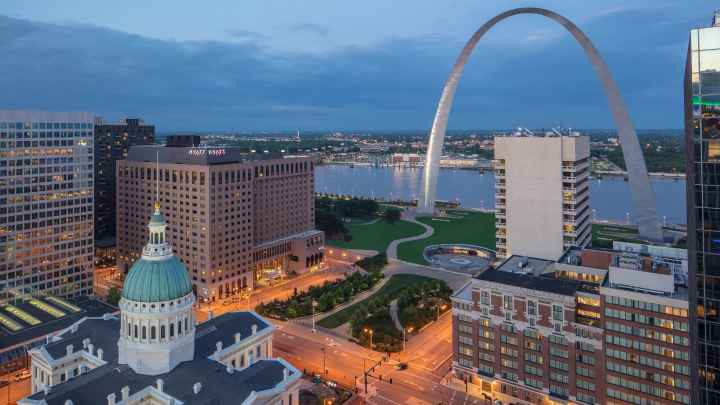
Hyatt Regency at the Arch, St. Louis, 19–21 March 2020
Proposals due by 15 September 2019
Proposals for papers to be presented at the 51st annual meeting of the American Society for Eighteenth-Century Studies, in St. Louis, are now being accepted. Proposals should be sent directly to the session chairs no later than 15 September 2019. Along with our annual business meeting, HECAA will be represented with the Anne Schroder New Scholars’ Session, chaired by Susanna Caviglia. A selection of additional sessions that might be relevant for HECAA members is included below. A full list of panels is available as a PDF file here.
◊ ◊ ◊ ◊ ◊
Anne Schroder New Scholars Session [Historians of Eighteenth-Century Art and Architecture]
Susanna Caviglia (Duke University), susanna.caviglia@duke.edu
This is an open session for advanced graduate students and early career scholars in the art and architectural history of the eighteenth century.
◊ ◊ ◊ ◊ ◊
Presidential Session: Fostering Eighteenth-Century Studies in Unwelcoming Places (Roundtable)
Michael Yonan (University of Missouri), yonanm@missouri.edu
The contemporary American cultural landscape poses challenges to scholars of the eighteenth century. While our research engages with Enlightenment ideals, we often conduct it while living and working in places seemingly opposed to those ideals. Recent political developments in multiple states (including Missouri) promise to impact the future development of our field significantly. This roundtable offers a forum for discussing these concerns. How can scholars, especially younger scholars, negotiate the tricky world of contemporary politics as they pursue their scholarly agendas? Topics may include: accepting a job in a state whose political mainstream differs from one’s own; contemporary reproductive rights and eighteenth-century studies; queering the eighteenth century in queerphobic settings; ideological fundamentalism and eighteenth-century scholarship; eighteenth-century antecedents to the contemporary political climate; and other subjects.
◊ ◊ ◊ ◊ ◊
Innovative Course Design
ASECS, asecsoffice@gmail.com
ASECS invites proposals for a new course on eighteenth-century studies or a new unit (1–4 weeks of instruction) within a course. Proposals may address a specific theme, compare related works from different fields (music and history, art and theology), take an interdisciplinary approach to a social or historical event, or suggest new uses for instructional technology. The unit/course should either have never been taught or have been taught recently for the first time. Applicants should submit a 750–1500 word proposal that focuses sharply on the leading ideas distinguishing the unit/course. The proposal should indicate why particular texts and topics were selected and (if possible) how they worked; ideally, a syllabus will be provided. The competition is open to current members of ASECS. Up to three proposals will be selected for presentation during the Innovative Course Design session at the Annual Meeting; a $500 award will be presented to each of the participants, who also will be asked to submit an account of the unit/course, a syllabus, and supplementary materials for publication on the ASECS website.
◊ ◊ ◊ ◊ ◊
The Sister Arts in Eighteenth-Century Ireland [Irish Caucus]
Scott Breuninger (University of South Dakota), Scott.Breuninger@usd.edu
During the eighteenth century, the sister arts of painting and poetry in Ireland were often linked to notions of political or social authority. Working in a society divided by religion, gender, and race, Irish artists were faced with the uncomfortably stark nature of political power and the (mis-)attribution of meaning(s) to their work. In this context, many of the themes explored by Irish poets, playwrights, musicians, and artists (among others) were necessarily grounded in discourses that tried to walk a fine line between personal expression and social expectations. Some of these creative works explicitly drew from Ireland’s past to inform their meaning, others looked toward the future with varying degrees of optimism and pessimism. In this nexus of aesthetic creativity, artists were forced to negotiate with a wide range of pressures that were unique to Hibernia. This panel welcomes proposals that address how issues of artistic representation related to questions of political and social power within eighteenth-century Ireland. Of particular interest are proposals that investigate how politically disenfranchised groups in Ireland addressed the connection between artistic representation, political power, and/or historical memory along lines associated with religion, gender, and race.
◊ ◊ ◊ ◊ ◊
Eighteenth-Century Italian Economies of Exchange [Italian Studies Caucus]
Irene Zanini-Cordi (Florida State University), izaninicordi@fsu.edu
The European Grand Tour destination, a center of port commerce for Europe and the Levant, and an ambitious participant in the Enlightenment Republic of Letters via an array of scientific and literary academies, prolific periodical publications, and the epistolary exchange of individual lights, Italy in the eighteenth century is especially fertile terrain for examining European and wider exchange economies. We seek papers on innovative networks in eighteenth-century Italy that sought to circulate, trade in, and trade on knowledge and ideas, material and cultural goods, and human beings. These may include but are not limited to the circulation of periodical literature; commercial ports of trade; Grand Tour networks; the trade in natural philosophical texts, instruments, specimens, and knowledge; fashion; the art market; culinary arts; and musical and theatrical production.
◊ ◊ ◊ ◊ ◊
Representations of Nature in Art, Literature, Philosophy, and Science of Eighteenth-Century Italy [Italian Studies Caucus]
Francesca Savoia (University of Pittsburgh), savoia@pitt.edu
In a period of burgeoning knowledge about the natural world, how did artists, writers, philosophers and scientists—working in or visiting Italy in the eighteenth century—respond to the wondrous and/or dreaded manifestations of Nature? How fruitfully did the artistic, figurative and literary representations, interpretations and/or re-creations of natural objects and phenomena intersect with philosophical speculation and scientific research? This session seeks contributions that address these questions from the widest range of disciplinary perspectives: ecocriticism; eco-critical art history; eco-musicology; environmental history; history of science; cultural studies.
◊ ◊ ◊ ◊ ◊
Repairing the Eighteenth Century
Katarina O’Briain (St. Mary’s University), kobriain@gmail.com; and Allison Turner (Columbia University), acturn@gmail.com
In a special issue of Studies in the Novel from 1996, Eve Kosofsky Sedgwick introduced the idea of reparative reading as a tool for replenishing (and repairing) literary studies. Whereas “paranoid” criticism sought to expose a damaging ideological substratum at every turn, Sedgwick’s reparative method would approach cultural objects with a sense of their potential for meaning-making: “this is the position,” she writes, “from which it is possible . . . to assemble or ‘repair’ the murderous part objects into something like a whole—though, [she] would emphasize, not necessarily like any preexisting whole.” To repair, Sedgwick implies, is not to restore some object or environment to a pastoral original; it is rather a way of doing anything at all with inevitably broken or mixed materials. If “the eighteenth-century origins of critique,” in Simon During’s phrasing, have been well established, this panel asks whether and how the notion of repair might offer new ways of thinking about our period. How, for instance, might repair complicate or contradict traditional narratives of capitalist accumulation and the rise of the consumer society? What sorts of repair are offered in response to political, environmental, and social crisis? Are there ways of thinking about repair outside of conventional notions of improvement, innovation, or progress? We invite proposals that approach repair in diverse ways—as a material process, methodological position, aesthetic operation, or conceptual tool. Proposals for papers that speak to the limits of repair or that suggest ways we might move beyond it are also welcome.
◊ ◊ ◊ ◊ ◊
Amateur or Professional? Reconsidering the Language of Artistic Status
Paris Spies-Gans (Harvard Society of Fellows), pspiesgans@gmail.com; Laurel Peterson (The Morgan Library & Museum), laurel.o.peterson@gmail.com
The categories of ‘amateur’ and ‘professional’ have long been used to demarcate artistic activity. However, these classifications are frequently anachronistic, and do not reflect the language that was used at the time—they are often inflected as much by historiography as by the lives that people lived. Indeed, ‘amateur’ did not enter the English language until the late eighteenth century. Our panel seeks to challenge the distinction of amateur vs. professional, asking instead what these terms meant in the eighteenth century, to artists as well as to their publics. We hope to suggest that a reevaluation of these terms can reorient, expand, and, perhaps, reshape our study of this period. We invite papers that explore the concepts of ‘amateur’ and/or ‘professional’ across artistic fields. Topics might include materiality, media, gender, social class, travel, and public exhibitions or displays. Presenters might challenge the binary of amateur vs. professional as it is applied to drawing vs. painting, to fine vs. decorative arts, to female vs. male artists, to private vs. public activity, to academic training vs. self-teaching, etc. Where did one cross over from being an amateur to being a professional, or vice versa? To what degree are these retroactively applied categories helpful to the study of the eighteenth-century world, and to what degree might they be delimiting?
◊ ◊ ◊ ◊ ◊
The Rise of the House Museum: Domestic Curatorial Practices
Kirsten Hall (The University of Texas at Austin), kirstenahall@utexas.edu; and Teri Fickling (The University of Texas at Austin), terifickling@utexas.edu
When Elizabeth Bennet and the Gardiners are led on a tour of Pemberley by housekeeper Mrs. Reynolds, Elizabeth owns, “Mrs. Reynolds could interest her on no other point. She related the subjects of the pictures, the dimensions of the rooms, and the price of the furniture, in vain.” As the Pemberley tour proves, the rising popularity of country house tours as a leisure pursuit suggests that the gentry had become captivated by the prospect of seeing up close how others—especially the rich, powerful, or famous of the present and past—lived through their catalogues of “fine carpets and satin curtains.” On one hand, “great house” tourism shored up class hierarchies, celebrating the prestige of the aristocracy. On the other hand, the case of Mrs. Reynolds seems to show how the practices of archiving and exhibiting were increasingly open not just to the elites of clubs and universities but also to women and, to some extent, the working class. This panel invites papers that address the popularity of domestic curatorial practices in the long eighteenth century, inviting a range of interdisciplinary perspectives that may consider topics such as: collecting, curating, and housekeeping in the public vs. private spheres; the relationship between literary genres like biography, the novel, the travel guide, and the encyclopedia and house tours; taxonomic and empirical methods in the arts and sciences; tourism and secular pilgrimage; women and museums; historic preservation, antiquarianism, and historical consciousness; current scholarly practices in historicizing ordinary life in the eighteenth century; and the status of eighteenth- century historic house museums today.
◊ ◊ ◊ ◊ ◊
Mineralogy and Artful Metamorphosis
Tara Zanardi (Hunter College), tzanardi@hunter.cuny.edu; and Christina Lindeman (University of Southern Alabama), clindeman@southalabama.edu
The burgeoning field of mineralogy in the eighteenth century not only pointed to the increase in the scientific study and mining practices of minerals, such as amethyst and emeralds, but also to their greater manipulation by artisans, architects, and artists in the creation of decorative objects, textiles, jewelry, interiors, and garden grottoes. Since antiquity humans have analyzed and contemplated minerals for their beauty, intricate structures, purported mystical and therapeutic powers, economic benefits, and spiritual and chemical properties. In the 1700s, they were avidly incorporated in elite and amateur collections and displayed in natural history cabinets, and this interest became more systematic and rigorous, aided by a constellation of institutions and governing bodies that funded expeditions and fostered scientific inquiry. This session invites papers to consider the multiple and complex roles of minerals in artistic and natural history contexts. How did the raw materials, mined at home or abroad, relate to nationalistic and imperial pursuits and the kinds of terrestrial bounty boasted by nations? How were such materials then catalogued, displayed, wielded, or molded in their new, ‘civilized’ environments? How were such natural objects sources of pleasure, instruction, wonder, spirituality, and the exotic? Ultimately, how did these minerals undergo metamorphosis in new and artful ways that embodied an individual’s or collective taste, knowledge, and identity? We also welcome papers that address the explorative methods of quarries and the labor used to extract minerals.
◊ ◊ ◊ ◊ ◊
Art Professions
Carole Paul (University of California, Santa Barbara), paul@arthistory.ucsb.edu
The eighteenth century seems to have been a watershed in the emergence and evolution of various different kinds of work involving the visual arts, some of which were established as professions during the period. This session aims to trace the development of some of these types of work, considering not only how they evolved over the course of the century, but also how they were related and, concomitantly, what factors—cultural, economic, social, etc.—engendered their growth or professionalization. How, or were, those who did this kind of work remunerated? How did they identify themselves professionally, if they did so at all? Examples include museum curators, directors, and guards, tour guides, art and architectural critics, dealers, restorers, landscape architects, interior decorators, art historians, connoisseurs, and antiquarians. Papers that address these types of work are encouraged; if they discuss individual figures, they should do so in relation to the broader context.
◊ ◊ ◊ ◊ ◊
On Mimesis (Roundtable)
Edmund Goehring (The University of Western Ontario), egoehrin@uwo.ca
Robert Pippin, taking up Hegel’s claim that art had become a “thing of the past,” proposes that, with Modernist French painters, representational art ceased “to compel conviction, to arrest attention, to maintain credibility” (“After the Beautiful”). Wye Allanbrook, in laying out a poetics of the music of Mozart’s era, is still more emphatic that something irrevocable happened at the beginning of the nineteenth century. By her account, a curtain came “down on habits of thought about music’s nature”—that is, the mimetic tradition—“that had been sustained in one mode or another since antiquity” (“The Secular Commedia”). These observations (and similar ones could be added) indicate how the question of representation in the arts is still a lively one and how much it is sustained by eighteenth-century thought and practice. This roundtable welcomes contributions, from across disciplines, that probe this topic further. Responses might consider (but need hardly be limited to) narrative approaches beholden to thresholds or tipping points, the social/political dimensions of these changes in poetics, the persistence of mimesis into modernity, or challenges to mimesis—in the theory or practice of art—that appeared well before the nineteenth century.
◊ ◊ ◊ ◊ ◊
Colonial Matter
Kaitlin Grimes (University of Missouri-Columbia), krgxb6@mail.missouri.edu; and Danielle Ezor (Southern Methodist University), dezor@mail.smu.edu
The long eighteenth century witnessed a freer and faster movement of increasingly diverse goods around the world than had ever existed before. New objects, materials, and consumables traversed oceans and crossed over lands to serve new global marketplaces. These material goods travelled not just from or to Europe as much recent scholarship has suggested, but between global metropoles well outside of Europe, as for example between China and New Spain or India and East Africa. However, colonialism facilitated the movement of these goods, and so colonialism also marked these objects, materials, and consumables. Studies of traded materials provide a greater understanding of relations between colonizer and colonized as well as illustrate how particular materials were received and perceived in an eighteenth-century colonial context. This panel seeks to explore the connection between material culture and colonialism and to decentralize Europe as the main purveyors of these materials. Such topics could include but are not limited: colonial materials, objects used to house, contain, or exhibit colonial goods and consumables and their display; the trade and/or market of colonial goods in the long eighteenth century; and colonial interpretations of such objects and consumables. The goal of this panel is to develop an ongoing conversation on the relationship between material culture and colonialism within the long eighteenth century and how colonialism’s role in spreading objects aids in the comprehension of eighteenth-century material and visual culture.
◊ ◊ ◊ ◊ ◊
“Too political, too big, no good”: Picturing Politics
Jessica L. Fripp (Texas Christian University), j.fripp@tcu.edu
“Too political, too big, no good” were the words Kim Sajet, director of the Smithsonian’s National Portrait Gallery, reportedly used to turn down Julian Raven’s gift of his propagandistic/fan-art portrait of Donald Trump, Unafraid and Unashamed. Inspired by this amusing, if somewhat absurd, event, this panel seeks papers that address political art in the long eighteenth century (1660–1830) that was celebrated at the time but is now maligned, or vice versa. Topics might include: official commissions celebrating events that have fallen out of favor due to changing understandings of histories of power (for example, colonial or imperialistic endeavors); works that have been positively or negatively affected by the vagaries of taste for a style or an artist; works taken up independently by artists that were well-received or rejected; or works that demonstrate the conflict between the needs of a political regime and the public. What did it mean for a work of art to be ‘too political’, ‘too big’, or ‘no good’ in the eighteenth century? What impact do these value judgments have on our understanding of political art, then and now?
◊ ◊ ◊ ◊ ◊
Built Form
Janet R. White (UNLV), janet.white@unlv.edu
Architects, landscape architects, interior designers, and historians of these disciplines are invited to submit abstracts to this interdisciplinary session dealing with the built environment of the long eighteenth century. Subjects might include analysis of individual eighteenth-century buildings, interiors or landscapes; discussion of eighteenth-century treatises that has an impact on built form; analysis of the work of individual designers; and discussion of movements such as Neo-Palladianism or French Structuralism.
◊ ◊ ◊ ◊ ◊
Do-Overs: Repetition and Revision
Elizabeth Mansfield (Penn State), ecm289@psu.edu
François-André Vincent’s painting Arria and Paetus (1784), now in the collection of the Saint Louis Art Museum, provides an occasion to revisit the significance of repetition in the long eighteenth century. As is well known, the practice of creating copies was not only a standard part of academic training, it was also a means of enhancing professional reputations and commercial success. A related but distinct phenomenon was the creation of variants. Vincent’s Arria and Paetus exemplifies this phenomenon. The painting in Saint Louis was exhibited at the 1785 Salon near a likewise fully finished but utterly different conception of the scene, also by Vincent. Both paintings represent the same encounter between the defeated Roman general and his wife, intent on mutual suicide to preserve the family’s honor. Whether the variants were presented at the Salon together to show the artist’s range, to illustrate a particular narrative theory, to create a quasi-cinematic visual effect, or were merely artifacts of artistic indecision remains uncertain. What is certain is that Vincent’s interest in repetition and variation is not unique. To gain a better understanding of this and other instances of authorial variation, it is necessary first to consider this phenomenon as a practice, as a mode of cultural expression and interchange. Toward this end, this session will address repetition and revision with priority given to papers that discuss variants in the visual arts.
◊ ◊ ◊ ◊ ◊
Collecting, Antiquities, and Eighteenth-Century Art
Lauren DiSalvo (Dixie State University); lauren.disalvo@dixie.edu; and Katherine Iselin (University of Missouri), ktp.iselin@gmail.com
The influence of the Greco-Roman world permeated eighteenth-century visual and material culture following the excavations that began at Pompeii and Herculaneum. Demand for large-scale sculpture and their copies, Greek vases, and the many Neoclassical paintings that were influenced by antiquity rose in the wake of eighteenth-century excavations as collectors passionately sought such objects. Likewise, more portable souvenirs such as prints, micro-mosaics, fans, gems, and architectural models also found their way into collectors’ hands. This panel seeks papers that examine the intersections of collecting, antiquities, and eighteenth-century art. What new perspectives can be used to explore how Greco-Roman art functioned in collecting during the long eighteenth century? This panel looks to examine collecting more broadly, including collections of specific collectors, types of popular collectibles, or reworked Greco-Roman artifacts. Papers focusing on non-traditional or little-known objects and collectors are particularly welcome.
◊ ◊ ◊ ◊ ◊
Experiencing the Past: Bringing Collections to Life through Experiment and Reconstruction
Al Coppola (John Jay College), acoppola@jjay.cuny.edu
Scholars such as Richard Sennett, Paola Bertucci and Pamela H. Smith of Columbia University’s Making and Knowing Project have drawn new attention to early modern crafts-people and artisanal practices in order to enrich our understanding of the bonds between making and knowing. In order to explore the embodied knowledge of historical actors, this cross-disciplinary scholarship brings together experts working in fields like technical art history, history of science and medicine, and food studies with modern scientists and artisanal practitioners. Insofar as this work promises to lend new insights into the ways life was experienced in the eighteenth century, this panel seeks participants who have undertaken—or plan to embark on—projects involving the recreation of historic recipes, experiments or related historical material. It seeks to understand the challenges, rewards, and unexpected findings that emerge when historical documents or objects are put into active use. Relevant projects might have to do with the recreation of historic recipes for medicines, food, drink, or pigments, the re-enactment of experiments with historical instruments, or other engagements. The panel especially welcomes projects that reach into the public realm, and it hopes to feature a special format in which a roundtable discussion will be enriched by tastings, demonstrations or other kinds of experiences. This panel has already secured interest from a collaboration between the Minneapolis Institute of Art, the Wangensteen Historical Library at the University of Minnesota, and the Tattersall Distilling Co. that explores the culture of distilled spirits in the eighteenth-century Atlantic world: https://bit.ly/2HcTtxI .
Note: Once papers for this session have been selected, the authors will consult with the panel chair, the Program Committee, and the Diversity, Equity, Inclusivity and Accessibility Committee regarding food allergies, scent sensitivities, etc.
◊ ◊ ◊ ◊ ◊
Herbarium: Illustration, Classification, Exchange
Sarah Benharrech (University of Maryland), sbenharr@umd.edu
This session proposes to focus on the cultural practices and on the literary and philosophical representations associated with herbaria and herbarium-making in the eighteenth century. It is inspired by the works of A. Cook who has demonstrated the importance of herbarium-making in the botanical activities of J.-J. Rousseau, of M. Flannery who highlighted their aesthetic value, and of S. Müller-Wille who examined their taxonomic and nomenclatural significance in the building of organized knowledge. As a collection of pressed plants, a herbarium replaces drawings, engravings, or textual descriptions of plants, with actual specimens. Herbaria might be bound and display a systematic classification; but when left unbound like decks of cards they allow for a flexible and temporary arrangement of plants. At the same time herbaria involve issues related to (re)presentation through the manner in which dry specimens are placed on paper. And last, herbaria were treated as commodities in the transactions among botanists and amateurs engaged in the social practice of gift exchange. As trophies brought back by colonialists and their supporters, herbaria captured the many ambiguities of naturalistic exploration and colonial exploitation. Presentations on material culture, networks and diffusion of knowledge, empire and botanical knowledge, imaginary and literary herbaria, or on other cultural practices associated with plant collection and preservation are welcome. Please send a 200-word abstract in English or in French.
◊ ◊ ◊ ◊ ◊
Political Revolutions and Art Historical Exile
J. Cabelle Ahn (Harvard University), jahn01@g.harvard.edu; and Elizabeth Saari Browne (MIT), esbrowne@mit.edu
In recent decades, scholars have investigated the revivals, echoes, and continuities of eighteenth-century artistic styles into and beyond the nineteenth century. Taking their lead, this session questions the effects that the presumed links between style, genre, medium and politics have had on our understanding of eighteenth-century artists whose oeuvres traverse the centuries and political regimes, but whose works, for the most part, remain unchanged. The turning of the century in France, for instance, was particularly marked by the colossal fragmentation in historical consciousness owing to the French Revolution. While scholars have recently challenged the transformative role of the Revolution as creating neat breaks in cultural consciousness that directly align with shifts in governance, the spotlight has remained firmly on ‘revolutionary’ artists whose production primarily sought to create an explicitly public and political effect. This approach leaves the visual productions of artists active during this tumultuous period—such as Clodion (1738–1814), Anne Vallayer-Coster (1744–1818), and Jean-Jacques de Boissieu (1736–1810)—in limbo, as seemingly oblivious to the gradual liberation of intellectual and cultural vision in the revolutionary period. Through this session, we aim to address the continuities of artistic production in moments of profound political change and historical segmentation (roughly 1776–1815), and we welcome papers that take on such ‘defiantly anachronistic’ artists as case studies, topics that examine similar divisions in other European and American schools, and proposals that offer methodological solutions for addressing these erasures.
◊ ◊ ◊ ◊ ◊
Global Animals
Adela Ramos (Pacific Lutheran University), ramosam@plu.edu; Gabriela Villanueva (UNAM: National Autonomous University of Mexico), g.villanueva.noriega@comunidad.unam.mx; and Bryan Alkemeyer (The College of Wooster), balkemeyer@wooster.edu
With some exceptions, the groundbreaking work of eighteenth-century scholars in animal studies over the last two decades has focused on English and French histories and literatures. The trend could appear symptomatic of what Karen Stolley has identified as the “partial diversification” of eighteenth-century studies, which even as it strives to account for “peripheral” or “global” enlightenments, tends to overlook the Spanish American eighteenth century. Africa, as Wendy Laura Belcher has pointed out, has likewise been under-studied. This panel seeks to address how animal studies might avoid the “methodological nationalism” (Ulrich Beck) of the traditional Humanities that Rosi Braidotti critiques in The Posthuman in order to “unthink Eurocentrism and anthropocentrism” with animals. How did other literatures and worldviews that might be regarded as outside of the center respond to the animal question and engage in the debate concerning the human/animal divide during the eighteenth century? Presentations from all fields (art history, history, literature, political theory) that provide an overview of how methodological and/or theoretical approaches might expand the national focus of animal studies, case studies which situate a text, event, or figure in a global context, or which investigate animals in underrepresented national literatures or histories are all equally welcome.
◊ ◊ ◊ ◊ ◊
The Visual Gothic
Kristin O’Rourke (Dartmouth College), kmo@dartmouth.edu
The burning of Notre Dame cathedral made clear how present the Gothic still is today in everyday life in Paris and throughout much of Europe: as tourist attraction, as spectacle, as nostalgia, as cultural or religious symbol. This panel strives to think about how the visual image of the Gothic impacted contemporary art and literature of the eighteenth and early nineteenth centuries. The ‘new’ Gothic fantasy of Walpole’s Strawberry Hill, Gilpin’s picturesque tours, the Troubadour style in French art, and the restoration and completion of centuries-old cathedrals, for example, demonstrate how the Gothic re-gained a hold over architecture, painting, and literature at a time of political and social change throughout Europe. Was the Gothic revival a rejection of the classicism spurred on by the Grand Tour and Napoleon’s empire, or one aspect of a nascent Romanticism? How do politics and religion figure into an aesthetic focus on the vernacular and idiosyncratic aspects of the Gothic as opposed to the universalizing rationality of the classical tradition? Can we read an anti-modern, anti-Enlightenment reaction in the art of the time, or was the Gothic just another form of exoticism?
◊ ◊ ◊ ◊ ◊
Sight and Seeing in Eighteenth-Century Fiction
John Han (University of Tennessee – Knoxville), jshan111@gmail.com
The development of the microscope and telescope drastically changed the way people used sight to interface with the world in the eighteenth century. But between such major shifts in modes of seeing—from the cellular to the cosmic—the most basic mode of sight itself changed. Manifested in technical uses—such as the technique of surveying, the practices of landscaping, and the art of engravings—vision became a formal site of practical epistemology. Sight, therefore, became the subject across a variety of texts, such as William Stow’s survey Remarks on London, William Hogarth’s The Analysis of Beauty, and William Chambers’s Dissertation on Oriental Gardening. Related to but apart from the scientific and technical arena, the eighteenth-century literary world—reliant on images, imagination, and imagery—portrayed the act, the process, or the object of seeing in its poems, dramas, and novels. From descriptions of characters looking at one another, to mirrors, and toward an outside environment, eighteenth-century writers allegorized the act of seeing. What do fictional accounts of sight tell us about the relationship between sight and imagination, ocular proof and illusion, material visibility and internal subjectivity?
◊ ◊ ◊ ◊ ◊
Rethinking Turquerie: New Definitions and Approaches
Ashley Bruckbauer (University of North Carolina at Chapel Hill), albruckbauer@gmail.com
A vogue for all things ‘Turkish’ spread throughout Europe during the eighteenth century. Trade and travel between the Ottoman Empire and European states enabled Ottoman goods, including coffee, textiles, and costume albums, to flow into Europe. Likewise, artists living in the Levant, such as Jean-Baptiste Vanmour, produced numerous prints and paintings of Ottoman society for European audiences. Such objects inspired Turkish-themed masquerades in Rome, London, and Paris as well as portraits of European elites dressed à la turque. French nobles built cabinets turcs furnished with divans, sophas, and ottomans, while British and Polish monarchs erected Turkish-style tents and kiosks. Despite its immense popularity, European visual and material culture related to the Ottoman Empire remains underanalyzed. Like other forms of exoticism, turquerie has often been trivialized as a ‘decorative’ style lacking both veracity and substance. This panel aims to critically rethink eighteenth-century objects and images categorized as turqueries. In line with recent reassessments of chinoiserie and the rococo, it seeks to explore new definitions and approaches that recognize the diversity and complexity of these works of art. Is turquerie a useful term? What are its characteristics and strategies? How do objects expand or challenge traditional understandings of turquerie? How is it similar to and different from other types of exoticism? Proposals addressing any aspect of the engagement of visual and material culture with real or imagined Ottoman forms, styles, and subjects are welcome.
◊ ◊ ◊ ◊ ◊
From Tabula Rasa to Terra Incognita: Landscape and Identity in the Enlightenment
Shirley F. Tung (Kansas State University), sftung@ksu.edu
Enlightenment philosophical discourse situates travel as both the navigation of the literal terra incognita and the figurative terra incognita of the self, conflating geographical bodies with the bodies of the travelers crossing the terrain. In turn, eighteenth-century travelers seized upon this metaphor of embodied earth to depict the ever-expanding borders of personal and national identity. The historical transition of how landscape was conceived—from prospects offering a ‘blank slate’ to places inscribed (and re-inscribed) with meaning—speaks also to its growing importance as a material and symbolic site where the potentiality of traveling subjects and the nations they represent could be explored on a global stage. Enlightenment era travel writers employed landscape as a means of actively shaping the dominant paradigm by conveying to their readership the perceived incommensurability between what their nation was becoming and what they, as self-reflexive subjects, might be. Such reconciliatory expressions of shifting selfhood anticipated solutions to particular sets of challenges commonly associated today with imperialism. The attempted resolution of these dynamic and oft-burdened relationships between individuals, homelands, and distant places lent a particular structure to eighteenth-century accounts of landscape which are evident across various genres and media. Accordingly, this panel welcomes proposals on landscape and identity in relation to Enlightenment literature, visual art, philosophy, geography, and science, and from within or across various national perspectives. Papers might focus on travel literature (both fictional and non-fiction accounts), loco-descriptive poetry, visual representations of landscape, cartography, tourism, scientific experiments and discoveries, philosophical treatises, and colonialism and/or empire.
◊ ◊ ◊ ◊ ◊
The Woman of Color in the Eighteenth Century
Regulus Allen (Cal Poly, San Luis Obispo), rlallen@calpoly.edu; and Nicole Aljoe (Northeastern University), n.aljoe@northeastern.edu
The republication of the 1808 novel The Woman of Colour, A Tale; the debut of Belle, a film inspired by the 1779 portrait of Dido Elizabeth Belle; the reissue of the 1767 text The Female American; a new edition of Lady Mary Wortley Montagu’s 1763 Turkish Embassy Letters; and work by scholars such as Lyndon Dominique, Felicity Nussbaum, and Sarah Salih have facilitated a greater focus on eighteenth-century representations of women of color, and have indicated that such depictions are more prevalent and complex than the criticism has previously suggested. This panel invites papers from all disciplines as we consider verbal and visual depictions of women of African, American, or Asian descent and their impact on eighteenth-century culture and society.
◊ ◊ ◊ ◊ ◊
Bringing Historical Maps into GIS (Workshop)
Kacie Wills (Illinois College), kacie.wills@gmail.com; and Erica Hayes (Villanova University), ericay.hayes@gmail.com
Interacting with historical maps in their proper geographic space allows for a more accurate representation of a particular place and the changes it has undergone over time. The study of historical maps is important to eighteenth-century scholarship, specifically as it deals with notions of globalization and attempts at de-colonizing empirical approaches to space. This workshop will provide participants with the technical skills to align geographic coordinates to a digitized historical map in the eighteenth—century in order to create a georeferenced historical map. Participants will learn how to use simple tools like Map Warper, an open source image georeferencer tool, in order to overlay the digitized historical map on top of a GIS modern basemap for comparison and use in an interactive web mapping application. This workshop is ideal for scholars working with historical maps or interested in learning digital humanities GIS skills. Workshop participants will need to bring their own laptops. No prior GIS or mapping experience is required.
Note: Please contact the organizers to secure your space in the workshop. Signups will be accepted on a first come, first serve basis; there is a limit of 30 participants. Workshop participants will not be listed in the program. If needed to secure travel funding, a letter from the ASECS Office formally inviting you to participate in the workshop will be provided.
◊ ◊ ◊ ◊ ◊
Visualizing the French Empire
Izabel Gass, izabel.gass@gmail.com; and Philippe Halbert (Yale University), philippe.halbert@yale.edu
In recent years, art history’s ‘global turn’ has worked to acknowledge the vital role that non- Western cultures and imperialism played in the formation of European art and material culture. This commitment to more inclusive narratives has had a pronounced impact on many fields that privilege and address eighteenth-century art and history. For example, the study of British culture in this period has in many instances been fully eclipsed by the emergence of a ‘British Atlantic World’ and a model of empire that no longer views colonies in isolation from metropolitan centers, and vice versa. This phenomenon is comparatively less pronounced among scholars of French art and those exploring the various legacies of France’s ‘first’ overseas empire, which at its height stretched from Cayenne to Québec and also included points in Africa, India, and the Indian Ocean. This panel seeks to address, and hopefully redress, this disparity as we meet in Saint Louis, founded by the French in 1764 and North America’s last French colonial settlement. We are interested in two lines of inquiry: first, historiographical and methodological papers that explore why, exactly, French visual culture (inclusive of canonical art and material culture) of the long eighteenth century has received less of a global perspective within art history; second, papers that take on this global perspective in exploring topics and themes within the visual culture of a larger, lived French colonial experience.
◊ ◊ ◊ ◊ ◊
Burneys and Stuff: Material Culture and the Visual Arts [The Burney Society]
Alicia Kerfoot (SUNY Brockport), akerfoot@brockport.edu
From the mechanical pineapple automaton in Evelina, to the pawnbroker’s shop in Cecilia, the locket in Camilla, or Van Dyke’s The Children of King Charles I of England in The Wanderer, Frances Burney’s novels, plays, letters, and journals are full of the material culture of eighteenth-century life. This panel calls for papers on any aspect of material culture or the visual arts in the works of Frances Burney or other members of the Burney family and their circle (including figures such as Frances Burney’s mother, Esther Sleepe, who was a fan-maker, or her cousin, the artist Edward Francisco Burney). Presentations might consider the relationship between objects as portrayed by any of the Burneys in art and literature (including novels, plays, letters, paintings, craft work, the needle arts, and music) and as surviving objects in archives and collections today. Papers might also focus on the historical and cultural networks that one object can conjure, the relationship between historical object and its textual representation, or on that which cannot be fully captured in the visual, textual, or material representation of stuff.
◊ ◊ ◊ ◊ ◊
“I Refute It Thus”: Encounters with Eighteenth-Century Objects (Roundtable) [Northwest Society for Eighteenth Century Studies]
Marvin Lansverk (Northwest Society for Eighteenth Century Studies), lansverk@montana.edu
Proposals invited on any aspect of encounters with eighteenth-century objects, then and now, whether personal, professional, or philosophical—whether in texts, or with texts, or without texts.
◊ ◊ ◊ ◊ ◊
Shorelines: The Enlightenment Experience of Beaches, Coasts, Harbors, Bays, Islands, and Riversides [South-Central Society for Eighteenth-Century Studies]
Kevin L. Cope (Louisiana State University), encope@lsu.edu
Transitions from water to land are everywhere in the long eighteenth-century experience. Both fictional and factual characters such as Robinson Crusoe and Philips Ashton wash up on beaches; history and portrait painters, including Benjamin West, deploy more than a few shoreline scenes; landscape daubers, whether Caspar David Friedrich or Claude Lorrain, juxtaposed sea against land, as did illustrators such as William Westall; eighteenth-century navies employed artist-navigators to sketch coasts; poets such as Abraham Cowley versified the edging of water along terra firma; explorers discovered assorted uncharted islands and new coasts; casual philosophers such as Margaret Cavendish imagined the arrival at utopian lands; geologists and paleontologists, including John Woodward and John Ray, wandered coasts in search of fossils; optical experts offered mariners ever-better spyglasses by which to sight faraway sands; even musical composers tried to capture the joys of making landfall. The artificial shore—the port; the harbor; the esplanade; the maritime supply infrastructure; even the boathouse—likewise bustled with international cultural, economic, and political activity. This panel will investigate the evocation, rendering, representation, uses, and influence of shores in the full range of long- eighteenth-century genres, disciplines, and pursuits. A special welcome is extended to authors of papers exploring the interaction of media, whether the interplay of early oceanography with imaging of seashores or whether the use of museum architecture to reorganize near-marine coastal artifacts.
Call for Essays | Huntington Library Quarterly, Essay Prize
From Penn Press:
Huntington Library Quarterly | Centennial Essay Prize
Essays due by 1 October 2019
The Huntington Library Quarterly invites submissions for the Huntington Centennial Essay Prize. Offered in celebration of the Huntington Library’s centennial in 2019–20, the prize aims to promote scholarship in British and American studies from the sixteenth through the long eighteenth centuries. The journal encourages interdisciplinary approaches and embraces research in all humanities fields. The competition is open to scholars at any stage. Essays need not be based on research in the Huntington Library’s collections.
The prize carries a cash award of $1,000 USD to the author, and the winning essay will be published in the journal. Entries must not have been published or be under submission elsewhere. In addition to appearing in the print publication and in Project MUSE for subscribers, the essay will be freely available on the journal’s Penn Press website and promoted there for the period of a year.
Application should be made via the HLQ’s online review and submission system. Submission deadline: October 1, 2019. Word limit: 10,000 words, including notes. Details are available here.
Exhibition | Freedom! The Eternal Reconquest
The exhibition is now on view in Bordeaux:
Liberté ! L’éternelle reconquête
Archives Bordeaux Métropole, 24 June 2019 — 24 April 2020
 Gravée au fronton des édifices publics et placée en tête de la devise nationale, solennellement affirmée en 1789 dans la Déclaration des droits de l’homme et du citoyen, la liberté semble une évidence. Pourtant, elle demeure un bien fragile qu’il a fallu conquérir et, parfois, reconquérir. Une pièce exceptionnelle prêtée par les Archives nationales, la plaque originale de la Déclaration de 1789, visible pendant les 3 premiers mois de l’exposition en donne une vision frappante. Ce texte fondamental de la Révolution française, gravé sur une plaque d’airain en 1792, fut rangé dans un coffre de bois de cèdre pour être placé dans la première pierre de la colonne de la Liberté imaginée sur les ruines de la Bastille. Mais la chute de la monarchie et l’avènement de la Convention en septembre 1792 rend ce texte obsolète : la plaque est pilonnée le 5 mai 1793. Pourtant, elle est conservée, en l’état, et déposée aux Archives nationales « pour l’édification des générations futures ». La déclaration de 1789 réapparaît et éclipse les deux versions postérieures, à telle enseigne qu’elle constitue le fondement de la déclaration universelle des droits de l’homme de 1948 et le préambule de la Constitution de la Ve République.
Autour de ce symbole unique, les Archives Bordeaux Métropole proposent d’explorer des fragments d’histoire bordelaise de quelques lieux emblématiques de l’espace public. Construits, détruits, malmenés ou préservés, ces monuments témoignent de l’appétence des Bordelais pour la liberté sous toutes ses formes. Le cadre chronologique couvre une large période, de 1789 au début du XXIe siècle.
À partir de la très symbolique Déclaration des Droits de l’Homme et du Citoyen est évoqué le contexte révolutionnaire, inscrit dans l’espace public bordelais : attribution de nouveaux noms de rues particulièrement évocateurs, fêtes de la liberté, projets architecturaux ambitieux en lieu et place de l’ancien Fort de la Révolution, le Château Trompette.
L’expression de cette liberté se fait l’écho des changements de régimes politiques et se montre destructrice : du dépeçage de la statue équestre de Louis XV en 1792 à la disparition de la statue de Napoléon III le 4 septembre 1870, jusqu’à la fonte de la statuaire particulièrement imposante de la IIIe République dans les années 1940. Les statues de la Liberté de Bartholdi, de Vercingétorix de Mouly ou du président de la République Sadi Carnot de Barrias sont ainsi sacrifiées. L’emblématique Monument aux Girondins échappe quant à lui à la destruction totale, mais, amputé de ses fontaines en 1943, il fait l’objet d’une restauration d’envergure en 1983.
Cette incarnation vigilante d’une liberté fragile se poursuit encore en ce début du XXIe siècle, du Mémorial de l’Armée des Ombres érigé en 1988 au buste de Toussaint Louverture inauguré le 10 juin 2005… Illustration parfaite d’une éternelle reconquête.
Exhibition | Antoine-Jean Gros: Drawings from the Louvre
Now on view at the Louvre:
Antoine-Jean Gros (1771–1835): Dessins du Louvre
Musée du Louvre, Paris, 27 June — 30 September 2019
Curated by Laura Angelucci
 One of Jacques-Louis David’s (1748–1825) most famous pupils, and known as the painter of the Napoleonic epic, Antoine-Jean Gros is rightly considered a forerunner of Romanticism. Early on, his drawings, more so than his paintings, began to reveal a gradual shift away from David’s teachings, leading to a definitive break with neoclassical aesthetics and a distinct style heralding the new artistic movement. In his most dramatic drawings, executed in pen and ink, Gros’s free, impetuous style and liberal use of wash accentuate the strength and originality of his art, which led Delacroix to single the artist out from David’s other pupils and consider him the first painter of the new school.
Organized to accompany the publication in June 2019 of the Inventaire général des dessins d’Antoine-Jean Gros (1771–1835) au Louvre, this exhibition features about forty drawings, as well as paintings from the museum’s collection and the Musée Delacroix. It offers an overview of Gros’s career, from his training to the peak of his artistic maturity, and highlights his draftsmanship, of which the public knows very little.
Organized by Laura Angelucci, documentary researcher, Department of Prints and Drawings, Musée du Louvre.
At Sotheby’s | Canaletto Drawing Sets New Auction Record

Giovanni Antonio Canal, called Canaletto (1697–1768), The Presentation of the Doge in San Marco, ca. 1766–67, pen and brown ink and three shades of grey wash, heightened with touches of (partly oxidised) white over black chalk, within original brown ink framing lines, 38 × 55 cm.
◊ ◊ ◊ ◊ ◊
From the press release (and the catalogue entry), via Art Daily:
On 3 July 2019, at Sotheby’s Old Master and British Works on Paper Sale (L19040), a rare drawing by Canaletto (Lot 338) realised £3.1m/ $3.9m, setting a new auction record for a drawing by the artist. A superbly preserved pen and brown ink drawing, The Presentation of the Doge in San Marco belongs to a highly original series of twelve depictions of the ceremonies and festival of Doges, the Feste Ducali, the majority of which now reside in museums around the world. The drawing is a masterpiece in the art of perspective and, though unusual in the artist’s canon of work, is definitive of his genius.
Imposing in scale and composition, totally engaging in terms of narrative, and brilliantly accomplished in its virtuosic lighting and handling of the media, this superbly preserved drawing ranks among the greatest that Canaletto (1697–1768) ever made. It belongs to a highly original series of twelve depictions of the ceremonies and festivals of the Doges, the Feste Ducali, conceived in the first instance as drawings, but made specifically to be engraved. Ten of the drawings are known today—four of them in the British Museum, two in the National Gallery of Art, Washington, D.C., and the remainder elsewhere [1]. This is only the second drawing from this extraordinary series to appear at auction since 1974, when two were offered for sale at Sotheby’s, from the collection of Eva, Countess of Rosebery [2].
Though Canaletto’s drawings and paintings are often very accurate renderings of specific locations—frequently made, one would assume, at the request of one of the artist’s illustrious noble patrons—images like these of actual historical events are relatively rare in his work. Yet he clearly relished the opportunities offered by the subjects of this series of depictions of ceremonies and pageants—fundamental to the Venetian spirit—and the compositions that he produced for this series are among his most original and inventive. In this work, the first in the series, we see the newly elected Doge being presented to the crowds for the first time in the grandiose interior of Saint Mark’s Basilica. Or rather, we see what is clearly an important ceremony going on, and somewhere in the middle of it we know the Doge, and this important moment, is to be found. Yet in fact, it is not the Doge himself and his presentation that is the subject here; it is the famous and elaborate interior of St. Mark’s, it is Venice, her life, and her people. As Peter Kerber so aptly wrote in the catalogue of the recent Getty Museum exhibition on depictions of historical moments in the 18th century, “The Doge is but a tiny figure… the true protagonist of this and the other depictions in the series is the Serene Republic, embodied by its rituals and traditions” [3].
Drawing, perhaps, on what he had learned early in life from his theatrical scene-designer father, Canaletto has here constructed his composition so as to maximise the impact and drama of the scene. Both in scale and in compositional complexity, this is one of the most ambitious of all the artist’s drawings, and it is highly unusual in being an interior scene. Perhaps understandably, given how central light and water clearly were to Canaletto’s art, he painted only a tiny handful of interior scenes, and almost all of those depict the rich and mysterious interior of St. Mark’s, with its abundant gilded mosaics and flickering light effects (the other interior that Canaletto painted, twice, was that of the Ranaleagh Rotunda in London) [4]. Two paintings, one of them part of the unrivalled collection of Canaletto’s works amassed by Consul Joseph Smith, and subsequently sold to King George III, the other in the Montreal Museum of Fine Arts, are views taken from much the same location as the present drawing, though slightly further to the right [5]. A third painting, also in the Royal Collection, is a view from the south transept towards the north, across the pulpit [6]. Canaletto used the latter viewpoint in making at least three drawings, one of them the very moving, highly finished drawing in Hamburg, on which the artist wrote, with feeling, that he had made it at the age of 68, without using his glasses, in the year 1766–67—the same moment, late in his career, when he executed the present work. A much sketchier drawing in the Robert Lehman Collection at the Metropolitan Museum of Art shows a small detail of the view seen here [8]. Otherwise, his only significant drawings of interiors seem to be the scene depicting The Doge giving thanks to the Maggior Consiglio in the same series as the present work (British Museum) [9], and the Interior of a Circular Building, in a private collection [10].
Canaletto was fascinated by the captivating atmosphere and light effects to be found in the interior of St. Mark’s, and the artist has here maximised the theatrical potential of his subject, using the deep recession and dramatic contrasts of light and shade within the famous church’s elaborate nave to the greatest possible effect, and filling it with an infinite variety of animated figures, so eager to see the proceedings that they have to be held back by ushers with sticks. More figures fill the galleries above the aisle arcades, teetering perilously over the long drop down to the floor below. All these figures are brilliantly rendered with minimalist penstrokes and vibrant highlights, whose motion the artist has hardly managed to arrest. You can almost hear the hubbub of excited conversation. Everything in this wonderfully rich image speaks of an essentially Venetian wit and lightness of being, from the brilliance of the architecture and the lighting to the animation of the endlessly varied figures, who seem about to step onto the stage for a popular theatre production.
The exact origin and chronology of this joy-filled series of drawings is unclear, but they surely originate from a major commission, seemingly the last such instruction that Canaletto received. The compositions exist in the form of drawings by Canaletto, prints by Giovanni Battista Brustolon which credit the designs to Canaletto, and paintings by Guardi, as well as through various other painted and drawn copies. This has given rise, over the years, to much discussion of which set of images came first and whether there were originally also paintings of these subjects by Canaletto, but the consensus is now that the initial commission was for Canaletto to produce drawings that would then be engraved by Brustolon, and that subsequently, probably around 1775, Guardi was asked to make a series of paintings, now in the collections of the Louvre, based on these prints [11]. Eight of the prints were announced for sale—though not yet actually printed—by the publisher, Lodovico Furlanetto, in March 1766, and four months later, in July, he obtained permission to extend the series to twelve plates [12]. There is no way of knowing exactly how much earlier than this the drawings were made, but one of them, The Doge Attends the Giovedi Grasso Festival in the Piazzetta, now in Washington [13], includes the arms of the Doge Alvise Mocenigo IV, who was elected in 1763; so it seems reasonable to assume that the drawings were all made some time between then and 1766, and in the case of those compositions that show events specific to the election of the Doge, rather than annual festivities, that they were based on Canaletto’s first hand observation of the festivities following the election of 1763.
Though the full series of the Feste Ducali prints consists of twelve compositions, drawings by Canaletto are only known for ten of them. These ten sheets were discovered in a bookseller’s in Venice (very probably the premises of the publisher Furlanetto himself), by Sir Richard Colt Hoare sometime between 1787 and 1789, when the dealer Giovanni Maria Sasso described them to Sir Abraham Hume, noting that they were as fine as any paintings [14]. Hoare proudly took the ten drawings back to Stourhead, in Wiltshire, where for the next century or so they were hung, as a set, over a fireplace in the library; a delightful watercolour, executed around 1808–13 by Francis Nicholson (1753–1844), shows the interior of the library, with Richard Colt Hoare seated at a table [15]. (The library must, however, have been kept very dark, as the drawings remain even today in outstandingly good, fresh condition.) In 1883, much of the contents of Stourhead were dispersed at auction, and the Canalettos were included in that sale, but this drawing and one other [16] were bought back by a family member, thereby remaining in the hands of the Hoare family until sold to the present owner a few years ago. The drawing has therefore only changed hands three times since its creation and has not been seen on the auction market since 1883.
Although the series of drawings to which this work belongs was executed late in Canaletto’s career (no dated work is known from after 1766–67, and he died only two years later), they are none the less all full of the vibrant, optimistic energy of the artist’s drawings from much earlier periods, yet given an added resonance by the historical subject-matter that ostensibly provides the focus for each scene. As already mentioned, although Canaletto did occasionally depict real historical events, as in the splendid painting of around 1735, The Doge Visiting the Church and Scuola di San Rocco, in the National Gallery, London [18], the vast majority of his paintings and drawings—even the most specifically topographical—are not linked to any particular moment. Indeed, the narrative content in this series of the festivals of the Doges is unparalleled in any other project undertaken by the artist, but the application of his extraordinary pictorial skills to this somewhat unfamiliar type of composition simply serves to add yet more layers of potential excitement and satisfaction for the viewer. All the visual riches of more typical masterpieces such as the capriccio Terrace and Loggia of a Palace on the Lagoon in the Royal Collection (a star of the recent Canaletto exhibition at the Queen’s Gallery, London [19]) are also abundantly present in the drawing now under discussion, but here they are interacting in a wonderful way with another, entirely different, realm of content and expression.
It is hard to imagine a more total expression of the essence of Canaletto’s genius as a draughtsman than this extraordinary drawing, which transports us to the very heart of 18th-century Venice, in all its glory, wit, and mystery. That it was loved and cherished for so long by one of the greatest families of English cognoscenti is the final piece in the jigsaw of elements that together make this by one of the two most important drawings by Canaletto to have come to the market in recent decades—and one of the most illuminating and enlightening, as well as one of the most visually exciting and satisfying, that he ever made.
Earlier in the sale, a newly-discovered 16th-century work by Rosso Fiorentino sold for £471,000 / $592,047, also setting a new record for a work on paper by the Italian Mannerist. Long thought lost, The Visitation is an extremely rare example of a chalk drawing by Rosso and the first compositional study by the artist to appear on the market for half a century. Although Rosso must have executed many drawings in his lifetime, almost all of his graphic works have been lost over the centuries and this work adds significantly to the understanding of the working method of an artist known for his eccentricity, and expressive, unconventional pictorial style.
1. W. G. Constable and J. G. Links, Canaletto: Giovanni Antonio Canal (1697–1768), 3rd edition, (Oxford, 1989), vol. II, pp. 525–32, nos. 630–39.
2. Constable/Links nos. 636 and 637, sold, London, Sotheby’s, 11 December 1974, lots 10 and 11, and no. 632, sold, London, Sotheby’s, 5 July 2017, lot 44.
3. Eyewitness Views: Making History in Eighteenth-Century Europe, exhibition catalogue (Los Angeles, J. Paul Getty Museum/Minneapolis Institute of Art/Cleveland Museum of Art, 2017–18), p. 15.
4. One of these paintings, dating from 1754, is in the National Gallery, London, the other in a private collection; see Constable/Links, nos. 420 and 421.
5. Constable/Links, nos. 79 and 78 respectively.
6. Ibid., no. 77.
7. Ibid., no. 558.
8. Ibid., no. 561.
9. London, British Museum, inv. 1910,0212.20, Constable/Links, no. 63.
10. Not in Constable/Links, but included by Alessandro Bettagno, in the 1982 exhibition, Canaletto: Disegni-Dipinti-Incisioni, at the Fondazione Giorgio Cini, Venice, no. 73.
11. The twelve paintings by Guardi are all in the collections of the Louvre, but three of them are on deposit in museums elsewhere (in Brussels, Grenoble and Nantes).
12. Constable/Links, pp. 525–26, citing earlier sources.
13. Ibid, no. 636.
14. Ibid, p. 527.
15. In the collection of the National Trust, inv. 730813.
16. Ibid, no. 632.
17. The latest known dated drawing is the view of the interior of St. Mark’s, Venice, now in the Hamburg Kunsthalle; Constable/Links no. 558.
18. Inv. no. NG937.
19. Constable/Links, no. 821; Rosie Razzall and Lucy Whitaker, Canaletto & the Art of Venice, exhibition catalogue (London, The Queen’s Gallery, 2017), no. 138.
Early Oil Painting by Turner to Stay in the UK

J.M.W. Turner, Walton Bridges, 1806, oil on canvas
(Norfolk Museums Service)
◊ ◊ ◊ ◊ ◊
Enfilade readers may recall that another painting of Walton Bridges by Turner—actually his third painting of the bridge, produced toward the end of his life in the 1840s—was recently auctioned at Sotheby’s in London (3 July 2019, Sale L19033, Lot 11). That work, Landscape with Walton Bridges, surpassed a high estimate of £6million, selling for nearly £8.2million. Press release (10 July 2019) from the UK’s Art Fund:
An early work by J.M.W. Turner (1775–1851) has been acquired by Norfolk Museums Service and will tour across the East Anglia region after being saved for the nation. Walton Bridges, sold at auction at Sotheby’s in July 2018 [Sale L18033, Lot 21], had been subject to a temporary export deferral in recognition of its immense cultural significance to the country. Major grants from the National Lottery Heritage Fund and Art Fund mean that this important early Turner will now enter public ownership.
It is the first Turner oil to enter a public collection in the east of England—specifically Norfolk, Suffolk, and Essex—where it will join an important collection of British landscape paintings by artists such as John Constable, Thomas Gainsborough, and the artists of the Norwich School, including John Sell Cotman and John Crome, who were strongly influenced by Turner.
Walton Bridges dates from 1806 and is believed to be the first oil by Turner to be painted in the open air, a practice which was to become an important element of his work. Depicting a bridge that ran across the Thames in Surrey, its contrasting of a rural scene and the modern structure of the bridge indicates the beginning of the Industrial Revolution.
The painting will be displayed first at Norwich Castle Museum & Art Gallery from September 2019 and will then go on tour around East Anglia with exhibitions planned at Kings Lynn, Ipswich, Colchester, and Great Yarmouth over the next three years. Norfolk Museums Service has partnered with Colchester and Ipswich Museums to create a four-year programme of exhibitions, learning and public engagement across the region. In 2023 the painting will go back on permanent display at Norwich Castle.
Arts Minister Rebecca Pow said: “Turner’s magnificent work, painted at the beginning of the Industrial Revolution, will now continue to be exhibited and admired and will inspire future generations of British artists thanks to Norfolk Museums Service. I am delighted that the export bar placed on the painting allowed time for the painting to be saved for the nation, and I congratulate all those involved.”
Art Fund director Stephen Deuchar said: “This is a landmark work representing a pivotal moment in the career of one of Britain’s most celebrated landscape artists. We are immensely proud to have helped save this important work—the first Turner to join a collection in the east of England, where it will now be enjoyed by a wide public from Norfolk, the UK, and beyond.”










 Enfilade
leave a comment