New Title | ‘The Only Unavoidable Subject of Regret’
From The University of Virginia Press:
Mary Thompson, ‘The Only Unavoidable Subject of Regret’: George Washington, Slavery, and the Enslaved Community at Mount Vernon (Charlottesville: The University of Virginia Press, 2019), 520 pages, ISBN: 978-0813941844, $30.
 George Washington’s life has been scrutinized by historians over the past three centuries, but the day-to-day lives of Mount Vernon’s enslaved workers, who left few written records but made up 90 percent of the estate’s population, have been largely left out of the story.
In “The Only Unavoidable Subject of Regret,” Mary Thompson offers the first comprehensive account of those who served in bondage at Mount Vernon. Drawing on years of research in a wide range of sources, Thompson brings to life the lives of Washington’s slaves while illuminating the radical change in his views on slavery and race wrought by the American Revolution.
Thompson begins with an examination of George and Martha Washington as slave owners. Culling from letters to financial ledgers, travel diaries kept by visitors and reminiscences of family members as well as of former slaves and neighbors, Thompson explores various facets of everyday life on the plantation ranging from work to domestic life, housing, foodways, private enterprise, and resistance. Along the way, she considers the relationship between Washington’s military career and his style of plantation management and relates the many ways slaves rebelled against their condition. The book closes with Washington’s attempts to reconcile being a slave owner with the changes in his thinking on slavery and race, ending in his decision to grant his slaves freedom in his will.
Mary V. Thompson, Research Historian at George Washington’s Mount Vernon, is the author of ‘In the Hands of a Good Providence’: Religion in the Life of George Washington (Virginia).
A Looking Glass from Mount Vernon Recreated by Eli Wilner & Co.
Press release, via Art Daily (29 June 2019) . . .

Reproduction of George and Martha Washington’s Front Parlor Looking Glass, made in 2018–19 by Eli Wilner & Co. (Photo by Gavin Ashworth).
In early 2017, Curator Adam Erby contacted Eli Wilner & Company about recreating a looking glass from an archival photo for the front parlor at George Washington’s Mount Vernon. Mr. Erby was already familiar with the firm’s capabilities in working from photos, including recreating a large pair of lost overmantle mirrors for Lyndhurst Mansion, a National Trust for Historic Preservation site in Tarrytown, New York.
In this case, the frame in the photo is in fact still in existence, but it is in the possession of another institution, and for various reasons, unavailable for long term loan. George and Martha Washington purchased the original elaborate English neoclassical looking glass from New York City merchants J. & N. Roosevelt on April 15, 1790, during the brief period of time the United States capital was in New York. They moved the mirror with them to Philadelphia for the duration of the presidency and then back to Mount Vernon where it took pride of place in the front parlor. Martha Washington thought so highly of the looking glass that she bequeathed it to her granddaughter Eleanor ‘Nelly’ Parke Custis Lewis in her will as “the large looking glass in the front Parlour.” It remained in the hands of descendants until they sold it to an institution in the 1870s. The original looking glass had lost many of its original elements and recreating them in the new mirror required careful research and coordination between Erby and the Wilner team.
After several months of discussion and establishing agreements as to how to financially and logistically make this unique project happen, an on-site meeting was arranged to view the original frame in storage in Washington D.C. There, Mr. Erby, along with Williamsburg, Virginia based conservator Thomas Snyder and two members of the Wilner team, took detailed measurements and discussed various observations on the original looking glass, particularly where there appeared to be missing elements and prior restoration attempts. Due to various circumstances, including the missing design elements, this replica would have to be an “inspired copy”.
In January of 2018, Mr. Erby and Senior Curator Susan Schoelwer personally met with the Wilner team at their studio in Long Island City, New York to finalize some subtle details regarding the overall flow of the elaborate crest design. With agreement from all involved regarding the scale and design of the inner frame, the wood profile was shaped and a system designed for securing the mirrored glass into the interior sections of the frame. After carving the lamb’s tongue ornament on the inner frame, and creating rows of beads to be applied, work on the elaborate crest elements was begun. This incredibly intricate and fragile design incorporated wire armature elements to support the delicate hand carved details.
The various elements of the frame and crests were then water gilded in the same manner as the original frame would have been. First, multiple layers of gesso were painted and sanded. This smooth surface was then painted with layers of ochre and red clay to recreate a similar tone to the original. Next gold leaf was applied with a squirrel hair brush and a water/alcohol/glue mixture known as ‘gilder’s liquor’, and the entire surface was selectively burnished. At the curator’s direction, the surface should look “15 years old”, therefore the finishers did minimal rub to the gilding. This was an unusual challenge for the Wilner studio, as normally the artisans are tasked with making a replica frame look older, rather than newer.
In January of 2019, during a follow up on-site visit to the Wilner studio, one last decision was handed over to Mr. Erby and Dr. Schoelwer to choose from two options of corner straps. Both of the existing frames that were being used as studies for the design were missing their original straps, so further research was done by the Wilner team to offer historically and aesthetically appropriate choices. Though these elements are purely superficial and do not actually function structurally, the width is critical to cover the edges of the glass contained inside. The straps needed to be sufficiently wide for tiny nails to be hammered through to the wood substrate, while maintaining an aesthetic delicacy consistent with the rest of the object. The straps on the original frames were most likely lost because they were only adhered with glue which dried out over time.
Within hours of this final decision, the frame was fully assembled, corner straps and all. The looking glass was then immediately secured inside a travel crate, ready to be shuttled to Mount Vernon by a trusted fine art shipper. In February 2019, the looking glass was officially installed in the front parlor at Mount Vernon and the fully restored room was reopened to the public shortly thereafter on February 16th, 2019, just in time for President’s Day weekend.
Coincidentally, just as the Wilner staff were wrapping up this two-year long project, they were contacted by Abigail Horrigan, Director of Marketing Partnerships, and Carrie Villar, Acting Vice President of Historic Sites from the National Trust for Historic Preservation, to advise on the restoration of frames enclosing four important portraits at Woodlawn Mansion.
Woodlawn, the first site operated by the National Trust, was originally part of George Washington’s Mount Vernon estate. In 1799, he gave the site to his nephew, Lawrence Lewis, and Lewis’ new bride, the aforementioned Eleanor ‘Nelly’ Parke Custis, Martha Washington’s granddaughter, in hopes of keeping Nelly close to Mount Vernon. The newly-married couple built the Georgian/Federal house designed by William Thornton, architect of the U.S. Capitol.
The frames sent to Eli Wilner & Company for restoration hold portraits of former owners of Woodlawn. In addition to two paintings of Nelly, there is a companion portrait of her husband Lawrence in a matching frame. The fourth frame was for a portrait of Senator Oscar Underwood from Alabama, who lived at the mansion from 1925 until his death in 1929.
The Nelly and Lawrence portraits are always on exhibit and are key parts of the site’s public tour interpretation. The condition of the frames, which included much cracking and losses to ornaments and gilding was beginning to detract from Woodlawn’s overall appearance and visitor experience.
At the Wilner Studio, the four frames were treated as thoughtfully as possible in order to retain the original character of the gilded surfaces. After gentle cleaning and various structural reinforcements, all losses to the ornaments were filled and then patinated to cosmetically blend with the original surface. In April 2019, the frames were reunited with the paintings and are now back on view to the public.
Eli Wilner & Company is extremely proud to add all of these projects to their list of framing accomplishments that have helped in preserving iconic moments and individuals in American History. Their most notable projects include: reframing Emanuel Leutze’s monumental Washington Crossing the Delaware for the Metropolitan Museum of Art , a total of 22 projects for the White House, and pairing the flag salvaged from Custer’s Last Stand with a period frame.
George Washington’s Mount Vernon and the National Historic Trust for Historic Preservation sites Woodlawn and Lyndhurst Mansion all directly benefited from Eli Wilner & Company’s philanthropic outreach and museum funding programs. All not-for-profit and government-supported public institutions are invited to submit proposals for historical picture framing projects on an ongoing basis. Proposals are reviewed daily.
New Book | The American Duchess Guide to 18th-Century Beauty
This companion volume to The American Duchess Guide to 18th–Century Dressmaking is scheduled to be released in July, when it will be available at Amazon, Barnes & Noble, and other major booksellers.
Lauren Stowell and Abby Cox, with Cheyney McKnight, The American Duchess Guide to 18th-Century Beauty: 40 Projects for Period-Accurate Hairstyles, Makeup, and Accessories (Salem: MA, Page Street Publishing, 2019), 240 pages, ISBN: 978-1624147869, $25.
 Ever wondered how Marie Antoinette achieved her sky-high hairstyle or how women in the 1700s created their voluminous frizz hairdos? The American Duchess Guide to 18th-Century Beauty answers all your Georgian beauty questions―and teaches you all you need to know to recreate the styles yourself. Learn how to whip up your own pomatum and hair powder and correctly use them to take your dos to the next level. From there, dive into the world of buckles, hair cushions, and papillote papers with historically accurate hairstyles straight from the 1700s. And top all your hair masterpieces with millinery from the time period, from a French night cap to a silk bonnet to a simple, elegant chiffonet. With step-by-step instructions and insightful commentary, this must-have guide is sure to find a permanent place on the shelves of 18th-century beauty enthusiasts.
Lauren Stowell and Abby Cox are the authors of The American Duchess Guide to 18th-Century Dressmaking, and their company, American Duchess Inc., has been providing historically accurate lady’s shoes since 2011. Their shoes and accessories have been used in productions all over the world, including ABC’s Once Upon a Time, Starz’s Outlander and American Gods, Broadway’s Hamilton: An American Musical, Dangerous Liaisons, and Cinderella. Their shoes have also been used by the New York Metropolitan Opera and Ford’s Theater and have walked the red carpet at the Academy Awards. They live in Reno, Nevada.
As Stowell and Cox describe the project on their blog:
The recipes in the book come from primary sources like Toilet De Flora (1772) and Plocacosmos (1782), among others. These books have multiple recipes for various types of pomades, powders, rouges, paints, perfumes, and dyes, some of which contain ingredients that are not available today. We went with the simplest and most accessible recipes, all with natural and safe ingredients easily obtained.
Exhibition | Three Centuries of Chinese Reverse Glass Painting
Now on view in Switzerland at the Vitromusée Romont:
Reflets de Chine: Trois siècles de peinture sous verre chinoise
Vitromusée Romont, 16 June 2019 — 1 March 2020
 As a museum entirely dedicated to the glass arts, the Vitromusée Romont houses a collection of more than 1300 reverse glass paintings—in addition to stained glass, glass containers, graphic works and tools related to glass arts. No museum in Switzerland or abroad, nor any private collection, holds such an important collection of this particular art in terms of quality, variety and quantity.
For its next temporary exhibition, the museum will highlight a form of artistic production little known to date, that of Chinese reverse glass painting. This will be the first exhibition in Switzerland devoted exclusively to this art created in China between 1750 and 1950, retracing its long history: from its conception in the 18th century with the successful artistic encounter between Chinese painting and that of Europe, to its subsequent ‘globalization’ before becoming a widespread popular art within China.
More information is available as a PDF file here»
Call for Papers | Reconsidering Chinese Reverse Glass Painting
From ArtHist.net:
China and the West: Reconsidering Chinese Reverse Glass Painting
Vitromusée Romont, 14–16 February 2020
Proposals due by 15 September 2019
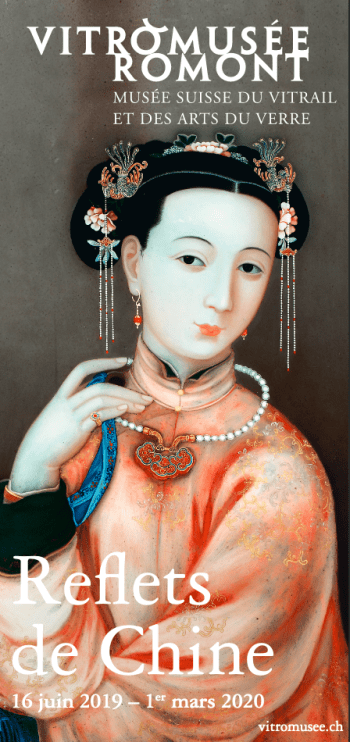 The Vitrocentre and Vitromusée Romont are pleased to announce the Call for Papers for an international conference on Chinese reverse glass painting and related research fields including other media to be held at the museum in Romont, Switzerland 14–16 February 2020. The workshop is jointly organized by the Vitrocentre and Vitromusée Romont and the Section of East Asian Art History (KGOA) at the University of Zurich. It will be held in conjunction with an important exhibition of Chinese reverse glass paintings, held at the museum from 16 June 2019 to 1 March 2020.
Devoted entirely to the glass arts, the Vitromusée Romont houses, manages and showcases important collections that bring together stained-glass windows, reverse glass painting, objects in glass, and graphic works, as well as tools and materials related to the glass arts. The Vitrocentre, its scientific partner, has core tasks primarily in researching the art history of glass arts. For the first time in Switzerland and at international scale, the Vitromusée presents a major survey dedicated to Chinese reverse glass painting, tracing its long history, little known to date. The exhibition gathers examples of the genre from two major collections, from Germany and France, as well as the Vitromusée’s own collection, and features both reverse glass paintings made for export to Europe and for local consumption within China.
The workshop aims to
• open a cross-cultural dialogue between scholars of Asian art and to offer a platform for the presentation and discussion of recent research on Chinese reverse glass paintings and popular culture
• revise historical approaches that have been prevalent in the study and research of Chinese reverse glass paintings and related fields
• elaborate on the existing theories and methodology on the topic
• form new research approaches and methods by young, emerging scholars.
Scholars and curators of Asian art from Europe and beyond are invited to submit their proposals for contributions on Chinese reverse glass paintings. Presenters can be either established scholars (working at museums, universities, or independent scholars) or junior scholars (holding an MA or PhD degree).
Possible topics for the workshop presentations on Chinese reverse glass paintings include
• Chinese reverse glass paintings as points of knowledge transfer between East and West
• Chinese reverse glass paintings in the context of cultural appropriation
• The question of export vs. local consumption of Chinese reverse glass paintings
• Chinese reverse glass paintings as popular and/or elite art
• Technical aspects, types of glass and painting techniques in Chinese reverse glass paintings
• Types of frames in Chinese reverse glass paintings and their meanings
• Connections of Chinese reverse glass paintings to Chinese popular prints
• Connections of Chinese reverse glass paintings to porcelain (Compagnie des Indes orientales, etc.)
• The question of 3D aesthetics in Chinese reverse glass paintings
• Various themes and motives represented in the Chinese reverse glass paintings
• Gaps in understanding of Chinese reverse glass paintings in the East and in the West
• Reception of Chinese reverse glass paintings in the West
• Other East Asian traditions of reverse glass paintings
• Collection histories of the Chinese reverse glass paintings in the West
The languages of the workshop are English, French, and German. Presentations are to last twenty minutes, followed by a ten-minute discussion period. The presentations and the viewing of the exhibition will take place on the first two days of the symposium (14-15 February). The final day (16 February) is an optional day with tours of local historical sites.
Please send a presentation title, a paper proposal (maximum 250 words), and a CV to Elisa Ambrosio (elisa.ambrosio@vitrocentre.ch) by 15 September 2019. Notifications of acceptance will be sent by 15 October 2019. The workshop will cover the costs of accommodation and food during the workshop. Participants are expected to pay for their own transportation. In case you have any questions, please contact: Elisa Ambrosio, elisa.ambrosio@vitrocentre.ch.
Organizational Committee
• Francine Giese (Director of the Vitromusée & Vitrocentre Romont)
• Hans Bjarne Thomsen (Professor of East Asian Art History, University of Zurich)
• Elisa Ambrosio (Curator of the Vitromusée Romont and scientific collaborator of the Vitrocentre Romont)
Exhibition | Chic Emprise: Art and Culture of Tobacco
Now on view at the Museum of the New World in La Rochelle, from the press release:
Chic emprise: Culture, usages et sociabilités du tabac du XVIe au XVIIIe siècle
Musée du Nouveau Monde, La Rochelle, 22 June — 23 September 2019
Curated by Maxime Georges Métraux and Annick Notter
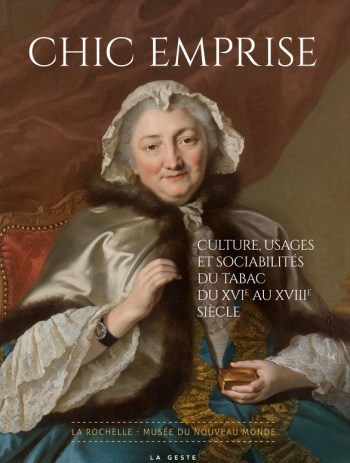 De l’Amérique du Nord en passant par les Caraïbes jusqu’au royaume du Kongo, le tabac est une plante incontournable de l’époque moderne (XVIe–XVIIIe siècle). À la fois produit de consommation, plaisir addictif et marqueur social, il s’est enraciné durablement dans l’ensemble des strates de la société en imprégnant aussi bien les mœurs aristocratiques et bourgeoises que populaires. Originaire d’Amérique, le tabac est rapidement importé avec succès en Europe où il a immédiatement entraîné de vifs débats entre ses défenseurs et ses opposants. Aujourd’hui discréditée et blâmée pour ses effets sur la santé, cette plante bénéficiait alors d’un statut différent, ses prétendues vertus curatives ont parfois été louées au point d’être l’objet de véritables discours de médicalisation. Le tabac véhicule un puissant imaginaire artistique et visuel comme en témoigne la vaste sélection d’œuvres présentées. Par ses multiples usages et son rôle éminemment social, la célèbre « herbe à Nicot » constitue un sujet idéal pour comprendre que l’époque moderne, et plus particulièrement le XVIIIe siècle, est l’un des moments de bascule d’une « civilisation de la rareté et de l’économie stationnaire à celle du développement et de l’abondance[1] ». Outre sa production et sa circulation, cette substance a engendré la fabrication de nombreux objets dédiés à ses diverses utilisations allant des pipes en pierre de Nouvelle-France jusqu’aux précieuses tabatières parisiennes. À l’instar du sucre et des boissons exotiques que sont le thé, le café et le chocolat, cette plante permet de saisir pleinement les processus coloniaux et leurs fonctionnements. L’essor de son commerce s’accompagne de la mise en place d’une imagerie promotionnelle massive dont les enseignes des marchands de tabacs constituent un précieux témoignage. À la croisée de l’histoire naturelle, de l’art et de la culture visuelle, cette exposition se propose d’étudier le tabac selon différentes approches afin d’en souligner son exceptionnelle richesse.
Cette exposition est l’occasion de présenter une grande sélection d’objets grâce à l’aide de plusieurs prêteurs publics (musée du Louvre, BnF, musée du Tabac de Bergerac, MAD Paris, Petit Palais, cité de la céramique de Sèvres, etc.) mais également du soutien de collectionneurs privés.
[1] Daniel Roche, Histoire des choses banales : naissance de la consommation dans les sociétés traditionnelles, XVIIe–XIXe siècle (Paris: Fayard, 1997), p. 14.
◊ ◊ ◊ ◊ ◊
Un catalogue a également été publié par les éditions La Geste:
Chic emprise: Culture, usages et sociabilités du tabac du XVIe au XVIIIe siècle (La Crèche: La Geste Editions, 2019), 256 pages, ISBN: 979-1035304669, €29.
L’ouvrage est richement illustré et composé d’une douzaine d’essais dont voici le sommaire :
1 La production de tabac en Amérique du Nord
• Elodie Peyrol-Kleiber, Les hommes aux pouces verts : cultiver le tabac dans la baie de Chesapeake
• Philippe Hrodej, Le cycle du tabac dans la partie française de Saint Domingue au XVIIe siècle
2 Les pratiques tabagiques
• Samir Boumediene, Du bon usage des choses. Les métamorphoses du tabac entre rites, savoir médicaux et pratiques de consommation
• Catherine Ferland, Usages du tabac au Canada, XVIe–XVIIIe siècle : la rencontre interculturelle
• Anton Serdeczny, De la fumée pour le mort : le tabac entre pratiques médicales et imaginaires culturels
3 Production et circulation des objets du fumeur
• Bernard Clist, Premières mondialisations de l’économie : témoignages par les pipes à fumer du royaume du Kongo de la fin du XVe siècle à la fin du XVIIIe siècle
• Marie-Hélène Daviau, Travailler la pierre pour faire naître la fumée : la pipe de pierre en Nouvelle-France
• Michèle Bimbenet-Privat, Les tabatières parisiennes : un luxe à la pointe de la mode
4 Le tabac et ses représentations
• Agnès Lugo-Ortiz, Des routes du démoniaque : tabac, commerce et culture visuelle aux Caraïbes et leurs axes transatlantiques
• Marianne Volle, La Nicotinia fait un tabac : du récit de voyage au livre botanique, XVIIe–XVIIIe siècles
• Pascale Cugy, ‘Agréable Tabac, charmant amuzement…’ Fumeurs, priseurs et râpeurs dans la gravure de mode sous Louis XIV
• Maxime Georges Métraux, Les enseignes des marchands de tabac au XVIIIe siècle : iconographie coloniale et culture visuelle de la consommation
At Sotheby’s | Treasures from Chatsworth: The Exhibition

Thomas Smith, View of Chatsworth from the Southwest, 1740–44, oil on canvas
(Chatwsorth)
◊ ◊ ◊ ◊ ◊
From Chatsworth:
Treasures from Chatsworth: The Exhibition
Sotheby’s New York, 28 June — 18 September 2019
Highlights from the Devonshire Collection have made their way to New York as part of Sotheby’s Treasures from Chatsworth: The Exhibition, open from 28 June to 18 September 2019 at Sotheby’s New York. Forty-three masterworks were selected to represent the remarkable breadth of the Devonshire Collection—fine art from Rembrandt van Rijn to Lucian Freud, furniture and decorative objects from the 16th century to 21st-century design, and exceptional jewels, garments, and archival materials commemorating historic occasions will all be on view.
Coinciding with Sotheby’s 275th anniversary, as well as the opening of the expanded and reimagined New York galleries, Treasures from Chatsworth is designed by the award-winning creative director David Korins, whose work includes the set designs for the Broadway musical phenomena Hamilton and Dear Evan Hansen, as well as past Sotheby’s exhibitions.
Presenting Treasures from Chatsworth in America is a step towards realising our ambition to share the Devonshire Collection with the world and a wonderful opportunity to engage new audiences with the stories of Chatsworth and the work of the Chatsworth House Trust. To help meet this ambition, Chatsworth in America, Inc—a US non-profit corporation—has been set up by and for Americans with an interest in the historic significance of Chatsworth. You can support Chatsworth in America as a US taxpayer with a tax deductible donation.
From Sotheby’s:
Inspired by Chatsworth: A Selling Exhibition
Sotheby’s New York, 28 June — 18 September 2019
Inspired by Chatsworth: A Selling Exhibition will present a carefully curated group of artworks and objects of exceptional quality that draw inspiration from the country-house aesthetic, as exemplified by the magnificent collection assembled by the Dukes of Devonshire over centuries at Chatsworth. On view alongside Treasures from Chatsworth: The Exhibition, the private selling exhibition will be on display in the newly expanded and reimagined galleries at Sotheby’s New York. The exhibitions will be open simultaneously and their visual parallel will provide the opportunity to celebrate collecting and collectors, of which Chatsworth and the Cavendish family are amongst the greatest examples in history. Inspired by Chatsworth: A Selling Exhibition will also provide today’s collectors with the opportunity to begin or enrich their collections with works of outstanding quality in the Chatsworth taste.
At Sotheby’s | Old Masters Evening Sale
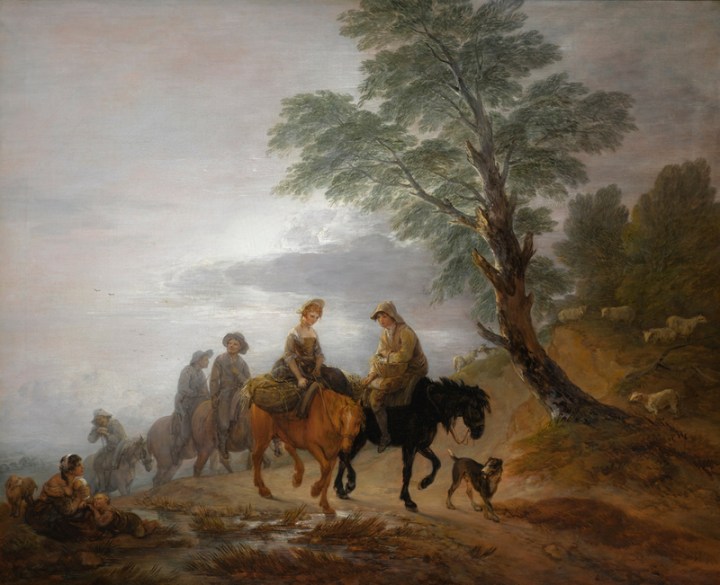
Thomas Gainsborough, Going to Market, Early Morning, oil on canvas, 122 × 147 cm (lot 22, estimate £7–9 million).
◊ ◊ ◊ ◊ ◊
Press release, via Art Daily:
Old Masters Evening Sale (Sale L19033)
Sotheby’s, London, 3 July 2019
This summer, Sotheby’s will present a roll-call of the greatest names in Western art history at its flagship Old Masters Evening Sale (L19033) on 3 July in London. With an overall estimate of £4665.9m/ $59.5–83.7m, the sale next week is one of the strongest sales ever staged in this category, both in value as well as in the quality of works on offer. From some of the finest works by the three key British landscape painters remaining in private hands, to masterpieces and newly discovered works by Renaissance and Baroque masters, the sale features works by the biggest household names spanning six centuries.
British Landscapes
Thomas Gainsborough, Going to Market, Early Morning, estimate £7–9 million
Going to Market, Early Morning (lot 22) is unquestionably one of Gainsborough’s finest masterpieces remaining in private hands, and one of the finest eighteenth-century British landscapes by any artist ever to likely come to market. Painted in 1773 it is one of an important group of three major landscapes Gainsborough painted at this period that deals with the subject of travellers going to or returning from market. The subject and composition of the picture demonstrates Gainsborough’s natural affinity with, and sympathy for the rural poor and includes one of his favourite themes—rustic lovers in an idealised rural setting. Beautifully evoking the early morning journey to market of rural folk as they rise out of the still misty valley into the watery sunlight, this painting acclaimed by scholars and widely praised is one of the artist’s most ravishing landscapes.
John Constable, Study for ‘The White Horse’, estimate £2–3 million
A rare and important compositional study for one of the most celebrated paintings of the English Romantic Movement: The White Horse, which now resides at The Frick Collection in New York. The painting that launched John Constable’s career, The White Horse was the first of Constable’s great ‘Six-Footers’ which cemented the artist’s contemporary fame and which defined his art for generations. Created in 1819, the painting was immediately a critical success and led to the artist being voted an Associate of the Royal Academy the same year. Unlike most of Constable’s major landscapes, for which he produced numerous sketches and went through several drafts before settling upon the final composition, only a small number of preparatory works relating to The White Horse are known. Possibly painted en plein air, the oil sketch shows Constable responding directly to the landscape, capturing the atmosphere of the River Stour, as well as the topographical detail.
J.M.W. Turner, Landscape with Walton Bridges, estimate £4–6 million
One of a small group of ten or so proto-impressionist late pictures by the artist left in private hands, Landscape with Walton Bridges comes to the market for the first time in over 35 years. The central motif—Walton Bridges—is one that the artist had treated twice before in oils, in 1806 and 1807. Clearly a subject with significant meaning to him, in this work he sets the bridge in an idealised, Italianate landscape of his own imagining. Essentially explorations of the effects of light, Turner created the late works for himself, rather than for exhibition or for sale, retaining them for the development of his art. With their bold application of colour, their treatment of light and their deconstruction of form, these late works revolutionised the way the painted image was perceived and are considered to be the artist’s supreme achievement, and the pictures upon which his artistic significance ultimately rest.
J.M.W. Turner, Sun-rise. Whiting Fishing at Margate, 1822, estimate £800,000–1.2 million (part of the Old Master & British Works on Paper Sale)
A celebrated picture which sees the artist working at the height of his powers and on a grand scale, Sun-rise. Whiting Fishing at Margate is one the greatest and most beautiful Turner watercolours to remain in private hands. Positioning himself off the Kentish coast at Margate, a town he had first visited as a small boy and which he regularly returned to throughout his life, Turner looks east in this painting, directly into a mesmeric sunrise, whose magical light gives warmth to everything it touches, before exploding into a myriad of colours on the glass-like surface of the sea. On the left, far in the distance, a guardship announces the dawn by firing its morning gun, while in the foreground, fishermen have already struck lucky and are excitedly hauling in a plentiful catch. Through the cluster of small vessels, the town itself can be made out.
New Discoveries
Diego Rodriguez de Silva y Velázquez, Portrait of Olimpia Maidalchini Pamphilj, estimate £2 –3 million
Lost for nearly 300 years, this is the hitherto missing portrait of Donna Olimpia Maidalchini Pamphilj (1591–1657), the most powerful woman in 17th-century Rome. Sister-in-law, reputed lover, and puppet master of Pope Innocent X, Olimpia controlled all aspects of Vatican life. Arguably one of the earliest feminists, this formidable woman, centuries ahead of her time, ruled in all but name as the de facto Pope, taking control of one of the most powerful and male dominated institutions in European history. Once part of the illustrious collection of the 7th Marques del Carpio, one of the greatest patrons and collectors of arts in 17th-century Italy, this painting was last recorded in 1724, before it disappeared without trace. The whereabouts of the painting remained completely unknown until one day, an unattributed work, sold in the 1980s as ‘anonymous Dutch school’, was brought into Sotheby’s Amsterdam office. An intriguing old cypher hidden on the back of the painting prompted Sotheby’s specialists to begin a process of research and discovery—all of which ultimately led to the realisation that this striking portrait was the long-lost original by Velázquez and one of only a handful of paintings by the great Spanish artist left in private hands.
Giovanni Battista di Jacopo Rosso, called Rosso Fiorentino, The Visitation, estimate £500,000–700,000 (part of the Old Master & British Works on Paper Sale)
This newly discovered 16th-century work by the Italian Mannerist painter is an extremely rare example of a chalk drawing by Rosso Fiorentino, and the first compositional study by the artist to appear on the market for half a century. Long thought lost, it is an important and vital addition to the artist’s corpus of drawings. Delicately executed in black chalk, the ten-figure composition was created by Rosso on the request of Aretine painter Giovanni Antonio Lappoli, who had been granted in 1524 a commission for a private altarpiece for the family chapel of the wealthy Aretine citizen, Cipriano d’Anghiari.
Although Rosso must have executed many drawings in his lifetime, almost all of his graphic works have been lost over the centuries and this work adds significantly to the understanding of the working method of an artist known for his eccentricity, and expressive, unconventional pictorial style. Interestingly, the work, which stayed undetected in the same collection since the 18th century, bears on the verso an old attribution to Michelangelo (probably from the 17th century), which may have contributed to the fact that the work is even now, still in excellent condition.
Baroque Pictures
Jusepe de Ribera, Girl with a Tambourine, estimate £5–7 million
One of Ribera’s most celebrated paintings, this arresting depiction of a girl singing a tune while tapping a tambourine embodies his extraordinary powers of expressive characterisation. Probably one of five works originally depicting the five senses, Girl with a tambourine encapsulates Ribera’s inimitable contribution to the imagery of music-making by merging allegory and genre, as well as portraiture, into one remarkable image. Dated to 1637, this painting also features the artist’s characteristic loyalty to his Spanish roots, signed ‘Ribera español’
Peter Paul Rubens, Head of a Young Warrior, estimate £2.5–3.5 million
Painted in the early 1610s, Head of a Young Warrior shows Rubens in complete control of his medium, his brush, and his subject. The characteristically vivacious and energetic study was most likely kept in the artist’s studio as a prop throughout his life for use in larger compositions, including his painting of Saint Ambrosius of Milan Barring Emperor Theodosius from Entering the Cathedral in Milan, painted ca. 1615–17, now in the Kunsthistorisches Museum in Vienna.
Johann Liss, The Temptation of Saint Mary Magdalene, estimate £4–6 million
One of the finest examples of the artist’s work to remain in private hands, this captivating depiction of the Magdalene choosing Salvation over Temptation marks Liss as one of the most fascinating painters of the entire 17th century. The painting sees the artist add a personal twist to the traditional iconography of the penitent Magdalene, portraying her turning away from worldly temptation towards an angel in a design that recalls traditional Netherlandish renderings of the Choice between Vice and Virtue.
Joachim Antonisz Wtewael, Diana and Actaeon, estimate £4–6 million
Joachim Antonisz Wtewael was the supreme exponent of the last great phase of mannerist painting in northern Europe and the most important in the Netherlands of mythological cabinet pieces painted on copper. The intimate scale of this panel, combined with the meticulous detail and smooth finish afforded by the copper’s surface, mark it as a work intended for personal enjoyment by the spectator, who can appreciate the excitement of the extraordinary myth in tandem with the erotic elegance of its forms.
Pieter Brueghel the Younger, Winter Landscape with a Bird Trap, estimate £1.5–2 million
One of the best loved of all the Brueghel compositions and, in its beautiful evocation of a winter’s day, one of the most enduring images in Western Art. This particular version of the Bird Trap is one of only a small handful that is both signed and dated by Pieter Brueghel the Younger himself, as well as being one of a few to include the figures of the holy family on the far bank.
18th-Century Masterpieces
Francesco Guardi, The Grand Canal, Venice, with San Simeon Piccolo, estimate: £1–1.5 million
Only recently brought to light for the first time, this beautiful depiction of the Grand Canal is a mature work by Francesco Guardi, most probably painted in the 1770s. The far north-western stretch of the Grand Canal, dominated by the neoclassical church of San Simeone Piccolo and its great dome, though not the most famous of Venetian views, was often chosen by Guardi as a subject for his paintings. This canvas is one of a small group of closely related vedute, probably also painted in the same decade and taken from the same viewpoint; it is moreover the only signed example known, and certainly the finest to remain in private hands. Its subtle colour harmonies of creams, pinks, blues and greys, and its wonderful capture of the atmospheric qualities of Venetian light attest to Guardi’s mastery of his subject, but equally noteworthy are his closely observed details of everyday life upon the canal.

Jean-Etienne Liotard, A Woman in Turkish Costume in a Hamam Instructing a Servant, pastel on paper, laid down on canvas, 70 × 56 cm (lot 33, estimate £2,000,000–3,000,00).
Jean-Etienne Liotard, A Woman in Turkish Costume in a Hamam Instructing a Servant, estimate: £2–3 million
This exceptional pastel is one of the most famous images created by Liotard, whose endeavours in exotic subjects such as this would have excited the senses of the 18th-century viewer, providing a window into a different world. Though his ties with his native Switzerland never wavered, there was perhaps no other 18th-century artist who was more truly cosmopolitan, with Liotard working in almost all the main cultural centres of Europe over a career that spanned six decades. His works in his preferred medium of pastel are often of startling technical and compositional originality. This portrait encapsulates all of the technical brilliance and timeless mystery that underpin Liotard’s genius and enduring appeal.
Medieval and Renaissance
Sandro Botticelli and Studio, Madonna and Child, Seated before a Classical Window, estimate £1,500,000–2,000,000
Painted in 1485, or soon after, this well preserved Madonna and Child follows the design of the central section of Botticelli’s famous altarpiece for the Bardi chapel in the church of Santo Spirito, Florence and since 1829 in the Gemaldegalerie, Berlin. Whether by Botticelli in its entirety, as believed by Prof. Laurence Kanter, or by Botticelli with some assistance from his workshop, the head and hand of the Madonna are of particular note and it seems very likely that the same cartoon, to map out the composition, was used for both this and the Bardi altarpiece.
Third Master of Anagni, The Madonna and Child, Two Angels in the Spandrels above, mid-1230s, estimate £200,000–300,000
Probably created in the mid-1230s, this is one the earliest paintings to be offered in an Old Masters sale at Sotheby’s. Executed in a deft graphic style, this remarkable early work depicts the Virgin with the Christ Child with an inset arch. Acquired for the illustrious Stoclet Collection in Brussels in the early 20th century, this work has not been offered for sale for nearly a century.
At Christie’s | Old Master Paintings and Sculpture Sales

Claude-Joseph Vernet, Un port de mer au clair de lune, 1774, oil on canvas, 115 × 163 cm
(Lot 33: sold for €416,000)
◊ ◊ ◊ ◊ ◊
Press release, via Art Daily:
Tableaux anciens et du XIXème siècle (Sale 17586)
Christie’s, Paris, 25 June 2019
The top lot of the Old Masters Paintings sale (17586) in Paris was Diane découvrant la grossesse de Callisto by Denys Van Alsloot (1570–1620), which sold for €454,000, four times its pre-sale estimate.

Attributed to François Boucher, Jeune garçon noir de profil, oil on canvas, 45 × 38 cm (Lot 33: sold for €43,750; estimate €20,000–30,000).
Pierre Etienne, International director of the department, stated: “We are proud of the results achieved today for the first sale of our new team, under the hammer of François de Ricqlès for which this auction was the last of his career at Christie’s. These strong results demonstrate that international buyers, from thirteen countries, are always attracted by high-quality paintings from private provenances and fresh to the market such as the beautiful painting by Claude-Joseph Vernet, which was acquired for €416,000 and for le Baron Gérard’s Portrait of the Countess Starzenska coming from the Counts Doria collection which realised €200,000.”
The young painter Théodore Chassériau was also represented in the sale with a beautiful replica of La Joconde executed when the artist was only seventeen years old. It sold for €162,500 against a pre-sale estimate of €50,000–70,000.
Astrid Centner, Director of the department added: “We were pleased to see the constant very positive response of the market for early Flemish paintings that realised great results today such as for a Portrait of a Man Holding a Carnation, which realised €298,000 against a pre-sale estimate of €40,000–60,000, and a portrait of Saint Magdalene executed by the Flemish school ca. 1530, which achieved €162,500.”
We can also notice the preemption made by the Hyacinthe Rigaud Museum for Portrait d’homme à l’habit bleu executed by Hyacinthe Rigaud ca. 1700–15, which sold for €25,000.
Sale total including buyer’s premium: €3.5million
◊ ◊ ◊ ◊ ◊
Sculpture et Objets d’Art européens (Sale 17587)
Christie’s, Paris, 25 June 2019
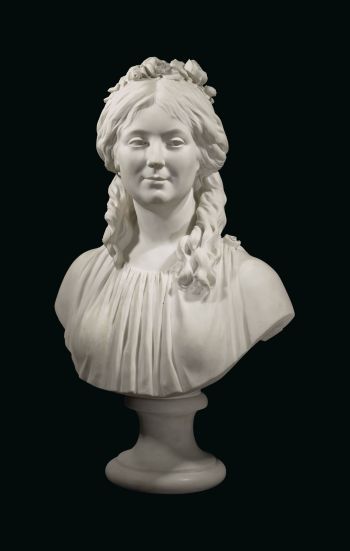
Jean-Antoine Houdon, Marble Bust of the Countess Jean-Isaac de Thellusson de Sorcy, ca. 1791 (Lot 147: sold for €562,000; estimate €200,000–300,000).
The top lot of the Sculpture and Objets d’Art sale (17587) was a bust by Jean-Antoine Houdon representing the Countess Jean-Isaac de Thellusson de Sorcy, executed ca. 1791, which sold for €562,000.
Isabelle d’Amécourt, Director of the department, stated: “We are pleased with these great results illustrating the continuing high demand for European sculptures and works of art. This auction, which attracted buyers from twenty countries, put forward religious iconography as seen with a stone group of Mary Magdalene and a donor (probably Jacqueline de Bavière), which sold for €478,000, and underlined also the immense talent of 18th-century artists such as Jean-Antoine Houdon or Joseph Chinard, whose bust representing the portrait of a lady artist was recently restituted to the Seligmann family thanks to great work of Christie’s teams.”
Further highlights included two impressive terracotta sculptures of allegorical figures by Mathieu de Tombay, which achieved €112,500 against a pre-sale estimate of €50,000–80,000, and a linden and walnut wood relief of the Abduction of Ganymede executed by Guiseppe Maria Bonzanigo, which realised €47,500.
A real enthusiasm was seen once again for beautiful walnut staircase models. The important group of sixteen staircase models from Henri Klinger’s collection achieved a total of €243,375. Among the highlights was a walnut double staircase executed by Ernst Pinedo in 1897, which was sold for €40,000 against a pre-sale estimate of €5,000–8,000, and another double staircase realised in Amiens ca. 1925, which achieved €37,500 against a pre-sale estimate of €6,000–9,000.
Sale total including buyer’s premium: €2.5million
Call for Papers | New Perspectives on British Orientalism
From WG-AV:
Eastern Questions: New Perspectives on British Orientalism
Watts Gallery – Artists’ Village, Compton (Surrey) and Royal Holloway, University of London, Egham (Surrey), 16–17 October 2019
Proposals due by 31 July 2019

John Frederick Lewis, The Attendant on the Bath, 1854, oil on panel (Preston: Harris Museum, Art Gallery & Library).
To coincide with Watts Gallery – Artists’ Village (WG-AV) exhibition John Frederick Lewis: Facing Fame (9 July – 3 November 2019) this interdisciplinary event aims to explore new perspectives on the intersection between Orientalism and visual culture across the long nineteenth century. Alongside WG-AV’s John Frederick Lewis exhibition, the collection of so-called ‘uncomfortable pictures’ at Royal Holloway (which includes Edwin Long’s Babylonian Marriage Market) will act as a catalyst for wide-ranging debates around Orientalism’s place within British scholarship today.
This conference invites contributions that explore the visual material of the Orient in the contexts of transculturation, imaginative geographies, and cultural border crossing in both directions. This event hopes to attract a wide range of perspectives and invites proposals from scholars in all sub-fields of the arts, humanities, and social sciences.
We welcome proposals for 20-minute papers and will be particularly interested in the following topics:
• The Orient in British painting, sculpture, photography, print, the decorative and applied arts or other media
• British artist-travellers to the Middle East and North Africa in the long nineteenth century
• Edward Said’s Orientalism and its legacy forty years on
• British imperialism, colonial histories, and notions of the Orient
• Networks of artistic production and influence among artist-travellers
• Women as agents of empire
• Construction and presentation of gender
• Role and representation of Spain and European-based ‘othering’ as a precursor to travels to the East
• Interrelationship between British and French Orientalism
• Interrelationship between the Middle and Far East (including Chinoiserie and Japonisme)
• Intersections between Orientalist painting, history painting, and genre painting
• Legacies of British Orientalist artworks in public and private collections
In addition to 20-minute papers, we also invite participants for a series of pop-up debates that will take place with the exhibition space. We invite submissions for informal 2– to 3–minute responses to the following key works in John Frederick Lewis: Facing Fame at Watts Gallery and the Royal Holloway Art Gallery:
• John Frederick Lewis, In the Bezestein: El Khan Khalil (1860), Blackburn Museum and Art Gallery
• John Frederick Lewis, In the Bey’s Garden (1865), Harris Museum & Art Gallery, Preston
• Edwin Long, The Babylonian Marriage Market (1875), Royal Holloway
• David Roberts, Pilgrims Approaching Jerusalem (1841), Royal Holloway
For 20-minute papers, please submit abstracts of 300 words and biographies of no more than 100 words. If you would like to be a respondent in a pop-up discussion, please submit proposals of 150 words and biographies of no more than 100 words. Please send submissions to Abbie Latham at Watts Gallery – Artists’ Village (curatorialtrainee@wattsgallery.org.uk) by 31 July 2019. Please do not hesitate to get in touch if you have any questions.
This event is kindly supported by the British Art Research School (BARS), University of York and the Association for Studies in Egypt and the Near East (ASTENE).










 Enfilade
leave a comment