At Sotheby’s | Jewels Owned by Marie Antoinette
Press release, via Art Daily, for the auction at Sotheby’s:
Royal Jewels from the Bourbon Parma Family
Sotheby’s, Geneva, 14 November 2018, Sale GE1809

Natural pearl and diamond pendant, 18th century; set with an oval diamond supporting a diamond bow motif and a slightly baroque drop-shaped natural pearl measuring approximately 16 × 18 × 26mm, hook and hinged back fitting. Estimated at $1–2 million.
Sotheby’s unveiled additional highlights from one of the most important royal jewellery collections ever to be presented at auction. On 14 November 2018, in Geneva, royal jewels from the Bourbon Parma Family will be offered at auction for the first time, including treasures which belonged to France’s ill-fated queen, Marie Antoinette (1755–1793). During an international tour of public exhibitions in the coming weeks, jewellery lovers will be able to view these historic jewels, which carry with them more than 200 years of European history.
An initial announcement in June captured the world’s imagination, when it was revealed that Sotheby’s would offer this extraordinary collection of treasures in Geneva. The sale includes pieces which can be traced back to Marie Antoinette led by an extraordinary diamond and natural pearl pendant estimated at $1–2 million, as well treasures from her brother-in-law, King Charles X of France (1757–1836), the Archdukes of Austria and the Dukes of Parma.
Jewels of Marie Antoinette
Never in the course of history has the destiny of a queen been so closely associated with jewels than that of Marie Antoinette. Her great love of pearls and diamonds is well-known and a number of historians have cited Napoleon’s view, that the so-called ‘affair of the diamond necklace’—a scandal which tarnished the queen’s reputation in 1785—was one of the causes of the French Revolution.
The impressive ensemble of jewels to be offered this autumn has an extraordinary story. In March 1791, King Louis XVI, Marie Antoinette and their children began to prepare their escape from France. According to accounts written by Marie Antoinette’s lady in waiting, Madame Campan, the queen spent an entire evening in the Tuileries Palace wrapping all of her diamonds, rubies, and pearls in cotton and placing them in a wooden chest. In the following days, the jewels were sent to Brussels, which was under the rule of the queen’s sister, Archduchess Marie-Christine and which was home to Count Mercy Argentau. The count, the former Austrian Ambassador to Paris, was one of the only men who had retained the queen’s trust. It was he who took delivery of the jewels and sent them on to Vienna, into the safe keeping of the Austrian Emperor, Marie Antoinette’s nephew.
Altogether, the collection includes 10 jewels which belonged to Marie Antoinette.
In 1792, the royal family was imprisoned in the Temple tower. Louis XVI and Marie Antoinette were executed by guillotine in 1793 and their 10-year old son, Louis XVII, died in captivity. The king and queen’s only surviving child, Marie-Thérèse de France (1778–1851), ‘Madame Royale’, was released in December 1795, after three years of solitary confinement. After learning of the deaths of her mother and brother, she was sent to Austria. Upon her arrival in Vienna in 1796, she was given her mother’s jewels by her cousin, the emperor. Having borne no children of her own, Madame Royale bequeathed part of her jewellery collection to her niece and adopted daughter, Louise of France (1819–1864), Duchess of Parma and grand-daughter of Charles X, King of France (1757–1836), who in turn left them to her son, Robert I (1848–1907), the last ruling Duke of Parma.
In addition to the exquisite pearl jewels announced in June, several more pearl jewels to be offered in November belonged to Marie Antoinette, including a beautiful pair of natural pearl and diamond earrings (estimate $200,000–300,000). Also from Marie Antoinette is a superb single-strand natural pearl necklace (estimate $40,000–70,000).
A beautiful six-strand pearl necklace also provides a direct link to the iconic queen of France. Its clasp—which remains unaltered today—was part of her collection and features five large and 18 smaller natural pearls. In Marie Antoinette’s day, it formed the clasp of a six-row natural pearl bracelet, one of a pair. The necklace was commissioned by later generations of the Bourbon Parma family and strung with cultured pearls (estimate $5,000–8,000).
Five fascinating diamond jewels to be auctioned in November can be traced back to Marie Antoinette. Among them is a stunning diamond brooch from the late 18th century, featuring a beautiful yellow diamond. The double ribbon bow was formerly part of Marie Antoinette’s collection, and it is thought that the yellow diamond pendant was added at a later date (estimate CHF $50,000–80,000).
Created as a memento, a diamond ring bearing initials ‘MA’ for Marie Antoinette and containing a lock of her hair provides a fascinatingly intimate link to the queen. It is offered together with a ring with the monogram and hair of her father-in-law, Louis, Dauphin of France (1729–1765) who died before he could ascend the throne, and a diamond plaque bearing the monogram ‘MT’ set in diamonds, which refers to Marie-Thérèse of Savoie (1803–1879), Duchess of Parma and wife of Charles II, Duke of Parma (estimate for the two rings and plaque: $20,000–50,000).
By family tradition, the diamonds adorning this beautiful brooch belonged to Marie Antoinette. In her detailed inventory of the family’s jewels, Maria Anna of Austria (1882–1940), explains she was informed of the history of the brooch by her father-in-law, Robert I of Parma (1848–1907), who presented it to her on the occasion of her engagement to his son, Elie de Bourbon Parme (1880–1959) (estimate $95,000–140,000).
Also passed down through generations of Marie Antoinette’s descendants is a diamond ring decorated with her portrait, made in the late 18th century. In her will, Marie Antoinette’s daughter, Marie Thérèse de France (also known as Madame Royale), mentions that the portrait, which is set within a frame of pearls, is a likeness of her mother (estimate $8,000–12,000).
Marie Antoinette’s passion for Jewellery also extended to fine watches, as is evidenced by a pocket watch. Although the movement of the watch has been changed, its case—in blue enamel and encrusted with pearls—belonged to the queen. It bears the initials ‘M.A.’ on the inside of the case, along with three fleur de lys motifs (estimate $1,000–2,000).
Additional Jewels from the French Royal Family
The collection is also highlighted by jewels that belonged to King Charles X (1757–1836), the last King of France and last of the Bourbon rulers, his son, the Duke of Angoulême and their descendants. Resolutely conservative, accused by his own brother Louis XVI of being “plus royaliste que le roi” (more royalist than the king), Charles X revived a number of orders of chivalry that had been abolished during the French revolution and under Napoleon’s rule.
A breathtaking diamond tiara (estimate $350,000–550,000) offers a fascinating insight into how precious objects were disassembled in order to retrieve diamonds and gemstones, so they could be re-used as fashions evolved. The diamonds that adorn the tiara came from a badge of the Royal Order of the Holy Spirit, a French order of chivalry founded by King Henri III in 1578. The insignia was originally owned by Charles X, Marie Antoinette’s brother-in-law. The diamonds later passed to Robert I, Duke of Parma (1848–1907). The tiara was created using the precious stones around 1912 for Archduchess Maria Anna of Austria (1882–1940) by the celebrated Vienna jeweller Hübner, who designed it to allow the wearer to explore different styles: the fleur de lys motifs of this stunning piece can be detached and worn separately as brooches. The frame of Charles X’s order, which originally held the diamonds, has remained in the family and will also be offered in November (estimate $150-300).
Extraordinary in its workmanship and powerful symbolism, this jeweled badge of the Order of the Golden Fleece belonged to Louis Antoine of Bourbon, Duke of Angoulême (1775–1844), who married Marie-Antoinette’s daughter, his cousin. The Order of the Golden Fleece is widely considered to be the most prestigious and exclusive order of chivalry in the world. It is likely that Louis Antoine received the badge following his participation in the Spanish Expedition of 1823, thanks to which his cousin, Ferdinand of Bourbon was restored as absolute king of Spain. A sumptuous example of the order’s symbol, beneath a large white diamond this badge features the traditional French royal symbol, the oriflamme, represented by a central sapphire, surrounded by flames composed of rubies. The fleece of the ram forms the lower part of the jewel, realized in gold and diamonds (estimate $300,000–400,000).
Boasting the same extraordinary provenance, this plaque of the Royal Order of the Holy Spirit (right) was awarded to Louis Antoine, Duke of Angoulême before being passed down through the generations to Robert I, son of Charles III of Parma and Louise de France (and Marie Antoinette’s great-nephew). The most prestigious French order of chivalry during its 252 years of existence (1578–1830), it was abolished during the French Revolution, and then revived by Charles X who restored the ceremonies of the Order. The loop at the top of the badge (adorned with baguette- and round-cut diamonds) was designed so that the order could be worn on a tie without having to alter the jewel (estimate $100,000–150,000).
Royal Treasures of Austria
Sumptuous jewels passed down through the Bourbon Parma family from the imperial family of Austria will also be offered in November. A beautiful Burmese ruby and diamond set, composed of a brooch and a pair of earrings, dates from the turn of the last century. It conjures up images of the glamour and elegance of the Austrian court. Originally part of the collection of Queen Isabella II of Spain (1830–1904), the set was later purchased by Archduke and Archduchess Frédéric of Austria and inherited by their daughter, Maria Anna, Archduchess of Austria (1882–1940), who mentions it in her inventory of the family jewels (estimate $150,000–250,000).
A diamond bow brooch from the 18th century also stands out among the jewels from the Austrian side of the Bourbon-Parma family. It originally belonged to Empress Marie Thérèse of Austria (1717–1780), Marie Antoinette’s mother, and later to Archduke Rainier of Austria (1827–1913) before passing down through the family to Maria Anna. Its intricate design and workmanship illustrate the quality of jewels created for the royal family (estimate $75,000–110,000).
In her inventory, Maria Anna recorded that this delightful diamond brooch, with a yellow sapphire in its centre, originally belonged to her mother, Princess Isabella of Croÿ (1856–1931) (estimate $40,000–65,000). Maria Anna received these simple yet elegant diamond earrings from her father, Archduke Frédéric, on the occasion of her wedding in 1903 (estimate $50,000–80,000).
Tour Dates
Munich | 18 September
Hong Kong | 28 September – 2 October
Dubai | 7–9 October
New York | 12–16 October
London | 20–22 October
Singapore | 26–27 October
Taipei | 30–31 October
◊ ◊ ◊ ◊ ◊
Note (added 15 November 2018) — The pearl pendant, estimated to sell for up to $2million, fetched an extraordinary $36millon. The ten pieces auctioned reached a total of $42.7 million against a pre-sale estimate of $1.6–2.9 million. The post sale press release is available here.
Conference | Hadrian’s Villa and Its Reception
From Munich’s Zentralinstitut für Kunstgeschichte:
Villa Adriana: Die kaiserliche Residenz und ihre Rezeption
Zentralinstitut für Kunstgeschichte, Munich, 17 October 2018
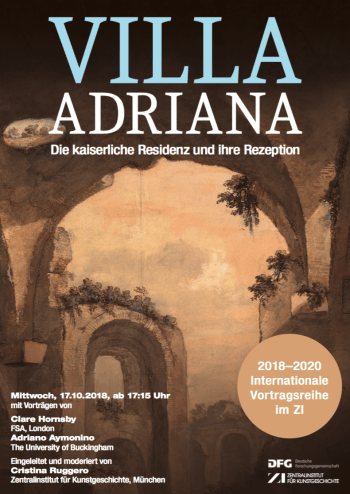 17:15 Cristina Ruggero (ZI, München), Bares für Rares: Antike aus der Hadriansvilla und der römische Kunstmarkt
17:45 Clare Hornsby (London), Man of Spirit, Man of Taste, Man of Fashion: Deciphering Identities of the British Collectors of Ancient Marbles
This talk will examine some examples of motivations for collecting: art as investment, response to peer pressure or fashion, ambition to form taste or to improve national standards; rarely were the motivations clear cut. The collectors included here will range from the politically ambitious commoner Bubb Dodington and his highly-placed dealer Cardinal Albani in the late 1740s, to the archetype of the nobleman collector the Earl of Shelburne, who acquired several pieces from Hadrian’s Villa in the 1760s and 70s. Others considered are the obsessively acquisitive gentleman-scholar Charles Townley and the banker-collector Lyde Browne, their activities furnishing us with a look at the role of the secondary market and the expansion of the mania for collecting. For all of these collectors, Hadrian’s Villa was the provenance par excellence for any ancient statue; reference will be made in this talk to some of the sculptures discovered there and how the British excavators and dealers used that provenance to add even further value to the perennial glamour of the ancient work of art.
18:30 Adriano Aymonino (The University of Buckingham), The Reception of Ancient Painting in the Eighteenth Century: Theoretical Debate, Antiquarian Publications, and the Visual Arts
This talk focuses on the nature of the relationship between the reception of ancient painting and the humanistic theory of art. It argues that this relationship was twofold: on the one hand, surviving textual evidence on Greek and Roman painting provided examples, tropes and principles that were instrumental in shaping art theory, from Leon Battista Alberti to Giovanni Pietro Bellori and the theoreticians of eighteenth-century classicism. On the other hand, the almost complete lack of physical remains of these artworks contributed to an idealised vision of ancient painting that was equally influential in defining some of the essential tendencies that shaped this theoretical tradition. Specifically, my paper will investigate how the relationship between theory and object evolved in the face of those new discoveries, publications and antiquarian ideas that proliferated over the course of the eighteenth century—with a particular focus on Hadrian’s Villa.
Additional information is available here»
Research Lunch | Nicole Cochrane on Classical Art in Britain
From the PMC:
Nicole Cochrane, Ancient Sculpture and the Narratives of Collecting: (Re)Contextualising the Collection and Display of Classical Art in Britain
Paul Mellon Centre for Studies in British Art, London, 5 October 2018

Joseph Wright of Derby, Academy by Lamplight, 1769, oil on canvas (New Haven: Yale Center for British Art, Paul Mellon Collection).
Collections of ancient art are an ever-present sight in British museums and art galleries, largely due to the efforts of the collecting practices of Britain’s wealthy, male elite. Through an exploration of private collections of ancient art and their transition to public display, this paper explores the implicit and explicit role of the individual collector on the reception of antiquity in the late eighteenth and nineteenth century museum. It will analyse how collection formation and display reinforced the connection between owner and object, irrevocably tying the collector with his possessions. Turning then to their museum contexts, arguing that the individual created a reception of the classical world which is always necessarily mediated by the narrative of the collector. It hopes to shed new light on the way we analyse the space and context of the public and private gallery, arguing that the identity and narrative of the collector continues to have an important, yet overlooked, effect on the way we understand the ancient world.
Research Lunches are a series of free lunchtime research talks. All are welcome, but please book a ticket in advance. 1:00–2:00pm, Seminar Room, Paul Mellon Centre.
Nicole Cochrane is a final year PhD candidate at the University of Hull as part of the AHRC Heritage Consortium. Her PhD explores the way we understand and interpret the ancient world within the museum environment, asserting the importance of the private collector and their private display as imbedding legacies and narratives of collecting on British museums and galleries of ancient art. As part of her PhD project, in 2016 she completed an internship at the Henry Moore Institute in Leeds proposing a project on the global history of sculpture collecting.
Exhibition | Isabelle de Borchgrave
From The Frick Pittsburgh:
Isabelle de Borchgrave: Fashioning Art from Paper
Dixon Gallery and Gardens, Memphis, 15 October 2017 — 7 January 2018
The Society of the Four Arts, Palm Beach, 27 January — 15 April 2018
Oklahoma City Museum of Art, 16 June — 9 September 2018
The Frick Art Museum, Pittsburgh, 13 October 2018 — 6 January 2019
The Baker Museum, Artis, Naples, February — May 2019
Curated by Dennita Sewell

Isabelle de Borchgrave, Banyan and Waistcoat, 1998; inspired by a banyan and waistcoat ca. 1730 worn by Peter the Great of Russia.
Co-organized by the Frick in collaboration with four other American museums, this major exhibition presents the full breadth of de Borchgrave’s exploration of historical costume through contemporary paper sculpture. If you’ve never seen the artist’s work, you will be delighted by these breathtaking, life-size renditions of historic clothing created completely from artfully painted, pleated, crumpled, and manipulated paper.
From replicas of Renaissance Italian gowns to recreations of the fantastical modernist costumes of the Ballet Russes, Isabelle de Borchgrave’s work is meticulously crafted and astonishingly beautiful. The artist’s interest in creating paper costumes was sparked by a visit to the Metropolitan Museum of Art in 1994, where she found herself inspired by the historic costumes on display. Back in her studio, she began to experiment with creating renditions of the pieces in paper. Since then, de Borchgrave’s paper costumes have been featured in major exhibitions around the world.
This immersive exhibition celebrates the breadth of de Borchgrave’s work with costume and fashion history and is designed to introduce her work to a wider audience. De Borchgrave’s paper sculptures are masterpieces of trompe l’oeil—even upon close inspection it is often difficult to discern that the costumes are made of paper. At the Frick, de Borchgrave’s work will be exhibited throughout the museum, creating a dialogue with the museum’s collection. Joining the exhibition will be the Frick’s recently commissioned piece inspired by one of our best-known masterpieces—Peter Paul Rubens’ Portrait of Charlotte- Marguerite de Montmorency, Princess of Condé.
The exhibition will include examples from all the artist’s major series, beginning with her exploration of 300 years of fashion history in the works created for Papiers à la Mode. The works from her Splendors of the Medici series are inspired by Italian Renaissance costumes portrayed in Old Master paintings. Her next series, The World of Mariano Fortuny explored the work of the iconoclastic Spanish fashion designer, famously based in Venice, and her most recent series, Les Ballet Russes features fantastical modernist costumes designed by artists like Picasso, Bakst, and Matisse. The Frick’s recent commission will be the only new piece included in the exhibition. A fully illustrated color catalogue accompanies the exhibition.
Research Lunch | Wolf Burchard on Italian Royal Furniture
From the PMC:
Wolf Burchard, Italian Royal Furniture at Attingham Park
Paul Mellon Centre for Studies in British Art, London, 2 October 2018
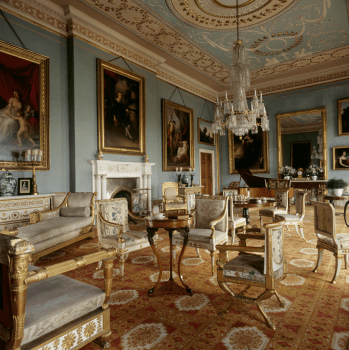 Attingham Park, Shropshire was home to eight generations of the Berwick family, before it was bequeathed to the National Trust in 1947. Its collection comprises a remarkable assemblage of early 19th-century Italian gilt-wood furniture, acquired by William Noel Hill, 3rd Lord Berwick during his diplomatic missions in Sardinia, Turin, and Naples between 1808 and 1833. The pièce de résistance of his furniture is a neo-classical daybed, which—for generations— was thought to have belonged to Caroline Murat, sister of Napoleon. New research, however, reveals that it actually belonged to Maria Theresa, Queen of Sardinia and niece of Marie Antoinette of France. Wolf Burchard’s lecture disentangles the fascinating history of Maria Theresa’s furniture—which is associated with two palazzi in Milan and Genoa as well as the leading architects of the day, Giocondo Albertolli and Carlo Randoni—and how it came to Attingham.
The Fellows Lunches are a series of free lunchtime research talks given by recipients of Paul Mellon Centre Fellowships and Grants. All are welcome, but please book a ticket in advance. 1:00–2:00pm, Seminar Room, Paul Mellon Centre.
Wolf Burchard is Furniture Research Curator at the National Trust. In 2015, the Trust’s Furniture Research and Cataloguing Project received generous funding from the Paul Mellon Centre and the Royal Oak Foundation. Burchard was previously Curatorial Assistant at the Royal Collection Trust from 2009 to 2014. He studied history of art and architecture at the universities of Tübingen, Vienna and the Courtauld Institute of Art, from which he holds an MA and PhD. He is the author of The Sovereign Artist: Charles Le Brun and the Image of Louis XIV (Paul Holberton Publishing 2016), publishes and regularly lectures on the art and architectural patronage at the British, French and German courts; he is on the board of trustees of the Georgian Group and the Furniture History Society as well as on the vetting panels of TEFAF Maastricht and New York, and Masterpiece Art Fair.
Exhibition | The Chocolate Girl by Liotard
Notice of the exhibition appeared at Enfilade in April, but here are the details for the catalogue, published in association with Hirmer Verlag:
Stephan Koja and Roland Enke, eds., ‘The Most Beautiful Pastel Ever Seen’: The Chocolate Girl by Jean-Étienne Liotard in the Dresden Gemäldegalerie (Munich: Hirmer Verlag, 2018), 272 pages, ISBN: 978-3777431369, $42.
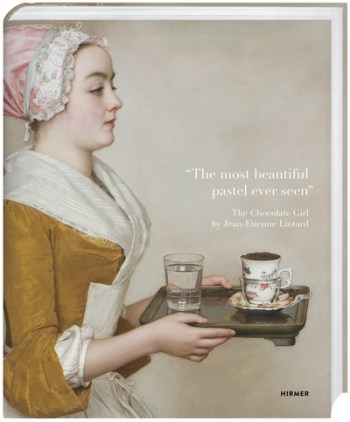 The Chocolate Girl is one of the most famous works by the Swiss artist Jean-Étienne Liotard. This richly illustrated volume leads the reader through the age in which it was created during the French-inspired Rococo and into the Vienna of Empress Maria Theresia, where the work was painted. It also explains the art of pastel painting, in which this enchanting work has been executed. The painting had a tremendous effect in those days and still does so today. Even during Liotard’s life (1702–1789) his pastel painting was highly valued, as the description by the most famous pastel artist Rosalba Carriera as “the most beautiful pastel” demonstrates. The Chocolate Girl shows a simple, unknown domestic servant, until then a rarely chosen subject. In its sober and precise observation it reflects the art of the Enlightenment as well as anticipating the realism of the nineteenth century. Chocolate itself, always associated with pleasure, contributes further to the particular charm. Characteristic works from other creative periods complete the overview of Liotard’s oeuvre.
New Book | Collecting the Past: British Collectors
From Routledge:
Toby Burrows and Cynthia Johnston, eds., Collecting the Past: British Collectors and their Collections from the 18th to the 20th Centuries (New York: Routledge, 2018), 144 pages, ISBN: 978-0815382348, $60.
 Today’s libraries and museums are heavily indebted to the passions and obsessions of numerous individual collectors who devoted their lives to amassing collections of books, manuscripts, artworks, and other culturally significant objects. Collecting the Past brings together the latest research on a wide range of significant British collectors from the eighteenth to the twentieth centuries, including Hans Sloane, Sarah Sophia Banks, Thomas Phillipps, Sydney Cockerell, J. P. Morgan Jr., Alfred Chester Beatty, and R. E. Hart.
Contributors to the volume examine the phenomenon of collecting in a variety of settings and across a range of different materials. Considering the aims and motives that led these collectors to assemble such remarkable collections, the book also examines the history of these collections after the collector’s death. Particular attention is given to the often complicated relationship between collectors and the public institutions that subsequently came to house their collections. Situated within the framework of cultural collecting more generally, this book offers an authoritative series of essays on key collectors.
Toby Burrows is Senior Researcher at the University of Oxford and a Senior Honorary Research Fellow at the University of Western Australia.
Cynthia Johnston is Lecturer in the History of the Book and Communications at the Institute of English Studies, School of Advanced Study, University of London.
C O N T E N T S
1 Toby Burrows and Cynthia Johnston, Collecting the Past: Manuscript and Book Collecting in the Nineteenth and Twentieth Centuries
2 Alice Marples, Creating and Keeping a National Treasure: The Changing Uses of Hans Sloane’s Collection in the Eighteenth Century
3 Arlene Leis, Sarah Sophia Banks: A ‘Truly Interesting Collection of Visiting Cards and Co.’
4 Toby Burrows, ‘There Never Was Such a Collector Since the World Began’: A New Look at Sir Thomas Phillipps
5 Laura Cleaver and Danielle Magnusson, American Collectors and the Trade in Medieval Illuminated Manuscripts in London, 1919–1939: J. P. Morgan Junior, A. Chester Beatty, and Bernard Quaritch Ltd.
6 Stella Panayotova, Sydney Cockerell: A Bibliophile Director-Collector
7 Cynthia Johnston, Spending a Fortune: Robert Edward Hart, Bibliophile and Numismatist, An Industrialist Collector in Blackburn, Lancashire
8 Karen Attar, Ossified Collections: The Past Encapsulated in British Institutions Today
Exhibition | Tudors to Windsors: British Royal Portraits
From the MFAH:
Tudors to Windsors: British Royal Portraits
Museum of Fine Arts, Houston, 7 October 2018 — 27 January 2019
Bendigo Art Gallery, 16 March — 14 July 2019
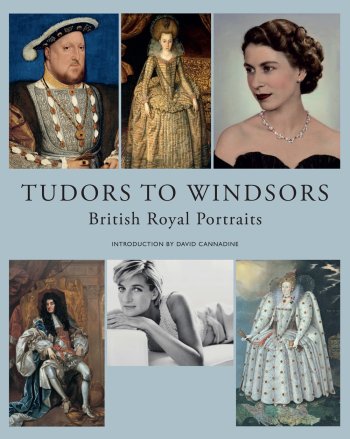 Tudors to Windsors: British Royal Portraits from Holbein to Warhol sheds new light on changing ideas of monarchy and nationhood in Britain. The exhibition features portraits of British royalty spanning 500 years, by artists from Hans Holbein and Sir Joshua Reynolds to Annie Leibovitz and Andy Warhol.
In a sweeping survey, Tudors to Windsors covers the cavalcade of kings, queens, princes, and princesses who have graced the British crown. The MFAH is the only U.S. venue to host this unprecedented exhibition, part of a major partnership with the National Portrait Gallery in London. Some 150 objects—most never before seen outside of England—tell the story of Britain’s monarchy through masterworks of painting, sculpture, and photography.
Visitors have an extraordinary opportunity to come face-to-face with the fascinating figures of British royalty. Tudors to Windsors explores four royal dynasties: the House of Tudor (1485–1603), the House of Stuart (1603–1714), the House of Hanover (1714–1901), and the present-day House of Windsor. Among the many works of art on view are portraits featuring King Henry VIII, Queen Elizabeth I, King George I, Queen Victoria, Queen Elizabeth II, Princess Diana, and Prince William.
Tudors to Windsors: British Royal Portraits, with an introduction by David Cannadine (London: National Portrait Gallery, 2018), 240 pages, ISBN 978-1855147560, $50.
Call for Nominations | Eldredge Book Prize
2019 Charles C. Eldredge Prize
Nominations due by 1 December 2018
The Smithsonian American Art Museum is now accepting nominations for the 2019 Charles C. Eldredge Prize. The prize is given annually by the museum for outstanding scholarship in the field of American art. A cash award of $3,000 is made to the author of a recent book-length publication that provides new insights into works of art, the artists who made them, or aspects of history and theory that enrich our understanding of the artistic heritage of the United States. The Eldredge Prize seeks to recognize originality and thoroughness of research, excellence of writing, clarity of method, and significance for professional or public audiences. It is especially meant to honor those authors who deepen or focus debates in the field, or who broaden the discipline by reaching beyond traditional boundaries.
Single-author books devoted to any aspect of the visual arts of the United States and published in the three previous calendar years (2016–2018) are eligible. To nominate a book, please send a one-page letter explaining the work’s significance to the field of American art history and discussing the quality of the author’s scholarship and methodology. Nominations by authors or publishers for their own books will not be considered. The deadline for nominations is December 1, 2018. Please send them to: The Charles C. Eldredge Prize, Research and Scholars Center, Smithsonian American Art Museum, P.O. Box 37012, MRC 970, Washington, D.C. 20013-7012. Nominations will also be accepted by email: eldredge@si.edu, or fax: (202) 633-8373. For more information about the prize, please visit americanart.si.edu/research/awards/eldredge.
The museum will host a lecture by University of Texas at Austin professor Susan Rather, winner of the 2018 Eldredge Prize, on February 7, 2019, at 4pm. The talk will be related to Rather’s award-winning book, The American School: Artists and Status in the Late Colonial and Early National Era. It will also be available via webcast.
Material Fictions, Special Issues of ECF, 2018–19
The editors are pleased to announce the upcoming publication of a special issue of Eighteenth-Century Fiction:
Material Fictions, a Special Issue of Eighteenth-Century Fiction
Edited by Eugenia Zuroski (McMaster University) and Michael Yonan (University of Missouri)
 Eugenia Zuroski and Michael Yonan, Material Fictions: A Dialogue as Introduction
Articles in Part 1 — ECF 31.1 (Fall 2018)
• Elizabeth Kowaleski Wallace, ‘Character Resolved into Clay’: The Toby Jug, Eighteenth-Century English Ceramics, and the Rise of Consumer Culture
• Emily M. West, Animal Things, Human Language, and Children’s Education
• Freya Gowrley, Craft(ing) Narratives: Specimens, Souvenirs, and ‘Morsels’ in A la Ronde’s Specimen Table
• Conny Cassity, Caught by the Throat: Anti-slavery Assemblages in Paul et Virginie and Belinda
• Emma Newport, The Fictility of Porcelain: Making and Shaping Meaning in Lady Dorothea Banks’s ‘Dairy Book’
• Joann Gohmann, Colonizing through Clay: A Case Study of the Pineapple in British Material Culture
• Tili Boon Cuillé, Of Mind and Matter in Charles Duclos’s Acajou et Zirphile
• Emma Peacocke, Puppets, Waxworks, and a Wooden Dramatis Personae: Eighteenth-Century Material Culture and Philosophical History in William Godwin’s Fleetwood
Articles in Part 2 — ECF 31.2 (Winter 2019), forthcoming
• Chloe Wigston Smith, Bodkin Aesthetics: Small Things in the Eighteenth Century
• Timothy Campbell, Soft Materiality: Dress and Material Fiction in T.S. Surr’s A Winter in London
• Tracey Hutchings-Goetz, The Glove as Fetish Object in Eighteenth-Century Fiction and Culture
• Alicia Kerfoot, Virtuous Footwear: Pamela’s Shoe Heel and Cinderilla’s ‘Little Glass Slipper’
• Samuel Diener, Eighteenth-Century Pipes and the Erasure of the Disposable Object
• Ula Lukszo Klein, Dildos and Material Sapphism in the Eighteenth Century
• Alicia Caticha, ‘Neither Poets, Painters, nor Sculptors’: Classical Mimesis and the Art of Female Hairdressing in Eighteenth-Century France
• Sean Silver, Afterword: What Do We Mean by ‘Material’?










 Enfilade
leave a comment