Williamsburg Acquires Silver Teapot

Teapot, 1771–72, marked by Andrew Fogelberg, Swedish/English, working ca. 1767–deceased ca. 1815; sterling silver and wood (Colonial Williamsburg, gift of Angus Sladen of Hampshire, England, a descendant of the fourth earl of Dunmore, 2018-128).
◊ ◊ ◊ ◊ ◊
Press release (17 September 2018) from Colonial Williamsburg:
A small, delicately engraved, silver teapot that belonged to the Scottish nobleman John Murray (ca. 1730–1809), fourth earl of Dunmore and Virginia’s last royal governor, which descended through Lord Dunmore’s family, is now part of the Colonial Williamsburg Foundation’s collection. Engraved with the Murray family armorial crest beneath an earl’s coronet, it was made in London in 1771–72 under the sponsorship of the Swedish-born silversmith Andrew Fogelberg. This gift is the first example of silver marked by Fogelberg to enter the collection.
“This remarkable teapot owned by Virginia’s last royal governor represents our nation’s history in a unique way that enables us to authentically tell America’s enduring story,” said Mitchell B. Reiss, president and CEO of the Colonial Williamsburg Foundation. “Gifts such as this one permit us to better convey the human dimension of our country’s history in an exceptional manner.”
Lord Dunmore, a Scottish peer initially sent to the colonies as royal governor of New York, was transferred to Virginia less than one year later as King George III’s representative in the same capacity. He had a strife-filled time in Williamsburg from 1771 to 1776. Dunmore likely acquired the teapot during the earliest years of his residency in the colonies, before his family joined him from Scotland in 1774. Although there is no written documentation to prove that this teapot was used in Virginia, the likelihood that it was is quite strong. The diminutive scale of the teapot would have been suitable for Lord Dunmore’s personal use while in the colonies before his family’s arrival.
All semblance of peaceful governance in Virginia ended when Dunmore seized the colony’s store of gunpowder in April 1775. Notoriously unpopular and sensing the danger of an armed rebellion, Dunmore took his family and some of their small valuables and fled the Governor’s Palace two months later. Lady Dunmore and their children returned to Britain and Dunmore lodged on an English warship anchored in the Chesapeake Bay. In the process, he abandoned most of his household furnishings and personal property. It is believed that the Fogelberg teapot returned to Britain with the family, as it passed down among his descendants until it was given to Colonial Williamsburg recently.
“Only a handful of objects have come down to us from Lord Dunmore’s time in the Governor’s Palace,” said Ronald L. Hurst, the Foundation’s Carlisle H. Humelsine chief curator and vice president for collections, conservation, and museums. “Given his explosive role in Virginia’s Revolutionary uprising, Dunmore’s personal possessions are now powerful interpretive tools. This well-preserved teapot comes as a very important addition to our collections.”
Diminutive in size and cylindrical in shape, the teapot is engraved with arcaded columns beneath a shell and acanthus border. The proper right side is engraved with the Murray family crest as used by the earls of Dunmore: a bearded man holding in his right hand a sword and in his left a key; above is an earl’s coronet with five pearls on raised stalks interspersed with four strawberry leaves. This unique combination of elements, together with the date of the teapot, identifies it as the property of John Murray, the fourth earl of Dunmore and royal governor of Virginia.
The teapot has a loose—rather than hinged—lid, perhaps indicative of the Swedish background of its silversmith/sponsor Andrew Fogelberg, as this feature is more typically found on Scandinavian, Baltic and Continental vessels. Few objects from Fogelberg’s shop survive, and he is best remembered today as the master who trained the better-known English silversmith Paul Storr.
“This teapot tells a fascinating story,” said Janine E. Skerry, senior curator of metals at the Colonial Williamsburg Foundation. “Made in the shop of a Swedish-born craftsman working in London, it was used in Virginia by a Scottish nobleman on the eve of the American Revolution. It then traveled back to Britain only to be rediscovered almost 250 years later.”
The teapot is a gift of Angus Sladen of Hampshire, England, a descendent of the fourth earl of Dunmore. It descended to him via Lady Evelyn Cobbold, née Murray (1867–1963), daughter of the seventh earl of Dunmore and Lady Gertrude Coke, daughter of the second earl of Leicester. “I have a great love of and admiration for the United States,” said Mr. Sladen. “It seemed clear to me that this small object most probably witnessed part of American Revolutionary history. Colonial Williamsburg, with its great collections and knowledgeable curators and experts, seemed the ideal home for it, and I felt it might mean a great deal to [its] visitors.”
The Dunmore teapot will be included in a multimedia exhibition focused on objects made or used in Williamsburg scheduled to open at the Art Museums of Colonial Williamsburg in 2019.
New Book | Marbled Paper
From Oak Knoll Press:
Richard Wolfe, Marbled Paper: Its History, Techniques, and Patterns (New Castle, Delaware: Oak Knoll Press, 2018), 245 pages, ISBN: 978-1584563600, $95.
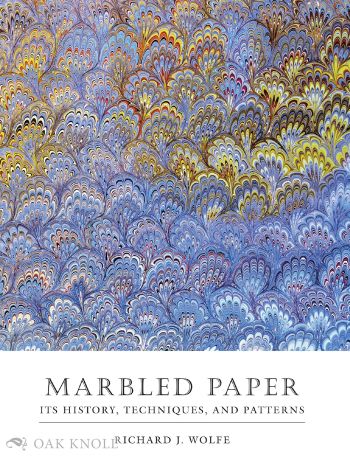 Second edition with corrections, from the original edition published in 1990 by the University of Pennsylvania Press (a publication of the A.S.W. Rosenbach Fellowship in Bibliography). With over 350 color and 80 black-and-white illustrations, and a new Foreword by Sidney Berger.
Richard J. Wolfe (1928–2017) was a rare book librarian, practicing marbler, and collector of marbled papers and books about marbling. This book is the result of more than twenty-five years of research and practical experience. Wolfe personally tracked down and sorted out historical records of marbling from their original sources, and he drew on his own extensive experience as a practitioner to write eloquently on technical and stylistic questions. The resulting study meticulously reconstructs the rise and fall of the craft and recounts its history, techniques, and patterns in such a way as to put all aspects of this fascinating craft in proper perspective.
When first published, Marbled Paper was immediately recognized as the most comprehensive study of marbling to that point, and its status as the standard history of the subject has not been diminished by more recent works. For that reason, and with the goal of making it available again to scholars, students, and practitioners of marbling, Oak Knoll Press is pleased to be able to present this second edition in cooperation with the Wolfe family, completed with minor corrections left by the author.
Exhibition | Ladies of Quality and Distinction
Press release for the exhibition now on view at The Foundling:
Ladies of Quality and Distinction
The Foundling Museum, London, 21 September 2018 — 20 January 2019

Andrea Soldi, Portrait of Isabella Duchess of Manchester, 1738 (London: Whitfield Fine Art).
This autumn, for the first time, visitors to the Foundling Museum will have an opportunity to discover portraits and stories of the remarkable women who supported the establishment and running of London’s Foundling Hospital. Marking 100 years of female suffrage, Ladies of Quality and Distinction resets the focus of the Hospital’s story and radically re-hangs the Museum’s Picture Gallery.
Despite its male face, women permeate every aspect of the Hospital story—as mothers, supporters, wet nurses, staff, apprentice masters, artists, musicians, craftsmen, and foundlings. Yet for almost 300 years, history has placed these women as a footnote in the story. The Museum is redressing this balance by bringing these overlooked stories to the fore.
Following a successful campaign via Art Happens, the Art Fund’s crowdfunding platform, the Museum brings together portraits of the ‘ladies of quality and distinction’ who signed Thomas Coram’s original petition to King George II in 1735, calling for the establishment of a Foundling Hospital. Working closely with eighteenth-century specialist Elizabeth Einberg, the Museum has identified portraits of these duchesses in public and private collections across the UK. Hung together for the first time, these paintings will temporarily replace the portraits of male governors that line the walls of the Museum’s Picture Gallery, reuniting the Ladies on the site of the charity they helped establish, and highlighting their role in shaping British society today. Included are magnificent court portraits by leading eighteenth-century painters William Hogarth, Thomas Hudson, and Godfrey Kneller. The majority of the portraits are in private collections, having remained within the family or ancestral home. Some paintings have not been on public display for many years.
Downstairs in the Museum’s exhibition gallery, the lives of the women who supported the day-to-day running of the institution will be brought to life. Women worked in many different roles at the Hospital, from laundresses and scullery maids, to cooks and matrons. Beyond its walls the organisation was supported by a small army of wet nurses who fostered the children in their infancy, as well as inspectors who supervised them. It was not until the twentieth century that the first woman was appointed Governor. Nevertheless, many female supporters of similar social class to the Hospital Governors gave valued advice, particularly around the proper care of infants, girls, and female staff.
Highlighted stories include: Mrs Prudence West, a female inspector and the only woman to run a branch Hospital; Miss Eleanor Barnes, one of the earliest female Governors of the Hospital; Mrs Elizabeth Leicester, an early matron of the Foundling Hospital who oversaw some of its most challenging years; and Jane Pett, a dry nurse highly acclaimed for her exceptional care.
Caro Howell, Director of the Foundling Museum said: “Women of every social class permeate every aspect of the Foundling Hospital story. After centuries of omission, their revolutionary, catalytic and invaluable contributions can at last be celebrated. We are incredibly grateful to the 336 donors who supported our Art Happens campaign to make this important exhibition possible.”
This exhibition forms part of the Museum’s year-long programme of exhibitions, displays, and events to mark the centenary of female suffrage, by celebrating women’s contribution to British society, culture, and philanthropy from the 1720s to the present day. The Museum raised over £20,000 towards this exhibition through a successful Art Happens crowdfunding campaign. The Museum is incredibly grateful to all our exhibition donors, including the 336 donors who gave to our Art Happens campaign, our main corporate exhibition sponsor Saxton Bampfylde, and to Art Fund, whose support made conservation of paintings loaned for this exhibition possible.
P R O G R A M M I N G
Georgian Women
The Foundling Museum, London, 19 October 2018
Discover what it meant to be a woman during this period and how three writers have brought the era to life. Speakers include Imogen Hermes Gowar, author of the Women’s Prize for Fiction shortlisted novel The Mermaid and Mrs Hancock; writer and television presenter Janet Ellis, author of The Butcher’s Hook; and Katharine Grant, whose novel Sedition was described by The Guardian as “subversive and unmissable.” Cash bar on the night. The programme begins at 19:00 (doors open at 18:30). Tickets £15 (£12.50 concessions and Foundling Friends). Details, including booking information, are available here.
Film Screening: The Duchess
The Foundling Museum, London, 9 November 2018
Join us for a unique cinema experience and enjoy the sensational 18th-century drama The Duchess, screened in the Picture Gallery. Keira Knightley and Ralph Fiennes star in this film exploring the life of Georgiana Spencer, Duchess of Devonshire, as she struggles to protect her children from her unscrupulous husband and social pressures, and find her independence. The film begins at 19:00. Tickets are £12. Details, including booking information, are available here.
Wikithon: Ladies Of Quality & Distinction
The Foundling Museum, London, 17 November 2018
Join our Wikipedia edit-a-thon and help us bring the overlooked stories of women and the Foundling Hospital to the fore. Bring your laptop and prepare with our Edit-a-thon guide. Led by researchers from the project Editing the Long Nineteenth Century: Recovering Women in the Digital Age in partnership with the Birkbeck Centre for Nineteenth-Century Studies, the session begins at 13:00 and lasts until 16:00; it is free, but booking is essential. This event is part of the Being Human Festival, organized by the School of Advanced Study, University of London, in partnership with the Arts & Humanities Research Council and the British Academy.
Workshop | Digitising the Paul Mellon Centre’s Photo Archive
From the Paul Mellon Centre:
Digitising the Paul Mellon Centre’s Photo Archive
Paul Mellon Centre, London, 13 November 2018
Registration due by 12 October 2018
 The Paul Mellon Centre (PMC) is currently in the process of digitising its institutional photographic archive collection. Since 1964, the Centre has amassed a collection of approximately 150,000 images of British paintings, decorative painting, sculpture and prints. The resulting images will be made available for research through a new online collections website. The key aims of this project are:
• the preservation of an important resource that has been a core part of the Centre’s activity since its foundation
• provide enhanced access to this material as a digital resource, both on- and off-site
• enable new research projects and discoveries
• produce high quality images for researchers to use free of charge in teaching, study and publication
The purpose of this workshop is to explore the potentials and challenges of using digitised photo archive materials and we invite academics, researchers, curators, conservators, collection managers, educators, arts professionals, photographic experts and digital technologists to take part in this roundtable discussion about the digital future of the PMC’s photo archive.
Topics that might be covered include:
• How are photo archive materials used in 2018? How will they be relevant to researchers in the future? How do researchers use photo archives? What are they looking for? How might digitisation help them to search the collections?
• What tools (e. g. image comparison tools) and search facilities would be useful for researchers consulting the photo archive online?
• What are the benefits and/or losses of viewing this collection online?
• How should this material be presented on a digital platform?
• What extra material might the PMC provide alongside the digitised images to facilitate research?
• What can this collection tell us about the historiography of British art and the development of the study of British art and architecture?
• Is this material of interest to those outside of the field of British art history, i.e. photographic historians or practicing artists?
• Could digitisation enhance how this collection might be used by conservators?
This will be an interactive workshop, and all participants will be expected to contribute to the discussion.
To register your interest in participating in this event, please email events@paul-mellon-centre.ac.uk by 12th October. We envisage that the workshop will run across a day from 10am until 4pm. Lunch, refreshments, and some travel expenses will be provided. Places are limited, so please register your interest in attending and provide a short paragraph outlining your interest in this project or photo archives more generally.
Site of Cook’s ‘Endeavour’ Likely Identified
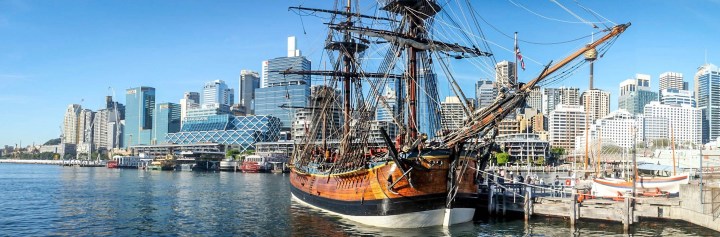
HM Bark Endeavour Replica in Darling Harbour, Sydney
(Photo: Wikimedia Commons, 30 September 2013)
◊ ◊ ◊ ◊ ◊
As reported by Matthew Knott for The Sydney Morning Herald (19 September 2018) . . .
Marine archaeologists believe they have finally identified the resting place of HMB Endeavour, the ship James Cook commanded to Australia on his first voyage of discovery, an achievement that would solve one of the greatest maritime mysteries of all time.
The breakthrough has raised hopes the remains of the vessel will be excavated next year, in time for the 250th anniversary of Cook’s arrival in Australia. The ship is historically significant to many countries—including the US, Britain, New Zealand and Australia—and its excavation could spark a battle over where the wreckage should be housed. The Rhode Island state government claimed official ownership of the fleet of shipwrecks including Endeavour in 1999, suggesting Australian officials would have to negotiate for any remnants to be brought to Australia.
The breakthrough, to be officially announced on Friday, follows an arduous 25-year search for the historic ship off Newport, Rhode Island, on the north-eastern coast of the US. . .
The full article is available here»
Pippa Shirley on a Royal Dinner Service, Waddesdon
From Waddesdon:
Pippa Shirley | Spotlight on a Royal Dinner Service
Waddesdon Manor, Buckinghamshire, 28 September and 11 October 2018

Silver dinner service, 1775–1824 (Waddesdon Manor, 8.2003.1-82).
Pippa Shirley, Head of Gardens and Collections at Waddesdon Manor, will be hosting a Spotlight session focused on Waddesdon’s magnificent silver dinner service. Guests are invited to imagine themselves dining with the King, as they explore this most fashionable dining set commissioned by George III in 1774.
More information is available here»
Exhibition | Russia: Royalty and the Romanovs
Press release (7 August 2018) for the exhibition:
Russia: Royalty and the Romanovs
The Queen’s Gallery, Buckingham Palace, London, 9 November 2018 — 28 April 2019
The Queen’s Gallery, Palace of Holyroodhouse, Edinburgh, 21 June — 3 November 2019

Vigilius Eriksen, Catherine II, Empress of Russia, ca.1765, oil on canvas, 276 × 202 cm (London: Royal Collection Trust, RCIN 404774).
For more than 300 years Britain has been linked to Russia through exploration and discovery, diplomatic alliances and, latterly, by familial and dynastic ties. Russia: Royalty & the Romanovs, opening on 9 November 2018, explores the relationship between the two countries and their royal families through works of art in the Royal Collection, many of which were acquired through the personal exchange of gifts.
In 1698 Tsar Peter I, known as Peter the Great, arrived in London. The first Russian ruler to set foot on English soil, he stayed for three months as part of a ‘Grand Embassy’, a diplomatic and fact-finding tour of Western Europe that included meetings with the British King, William III. On his departure Peter presented the King with his portrait, painted by Sir Godfrey Kneller. Kneller depicts the Tsar as a young and vibrant ruler, looking to the West and hoping to establish a new, ‘open’ Russia.
During the reign of the Empress Catherine II (Catherine the Great) Russia’s borders expanded to the south and west, and the country was established as one of the great powers in Europe. The Empress’s coronation portrait by Vigilius Eriksen, c.1765–69, is thought to have been given to George III and is recorded as hanging in the Privy Chamber at Kensington Palace in 1813. George III never visited Russia, yet his interest in the country is evident from the books in his library. These included the accounts of European merchants and the first description of Russia in the French language by the mercenary soldier Jacques Margeret.
The year 1815 saw final victory in the Napoleonic wars by the allied forces, including those of Great Britain and Russia. George IV commissioned Sir Thomas Lawrence to paint portraits of the central figures in the defeat of Napoleon for the Waterloo Chamber at Windsor Castle, a room created to celebrate the achievement. Paintings of Matvei Ivanovitch, Count Platov, commander of the Cossack cavalry, and of General Fedor Petrovitch Uvarov, Emperor Alexander I’s Aide-de-Camp at the Congress of Vienna, recognised Russia’s important contribution to the defeat of Napoleon.
A steady stream of Russian emperors, empresses, grand dukes, and grand duchesses were entertained in Britain in the following years. The future Emperor Nicholas I visited in 1816–17, when he attended a banquet of more than 100 courses, hosted by the Prince Regent at his seaside residence, Brighton Pavilion, in the company of Frederick, Duke of York and the Duke of Clarence, later William IV. In gratitude for the hospitality shown to the future Emperor, his mother, Empress Maria sent the Prince Regent’s daughter, Princess Charlotte, the insignia of the Order of St Catherine. The Order had been instituted in 1714 by Peter I on the occasion of his marriage to Catherine I and was the most prestigious award for women in Imperial Russia. The Princess is shown wearing the badge on a Russian-style dress in a portrait of c.1817.
Queen Victoria’s eldest son, Albert Edward, Prince of Wales (later King Edward VII), married Princess Alexandra of Denmark in 1863. Three years later, Alexandra’s sister, Princess Dagmar, married Tsesarevich Alexander, later becoming Empress Maria Feodorovna and linking the English, Russian and Danish royal houses. In 1874, Queen Victoria’s second son Alfred, Duke of Edinburgh, married Grand Duchess Marie Alexandrovna, daughter of Emperor Alexander II, as recorded in Nicholas Chevalier’s painting of the ceremony. This first direct dynastic marriage between the two families was followed by the marriage of two of Queen Victoria’s granddaughters, the Princesses Elizabeth and Alix of Hesse, to Grand Duke Sergei, son of Alexander II, and the future Nicholas II respectively.
The English, Russian, and Danish royal families regularly visited one another and marked these occasions in paintings and photographs, and through the exchange of gifts. The Danish artist Laurits Regner Tuxen was commissioned to record significant family events, including The Marriage of Nicholas II, Emperor of Russia, 26th November 1894 and The Family of Queen Victoria in 1887, celebrating the Queen’s Golden Jubilee that year. A great number of works by Carl Fabergé entered the Royal Collection as a result of the close relationship and shared tastes of the sisters Queen Alexandra and Empress Maria Feodorovna. Among them are a framed portrait miniature of the Empress and a gold cigarette case, given to King Edward VII as a 40th wedding anniversary present in 1903.
Nicholas II and his family made their last visit to England in August 1909. They attended the annual regatta at Cowes on the Isle of Wight, and the royal families dined together on each other’s yachts. A local photographer was commissioned to record the occasion and produced a double portrait of the Prince of Wales (later King George V) and his cousin Emperor Nicholas, which shows the strong family resemblance. During the visit the Princess of Wales (later Queen Mary) was given a diamond-set Fabergé brooch made from a Siberian amethyst, a stone famous for its intense purple hue. Following the deaths of the Imperial Family in 1918, King George V and Queen Mary assembled a collection of works of art that had belonged to their Russian relations as poignant reminders of happier times.
In 1923 the Duchess of York (later Queen Elizabeth The Queen Mother) commissioned a portrait of herself from the Russian artist Savely Sorine. Twenty-five years later she commissioned Sorine to paint a portrait of her daughter Princess Elizabeth, Duchess of Edinburgh, the future Queen Elizabeth II. During an official visit in 1956, First Secretary Nikita Khrushchev and Premier Nikolai Bulganin presented Her Majesty The Queen with a number of gifts, including the oil painting A Winter’s Day by the prominent painter, publisher, and art historian Igor Grabar.
Call for Papers | Russia: Courtly Gifts and Cultural Diplomacy
From H-ArtHist:
Russia: Courtly Gifts and Cultural Diplomacy
The Queen’s Gallery, London, 22 March 2019
Proposals due by 15 October 2018
A collaboration between Royal Collection Trust, Cambridge Courtauld Russian Art Centre, and The Burlington Magazine, this one-day international academic conference takes its cue from the exhibition Russia: Royalty and the Romanovs, to be held at The Queen’s Gallery, Buckingham Palace, London, from 9 November 2018 to 28 April 2019.
The conference Russia: Courtly Gifts and Cultural Diplomacy will explore themes of courtly gift-giving and cultural diplomacy between Russia and the West, a history that sits within the broader framework of the history of British-Russian state and cultural relations [ca. 1698–1950s]. Scholarly research in these areas has flourished over the past few decades, and continues to generate debate and activity as the discipline of history itself has developed to encompass the study of material culture, sensory history and the history of emotions, domestic history, histories of power, ceremony and ritual, and internationalism and cross-cultural exchange. Increasing access to archives and the availability of new methodologies, not least the advent of the ‘digital’ humanities, have provided further opportunities for cutting-edge research. This conference accordingly embraces innovative methodologies from disciplines including history, art history, literature, area studies, and anthropology to explore ways in which Russia’s international relations have been forged, fermented, and fractured by the exchange of material objects in the social, cultural, and political spheres.
Papers are invited on the following themes:
• practices of gift-giving between the British and Russian monarchies and governments
• British-Russian cultural exchange at state and diplomatic level
• interactions between cultural diplomacy, art and politics
• cultural diplomacy and nationalism/imperialism
• gift-exchange in the formation of royal collections
• royal portraits as gifts
• the exchange of court artists, craftsmen and other cultural producers
• the role of ambassadors and cultural mediators
• royal photographs, photographs of royalty
• royal patronage in the cross-cultural context
• gift-giving and domestic court life
• family, marriage, and dynastic ties
• material culture and gift-giving
• the material accompaniments of royal travel and state visits
• transcultural ritual and ceremony
• custom, convention and protocol
• societies promoting cultural exchange between governments
• the forging of cultural links between state departments
• British artists and makers and Russian royal patronage (e.g., Godfrey Kneller, Christopher Galloway, George Dawe, Christina Robertson, Charles Cameron)
• Russian artists and makers and British royal patronage (e.g., Carl Fabergé, Savely Sorine)
Paper topics should relate to a British-Russian or British-Soviet context and, to complement the exhibition, may address any period from the late seventeenth to the mid twentieth century. Papers shall be twenty minutes long and will be organised into panels of two to four papers, with time allocated for questions on all papers at the end of each session.
Participation in the conference for both speakers and delegates will include an opportunity to visit the exhibition and an early evening drinks reception. In accordance with the event policy for conferences held at The Queen’s Gallery, the organisers will not be able to reimburse travel expenses or arrange accommodation for speakers. Some limited funding may become available as a result of grant applications that are in progress; if you wish to be considered for this, please provide an estimate of costs as part of your proposal.
Abstracts of up to 300 words should be submitted to Dr Louise Hardiman (Cambridge Courtauld Russian Art Centre) at courtlygifts2019@gmail.com. Please include a paper title, your name, institution (if applicable), brief biography, and full contact information (address, phone number, and email). Any questions about the conference may also be sent to the above email address.
Cambridge Courtauld Russian Art Centre (CCRAC) is an academic collaboration between the Department of History of Art at the University of Cambridge and The Courtauld Institute of Art. CCRAC promotes research, collaboration and scholarly debate on all aspects of the visual arts, architecture, design, and exhibitions in Russia and the Soviet Union.
Organising Committee
Caroline de Guitaut (Royal Collection Trust), Dr Louise Hardiman (CCRAC), Professor Rosalind P. Blakesley (University of Cambridge and CCRAC), Professor John Milner (The Courtauld Institute of Art and CCRAC), and Michael Hall (Editor, The Burlington Magazine).
Seminar | Stone Face
From H-ArtHist:
Stone Face: The Psychology of the Face, the Phenomenology of the Bust
University of Copenhagen, 1–2 October 2018
Registration due by 20 September 2018
 This seminar explores the portrait from a phenomenological and psychological approach, looking at how it affects the viewer and what kinds of reactions it prompts. We will be discussing the significance of the bust format, primary sources describing encounters with portraits and busts as well as the significance of the face and the psychology of face perception. The seminar is a preparatory work for understanding the Neoclassical artist Bertel Thorvaldsen (1770–1844) as a portrait sculptor within a broader context of sculpture theory and art history.
The seminar is the second in a series of seminars under the cross-disciplinary project research and dissemination Powerful Presences: The Sculptural Portrait between Absence and Presence, Group and Individual. The seminar is free and open to everyone. Additional programme and registration details are available here. For more information, please contact Lejla Mrgan, lejla@hum.ku.dk.
M O N D A Y , 1 O C T O B E R 2 0 1 8
8.45 Arrival and coffee
9.00 Welcome (Jane Fejfer)
9.15 Session 1 | Imagination and Attachment
• Melissa Percival, The Painted and Sculptural Imagination: Short Cuts
• Lejla Mrgan, Perception and imagination: Busts as Objects of Attachment
• Tomas Macsotay, Women and Sculptural Resignification: The Cases of Catherine the Great and the Countess of Albany
• Andreas Grüner, Strike! Diderot and the Reproduction of Immediacy in Ancient Portraits
12.45 Lunch
13.45 Session 2 | Bust and Body
• Jeanette Kohl, The Silence of Busts: Phenomenology, Ontology, Presence?
• Joris van Gastel, The Coat of Arms and the Portrait Bust: Sculpted Presence in Late Renaissance Florence
• Helen Ackers, Networks of interaction: The Roman portrait bust in its familial context
• Josefine Baark, ‘The Originals’: Commemorative Clay Likenesses and Portrait Sculpture in Qing China
17.15 Drinks
19.00 Dinner (speakers only)
T U E S D A Y , 2 O C T O B E R 2 0 1 8
9.30 Session 3 | Portraits and Faces
• Malcolm Baker, Busts and Faces: Aesthetic Theory and Perceptual Difference
• Alexander Todorov, The Inherent Ambiguity of Facial Expressions
• Anna Schram Vejlby, The Inner Gaze
• Rubina Raja, The Palmyrene More-Than-Bust Funerary Portraits
• Michael Yonan, Messerschmidt, Thorvaldsen, and the Specious Surfaces of the Self
13:30 Lunch
14:00 Summary and perspectives, Whitney Davis and Rolf Schneider
16:00 Portrait talk between artist Trine Søndergaard (Copenhagen) and professor of Art History Jeanette Kohl (University of California Riverside). This special event at Thorvaldsens Museum requires a ticket.
17:00 Closing Reception at Thorvaldsens Museum
New Book | Experimental Selves
From the University of Toronto Press:
Christopher Braider, Experimental Selves: Person and Experience in Early Modern Europe (Toronto: University of Toronto Press, 2018), 448 pages, ISBN: 9781487503680, $90.
 Drawing on the generous semantic range the term enjoyed in early modern usage, Experimental Selves argues that ‘person,’ as early moderns understood this concept, was an ‘experimental’ phenomenon—at once a given of experience and the self-conscious arena of that experience. Person so conceived was discovered to be a four-dimensional creature: a composite of mind or ‘inner’ personality; of the body and outward appearance; of social relationship; and of time.
Through a series of case studies keyed to a wide variety of social and cultural contexts, including theatre, the early novel, the art of portraiture, pictorial experiments in vision and perception, theory of knowledge, and the new experimental science of the late-seventeenth and eighteenth centuries, the book examines the manifold shapes person assumed as an expression of the social, natural, and aesthetic ‘experiments’ or experiences to which it found itself subjected as a function of the mere contingent fact of just having them.
Christopher Braider is a professor of French and Comparative Literature at the University of Colorado, Boulder.
C O N T E N T S
Introduction — Changing the Subject: Early Modern Persons and the Culture of Experiment
1 The Shape of Knowledge: The Culture of Experiment and the Byways of Expression
2 The Art of the Inside Out: Vision and Expression in Hoogstraten’s London Peepshow
3 Persons and Portraits: The Vicissitudes of Burckhardt’s Individual
4 Justice in the Marketplace: The Invisible Hand in Ben Jonson’s Bartholomew Fayre
5 Actor, Act, and Action: The Poetics of Agency in Corneille, Racine, and Molière
6 The Experiment of Beauty: Vraisemblance Extraordinaire in Lafayette’s Princesse de Clèves
7 Groping in the Dark: Aesthetics and Ontology in Diderot and Kant
Conclusion — Person, Experiment, and the World They Made










 Enfilade
leave a comment