New Gravestone for William Blake
As reported by AFP (via Art Daily, 13 August 2018). . .

Lida Cardozo Kindersley, Gravestone of William Blake, Bunhill Fields, London, unveiled on 12 August 2018 (Photograph by Lida Cardozo Kindersley).
The lost resting place of British poet and artist William Blake was finally marked Sunday [12 August 2018] with a gravestone, almost 200 years after he died.
Despite his influence today, Blake died in obscurity in 1827 and was buried in an unmarked common grave in Bunhill Fields, a London cemetery. Only a plain memorial stone recorded that he was buried nearby, much to the dismay of two devotees who visited, and who decided to find his exact resting place. Luis and Carol Garrido had as their guide the original coordinates of his burial, which were based on a grid of graves but became confused when parts of the cemetery were converted into gardens. After two years of research and some painstaking work with a tape measure, they found it, and the Blake Society—of which they were members—began fundraising for a new memorial to mark the spot. . .
The full article is available here»
Postdoctoral Position: Shakespeare in the Royal Collections
Postdoctoral Research Associate: ‘Shakespeare in the Royal Collections’
Applications are due by 14 September 2018
Applications are invited for a three year, full-time Postdoctoral Research Associate to work on the AHRC funded project, ‘Shakespeare in the Royal Collections’. This is led by Principal Investigator Professor Gordon McMullan (Department of English, King’s College London) and Co-Investigator Dr. Kate Retford (Department of History of Art, Birkbeck College, University of London).
‘Shakespeare in the Royal Collections’ seeks to establish a new understanding of the relationship of Shakespeare and the royal family 1700–1900 by way of the first thorough investigation of the Shakespeare-related holdings in the Royal Collections, from manuscripts through paintings and prints to performance records. It explores the mutually sustaining and legitimating nature of the development of both Shakespeare and the royal family as hegemonic cultural phenomena, asking the twin questions: what has Shakespeare done for the royals, and what have the royals done for Shakespeare?
The PDRA (one of two, with the other working on literary/performance matters) will work on visual culture, with a focus on eighteenth-century material. He/she will assist the PI and CI in delivering the research outputs of the project and contribute to those outputs: the creation of a website containing digital images of all the Shakespeare-related holdings, a set of annotations and contextual data; an innovative set of 3D visualisations; two symposia and a conference; a TV documentary; and an exhibition at Shakespeare’s Globe (2021). He/she will write a monograph based on Shakespeare-related art and material culture objects in the holdings. These range from paintings, sculptures and prints through to a doll of Portia and boxes made from the ‘Mulberry Tree planted by Shakespeare’. Two likely themes for the monograph are: an exploration of the fashioning of royal identities through visual and material identification with key characters and events from Shakespeare; the significance of the Shakespeare holdings for an understanding of the Royal Collections as a whole by providing a key opportunity to juxtapose items inherited, gifted, purchased and commissioned. The PDRA will be fully engaged in developing and shaping the book project according to his/her interests and findings.
Candidates should have a PhD in History of Art or cognate field, which will have been completed before the start of the role. If their PhD is not in History of Art, they should be able to show particular evidence of full awareness of the methodologies and theories of the discipline. The PDRA will have expertise in eighteenth-century material to complement the specialism of the other PDRA (already appointed) in Victorian and early-twentieth-century performance. Engagement with interdisciplinary approaches and a willingness to work across visual and literary culture are vital. Collections-based experience, such as cataloguing or provenance work, whether professional or gained through academic research, is highly desirable. Applicants should also be able to demonstrate ability to work well in a team, to manage their time and research efficiently and either have or be willing to acquire the appropriate digital competence.
Additional information is available here»
New Book | Francesco Solimena (1657–1747)
From ArtBooks.com:
Nicola Spinosa, Francesco Solimena (1657–1747) e le Arti a Napoli (Rome: Ugo Bozzi, 2018), 2 volumes, 1100 pages, ISBN: 978-8870030600, 320€ / $425.
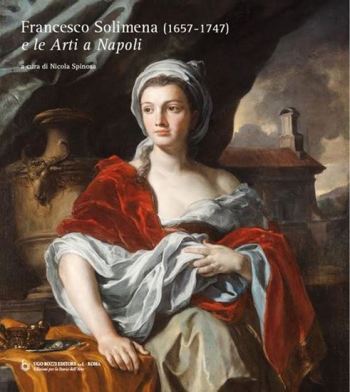 Vol. 1 – dedicato al catalogo ragionato dei dipinti di Solimena (Nicola Spinosa); indici dei nomi e dei luoghi realtivi al volume I. Vol. 2 – dedicato al catalogo ragionato dei disegni di Solimena (Cristiana Romalli); con saggi sull’architettura (Leonardo Di Mauro), sulla scultura e le arti decorative (Gian Giotto Borrelli), su Solimena illustratore (Lorella Starita) e sulla musica al tempo di Solimena (Dinko Farbis); regesto su Solimena pittore a cura di Tiziana La Marca; Bibliografia generale (volumi I e II; indici dei nomi e dei luoghi relativi al volume II).
New Book | Human Redemption: The Cycle in the Chiesa Nuova
Published by Gangemi, and available from ArtBooks.com:
Giulia Silvia Ghia, ed., La Salvazione Umana: Il ciclo della Chiesa Nuova in cerca di un mecenate / Human Redemption: The Cycle in the Chiesa Nuova in Search of a Patron (Rome: Gangemi Editore, 2018), 160 pages, ISBN: 9788849236194, $65. Italian and English text.
 The majestic cycle of fifteen canvases completing the decoration of Santa Maria in Vallicella was unveiled just prior to the 1700 Jubilee. This church is now owned by the Fondo Edifici di Culto, which safeguards, conserves, and promotes more than 820 religious structures across Italy. Lining the path toward St Peter’s Basilica, its paintings continue to present the world with the precious message of Human Redemption. This book retraces the history, importance, and exceptional beauty of this largely unknown cycle. More importantly it brings attention to the need for its restoration that, now as 320 years ago, requires the support of one or more patrons, inspired by a passion for this story.
C O N T E N T S
• The Cycle of Human Redemption: A Comprehensive Overview
• The Chiesa Nuova before the 1675 Jubilee
• The Decoration of the Chiesa Nuova during the Last Quarter of the Seventeenth Century
• A Study of the Use of Materials, Methods of Realization, and Requirements for the Restoration of the Cycle of Human Redemption
Symposium | Resurrecting the Dead
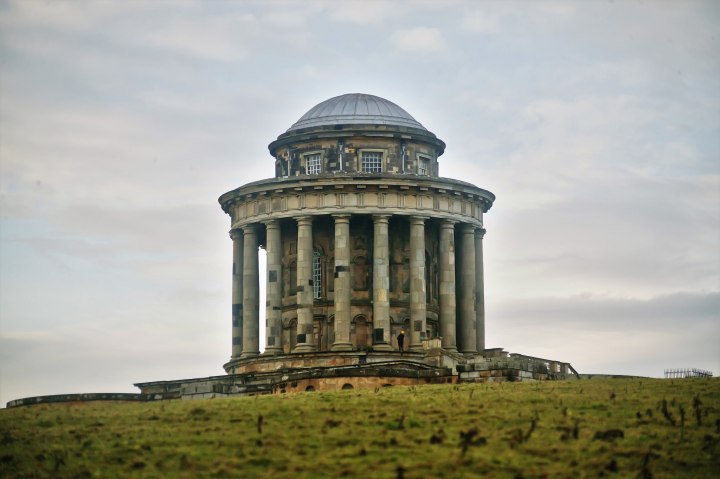
Nicholas Hawksmoor, Howard Mausoleum at Castle Howard, North Yorkshire, 1729.
◊ ◊ ◊ ◊ ◊
From The Mausolea and Monuments Trust:
Resurrecting the Dead: The Mausolea and Monuments Trust 2018 Symposium
The Gallery, London, 13 October 2018
The theme of the symposium is the maintenance and restoration of funerary architecture and sculpture. We will explore the field through a range of approaches, with papers from some of the country’s leading curatorial and architectural professionals, showcasing a variety of significant subjects from their differing perspectives. The registration fee is £25. Thanks to generous support from the Society of Architectural Historians of Great Britain, we are able to offer eight free places to current university students (at any point in their education); to apply please send a short explanation of your current studies to fsands@soane.org.uk.
P R O G R A M M E
10.30 Coffee
11.00 Session One
• Bernadette Gillow (National Trust, Ightham Mote Portfolio), Darnley Mausoleum, Cobham: A Phoenix from the Ashes
• Paul Harrison (Harrison Design Development Ltd), Restoration at West Norwood Cemetery
• Amy Frost (Museum of Bath Architecture and Beckford’s Tower, Bath Preservation Trust), Landscape as Monument: The Suffragettes Wood in Bath
13.15 Lunch
14.15 Session Two
• Charles Wagner (Built Heritage Consultancy), Tom Drysdale (Historic Royal Palaces), and Gabriel Byng (Cambridge University), Just How Important Is That Pile of Stones? Or How Do You Convince Charitable Funders That It Is Worth Spending £¼Million on the Ruins of a Building of Absolutely No Practical Use?
• Christopher Ridgway (Castle Howard), The Castle Howard Mausoleum: Form, Function and Future
15.45 Tea
Exhibition | The Genius of Grinling Gibbons
Now on view at Fairfax House:
The Genius of Grinling Gibbons: From Journeyman to King’s Carver
Fairfax House, York, 14 April – 14 September 2018

Grinling Gibbons, King David Panel, ca. 1670, boxwood (York: Fairfax House).
Fairfax House is delighted to announce the recent acquisition of Grinling Gibbons’s King David Panel the earliest-known, surviving work by Gibbons—made in York. Saved from international export and potential obscurity in a private collection, this magnificent work now forms part of the permanent collection at Fairfax House.
To celebrate the ‘home-coming’ of this exquisite piece of craftsmanship and to illuminate the extraordinary skill of Grinling Gibbons—the ‘Michelangelo of Wood’—Fairfax House will be mounting a major new exhibition in 2018, The Genius of Grinling Gibbons: From Journeyman to King’s Carver. Opening on the 370th anniversary of Grinling Gibbons’ birth, this exhibition also marks the 350th year of his arrival in York. Drawing on new research and bringing together artworks and sculpture by the hand of this iconic individual from across the country (including St Paul’s Cathedral, Hampton Court Palace, the Sir John Soane Museum, and the V&A), The Genius of Grinling Gibbons celebrates Grinling Gibbons’s unequalled talent, his visionary genius, and his ability to transform the medium of wood into something magical. It will explore his development from an obscure journeyman through to becoming the country’s most celebrated master-carver, working for the King himself.
Call for Papers | Rethinking the Genius of Grinling Gibbons

◊ ◊ ◊ ◊ ◊
From the Call for Papers:
2018 Fairfax House Georgian Studies Symposium
Rethinking the Genius of Grinling Gibbons
Fairfax House, York, 19 October 2018
Proposals due by 31 August 2018
The sixth Fairfax House Symposium in Georgian Studies, held in conjunction with the exhibition The Genius of Grinling Gibbons at Fairfax House, and in partnership with the History of Art department at the University of York, aims to stimulate new thinking and new perspectives on the life, work, legacy, and significance of Grinling Gibbons (1648–1721), master carver of Restoration England.
Gibbons is a celebrated figure, yet much about his life and work remains obscure and contentious: not least, the difficulties of attribution have meant that the exact extent, chronology, and character of his oeuvre remain unclear. Similarly, as a ‘great figure’ of the Restoration, he has tended to be considered in isolation rather than placed in his social, political, scientific, architectural, and artistic contexts, while his position within the marginalized field of decorative arts has distorted the scholarly and antiquarian perspectives through which he has been viewed. Questions of patronage, politics, artistic influence, and the collaborative and workshop cultures of creation, as well as the national identity ascribed to this ‘English genius’ who was born and trained in the Netherlands, may all require reassessment. The 370th anniversary of Gibbons’ birth (and the 350th anniversary of his arrival in York) provide an opportune moment to draw together the knowledge gained from previous generations of scholarship, to stimulate new ideas and perspectives, and to rethink the perception and reality of ‘England’s Master Carver’.
Proposals for papers dealing with ‘rethinking’ Grinling Gibbons are enthusiastically invited for potential inclusion in a one-day interdisciplinary symposium. We are keen to encourage participation from people from a wide range of disciplines and career profiles: museum professionals and volunteers, early career and distinguished scholars, curators and teachers in higher education, as well as artists, craftspeople and other practitioners.
We are seeking (1) more formal 20-minutes papers to be presented in panels organised around relevant themes, and (2) 10-minute object-based presentations and discussions which can be informal or formal in nature, focused on a particular work by or relevant to Gibbons. Please send proposals for either section 1 (formal 20-minute papers) or section 2 (10-minute object-based presentations), accompanied by a brief biography, to fairfaxhousesymposium@gmail.com by 31 August 2018. Any queries about the symposium should be sent to the same address.
◊ ◊ ◊ ◊ ◊
Note (added 8 November 2018) — I’m sorry to have not added the conference programme before the event took place, but for anyone who may have stumbled upon this page for information purposes after the fact, the programme is available as a Word file here. –CH
Course | The Artist and the Garden
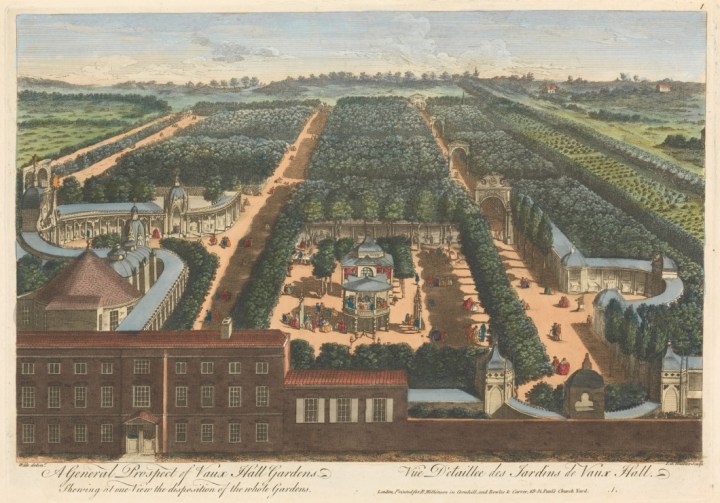
John S. Muller, A General Prospect of Vaux Hall Gardens, Shewing at one View the disposition of the whole Gardens, ca. 1715–92, hand-colored engraving on wove paper (New Haven: Yale Center for British Art, Paul Mellon Collection).
◊ ◊ ◊ ◊ ◊
From the Paul Mellon Centre:
Public Lecture Course | The Artist and the Garden
Paul Mellon Centre for Studies in British Art, London, Thursdays, 27 September — 25 October 2018
Registration opens on 20 August 2018
The Artist and the Garden will explore the multifarious ways in which the artist has impacted upon our understanding and perception of the British garden from the seventeenth century to the present day. Through a series of related but discrete talks, speakers will explore not only the ways in which artists depicted gardens but how so many of them were active as gardeners themselves, whether they were formulating grand landscape designs or cultivating private domestic spaces. The course will feature lectures from Christopher Woodward, Director of the Garden Museum, noted academics such as Joy Sleeman and Stephen Daniels, as well as landscape architect Todd Longstaff-Gowan.
The course meets every Thursday for five weeks from 27 September to 25 October 2018, 6.30–8.30pm (6.30–7.00 Drinks, 7.00–8.30 Lecture and Discussion). The course is open to all and free to attend, but enrolment is required. Registration will open at 10am on 20 August. In the meantime please read the Frequently Asked Questions for information on changes to our enrollment and booking procedures.
27 September — Introduction, with Christopher Woodward
4 October — Repton and the Landscaped Garden, with Stephen Daniels
11 October — Country Gardens, with Martin Postle
18 October — Land Art, with Nicholas Alfrey and Joy Sleeman
25 October — Artist in Focus: Eileen Hogan, with Todd Longstaffe-Gowan
Lecture | Laura Mayer on Repton
From The Gerogian Group:
Laura Mayer | ‘All around Is Fairy Ground’: Repton and the Regency Garden
Keats House, Hampstead, London, 6 September 2018
 The Georgian Group is holding an evening lecture at Keats House, Hampstead, to celebrate the bicentenary of Humphry Repton (1752–1818). The lecture will be given by Dr. Laura Mayer, who has published extensively on eighteenth- and early nineteenth-century landscape history and is a former winner of the prestigious Gardens Trust Annual Essay Prize.
Repton ambitiously named himself as Capability Brown’s successor and was responsible for developing a new landscape aesthetic, which he termed ‘Ornamental Gardening’. Known for his famous Red Books, illustrated to help his clients visualise the pleasurable potential of their properties, Repton did much to encourage an appreciation of landscape aesthetics amongst the rising middle classes. Dr. Mayer’s lecture will trace his designs from their Picturesque beginnings to the progressive Gardenesque style.
Thursday, 6 September, at Keats House, 10 Keats Grove, Hampstead, London NW3 2RR. Doors open at 6pm; the lecture starts at 6.30. Tickets are £20 and include wine. This event is open to Georgian Group members and non-members.
Exhibition | Masterpieces of French Faience
Press release for the exhibition opening this fall
Masterpieces of French Faience: Selections from the Sidney R. Knafel Collection
The Frick Collection, New York, 9 October 2018 — Autumn 2019
Curated by Charlotte Vignon
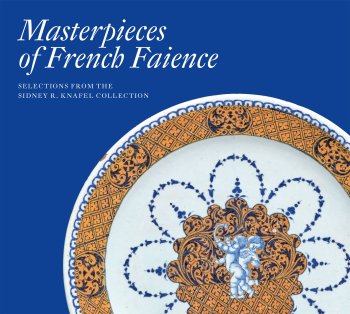 This fall, an exhibition at the Frick will draw from the holdings of Sidney R. Knafel, who has one of the world’s finest and most comprehensive private collections of French faience. With seventy-five objects, the presentation in the Portico Gallery tells the fascinating and complex history of an aspect of European decorative arts that warrants greater attention. The production of faience, a colorful tin-glazed earthenware, spans a vast history of more than two centuries. The earliest French examples were made in Lyon in the sixteenth century, while works from France’s Golden Age of production were made in Nevers and Rouen in the seventeenth and early eighteenth centuries. Production in the eighteenth century expanded to other locations, including Marseille, Moustiers, Sinceny, and Moulins. Comments Charlotte Vignon, the Frick’s Curator of Decorative Arts and organizer of the exhibition, “Faience was largely commissioned by a local regional aristocracy, and the result is another wonderful chapter in the history of ceramics that developed quite apart from the centers of political power and artistic innovation in Versailles and Paris. The Frick has never before exhibited such a large and impressive body of French faience, and we are delighted to illuminate the topic through such a distinguished collection.” The exhibition will be accompanied by a catalogue published in hard and softcover editions by the Frick, in association with D Giles Ltd.
As with other types of earthenware, faience remains porous after firing and therefore must be covered with a glaze. The glazes used include a tin oxide that creates the opaque white surface that covers the color of the underlying clay and also creates a stable surface for painting. The Knafel Collection comprises pieces decorated exclusively with the grand feu (literally, “ high fire”) technique, in which metal oxides are mixed with water and applied to the tin-glazed surface before firing at a temperature of about 1650° F. The palette is necessarily limited to those oxides that can withstand such extreme heat: cobalt (blue), antimony (yellow), manganese (purple and brown), iron (red-orange), and copper (green).
The production of faience in France corresponds to the arrival in Lyon, during the second half of the sixteenth century, of several Italian maiolica potters and painters seeking opportunities outside Italy. This influence is reflected in the French word faience, which derives from the northern Italian city of Faenza, an important center of maiolica production during the Renaissance. French faience draws inspiration from multiple sources, with decoration simultaneously indebted to Italian maiolica, Asian porcelain, and contemporary engravings, while the forms derived mostly from European ceramics and silver.
The function of a piece of French faience depended on the nature of the commission, the patron who first owned it, and its price. During the late sixteenth and seventeenth centuries, objects in faience were costly and therefore acquired, collected, and gifted exclusively by those at the highest levels of French society. Consequently, earlier pieces from Lyon and Nevers in the Knafel Collection were originally intended only for display, to be admired by their owners and guests. The spread of faience workshops in Nevers, Rouen, and elsewhere in France during the eighteenth century inevitably changed the status of these objects and hence their function. One of the most important changes was the later use of faience as dishware, on which to eat or serve food. To ensure the success of their workshops, French potters—beginning with those in Rouen—closely followed the culinary developments occurring in France at the time. Multiple dishes in different shapes and sizes were created in response to the requirements of the service à la française, which necessitated serving various dishes of a particular course at the same time. As the eighteenth century progressed, faience was increasingly used at all times of the day. In the morning, small faience boxes and jars stored pomades, powders, and other accessories of make up, alongside silver and porcelain vessels on a dressing table for ‘la toilette’.
Charlotte Vignon, Masterpieces of French Faience: Selections from the Sidney R. Knafel Collection (London: D. Giles, 2018), 72 pages, ISBN: 978-1911282310.










 Enfilade
leave a comment