Enfilade

Call for Papers | Women and Architecture, 1660–1830

Posted in Calls for Papers by Editor on December 15, 2018

From The Georgian Group:

‘Embroidered with Dust and Mortar’: Women and Architecture, 1660–1840
2019 Georgian Group Symposium
Society of Antiquaries, Burlington House, London, 28 September 2019

Proposals due by 31 January 2019

Henry Robert Morland, Charlotte Sophia, Queen Consort of George III (The Queen’s College Oxford).

The Georgian Group is organising a day-long symposium on the theme of Women and Architecture, 1660–1830, which will be held at the Society of Antiquaries at Burlington House, London, on Saturday 28 September 2019. Following successful conferences run by the Group in previous years on James Gibbs and the Adam brothers, the symposium will explore how women contributed to and interacted with architecture in the period 1660–1830, including, but not limited to, the following topics:
• Building, remodelling, and the repairing of country houses, town houses, churches, almshouses, and villas
• Relationships with architects and contractors
• Architectural discourse, drawing, and design
• The creation of identity through the medium of architectural space

Proposals are invited for 15- to 30-minute papers based on original research. Please send abstracts of no more than 200 words and a copy of your CV to Dr Amy Boyington (education@georgiangroup.org.uk) by the end of January 2019. Any questions regarding the symposium should be sent to the same address. Further details will be made available, and tickets will go on sale, in the spring.

Launch of Royalpalaces.com

Posted in resources by Editor on December 15, 2018


◊  ◊  ◊  ◊  ◊

From The Society of Antiquaries of London Online Newsletter (Salon) issue 419 (11 December 2018) . . .

Royalpalaces.com

Simon Thurley FSA, one-time Curator of Historic Royal Palaces (1989–97) and Chief Executive of English Heritage (2002–15) . . . has launched Royalpalaces.com, which he describes as

“an encyclopaedic website about British royal residences . . . There is currently nowhere online that people can go to find authoritative information about royal residences from the Saxons to the present, or to find out quickly and easily about royal domestic architectural patronage. RoyalPalaces.com will eventually have nearly 150 place entries covering royal residences from Abingdon to York; most entries have an image and a plan in addition to explanatory text. The website has launched with the first 50 entries. There will also be nearly 30 monarch entries for the greatest British royal architectural patrons—the website launches with ten, including one for Queen Elizabeth II. There will also be podcasts covering various thematic issues. The first podcast deals with the tricky issue of ‘what is a palace?’—and the answer is not ‘a royal residence’. Hopefully of use to the more scholarly-minded will be the bibliographies attached to each entry. All contributions or omissions in these will be gratefully received as will notification of errors spotted.”

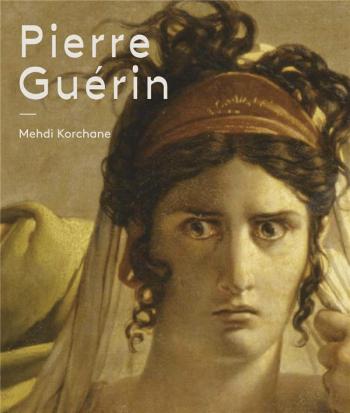
New Book | Pierre Guérin

Posted in books by Editor on December 14, 2018

Published by Mare et Martin and available from Artbooks.com:

Mehdi Korchane, Pierre Guérin (1774–1833) (Paris: Mare et Martin, 2018), 400 pages, ISBN: 979-1092054705, 65€ / $110.

De tous les peintres qui dominent la scène française au début du XIXe siècle, Pierre Guérin (1774–1833) est le plus méconnu. L’évolution de la peinture d’histoire du Directoire à la monarchie de Juillet ne peut pourtant se comprendre sans cet artiste capital, passeur entre la modernité de David, qu’il a transformée en l’assimilant, et celle des peintres romantiques qu’il a formés. Guerin doit au Retour de Marcus Sextus, mémorial des peines endurées par la famille France au cours de la Révolution, des débuts mythiques au Salon de 1799, et l’extraordinaire succès de Phèdre et Hippolyte en 1802, lui assure un statut équivalent à celui de Chateaubriand dans la sphère publique. Il produit au cours de l’Empire et de la Restauration des oeuvres qui ont marqué la mémoire collective et occupent, de longue date, les cimaises du musée du Louvre (Aurore et Céphale, Didon et Enée…). Membre de l’Académie de beaux-arts, promoteur d’un beau idéal prenant sa source dans l’Antiquité, tout en favorisant par son action pédagogique l’essor de la peinture romantique, il incarne tous les paradoxes de cette époque en rupture.
New Book | Le Voyage pittoresque de la Flandre et du Brabant

Posted in books by Editor on December 13, 2018

From Brepols:

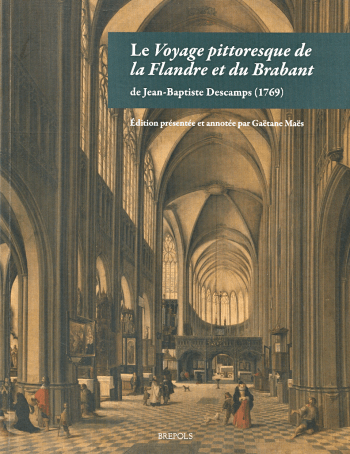
Gaëtane Maës, ed., Le Voyage pittoresque de la Flandre et du Brabant de Jean-Baptiste Descamps (1769) (Turnhout: Brepols, 2018), 492 pages, ISBN: 978-2503577036, 125€.

Cette édition du Voyage pittoresque de la Flandre et du Brabant (1769) de Jean-Baptiste Descamps permet non seulement de comprendre l’importance de l’ouvrage dans l’émergence du tourisme d’art, mais elle est aussi la première à fournir la localisation actuelle des oeuvres commandées par les églises aux anciens maîtres flamands.

En publiant Le Voyage pittoresque de la Flandre et du Brabant à Paris en 1769, Jean-Baptiste Descamps (1715–1791) a fait connaître au public européen les richesses artistiques conservées dans les églises des Pays-Bas du Sud (actuelle Belgique). Alors qu’il était d’usage de se rendre en Italie depuis la Renaissance, son livre était le premier à imposer une autre destination culturelle aux amateurs d’art. A ce titre, il a connu un succès considérable, ne s’éteignant qu’à l’époque napoléonienne en raison du nombre important d’oeuvres disparues ou déplacées.

A cet égard, l’ouvrage de Descamps conserve une importance unique, car il fournit un état des lieux du patrimoine visible dans la Flandre et le Brabant jusqu’au XVIIIe siècle, avant les trois événements qui le bouleversèrent à jamais. Il y eut, d’abord, les édits autrichiens supprimant l’ordre des Jésuites en 1773, puis les couvents en 1783, qui aboutirent tous deux à des ventes massives d’oeuvres d’art ; il y eut, ensuite, les saisies effectuées par les troupes françaises de la République en 1794. Par ces dépouillements successifs, le guide écrit par Descamps pour une banale vocation touristique est devenu un document irremplaçable que l’édition critique vise à actualiser et à enrichir. Celle-ci donne, en effet, les moyens de visualiser cet état originel du patrimoine belge décrit par l’auteur grâce aux nombreuses illustrations et aux notes fournissant les localisations actuelles des oeuvres. Un index complète ces éléments en répertoriant la production personnelle des artistes cités par Descamps afin de contribuer à une meilleure connaissance de chacun d’entre eux.

Gaetane Maes est Maître de conférences habilitée à diriger des recherches, et elle enseigne l’Histoire de l’Art des Temps modernes à l’université de Lille. Spécialiste des échanges artistiques entre la France et les anciens Pays-Bas (Flandre et Hollande), elle a notamment publié De l’expertise à la vulgarisation au siècle des Lumières: Jean-Baptiste Descamps (1715–1791) et la peinture flamande, hollandaise et allemande (Brepols, 2016). Elle est également l’auteur de nombreux articles sur l’historiographie des peintres et les fonctions sociales de l’art aux XVIIe et XVIIIe siècles.
PhD Research Residencies | Naples, 2019–20

Posted in graduate students by Editor on December 12, 2018

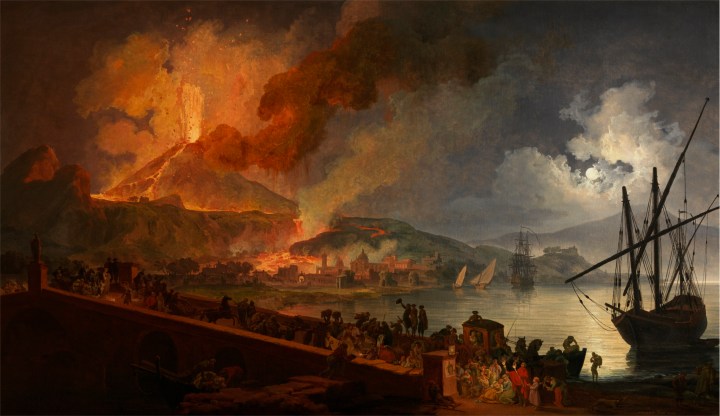
Pierre-Jacques Volaire, Eruption of Vesuvius, oil on canvas, 1769
(Naples: Museo di Capodimonte)

◊  ◊  ◊  ◊  ◊

For PhD students working on the cultural history of Naples who need access to materials in southern Italy including artworks, sites, archives, and libraries. From H-ArtHist:

Research Residencies, 2019–20
Center for the Art and Architectural History of Port Cities, Naples

Applications due by 15 February 2019

Opened in Fall 2018, the Center for the Art and Architectural History of Port Cities / Centro per la Storia dell’Arte e dell’Architettura delle Città Portuali is a collaboration between the Museo e Real Bosco di Capodimonte in Naples and the Edith O’Donnell Institute of Art History at the University of Texas at Dallas, with the participation of the Université Paris-Sorbonne.

Housed within the Capodimonte’s bosco in a rustic eighteenth-century agricultural building called La Capraia (the goat farm), the Center is a laboratory for new research in the cultural histories of port cities and the mobilities of artworks, people, technologies, and ideas. Research and programs at La Capraia are dedicated to exploring global histories of art, architecture, and cultural production, while grounded in direct study of artworks, sites, and materials in Naples as well as southern Italy. Through Research Residencies and regular site-based Research Workshops and Symposia, the Center at La Capraia supports scholarly access to Naples, fosters new research on Naples and on other port cities, and creates a network of students and scholars working on related projects.

The Advisory Committee of the Center for the Art and Architectural History of Port Cities invites applications for Research Residencies for PhD students in the earlier stages of their dissertations. Projects, which may be interdisciplinary, may focus on art and architectural history, music history, archeology, or related fields, from antiquity to the present. All projects must address the cultural histories of Naples as a center of exchange, encounter, and transformation, while making meaningful use of research materials in Naples and southern Italy including artworks, sites, archives, and libraries.

This year, Residencies will run for 9 months (2 September 2019 – 29 May 2020). Residents will be awarded free lodging and work space at La Capraia and, thanks to the logistical support of the Amici di Capodimonte, a modest award of 5,200 EUR to help defray the cost of living during the nine-month period. Residents will be granted privileged access to collections and research resources at the Capodimonte, and access to other sites, collections, and research materials will be arranged as needed. Residents will be responsible for obtaining appropriate visas (the Center will provide official letters of support) and for providing proof of health insurance. During their time in Naples, Residents are expected to share their research in a public lecture, gallery talk, or site visit, to participate fully in the Center’s organized activities, and before the end of the residency period to submit a written report on their progress.

We welcome applications from scholars of any nationality. Applicants are invited to submit a CV, a letter of intent, and a proposal of 1,000–1,500 words that outlines the research project and the resources that will be used in Naples. Materials should be sent in a single PDF file to the Center’s Research Coordinator, Dott.ssa Francesca Santamaria (francesca.santamaria@utdallas.edu). In addition, applicants must invite three recommenders to send letters of support directly to the same email address. All materials, including letters of recommendation, are due by Friday, February 15, 2019.

Colloquium | Venetian Artists and Artistic Exchanges in Europe

Posted in conferences (to attend) by Editor on December 11, 2018

In connection with the exhibition Magnificent Venice! Europe and the Arts in the 18th Century; from H-ArtHist:

La ‘diaspora’ des artistes vénitiens et les échanges artistiques en Europe au XVIIIe siècle
Auditorium du Louvre / Institut Culturel Italien, Paris, 12–13 December 2018

L’exposition Éblouissante Venise: Venise, les arts et l’Europe au XVIIIe siècle (Galeries nationales du Grand Palais, 26 septembre 2018 — 21 janvier 2019) propose un parcours de la civilisation vénitienne du XVIIIe siècle au travers d’un choix de peintures, sculptures, objets d’art, costumes et instruments de musique. À cette occasion l’auditorium du Louvre organise un colloque en collaboration avec l’Institut Culturel Italien et l’Association des Historiens de l’Art Italien (AHAI), qui portera sur la diaspora des artistes vénitiens et les échanges artistiques en Europe au XVIIIe siècle. Ce rayonnement de Venise au-delà de ses frontières constitue une singularité et s’explique par différents facteurs économiques, diplomatiques et politiques au-delà du génie propre aux artistes qui attire les mécènes les plus puissants. Le colloque se propose d’approfondir certains des aspects les plus complexes et les plus riches de ce phénomène.

M E R C R E D I ,  1 2  D É C E M B R E  2 0 1 8

10.00  Ouverture, Auditorium du Louvre

10.30  Matin
Directeur de séance: Stéphane Loire (Musée du Louvre)
• Catherine Loisel (conservateur général du patrimoine, commissaire de l’exposition), Venise et l’Europe au 18e siècle, de la problématique historique à l’exposition
• Valentine Toutain Quittelier (Université Paris-Sorbonne), Venise et la douloureuse quête de mécènes et de subsides
• Paolo Delorenzi (Università Ca’ Foscari, Venise), Venise et la France: Antonio Maria Zanetti comme intermédiaire

12.00  Débat

15.00  Après-midi
Directrice de séance: Paola Marini (Gallerie dell’Accademia, Venise)
• Monica De Vincenti (Università Internazionale dell’Arte di Venezia), Sculptures vénitiennes du Settecento dans les jardins princiers européens
• Françoise Joulie (historienne de l’art), Les tombeaux des princes, des grands capitaines et autres hommes illustres (1735): Une entreprise franco-anglo-vénitienne
• Adrián Almoguera (Université Paris Sorbonne), L’art vénitien et la cour de Madrid au temps des Lumières: Triomphe et déclin d’une magnificence allégorique
• Viviana Farina (Accademia di Belle Arti, Naples), Passion pour la lumière: Relations entre Naples et Venise au début du XVIIIe siècle

17.00  Débat

J E U D I ,  1 3  D É C E M B R E  2 0 1 8

15.00  Ouverture, Institut Culturel Italien

15.30  Après-midi
Directeur de séance: Sergio Marinelli (Università Ca’ Foscari)
• Massimiliano Simone (École pratique des Hautes Études, Paris), ‘L’eroica poesia’ de La Jérusalem délivrée illustrée par Piazzetta: Chef-d’œuvre de l’imprimerie vénitienne
• Gabriele Rossi Rognoni (Royal College of Music, Londres), Instruments, musique et musiciens: Quand la musique vénitienne conquit l’Europe
• Anne Houssay (Laboratoire du Musée de la musique, Cité de la Musique – Philharmonie de Paris), Des violoncelles vénitiens pour créer un son nouveau: Les innovations de l’atelier de Matteo Goffriller
• Caroline Giron-Panel (École nationale des chartes, Paris), ‘Une école dans le goût des conservatoires d’Italie’: Modèles vénitiens pour le Conservatoire de Paris

17.30  Débat

20.00  Concert — La mandoline baroque à Venise au XVIIIe siècle
Ensemble Pizzicar Galante
• Anna Schivazappa, mandolino veneziano (mandoline vénitienne)
• Daniel de Moraïs, tiorba (théorbe)
• Fabio Antonio Falcone, clavicembalo (clavecin)

New Book | Io Sono ‘700: L’anima di Venezia

Posted in books by Editor on December 11, 2018

Published by Cierre and available from Artbooks.com:

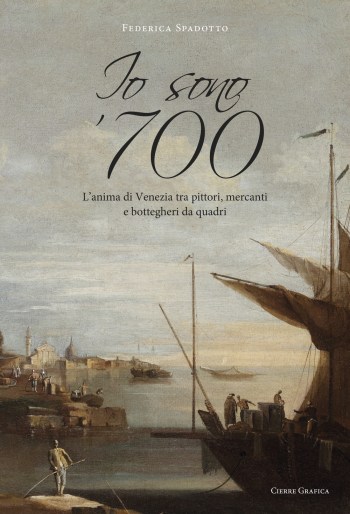
Federica Spadotto, Io Sono ‘700: L’anima di Venezia tra pittori, mercanti e bottegheri da quadri (Caselle di Sommacampagna: Cierre, 2018), 232 pages, ISBN: 978-8898768806, $34 (marked down from $68).

Il volume illustra il mercato dei quadri a Venezia nel Settecento. Per la prima volta l’attenzione critica si sposta dai grandi collezionisti alle dinamiche commerciali vere e proprie, che coinvolgevano gli stessi artisti, oltre a intermediari, diplomatici ed i cosiddetti ‘botegheri da quadri’. Questi ultimi, titolari di negozi/ laboratori per la vendita di dipinti al dettaglio, decreteranno, insieme a figure come il Console Smith o John Strange—di cui è resa nota l’inedita corrispondenza con l’intendente veneziano Giovanni Maria Sasso—le sorti di Michele Marieschi, Canaletto e molti protagonisti del paesaggio e della veduta, ovvero i generi che hanno reso celeberrima Venezia nel suo secolo d’oro. Tra aneddoti, riflessioni e documenti, i dipinti sfilano ad illustrare uno scenario dai risvolti inaspettati, dove luci e ombre del mercato lagunare divengono metafora del nostro tempo.

Call for Papers | Encounters, Entanglements, and Exchanges

Posted in Calls for Papers by Editor on December 10, 2018

Basket, American China Manufactory, Philadelphia, 1770–72 , soft-paste porcelain
(New Haven: Yale University Art Gallery). More information is available here»

◊  ◊  ◊  ◊  ◊

Encounters, Entanglements, and Exchanges
Fifteenth Annual Yale American Art History Graduate Student Symposium
Yale University, New Haven, 6 April 2019

Proposals due by 1 February 2019

Points of encounter can occur across time and space. In the colonial Americas, both blue and white earthenware vessels made in the Mexican city of Puebla and soft-paste porcelain wares produced at the American China Manufactory in Philadelphia, Pennsylvania, responded to East Asian hard-paste porcelain. At the same time, ceramic manufacturers in China adapted designs that catered to pan-American tastes. More recently, Carrie Mae Weems’s The Hampton Project reexamined a nineteenth-century vocational school that served as a cultural crossroads for formerly enslaved African Americans, American Indians, and white Americans to raise pressing questions of race, imperialism, and nationalism in the twenty-first century. These points of convergence between individuals, groups, places, and objects often instigate shifts in creative production with lasting and global resonances. The interaction of disparate cultures offers a rich nexus for artistic creation. Yet such encounters are also inseparable from the shifting dynamics of power that operate along gendered, racial, economic, and political lines. What can exchanges and entanglements reveal about the nature of encounter? How do encounters shape exchanges? In what ways do exchanges propagate new encounters?

The Fifteenth Annual Yale University American Art Graduate Symposium invites papers that interrogate the dialectical relationship between encounter and exchange and explore the legacies of cultural intersection. We invite submissions that address art across North, Central, and South America and the Caribbean, that engage a range of critical perspectives, and that speak to a variety of time periods and artistic practices.

Possible topics include, but are not limited to:
• Activism, coalition building, and the arts
• Micro-histories that address a specific instance of encounter
• Collaborations that problematize narratives of ‘influence’ across social, cultural, or political hierarchies
• Impact of religious proselytization and conversion in the arts
• Gift exchange, diplomacy, and trade
• Appropriation, fetishism, and mimicry
• Contact zones, intersectionality, and peripheries
• Imbalanced power dynamics within systems of colonialism, racism, homophobia, or sexism
• Immigration, migrants, and refugees
• Authorship and ownership
• Tourism and travel narratives
• Global encounters with the notion of ‘Americanness’
• Networks created via technology, globalization, and media

Interested participants are invited to submit an abstract of no more than 350 words along with a CV to americanist.symposium@gmail.com by 1 February 2019. Accepted participants will be notified in mid-February. Accommodations will be provided for all participants in New Haven, Connecticut.

New Book | The Rebirth of an English Country House: St Giles House

Posted in books by Editor on December 10, 2018

From Rizzoli:

Tim Knox and The Earl of Shaftesbury, with photographs by Justin Barton and an introduction by Nick Ashley-Cooper and Jenny Chesher, The Rebirth of an English Country House: St Giles House (New York: Rizzoli, 2018), 256 pages, 978-0847863204, $55.

The brilliantly restored St. Giles House, in the idyllic Dorset countryside, offers high-point Georgian architecture and interiors that bridge many historical styles.

The 12th Earl of Shaftesbury, 39-year-old Nicholas Ashley-Cooper, invites the reader into the house that his family has called home since the fifteenth century. In recent years, his award-winning restoration has brought the house back to life, transforming exquisite spaces that honor the past while being suited to twenty-first-century living. English country-house splendor, through the hands of some of the world’s top artisans and craftspeople, returns to the house in the form of re-created wallpapers, customized paints, revived furniture from the Georgian and Victorian periods, reworked antique Brussels tapestries, restored plasterwork and textiles, and a complete overhaul of the landscape, with its sunken garden, woodlands, avenue of beeches, lake, and shell-encrusted grotto.

With stories of noteworthy architecture, beautiful interiors, and centuries of a single family’s involvement in British and world history, this book will appeal to devotees of country living, the aristocratic life, historic houses, and English interior design.

The 12th Earl of Shaftesbury, Nicholas Ashley-Cooper, is an English peer and philanthropist. Tim Knox is a British art historian and director of the Royal Collection Trust. Justin Barton is a London-based photographer.


New Book | Great English Interiors

Posted in books by Editor on December 10, 2018

Featuring twenty-two interiors, including five eighteenth-century houses; from Prestel:

David Mlinaric and Derry Moore, Great English Interiors (London: Prestel, 2018), 224 pages, ISBN: 978-3791381985, £40 / $60.

Famed photographer Derry Moore and renowned interior designer David Mlinaric offer a panoramic tour inside some of Britain’s finest manor houses, halls, castles, and public buildings. Bridging five centuries, this lavishly illustrated book looks at houses such as Haddon Hall, Chastleton, and Knole, each with superb examples of Tudor and Stuart interiors. Including Houghton Hall from the 18th century and Waddesdon Manor from the 19th century, the book continues into the 20th century to feature the homes of such influential figures as Nancy Lancaster, Pauline de Rothschild, and David Hicks, guiding readers through the finest examples of English interior design. The work of British masters including Inigo Jones, William Kent, and Robert Adam is beautifully portrayed in striking photographs while complementary essays enlighten readers on the events and personalities that lend each site cultural significance. Anglophiles, armchair tourists, and lovers of grand interiors will enjoy these gorgeous photographs while discovering more about the designers, architects, and trends that have made British style so alluring and enduring over the centuries.


Derry Moore is a British architectural photographer and portraitist. He is the author of An English Room and In the Shadow of the Raj (both by Prestel).

David Mlinaric is a British interior designer whose work ranges from commissions for private clients such as Lord Rothschild and Mick Jagger to public galleries and museums, including the National Gallery, and the Victoria and Albert Museum in London.

