Conference | Art and Power, the Power of Art, Part III
From H-ArtHist:
Art et pouvoir, le pouvoir de l’art, III
Le séminaire annuel de l’équipe Histara, EA 7347, École Pratique des Hautes Études (EPHE)
Institut national d’histoire de l’art (INHA), Paris, 5 December 2018
P R O G R A M M E
9.30 Sabine Frommel (EPHE) Introduction
9.45 Matin
Présidence: Rachel Lauthelier-Mourier (EPHE)
• Emilie d’Orgeix (EPHE), Dessiner le vide: Vues de villes et matérialisation du pouvoir, XVIIe–XVIIIe siècles
• Marina Viallon (EPHE), Les tournois à la cour de France à la Renaissance
11.15 Pause café
11.30 Matin
Présidence: Rachel Lauthelier-Mourier (EPHE)
• Kristina Deutsch (Westfälische Wilhelms-Universität Münster), Le décor du pouvoir entre la France et l’Allemagne vers 1700: Le pavillon des bains du château de Nymphenburg à Munich
• Jean-Michel Leniaud (EPHE), Les peintures de Delacroix à la bibliothèque du Sénat
13.00 Pause déjeuner
14.15 Après-midi
Présidence: Isabelle Saint-Martin (EPHE)
• Rachel Lauthelier-Mourier (EPHE), Les monarchies de l’âge classique confrontées au dévoilement du site de Persépolis et à l’obsédante question de la décadence
• Emmanuel de Waresquiel (EPHE), La prise de la Bastille et les métamorphoses de la liberté, 1789–1830
• Barbara von Orelli (Université de Zurich), Le préventorium Le Rosaire à Les Sciernes-d’Albeuve (Suisse): Un monument Art déco entre législation, administration et philanthropie
16.30 Pause café
16.45 Après-midi
Présidence: Isabelle Saint-Martin (EPHE)
• Florence Descamps (EPHE), Bercy. Décors ministériels
• Agnès Callu (CNRS), Domination(s): Histoire politique des commandes aux artistes, de 1980 à nos jours
• Jean-Miguel Pire (EPHE), L’histoire de l’art dans le débat public: Une ‘discipline active dans la cité’ (Chastel)?
19.00 Fin des travaux
Print Quarterly, December 2018
The eighteenth century in the current issue of Print Quarterly:
Print Quarterly 35.4 (December 2018)

François Vivares after Samuel Wale, Trade Card of Henry Scott, Gardener and Fruitseller, Weybridge, Surrey, 1754, etching and engraving, 281 × 211 mm (London: The British Museum).
A R T I C L E S
• Bryony Bartlett-Rawlings, “Jonathan Richardson (1667–1745) as Etcher,” pp. 392–406.
On the basis of the 1772 auction catalogue for the sale of Jonathan Richardson Jr’s collection, the article sheds light on Richardson’s activity as a printmaker, his working method, and intended audience. By quoting contemporary correspondence by and on the artist, the article also places Richardson’s etchings within the context of his life and work.
• Martin Hopkinson, “Gardeners’ Trade Cards by William Kilburn and François Vivares,” pp. 420–26.
Deservedly famous for his outstanding textile designs and illustrations to William Curtis’s Flora Londinensis, Kilburn also etched a trade card for the gardener Thomas Greening, an image of great botanical precision. A comparison is drawn with two elaborate trade cards for gardeners by François Vivares.
N O T E S A N D R E V I E W S
• Jean-Gérald Castex, Review of the exhibition catalogue, A Kingdom of Images: French Prints in the Age of Louis XIV, 1660–1715 (Getty Research Institute, 2015; and Bibliothèque National de France, 2015–16), pp. 430–32.
• An Van Camp, Review of Ad Stijnman and Simon Turner, ed., The New Hollstein Dutch & Flemish Etchings, Engravings, and Woodcuts, 1450–1700: Johannes Teyler and Dutch Colour Prints, parts 1–4 (Sound and Vision Publishers, 2017), pp. 432–34.
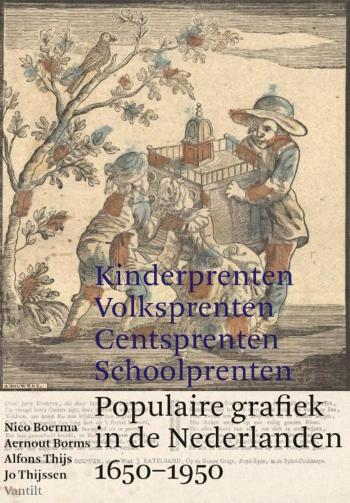 • Ger Luijten, Review of Nico Boerma, Aernout Borms, Alfons Thijs, and Jo Thijssen, eds., Kinderprenten, Volksprenten, Centsprenten, Schoolprenten: Populaire grafiek in de Nederlanden 1650–1950 (Uitgeverij Vantilt, 2014), p. 434.
“At more than a thousand pages,” this volume “is a reference work that deserves a place in any library striving to cover the history of printmaking … Written and compiled by Dutch and Flemish specialists of popular prints over a period of some ten years, it provides a mine of information that is nowhere else to be found … The book has a useful summary in English and German.”
• Anthony Dyson, Review of Richard Goddard, ‘Drawing on Copper’: The Basire Family of Copper-Plate Engravers and Their Works (Maastricht University Press, 2016), pp. 437–39.
• Notice of the exhibition catalogue, Marcela Vondráčková, Norbert Grund (1717–1767): Půvab všedního dne / The Charm of the Everyday, Czech and English (National Gallery in Prague, 2017), p. 459.
“This handsomely-illustrated exhibition catalogue gives a survey of the work of the delightful rococo painter Norbert Grund (1717–1767), who is scarcely known outside Central Europe … We look forward to learning more … in a comprehensive monograph on Grund’s oeuvre, which is due to be published by Marcela Vondráčková.”
• Patricia Emison, Review of Susanna Berger, The Art of Philosophy: Visual Thinking in Europe from the Late Renaissance to the Early Enlightenment (Princeton University Press, 2017), pp. 471–74.
“Berger’s readable and well-illustrated account tackles the topic of logic’s contribution to the history of visualization, and of scholastics’ interest in transmitting knowledge via images … Berger has dug deep in unusual places,” including a mnemonic treatise of 1725 and eighteenth-century student notebooks from Paris and Leuven. “This is fascinating material.”
• Sarah Grant, Review of April Calahan, Fashion Plates: 150 Years of Style (Yale University Press, 2015), pp. 474–78.
Exhibition | Georges Focus: The Madness of a Painter
From the communiqué de presse:
Georges Focus (1644–1708): La folie d’un peintre de Louis XIV
Palais des Beaux-Arts, Paris, 13 October 2018 — 6 January 2019
Curated by Emmanuelle Brugerolles
 La découverte de l’œuvre de Georges Focus produite lors de son enfermement aux Petites Maisons suscite aujourd’hui l’étonnement, pour ne pas dire un choc, qui nous bouleverse. Elle nous inspire le sentiment de l’inédit, du jamais vu, et remet en cause nos idées reçues. Georges Focus, membre de l’Académie royale de peinture et de sculpture sous Louis XIV, eut une double production artistique, académique d’une part, personnelle et intime, d’autre part. L’étonnant corpus réuni en France pour la première fois au Palais des Beaux-Arts, soit environ 80 dessins ainsi que des estampes et des peintures provenant de l’université d’Édimbourg, de collections particulières et d’institutions publiques dont les Beaux-Arts de Paris, rend compte de sa trajectoire unique. Une occasion d’explorer l’oeuvre exceptionnelle et singulière d’un artiste de l’époque de Louis XIV, atteint de folie.
Emmanuelle Brugerolles, ed., Georges Focus: La Folie d’un Peintre de Louis XIV (Paris: Beaux-Arts de Paris Editions, 2018), 447 pages, ISBN: 978-2840565444, $80.
The full press release is available here»
Exhibition | Bed Furnishings in Early America
Now on view at the Wadsworth Atheneum:
Bed Furnishings in Early America: An Intimate Look
Wadsworth Atheneum Museum of Art, Hartford, Connecticut, 26 September 2018 — 27 January 2019
Curated by Brandy Culp

Anna Tuels, Paper Template-pieced Quilt, Hourglass, 1785, New England, various worsteds, silk, and printed cottons, with a wool backing and wool batting (Wadsworth Atheneum, 1967.75).
From birth to death, the bed played a significant role in life’s daily cycles. Almost a room within a room, the bed was a place for sleeping as well as intimate activities, such as sex, childbirth, nursing, convalescence, and even death. From the seventeenth to early nineteenth century there was a bed in almost every room of the home. The ‘best bed’—today we call it the master bed—was usually located in either the distinguished parlor or ‘best’ bedchamber. These were public spaces, where guests were entertained and daily activities took place.
The fully-outfitted bedstead was one of the most expensive household items in Early America, regardless of one’s wealth. Bed hangings, counterpanes, coverlets, bed rugs, and quilts bear witness to the aspirations of their owners and makers. All are exceptional examples of handwork that reflect the skills of talented artisans, whether hired professional or homemaker, and mark the global intersections between people of various cultures. Bed Furnishings in Early America, An Intimate Look explores the evolution of privacy, intimacy, status, and global exchange through the bedstead, its textiles, and their placement within the home into the late nineteenth century.
Exhibition | Bouke de Vries: War and Pieces

Bouke de Vries, War and Pieces, 2012, 18th-, 19th-, and 20th-century porcelain, plastic, sprayed plaster, acrylic, steel, aluminum, gilded brass, and mixed media (installation view at the Wadsworth Atheneum Museum of Art, 2018).
◊ ◊ ◊ ◊ ◊
From the press release, via Art Daily:
Bouke de Vries: War and Pieces
Wadsworth Atheneum Museum of Art, Hartford, Connecticut, 4 October 2018 — 6 January 2019
Montgomery Museum of Fine Arts, Montgomery, Alabama, 2 February — 12 May 2019
For years, the work of celebrated artist Bouke de Vries has been shown all over Europe in museums, galleries, castles, and palaces. America won’t be left behind. Now and through the middle of 2019, several sculptures by Dutch-born de Vries will be making their stateside debut at museums in Hartford, Connecticut; Montgomery, Alabama; and Nashville, Tennessee. Foremost among them is his pièce de résistance: War and Pieces, a 26-foot-long installation inspired by the lavish decorative centerpieces of 18th-century European banqueting tables.
The first venue is the Wadsworth Atheneum, in Hartford, where de Vries is the featured artist in the 180th installment of the museum’s MATRIX contemporary art exhibition series, running from 4 October 2018 until 6 January 2019. “Because the Wadsworth Atheneum possesses such an outstanding collection of the very kind of porcelain figures and centerpieces that Bouke de Vries references in his monumental work,” observes Linda Roth, Senior Curator and Charles C. and Eleanor Lamont Cunningham Curator of European Decorative Arts, “featuring War and Pieces at our museum makes perfect sense.” Adds de Vries: “It is an honor to debut my most ambitious work at America’s first-ever museum of art, the Wadsworth Atheneum, in their longstanding and groundbreaking MATRIX series.”
From Hartford, War and Pieces travels South, to Alabama, where it will be on view at the Montgomery Museum of Fine Arts from 2 February to 12 May 2019.
Employing broken shards of various kinds of porcelain-ancient and modern—from Hummel thru blanc de Chine to IKEA—the artist has arranged them into apocalyptic vignettes of orchestrated destruction. Dead center is a towering nuclear mushroom cloud. Six mano-a-mano battle scenes flank the cloud, fought by armour-clad figures molded from 18th-century embodiments of Mars and Minerva by England’s Derby factory. The sugarcoated warring figures are mutating into cyborgs with colorful bionic limbs and weaponry from Transformer toys. The striking diversity among the sugar, porcelain and plastic underscores the tension between the handmade and the industrial. De Vries’s masterwork is an unforgettable commentary on the follies of war and is perhaps the most startling tablescape since Judy Chicago’s landmark Dinner Party, 1979.
London-based, de Vries first worked in fashion with John Galliano, Stephen Jones, and Zandra Rhodes before switching careers. Since then the 57-year-old artist has worked as a conservator of ceramics and glass, in addition to his pursuits as an artist since 2010. Ironically, the skills he deploys as a restorer went in a totally opposite direction for War and Pieces. Instead of reconstructing shattered porcelain, he deconstructed it, inaugurating a new status while creating new virtues. Says de Vries: “I have dreamed of sharing my approach to art—especially War and Pieces—at such prestigious museums around the United States.”
In addition, from 2 February until 9 June 2019, as part of Derived from the Decorative: Works by Faig Ahmed, Beth Lipman and Bouke de Vries at Nashville’s Cheekwood Estate and Gardens, other works by de Vries will be making their American bow. Peacock 1 and Glass Cloud are also both constructed of broken pieces of historic ceramic and glass. Bouke de Vries is represented in the United States by Ferrin Contemporary in North Adams, Massachusetts.
Exhibition | Thomas Gainsborough: Drawings at the Clark
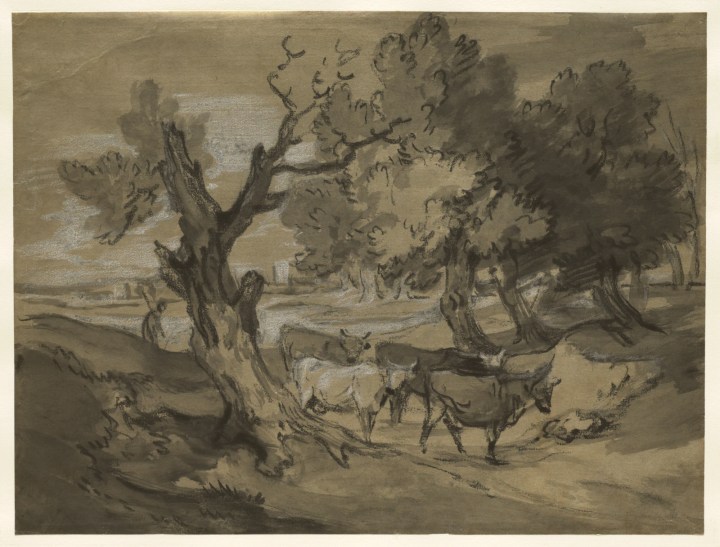
Thomas Gainsborough, Landscape with Herdsman Driving Cows and Distant Buildings, mid to late 1780s, black chalk over brush and gray wash with lead white on beige laid paper, fixed with gum (Williamstown: The Clark Art Institute, gift of the Manton Art Foundation in memory of Sir Edwin and Lady Manton, 2007.8.77).
◊ ◊ ◊ ◊ ◊
From The Clark:
Thomas Gainsborough: Drawings at the Clark
The Clark Art Institute, Williamstown, Massachusetts, 1 December 2018 — 17 March 2019
Though recognized as one of the most fashionable portrait painters of the eighteenth century, Thomas Gainsborough (1727–1788) made hundreds of drawings of the English landscape. Abounding with foliage, cottages, and pastoral figures—shepherds driving flocks of sheep and cows drinking from pools or streams along meandering paths—Gainsborough’s landscapes present an idealized view of country life. Rather than depicting specific locales, these lyrical sheets evoke the gentle woodland and heath of his native Suffolk, in the east, and later, the mountainous Lake District of Cumbria, in the northwest. Thomas Gainsborough: Drawings at the Clark reveals the artist’s fascination with mixed-media technique: graphite, chalks, ink washes, watercolor, and oil paints intermingle on toned papers. Together, the sixteen drawings on view in the Clark’s Manton Gallery for British Art demonstrate how Gainsborough championed an imaginative approach over naturalistic detail and reveal his fascination with mixed-media technique.
The Clark Acquires Lethière’s ‘Brutus Condemning His Sons’

Guillaume Lethière, Brutus Condemning His Sons to Death, 1788, oil on canvas, 23 × 39 inches
(Williamstown: The Clark Art Institute, 2018.1.1)
◊ ◊ ◊ ◊ ◊
In May the Clark announced this acquisition; the painting is now on display. From the press release:
For the first time since acquiring Guillaume Guillon Lethière’s masterpiece, Brutus Condemning His Sons to Death, the Clark presents the painting in its permanent collection galleries. The painting was acquired at auction in spring 2018 along with a preparatory drawing by Lethière (c. 1788) and a stipple engraving dated 1794 by Pierre Charles Coqueret (Paris, 1761–1832) after Lethière’s painting. All three works are on view in a special installation in the Clark’s permanent collection galleries. . . .
The full press release is available here
Call for Papers | The Art of Ugliness, Graduate Symposium
From H-ArtHist:
The Art of Ugliness, 29th Annual Art History Association Graduate Symposium
Indiana University, Bloomington, 13 April 2019
Proposals due by 10 January 2019
Keynote address: “The Use Value of Ugliness” by Dr. Andrei Pop (Associate Professor, Committee on Social Thought, Art History, and the College, The University of Chicago) and Dr. Mechtild Widrich (Assistant Professor, Art History, Theory and Criticism, School of the Art Institute of Chicago)
Is ugliness diametrically opposed to beauty? Or is ugliness simply another aspect of the same coin systematically constructed and cultivated over centuries? While beauty has been fruitfully examined in fields ranging from philosophy to aesthetics and art history, less attention has been given to discourses concerning ugliness. We consider it imperative to reconsider ugliness at this moment to flesh out the ways in which discourses surrounding the ‘ugly’ shape ideas surrounding acceptability. Why do we define, name, or think of something or someone as ‘ugly’? Is it a psychological reaction to what we perceive as gross or disgusting? Does it violate morality? The Art of Ugliness will explore the complex social, cultural, and political aspects embedded within notions of ugliness as well as the aesthetic and philosophical implications of ‘the ugly’.
Potential topics include, but are not limited to:
• Changing perceptions of the nude
• The geography of decay- the ruinous landscape
• Disease and the body
• Xenophobia
• Class and the representation of the profane and abject
• Ugliness and (pseudo)scientific visual culture: phrenology, physiognomy
• Technology and the body
• Evolutionary Theories and Aesthetics
• Relationships to the ‘exotic’/ ‘other’
• The Grotesque; the monstrous; the strange
We invite papers that address ideas of ugliness and aesthetics and greatly encourage the submission of papers engaging objects from a broad variety of periods, geographies, and social groups. Paper sessions, followed by a panel response and discussion, will occur on Saturday, April 13th followed by the keynote address. Current graduate students in art history and related disciplines are invited to submit an abstract (maximum 300 words) for a twenty-minute presentation and CV to ahasympo@gmail.com by January 10th, 2019. Honoraria will be awarded to all presenters who attend from outside Bloomington.
Call for Papers | Early Modern Privacy: Notions, Spaces, Implications
From the Call for Papers:
Early Modern Privacy: Notions, Spaces, Implications
Royal Danish Academy of Science and Letters, Copenhagen, 9–10 April 2019
Proposals due by 2 December 2018

Pieter Bruegel the Younger, Visit to the Farmhouse, c.1620–30, oil on panel, 37 × 49 cm (Bath: The Holburne Museum).
The Danish National Research Foundation Centre for Privacy Studies (PRIVACY) at the University of Copenhagen invites applications for its inaugural conference. Our goal is to provide an opportunity to discuss and re-examine source material in order to understand practices, spaces, and ideas of privacy and related concepts that emerged in the early modern period across historical disciplines. We welcome (interdisciplinary) considerations of practice and performances of privacy and its opposites, as well as analyses of terminology, vocabulary, and languages, for example, in sources mentioning words using the prefix priv-.
Confirmed Keynote Speakers
• Willem Frijhoff (Erasmus University of Rotterdam)
• Hélène Merlin-Kajman (Université Sorbonne Nouvelle Paris 3)
• Mia Korpiola (University of Turku)
• Maarten Delbeke (ETH Zurich)
We invite colleagues working within any field of Early Modern studies to submit proposals for papers in English of 20 minutes duration. Please upload paper title, an abstract of no more than 300 words, and a concise CV via PRIVACYs website no later than Sunday, 2 December 2018. Abstracts and CVs should be in English. A limited number of travel bursaries are available on a need basis; submit your travel bursary application with an estimated budget alongside your materials at the link above. For further information, please email privacy@teol.ku.dk. A final program from the conference will be published in early January.
Suggested Topics
• Legal and religious definitions of private and public
• Individuality and subjectivity in relation to private and public spaces
• The emergence of the modern home and life-cycle inside and outside a (house-)hold
• Vagrancy, poverty and homelessness
• Education and access to knowledge
• Confidentiality, gossip, secrecy and surveillance within communities
• Sexual normativity and deviance from sexual norms
• Confessional spaces
• Interior and exterior design and life
• Public and private politics
Organizing Committee
Michaël Green, Natália da Silva Perez, Anna Katharina Becker, Fredrik Torisson
Call for Papers | Antiquarian ‘Science’ in the Scholarly Society
From the Call for Papers:
Antiquarian ‘Science’ in the Scholarly Society
Society of Antiquaries of London, Burlington House, 1–2 April 2019
Proposals due by 30 November 2018
This is workshop two of the AHRC International Networking Grant: Collective Wisdom: Collecting in the Early Modern Academy led by Anna Marie Roos (Lincoln) and Vera Keller (Oregon).
We will explore how ‘antiquarian science’ informed collecting in the early modern scholarly academy, as many members of these societies like astronomer Martin Folkes (1690–1754) also were connoisseurs and antiquaries. Folkes was Newton’s protégé, President of both the Royal Society and Society of Antiquaries of London, and he even tried to unite the two societies as they had many common members and goals.
In this workshop we will ask (inter alia):
What was the relationship between archaeological fieldwork or antiquarianism and learned travel or the Grand Tour? What does collecting on tour say about the manner and scale of personal and institutional contacts between London and the scientific world of the Continent? What tools of natural philosophy were utilised to understand buildings and artefacts? What were the implications of the collecting of ethnographic objects for political dominance and Empire?
A working session using sources from the Society of Antiquaries Library and Museum will also be part of the programme. The Society’s library is Britain’s oldest major research library for archaeology, architectural history, decorative arts (especially medieval), material culture and the historic environment. It contains books, archives, manuscripts, prints and drawings. Its accredited museum collection—which was formed before the introduction of public museums and galleries in the mid-18th century—contains prehistoric, classical and medieval antiquities, seal matrices and impressions, and paintings.
Speakers include Philip Beeley (Oxford), Dominik Collet (Heidelberg), Dustin Frazier-Wood (Roehampton), Stephanie Moser (Southhampton), Cesare Pastorino (Berlin), Anna Marie Roos (Lincoln), Edwin Rose (Cambridge), Kim Sloan (British Museum), Alexander Wragge-Morley (UCL), Elizabeth Yale (Iowa)
We welcome papers of 25 minutes duration from established and early career scholars on the themes above. Please send an abstract of 200 words to Anna Marie Roos (aroos@lincoln.ac.uk) by 30 November 2018.










leave a comment