Frick Acquires Vase by Luigi Valadier
Press release from The Frick:

Luigi Valadier (1726–1785), Vase, ca. 1770s, Rosso Appennino marble and gilt silver, approximately 9 × 6 × 4 inches (New York: The Frick Collection; photo by Michael Bodycomb).
Luigi Valadier was the preeminent silversmith in Rome during the second half of the eighteenth century. His work was admired by popes, royalty, and aristocrats throughout Europe. His oeuvre will be the subject of an upcoming monographic exhibition and publication at The Frick Collection, Luigi Valadier: Splendor in Eighteenth-Century Rome (31 October 2018, through 20 January 2019). Inspired by this project—the second in a series of much-needed exhibitions to focus on decorative artists who deserve fresh scholarship—the museum has purchased a unique vase by the artist. The vase, believed to be a special commission, is the only known marble example attributed to Valadier that was executed with gilt-silver mounts, rather than his more typical gilt bronze. The marble used for the vase is also unusual, a rarely used blood-red variety identified as Rosso Appennino. The vase is currently on view in the museum’s Library gallery.
The design of the vase—an ovoid body on a square base, with lanceolate leaves at the bottom and two lion heads with rings in their jaws at the neck—appears in a number of Valadier drawings: two sheets in the Museo Napoleonico, Rome, and one in the Museo di Roma. They all illustrate marble or alabaster vases to be used for flowers or as candlesticks, with lion heads on their sides. Four vases in alabaster following this design were given by the Roman senator Abbondio Rezzonico to Cardinal Giuseppe Doria Pamphilj and are still preserved in the family palace in Rome. One of the drawings in the Museo Napoleonico shows measurements in Genoese palmi, suggesting that this specific design was made for the work done about 1779, at Palazzo Spinola in Genoa, by the French architect Charles de Wailly, who was collaborating with Valadier at the time.
Professor Alvar González-Palacios, the world’s expert on Valadier and the curator of the Frick’s upcoming exhibition, believes that the marble vase may have been carved by Francesco Antonio Franzoni (1734–1818), a sculptor known for producing precious objects, often in bizarre and uncommon materials. The precious materials used for this vase—Rosso Appennino marble and gilt silver—and the quality of the chasing of the metal suggest that it was a private commission for an important aristocrat. The top, unlike the lids of other vases of similar design by Valadier, is not detachable, indicating that the vase was ornamental rather than utilitarian. The finial also differs from the other vases depicted in the drawings by Valadier; whereas the other finials are pine cones, the finial of the Frick vase is an acorn. Professor González-Palacios suggests that this may have heraldic significance and allude to one of Rome’s most prominent aristocratic families, the Chigi, whose coat of arms included oak branches and acorns. Prince Sigismondo Chigi (1736–1793) was one of Valadier’s most important patrons in the 1770s and early 1780s.
Sometime after 1716, Valadier’s father, André, moved from Avignon, in the south of France, to Rome, where he established a silversmith workshop that became one of the best known in the city. Luigi inherited his father’s business in 1759, and his unsurpassed technical expertise combined with his aesthetic taste led to a successful career marked by the production of extraordinary objects in gold, silver, and bronze. Antique sculptures, cameos, architectural details, and ruins of Roman monuments served as the inspiration for his imaginative candelabra, tableware, church altars, and centerpieces. The financial state of the Valadier workshop, however, was often precarious, and it seems the artist suffered as a result of commissions that were never paid. He committed suicide in 1785, drowning himself in the Tiber, presumably because of the debts he had accumulated.
Comments Xavier F. Salomon, Peter Jay Sharp Chief Curator, “An exceptional object by Valadier, this vase is an excellent example of the silversmith’s art and a superb object to represent him at The Frick Collection. We are thrilled to add it to our holdings, as it perfectly complements our works by Pierre Gouthière, Valadier’s contemporary in France. It provides a wonderful introduction to New Yorkers as a part of the forthcoming exhibition.”
Xavier Salomon Named Cavaliere dell’Ordine della Stella d’Italia
Press release (28 June 2018) from The Frick:
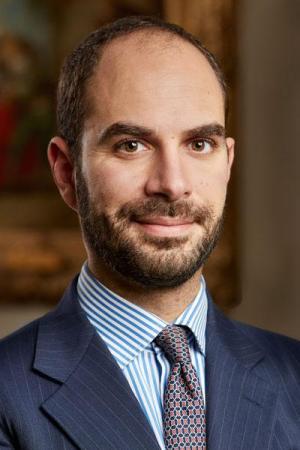 Xavier F. Salomon, Peter Jay Sharp Chief Curator of The Frick Collection has been named Cavaliere dell’Ordine della Stella d’Italia for his contribution to the artistic heritage of Italy, his native country. In a private ceremony at the museum in late May, the honor was bestowed by the President of the Republic of Italy, and Salomon was invested by Armando Varricchio, Ambassador of Italy to the United States. The Ordine della Stella d’Italia was established in 2011, to reward individuals who have collaborated and solidified friendly relationships and cooperation between Italy and foreign countries. This award was reformed from the Ordine della Stella della Solidarietà Italiana, established after World War II to recognize individuals who were contributing to the reconstruction of Italy.
Salomon, an internationally renowned scholar of Paolo Veronese, was appointed by The Frick Collection in January 2014 as the museum’s Peter Jay Sharp Chief Curator. In addition to overseeing the Frick’s curatorial activities, he has organized several exhibitions focusing on Italian and Spanish art. Salomon is the curator of the Frick’s current acclaimed exhibition Canova’s George Washington, which explores the creation of Antonio Canova’s lost statue of George Washington, the only work he created for America. The exhibition features the artist’s full-size preparatory plaster model, executed in 1818, as well as other objects connected to its creation. Following its presentation at the Frick, the show will travel to the Gypsotheca e Museo Antonio Canova in Possagno, Italy, in the fall of 2018. The catalogue, written by Salomon; Mario Guderzo, Director of the Gypsotheca e Museo Antonio Canova; and Guido Beltramini, Director of the Palladio Museum, is a major addition to the current body of knowledge on Canova’s work, as well as on the classical revivalist sculpture of the early nineteenth century on both sides of the Atlantic. Salomon is also co-curating (with Professor Alvar González-Palacios) the Frick’s upcoming exhibition Luigi Valadier: Splendor in Eighteenth-Century Rome, opening in the fall of 2018. This show is the next in an ongoing series of monographic exhibitions presented by the Frick that focus on remarkable decorative arts artists. Accompanying the exhibition will be the first complete publication on the Roman silversmith. A related presentation of this exhibition will be shown in 2019 at the Galleria Borghese, Rome.
Other notable exhibitions at the Frick organized by Salomon include Murillo: The Self Portraits (2017), Veronese in Murano: Two Venetian Renaissance Masterpieces Restored (2017), Cagnacci’s Repentant Magdalene: An Italian Baroque Masterpiece from the Norton Simon Museum (2016), and El Greco at The Frick Collection (2014). In addition to contributing to and authoring several exhibition catalogues, Salomon has written on the museum’s rich holdings, including the recently published Holbein’s Sir Thomas More. Co-authored with the celebrated novelist Hilary Mantel, author of the best-selling Wolf Hall, Salomon and Mantel’s is the inaugural book of Frick Diptychs, a series of small-format books that focus on a single work from the museum’s permanent collection. Each book pairs an in-depth essay by a Frick curator with a contribution from a contemporary cultural figure.
Salomon has also been published in The Metropolitan Museum of Art Journal, Apollo, The Burlington Magazine, Master Drawings, The Medal, The Art Newspaper, and the Journal of the History of Collections. Additionally, he oversees the museum’s acquisitions program, and, under his purview, the Frick has added several objects to complement the collection, including its newest acquisition, a vase by the Italian silversmith Luigi Valadier, which will be included in this fall’s upcoming exhibition on the artist. He sits on the Consultative Committee and is a trustee of The Burlington Magazine and Save Venice, and is a member of the International Scientific Committee of Storia dell’Arte and Arte Veneta. He is an alumnus of the Center for Curatorial Leadership (2015).
In 2015, Salomon helped launch the Frick’s groundbreaking collaboration with the Ghetto Film School, a Bronx-based independent film organization that brings high school students from New York City into the museum for onsite instruction across two creative disciplines, the fine arts and the cinematic arts. The program culminates with the creation of a student-produced short film inspired by the Frick and filmed on location at the museum. The partnership was recently featured in an episode NYC-Arts on THIRTEEN, and in an episode of the documentary series Treasures of New York, which focused on The Frick Collection. This program is now heading into its fourth year.
Born in Rome and raised in Italy and the United Kingdom, Salomon received his Ph.D. from the Courtauld Institute of Art for his research on the patronage of Cardinal Pietro Aldobrandini. He began his professional career at the Frick in 2004, where he spent two years as the museum’s Andrew W. Mellon Curatorial Fellow. From 2011 to 2014 he was Curator in the Department of European Paintings at The Metropolitan Museum of Art, and, prior to that, the Arturo and Holly Melosi Chief Curator at Dulwich Picture Gallery, London. During his tenure at Dulwich, he co-organized, with Colin B. Bailey (then the Frick’s Chief Curator) Masterpieces of European Painting from Dulwich Picture Gallery, which was presented by the Frick in 2010. As a Veronese scholar, he has organized several exhibitions on the artist, including the Frick’s acclaimed dossier show Veronese’s Allegories: Virtue, Love, and Exploration in Renaissance Venice (2006) and the monographic exhibition on the artist at the National Gallery, London (2014).
Comments Frick Director Ian Wardropper “We are thrilled that Xavier’s contributions have been recognized by the Italian government and he has been honored with the Cavaliere dell’Ordine della Stella d’Italia. His achievements at the Frick are many and include a number of remarkable exhibitions focusing on Italian artists. These exhibitions were the result of rigorous scholarship and created opportunities for engaging public programming and wonderful collaborations with Italian institutions.”
New Book | Enchanted Islands
From The University of Chicago Press:
Mary D. Sheriff, Enchanted Islands: Picturing the Allure of Conquest in Eighteenth-Century France (Chicago: The University of Chicago Press, 2018), 416 pages, ISBN: 978-0226483108, $55. Also available as an e-book.
 In Enchanted Islands, renowned art historian Mary D. Sheriff explores the legendary, fictional, and real islands that filled the French imagination during the ancien regime as they appeared in royal ballets and festivals, epic literature, paintings, engravings, book illustrations, and other objects. Some of the islands were mythical and found in the most popular literary texts of the day—islands featured prominently, for instance, in Ariosto’s Orlando furioso, Tasso’s Gerusalemme liberata, and Fénelon’s Telemachus. Other islands—real ones, such as Tahiti and St. Domingue—the French learned about from the writings of travelers and colonists. All of them were imagined to be the home of enchantresses who used magic to conquer heroes by promising sensual and sexual pleasure. As Sheriff shows, the theme of the enchanted island was put to many uses. Kings deployed enchanted-island mythology to strengthen monarchical authority, as Louis XIV did in his famous Versailles festival Les Plaisirs de l’île enchantée. Writers such as Fénelon used it to tell morality tales that taught virtue, duty, and the need for male strength to triumph over female weakness and seduction. Yet at the same time, artists like Boucher painted enchanted islands to portray art’s purpose as the giving of pleasure. In all these ways and more, Sheriff demonstrates for the first time the centrality of enchanted islands to ancient regime culture in a book that will enchant all readers interested in the art, literature, and history of the time.
Eighteenth-Century Studies, Summer 2018
While there’s plenty to relish in the latest issue of ECS, I’m glad to highlight, in particular, this important article by Paris Amanda Spies-Gans. I’ve also listed all three single title book reviews; while none of them deal specifically with the visual arts, it’s easy to see (perhaps particularly with the first two) points of methodological relevancy for art history. –CH
Eighteenth-Century Studies 51.4 (Summer 2018)
A R T I C L E S
 • Paris Amanda Spies-Gans, “Exceptional, but not Exceptions: Public Exhibitions and the Rise of the Woman Artist in London and Paris, 1760–1830,” pp. 393–416.
From 1760 to 1830, more than 1,300 women exhibited more than 6,000 works of art in London and Paris’ premier art exhibitions—an unprecedented surge in female artistic activity and its public reception. This article traces that transformation, which strikingly mirrors the progress of the French Revolutionary Wars, and contends that the Revolutionary era opened vital opportunities for female artists on both sides of the Channel despite cultural differences. It thus argues for a recasting of period’s historical narrative to integrate women’s omnipresence in the public, professional art world, and a reevaluation of their hitherto dominant categorization as ‘amateur’ artists. It also challenges the historiographical argument that the Revolutionary era was principally a defeat for women in Britain and France.
R E V I E W S
• Kristina Straub, Review of Susan Lanser, The Sexuality of History: Modernity and the Sapphic, 1565–1830 (The University of Chicago, 2014), pp. 479–82.
• Renee Bryzik, Review of Katrin Berndt, Narrating Friendship and the British Novel, 1760–1830 (Routledge, 2017), pp. 483–85.
• Nancy Vogeley, Review of Jonathan Israel, The Expanding Blaze: How the American Revolution Ignited the World, 1775–1848 (Princeton University Press, 2017), pp. 485–87.
New Book | Visualizing Disease
From The University of Chicago Press:
Domenico Bertoloni Meli, Visualizing Disease: The Art and History of Pathological Illustrations (Chicago: The University of Chicago Press, 2018), 288 pages, ISBN: 978-0226110295, $55.
 Visual anatomy books have been a staple of medical practice and study since the mid-sixteenth century. But the visual representation of diseased states followed a very different pattern from anatomy, one we are only now beginning to investigate and understand. With Visualizing Disease, Domenico Bertoloni Meli explores key questions in this domain, opening a new field of inquiry based on the analysis of a rich body of arresting and intellectually challenging images reproduced here both in black and white and in color.
Starting in the Renaissance, Bertoloni Meli delves into the wide range of figures involved in the early study and representation of disease, including not just men of medicine, like anatomists, physicians, surgeons, and pathologists, but also draftsmen and engravers. Pathological preparations proved difficult to preserve and represent, and as Bertoloni Meli takes us through a number of different cases from the Renaissance to the mid-nineteenth century, we gain a new understanding of how knowledge of disease, interactions among medical men and artists, and changes in the technologies of preservation and representation of specimens interacted to slowly bring illustration into the medical world.
Domenico Bertoloni Meli is provost professor of history and philosophy of science and medicine at Indiana University, Bloomington.
C O N T E N T S
Preface
Introduction: Bodies, Diseases, Images
1 Visualizing Disease in the Early Modern Period
2 ‘Sic nata est anatome pathologica picta’: The Diseases of Bones
3 Preserved Specimens and Comprehensive Treatises
4 Intermezzo: Identifying Disease in Its Inception
5 The Nosology of Cutaneous Diseases
6 Morbid Anatomy in Color
7 Comprehensive Treatises in Color
Concluding Reflections
Acknowledgments
Illustration Credits
List of Abbreviations
Notes
Bibliography
Index
Exhibition | Peintures des lointains
Now on view at the Musée du Quai Branly:
Paintings from Afar: The Musée du Quai Branly-Jacques Chirac Collection
Musée du Quai Branly, Paris, 30 January 2018 — 6 January 2019
Curated by Sarah Ligner
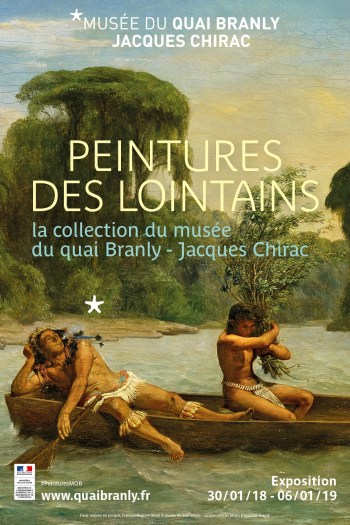 For this initial exhibition devoted to the painting collection at the quai Branly, Paintings from Afar (Peintures des lointains) brings together nearly two hundred canvases and graphic works selected from among the five hundred works in the entire collection and dating from the late 18th century to the mid-20th century. It is a composite and largely unknown collection, where Ange Tissier’s odalisque sits alongside portraits of American Indians by George Catlin and scenes of day-to-day life in Cairo by Émile Bernard stand shoulder to shoulder with prints and drawings of Tahiti by Matisse and Gauguin.
This collection tells the story of an encounter with the Other and the Elsewhere, questioning the evolution of the artistic perspective of the unknown. In a rapidly expanding colonial Europe, Western art takes different paths when faced with the shock of a world that welcomes it in, first succumbing to the temptation of exoticism, where the exaltation of colour and light fuels dreams of a luxurious and exquisite Eastern world, before later coming to represent a more realistic, ethnographic perspective that is mindful of the Other. From oneirism and naturalism, fantasy to documentary and romanticism to colonial propaganda, the collection offers a reflection of artistic and political history.
The exhibition is curated by Sarah Ligner, Head of the Historic and Contemporary Globalisation Heritage Unit at the Musée du quai Branly-Jacques Chirac.
The Art Bulletin, June 2018
In the current issue of The Art Bulletin 100 (June 2018):
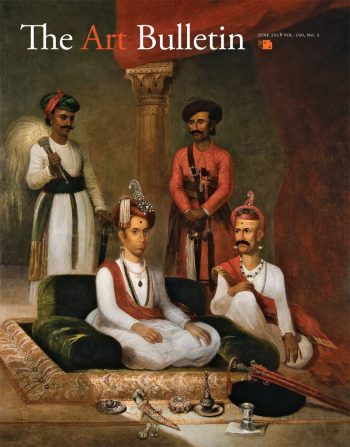 Oliver Wunsch, “Watteau, through the Cracks,” pp. 37–60.
Antoine Watteau’s paintings decayed rapidly. Soon after his death, his contemporaries bemoaned the cracks ravaging his works. They regarded the problem as the product of Watteau’s restless character, noting that his shortsighted personality led him to paint improperly. A deeper explanation situates Watteau’s impatient attitude and impermanent techniques within an emerging culture of ephemeral consumption. An examination of the afterlife of Watteau’s decaying work in the form of reproduction points to an alternative understanding of permanence based less on material immutability than on commercial dissemination. Permanence has a history, and Watteau offers insight into a crucial transition.
Holly Shaffer, “‘Take All of Them’: Eclecticism and the Arts of the Pune Court in India, 1760–1800,” pp. 61–93.
At the peshwa’s court in the western Indian city of Pune in the late eighteenth century, the powerful minister Nana Fadnavis deliberately formulated an eclectic aesthetic. From soliciting Mughal and Rajput paintings at North Indian imperial centers such as Delhi and Jaipur to employing painters from South India and the painter James Wales from Britain, Fadnavis sought entry into a worldly artistic culture. Yet he balanced his cosmopolitan ambitions with emphasis on local devotional traditions. The resultant eclecticism would transform the nature of human and divine representation at the court, and it offers a model for investigating this period today.
Getty Foundation Launches ‘Conserving Canvas’
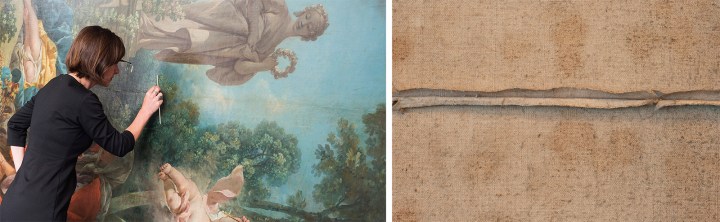
Left: Examination of François Boucher’s Vertumnus and Pomona (1757) in the conservation studio at the de Young Museum. Right: A detail of the back of the painting shows a seam in the lining canvas. Images from the Getty’s blog, The Iris.
◊ ◊ ◊ ◊ ◊
Press release (1 August 2018) from The Getty:
The Getty Foundation announced today the launch of Conserving Canvas, a new initiative that aims to ensure that critical conservation skills needed to care for paintings on canvas do not disappear. Conserving Canvas will keep much-needed skills alive through a number of grants that support the conservation of paintings, workshops, seminars, training residencies, and a major symposium. The initiative’s initial projects support the study and conservation of world-renowned works on canvas, including Thomas Gainsborough’s The Blue Boy (1770), Anthony van Dyck’s Equestrian Portrait of Charles I (1637–38), and François Boucher’s Vertumnus and Pomona (1757). The inaugural Conserving Canvas grantees include The Huntington Library, Art Collections, and Botanical Gardens, San Marino, CA; the National Gallery, London; Fine Arts Museums of San Francisco; Statens Historiska Museer, Sweden; Stichting Restauratie Atelier Limburg, the Netherlands; University of Glasgow, Scotland; and Yale University.
“Through extensive consultation with specialists in the conservation field including experts at the Getty, we heard that there is a growing skills gap between senior conservators who learned treatments of paintings on canvas decades ago and newer museum conservators who need to address pressing problems for paintings in their own collections,” says Deborah Marrow, director of the Getty Foundation. “Conserving Canvas creates opportunities for international collaboration among conservation professionals, so that critical knowledge can be shared, discussed, and disseminated.”
Canvas supports became popular at the end of the 15th century, and have continued to be the primary material on which painters create their work. For centuries, it was common for restorers and conservators to protect these paintings by backing or lining them with another canvas to add general structural strength or repair rips and tears. As these linings age, some can create strains on the original canvas that cause the paint layer to separate and ‘cup’ away from the fabric support. In other instances bubbles can form, often significantly disfiguring the painted image.
Recent decades have seen the field embrace minimal intervention for paintings on canvas—altering an existing artwork as little as possible—as best practice, but this comes at a price. Today many paintings in museum collections around the world that were lined—and now have structural failures—are not being treated, largely because conservators feel insufficiently experienced with existing practices for safe intervention. While this loss of ‘bench skills’ is a concern for the field-at-large, it is particularly pressing for the care of paintings on canvas. There are thousands of old master paintings on fabric supports that were lined in the past, and these works are now beginning to need re-treatment. In addition, modern and contemporary paintings—especially larger works—tend to be more delicate due to the often experimental nature of artist’s materials and techniques. If the issue is not addressed, several generations of conservators are at risk of not being prepared to care for masterpieces on canvas in collections worldwide.
Conserving Canvas will foster inter-generational and inter-organizational sharing of information and best practices by creating opportunities where conservators can regain knowledge about past conservation techniques, work together to make decisions, and experience hands-on training. To this end, a major symposium that addresses the state of the field, the first such meeting since 1974, will be held at Yale University in October 2019.
“For years museum conservators have adopted a ‘wait and monitor’ approach to any major structural intervention on canvas paintings. But the danger is that once treatment can no longer be delayed, the experts with direct knowledge of lining and re-lining won’t be there to offer help,” says Antoine Wilmering, senior program officer at the Getty Foundation. “The field will benefit when conservators are aware of the full range of treatment options available for canvas paintings, whether that is lining or re-lining the canvas, removing a lining and its adhesives, tear mending or re-weaving losses in a canvas, or any other type of intervention. Conserving Canvas will provide international dialogue and opportunities to see these techniques in action so that professionals can advance their practice before it’s too late.”
More information about Conserving Canvas can be found here.
Grants Awarded

Thomas Gainsborough, The Blue Boy, 1770 (San Marino: The Huntington Library, Art Collections, and Botanical Gardens).
The Huntington Library, Art Collections, and Botanical Gardens, San Marino
Thomas Gainsborough’s The Blue Boy is the most famous painting in the Huntington’s collection, having been on display for nearly 100 years without interruption. Despite the best of care, conservation treatment is now necessary to address lifting and flaking paint, the separation of the canvas from its support lining, and the accrual of layers of varnish on the painting’s surface. A grant is allowing the Huntington to bring together highly respected experts in the conservation of 18th-century British canvas paintings in order to finalize the treatment plan for addressing the structural concerns. A cohort of conservators is gaining valuable experience by participating in the decision-making process and structural intervention of this highly significant and celebrated canvas painting. During the year-long conservation treatment, The Blue Boy is remaining largely on public view in order to educate vast audiences about the field of preservation. Grant awarded: $150,000 (2018).
The National Gallery, London
With Getty support, the National Gallery, London is undertaking a major conservation treatment of one of the most prominent canvas paintings in its collection, Anthony van Dyck’s Equestrian Portrait of Charles I (1637–38). Since its acquisition in 1885, the monumental work—which depicts the king as the divinely chosen ruler of Great Britain—has rarely been off view. While the painting is in relatively good condition, the present lining is failing, and the original canvas is too weak to hold the painting up by itself. Old tears are lifting at the edges, and a network of surface cracks (which indicate the painting has been rolled in the past) disrupt the image. Additionally, the picture surface is somewhat rippled in parts from earlier structural treatments. Led by National Gallery conservators, a complex conservation intervention will remove the current lining and apply a new one. Visiting conservators will receive training in the techniques and complex logistics of relining a large and fragile painting, an undertaking in which the National Gallery’s conservation department has particular expertise. A culminating workshop will share the project results with a larger group of 20–30 specialists in the field. Grant awarded: £70,800 (2018).
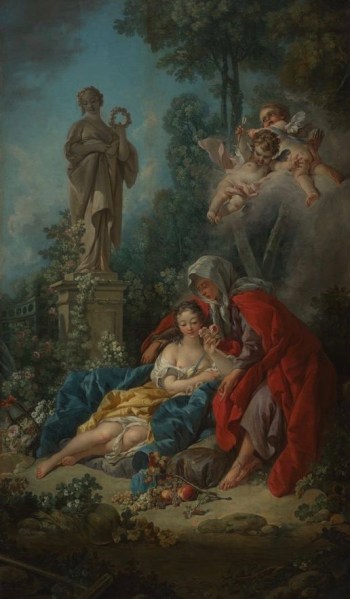 Fine Arts Museums of San Francisco
François Boucher’s Vertumnus and Pomona (1757) is one of the largest paintings in the European collection of the Legion of Honor, which together with the de Young museum compose the Fine Arts Museums of San Francisco. For many years, the painting was the focal point of a large gallery devoted to 18th-century French and Italian art; however, upon the gallery’s reinstallation in 2013, the painting was removed from display due to its appearance. The work had become increasingly compromised by canvas distortions, a failing lining, yellowed surface varnish, and discolored retouching. Led by senior conservators, the Getty grant-funded conservation treatment will create the opportunity for a group of visiting museum conservators to develop hands-on skills in lining and canvas repair, while also engaging in dialogue about surface aesthetics and treatment methodology. A related technical study will address long-standing questions about the painting’s early history. Grant awarded: $129,000 (2018).
Statens Historiska Museer, Stockholm
Sweden’s National Historical Museums is organizing a 13-day collections-based seminar for up to 16 conservators and curators to study canvas paintings at Skokloster Castle in Sweden. The seminar provides a hands-on introduction to the mechanical behavior of paintings on cloth supports, the deterioration of materials such as canvas and adhesives, and the aesthetic impact of different canvas conservation treatment methods. A workshop on tear mending is offering conservators the chance to learn a newer, less invasive repair technique, while case studies involving three 17th-century paintings from the collection—including Jacob Jordaens’s The Return of the Holy Family from Egypt—promote problem-solving skills. The Skokloster collection is especially well-suited for training exercises given its lack of climate control over the centuries; trainees can witness firsthand the effects of uncontrolled climate conditions on the collection’s lined and unlined paintings and discuss possible conservation treatments. Grant awarded: 1,130,000 kr (2018).
Stichting Restauratie Atelier Limburg (SRAL), Maastricht
A Getty grant is supporting an advanced conservation workshop on mist lining, a minimally invasive technique developed to stabilize paintings on canvas. The practice, which was developed in the 1980s, involves the application of minimal amounts of adhesive, heat, and pressure to join a lining canvas to the reverse of the original painting. Since mist lining is still a relatively new technique and not yet a part of many conservators’ ‘toolkit’, the advanced workshop is especially timely for the field. The workshop will consist of a two-phase program. A group of selected practicing mid-career conservators will be invited to SRAL for a week-long workshop outlining the technique and its variables. Follow-up residencies of two weeks will allow the same conservators to put new skills and acquired knowledge into practice. These slightly longer, bench-skill workshops involve the actual treatment of paintings requiring lining. This format will ensure the promotion of in-depth learning about this particular conservation approach and promote a collaborative network able to further disseminate this technique. Grant awarded: €234,000 (2018).
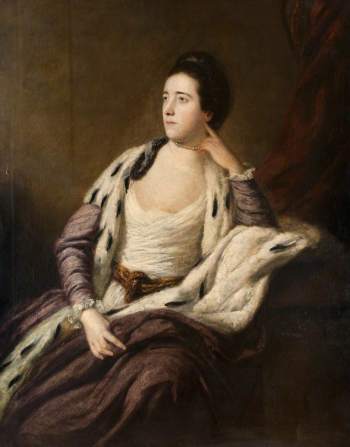
Sir Joshua Reynolds, Lady Maynard, ca. c.1759–60 (Hunterian Art Gallery, University of Glasgow).
University of Glasgow
A Getty grant is bringing pairs of conservators-curators to the College of Arts and The Hunterian at the University of Glasgow for training workshops related to the conservation of five canvas paintings from The Hunterian and the National Galleries of Scotland, including Sir Joshua Reynolds’s Lady Maynard (c.1759–60). The workshops, which focus on the interdisciplinary involvement of both curators and conservators, are conceived around the principle that canvas conservation is part of a holistic process which interrelates all aspects of the condition, aesthetic, interpretation, and presentation of the painting. Participants will research the evolution of lining materials and techniques, and review how past structural treatments affect a painting’s appearance. They will also examine the visual presentation of paintings with different approaches to treatments with reference to the collections at The Hunterian, National Galleries of Scotland, Glasgow Museums, and Yale University. Afterwards they will complete individual month-long residencies in Scotland to treat the five selected paintings. Grant awarded: £115,000 (2018).
Yale University, New Haven
The Institute for the Preservation of Cultural Heritage at Yale University is organizing an international symposium on the conservation of canvas paintings to be held in October 2019 for conservators, conservation scientists, and curators. This will be the first major international gathering on the subject since 1974. The symposium will address historical approaches to the structural treatment of canvas paintings; current methods, materials, and research; and the challenges facing the structural conservation of modern and contemporary works. With today’s field embracing minimal-intervention techniques and maintaining differing opinions on the efficacy of more invasive approaches, the symposium will provide a long overdue forum to reevaluate historical and current practices as well as inform future directions for the conservation of canvas paintings. Grant awarded: $212,000 (2018).
Call for Articles | Special Issue of ‘Perspective’ on Multiples

Utagawa Kunisada (1786–1864), Shokunin (Artisans), 1857, woodblock, triptych, mitate
(London: The British Museum, 1907,0531,0.204)
◊ ◊ ◊ ◊ ◊
From the English Call for Papers (with the French version available here). . .
Perspective: actualité en histoire de l’art 2019.2
Special Issue on Multiples
Proposals due by 24 September 2018; full texts due by 30 April 2019
Using the notion of multiples, the next thematic issue of Perspective: actualité en histoire de l’art (2019.2) will examine the issue of mechanical reproduction. Though the phrasing inevitably refers to Walter Benjamin and his famous essay “The Work of Art in the Age of Mechanical Reproduction” (1935–36), this call for papers does not intend to limit the scope of contributions to the mass reproduction pertaining to the advent of photography and cinema, but to embrace all the means of reproduction, ranging from the most traditional, such as bronzes, terracottas, and coins, to the most contemporary related to the rise of new technologies, while not neglecting engraving, screen printing, or lithography. The aim is to analyze the ways in which reproductive techniques influence the production of works of art, while disturbing ontological presuppositions that oppose the original to its copy, the aura to inauthenticity, ritual value to exhibition value.
Starting from Walter Benjamin’s statement that “in principle the work of art has always been reproducible,” this propensity for multiplication, which may appear to be a work of art’s vital principle, does not signify the same reality in different geo-cultural periods and areas. Furthermore, is the distinction between the original and its copy a fact of modern Western culture which, since the eighteenth century and the rise of the art market, has celebrated the gure of the author and invented the notion of genius? A series of questions emerges and among them, to list just a few at random: To what needs—aesthetic, historical, anthropological, political, economic, etc.—does this propensity for multiplication that is a characteristic of artworks respond? What are the different modalities of the dialectical relationship between the original and its reproduction? Can we distinguish different phases within the history of reproduction? In what way does the advent of mass reproduction techniques constitute a turning point in the production and dissemination of artworks? Does the successive appearance of different techniques that rely on an increasingly complex apparatus which downgrades the hand in favor of the eye necessarily lead to the disappearance of the craft? Can we imagine the very existence of the aura outside of techniques of mass reproduction?
Furthermore, this issue will focus on all possible forms of multiples produced by means of mechanical reproduction processes, from the most rudimentary to the most elaborate, within a broader theoretical and geographical perspective that will give full weight to the periods preceding our own, as well as non-Western production. Though the journal is dedicated to artworks, heritage, history of architecture and urbanism, archeology, or museography, it also welcomes articles on photography, cinema, performance, dance, design, music, theater, and all forms of hybridization that the encounters of these different media can produce, provided that they are considered through the lens of visual history. Regardless of the subject proposed, contributions should follow the editorial guidelines of Perspective which publishes articles (25,000 or 45,000 characters) offering historiographical surveys of fundamental questions and/or which embody current trends in the discipline within the proposed topic.
Please submit your proposals (2,000–3,000 character summary and a 2–3 line biography) to the editorial address (revue-perspective@inha.fr) by Monday, 24 September 2018. The journal will take responsibility for translations if necessary. Proposals will be examined by the editorial committee of the issue, regardless of the language of submission. Authors of selected articles will be informed of the committee’s decision in October 2018 while full texts of accepted contributions will be due by the end of April 2019.
New Book | La scuola ascolana di pittura tra XVII e XVIII secolo
An account of painters in Ascoli working after Carlo Maratti, from Il Lavoro:
Valentina Coccia, Una Città, un’Accademia e l’Eredità Marattesca: La scuola ascolana di pittura tra XVII e XVIII secolo (Ancona: Il Lavoro Editoriale, 2018), 234 pages, ISBN: 9788876638602, $50.
 Era il 1834 quando Amico Ricci, con le sue Memorie storiche, aprì per la prima volta uno squarcio sulla realtà pittorica ascolana tra XVII e XVIII secolo, facendo riferimento all’Accademia aperta nella città di Ascoli Piceno da Ludovico Trasi, primo pittore di cultura barocca presente sul territorio e precoce divulgatore del linguaggio marattesco. Questo volume raccoglie il prezioso spunto offerto dallo studioso andando ad analizzare quel nutrito gruppo di artisti, finora pressoché ignoti, che aderirono a questa scuola (Luca Vitelli, Silvestro Mattei, Carlo Palucci, Giuseppe Angelini e Biagio Miniera), erroneamente considerati minori e secondari, in realtà laboriosi tessitori di quella fitta trama di sperimentazioni stilistiche, linguaggi e modelli sulla quale sono nate ed evolute le personalità più note—dal Trasi stesso, al Nardini, fino a Nicola Monti. Lo studio va dunque ad illuminare questa scuola pittorica—una scuola in dialogo costante con Roma e capace perciò di assorbirne i vitali impulsi figurativi—con numerose novità relative ai pittori e al loro operato, colmando il vuoto lasciato dalla letteratura artistica esistente in materia. Una scuola nella quale l’arte di Carlo Maratti risulta agire come una sorta di forza invisibile, che con maniacale operosità va ad insinuarsi nelle fessure di ogni tela, lungo lo scorrere di ogni pennellata, sin nelle più profonde trame del malconcio intreccio del più dimenticato stendardo processionale, riemergendo con sorprendente forza a rivendicare tutto il suo, indiscusso, primato.










 Enfilade
leave a comment