Early Modern French Studies 40 (2018)
Three of the articles focus specifically on the eighteenth century:
Early Modern French Studies 40 (2018)
Anticipated Afterlives: Envisaging Posterity in Early Modern France
• Oliver Wunsch, “Diderot and the Materiality of Posterity,” 63–78.
• John Leigh, “Posterity and Progeny: Memoirs and Autobiographical Writing in the Late Eighteenth Century,” 79–92.
• Olivier Ritz, “La Postérité Littéraire à l’Epreuve de la Révolution,” 93–101.
An excerpt from Jessica Goodman’s introduction to the issue:
Much work has been done on the questions of reception history, literary influence, commemoration, and life writing. Rather than treading over the same ground, however, this volume, in a self-reflexive twist, addresses what we have called ‘anticipated afterlives’: the different ways in which early modern individuals are aware that they stand to ‘live on’ in some sense after their biological death, and how they attempt to manage this transition to posterity. This focus on the ‘before’ of anticipation rather than the ‘after’ of posthumous reputation derives from the idea that posterity, in its purest sense, can only ever be anticipated. It is almost always a projection into an unknown future, a continually receding vanishing point. The individual, standing Janus-like between a lived but disappearing past, and a future that retreats as he approaches it attempts nonetheless to fix a version of that past (whether his own, or that of another) for those to come, whose interpretations he can only guess at.
New Book | Unfabling the East
From Princeton UP:
Jürgen Osterhammel, Unfabling the East: The Enlightenment’s Encounter with Asia, translated by Robert Savage (Princeton: Princeton University Press, 2018), 696 pages, ISBN: 9780691172729 (hardcover), $35 / ISBN: 9781400889471 (ebook).
 During the long eighteenth century, Europe’s travelers, scholars, and intellectuals looked to Asia in a spirit of puzzlement, irony, and openness. In this panoramic and colorful book, Jürgen Osterhammel tells the story of the European Enlightenment’s nuanced encounter with the great civilizations of the East, from the Ottoman Empire and India to China and Japan.
Here is the acclaimed book that challenges the notion that Europe’s formative engagement with the non-European world was invariably marred by an imperial gaze and presumptions of Western superiority. Osterhammel shows how major figures such as Leibniz, Voltaire, Gibbon, and Hegel took a keen interest in Asian culture and history, and introduces lesser-known scientific travelers, colonial administrators, Jesuit missionaries, and adventurers who returned home from Asia bearing manuscripts in many exotic languages, huge collections of ethnographic data, and stories that sometimes defied belief. Osterhammel brings the sights and sounds of this tumultuous age vividly to life, from the salons of Paris and the lecture halls of Edinburgh to the deserts of Arabia, the steppes of Siberia, and the sumptuous courts of Asian princes. He demonstrates how Europe discovered its own identity anew by measuring itself against its more senior continent, and how it was only toward the end of this period that cruder forms of Eurocentrism–and condescension toward Asia—prevailed.
A momentous work by one of Europe’s most eminent historians, Unfabling the East takes readers on a thrilling voyage to the farthest shores, bringing back vital insights for our own multicultural age.
Jürgen Osterhammel is professor of modern and contemporary history at the University of Konstanz. He is a recipient of the Gottfried Wilhelm Leibniz Prize, Germany’s most prestigious academic award. His books include The Transformation of the World: A Global History of the Nineteenth Century and, with Jan C. Jansen, Decolonization: A Short History (both Princeton). He lives in Freiburg, Germany.
Kee Il Choi, On Johannes Kip and Export Landscape Painting

Johannes Kip, A Prospect of West-minster & A Prospect of the City of London, Netherlands, ca. 1720; two engravings, printed from two plates on four sheets of paper, 51 × 234 cm overall (New York: The Metropolitan Museum of Art, 2017.128a,b).
◊ ◊ ◊ ◊ ◊
In the latest issue of The Rijksmuseum Bulletin, a paper that emerged from a 2017 ASECS session on Art Markets organized by Wendy Roworth.
The Rijksmuseum Bulletin 66.2 (2018)
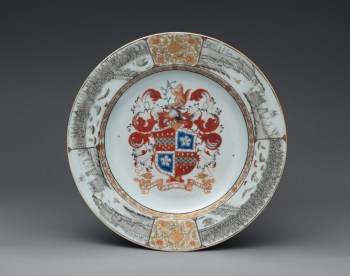
Dish, or Plate, ca. 1730, hard paste porcelain, 28.4 cm (New York: The Metropolitan Museum of Art, Gift of Mrs. Joseph V. McMullan, 58.126).
Kee Il Choi, Jr., “‘Partly Copies from European Prints’: Johannes Kip and the Invention of Export Landscape Painting in Eighteenth-Century Canton,” pp. 120–43.
This paper introduces the way Johannes Kip’s A Prospect of Westminster & A Prospect of the City of London (c. 1720) furnished the design for a handscroll of the Thames River enamelled on the rim of a renowned armorial porcelain service made around 1730–40. Having thus situated an important exemplar of northern European landscape art in China by 1750, it further suggests that Kip’s topographic print may well have played an influential, not to say seminal role in the conceptualization of monumental, panoramic handscrolls of the foreign factories from which ultimately the iconic landscape genre emerged. Descriptive of the site of both commerce and aesthetic exchange, these export paintings have exercised a lasting hold on the historical imagination. In as much as export porcelain signified the China trade for Westerners, export paintings came to represent Canton, if not the whole of China for a global audience.
Enfilade Turns Nine! Buy an Art Book! Donate to HECAA!
From the Editor
As Enfilade turns nine (22 June 2018), I’m glad to write with my usual observations and admonitions. The site exists because you—along with lots of others reading alongside you—continue to tune in. We’ve just surpassed 920,000 views. Thanks so much! And so to celebrate . . .
1) Buy an art book this weekend. In the world of academic art history publishing, several hundred books sold over a few days is stellar. It’s an important way to communicate that the eighteenth century is a thriving field with a vital, engaged audience. The more people who buy books addressing the eighteenth century, the easier it will be to publish your next book on the eighteenth century.
2) Renew your HECAA membership. In the normal world $30 doesn’t really count as philanthropy. For a small academic society it does. Because HECAA is registered as a 501c3, all donations are tax deductible in the United States. So send in a contribution of $100 or $5. But donate something. We accept PayPal.
3) Register for the HECAA conference in November. Early registration rates apply until July 1. More information is available here.
4) Finally, send in news you’d like to see reported! I’m glad to post announcements about conferences, forthcoming books, journal articles, exhibitions, fellowship opportunities, &c. Just about anything except job listings. The postings readers most enjoy are inevitably original content, reports of interesting collections, house museums, resources, and the like. No reason to be shy.
Again, thanks to all of you and all the best!
Craig Hanson
Nationalmuseum Sweden Acquires Per Krafft’s ‘Belisarius’
Press release (19 June 2018) from Sweden’s Nationalmuseum:

Per Krafft the Younger, Belisarius, 1799, oil on canvas, 125 × 94 cm (Stockholm: Nationalmuseum, NM 7468).
Nationalmuseum has acquired a painting by Per Krafft the Younger (1777–1863) depicting the blind former general Belisarius. This painting ought to be regarded as one of the most prominent Swedish works executed in the French Neoclassical style.
In 1796, at the age of nineteen, Per Krafft the Younger was awarded a travel scholarship by the Royal Swedish Academy of Fine Arts, in part because Jonas Åkerström (1759–1795), who had used the scholarship to spend time in Rome, had suddenly died the year before at the early age of 36. Krafft went to Paris where as the only Swede he spent three years studying under Jacques-Louis David (1748–1825). David had a large number of pupils, and his teaching, which in those days was held at the Louvre, laid emphasis on painting and drawing technique, modelling, and nature studies in order to depict only the ideal subject matter: themes from antiquity.
David’s influence is evident in Krafft’s painting, which ought to be regarded as one of the most prominent Swedish works executed in the French Neoclassical style. It shows the strict lines of classical architecture in the background and a sculptural approach to the figure drawing. The palette is also a reminder of David’s work, with fine contrasts between their clothing—white and green and red—worn by Belisarius and the boy, their skin tone, and the shiny surface of the reflective metal on the belt and helmet. The figures almost stand out in relief against the light brown, yellow, and blue-grey tones of the background. The work was executed in 1799 and sent together with three other paintings—Phrygian Lyre Player Meditating, Paris, and Love—to Stockholm for exhibiting at the Royal Academy of Fine Arts in 1801.
The motif showing the successful Byzantine general Belisarius who was reduced to beggar status proved popular in the latter part of the 18th century as a result of the novel Bélisaire by Jean-François Marmontel (1723–1799), which was published in 1767. As a punishment for the general who was suspected of having conspired against him, the Byzantine emperor Justinian I is alleged to have put out Belisarius’s eyes, after which Belisarius was forced to beg by the gates of Rome. This choice of motif gave Krafft the opportunity to direct criticism in allegorical form at the tyrannical rulers of his day. Nor is it altogether surprising that Krafft’s teacher, the Republican David, had used the motif in a famous painting from 1781, now on display in the Palais des Beaux-Arts in Lille. A further famous example was executed by another of David’s pupils, François-Pascal-Simon Gérard (1770–1837), now on display in the J. Paul Getty Museum in Los Angeles.
Krafft emphasises the pathos of his subject in the sober mood that permeates his work in general and in the detail in particular, such as the way the old soldier uses his helmet to collect the alms received. Per Krafft the Younger enjoyed a long life. He was appointed court painter and professor at the Royal Academy of Fine Arts. During his career he was to become primarily a portrait painter.
Nationalmuseum receives no state funding for art acquisitions; rather, the collections benefit from donations and funding from private trusts and foundations. This acquisition has been made possible by a generous donation from the Hedda & N.D. Qvist Memorial Fund.
Nationalmuseum in Stockholm to Reopen October 13

From the Nationalmuseum in Stockholm:
The New Nationalmuseum at Blasieholmen opens again October 13, 2018. After five years closed, we wish you a warm welcome to a whole new museum experience. The renovation is finished, and we are currently working on the displays and exhibitions.
The renovation project has created a modern museum environment that is better for the art, the exhibitions, and for visitors. The New Nationalmuseum will be an open, visitor-friendly place where art can be experienced on both a large and a small scale—while preserving the integrity of the museum’s architectural heritage. The long-awaited climate control system will enable us to present the museum’s collections in an integrated way, crossing the boundaries between artistic disciplines. We will be able to exhibit paintings and other works that are more climate-sensitive, such as drawings and graphic art, alongside applied art and design. This will enhance the visitor experience by tying together multiple stories. It will also allow us to put more artworks on display.
Thanks to the relocation of behind-the-scenes activities such as administration and storage, the New Nationalmuseum will have more public space for exhibits and visitor amenities. By opening up both courtyards for use as multifunctional spaces, we can also improve the logistics of the main floor. The building will have multiple entrances and exits, as required by the fire code, which determines the maximum number of visitors that can be accommodated at any time—a number that is likely to increase.
Built in 1866, the Nationalmuseum building is over 150 years old. For decades, the building has been constantly repurposed and adapted to the museum’s changing and growing requirements. One layer of modifications has been piled on top of another. However, the building had never been thoroughly renovated and did not meet today’s accepted international standards in terms of safety, climate control, fire safety, working environment, and logistics. The renovations has brought the building up to modern operational and regulatory standards.
Technical innovations have made it possible to reinstate bricked-up windows to let in natural light. Specially developed technology will ensure that no artworks are damaged. A state-of-the-art climate control system will be installed, improving the environment for artworks, visitors, and staff. The public spaces will be expanded considerably, adding about 2300 square metres. Both courtyards, which currently house the auditorium and the restaurant, will be turned into public spaces housing visitor amenities and some exhibits. A new layout and security technology will enable us to keep the museum’s lower level open in the evenings independently of the rest of the building.
New Book | Raffinesse im Akkord: Meissener Porzellanmalerei
Published by Michael Imhof and available from ArtBooks.com:
Claudia Bodinek, Raffinesse im Akkord: Meissener Porzellanmalerei und ihre grafischen Vorlagen (Petersberg: Imhof, 2018), 2 volumes, 768 pages, ISBN: 9783731904724, 135€ / $195.
 Ohne grafische Vorlagen wäre die erstaunliche Themenvielfalt der malerischen Dekore auf Meissener Porzellan des 18. Jahrhunderts nicht denkbar. Die reich bebilderte Publikation führt erstmals anhand einer Fülle von Beispielen aus Barock, Rokoko und beginnendem Klassizismus vor Augen, wie kreativ die Meissener Maler Motive aus Kupferstichen, Radierungen und Zeichnungen in immer neue Dekore auf Porzellan übertrugen. Neben den bis heute erhaltenen Vorlagen im Manufakturarchiv diente auch die einstige königliche Kollektion im Dresdner Kupferstich-Kabinett als Vorbildersammlung. Beiden historischen Beständen sind gleichfalls eingehende Studien gewidmet.
New Book | Eighteenth-Century Wallpaper in Britain
From Routledge:
Clare Taylor, The Design, Production and Reception of Eighteenth-Century Wallpaper in Britain (New York: Routledge, 2018), 234 pages, ISBN: 978-1472456151 (hardback), $150 / ISBN: 978-1351021784 (ebook), $55 (ebook rental from $27).
 Wallpaper’s spread across trades, class, and gender is charted in this first full-length study of the material’s use in Britain during the long eighteenth century. It examines the types of wallpaper that were designed and produced and the interior spaces it occupied, from the country house to the homes of prosperous townsfolk and gentry, showing that wallpaper was hung by Earls and merchants as well as by aristocratic women. Drawing on a wide range of little known examples of interior schemes and surviving wallpapers, together with unpublished evidence from archives including letters and bills, it charts wallpaper’s evolution across the century from cheap textile imitation to innovative new decorative material. Wallpaper’s growth is considered not in terms of chronology, but rather alongside the categories used by eighteenth-century tradesmen and consumers, from plains to flocks, from China papers to papier mâché and from stucco papers to materials for creating print rooms. It ends by assessing the ways in which eighteenth-century wallpaper was used to create historicist interiors in the twentieth century. Including a wide range of illustrations, many in colour, the book will be of interest to historians of material culture and design, scholars of art and architectural history as well as practicing designers and those interested in the historic interior.
Clare Taylor is Senior Lecturer in Art History, The Open University.
C O N T E N T S
List of Figures and Plates
Preface
Introduction
1 ‘Paper Hangings for Rooms’: The Arrival of Wallpaper
2 A Contested Trade
3 Imitation and the Cross-Cultural Encounter: ‘India’ and ‘Mock India’ Papers, Pictures, and Prints
4 In Search of Propriety: Flocks and Plains
5 Challenging the High arts: Papier Mâché, Stucco Papers, and ‘Landskip’ Papers
6 ‘Our Modern Paper Hangings’: In Search of the Fashionable and the New
Epilogue
Appendix 1: List of Principal Wallpapered Rooms Discussed, c.1714–c.1795
Appendix 2: List of Eighteenth-Century London Paper Hangings Tradesmen DIscussed
Bibliography
Index
New Book | Art and War in the Pacific World
From the University of California Press:
J.M. Mancini, Art and War in the Pacific World: Making, Breaking, and Taking from Anson’s Voyage to the Philippine-American War (Berkeley: University of California Press, 2018), 344 pages, ISBN: 9780520294516, $65 / £50.
 The Pacific world has long been recognized as a hub for the global trade in art objects, but the history of art and architecture has seldom reckoned with another profound aspect of the region’s history: its exposure to global conflict during the British and US imperial incursions of the eighteenth and nineteenth centuries. Art and War in the Pacific World provides a new view of the Pacific world and of global artistic interaction by exploring how the making, alteration, looting, and destruction of images, objects, buildings, and landscapes intersected with the exercise of force. Focusing on the period from Commodore George Anson’s voyage to the Philippine-American War, J. M. Mancini’s exceptional study deftly weaves together disparate strands of history to create a novel paradigm for cultural analysis.
J. M. Mancini is Senior Lecturer in the Department of History, Maynooth University, Ireland. Her publications include Pre-Modernism: Art-World Change and American Culture from the Civil War to the Armory Show and Architecture and Armed Conflict, edited with Keith Bresnahan.
Exhibition | The Remaking of Scotland
Press release (12 June 2018) from the National Galleries of Scotland:
The Remaking of Scotland: Nation, Migration, Globalisation 1760–1860
Scottish National Portrait Gallery, Edinburgh, 16 June 2018 — 27 June 2021
A dynamic new exhibition at the Scottish National Portrait Gallery (SNPG) explores how Scotland’s place in the world was dramatically transformed after the mid-eighteenth century, as the country emerged as a leader of European cultural life and a major force in Britain’s industrial and imperial expansion. The Remaking of Scotland: Nation, Migration, Globalisation 1760–1860 traces this remarkable transformation through the many extraordinary personalities who contributed to this turning point in Scottish history, bringing together a range of fascinating paintings, sculptures, and drawings from the National Galleries of Scotland’s outstanding collection.
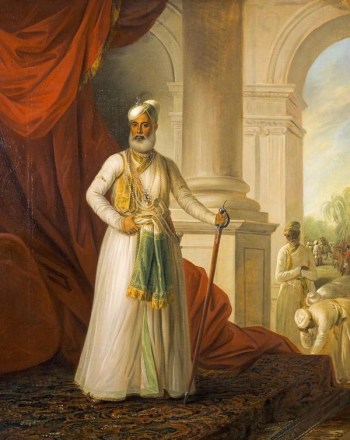
George Willison, Mohamed Ali Khan Walejah, Nawab of the Carnatic, 1777, oil on canvas, 236 × 146 cm (National Galleries of Scotland, Bequeathed by Douglas Willison Clark 1994, PG 2959).
As well as tracing the changes that took place within Scotland in the areas of science, technology, and literature, it will also look beyond Scotland’s borders to highlight the many Scots who ventured further afield—as soldiers, sailors, administrators, artists, missionaries, and adventurers. Their destinations ranged across the world, and the exhibition showcases work featuring Scots with close relationships to India, the Americas and Arctic, as well as the Caribbean.
Among the portraits on display is a captivating new acquisition—a portrait of the lawyer Sir Thomas Strange (1756–1841) by the fashionable London painter John Hoppner. Strange was the son of a Scottish engraver and spent his entire career abroad, first in Nova Scotia, Canada and then in India. While in Nova Scotia he used his position as Chief Justice to protect runaway slaves from their masters. In India, he helped create the fusion between British Common Law and Hindu traditions that would be the foundation of the modern Indian legal system. Hoppner’s characterful portrait gives a vivid sense of Strange’s intelligence and fair-mindedness. Strange’s portrait will be shown with a number of other paintings highlighting the relationships between Scotland and India at this time, including Scottish artist George Willison’s dramatic portrait of his Indian patron, Ali Khan Waledjah, Nawab of Arcot (1717–1795).
Other highlights of the display include Alexander Nasmyth’s portrayal of John Sakeouse (1792–1819), the first arctic Inuit to travel to Scotland. Sakeouse attained instant celebrity from the moment he arrived in Leith in 1816 as a stowaway on a whaling ship and was particularly famous for his remarkable canoeing and harpooning skills, which he demonstrated at the docks. Nasmyth painted the portrait after spotting Sakeouse on the street and went on to give him drawing lessons. Sakeouse became an indispensable member of Admiral John Ross’s arctic expedition of 1817–18, acting as a translator and artist. Fittingly, Sakeouse will be shown alongside a portrait of Ross, one of the great explorers of his time and one of the first Scots of the period to be represented in the collections of the SNPG.

John Singleton Copley, Hugh Montgomerie, 12th Earl of Eglinton, ca. 1780, oil on canvas, 226 × 149 cm (National Galleries of Scotland, PG 1516; photograph by Antonia Reeve).
In addition to documenting the material and cultural benefits that came from this period of unprecedented achievement, the display will also consider some abhorrent contemporary issues. A particularly important theme is Scotland’s extensive involvement in the plantation economy of the Caribbean and its dependence on slave labour. Many Scots went to the Caribbean in the hope of making their fortunes, becoming plantation and slave owners on a large scale. Meanwhile, Scottish merchants in the great ports of Glasgow and Leith maintained a vast West Indies trade, importing slave-produced sugar, rum, and tobacco. Some became hugely wealthy, but they were only the most prosperous of the thousands of Scots who enjoyed secure incomes from plantation investments. Others, however, were inspired by religious and moral convictions to oppose the appalling human cost of the slave trade. In the face of fierce resistance, abolitionists, including the prominent Scottish liberal lawyer and politician, Lord Brougham (1778–1868)—also featured in the display—finally brought slavery to an end in 1838.
Warfare, too, was a constant feature of life in this period, as Britain’s imperial interests involved the many Scottish soldiers and sailors in the British armed forces in bloody land and sea battles. Two spectacular full-length portraits of soldiers in full Highland Dress, John Singleton Copley’s Hugh Montgomerie, 12th Earl of Eglinton (who served in the French and Indian War of 1754–63) and Sir Joshua Reynolds’s John Murray, 4th Earl of Dunmore (made Governor of New York in 1770 and then of Virginia in 1771), show how the cost of war to life and health was made acceptable by the glory of victory.
Taken together, these diverse works give a vivid portrait of the richly complex, and sometimes controversial, legacies of this remarkable period, both at home in Scotland and across the wider world.










leave a comment