Symposium | Global Impact of Asian Aesthetics on American Art
From the University of Delaware:
Global Impact of Asian Aesthetics on American Art and Material Culture
Winterthur, Wilmington, Delaware, 10–14 October 2018
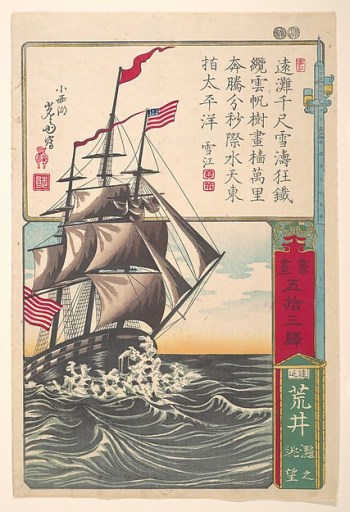
Utagawa Yoshimori, An American Sailing Ship off Arai, 1872; polychrome woodblock print, ink and color on paper (New York: Metropolitan Museum of Art, 2007.49.243).
How do design ideas, patterns, and aesthetics travel across the globe, even when objects themselves do not?
The idea behind this project’s question grew out of a string of provocative inquiries that emerged following exhibitions and recent projects that our alumni and faculty members of the University of Delaware have worked on in the past 10 years (Collecting China [UD-Winterthur, DE], Asia in Amsterdam [PEM, MA], Made for the Americas [MFA Boston, MA], among others). While existing scholarship has recognized the global circulation of objects, artistic forms in the American field sometimes have less to do with the mobility of actual objects from Asia than with translations of Asian aesthetic influences that create new forms in new regions. This project therefore explores ideas about transcultural circulation beyond the concept of objects as commodities, by urging researchers to collaboratively study ideas and influences, across time and space, which have inspired, integrated, and re-generated new aesthetics in and beyond America.
‘Asia’ and ‘America’ are taken in this project as pointers to encourage a mapping of global and multi-directional flow of aesthetics and aesthetic translation, not merely an exchange between Asia and North America. Our long-term goal is to generate a multi-level investigation that comprehensively encompasses Asia, Europe, the Americas and other related world regions into the study of American art and material culture.
For details about the symposium, a graduate student workshop and presentation, and a living repository site for research data, please visit the website. All events are free and open to the public, but registration is required. Lodging is also available at discounted price for registered participants.
Roundtable Panelists
J. Ritchie Garrison (University of Delaware, Winterthur Program, Newark)
Michael Leja (University of Pennsylvania, Philadelphia)
Partha Mitter (University of Sussex, emeritus, Oxford)
Alexandra Munroe (Guggenheim Museum, New York, New York City)
Nasser Rabbat (MIT, Cambridge)
Moderated by Vimalin Rujivacharakul (University of Delaware, Art History, Newark)
Speakers (by the order of team members’ last names)
Team 1
Glenn Adamson (New York & London)
Ming Tiampo (Carleton University, Ottawa)
Team 2
Jens Baumgarten (Universidade Federal de Sao Paulo, Brazil)
Dennis Carr (Museum of Fine Arts, Boston)
Team 3
Ned Cooke (Yale, New Haven)
Dorothy Ko (Barnard/Columbia, New York City)
Team 4
Karina Corrigan (Peabody Essex Museum, Salem)
Femke Diercks (Rijksmuseum, Amsterdam)
Team 5
Linda Eaton (Winterthur Museum, Garden & Library)
Giorgio Riello (University of Warwick, England)
Team 6
Lee Glazer (Freer|Sackler Galleries, Washington DC)
Stacey Pierson (School of Oriental and African Studies, England)
Team 7
Medill Harvey (American Wing, Metropolitan Museum, New York City)
Forrest McGill (Asian Art Museum, San Francisco)
Team 8
Liu Chang (Tsinghua University & Palace Museum, Beijing)
Greg Landrey (Winterthur Museum, Garden & Library, Winterthur)
Team 9
Darielle Mason (Philadelphia Museum of Art, Philadelphia)
Asma Naeem (National Portrail Gallery, Washington DC)
Team 10
Marco Musillo (Kunsthistorisches Institut in Florenz, Florence)
Catharine Dann Roeber (Winterthur Museum, Garden & Library, Winterthur)
Graduate Student Workshop | Asian Aesthetics and American Art
From the University of Delaware:
International Graduate Student Workshop
Global Impact of Asian Aesthetics on American Art and Material Culture
The University of Delaware and Winterthur Museum, Garden, and Library 11–12 October 2018
Proposals due by 8 June 2018
With the generous support of the Terra Foundation for American Art, the University of Delaware’s Department of Art History and the Winterthur Program of American Material Culture will host a two-day International Graduate Student workshop on October 11 and 12, 2018. This workshop is part of a series of events in October 2018 to launch the project In Search of Global Impact of Asian Aesthetics on American Art and Material Culture.
We invite graduate students from a variety of fields, from all regions of the world, to submit a short abstract of a dissertation in progress or a project that: 1) redefines the canon of art history, with a focus on the multidirectional impact of Asian aesthetics on American art and material culture, and/or 2) proposes new interpretations of the transcultural and transhistorical flow of aesthetics that not only redefine the geocultural boundaries of Asia and North America, but also rethink methodological formations of aesthetic emergence.
We strongly encourage proposals that consider the flow of global aesthetics beyond the circulation of objects, as well as those that examine ‘Asia’ and ‘North America’ as discursive structures or cultural constructs in connection with other world regions such as Africa, Europe, South America, among others. In sum: How do design ideas, patterns, and aesthetics travel across the globe, even when objects do not?
To apply, send a short abstract written in English (300–500 words) and a 2-page CV to global-aesthetics@udel.edu by 8 June 2018. Applicants will be notified of decisions by 8 July 2018. Successful applicants will be invited to submit a dissertation chapter or excerpt, or paper, (9000–10000 words), to be pre-circulated and read before the workshop.
Official respondents are: Partha Mitter (Sussex, emeritus), Dorothy Ko (Barnard/Columbia), Lee Glazer (Freer/Sackler Galleries), Marco Musillo (Kunsthistorisches Institut in Florenz), with the Terra Foundation’s guest critics: Zhang Gan and Chen Anying (Academy of Arts and Design, Tsinghua, Beijing), in addition to the faculty workshop advisors from the Department of Art History and the Winterthur Program of the University of Delaware.
Lodging and meals are provided for invited participants throughout the workshop. Applicants seeking travel support should include in the application a letter demonstrating the need and a budget plan.
In addition to the Terra Foundation, we thank the following organizations for their support: The University of Delaware’s Office of Graduate and Professional Education and the Center for Material Culture Studies, with grants from the Unidel Foundation, and National Endowment for the Humanities.
Conference | HECAA at 25, November 2018
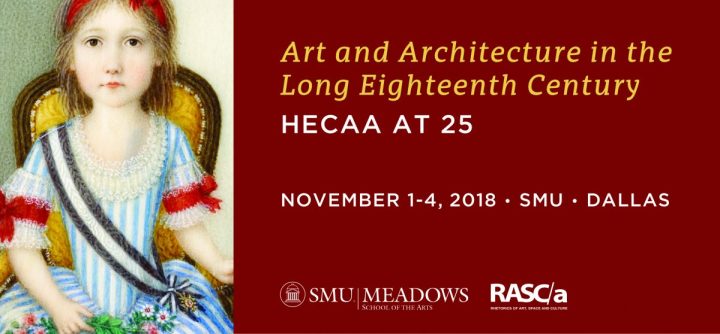
Francisca Efigenia Meléndez y Durazzo, Portrait of a Girl, ca. 1795, tempera on ivory, 5 × 5 cm (Dallas: Meadows Museum, SMU, Museum Purchase with funds from The Meadows Foundation, MM.08.01.20).
From SMU:
Art and Architecture in the Long Eighteenth Century
HECAA at 25, Conference Program and Registration
Southern Methodist University, Dallas, 1–4 November 2018
The Art History Department, its graduate program in the Rhetorics of Art, Space, and Culture (RASC/a), and the Meadows School of the Arts at Southern Methodist University are proud to announce the program for Art and Architecture in the Long Eighteenth Century: HECAA at 25, a conference to be held 1–4 November 2018 in celebration of the twenty-fifth anniversary of the founding of the Historians of Eighteenth-Century Art and Architecture.
HECAA at 25 will present recent research on eighteenth-century visual culture, consider questions of historiography and pedagogy, and chart paths for the future of the field. The program also includes visits to the Meadows Museum, the Dallas Museum of Art, and the Kimbell Art Museum.
Come to Texas, y’all!
For the program and conference information, visit: smu.edu/HECAA25
Registration information is available here»
Questions? Contact us at hecaa25@gmail.com.
Exhibition | Venice in the Footsteps Casanova
Now on view in Grenoble, at the the Convent of St Cecilia, headquarters of the Glénat publishing house:
Venise sur les pas Casanova: De la peinture du XVIIIe siècle à la bande dessinée
Musée d’Angoulême, 25 January — 11 March 2018
Couvent Sainte-Cécile, Grenoble, 22 March — 16 June 2018
Curated by Stéphane Beaujean and Bożena Anna Kowalczyk
 Le Fonds Glénat pour le Patrimoine et la Création (couvent Sainte-Cécile – Grenoble) et le Festival International de la Bande dessinée dédient une nouvelle exposition à la Venise de Canaletto et de Casanova. Les deux images de la ville, pour la première fois confrontées, celle perpétuée par la peinture du XVIIIe siècle, officielle, sereine, de la carte postale, et le scenario des aventures vénitiennes de l’auteur libertin de L’Historie de ma vie, sont complémentaires et nous introduisent dans cette ville fascinante, la plus admirée dans l’Europe de l’époque. L’exposition permettra de faire dialoguer des toiles du XVIIIe siècle avec des images contemporaines, et mettra tout à la fois en évidence l’opposition entre le centre de la ville, magnifié par la veduta, et les ruelles plus interlopes empruntées par Casanova, la vision, d’une ville essentielle de l’Europe renaissante qui continue aujourd’hui d’enchanter des visiteurs du monde entier par son imaginaire, mais aussi bien entendu le dialogue entre ces deux arts que sont la peinture et la bande dessinée.
Stephane Beaujean and Bozena Anna Kowalczyk, Venise sur les pas de Casanova: De la peinture du XVIIIe siècle à la bande dessinée (Grenoble: Glénat Livres, 2018), 96 pages, ISBN: 978-2344023907, 15€.
New Book | The Savage and Modern Self
From the University of Toronto Press:
Robbie Richardson, The Savage and Modern Self: North American Indians in Eighteenth-Century British Literature and Culture (Toronto: University of Toronto Press, 2018), 264 pages, ISBN 9781487503444, $70.
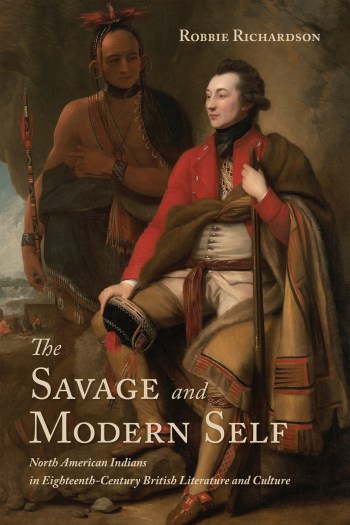 The Savage and Modern Self examines the representations of North American ‘Indians’ in novels, poetry, plays, and material culture from eighteenth-century Britain. Robbie Richardson argues that depictions of ‘Indians’ in British literature were used to critique and articulate evolving ideas about consumerism, colonialism, ‘Britishness’, and, ultimately, the ‘modern self’ over the course of the century.
Considering the ways in which British writers represented contact between Britons and ‘Indians’, both at home and abroad, the author shows how these sites of contact moved from a self-affirmation of British authority earlier in the century, to a mutual corruption, to a desire to appropriate perceived traits of ‘Indianess’. Looking at texts exclusively produced in Britain, The Savage and Modern Self reveals that ‘the modern’ finds definition through imagined scenes of cultural contact. By the end of the century, Richardson concludes, the hybrid Indian-Brition emerging in literature and visual culture exemplifies a form of modern, British masculinity.
Robbie Richardson is a lecturer in Eighteenth-Century Literature at the University of Kent.
C O N T E N T S
1 Indians and the Construction of Britishness in the Early Eighteenth Century
2 The Indian as Cultural Critic: Shaping the British Self
3 Captivity Narratives and Colonialism
4 Novel Indians: Tsonnonthouan and the Commodification of Culture
5 Becoming Indians: Sentiment and the Hybrid British Subject
6 Native North American Material Culture in the British Imaginary
Conclusion: ‘Pen-and-Ink Work’
Display | Publishing at the Paul Mellon Centre
On view at the Mellon Centre:
Publishing at the Paul Mellon Centre: A Brief History
Paul Mellon Centre for Studies in British Art, London, 19 January — 18 May 2018
Organized by Emily Lees
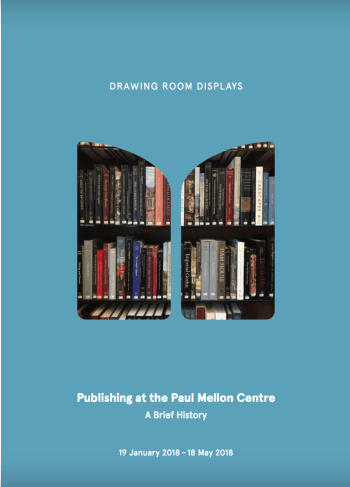 The new Drawing Room Display and accompanying brochure are designed to give a brief introduction to the beginnings of our publishing history and to highlight the different strands of our list. We begin with the story of our very earliest publications; and then, to showcase the variety of our output, we have asked a selection of colleagues associated with the Centre to tell the stories behind some of our most important books. Inevitably, we only had space for a small selection of our publications in the display itself. However, to see our complete list, the variety of subjects we have covered and the pantheon of authors we have been privileged to work with, you will find a copy of every book we have published in the bookcases in the Drawing Room. All the material in this display is taken from the PMC’s institutional archive and library.
The 36-page brochure accompanying the display includes brief entries by ten contributors and is available online. As Emily Lees writes:
The Paul Mellon Centre’s first fully fledged publications, and the first of its books to be published in association with its long-standing partner, Yale University Press, was Ronald Paulson’s Hogarth: His Life, Art, and Times, which was published in the spring of 1971 (13).
Conference | American Latium
Next month at the Center for American Studies in Rome, from the conference flyer:
American Latium: American Artists and Travellers in and around
Rome in the Age of the Grand Tour
Centro Studi Americani, Palazzo Mattei di Giove, Rome, 7–8 June 2018
Organized by Christopher M.S. Johns, Tommaso Manfredi, and Karin Wolfe
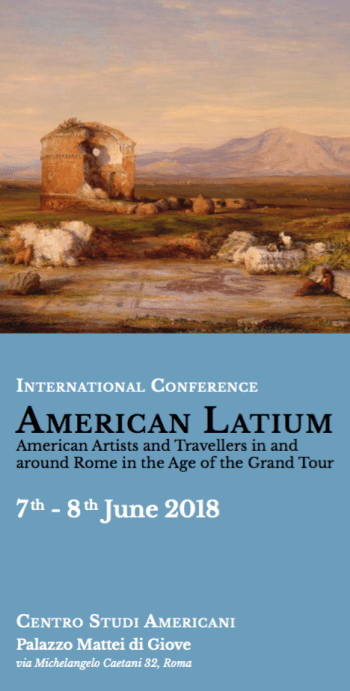 American Latium addresses the pioneering origins of the artistic relations between America, Rome, and its environs from the eighteenth century up until 1870, in order to define the extraordinary impact of the arts of Rome, from antiquity through to the modern period, that in large part resulted in the birth of a national American aesthetic. Interdisciplinary in nature, this conference will put forward new research and new research approaches to the study of cultural travel and cultural exchange, including exploring the reverse side of this story of exchange, foregrounding the experiences and the contributions of the first Italians who travelled to America in search of work opportunities and cultural acclaim.
Organised by Centro Studi Americani, Roma; Accademia Nazionale di San Luca, Roma; Department of History of Art, Vanderbilt University, Nashville; and Dipartimento PAU, Università Mediterranea di Reggio Calabria.
T H U R S D A Y , 7 J U N E 2 0 1 8
9.15 Welcome, Paolo Messa (Centro Studi Americani)
9.30 Francesco Moschini (Accademia Nazionale di San Luca), Il Principe e il Presidente: Riflessioni sull’incontro londinese tra Antonio Canova e Benjamin West
10.00 The American Grand Tour in Europe: Origins and Dynamics
Chair: Christopher M.S. Johns (Vanderbilt University)
• Jonathan Yarker (Lowell Libson & Jonny Yarker, Ltd), Copying Old Masters for the New World: American Eighteenth-Century Painters in Rome
• Sarah Cantor (University of Maryland, Adelphi), James Bowdoin III and Ward Nicholas Boylston in Italy: American Collectors in the Later Eighteenth Century
• Vincent Pham (University of California San Diego), Benjamin West, the American School, and the Remediation of History Painting
• Martin Postle (Paul Mellon Centre for Studies in British Art), London between America and Continental Europe: Art and Academies
• Duccio K. Marignoli (The Marignoli di Montecorona Foundation), Benjamin West’s Portrait of Benjamin Franklin: New Themes and New Approaches for a New Nation
13.00 Lunch Break
14.00 American Rome and Latium: Image, Sites, and Itineraries
Chair: Tommaso Manfredi (Università Mediterranea di Reggio Calabria)
• Fabrizio Di Marco (Sapienza Università di Roma), Luoghi e itinerari statunitensi a Roma dalla ne del Settecento a metà dell’Ottocento
• Nicholas Stanley-Price (Independent Scholar), The Final Destination: Early American Presence at the Protestant Burying- Ground in Rome
• Mary K. McGuigan (Independent Scholar), Scenery Found: John Gadsby Chapman and Open-Air Oil Sketching in and around Rome, 1830–77
• Luca Attenni (Università degli Studi Roma Tre), John Izard Middleton: Un archeologo americano nel Lazio
• Francesco Petrucci (Palazzo Chigi, Ariccia), La ‘Scuola dei Castelli Romani’ e la Locanda Martorelli ad Ariccia: Artisti e intellettuali dall’Europa all’America nel XIX secolo
• Lisa Beaven (LaTrobe University, Bendigo), Sense and Sensibility Part I: American Artists Experiencing the Roman Campagna
• David R. Marshall (University of Melbourne), Sense and Sensibility Part II: American Artists Experiencing the Roman Campagna, The Tor de’ Schiavi
F R I D A Y , 8 J U N E 2 0 1 8
9.00 Americans and the Artistic Culture of Rome: From Old Masters to New
Chair: Karin Wolfe (British School at Rome)
• Wendy Wassyng Roworth (University of Rhode Island), Angelica Kauffman’s Portraits of Americans in Rome and a Self-Portrait in Philadelphia
• Christopher M.S. Johns (Vanderbilt University), John Singleton Copley in Rome: The Challenge of the Old Masters Accepted
• Tommaso Manfredi (Università Mediterranea di Reggio Calabria), La Roma di Charles Bul nch: un itinerario culturale al tempo di Pio VI
• Maria Cristina Loi (Politecnico di Milano), L’idea di Roma di Thomas Jefferson e il suo viaggio in Italia
• Francesca Orestano (Università degli Studi di Milano), John Neal, the Old Masters, and the American Muse
• John F. McGuigan Jr. (Independent Scholar), A Painter and a Diplomat: The Two Careers of James E. Freeman and Their Correspondences
• Pier Paolo Racioppi (Fondazione IES Abroad Italy, Roma), Vivere e creare nell’Antico: Le dimore e gli studi romani degli scultori Crawford, Story ed Ezekiel
• Kevin Salatino (The Art Institute of Chicago), Undressing America: Nineteenth-Century Expatriate Sculptors in Rome and the Question of Nudity
13.30 Lunch Break
14.30 Rome in America: Transpositions of Ideas, Art, and Artists
Chair Francesco Moschini Accademia Nazionale di San Luca
• Mario Bevilacqua (Università degli Studi di Firenze), Piranesi in Eighteenth-Century America: Ancient Models for the New Nation
• Karin Wolfe (British School at Rome), Imagining Liberty: The Roman Sculptor Giuseppe Ceracchi in America
• Giovanna Capitelli (Università della Calabria), An Ecclesiastical Network? Altarpieces Sent from Rome to the United States during the Second Half of the Nineteenth Century in the Papacy of Pius IX
• Tiziano Antognozzi (Independent Scholar), From One Capitol to the Other: Exploring Constantino Brumidi’s Agency across the Atlantic
• Linda Wolk-Simon (Fairfield University Art Museum), ‘In the Beginning There Was the Word’: American Writings on Raphael from the Founding Fathers to the Gilded Age
17.00 Discussion
Image: Thomas Hiram Hotchkiss, Torre di Schiavi, 1865, detail (Smithsonian American Art Museum).
New Book | Emma Hamilton
From Routledge:
Ersy Contogouris, Emma Hamilton and Late Eighteenth-Century European Art: Agency, Performance, and Representation (New York, Routledge, 2018), 172 pages, ISBN: 9780815374237, $150.
 This book uses an art historical and feminist methodology to engage with Emma Hamilton, an eighteenth-century celebrity who appeared in many works of art by important artists including Angelica Kauffmann, George Romney, and Élisabeth Vigée-Le Brun. Ersy Contogouris analyzes works of art in which Hamilton appears, her performances, and writings by her contemporaries to establish her impact on this pivotal moment in European history and art. This pioneering volume shows that Hamilton did not attempt to present a coherent or polished identity, arguing instead that she was a kaleidoscope of different selves that she used to both express herself and present to others what they wanted to see. She was resilient, effectively asserted her agency, and was a powerful inspiration for generations of artists and women.
Ersy Contogouris is Assistant Professor at Université de Montréal.
C O N T E N T S
Introduction: Emma Hamilton, the Most Beautiful Compound Ever Beheld
1 La vie de Lady Hamilton est un roman
2 The Acme of Sir William’s Delights
3 Emma’s Attitudes: Movements and Surprising Transformations
4 The Tarantella
5 Model, Muse, and Artist
Conclusion
New Book | Architecture and Urbanism in the French Atlantic Empire
From McGill Queen’s University Press:
Gauvin Alexander Bailey, Architecture and Urbanism in the French Atlantic Empire: State, Church, and Society, 1604–1830 (Montreal: McGill Queen’s University Press, 2018), 696 pages, ISBN: 978-0773553149, $75.
 Spanning from the West African coast to the Canadian prairies and south to Louisiana, the Caribbean, and Guiana, France’s Atlantic empire was one of the largest political entities in the Western Hemisphere. Yet despite France’s status as a nation at the forefront of architecture and the structures and designs from this period that still remain, its colonial building program has never been considered on a hemispheric scale.
Drawing from hundreds of plans, drawings, photographic field surveys, and extensive archival sources, Architecture and Urbanism in the French Atlantic Empire focuses on the French state’s and the Catholic Church’s ideals and motivations for their urban and architectural projects in the Americas. In vibrant detail, Gauvin Alexander Bailey recreates a world that has been largely destroyed by wars, natural disasters, and fires—from Cap-François (now Cap-Haïtien), which once boasted palaces in the styles of Louis XV and formal gardens patterned after Versailles, to failed utopian cities like Kourou in Guiana. Vividly illustrated with examples of grand buildings, churches, and gardens, as well as simple houses and cottages, this volume also brings to life the architects who built these structures, not only French military engineers and white civilian builders, but also the free people of colour and slaves who contributed so much to the tropical colonies. Taking readers on a historical tour through the striking landmarks of the French colonial landscape, Architecture and Urbanism in the French Atlantic Empire presents a sweeping panorama of an entire hemisphere of architecture and its legacy.
Gauvin Alexander Bailey is professor and Alfred and Isabel Bader Chair in Southern Baroque Art at Queen’s University.
New Book | The Palace of Sans-Souci in Milot, Haiti, ca. 1806–13
From Deutscher Kunstverlag:
Gauvin Alexander Bailey, Der Palast von Sans-Souci in Milot, Haiti (ca. 1806–1813): Das vergessene Potsdam im Regenwald / The Palace of Sans-Souci in Milot, Haiti (ca. 1806–1813): The Untold Story of the Potsdam of the Rainforest (Berlin: Deutscher Kunstverlag, 2017), 200 pages, ISBN: 978-3422074668, 15€. German and English.
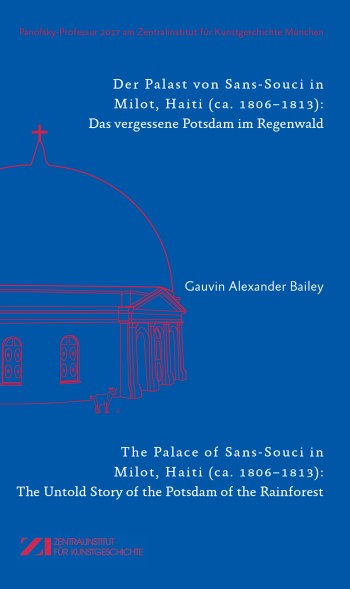 One of the most mysterious buildings in the Western hemisphere, King Henri Christophe’s lavish neoclassical palace in the rain forest, enthrones the small Haitian town of Milot. Begun less than a decade after the Haitian Revolution for independence (1804) by the first black African king in the Americas, this massive monument was built to showcase Haiti’s power and self-confidence. Despite its status as UNESCO World Heritage and a tourist attraction, the unusual building has never before been the subject of a study. On the basis of unpublished archival sources and exact photographic documentation, this book is the first to publish detailed information about the genesis this extraordinary architecture and the story of its builder.
Gauvin Alexander Bailey is professor and Alfred and Isabel Bader Chair in Southern Baroque Art at Queen’s University.










 Enfilade
leave a comment