Ghislain d’Humieres To Oversee Core Operations at Williamsburg
Press release (via Art Daily). . .
 As part of a streamlining of its leadership team, the Colonial Williamsburg Foundation has named Ghislain d’Humières as its executive director and senior vice president, core operations, a newly created position that will report to President and CEO Mitchell B. Reiss. In this new role, d’Humières will carry out the vision of Reiss and the Foundation’s Board of Trustees to attract new audiences, engage and entertain guests and instill a lifelong love of Colonial Williamsburg and its enduring role in the American story. d’Humières will oversee the Collections, Conservation and Museums Division and Colonial Williamsburg’s Education, Research and Historical Interpretation Division, as well as its Strategic Communications and Development divisions. He will begin his new role on January 15, 2018.
“Colonial Williamsburg’s commitment to history education and the arts is strong,” said Reiss. “We believe that hiring a seasoned arts professional to lead the Foundation’s core experience will further enhance our ability to captivate visitors through even more engaging programming within the Historic Area and the Art Museums. Ghislain’s leadership of day-to-day operations will enable me to foster critical relationships with the community, supporters and other partners to elevate Colonial Williamsburg and its mission to share America’s enduring story.”
Most recently the director and CEO of the Speed Art Museum in Louisville, Kentucky, from 2013 to earlier this year, d’Humières oversaw an extensive $60 million renovation that transformed the state’s only fine arts museum and enabled it to further expand its audience’s diversity. Previously, he served as the director and chief curator of the Fred Jones, Jr. Museum of Art at the University of Oklahoma in Norman from 2007 to 2013; he has also held positions at Sotheby’s, Christies, and Heritage Auctions. d’Humières is a former member of the French armed forces and served as aide-de-camp to the grand chancelier of the Order de La Libération. He was also an assistant curator of Paris’ Ordre de La Libération Museum. He is a graduate of the Sorbonne and Paris Nanterre University.
“Colonial Williamsburg is a treasure that preserves the birthplace of American democracy and enshrines ideals that still guide the nation and world,” d’Humières said. “I am honored to join this institution, especially amid its re-imagination and commitment to engage new and wider audiences. I look forward to sharing the journey with the team, our community, and most of all, our guests.”
Among key areas of the Foundation that will now be included under d’Humières’s umbrella of responsibilities are major areas of investments in the Campaign for History and Citizenship, the $600 million capital campaign initiated to both reinforce and reimagine Colonial Williamsburg’s role in the 21st century as a leader in history education and historical preservation, which was publicly announced in 2014. One such area is the $41.7-million donor-funded expansion of the Art Museums of Colonial Williamsburg, home of the Abby Aldrich Rockefeller Folk Art Museum, the oldest continuously operating institution in the United States dedicated solely to the collection, exhibition and preservation of American folk art now celebrating its 60th anniversary. It is also home to the DeWitt Wallace Decorative Arts Museum, which marked its 30th anniversary in 2015 and features premier examples of British and American fine and decorative arts from 1670 to 1840. Combined, these diverse and extensive collections play critical roles in Colonial Williamsburg’s goal of engaging audiences with the dramatic story of America’s founding. Under the direction of Ronald L. Hurst, Carlisle H. Humelsine chief curator and vice president for collections, conservation and museums, both the Abby Aldrich and DeWitt Wallace museums will remain open through construction, which began on Oct. 1. It will add 60,000 square feet to the building for a 22-percent increase in gallery space, as well as significantly improve public access through a new visitor-friendly entrance and other enhancements. It is projected that by late summer 2018 the enlarged space will be completely enclosed and new climate control systems will be fully functioning. Construction is expected to be complete by late 2019.
Other vital areas of the Foundation’s mission that also are within d’Humières’s area of responsibility include:
• Continued re-imagination of Historic Area programming with diverse, new character interpretation and technology enhancements, including the Colonial Williamsburg Explorer mobile app; supervising 24 historic trades, modern entertainment and tours, signature events (such as Grand Illumination and Fourth of July), the Costume Design Center that crafts and maintains clothing worn by the Historic Area personnel, the Coach and Livestock department that operates the Rare Breeds Program, and the Colonial Williamsburg Fifes & Drums
• Development of compelling outreach programs that reach national and even global audiences, including teacher professional development programs and digital technology initiatives in order for Colonial Williamsburg to continue to support and supplement the teaching of American history and civics in home and school settings
• Directing historical research and training, along with the John D. Rockefeller Jr. Library and the Colonial Williamsburg corporate archives
• Oversight of the departments that conduct archaeological research and care for the more than 60 million archaeological items in the Foundation’s collections
• Leadership of the departments that preserve 88 original and roughly 500 reconstructed Historic Area structures, as well as daily care of Historic Area interiors and collection items on display throughout Colonial Williamsburg properties
• Management of Colonial Williamsburg’s state-of-the-art DeWitt Wallace Collections and Conservation Building, which includes eight discipline-specific labs—Archaeological Materials, Wooden Artifacts, Instruments and Mechanical Arts, Objects, Paintings, Paper, Textiles and Upholstery—as well as the Preventive Conservation group. There, analysis, examination, treatment, and documentation are performed in strict accordance with the Code of Ethics of the American Institute for Conservation of Historic & Artistic Works.
Call for Articles | Spring 2019 Issue of J18: Animal
From J18:
Journal18, Issue #7 (Spring 2019) — Animal
Edited by Katie Hornstein
Proposals due by 1 April 2018; finished articles will be due by 15 October 2018
Recently scholars across the humanities have been examining the role animals play in representations across media, cultures, and historical moments. While art historians have begun to turn their attention to animality, the most intensive efforts on the part of humanities scholars have been located in literary disciplines and have tended to embrace activist and theoretically-based approaches. Why has art history been slower than other humanities disciplines to contend with animality? Has art history’s traditional humanistic focus precluded critical and theoretical thinking about animals as more than just symbols and subject matter within visual representation, especially with regard to art made before the nineteenth century? In devising his theory of humanistic art history, for example, Erwin Panofsky enacted a series of exclusions and disavowals that celebrated the uniqueness of human object-making and ideation, with a sharp separation between nature and culture. In response to a history of art that has traditionally celebrated and elevated works of art as the highest of human achievements, animal studies presents a potentially destabilizing challenge: how do animals structure our understanding of what it is to be human?
The Spring 2019 issue for Journal18 seeks contributions from scholars who work at the intersections of art history, visual and material culture, and animal studies. Articles should use the historical frame of the long-eighteenth century (c. 1660–1830) to address the animal as an actor, agent, and formative presence within art’s histories. Contributions might address how the figure of the animal and ideas about animality contest the preeminence of human-based subjectivities that have traditionally (and perhaps necessarily) structured art historical approaches to visual representation. Authors might also ask questions that revolve around the circulation and exchange of animal-based products in the burgeoning global economy of the eighteenth century. Articles that address the unique signifying power of visual representations of animals across media and consider how images depict animals as responsive subjects are equally welcome. Submissions may take the form of an article (up to 6000 words) or a shorter vignette (no more than 2,500 words).
For authors who have their submissions selected, there will be a study day held in New York City in early September 2018, ahead of the due date of October 15, 2018 for completed texts. This will be an opportunity to present research, share ideas, and receive feedback before handing in your final articles. For any contributors unable to travel to New York, we aim to make remote participation possible via weblinks.
Proposals for #7 ANIMAL are now being accepted. Deadline for proposals: 1 April 2018. To submit a proposal, please specify whether you intend to write an article (6,000 words) or a shorter vignette (2,500 words). Send an abstract (200 words) and a brief CV to editor@journal18.org and katherine.s.hornstein@dartmouth.edu.
Issue editor
Katie Hornstein, Dartmouth College
Fellowships | Lewis Walpole Library, 2018–19
From The Lewis Walpole Library:
Visiting Fellowships and Travel Grants
The Lewis Walpole Library, 2018–19
Applications due by 8 January 2018
 The Lewis Walpole Library, a department of Yale University Library, funds four-week visiting fellowships and two-week travel grants to support research in the Library’s rich collections of eighteenth-century materials (mainly British). In addition, the Library administers two jointly funded residential fellowships: The LWL / ASECS Library Fellowship is awarded to an ASECS member in good standing for up to four weeks of research at the Lewis Walpole Library, and The LWL / Beinecke Rare Book and Manuscript Library Fellowship is awarded to support up to eight weeks of research in the collections of both libraries.
The Lewis Walpole Library is a research center for eighteenth-century studies and an essential resource for the study of Horace Walpole and Strawberry Hill. Its collections include important holdings of eighteenth-century British prints, drawings, manuscripts, rare books, paintings, and decorative arts. It is located in Farmington, Connecticut, in several eighteenth-century buildings on a fourteen-acre campus.
Scholars pursuing postdoctoral or advanced research, as well as doctoral candidates at work on a dissertation, are encouraged to apply. The fellowship year runs from July 1, 2018, through June 30, 2019, and all fellowships must be completed within the fellowship year. All fellowship recipients are expected to be in residence at the Library, to be free of other significant professional obligations during their stay, and to focus their research substantially on the Lewis Walpole Library’s collections. Fellows also have access to additional resources at Yale, including those in the Sterling Memorial Library, the Beinecke Rare Book and Manuscript Library, and the Yale Center for British Art.
Application materials must be submitted directly through the listing in the Yale Grants Database. Search for Visiting Fellowships Lewis Walpole. Please note you will need to login to access the application form. Decisions are based on a number of factors, including the merits of the project and fit with the collections. Applications for 2018–19 are due Monday, January 8, 2018.
Image: William Dent, French Flight, or, The Grand Monarque and the Rights of Kings Supported in a Sublime and Beautiful Manner, 26 June 1791 (The Lewis Walpole Library, Yale University, digcoll:2811126).
New Book | The Jewish Journey: 4000 Years in 22 Objects
Distributed by ACC Publishing:
Rebecca Abrams, The Jewish Journey: 4000 Years in 22 Objects from the Ashmolean Museum (Oxford: Ashmolean Museum, 2017), 232 pages, ISBN: 978 191080 7033, $20.
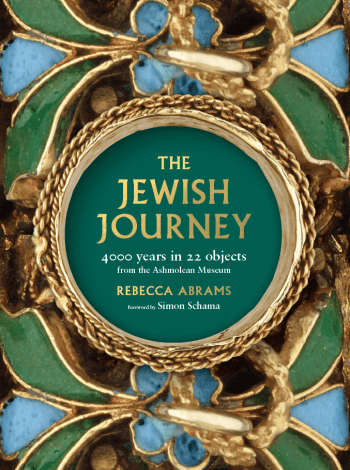 The 22 objects include pottery, coins, jewelry, household artifacts, sacred items, musical instruments and paintings. Together they bring to life the experiences of the real men and women who owned, made and used them, from kings, courtiers and scholars to guerrilla fighters, musicians and market stall holders. Individually and collectively, the objects vividly document dark periods of persecution and forced migration, whilst highlighting the astonishing resilience and diversity of Jewish life, revealing centuries of two-way interaction with many other cultures and religions. Through the histories of each of the objects, the reader is guided on a double journey, one leading through the galleries of the Ashmolean, the other accompanying the Jewish people across the centuries. The Jewish Journey brings to light for the first time the amazing Jewish treasures in the Ashmolean Museum, explaining their specifically Jewish significance in a direct, accessible style for the general reader.
The Jewish Journey is unique in three respects. First, it is a short, accessible, illustrated history of the Jewish people aimed at the general public. Secondly, the book is unique in highlighting Jewish objects drawn from the permanent collection of a world-renowned public museum. Jewish history is more normally confined to dedicated Jewish museums. This book breaks new ground by showing Jewish history in its wider historical, social and cultural context. In addition, it presents objects that reflect on daily life over the centuries, e.g. family, marriage, trade, travel, rather than the more common depictions of artifacts for sacred and religious use. Thirdly, the Jewish significance of these particular 22 objects has until now been overlooked. This book draws them together for the first time to highlight their specific relevance to Jewish history, revealing both distinctive features of Jewish experience and evidence of centuries of close interaction with other cultures and religions.
Rebecca Abrams is an award-winning author of both fiction and non-fiction. Her most recent book, Touching Distance, won the MJA Open Book Award and was shortlisted for the McKitterick Prize for Literature. A graduate of Newnham College, Cambridge, she is a longstanding tutor in Creative Writing at the University of Oxford, before which she was an Honorary Teaching Fellow on the Warwick University Writing Programme and 2014 Gladstone’s Library Writer-in-Residence. She has recently been appointed a Royal Literary Fund Writing Fellow. A regular literary critic for the Financial Times and a former columnist on The Daily Telegraph, she has written extensively for the UK national press and is the recipient of an Amnesty International Press Award.
Court Studies Seminars, 2018 Schedule
From The Society for Court Studies:
Society for Court Studies Seminars, 2018
New York University, Bedford Square, London
An annual programme of seminars is run by the Society for Court Studies in which new work in the field is presented and discussed. These take place in London on Monday evenings, starting at 6:00pm, at New York University, 6 Bedford Square, London, WC1B 3RA, room 102. Refreshments, including wine, are served. The seminars are free (except the guest lecture) and open to everyone. For further details, please contact the Seminar Secretaries, Jo Tinworth (jtinworth@soane.org.uk) and Nicola Clark (Nicola.Clark.2008@kent.ac.uk). Historians interested in giving a seminar paper to the Society should contact the Seminar Secretaries as well. Members of the society do not need to book in advance. If you are not a member, please register your interest using the booking link next to the relevant seminar paper.
29 January
Katarzyna Kuras (Jagiellonian University, Cracow), Conflicts or Cooperation? The World of Courtiers of the Queen Maria Leszczyńska (1725–1768)
19 February
James Legard (University of Edinburgh), ‘Princely Glory’: The 1st Duke of Marlborough, Court Culture, and the Construction of Blenheim Palace
12 March
Valerie Schutte (independent scholar), Princess Elizabeth Tudor: Book Dedications and the New Year’s Gift Exchange
16 April
David Parrott (New College, Oxford), Anne of Austria, Mazarin, and the French Court in Crisis, 1650–54
4 June
Joint event with the Institute of Historical Research Tudor and Stuart seminar, location to be confirmed
Samantha Harper (Winchester University), Continuity and Change in the Household of Henry VII and Henry VIII
17 September
Alden Gregory (Historic Royal Palaces), The Tudor Court under Canvas: Royal Tents and Timber Lodgings, 1509–1603
15 October
Mandy Richardson (University of Chichester), Hunting, Hounds, and Hospitality: Gendered Aspects of the Late Medieval and Early Modern Royal Hunt
12 November
Peter Barber (King’s College London), George III as a Map Collector
3 December
Helen Watanabe O’Kelly (University of Oxford), Catholic Ruler, Protestant People: The Impact of the Reformation on Court and Civic Festivals in Early Modern Europe
Lecture | Wolf Burchard on Savonnerie Carpets: Stages of Power
From the BGC:
Wolf Burchard | Savonnerie Carpets: Stages of Power
Françoise and Georges Selz Lectures on Eighteenth- and Nineteenth-Century French Decorative Arts and Culture
Bard Graduate Center, New York, 6 February 2018
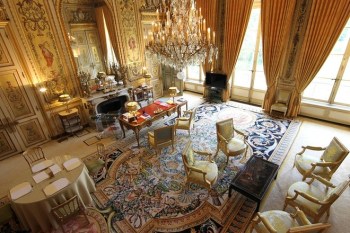
The Salon Doré: President Macron’s office at the Elysée Palace with one of Louis XIV’s Savonnerie carpets.
Wolf Burchard will deliver a Françoise and Georges Selz Lecture on Eighteenth- and Nineteenth-Century French Decorative Arts and Culture on Tuesday, February 6, at 6pm. His talk is entitled “Savonnerie Carpets: Stages of Power.”
Since the Second World War, every President of France has had one of Louis XIV’s famed Savonnerie carpets in his office at the Elysée Palace. Sumptuous stages on which key events of French history have unfolded, these spectacular weavings initially formed part of an unprecedented commission from the Sun King for no less than 93 carpets to cover the entire Long Gallery of the Louvre, spanning more than 442 meters. However, as Louis gradually lost interest in the Louvre Palace, instead choosing Versailles as the headquarters of the Bourbon monarchy, these magnificent carpets, originally intended to be laid out side to side, were largely separated and used singly as focal points in the lavishly decorated salons of Louis XIV and his successors.
Wolf Burchard’s lecture will revisit the history of the Savonnerie manufactory from its beginnings under Louis XIII to the present day, focusing on its major commissions for the Louvre, Versailles, and Notre Dame. His talk will also examine the dispersal of many of these weavings after the French Revolution in 1789, both through sale and as diplomatic gifts, as well as the rising British and American taste for Savonnerie carpets beginning around 1900.
Wolf Burchard is the Furniture Research Curator at Britain’s National Trust and the author of The Sovereign Artist: Charles Le Brun and the Image of Louis XIV (Paul Holberton Publishing, 2016). From 2009 to 2014 he was Curatorial Assistant at the Royal Collection Trust, where he co-curated The First Georgians: Art & Monarchy, 1714–1760, an exhibition held at The Queen’s Gallery, Buckingham Palace, to commemorate the tercentenary of George I’s accession to the British throne. He studied the history of art and architecture at the universities of Tübingen and Vienna as well as the Courtauld Institute of Art in London, from which he holds an MA and PhD. Wolf Burchard regularly writes and lectures about the art and architectural patronage at the British, French, and German courts. He has worked extensively on the Savonnerie manufactory and in 2012 published an update of Pierre Verlet’s catalogue of Louis XIV’s carpets for the Louvre’s Long Gallery, adding newly discovered carpets, carpet fragments and designs. He serves on the Executive Board of the Georgian Group and the Council of the Furniture History Society and was a member of the Committee of the Society for Court Studies from 2011 to 2017.
Exhibition | From Life

Thomas Rowlandson, Drawing from Life at the Royal Academy, (Somerset House), hand-coloured aquatint by A. C. Pugin and Thomas Rowlandson published in Ackermann’s The Microcosm of London, 1 January 1808. 20 × 26 cm (London: Royal Academy of Arts).
◊ ◊ ◊ ◊ ◊
Press release from the RA for the exhibition:
From Life
Royal Academy of Arts, London, 11 December 2017 — 11 March 2018
Curated by Adrian Locke
The Royal Academy of Arts presents From Life, a special exhibition project taking place across two distinct spaces: the Sackler Wing of Galleries and the Tennant Gallery. From Life examines what making art from life has meant to artists throughout history and how the practice is evolving as technology opens up new ways of creating and visualising artwork.
Drawing from casts of Classical and Renaissance sculpture and life models was long considered essential training for any aspiring artist, and was once a staple of the RA Schools, Britain’s longest established fine art school. Beginning with a display of historic paintings and works on paper drawn from the RA Collection, From Life explores the practice of life drawing, from the origins of the Royal Academy in the 18th century to the present day, whilst also looking to the future. Historic paintings by artists such as Johann Zoffany are followed by works in a diverse range of media by contemporary artists, including Jeremy Deller’s Iggy Pop Life Class (2016), Cai Guo-Qiang’s film One Thousand Youngsters Drawing David (2010), and Jenny Saville’s Entry (2004). From Life also presents work by Royal Academicians who continue to interrogate the practice of working from life, among them Antony Gormley, Chantal Joffe, Michael Landy, and Gillian Wearing.
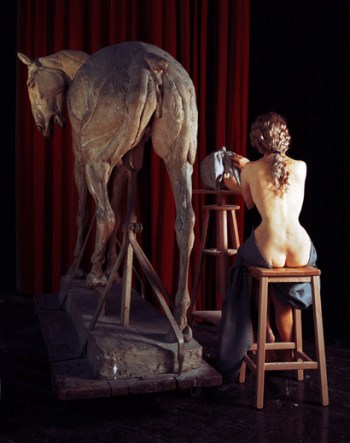
Liane Lang, Casts Series (Royal Academy), Ars Equina, 2006–07, c-type photographic print.
For the first time the Royal Academy is working with artists exploring emerging technologies, which presents them with new ways to both observe and represent themselves and the world around them. Farshid Moussavi RA, Humphrey Ocean RA, Yinka Shonibare RA, and Jonathan Yeo have experimented with virtual reality technologies, creating new artwork for the exhibition using virtual reality platform HTC Vive, Tilt Brush by Google, and artistic software programmes, including MakeVR Pro. Farshid Moussavi’s VR experience transports visitors into masterpieces of ecclesiastical architecture, which they can adapt and transform themselves, while creative technology and content studio Happy Finish have worked with Yinka Shonibare to develop a three-dimensional rendering of a neo-classical painting, featuring a cast of Venus dressed in Shonibare’s trademark batik fabric. Meanwhile, Humphrey Ocean invites audiences to create their own three-dimensional sketches within a playful virtual environment centred on the artist’s fascination with chairs.
From Life reveals the creative process in making these new artworks, as well as opening up the exciting potential of future artistic applications of virtual reality. HTC Vive has supported the development of these works, which will also be available for audiences to experience at home on Viveport, HTC’s global VR app store. Artist Jonathan Yeo has collaborated with Google Arts & Culture to create the first physical free-standing sculpture in metal made by using Tilt Brush, his creative process is captured in a VR film to be published on Google Arts & Culture Youtube channel. The visitors’ experience of the virtual reality element within the exhibition will depend on availability. As each virtual reality artwork can only be experienced individually, access cannot be guaranteed.
Tim Marlow, Artistic Director of the Royal Academy of Arts said: “This is an experimental project that explores everything from artistic process to technological evolution and creative collaboration. In a sense, From Life embodies what an artist-run academy was, is and might become.”
Sky Arts have commissioned immersive content studio Factory 42 to produce a documentary entitled Virtual Reality: Mystery of Creativity, which explores creating art in a virtual environment and how artists use these cutting-edge technologies to explore the limits of traditional artistic methods. There are also a series of short films across the Royal Academy’s online platforms, as well as available via the Sky VR and Google Arts & Culture apps.
To coincide with From Life and as part of the 250th anniversary celebrations in 2018, the Royal Academy is offering free life drawing classes for 250 people of all abilities in the historic Life Room in the RA Schools [dating to the 1860s]. Each class is for a particular group that has a special relationship with either the RA, drawing, or the human body, from members of the Royal Academy’s outreach programmes to nurses and architects. The guest tutors will not be revealed until the life drawing class begins. The project will be documented by online features and videos. The RA is also inviting the public and Friends of the RA to participate through an open ballot to win 50 places at the following free classes, led by guest tutors who will be revealed on the day. Enter the ballot here.
13 December 2017 (10.30am–1.30pm), exclusive to Friends of the RA
24 January 2018 (10.30am–1.30pm), open to all
Sam Phillips, ed., Artists Working From Life (London: Royal Academy, 2017), 160 pages, ISBN: 978 19103 50904, £22.
 From Michelangelo’s marbles to photographer’s self-portraits, artists have always been fascinated by their creative encounters with the human body. Often a key part of their early training, drawing and sculpting from life go on to inform their later work in unexpected and inspiring ways. This illuminating publication brings together interviews with over 19 artists from all disciplines, including painters, sculptors and conceptual artists, working in a variety of different media. Through in-depth conversations with them, the authors explore the many ways artists work ‘from life’: from Jeremy Deller’s open life class with Iggy Pop as model, to Jonathan Yeo’s innovative use of 3D scanners and virtual reality. The interviews are written by contributors including Caroline Bugler, Martin Gayford, Laura Gascoigne, Angela Kingston, Adrian Locke, Ben Luke, Sam Phillips, and Michael Prodger. The book is introduced by an essay on the history of life drawing by Annette Wickham, the Royal Academy’s Curator of Works on Paper.
Sam Phillips is editor of the Royal Academy of Arts Magazine.
Colin Sheaf on Chinese Art for Western Interiors, 1650–1850
From the Society of Antiquaries:
Colin Sheaf | Chinese Art for Western Interiors, 1650–1850
Society of Antiquaries of London, 16 January 2018
Linking Asian craftsmanship with evolving Western tastes in interior decoration and passion for Chinoiserie, the ‘China Trade’ facilitated the arrival in London of principally Chinese artefacts and traditions like tea-drinking, which greatly enriched English polite society between about 1600 and 1850. This lecture will explore this exotic yet fundamentally commercial maritime relationship, illustrating some of the fine lacquers, ‘Export-taste’ ceramics, silks and wallpapers which the ‘Honourable East India Company’ regularly imported.
Colin Sheaf has enjoyed a distinguished 40-year career in the London art auction world after reading Modern History at Worcester College Oxford. A world authority on Asian ceramics and Chinese Art, as Chairman of Bonhams UK and Asia, and Global Head, he directs Asian Art specialist teams across four continents. He has lectured widely in the UK and Asia, and—besides publishing some 120 specialist articles—is co-author of a definitive study of Qing Dynasty Chinese ceramics. He was recently appointed Chairman of the world-famous Sir Percival David Foundation of Chinese Art, and chairs the Company running an award-winning historic London Square garden.
All lectures begin at 13.00. Doors open at 12.30 on the day of the lecture. Our Public Lectures are free and open to the public, but space is limited and reservations are strongly recommended to avoid disappointment. To book online, simply click the ‘Reserve Your Seat’ button at the Society of Antiquaries website.
Call for Papers | Fashioning the Early Modern Courtier
From the Call for Papers:
Fashioning the Early Modern Courtier
St John’s College, Cambridge, 16 May 2018
Proposals due by 22 January 2018
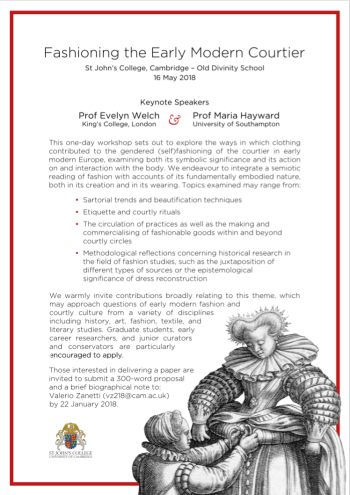 Early modern courts were crucial sites for the elaboration and diffusion of specific corporeal models aspiring to shape the ideal man and woman. Fashion, then as now, provides a very material setting that has the power to promote specific patterns of thought and action. This one-day workshop sets out to explore the ways in which clothing contributed to the gendered (self)fashioning of the courtier in early modern Europe (ca. 1500–1750), examining both its symbolic significance and its action on and interaction with the body.
Embracing a corporealist perspective, we endeavour to integrate a semiotic reading of fashion with accounts of its fundamentally embodied nature, both in its creation and in its wearing. Topics examined may range from sartorial trends and beautification techniques to issues related to etiquette and courtly rituals more broadly. The circulation of such practices as well as the making and commercialising of fashionable goods within and beyond courtly circles will also be investigated. Methodological reflections concerning historical research in the field of fashion studies are also welcome, such as the juxtaposition of different types of sources or the epistemological significance of dress reconstruction.
We are delighted to announce two keynote lectures to be delivered by leading scholars, Evelyn Welch (King’s College, London) and Maria Hayward (University of Southampton).
We warmly invite contributions broadly relating to this theme, which may approach questions of early modern fashion and courtly culture from a variety of disciplines including history, art, fashion, textile, and literary studies. Graduate students, early career researchers, and junior curators and conservators are particularly encouraged to apply. Those interested in delivering a paper are invited to submit a proposal of up to 300 words and a brief biographical note to Valerio Zanetti (vz218@cam.ac.uk) by 22nd January 2018.
New Book | Revolutionary Paris and the Market for Netherlandish Art
From Brill:
Darius Spieth, with a foreword by Marc Fumaroli, Revolutionary Paris and the Market for Netherlandish Art (Leiden: Brill, 2017), 514 pages, ISBN: 978 90043 36988, €116 / $134.
 Seventeenth-century Dutch and Flemish paintings were aesthetic, intellectual, and economic touchstones in the Parisian art world of the Revolutionary era, but their importance within this framework, while frequently acknowledged, has never attracted much subsequent attention. Darius Spieth’s Revolutionary Paris and the Market for Netherlandish Art reveals the dominance of ‘Golden Age’ pictures in the artistic discourse and sales transactions before, during, and after the French Revolution. A broadly based statistical investigation, undertaken as part of this study, shows that the upheaval reduced prices for Netherlandish paintings by about 55% compared to the Old Regime and that it took until after the July Revolution of 1830 for art prices to return where they stood before 1789.
Darius A. Spieth, PhD University of Illinois at Urbana-Champaign, is Professor of Art History at Louisiana State University. He is the editor of the Grove Guide to Art Markets and Collecting (forthcoming), and author of Napoleon’s Sorcerers: The Sophisians (2007).
C O N T E N T S
Acknowledgements
Foreword by Marc Fumaroli
List of Illustrations
A Note on Currencies
1 From Eyesores to Blue Chip Art
Origins of the Parisian Marketplace for Netherlandish Painting
Art Publications and the Dissemination of Information
France as International Tastemaker for Golden Age Art After 1740
Royal Collections and Northern Masters, 1777–1792
The Twilight of the Auction Business, 1775–1825
The Fate of Golden Age Art Under Terror and Inflation
The Louvre and the ‘Artistic Conquests’ in Belgium and the Netherlands
The Post-Revolutionary Market for Netherlandish Art
The Expanding Mass Market for Copies and the Rise of the Bourgeoisie
Golden Age Art and Popular Culture
Netherlandish versus Italian Art
The Parisian Apartment: A Bourgeois Space for Art
2 On the Art of Surviving the Revolution: Jean-Baptiste Pierre Lebrun
Art Dealer to the Ancien Régime’s Elite, 1776–1789
Painful Adjustments, 1789–1795
Co-Conspirator of Jacques-Louis David, 1792–1794
From The Ministry of Finance to the Louvre, 1794–1799
A Long Good-Bye from the Louvre, 1799–1803
A Difficult Comeback as Dealer-Expert, 1801–1804
Deceptions of the Napoleonic Age, 1807–1813
3 A Long Good Bye to the Palais Royal: The Northern Pictures in the Orléans Collection
The Art Collections in the Palais Royal until 1780
Inside the Art Deal of the Century
The Netherlandish Pictures of the Palais Royal Collection
A Look Inside the Galeries De Bois
4 Liberty’s Toll on Beauty’s Price
Myths and Realities of the Parisian Auction Market in the 1790s
Turnover of the Parisian Art Auction Market and its Economic Context, ca. 1775–1850
The Evolution of Prices for Netherlandish Art in Revolutionary Paris
Bidding Wars: The Picture Trade with Great Britain
The ‘Guilty Industry’ and Netherlandish Art
5 Netherlandish Art in France: A History of Taste and Money across Three Centuries
Poussinists versus Rubenists
The Marquis D’argens and Academic Prejudices Against Northern Art
The Re-Evaluation of Netherlandish Aesthetics from David to Thoré
The Politicization of Nehterlandish Art in the Nineteenth Century
Class, Taste, and the First Art Price Rankings
Appendix
Bibliography
Photograph Credits
Index










 Enfilade
leave a comment