Frick Acquires Gérard’s Portrait of Prince Camillo Borghese
Press release (5 December 2017) from The Frick Collection:
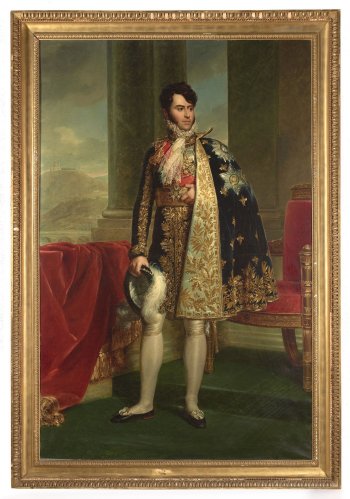
François-Pascal-Simon Gérard, Camillo Borghese, ca. 1810, oil on canvas, 84 x 55 (New York: The Frick Collection).
The Frick Collection announces its most important painting purchase since 1991 with the acquisition of François-Pascal-Simon Gérard’s full-length portrait of Prince Camillo Borghese, a notable art patron and the brother-in-law of Napoleon Bonaparte. Gérard (1770–1837) was one of the most significant French artists of the first half of the nineteenth century, and this stunning canvas will coalesce seamlessly with the museum’s holdings, which until now have not included his work. Chronologically, the painting sits between the museum’s French masterpieces by Boucher and Fragonard and later works by Ingres, Renoir, Monet, and Manet, while joining contemporaneous portraits by Chinard and David. It will, likewise, find good company in major works of portraiture by Bronzino, Rembrandt, Titian, Holbein, Van Dyck, Gainsborough, Reynolds, Romney, and Hogarth, Goya, and Whistler. Following conservation and technical study this winter and spring at The Metropolitan Museum of Art, Prince Camillo Borghese will go on view at the Frick later in 2018.
Comments Chairman of the Board of Trustees Elizabeth Eveillard, “The Frick’s holdings, as a group, have been compared to a necklace assembled one precious pearl at a time. The sentiment reflects the modest scale of the collection born of its founder’s individual taste, balanced by the absolute requirement of quality. Just as Henry Clay Frick (1849–1919) made a series of unrushed choices, the growth of the collection in nearly one hundred years since his passing has been steady but measured, including sculpture and decorative arts, always meeting the criteria of high quality. With this striking painting, coming to the Frick with an unbroken provenance from the Borghese family, still on its original, unlined canvas, and in its original frame, the Frick has found a rare masterpiece to harmonize with its esteemed holdings.” Adds Director Ian Wardropper, “The last opportunity the Frick had to purchase a major French School painting was nearly thirty years ago, with the acquisition of Watteau’s Portal of Valenciennes. Today, it is deeply rewarding to have the rare opportunity to bring to the museum such an important work as this one, a historic portrait we feel would have compelled Henry Clay Frick. While the portrait has been shown in Rome, it has never been seen publicly in America. We look forward to sharing it in the atmospheric setting of the former Frick residence and among equally well chosen works.”
About the Artist, Portraitist to the Bonaparte Family
Gérard studied with the painter Jacques-Louis David (1748–1825), becoming one of his most talented pupils. At the time of the French Revolution, Gérard produced a number of historic paintings, including his celebrated Belisarius and Cupid and Psyche. In 1796, he painted a portrait of his friend the miniaturist Jean-Baptiste Isabey (1767–1855) and his daughter (all three works can be seen at the Musée du Louvre, Paris). The latter work marked Gérard’s public success as portraitist, and it soon became the primary genre in which he worked. With the advent of Napoleon, the artist found enormous favor with the emperor and his immediate family. Made a Baron of the Empire in 1809, Gérard exhibited a vast number of portraits at the various Paris Salon exhibitions almost every year during the first quarter of the nineteenth century. Even after the fall of Napoleon, in 1815, Gérard’s stellar career continued under the Bourbon Restoration in France.
Gérard’s role as portraitist to the Bonaparte family was the apex of his career. From the early 1800s until the fall of the empire in 1815, he portrayed most members of the imperial family, works that are today highlights of major collections internationally. These include Napoleon in coronation robes (Château de Versailles), his mother, Letizia Ramolino (Scottish National Gallery, Edinburgh), and the Empress Josephine (Hermitage, Saint Petersburg). Napoleon’s brothers Joseph and Louis, brother-in-law Joachim Murat, sisters Elisa and Caroline, and sister-in-law Hortense de Beauharnais also sat at different times for him. The Metropolitan Museum of Art owns large portraits by Gérard of Madame Talleyrand and her celebrated husband, politician Charles Maurice de Talleyrand Périgord.
The Borghese Family: Aristocratic Collectors and Patrons of the Arts
Camillo Borghese was born to one of the most important families of the Roman aristocracy. The family acquired substantial works of fine and decorative arts, patronizing sculptor Giovan Lorenzo Bernini in the seventeenth century and figures such as the silversmith and decorator Luigi Valadier in the eighteenth century. They were also interested in antiquities, and today their collection remains the foundation of the Greek and Roman holdings of the Musée du Louvre. Also a patron of the arts, Prince Borghese is most famously remembered for commissioning from Antonio Canova a full-length sculpture of his wife in the nude, as Victorious Venus. One of the best-known and beloved sculptures in Rome from the moment it was carved, this marble statue of Paolina Borghese is today one of the glories of Villa Borghese.
The family was known for its Napoleonic sympathies, and Camillo moved to Paris in 1796. In 1803 he married Napoleon’s favorite sister, Paolina Bonaparte (1780–1825). It was a tempestuous marriage. At first, the couple lived in gilded splendor between Paris and Rome, where they refurbished the apartments of Camillo’s parents in the Palazzo Borghese; however, they soon became estranged and each took lovers. Paolina was still officially at her husband’s side when, in February 1808, Napoleon effectively put him in charge of Piedmont, Liguria, Parma, and Piacenza. Camillo and Paolina moved from Paris to Turin in April of that year and lived between the Piedmontese capital, Paris, and Rome until April 1814. In 1808, when Camillo and Paolina moved to Turin, they shipped most of the paintings, sculptures, silver, and porcelain from the Palazzo Borghese in Rome to their new residence. In 1814, they returned to Rome, and an inventory drafted on April 25, 1814—lists a portrait of the prince, likely this one, which has become the official and most famous image of him, and is understood from the iconography in the work to have been painted around 1810 in Paris.
Call for Essays | American Art and Economics
Special Issue of American Art: Economics, Money, and the Art Market
Edited by John Ott and Robin Veder
Proposals due by 1 February 2018; final MSS will be due 1 September 2018
American Art, the peer-reviewed journal co-published by the Smithsonian American Art Museum and the University of Chicago Press, invites historians of American art to answer the question, “What do we talk about when we talk about economics, money, and the art market?” In the spirit of the October Visual Culture questionnaire, replies may address any or all of the following questions and should take the form of brief position papers rather than intensive case studies. In the historiography of American art history, what shifts have we seen in ways of thinking about artistic production, the art market, and the visual cultures of economics? When we study financial systems, institutions, instruments, and objects, do we examine them in relation to economic power and social class, or in relation to other social phenomena, and why? To what extent have economic forces such as the art market and institutional funding shaped the field of American art, whether in terms of the objects and inquiries we pursue and neglect, or with regard to the vocabulary we use and avoid?
For consideration, submit abstracts of 250–500 words by February 1, 2018. The organizers, John Ott, professor of art history at James Madison University, and Robin Veder, executive editor of American Art at the Smithsonian American Art Museum, will review submissions and encourage selected authors to submit full manuscripts for further consideration. These should be 1,500–2,500 words including endnotes, with 1–4 images, and will be due by September 1, 2018. The journal will evaluate the manuscripts and select some for publication in a 2019 issue of American Art. Accepted authors will workshop the manuscripts together before final revision. Submit abstracts to americanartjournal@si.edu. For other inquiries, contact John Ott at ottjw@jmu.edu.
Lubaina Himid Wins the 2017 Turner Prize
◊ ◊ ◊ ◊ ◊
Lubaina Himid, this year’s Turner Prize winner, engages various themes relevant to the eighteenth century—from porcelain to slavery to Hogarth—within the larger context of African diasporan contributions “to the richness and layering of European culture.” The work is on display at Ferens Art Gallery, Hull for a few more weeks.
Turner Prize 2017
Ferens Art Gallery, Hull, 26 September 2017 — 7 January 2018
Turner Prize, one of the world’s most renowned art prizes, is awarded by Tate to an artist who has exhibited outstanding work in the previous year. The four shortlisted artists for 2017—Hurvin Anderson, Andrea Büttner, Lubaina Himid, and Rosalind Nashashibi—will exhibit their work at Ferens Art Gallery, Hull, from September with the overall winner announced in early December. Through genres such as portraiture, landscape and still life, the four artists explore how art is able to respond to political and social upheaval.
Attingham Offerings for 2018
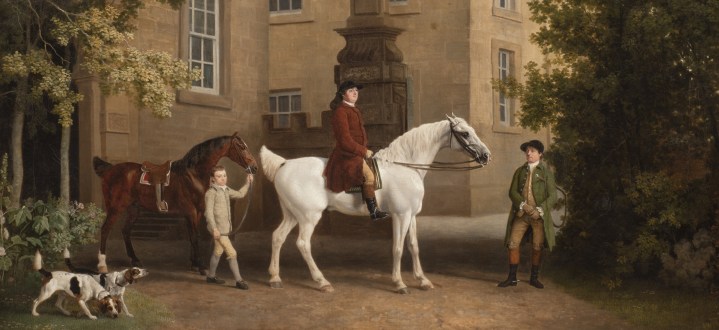
George Stubbs, 3rd Duke of Portland, Welbeck Abbey, detail, 1766
(The Portland Collection)
◊ ◊ ◊ ◊ ◊
Along with Attingham’s regular course offerings, next year’s study programme will address ‘The Horse and the Country House’. More information and application forms are available at Attingham’s website. Applicants from the U.S. may contact Mary Ellen Whitford, admin@americanfriendsofattingham.org. Applicants from outside the U.S. may contact Rita Grudzień, rita.grudzien@attinghamtrust.org.
French Eighteenth-Century Studies at The Wallace Collection, 25–29 June 2018
Applications due by 26 January 2018
French eighteenth-century studies is organised by The Attingham Trust on behalf of the Wallace Collection. Based at Hertford House, this intensive, non-residential study programme aims to foster a deeper knowledge and understanding of French eighteenth-century fine and decorative art and is intended primarily to aid professional development. A day at Waddesdon Manor, Ferdinand de Rothschild’s former country house, will help broaden the scope of the course still further. The academic programme will provide privileged access to the world-class collections of furniture, paintings, sculpture, textiles, metalwork and porcelain in these two collections. The group will be limited to a small number to allow for detailed, object-based study, handling sessions and a look at behind-the-scenes conservation. This course is primarily aimed at curators and other specialists in the fine and decorative arts.
The 67th Attingham Summer School, 12–29 July 2018
Applications due by 26 January 2018
Over the course of 18 days, the 67th Attingham Summer School will visit country houses in Sussex, Derbyshire, Nottinghamshire, County Durham, and Northumberland. The Summer School will examine the country house in terms of architectural and social history, and the decorative arts.
Royal Collection Studies, 2–11 September 2018
Applications due by 12 February 2018
Run on behalf of Royal Collection Trust, this strenuous 10-day course is based near Windsor. The school will visit royal palaces in and around London with specialist tutors (many from the Royal Collection) and study the extensive patronage and collecting of the royal family from the Middle Ages onwards.
The Attingham Study Programme: The Horse and the Country House, 19– 28 September 2018
Applications due by 12 February 2018
This intensive, 10-day study programme, will examine the country house as a setting for outdoor pursuits, such as hunting and racing, and as a focus for horse-drawn travel. The course will be based in two different locations, East Anglia and Yorkshire, and concentrate on houses where the architecture, interior design and works of art have strong equine connections. There will be visits to houses with good sporting art collections, noteworthy stable blocks, riding houses or carriage collections.
New Book | Artisanal Enlightenment
From Yale UP:
Paola Bertucci, Artisanal Enlightenment: Science and the Mechanical Arts in Old Regime France (New Haven: Yale University Press, 2017), 312 pages, ISBN: 978 03002 27413, $40.
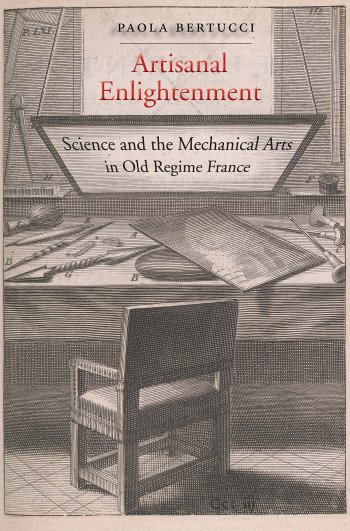 What would the Enlightenment look like from the perspective of artistes, the learned artisans with esprit, who presented themselves in contrast to philosophers, savants, and routine-bound craftsmen? Making a radical change of historical protagonists, Paola Bertucci places the mechanical arts and the world of making at the heart of the Enlightenment. At a time of great colonial, commercial, and imperial concerns, artistes planned encyclopedic projects and sought an official role in the administration of the French state. The Société des Arts, which they envisioned as a state institution that would foster France’s colonial and economic expansion, was the most ambitious expression of their collective aspirations. Artisanal Enlightenment provides the first in-depth study of the Société, and demonstrates its legacy in scientific programs, academies, and the making of Diderot and D’Alembert’s Encyclopédie. Through insightful analysis of textual, visual, and material sources, Bertucci provides a groundbreaking perspective on the politics of writing on the mechanical arts and the development of key Enlightenment concepts such as improvement, utility, and progress.
Paola Bertucci is associate professor of history at Yale University. She has published extensively on the public culture of science in eighteenth-century Europe, and is the author of prize-winning essays on secrecy, selective visibility, and industrial travel in the Enlightenment.
Exhibition | Modernity vs. Tradition: Art at the Parisian Salon
 From the Redwood Library and Athenaeum:
Modernity vs. Tradition: Art at the Parisian Salon, 1750–1900
The Redwood Library and Athenæum, Newport, 1 December 2017 – 8 April 2018
Curated by Benedict Leca
Named after the Salon carré at the Louvre, where it was held between 1725 and 1848, the Salon’s rise as the world’s preeminent regular exhibition of contemporary art was intertwined with the rise of a modern viewing public. Early presentations—first at the Palais Royal and then in the Grande Galerie of the Louvre by the 1690s (above)—were of comparatively restricted attendance. Yet already contained in them was the tension between the rule-bound tradition of academic pedagogy and the more progressive tendencies of venturesome artists pandering to popular taste.
What had begun in the 1670s as the French Académie Royale de Peinture et Sculpture’s desire to foster artistic competition and thus progress, and as an invitation to a nascent public to scrutinize and judge the products of its Academicians, had evolved by the mid-eighteenth century into one of the most charged public forums for the exchange of aesthetic and political ideas. A catalyst was the emergence of the new literary genre of art criticism in the 1740s, which from the outset contained a strongly partisan wing highly critical of official art and of the Crown’s management of national art production. Aesthetic judgements were in this way often of a piece with political critiques, thus compounding the meanings and public impact of artworks and their interpretation.
As an arm of the French Crown, the Académie suffered a similar fate during the Revolution, being abolished in 1793 only to re-emerge as the Institut national and, later, as the École des Beaux Arts. These successive institutions managed the Salon fitfully. It endured in close alliance with official arts policy during the Empire and benefited from the more permissive era of the Bourbon Restoration. Later, having fully entered the popular imaginary through the explosion of modern press coverage after mid-century, it became the defining context that gave rise to modern art. Indeed, if the number of exhibitions and visitors doubled during Napoleon’s reign, by the last quarter of the century the Salon had reached an altogether different level of impact. Now featuring thousands of works viewed by tens of thousands of visitors, the Salon as an international cultural phenomenon can be seen as the precursor of today’s many biennales.
Seminar Series | Art and the Senses

From the University of Cambridge:
Art and the Senses
Department of History of Art Graduate Research Seminar Series, University of Cambridge, Lent 2018
The work of art is more than a visual object. It has surface, texture that can be touched, and emits or evokes sounds, smells, and tastes. Recently, academic studies on the senses have flourished, especially in the context of the material approach to visual studies; meanwhile, museums and art institutions have been considering new ways to augment visitor experience through the senses, and better engage with visitors who have sensory impairments; and in contemporary art, performance, video, and sound can incorporate more than one sense at a time, and calls into question the primacy of the visual. This Graduate Seminar Series, Art and the Senses, seeks to appreciate the roles of the senses in visual culture, explore the senses’ problematic and pleasurable qualities, and ultimately offer participants the opportunity to engage with their own senses.
Wednesdays at 5pm
History of Art Graduate Centre
4a Trumpington Street, CB2 1QA
Refreshments provided, all welcome
Making
Wednesday 17 January
Nose-First: Rendering Visible the Humanist Smellscape
Kate McLean – Programme Director, Graphic Design Canterbury Christ Church University and Information Experience Design PhD Candidate RCA
Seeing
Wednesday 24 January
Investigating the Invisible: Optiques and Visual Culture in the French Merveilleux-Scientifique Genre (1880–1930)
Fleur Hopkins – History of Art PhD Candidate, Université Paris 1 Panthéon-Sorbonne and Assistant Researcher at the Bibliothèque Nationale de France, département des Sciences et Techniques
Tasting
Wednesday 31 January
Tasting Impressionism
Dr Allison Deutsch – Junior Research Fellow, Institute of Advanced Studies, University College London
Smelling
Wednesday 7 February
In Search of Lost Scents: (Re-)constructing the Aromatic Heritage of History of Art and How to Use the Nose as a Methodological Tool
Caro Verbeek – Curator and PhD Candidate, Vrije Universiteit, Amsterdam, Embedded Researcher Rijksmuseum and International Flavors & Fragrances
Hearing
Wednesday 14 February
Emergency Noises: Sound Art and Gender
Dr Irene Noy – Independent scholar
Touching
Wednesday 21 February
Touching the Renaissance: The Material Culture of Skin in Europe, 1450–1700
Professor Evelyn Welch FKC – Provost/Senior Vice President (Arts & Sciences) and Professor of Renaissance Studies in the Department of History, School of Arts & Humanities
Displaying
Wednesday 28 February
Sensory Experiences in the National Gallery
In Conversation with Dr Caroline Campbell – The Jacob Rothschild Head of the Curatorial Department, The National Gallery, London
Love Making
Wednesday 7 March
Illustration and the Erotics of Re-Use in Victorian Print Culture
Dr Sarah Bull – Wellcome Trust Research Fellow, History and Philosophy of Science, Cambridge
Convenors: Lizzie Marx and Lorraine de la Verpillière
Twitter: @ArtSensesCam | Facebook: ArtSenseCambridge
Print Quarterly, December 2017
The eighteenth century in the current issue of Print Quarterly:
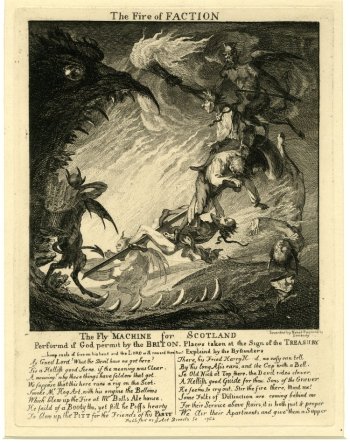
Paul Sandby, The Fire of Faction. The Fly Machine for Scotland, 1762, etching (London: The British Museum).
Print Quarterly 34.4 (December 2017)
A R T I C L E S
• Aaron M. Hyman, “Patterns of Colonial Transfer: An Album of Prints in Mexico City,” pp. 393–99.
“The rediscovery of an album of European prints in Mexico City promises to fill in some of the scholarly gaps by bringing to roughly 500 the number of extant, loose-leaf European prints in Mexico that survive from the colonial period—vastly more than scholars were aware of only a decade ago. . . The album is loosely organized chronologically and by national schools, with the earliest prints appearing at the beginning, followed by the eighteenth-century material that constitutes most of it.”
• Ann V. Gunn, “The Fire of Faction: Sources of Paul Sandby’s Satires of 1762–63,” pp. 400–18.
“On 23 September 1762, ‘The Butifyer, a touch on the times. Also a poor man loaded with mischief, or John Bull and his sister Peg . . . Likewise the Fire of Faction’ were announced in The Public Advertiser, the first of three of a series of seven satirical prints created by Paul Sandy (1731–1809) in late 1762 during the negotiations for the Treaty of Paris that ended the Seven Years’ War . . . This group, however, has never been examined as a whole before. This article discusses the context within which these prints were made and identifies the imagery and literary sources employed in them.”
N O T E S A N D R E V I E W S
• Louis Marchesano, Review of Kristina Deutsch, Jean Marot: Un graveur d’architecture à l’époque de Louis XIV (Berlin: De Gruyter, 2015), pp. 437–38.
• James Grantham Turner, Review of an issue of Casabella 856 (December 2015), dedicated to the Fondazione Querini Stampalia’s 2016 exhibition Giulio Romano’s I Modi and the Modi of of Carlo Scarpa and Alvaro Siza, which featured drawings by two modern architects with sexually explicit Italian prints from the sixteenth to nineteenth centuries, pp. 441–42.
• Antony Griffiths, Review of the exhibition catalogue Freyda Spira and Peter Parshall, The Power of Prints: The Legacy of William M. Ivins and A. Hyatt Mayor (New Haven: Yale University Press, 2016), pp. 468–70.
P U B L I C A T I O N S R E C E I V E D
• Sharon Liberman Mintz, Shaul Seidler-Feller, and David Wachtel, eds., The Writing on the Wall: A Catalogue of Judaica Broadsides from the Valmadonna Trust Library (London: Valmadonna Trust Library, 2015), p. 462.
• Christien Melzer, ed., Im Zeichen der Lilie: Französische Druckgraphik zur Zeit Ludwigs XIV (Bremen: Kunstverein Bremen, 2017), pp. 462–63.
• Petra Zelenková, Jan Kupecký a ‘černé umění’ / Johann Kupezky (1666–1740) and ‘The Black Art’ (Prague: National Gallery, 2016), p. 463.
• Anna Schultz, Johann Gottlieb Glume (1711–1778): Das Druckgraphische Werk (Berlin: Galerie Bassenge, 2016), p. 463.
• Laura Moretti, Recasting the Past: An Early Modern ‘Tales of Ise’ for Children (Leiden: Brill, 2016), p. 463.
Exhibition | The Business of Prints
Press release (via Art Daily) for the exhibition:
The Business of Prints, 1400–1850
The British Museum, London, 21 September 2017 — 28 January 2018
Curated by Antony Griffiths
 The British Museum has one of the greatest collections of prints in the world and holds the UK’s national collection. The majority of this collection, which totals more than two million prints, was made in the years before the invention of photography. Due to the sheer volume of the collection it can become difficult to grasp its contents, and many of the prints are today very unfamiliar and puzzling. For the past century, prints have usually been discussed either as finished works of art or as illustrations of a particular subject. This exhibition reverses the perspective in a way that has not been attempted before, and endeavours to show prints as an object of trade.
The exhibition The Business of Prints is in part based on the book The Print before Photography: An Introduction to European Printmaking, 1550–1820 by Antony Griffiths, published last year by British Museum Press. This won the Apollo Prize for the best art book of the year 2016. It is the first work ever to attempt to explain how the print world worked.
The exhibition focuses on four major topics: the production of prints, the lettering on prints, the usage of prints, and the collecting of prints and the concern for quality. In addition, books and series are being shown in table cases, and framed prints on the wall. Famous works by artists such as Dürer, Rembrandt, and Goya are being shown alongside far less familiar subjects by artists of the print trade who have almost been forgotten. Among them is a rabbit used as target practice, a prompt for an early form of karaoke, and prints from plates that had been so heavily used that they had almost worn out. The display offers a more complete understanding of the lettering on prints, the information it gives us, and some of the complicated ways in which images were linked with text.
We are now so used to the deluge of photographically-derived imagery of the modern world that it is difficult to imagine a period which lasted for nearly 450 years, from around 1400 to 1850, when every pictorial image had to be designed by someone and then cut by a craftsman onto a copper plate or wooden block—there were no mechanical aids. These were then printed by another expert, and distributed by printsellers to buyers around the whole of Europe. Behind them stood the publishers and entrepreneurs, who financed the production, and frequently came up with ideas for new subjects. It was a huge business, which gave work to thousands of people. The exhibition sheds light on this forgotten trade of mass production which required numerous collaborations in order to produce a single print, whilst revealing some of the complexities of the craftsmanship and the process, the varied nature of the prints themselves, and the ways in which buyers used or collected them.
Johannes Gutenberg invented moveable type in Mainz in the late 1440s. However, type is designed to deal with words, and as soon as the need to communicate goes beyond the verbal, the support of another variety of printing must be called on—one that is specifically suited for images. Two such technologies were used alongside type, one based around cutting designs into wooden blocks (the relief process of woodcut), the other in which the design was incised as lines into a copper plate (the intaglio processes such as engraving and etching).
The uses to which these technologies were put were enormously varied. The printing of maps and music, wallpaper, diagrams, decorative paper, bank notes, playing cards and fans, as well as many types of decoration of textiles and ceramics, depended on woodcut or engraving. Many of these applications spun off to become separate businesses. In museums the field is conventionally narrowed to one area of this vast expanse, that of pictorial images on sheets of paper. This is still very wide, covering a wide range of functions, such as portraits, devotional images, current events, landscape and topography, caricature, fantasy and designs for the decorative arts. Many of these classes of print did not need the support of typography, and most intaglio prints carried their text engraved on the plate itself alongside the image. One example that demonstrates the volume and diversity of the European print trade is the mass production of the recognisable image of a devotional saint which would have been sold by pedlars and worn as amulets by peasants. These were often printed on vellum, a more durable material than paper, to withstand daily wear and tear.
When speaking of the display, curator Antony Griffiths highlights that “this is the first exhibition ever to demonstrate what prints can tell us about the vast business of trading prints. The exhibition aims to open the visitor’s eyes to the business of printing. Prints were multiples made in the hope that people would buy lots of them. The range of subjects, sizes and purposes was huge—far larger than people realise today.”
Call for Papers | Fashion and Clothing in European Museums
From H-ArtHist:
Fashion and Clothing in European Museums: Collection, Research, Exhibition
Musée Alsacien, Strasbourg/Haguenau, 17–19 May 2018
Proposals due by 19 December 2017

Courtyard of the Alsatian Museum in Strasbourg (Photo: Wikimedia Commons, June 2009).
This interdisciplinary international conference Fashion and Clothing in European Museums: Collection, Research, Exhibition is organised by the European Research Interest Group Appearances, Bodies and Societies / Apparences, Corps et Sociétés (ACorSo). With the intent of reflecting the current museum landscape and of developing debate on future directions for museums of art, dress and textiles, ethnography and history, members of the Research Interest Group welcome papers that respond closely to the following issues:
• What fundamental themes and debates have museums attached to their collections of textiles, dress, and fashion?
• What ambitions have been attached to the development of dress, fashion, and textile collections? How are these collections integrated within the global project of museums and the museum itinerary?
• How can we overcome the status of differences that exist between (high) fashion and everyday and ethnographical dress and their museum display?
• Should the promulgators of the new museologies of the study of fashion and dress—so far mostly applied to analysis of museums of international standing or to specialised museums—take an interest in the work of small and medium sized museums?
• In what ways is digitization a challenge or a potential to the museum?
• Where should small and medium sized museums seek professional advice? What professional skills are needed for these museums? Is there a preferred work methodology?
• What links to established research can museums initiate and set in place, precisely because of their specificities? What has already been initiated?
• The situation of some of some small local museums with collections including dress, textiles, and their related industries is now so perilous that some have been, and are being, closed. What positive proposals have been set in place that have already addressed this problem or are currently dealing with it?
We are interested in receiving discussion papers from colleagues working with collections, be they curators, collectors, researchers, managers, museographers, etc. The languages of the conference will be French, German, and English. In view of the trans-European character of this conference, we ask you to submit your abstract in two languages—in any combination of French, German, and English (i.e. French and German, French and English, or English and German). Your submission should be 300 words long, with the translation bringing it to a total of 600 words. Abstracts must be relevant to the issues detailed in this Call for Papers and should clearly highlight the specific themes your paper will address. You will be informed in January on the status of your submission.
Abstracts should be submitted to
• Lou Taylor, Prof. Emerita (lt73@brighton.ac.uk); Dr. Charlotte Nicklas (c.nicklas@brighton.ac.uk). School of Humanities, University of Brighton, 10/11, Pavilion Parade, Brighton, BN 2 1RA, UK.
• Jean-Pierre Lethuillier (jean-pierre.lethuillier@univ-rennes2.fr). Université Rennes 2, Département d’Histoire, Place du recteur Henri Le Moal, CS 24307, 35043 Rennes cedex, France.










 Enfilade
leave a comment