Exhibition | Jean-Baptiste Perronneau
Now on view in Orléans:
Jean-Baptiste Perronneau: Portraitiste de génie dans l’Europe des Lumières
Musée des Beaux-Arts d’Orléans, 17 June — 22 October 2017
Curated by Dominique d’Arnoult with Valérie Luquet and Olivia Voisin
 Du 17 juin et au 17 septembre 2017, le musée des Beaux-Arts d’Orléans présente la première rétrospective consacrée à Jean-Baptiste Perronneau (v. 1715–1783), véritable portraitiste de génie à la personnalité artistique singulière et exigeante.
Cette exposition invite à visiter l’Europe des Lumières—moment du plus extraordinaire engouement pour le portrait jamais connu—à travers 120 oeuvres provenant de prestigieuses collections publiques (musée du Louvre, National Gallery…) et privées, souvent inédites, mais aussi du musée des Beaux-Arts d’Orléans qui conserve le fonds le plus riche d’oeuvres de l’artiste.
Dans un parcours chronologique, l’exposition retrace l’incroyable carrière de Perronneau (depuis sa formation et ses débuts fulgurants à Paris, marqués par sa réception à l’Académie royale en 1753, jusqu’aux voyages qui lui feront aborder les villes de France (Lyon, Toulouse, Bordeaux, Orléans) et d’Europe (Bruxelles, Rome, Londres) avant de faire d’Amsterdam un port d’attache et de départ vers les villes hanséatiques comme Hambourg ou vers Saint-Pétersbourg et Varsovie.
Illustrant le goût du XVIIIe siècle pour le brillant et l’éclat, les pastels de Perronneau côtoient ici ses portraits peints à l’huile et comme chez leurs commanditaires de l’époque, des peintures des maîtres anciens, des oeuvres de peintres et de sculpteurs contemporains de l’artiste, ainsi que des objets d’arts décoratifs. Tous réunis, ils offrent un regard neuf sur ce portraitiste trop rapidement classé comme le rival malheureux de Maurice Quentin Delatour (1704–1788) et qui s’avère être, au contraire, un artiste virtuose dont le parcours se distingue nettement de ses contemporains.
Ses réseaux de sociabilité embrassent en effet le siècle de manière plus complète que pour d’autres peintres, avec cette nouvelle composante de sa clientèle que représentent les acteurs du négoce et du grand commerce, qu’ennoblit la sociabilité artistique.
L’exposition reconstitue les liens que noue Perronneau lors de ces nombreux voyages avec les amateurs d’art et notamment sa longue amitié avec Aignan Thomas Desfriches—riche entrepreneur orléanais et futur fondateur du musée des Beaux-Arts d’Orléans—de laquelle naîtra une série de pastels parmi les plus importants de sa carrière.
Depuis 1860, le musée des Beaux-Arts d’Orléans, n’a cessé d’acquérir des oeuvres de Perronneau, jusqu’à l’achat en juin 2016 d’un chef-d’oeuvre—le portrait d’Aignan Thomas Desfriches—à la suite duquel le musée a souhaité restituer l’oeuvre de Perronneau dans son siècle avec cette première rétrospective.
Olivia Voisin and Dominique d’Arnoult, eds., Jean-Baptiste Perronneau: Portraitiste de génie dans l’Europe des Lumières (Paris: Réunion des Musées Nationaux, 2017), 192 pages, ISBN: 978 23590 62021, 29€.
Neil Jeffares provides a glowing review (in English) here»
New Book | Wedgwood: A Story of Creation and Innovation
From Rizzoli:
Gaye Blake-Roberts and Mariusz Skronski, with a foreword by Alice Rawsthorn, Wedgwood: A Story of Creation and Innovation (New York: Rizzoli, 2017), 304 pages, ISBN: 978 08478 60104, $60.
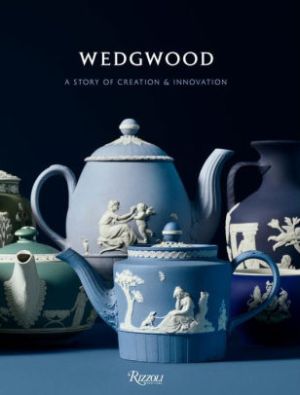 Founded in 1759, Wedgwood has a deep heritage in pottery making that represents timeless design and enduring style. The eponymous founder, Josiah Wedgwood, was an entrepreneur and visionary who quickly became Britain’s most successful ceramics pioneer, elevating pottery from a cottage craft into a luxury good and an art form. He was the mastermind behind Wedgwood’s most enduring pieces, including Queen’s Ware, Black Basalt, and Jasperware. That tradition of master craftsmanship and innovation continues today as Wedgwood works with celebrated designers such as Vera Wang and Jasper Conran.
With historic photographs, drawings, and watercolors from Wedgwood’s extensive archive, which display the craftsmanship and technical innovation, this book is a visual celebration of English design. It offers a lavish look at some of the most timeless china creations in history with a focus on Wedgwood’s 100 icons, in-depth essays on the brand and its history, and pattern books and sketches from the Wedgwood archives. While paying homage to the pioneering spirit of Wedgwood, this volume documents the achievements of a brand that is a symbol of elegance and timelessness, infusing classic craftsmanship with fresh design, and promises to impress fans of Wedgwood, old and new.
Gaye Blake-Roberts is a design historian and the curator of the Museum at Wedgwood. Alice Rawsthorn, OBE, is a British design critic who writes for the international edition of The New York Times. Mariusz Skronski is the creative and strategic director at Fiskars Living Brands.
Conference | Collections, Displays and the Agency of Objects
From the conference programme:
Collections, Displays and the Agency of Objects
Cambridge University, 20–22 September 2017
Registration due by 10 September 2017
Conference organized as part of the BMBF project Parerga and Paratexts – How Things Enter Language: Practices and Forms of Presentation in Goethe’s Collections in collaboration with the Department of Art History in Cambridge.
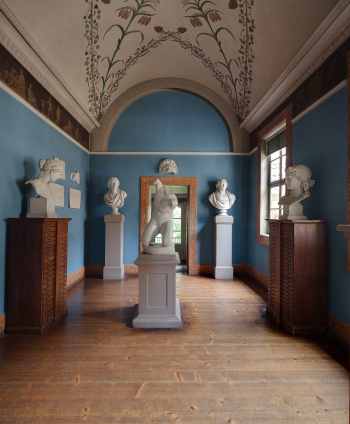
Brückenzimmer of Goethe’s House, Weimar.
2 0 S E P T E M B E R 2 0 1 7
6:00 Welcome and Introduction
6:30 Opening Lecture
• Ivan Gaskell (Bard Graduate Center), Display Displayed
2 1 S E P T E M B E R 2 0 1 7
9:00 Session I
Moderator: Johannes Grave (Universität Bielefeld)
• Ruth Bielfeldt (Ludwig-Maximilians-Universität München), Do Things Talk? On the Practice of Epigraphein in Greek Sanctuaries
• Elsje van Kessel (University of St. Andrews), The Street as Frame
• Peter Schade (National Gallery, London), The Framing of Sebastiano del Piombo’s The Raising of Lazarus
• Hannah Williams (Queen Mary University of London), Staging Belief: Immersive Encounters and the Agency of Religious Art in 18th-Century Paris
12:15 Lunch break
2:00 Encounters with Objects
4:15 Session II
Moderator: Wolfgang Holler (Klassik Stiftung Weimar)
• Eelco Nagelsmit (ETH Zürich), Interiority on Display: Models of Holy Sites in Halle Pietism
• Thomas Schmuck (Klassik Stiftung Weimar), Vestiges of Earth History: Objects and Order in Goethe’s Geological Collections
• Diana Stört (Martin-Luther-Universität Halle-Wittenberg), Goethe’s Cabinets as Epistemic Furniture
2 2 S E P T E M B E R 2 0 1 7
9:00 Session III
Moderator: Cindy Kang (The Barnes Collection)
• Mechthild Fend (University College London), Order and Affect: The Museum of Dermatological Wax Moulages at the Hôpital Saint Louis in Paris
• Juliet Carey (Waddesdon Manor, The Rothschild Collection), Staging Things: Framing the Rothschild Collection at Waddesdon Manor
• Dario Gamboni (Université de Genève), Ready-made Eye-opener: Models, Functions and Meanings of the Ironwork in Albert C. Barnes’s Displays
11:45 Lunch break
2:00 Encounters with Objects
4:15 Session IV
Moderator: Valérie Kobi (Universität Bielefeld)
• Noémie Étienne (Universität Bern), Unfolding the Specimen: Display and Diorama in New York, 1900
• Angela Matyssek (Philipps-Universität Marburg), Death by/Life by Wall Label
5:45 Final Discussion and Conclusions
Eike Schmidt Named Director of Vienna’s Kunsthistorisches Museum
As reported by The Art Newspaper (1 September 2017). . .
The director of the Uffizi galleries in Florence, Eike Schmidt, is stepping down to become head of Vienna’s Kunsthistorisches Museum (KHM). The German-born sculpture specialist will replace Sabine Haag in 2019, announced the Austrian culture minister, Thomas Drozda, at a press conference today (1 September).
Schmidt made waves when he was named the first non-Italian to lead the Uffizi in 2015, among 20 new ‘super directors’ appointed to modernise Italy’s top museums and heritage sites. Following curatorial posts at the National Gallery of Art in Washington, DC (2001–06), the J. Paul Getty Museum in Los Angeles (2006–08), and the Minneapolis Institute of Arts (2009–15), and a stint in charge of the European sculpture and works of art department at Sotheby’s London (2008–09), it was his first museum directorship. . .
The full article is available here»
New Book | Picturing India
From the University of Washington Press in conjunction with the British Library:
John McAleer, Picturing India: People, Places, and the World of the East India Company (Seattle: University of Washington Press, 2017), 224 pages, ISBN: 978 029574 2939, $40.
 The British engagement with India was an intensely visual one. Images of the subcontinent, produced by artists and travelers in the eighteenth- and nineteenth-century heyday of the East India Company, reflect the increasingly important role played by the Company in Indian life. And they mirror significant shifts in British policy and attitudes toward India. The Company’s story is one of wealth, power, and the pursuit of profit. It changed what people in Europe ate, what they drank, and how they dressed. Ultimately, it laid the foundations of the British Raj.
Few historians have considered the visual sources that survive and what they tell us about the link between images and empire, pictures and power. This book draws on the unrivalled riches of the British Library-both visual and textual-to tell that history. It weaves together the story of individual images, their creators, and the people and events they depict. And, in doing so, it presents a detailed picture of the Company and its complex relationship with India, its people and cultures.
John McAleer is lecturer in history at the University of Southampton. He was previously curator of imperial and maritime history at the National Maritime Museum, Greenwich. He is the author of Britain’s Maritime Empire: Southern Africa, the South Atlantic and the Indian Ocean 1763–1820.
Exhibition | Model Citizens
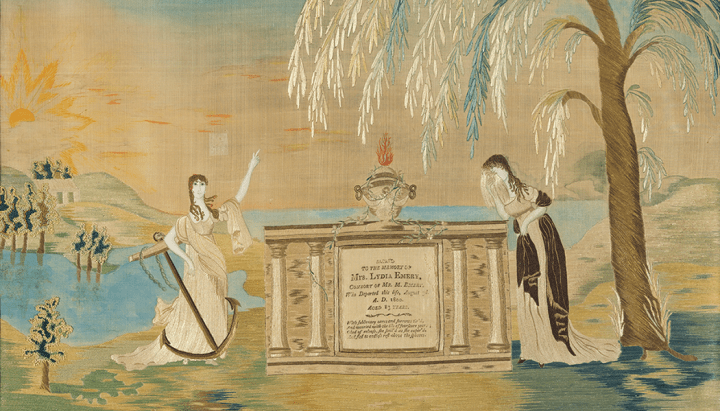 Susan Merrill, Memorial to Mrs. Lydia Emery (1717–1800), 1811; watercolor on silk
(Portland Museum of Art, 1968.4)
◊ ◊ ◊ ◊ ◊
From the Portland Museum of Art:
Model Citizens: Art and Identity in the United States, 1770–1830
Portland Museum of Art, 10 September 2017 — 28 January 2018
Model Citizens: Art and Identity in the United States, 1770–1830 presents works from the PMA’s permanent collection by the most celebrated artists of the early United States alongside portrait miniatures, samples, and silhouettes. This wide range of visual culture provides a glimpse into how late 18th- and early 19th-century Americans elected to represent themselves in private and public spheres as husbands, wives, children, and citizens.
Arranged in three sections, the exhibition uses the life cycle as an organizing principle to introduce viewers to the many modes of self-representation popular in the era, from finely painted portraits by Gilbert Stuart and Thomas Badger to modestly-scaled cut silhouettes and mourning embroideries. The first section showcases paintings of children alongside embroidered samplers produced by the young women of the Stone family at Portland’s Miss Martins’ School. This portion provides a glimpse of how families understood lineage as well as how painters helped visualize changing ideas about the nature of childhood. The samplers show how young, upper-class women expressed their creativity and accomplishment. The second section features works that portray grown men and women, often commemorating major life events such as marriage. In addition to paired portraits and individual works by renown painters such as Stuart and John Singleton Copley, this section will also feature silhouettes and minatures—small-scale, modestly priced works that allowed sitters to circulate likenesses among family and friends. The final section presents examples of men and women at the end of life such as the PMA’s newly acquired portrait of Judge Stephen Jones, who was in his eighties when he sat for Gilbert Stuart. This section will also include mourning emroideries to underscore how early Americans used painting and needle work to commemorate loved ones after death.
Generously supported by Shannon C. Gordon with additional support from Friends of the Collection.
Exhibition | Louis-Nicolas van Blarenberghe and the Battle of Yorktown

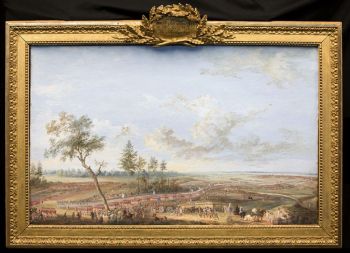
Louis-Nicolas Van Blarenberge, The Siege of Yorktown, 1786; gouache on panel, 24 × 37 inches
(Private Collection of Nicholas Taubman)
◊ ◊ ◊ ◊ ◊
Press release (24 August 2017) from the Museum of the American Revolution:
Louis-Nicolas van Blarenberghe and the Battle of Yorktown
Museum of the American Revolution, Philadelphia, until 24 September 2017
Only one month remains to see two 18th-century paintings depicting the last major land battle of the Revolutionary War on display at the Museum of the American Revolution. The paintings, The Siege of Yorktown and The Surrender of Yorktown, are incredibly detailed and populated with hundreds of tiny figures, like 18th-century ‘Where’s Waldo?’ scenes. The original versions of the paintings were created for King Louis XVI by French artist Louis-Nicolas van Blarenberghe, the court Painter of Battles to the King. Those paintings are on display at the Palace of Versailles. The paintings on view at the Museum of the American Revolution are secondary versions created by Van Blarenberghe in 1786 for French General the Comte de Rochambeau, the commander of the French forces at Yorktown. The paintings remained in the Rochambeau family until about 15 years ago and are in pristine condition.
“We are thrilled to be able to offer our visitors the extraordinary opportunity to view these incredible, richly detailed paintings,” said Museum President Michael Quinn. “The discovery of previously undetected differences between the two sets of paintings is a fascinating detective story, making the paintings all the more intriguing.”
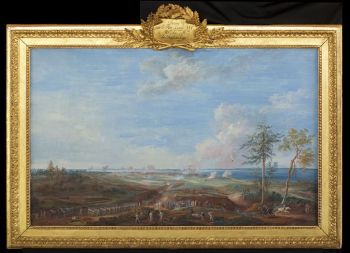
Louis-Nicolas Van Blarenberge, The Siege of Yorktown, 1786; gouache on panel, 24 × 37 inches.
Having researched the paintings, Christopher Bryant, a Massachusetts-based independent scholar and dealer of historical portraits and artifacts, believes that Rochambeau gave direction to Van Blarenberghe in the execution of the paintings on display at the Museum. Bryant argues that, given the interest taken by Rochambeau in the paintings as visual records of the crowning achievement of his career and the fact that he was an eyewitness to the events depicted, the differences between the paintings are likely corrections made from the originals, rendering Rochambeau’s copies even more historically accurate than those painted for King Louis XVI.
Louis-Nicolas Van Blarenberge, The Surrender of Yorktown, 1786; gouache on panel, 24 × 37 inches.
The most prominent alteration to the 1786 version of the Siege is the addition of a group of American officers near the figure of Rochambeau. While the original painting includes only one American officer holding a map, the replica depicts a group of ten officers gathered around that original figure, now identifiable as General George Washington. The map he holds can be identified as a plan drawn by Lafayette’s cartographer of the British fortifications at Yorktown. Interestingly, this same scene is reprised in Louis-Charles-Auguste Couder’s Siege of Yorktown (1836), a 19th-century copy of which is displayed on the Museum’s second floor.
“These paintings are remarkable in being superb works of art while also being extraordinarily accurate and detailed. It is very rare that you have that combination as those two circumstances are usually mutually exclusive,” said Bryant. “However, these paintings are both: they are wonderful paintings on an artistic basis, but there is also so much historical information within them that can be independently corroborated, that they can now be seen as important historical documents in their own right. The Surrender provides one of the most accurate accounts of this historic event known.”
Other changes to the paintings include alterations to the uniforms worn by Rochambeau and Washington, several topographical revisions, and the addition of a tree to obscure portions of a scene in Surrender. Van Blarenberghe also altered the location of the Metz Artillery, the senior French artillery present at the battle, within the Surrender painting. This change reveals the important role the Metz Artillery played in the surrender ceremony.
The paintings, on short-term loan from Ambassador and Mrs. Nicholas F. Taubman, are located in one of the Museum’s final galleries that explores the battles and skirmishes in 1781 that culminated with the Siege of—and ultimately, the Surrender of General Cornwallis’s 6,000-man British army at—Yorktown, Virginia. They will be replaced with two 18th-century prints from the Museum’s collection, one of British General Charles Cornwallis and one of British Lieutenant Colonel Banastre Tarleton.
New Book | The Art of Painting in Colonial Bolivia
From Saint Joseph’s University Press:
Suzanne Stratton-Pruitt, ed., The Art of Painting in Colonial Bolivia / El arte de la pintura en Bolivia colonial (Philadelphia: Saint Joseph’s University Press, 2017), 530 pages, ISBN: 978 1945402 319, $120.
 This anthological volume is dedicated to the art of painting in pre-independence Bolivia, prompted by the belief that a compendium of handsomely photographed, full-color images will bring renewed public and scholarly attention to a rich cultural heritage that has not received its due. An ambitious round of new photography has been joined by an international roster of scholarly contributors from the United States, Argentina, Peru, and Bolivia to offer both the general reader and specialists an overview of the art of painting in the region of South America once called ‘Charcas’ and later ‘Alto Perú’. Attention is brought to the role of European subjects and styles in the development of regional forms of expression, as well as the influence of art and artists from Cuzco, Peru. Works by painters active in La Paz, Sucre, and Potosí such as Leonardo Flores, Melchor Pérez Holguín, and Gaspar Miguel de Berrío have received close reading of iconographical themes that were often of particularly local interest.
Suzanne L. Stratton-Pruitt has, from the mid-1970s, taught, published, and curated exhibitions about Spanish Early Modern art, for which she was awarded the Lazo de Dama de la Orden de Isabel la Católica. Since 2003 she has focused on Spanish colonial art, co-editing with Joseph J. Rishel the catalogue of the exhibition The Arts in Latin America 1492–1820 (Philadelphia Museum of Art, 2006). As curator of the Carl and Marilynn Thoma Collection of Spanish Colonial Painting, she organized the exhibition catalogue The Virgin, Saints, and Angels: South American Paintings 1600–1825 from the Thoma Collection (Milan: Skira editore, 2006). Stratton-Pruitt edited The Art of Painting in Colonial Quito/El arte de la pintura en Quito colonial (Philadelphia: Saint Joseph’s University Press, 2012) as well as Journeys to New Worlds: Spanish and Portuguese Colonial Art in the Roberta and Richard Huber Collection (Philadelphia Museum of Art, 2013), and she wrote about “Paintings in the Home in Spanish Colonial America” for the catalogue of the exhibition Behind Closed Doors: Art in the Spanish-American Home 1492–1898 (Brooklyn Museum, 2013).
C O N T E N T S
Mitchell Codding, Prologue / Prólogo
Acknowledgments / Agradecimientos
Essays
• Suzanne Stratton-Pruitt, The Art of Painting in Colonial Bolivia 1600&1825 / El arte de la pintura en la Bolivia colonial, 1600&1825
• Philipp Schauer, Mural Painting in Bolivia / Pintura mural en la Bolivia
• Ramón Mujica Pinilla, The Pillars of Hercules in Charcas: Imperial Visual Politics in the Viceregal Art in Bolivia / Las columnas de Hércules en Charcas: Política visual imperial en el arte virreinal boliviano
• Almerindo Ojeda Di Ninno, The Use of Prints in Spanish Colonial Art: Approaching the Bolivian Corpus / El uso de grabados en el arte colonial: Una aproximación al corpus boliviano
• Carolyn C. Wilson, The Image of Saint Joseph in a Selection of Colonial Paintings in Bolivian Collections / La imagen de San José en una selección de pinturas coloniales en colecciones bolivianas
• Jaime Mariazza F., Portraiture in the Real Audiencia of Charcas / El retrato en la Real Audienca de Charcas
• Agustina Rodríguez Romero, Old Testament Paintings in Colonial Bolivia: A Remote Past for New Believers / Pinturas del Antiguo Testamento en la Bolivia colonial: Un pasado remoto para nuevos creyentes
• Jeffrey Schrader, Statue Paintings: The Wayfaring Marian Images of Spain in Bolivia / Pinturas de estatua: Las imágenes españolas viajares de María en Bolivia
• Maya Stanfield-Mazzi, Uniquely American Visions of the Virgin Mary / Imágenes unívocamente americanas de la Virgen María
• Gustavo Tudisco, Mountains, Volcanoes, Stones and Promontories: Eighteenth-Century Marian Devotion and Painting in the Andes / Montañas, volcanes, piedras y promontorios. El culto a María en los Andes y la pintura devocional del siglo XVIII
• Jeanette Favrot Peterson, Through Ocaña’s Eyes: Our Lady of Guadalupe in Sucre, Bolivia / A través de la mirada de Ocaña: Nuestra Señora de Guadalupe en Sucre, Bolivia
• Adriana Pacheco Bustillos, The Nuns of Colonial Bolivia and the Art of Painting / Las monjas en la Bolivia colonial y el arte de la pintura
• Gabriela Siracusano, The Carabuco Paintings of the ‘Four Last Things’ /La pinturas de las Postrimerías de Carabuco
• Lucía Querejazu Escobari, Iconography and Ideology in the Paintings of Caquiaviri / Iconografía e Iconología en las pinturas de Caquiaviri
Iconographical Studies / Estudios iconográficos
With contributions by Suzanne Stratton-Pruitt, Lucía Querejazu Escobari, Agustina Romero Rodríguez, Héctor Schenone, and Gustavo Tudisco
• The Painted Decoration of the Church of Jerusalem, Potosí / La decoración pintada de la Iglesia de Jerusalén de Potosí
• The Presbytery at the Sanctuary of Copacabana, Bolivia / Decoración del Presbiterio del Santuario de Copacabana, Bolivia
• Christ Crucified with Saints, Church of Santo Domingo, Sucre / Crucificado de Santo Domingo de Sucre
• Christ Carrying the Cross / Cristo con la cruz a cuestas
• The Passion of Christ / La Pasión de Cristo
• Christ of Malta / El Cristo de Malta
• ‘True Portraits’ of Jesus Christ and the Virgin Mary / ‘Retratos Verdaderos’ de Jesucristo y de la Virgen María
• Praise be / Alabado Sea
• The Soul of Mary / El Alma de María
• Our Lady of Succor / Nuestra Señora de Socorro
• Our Lady of Remedies of La Paz / Nuestra Señora de los Remedios de La Paz
• Our Lady of Multiple Devotions / Nuestra Señora de Advocaciones Múltiples
• Mary, Queen of Heaven / María, Reina del Cielo
• The Divine Shepherdess / La Divina Pastora
• Presentation of the Chasuble to Saint Ildephonsus / La imposición de la casulla a San Ildefonso
• Our Lady of Soterraña of Nieva / Nuestra Señora de Soterraña de Nieva
• The Virgin of the Immaculate Conception in Paintings in Colonial Bolivia / La Virgen de la Inmaculada Concepción en las pinturas de la Bolivia colonial
• The Painted Angels of Colonial Bolivia / Las pinturas de ángeles de la Bolivia colonial
• Saint Nicholas of Tolentino and Saint Nicholas of Bari / San Nicolás de Tolentino y San Nicholás de Bari
• Saint Augustine, Patron Saint of the Rich Hill of Potosí / San Agustín, Santo Patrono del Cerro Rico de Potosí
• Virgin Saints and Martyrs / Vírgenes Santas y Mártires
Bibliography/ Bibliografía
Index/ Índice
Contributors / Autores
Exhibition | Streams and Mountains

Ten Thousand Miles along the Yellow River, detail, 1690–1722; Chinese, Qing Dynasty (1644–1911); two handscrolls; ink, color, and gold on silk; image is 78 × 1285 cm (New York: The Metropolitan Museum of Art, 2006.272a, b). More information is available here»
◊ ◊ ◊ ◊ ◊
Press release (10 August) from The Met:
Streams and Mountains without End: Landscape Traditions of China
The Metropolitan Museum of Art, New York, 26 August 2017 — 6 January 2019 (with three rotations)
Curated by Joseph Scheier-Dolberg
From the standpoint of splendid scenery, painting cannot equal [real] landscape. But when it comes to the wonders of brush and ink, [real] landscape is no match for painting! —Dong Qichang (1555–1636)
About a thousand years ago, the legendary Chinese landscape painter Guo Xi posed the question, “In what does a gentleman’s love of landscape consist?” This question is at the heart of The Metropolitan Museum of Art’s Streams and Mountains without End: Landscape Traditions of China.
Showcasing more than 120 Chinese landscape paintings in three rotations, Streams and Mountains without End explores the many uses of landscape in the Chinese visual arts. The focus is on paintings, but textiles, ceramics, bamboo carvings, and objects in other materials are also included. Arranged in thematic groupings, the works in the exhibition have been selected to provide gateways into the tradition, drawing out distinctions between types of landscape that may not be obvious at first glance. What appears to be a simple mountain dwelling is revealed to be the villa of the painter’s friend, which encodes a wish for his happy retirement; what seems to be a simple study in dry brushwork turns out to be an homage to an old master, a sign of reverence for what had come before. The exhibition brings the tradition to life by showing the layers of meaning that lie behind these ubiquitous images of tree, stream, and mountain. A quotation from classical Chinese painting theory introduces each grouping, giving the tradition itself a voice in the exhibition. The works in the exhibition are drawn primarily from The Met collection, supplemented by a dozen works from private lenders. The exhibition is made possible by the Joseph Hotung Fund.
Among the show’s highlights are a Song dynasty (960–1279) handscroll, Two Landscapes Inspired by the Poetry of Du Fu, a rare example of early literati painting, attributed to Sima Huai (Chinese, active ca. 1131–62); a 15th-century handscroll, The Four Seasons, which takes the viewer through an extended journey; the 1571 handscroll Fantastic Scenery in the Human Realm, a dynamic landscape of bizarre and contorted forms, by Wen Boren; and two majestic landscapes from the Qing dynasty court: Ten Thousand Miles along the Yellow River, dated to 1690–1722, and the The Qianlong Emperor’s Southern Inspection Tour, scroll four, dated 1770, by Xu Yang (active ca. 1750–after 1776).
In conjunction with the exhibition, The Met’s Education Department is offering tours led by the exhibition organizer Joseph Scheier-Dolberg, Assistant Curator in the Museum’s Department of Asian Art, on September 27 and November 8; the one-hour tours start at 10:30am.
Exhibition | Leonardo to Matisse: Master Drawings
From The Met:
Leonardo to Matisse: Master Drawings from the Robert Lehman Collection
The Metropolitan Museum of Art, New York, 4 October 2017 — 7 January 2018
Curated by by Dita Amory and Alison Nogueira
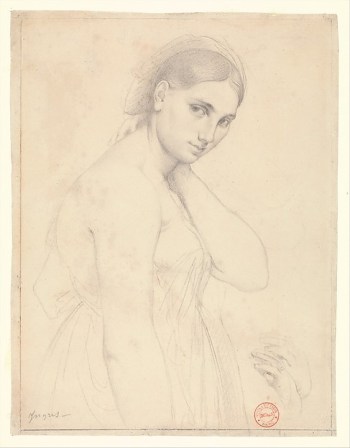
Jean Auguste Dominique Ingres, Study for ‘Raphael and the Fornarina'(?), ca. 1814; graphite on white wove paper, 25.4 × 19.7 cm (New York: The Metropolitan Museum of Art, Robert Lehman Collection, 1975.1.646).
This exhibition will trace the development of European drawing from the Renaissance to the early 20th century through works by celebrated masters such as Leonardo da Vinci, Dürer, Rembrandt, Tiepolo, Ingres, Seurat, and Matisse. Fifty-five drawings from the Museum’s acclaimed Robert Lehman Collection will present a dynamic array of styles, techniques, and genres—from panoramic landscapes and compositional studies for mythological and biblical narratives to arresting studies of the human form.
The selection will illustrate different facets of the artists’ creative processes—from Leonardo’s keen anatomical observation in his Study of a Bear, to Dürer’s awakening self-consciousness as an artist in his Self-Portrait study, to Rembrandt’s reinterpretation of Leonardo’s painted masterpiece, The Last Supper. The exhibition will also be the first to explore Robert Lehman’s significant activity as a 20th-century collector by highlighting the full range of his vast and distinguished drawings collection, which numbers more than 700 sheets.
The exhibition is organized by Dita Amory, Curator in Charge, and Alison Nogueira, Associate Curator, both of the Robert Lehman Collection at The Met.










 Enfilade
leave a comment