New Book | Enchanted World of German Romantic Prints
The related exhibition was on display at the Philadelphia Museum of Art in the autumn of 2013. From Yale UP:
John Ittmann, ed., with essays by Warren Breckman, Mitchell B. Frank, Cordula Grewe, John Ittmann, Catriona MacLeod, and F. Carlo Schmid, Enchanted World of German Romantic Prints, 1770–1850 (New Haven: Yale University Press, 2017), 424 pages, ISBN: 978 03001 97624, $65.
 From the 1770s through the 1840s, German, Austrian, and Swiss artists used the medium of printmaking to create works that synthesized poetry, literature, music, and the visual arts in new and captivating ways. Finding an eager audience in the growing number of educated middle-class collectors, printmakers experimented with modern technologies, such as lithography, and drew on the contemporary interest in regional folklore and traditional fairy tales to produce innovative compositions that both contributed to and reflected the dramatic cultural and political upheavals of the Romantic era. Featuring the work of more than 120 artists, including Casper David Friedrich, Ludwig Emil Grimm, Joseph Anton Koch, Philipp Otto Runge, and Johann Gottfried Schadow, this authoritative book contains many unique and never-before-published examples of prints from the Philadelphia Museum of Art’s unrivaled collection.
John Ittmann is the Kathy and Ted Fernberger Curator of Prints at the Philadelphia Museum of Art.
Bellotto’s ‘Fortress of Königstein’ Acquired by NG, London

Bernardo Bellotto, The Fortress of Königstein from the North, ca. 1756–58; oil on canvas, 132 × 236 cm
(London: The National Gallery)
◊ ◊ ◊ ◊ ◊
Press release from The National Gallery:
The Fortress of Königstein from the North by Bernardo Bellotto (1722–1780), which was due to be exported from Britain, has been saved for the nation and went on display in Trafalgar Square today (Tuesday, 22 August 2017).
Bernardo Bellotto’s works are among the very greatest of 18th-century view paintings, and The Fortress of Königstein from the North is one of the finest examples. It stands out as a highly evocative and beautiful depiction of a fortified location within an extensive panoramic landscape, and has no real parallel in European painting. If Bellotto was once overlooked in favour of his more famous uncle, Canaletto, today he is recognised as one of the most distinctive artistic personalities of his century. The acquisition of this masterpiece by the National Gallery will cement Bellotto’s reputation with both British and international visitors, giving him a significant place on the walls at Trafalgar Square that is long overdue.
The National Gallery is very strong in 18th-century view paintings; however, almost all of its works are of Italian sites. Bellotto’s The Fortress of Königstein from the North is the first major 18th-century landscape at the National Gallery to depict a Northern European view, and so this acquisition creates a bridge between Northern and Southern European painting in the collection.
The £11,670,000 acquisition was made possible thanks to a generous legacy from Mrs. Madeline Swallow, a £550,000 grant from Art Fund, contributions from the American Friends of the National Gallery and the National Gallery Trust, and the support of Howard and Roberta Ahmanson, the Deborah Loeb Brice Foundation, the Manny and Brigitta Davidson Charitable Foundation, the Sackler Trust, and other individual donors, trusts, and foundations.
The vast panoramic painting (132 × 236cm) depicts the Fortress of Königstein, near Dresden, and is one of a series of five large-scale views of the ancient hilltop fortress commissioned by Augustus III, King of Poland and Elector of Saxony, in about 1756. Here, the fortress is seen perched atop a crag, its fortifications providing an imposing contrast to the verdant landscape that surrounds it, in which peasants talk and work. Bellotto combines topographical accuracy in the fortress with pastoral invention in the figures. Imbued with a monumentality rarely seen in 18th-century Italian view painting, The Fortress of Königstein from the North dramatically illustrates the very different direction in which Bellotto took the Venetian tradition of the veduta.
The escalation of the Seven Years’ War in Saxony—a war that reshaped the balance of power in Europe—just after the series was commissioned meant that the views of Konigstein were never delivered. All five paintings were imported into Britain, probably during Bellotto’s lifetime, and they all remained in this country until 1993 when one of them was sold to Washington.* Unlike Canaletto, Bellotto is today underrepresented in the UK: there are just thirteen Bellotto paintings in British public collections, nearly all Italian views and mostly minor works.
Visitors can see The Fortress of Königstein from the North as part of a special display in Room 40 dedicated to its purchase. In early 2018 it will move to Room 38 and hang alongside works by fellow Italian view painters, his uncle Canaletto, and Canaletto’s successor in Venice, Francesco Guardi. The painting will also be the focus of wide-ranging public programmes engaging audiences nationwide, including a touring exhibition and educational programmes at museums across the UK.
* Locations of the other four works in the series: The Fortress of Königstein from the South (Knowsley Hall, UK), The Fortress of Königstein from the North-West (The National Gallery of Art, Washington D.C.), The Fortress of Königstein: Courtyard with the Brunnenhaus and The Fortress of Königstein: Courtyard with the Magdalenenburg, (both Manchester Art Gallery).
Paul Mellon Centre Publication Grants

From the PMC:
Paul Mellon Centre Publication Grants
Applications due by 30 September 2017
The Paul Mellon Centre for Studies in British Art offers a variety of Fellowships (for individuals) and Grants (for institutions and individuals) twice a year in a strictly timetabled schedule. The programme supports scholarship, academic research and the dissemination of knowledge in the field of British art and architectural history from the medieval period to the present, although all supported topics must have an historical perspective.
We do not offer fellowships and grants in the fields of archaeology, the current practice of architecture or the performing arts. We have no discretionary funds outside our stated programme.
Publication Grants are offered annually. They are awarded to publishers, institutions and/or authors to offset costs incurred in producing works of scholarship in print or in other media. Grants are intended to make possible publications and articles which would otherwise not appear or which would appear in reduced specification.
The Paul Mellon Centre supports scholarly publications concerned with the study of British art and architectural history in both print and online format. Applications will be considered for both long (monographs, catalogues, edited volumes) and short form (articles) texts.
Publisher Costs
A maximum grant of £7,000 is available when applied for by a Publisher to support costs associated with the production of long-form publications in print or digital format. The following costs may be claimed:
• Printing and binding
• Design and layout
• Licensing of images, reproduction and copyright costs
• Graphics
• Indexing
• Production
Author Costs
A maximum grant of £3,000 is available to support costs incurred by authors for long-form publications, or £1,000 for a short-form publications, in either print or digital format. The following costs may be claimed:
• Licensing of images, reproduction and copyright costs
• Commission of new photography
• Commission of graphics
Joint applications from Authors and Publishers may be considered for a maximum of £10,000 (£7,000 towards production costs and £3,000 towards the reproduction costs incurred by the Author) with the fund being paid in a lump sum to the Publisher.
Alternatively, a Publisher may apply separately for publishing costs of up to £7,000 or an Author may apply separately for costs concerning image reproductions of up to £3,000. Only one grant application can be made per publication.
A smaller amount of up to £1,000 can be applied for by an Author working on an article (in print or online) for image licencing costs.
Publication projects should be ready to go to press or appear online within two years from January 2018. The Centre does not make any retrospective awards for books already published nor will it accept applications for funding for books due to be published before the end of 2017.
New Book | Reconstructing the Lansdowne Collection
Published by Hirmer and distributed by The University of Chicago Press:
Elizabeth Angelicoussis, Reconstructing the Lansdowne Collection of Classical Marbles (Munich: Hirmer, 2017), 2 vols., 624 pages, ISBN: 978 37774 28178, £60 / $80.
 Begun by Gavin Hamilton (1723–1798), one of the most prominent British explorers of classical sites of the eighteenth century, the Lansdowne Collection came to hold more than one hundred stellar examples of classical statuary, displayed in a specially designed gallery in Lansdowne-House in London. The collection, however, was dispersed in the years after 1930, and its works are now scattered across the globe. This book reunites the collection, under the expert guidance of Roman sculpture specialist Elizabeth Angelicoussis. Volume one relates the history of the collection and the gallery, while the second catalogs and assess each known sculpture, setting it in the context of the most current research into Roman art history.
Elizabeth Angelicoussis is a fellow of the Society of Antiquarians, a member of the Institute of Classical Studies, London, and a senior member of the American School of Classical Studies, Athens.
Searching for Wrecked Slaving Ships

The House of Slaves (Maison des Esclaves) with the narrow door, the Point-of-no-return, through which slaves were loaded onto ships bound for the Americas, visible in the center. The building opened as a museum in 1962. Photo by Robin Elaine (3 September 2004), Wikimedia Commons.
◊ ◊ ◊ ◊ ◊
As reported by AFP, via Art Daily (20 August 2017). . .
Staring out to sea [off the coast of Dakar] on a flawlessly sunny day, underwater archaeologist Ibrahima Thiaw visualises three shipwrecks once packed with slaves that now lie somewhere beneath Senegal’s Atlantic waves. He wants more than anything to find them.
Thiaw has spent years scouring the seabed off the island of Gorée, once a west African slaving post, never losing hope of locating the elusive vessels with a small group of graduate students from Dakar’s Cheikh Anta Diop University. Gorée was the largest slave-trading centre on the African coast between the 15th and 19th century, according to the UN’s cultural agency UNESCO, and Thiaw believes his mission has a moral purpose: to heal the open wounds that slavery has left on the continent.
“This is not just for the fun of research or scholarship. It touches us and our humanity and I think that slavery in its afterlife still has huge scars on our modern society,” he said, pulling on a wetsuit and rubber boots for the day’s first dive.
Thiaw believes his native Senegal, with its own long and violent history of trade in human flesh, could tell the world more about how modern capitalism was founded on violence inflicted on African bodies. . . .
Thiaw, who originates from a rural area of Senegal but went on to study in the United States [earning a PhD from Rice University], had become known for his research into slaves’ living conditions on Goree island when he was approached three years ago by the US National Park Service and National Museum of African American History and Culture to find a west African base for their ‘Slave Wrecks Project‘. . . .
The trio of wrecks Thiaw seeks—the Nanette, the Bonne Amitie, and the Racehorse—all disappeared off Gorée in the 18th century, taking with them crucial evidence of how enslaved Africans were carried across the harrowing Middle Passage. . . .
The full article is available here»
Kevin Sieff reported on the project for The Washington Post (20 August 2017), available here»
Excavating the VOC ‘Rooswijk’, a 1740 Shipwreck

Pewter tankard found in the wreck of the Rooswijk, which sank in 1740
© Historic England/RCE
◊ ◊ ◊ ◊ ◊
As reported by AFP, via Art Daily (20 August 2017) . . .
Maritime archaeologists said Friday they have begun excavating the wreck of a Dutch ship that sank off the English coast in 1740, recovering leather shoes, silver and the bones of its lost crew. The Rooswijk, a Dutch East India Company ship, was on its way to what is now Jakarta when it went down with around 300 people and a large cargo of silver ingots and coinage aboard.
Following its discovery in 2005, most of the precious goods were removed, but a full excavation is now underway due to concerns it could be destroyed by shifting sands and currents.
Remains of some of the sailors who perished have been found preserved on the seabed 26 metres (85 feet) down, along with more coins, leather shoes, an oil lamp, glass bottles, pewter jugs and spoons, and ornately carved knife handles.
“It’s a snapshot of a moment in time,” said Alison James, a maritime archaeologist at Historic England, while one her colleagues said it was like “an underwater Pompeii.” . . .
The project is the largest of its scale on a ship from the Dutch East India Company [the VOC], which lost a total of 250 vessels to shipwreck—of which only a third have been located.
Reporting by Sarah Gibbens for National Geographic is available here»
Print Quarterly, September 2017
The eighteenth century in the current issue of Print Quarterly:
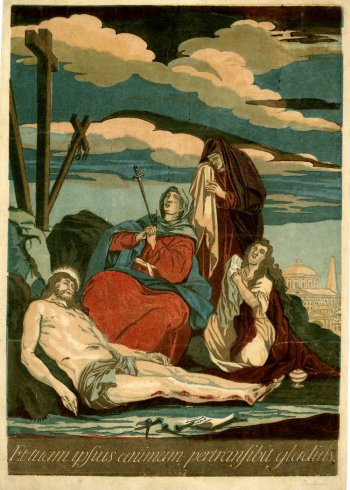
John Baptist Jackson, Lamentation over the Body of Christ, ca. 1740–44, woodcut with embossing (London: The British Museum).
Print Quarterly 34.3 (September 2017)
A R T I C L E S
• Evelyn Wöldicke, “John Baptist Jackson’s Woodcuts and the Question of Embossing,” pp. 298–310.
• Freyda Spira, “Micrographic Allegories by Johann Michael Püchler and Matthias Buchinger,” pp. 310–16.
R E V I E W S
• Adriano Aymonino, Review of the exhibition catalogue, Maria Rosaria Nappi, ed., Immagini per il Grand Tour: L’attività della Stamperia Reale Borbonica (Edizioni Scientifiche Italiane, 2015), pp. 328–31.
• Rolf Reichardt, Review of Philippe de Carbonnières, La Grande Aarmée de papier: Caricatures napoléoniennes (Presses Universitaires de Rouen et du Havre, 2015), pp. 331–33.
• Perrin Stein, Review of Kristel Smentek, Mariette and the Science of the Connoisseur in Eighteenth-Century Europe (Ashgate, 2014), pp. 340–44.
Exhibition | Witches: Metamorphosis of Goya
Press release (via Art Daily) for the exhibition:
Denise de la Rue, Witches: Metamorphosis of Goya / Brujas: Metamorfosis de Goya
Lázaro Galdiano Museum, Madrid, 21 June — 31 October 2017
Curated by Carmen Espinosa and Flavia Hohenlohe
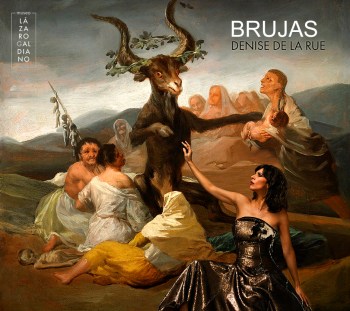
Denise de la Rue, ‘Maribel Verdú y Goya’, a partir de ‘El Aquelarre’ de Francisco de Goya (1798), 2017.
Witches, an exhibition by Mexican artist Denise de la Rue, curated by Carmen Espinosa and Flavia Hohenlohe at the Lázaro Galdiano Museum in Madrid, is the second component of her series Angels and Witches: Goya, Metamorphose, a study of Francisco de Goya’s paintings through a reinterpretation of the old master’s work. De la Rue has created a series of photographs juxtaposing iconic Spanish actresses with the painter’s work, analysing the dichotomies and similarities between these characters whilst engaging with historical and relevant sites such as the Museum. Taking elements of the actor profession that coincide with the characteristics of angels and witches such as mysticism, magic, life, death and the power of creation, transformation and destruction, De la Rue has created a dialogue between the actresses and Goya’s paintings. The essence of this series is the interest of the artist in researching the capability of women to transform and empower themselves, which historically has been seen as threatening to the conservative preconception of patriarchal societies.

Denise de la Rue, a partir de ‘Vuelo de Brujas’ de Francisco de Goya (Prado, 1798), 2017.
As a starting point to create Witches, a new body or work, De la Rue has taken Goya’s Vuelo de Brujas (Witches’ Flight), Prado Museum; El Aquelarre (Witches’ Sabbath) and Las Brujas (The Witches), both at the Lázaro Galdiano Museum; Hechizado a la Fuerza (The Forcibly Bewitched), National Gallery London; La Cocina de las Brujas (The Witches’ Kitchen), untraced; and Don Juan y el Comendador (Don Juan and the Commander), untraced. The series was commissioned by the Dukes of Osuna between 1797 and 1798 for the Alameda Palace in Madrid, best known as El Capricho.
Two of these pieces, Las Brujas and El Aquelarre, are part of the Museum’s permanent collection and will be displayed alongside De la Rue’s work, creating a conversation between the old master and the contemporary artist. The extravagance of these two pieces also draws special attention. Here the unreal becomes visible, riding between the terrifying and the ironic. Both paintings appear to be inspired by eighteenth-century texts as well as popular tradition, a key focus in De la Rue’s research. The exhibition of Witches is a unique opportunity not only to see two of Goya’s original paintings of witches together but to appreciate the full series through De la Rue’s work.
Two of the original paintings have been lost, and De la Rue has recaptured them by retrieving historic files that include details of the works. Using photography technology, the artist has reconstructed the works and reunited them in the same space for the first time since the pieces left the Dukes of Osuna’s hands.
In addition to the photographs, the Museum will present De la Rue’s video dedicated to the painting Las Brujas in which the actress Bárbara Lennie dances to the poem “Pequeño vals Vienés” (“Little Venice Waltz”) by Federico Garcia Lorca interpreted by flamenco singer Enrique Morente.
The first component of the exhibition Angels and Witches Goya, Metamorphose was the chapter of Angels at the Royal Chapel of San Antonio de la Florida in Madrid where Goya remains rest, as well as where some of his most recognised frescos are. The exhibition opened in February and was a highlight of the Madrid cultural calendar. Having the two exhibitions of Angels and Witches in dialogue with Goya’s work in these unique venues is a rare opportunity to see and understand Goya’s interest in witchcraft and the holy, revised by photography and a contemporary perspective.
Video from the previous installation Ángelas:
Conference | Digital Art History: Practice and Potential

From the Paul Mellon Centre:
Digital Art History: Practice and Potential
Paul Mellon Centre and the Courtald Institute of Art, London, 11 October 2017
Organized by Hana Leaper, Sophie Hatchwell, and Fern Insh
The first conference of the Early Career Researchers in British Art Network in partnership with The Courtauld Institute of Art’s Digital Art History Research Group (#DAHRG) and the Paul Mellon Centre for British Art
This conference, organised under the auspices of the Early Career Researchers in British Art Network, and Digital Art History Research Group (#DAHRG), provides a platform for Early Career Researchers engaged or interested in digital art history to showcase their work, develop skills, and think broadly about how digitisation can innovate, challenge convention, and inform art-historical practice.
In recent years, academics and institutions engaged in the Digital Humanities have brought together new technologies with historical research and scholarship. As a result, departments and institutions dedicated to the study of the Digital Humanities are becoming increasingly commonplace. Concurrently, art historians have sought to define what Digital Art History is, with eminent scholars such as Johanna Drucker and Diane M. Zorich interrogating its place within disciplinary practice and theory and many conferences and publications devoted to specifically defining what Digital Art History means. By inviting an emergent generation of scholars together, this conference intends to move beyond defining Digital Art History. Instead, we consider how digital technology integrates with and enhances art historical methodologies and theories in today’s digital world.
Convened by Dr Hana Leaper (Paul Mellon Centre), Dr Sophie Hatchwell (University of Bristol), and Dr Fern Insh (Courtauld Institute of Art)
S C H E D U L E
9.30 Registration and introduction at the Paul Mellon Centre
10.00 Panel 1 | Practice: Exploring the Nexus of Digital Technologies and Art Historical Research
• Élodie Gössant, Reconstructing a Lost Country House: The Case of Erlestoke Park (Wiltshire)
• Phillippa Plock and Colette Warbrick, Digital/ized Art History at Waddesdon Manor
• Shu-Chi Shen, Revisualising, Reconstruction and Recreation: The Case Study on a Digital Exhibition in the National Palace Museum
11.30 Break
12.00 Panel 2 | Potential: Evolution and Synthesis of Art Historical Methodologies
• Nirmalie Alexandra Mulloli and Christina Bartosch, Exhibitions of Modern European Art, 1905–15: Building Metadata to Reveal Artist Exhibition Strategies and Advance Theoretical Possibilities of Exhibition Spaces
• Ricarda Brosch and Adam Knight, The Quantitative Turn: Big Data Ethics in Digital Art History
• Rosário Salema de Carvalho and Inês Aguiar, Match! Image recognition issues on Az Infinitum: Azulejo Indexation and Referencing System
1.30 Lunch
1.30 Workshop Session
• Fern Insh, App Building for History and Heritage
3.30 Break
4.00 Roundtable Discussion
• Early Career Researchers’ Role in Developing Digital Practice
6.00 Lecture, at the Courtauld Institute of Art
• Emma Stanford, The Art of Losing: A Wishlist for Responsible Digitization
7.15 Reception
Abstracts are available here»
Symposium | Art of Power: The 3rd Earl of Bute, Politics, and Collecting
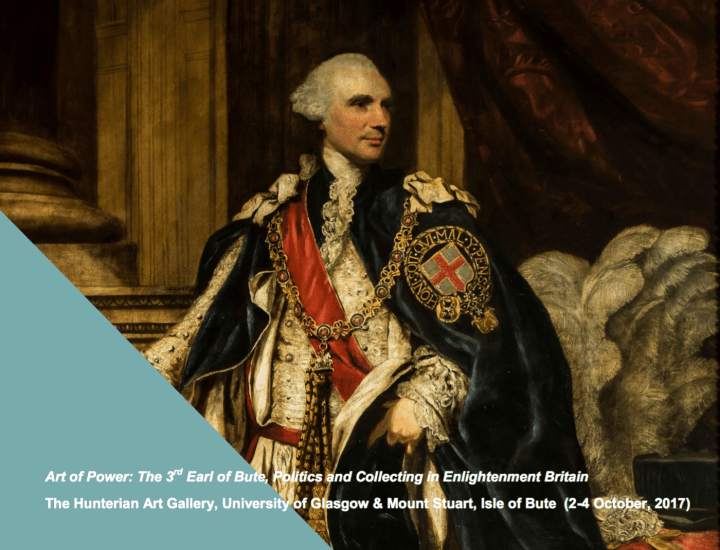
From the symposium flyer:
Art of Power: The 3rd Earl of Bute, Politics, and Collecting in Enlightenment Britain
The Hunterian Art Gallery, University of Glasgow and Mount Stuart, Isle of Bute, 2–4 October 2017
In 2017, the Mount Stuart Trust and The Hunterian Art Gallery, University of Glasgow, are hosting a major exhibition merging art, biography, politics, and cultural history. Art of Power: Masterpieces from the Bute Collection uncovers the fascinating Enlightenment figure, John Stuart, 3rd Earl of Bute (1713–1792), and his collection of rarely-seen masterpieces. A three-day interdisciplinary symposium inspired by themes of the exhibition will explore the dynamic interplay between art, politics, and collecting so evident in the life of the 3rd Earl of Bute. In sessions open to the public, papers will be delivered on day one in Glasgow. Days two and three will take place at Mount Stuart (with only a very limited number of spaces) and will include tours of the house, archives, and collection highlights.
Confirmed Speakers
Desmond Shawe-Taylor (Royal Collection), Rosie Razzall (Royal Collection), Anne T. Woollett (J. Paul Getty Museum), Anthony Lewis (Glasgow Museums), Wayne E. Franits (Syracuse University), Graham Rowe (University of Derby), Heiner Krellig (independent), Janet Stiles Tyson (Birkbeck), Oliver Cox (Oxford), Peter Black (Hunterian), Mungo Campbell (Hunterian), and Caitlin Blackwell (Mount Stuart)










 Enfilade
leave a comment