Colloquium | Horace Walpole and His Legacies
Next week at Durham University:
Horace Walpole and His Legacies: A Tercentenary Colloquium
Durham Castle, 5 May 2017
Organized by Fiona Robertson
 An informal gathering with presentations, discussion, and a workshop, as part of Durham’s series of events marking the tercentenary of the birth of Horace Walpole—novelist, playwright, designer, collector, and letter-writer extraordinaire. Friday, 5 May 2017, 10.00–14.00 in the Senate Suite, Durham Castle. This event is free of charge, and a working lunch will be provided. Participants are asked to register their interest in advance by emailing fiona.robertson@durham.ac.uk.
Presentations
• Peter N. Lindfield, Walpole’s Paper House
• Dale Townshend, Walpole, Enchantment, and the Legacy of The Castle of Otranto
• Serena Trowbridge, Teaching Gothic: Walpole’s Shadows
Workshop
• Stephen Regan, Reading Walpole’s Letters
New Book | Oxford Botanic Garden and Arboretum
Happy National Arbor Day!
Distributed for the Bodleian Library by The University of Chicago Press:
Stephen Harris, Oxford Botanic Garden and Arboretum: A Brief History (Oxford: Bodleian Library, 2017), 144 pages, ISBN: 978 18512 44652, £15 / $25.
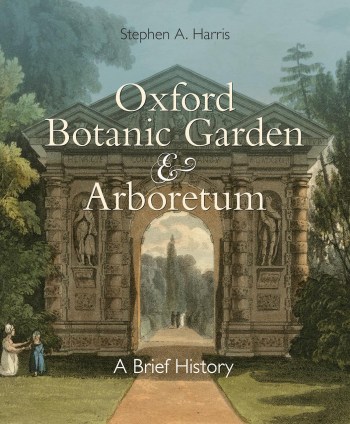 The Oxford Botanic Garden is the oldest surviving botanic garden in Britain, occupying the same location in central Oxford since 1621. Designed as a nursery for growing medicinal plants amid the turmoil of the civil war, and nurtured through the restoration of the monarchy, it has, perhaps unsurprisingly, a curious past.
This book tells the story of the garden through accounts of each of its keepers, tracing their work and priorities, from its founding keeper, Jacob Bobart, through to the early nineteenth-century partnership of gardener William Baxter and academic Charles Daubeny, who together gave the garden its greenhouse and ponds and helped ensure its survival to the present. Richly illustrated, this book offers a wonderful introduction to a celebrated Oxford site.
Stephen A. Harris is the Druce Curator of the Oxford University Herbaria and a University Research Lecturer. He is the author, most recently, of What Have Plants Ever Done for Us?, also published by the Bodleian Library, University of Oxford.
Call for Papers | Building the Scottish Diaspora
From the conference website:
Building the Scottish Diaspora: Scots and the Colonial Built Environment, 1700–1920
University of Edinburgh, 17–18 November 2017
Proposals due by 24 July 2017
This symposium takes as a point of departure, colonial cultures of Scottish entrepreneurship operating and building in the hemispheres of the Atlantic and the India-Pacific from the eighteenth to the twentieth centuries. It seeks contributions that explore Scottish traders, merchants, agents, missionaries and others influential in colonial arenas of the Atlantic and India-Pacific ‘worlds’, especially within the analytical frameworks of regional, oceanic, and World/Global historiography, methods of cultural and historical geography, as well as economic and business history. We are interested in research that maps diasporic networks—familial, professional, entrepreneurial, religious etc.—and their material presence with a view to better understanding the significance of Scottish modes of operation, particularly (but not exclusively) those that demonstrate their achievement as entrepreneurs in a networked, international environment. In sum, we seek a range of disciplinary perspectives on the spatial and material dimensions of Scottish entrepreneurship in the colonial arena.
Related questions include (but are not limited to): how do we begin to understand the particular Scottish contribution to the colonial built environment, and why is it important? Does reference to a ‘British’ empire in this context too readily encourage coagulation, even confusion, especially where clear ethnic predominance was seen to occur? And how might architecture have been used to forge, or even dissolve, distinctive forms of Scottishness within the wider limits of British identity? Please send paper abstracts of no more than 300 words, plus a brief bio of 150 words, to buildscotdiaspora@gmail.com by 24 July 2017.
Conference | Allegory after 1789
From the Workshop des Kunstgeschichtlichen Instituts der Goethe-Universität Frankfurt am Main:
Allegorie nach 1789: Kritik und Transformation
Museum Giersch der Goethe-Universität, Frankfurt am Main, 19 May 2017
Workshop des Kunstgeschichtlichen Instituts der Goethe-Universität Frankfurt am Main in Kooperation mit eikones NFS Bildkritik, Universität Basel
Die Allegorie als künstlerische und literarische Form sah sich im Laufe des 18. Jahrhunderts vielfacher Kritik ausgesetzt, wobei die Vorwürfe von ihrer Abwertung als dunkel und unverständlich bis zur Diskreditierung als rein willkürlicher Modus der Bedeutungsproduktion reichen. Mit dem folgenreichsten Ereignis des 18. Jahrhunderts, der Französischen Revolution, gewannen diese kritischen Spannungen an verschärfter Aktualität. Angesichts der umwälzenden Ereignisse und der zunehmenden Schwierigkeit, diese historisch sinnfällig zu deuten, erlebte die Allegorie als Mittel der semantischen Stabilisierung jedoch auch eine Wiederbelebung sowohl in der Malerei wie insbesondere in der Druckgraphik.
Der Workshop beschäftigt sich mit der Wiederaufnahme der Allegorie, ihrer kritischen Debatte während und nach der Revolution und der transformierenden Kraft, die diese Kritik entfaltete. Dabei steht nicht nur die Frage nach der kunsthistorischen Bedeutung der ›Sattelzeit‹ um 1800 zur Diskussion, sondern mehr noch die Relevanz vormoderner Formen der malerischen und literarischen Sinnstiftung unter den Bedingungen moderner Autonomieästhetik. Nicht zuletzt entstehen mit der Transformation der Allegorie im 18. und 19. Jahrhundert auch neue Lektüretechniken der Kunstkritik und schließlich der Kunstgeschichte, die an die Technik der Allegorese anknüpfen. Kontakt: Gabriel Hubmann, hubmann@kunst.uni-frankfurt.de.
P R O G R A M M
10:00 Ralph Ubl/Barbara Wittmann, Begrüßung
10:15 Gabriel Hubmann, Die Problematik der Allegorie in der französischen Bildproduktion um 1800
11:30 Barbara Wittmann, Allegorie und die Launen der Einbildungskraft nach Anne-Louis Girodet
12:45 Mittagessen
14:30 Ralph Ubl, Allegorien einer Allegorie? Delacroix’ Die Freiheit führt das Volk (1830) in den Salons von 1838 und 1845
15:45 Philipp Ekardt, Post-Pygmalionisch, Fast-Allegorisch: Körperfigurationen bei Eichendorff und Goethe
17:00 Pause
17:30 Regine Prange, Respondenz
18:30 Abendvortrag: Philippe Bordes, The Allegorical Imagination in French Painting around 1800: Poetic Invention versus Political Service
Chatsworth House Acquires Bird’s Eye View of the Estate
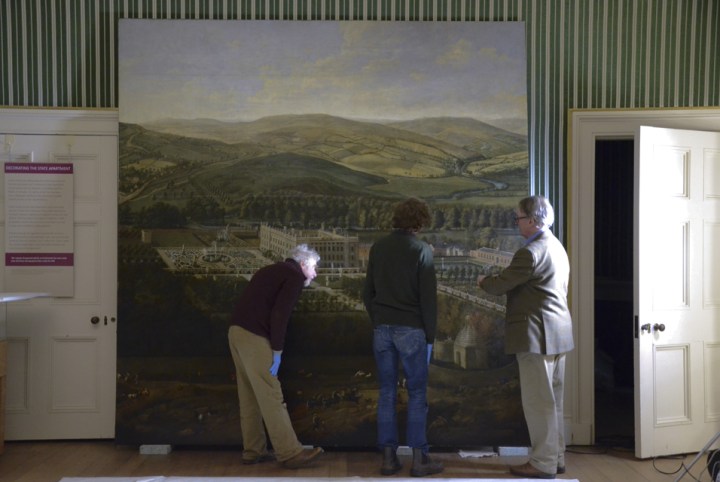
Jan Siberechts, A View of Chatsworth, ca. 1703; the painting is now on display at Chatsworth in the Green Satin Room
(Chatsworth House Trust)
◊ ◊ ◊ ◊ ◊
Press release, via Art Daily:
Visitors can now discover how Chatsworth appeared in the early eighteenth century thanks to the acquisition of an important major landscape painting giving a detailed bird’s eye view of the estate. The Directors of the Chatsworth House Trust announced the arrival of an important addition to the Devonshire Collection: A View of Chatsworth by Jan Siberechts, painted circa 1703. Until now a painting of the house and garden in the 1st Duke’s time was missing from the collection. This large scale, detailed painting is now on display at Chatsworth, with a series of landscape paintings of the house and garden detailing major changes through the past 400 years.
The Duke of Devonshire said, “I am extremely excited that this landscape has joined the Devonshire Collection. It will be of great interest to our visitors as it portrays on a grand scale a complete view of Chatsworth, house, garden and park as built and laid out by the 1st Duke and this enables us all to know so much more about Chatsworth at the very beginning of the eighteenth century.”
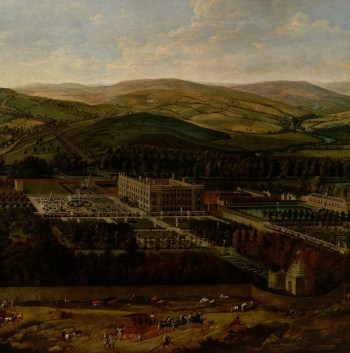
Jan Siberechts, A View of Chatsworth, ca. 1703 (Chatsworth House Trust).
This bird’s eye view of Chatsworth originally belonged to Admiral Edward Russell, later 1st Earl of Orford, a close friend and political colleague of the 1st and 2nd Dukes of Devonshire. It passed by descent to his great-niece Letitia Tipping who married the 1st Lord Sandys in 1725 and has remained in the Sandys family until now. Previously catalogued as by an unknown late seventeenth-century English artist, A View of Chatsworth has recently been reattributed by Omnia Art to Jan Siberechts, who specialised in painting bird’s eye views of English country houses in this period. Siberechts is known to have worked for the 1st Duke of Devonshire as payments to the artist are recorded in the Chatsworth archives, and a number of watercolours by Siberechts exist showing views of Derbyshire near Chatsworth.
His view of Beeley near Chatsworth of 1699, which shows the meeting of the rivers Derwent and Wye, is in The British Museum.
Chatsworth’s Curator of Fine Art, Charles Noble advised the Directors of the Chatsworth House Trust said, “I am absolutely thrilled to have been a part of this acquisition from a leading landscape artist working in England at the turn of the eighteenth century. It is of historical importance both in art and to Chatsworth.”
Exhibition | Cross-Pollination

Dish from Chelsea Porcelain Factory, ca.1760; glazed porcelain with enamel; approximately 10 × 8 inches (Saint Louis Art Museum, Gift of Melanie Redler from the collection of Dr. and Mrs. Irving Redler, 188:2015).
◊ ◊ ◊ ◊ ◊
Opening next month at the Saint Louis Art Museum (along with Reigning Men: Fashion in Menswear, 1715–2015, which was previously on view in Los Angeles and Sydney) . . .
Cross-Pollination: Flowers in 18th-Century European Porcelain and Textiles
Saint Louis Art Museum, 26 May — 26 November 2017
Curated by Genevieve Cortinovis
Intoxicated by scientific discovery, the fervor for natural science, particularly botany, reached new heights in 18th-century Europe. Botanical gardens and nurseries flourished, as did expertly illustrated albums describing flora and fauna of the Old and New World in tantalizing detail. Naturalism triumphed across the decorative arts, but especially in textiles and porcelain, where the media’s vibrant colors and painterly effects allowed for particularly artful and accurate botanical imagery.
The exhibition will feature a number of artworks never before exhibited at the Museum. Outstanding recent acquisitions include a rare silk damask by the English textile designer Anna Maria Garthwaite and an exceptional porcelain tureen and stand from a little-known Meissen dinner service. Two mid-18th-century dresses made of exquisite floral silk will be presented alongside recent gifts of Chelsea porcelain delicately painted with sprays of lilies, roses, and violets.
Cross-Pollination also examines potential sources for floral imagery by presenting rare illustrated books and plant specimens on loan from the Missouri Botanical Garden. The result is an interdisciplinary look at the dialogue between fashionable goods, nature, and natural science in the 18th century.
Cross-Pollination is curated by Genevieve Cortinovis, assistant curator of decorative arts and design at the Saint Louis Art Museum.
Call for Papers | Saint-Cloud to Bernardaud: French Porcelain
Saint-Cloud to Bernardaud: New Horizons in French Porcelain, 1690–2000
The French Porcelain Society Symposium
The Wallace Collection, London, 20–21 October 2017
Proposals due by 15 June 2017
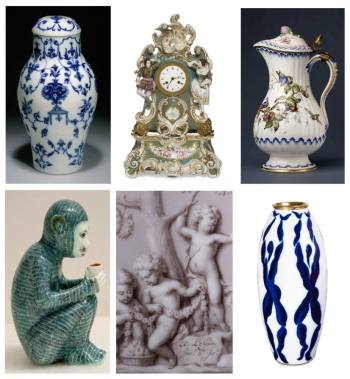
From top left: Saint-Cloud Vase, 1695–1710 (New York: The Metropolitan Museum of Art); Bastien & Bugeard Clock, 1848–58 (Paris: Musée des Arts décoratifs); Mennecy Jug, 1760 (London: Victoria and Albert Museum); Villeroy Monkey, 1745 (New York: The Metropolitan Museum of Art); Guérhard & Dihl Vase, 1797–1804 (Clandon Park, National Trust); and Bernardaud Vase, 2015, by Hervé Van Der Straeten.
The French Porcelain Society is pleased to announce this year’s two-day symposium, entitled Saint-Cloud to Bernardaud: New Horizons in French Porcelain, 1690–2000. It will be chaired by Dr Aileen Dawson, former Curator, The British Museum, London, and will take place on 20–21 October 2017 at The Wallace Collection, London. The symposium will present new research on French porcelain factories outside royal or state control. At times unjustly neglected in favour of the royal manufactory at Sèvres, these earliest factories operated from the late seventeenth century; many continue in production today. They include, but are not limited, to Saint–Cloud, Villeroy, Mennecy, Niderviller, the Paris factories, such as Dihl, Schoelcher and Dagoty, and Limoges factories operating during the 19th century and up to the present day. Subjects for consideration include: locations, size, capitalisation, techniques of manufacture, employment of artists and designers, marketing, and clientele, each deserving of greater scholarly attention.
The French Porcelain Society encourages networking between academic researchers and museum professionals. Proposals are welcomed from doctoral candidates in art history as well as curators, collectors, and researchers; we are also pleased to receive papers from colleagues working in literature, philosophy, and history. Speakers confirmed to date include Sonia Banting, Howard Coutts, Aileen Dawson, Virginie Desrante, Nicole Duchon, Cyrille Froissart, Errol Manners, Audrey Gay-Mazuel, Hélène Huret, Tamara Préaud, and John Whitehead.
Themes for papers may include
• History of collecting (public and private) and connoisseurship
• Historical, political and socio-economic background to French porcelain production
• Design sources, production trends, fashion
• Cross-cultural influences
• Porcelain used as diplomatic gifts
• Domestic uses, tablewares and the history of dining
• Literary and theatrical themes, especially in figure production
• Porcelain as sculpture at Niderviller and other factories
• The art market
Papers should be between 20 and 50 minutes in length and fully illustrated. They may be presented in English or French. Please send a 300-word abstract with a short CV in the form of a PDF file to Aileen Dawson at aileendawson@hotmail.com by 15th June 2017.
New Book | Late Eighteenth-Century Music and Visual Culture
From Brepols:
Cliff Eisen and Alan Davison, eds., Late Eighteenth-Century Music and Visual Culture (Turnhout: Brepols Publishers, 2017), 225 pages, ISBN: 978 2503 546292, $106.
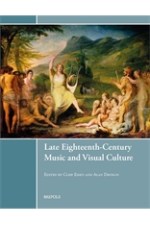 The late eighteenth century witnessed a flourishing exchange between music and visual art which was expressed in the creative as well as commercial cultures of the time. Nevertheless, there has been relatively little research to actively consider and thoroughly examine the symbiotic relationship between looking and listening during the period.
In this volume, nine prominent scholars employ a set of interdisciplinary methodological tools in order to come to a comprehensive understanding of the rich tapestry of eighteenth-century musical taste, performance, consumption and aesthetics. While the link between visual material and musicological study lies at the heart of the research presented in this collection of essays, the importance of the textual element, as it denoted the process of thinking about music and the various ways in which that was symbolically and often literally visualized in writing and print culture, is also closely examined.
Through a critical analysis of a number of important contemporary sources as well as current scholarship and research, the authors draw conclusions that extend well beyond the scope of their immediate material and closely-formulated questions. The conversation opened up in the chapters of this volume will hopefully break new ground on which the interrelationship between art and music, and more broadly between visual art and other forms of creative practice, may be studied and debated.
C O N T E N T S
Introduction — Cliff Eisen and Alan Davison
Charles Burney’s Wunderkammer of Ancient Instruments in his General History of Music — Zdravko Blažeković
John Brown’s Dissertation (1763) on Poetry and Music: An Eighteenth-Century View on Music’s Role in the Rise and Fall of Civilization — Alan Davison
Developing an Eye for Harmony: Rubens in Mozart’s Education — Thomas Tolley
Gothic Musical Scenes and the Image of Performance — Annette Richards
The Visual Traces of a Discourse of Ineffability: Late Eighteenth-Century German Published Writings on Music — Keith Chapin
Marketing Ploys, Monuments, and Music Paratexts: Reading the Title Pages of Early Mozart Editions —Nancy November
Musical Allegories in the Printed Edition of the Máscara Real: New Iconographic Models in Catalonian Engravings of the Second Half of the Eighteenth Century — Vanessa Esteve Marull
Authenticity and Likeness in Mozart Portraiture — Cliff Eisen
Imaging Beethoven — Simon Shaw-Miller
New Book | Blake, Myth, and Enlightenment
From Palgrave Macmillan:
David Fallon, Blake, Myth, and Enlightenment: The Politics of Apotheosis (London: Palgrave Macmillan, 2017), 343 pages, ISBN: 978 11373 90349, $100.
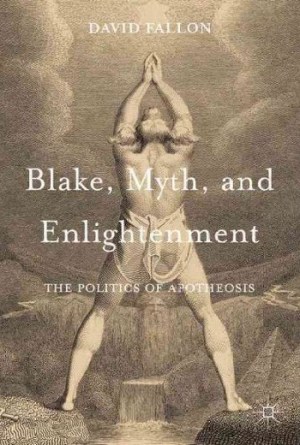 This book provides compelling new readings of William Blake’s poetry and art, including the first sustained account of his visionary paintings of Pitt and Nelson. It focuses on the recurrent motif of apotheosis, both as a figure of political authority to be demystified but also as an image of utopian possibility. It reevaluates Blake’s relationship to Enlightenment thought, myth, religion, and politics, from The French Revolution to Jerusalem and The Laocoön. The book combines careful attention to cultural and historical contexts with close readings of the texts and designs, providing an innovative account of Blake’s creative transformations of Enlightenment, classical, and Christian thought.
David Fallon is Senior Lecturer in English at the University of Sunderland, UK. From 2009 to 2012 he was a British Academy Postdoctoral Fellow at the University of Oxford. He has published on Blake and on eighteenth-century and Romantic-period booksellers and co-edited Romanticism and Revolution: A Reader (2011) with Jon Mee.
C O N T E N T S
1 Introduction: ‘A Saint Amongst the Infidels & a Heretic with the Orthodox’
2 ‘The Deep Indelible Stain’: Apotheosis in the Eighteenth Century
3 ‘Spirits of Fire’: Ambiguous Figures in The French Revolution
4 ‘Breathing! Awakening!’: Contesting and Transforming Apotheosis in America a Prophecy
5 ‘The Night of Holy Shadows’: Europe and Loyalist Reaction
6 ‘Serpentine Dissimulation’: Apotheosis in Urizen, Ahania, and The Song of Los
7 ‘The Name of the Wicked Shall Rot’: Blake’s Oriental Apotheoses of Nelson and Pitt
8 Transforming Apotheosis in The Four Zoas and Milton
9 ‘Ever Expanding in the Bosom of God’: Deification and Apotheosis in Jerusalem
10 Conclusion
Bibliography
Index
List of Figures
Call for Papers | The Image of the Multitude in Art and Philosophy
From H-ArtHist:
Imago Multitudinis: The Image of the Multitude in Art and Philosophy
The Courtauld Institute of Art, London, 10 March 2018
Proposals due by 15 September 2017
The Courtauld Institute of Art, The British Academy and the Collège International de Philosophie are pleased to announce a one-day interdisciplinary conference focusing on the philosophical representation and the artistic conceptualisation of the multitude and its associated concepts: the many, the masses, the crowd, the mob, and the commonality.
A spectre is haunting our times: the spectre of the multitude. Uprisings, popular unrests, mass migrations, revolutions—the past ten years have been marked by unprecedented quests for freedom, embodied by unconventional political subjects pointing to the possibility of alternative outcomes of the crisis of both authoritarian regimes and representative democracies. Through the masterful drawing of Abraham Bosse, Hobbes attempted to tame the multitude forever. Constrained within the body politic of the monstrous Leviathan (1651), the multitude was transfigured into an obedient people and its potentia was (apparently) usurped. Yet, the multitude resisted—and still resists—this movement, challenging the predominant definitions of sovereignty. Following the collapse of modern master narratives, such as in the nascent seventeenth century, the multitude has returned.
Our investigation revolves around the political and aesthetic meanings of this omnipresent, if elusive, collective being. In particular, we would like to ask the following questions: how do philosophers represent the multitude and translate their concepts into cogent images? How do artists think about the multitude and its agency? This enquiry, which spans from the Middle Ages to the present, concentrates on the way in which images and iconographic motifs are elaborated in philosophy, as well as how political concepts are articulated in the visual arts. In order to understand the images pervading, and the concepts informing, recent collective political action (from Tahrir Square to the streets of Tunis, New York, Madrid, Ferguson via Rojava and Lampedusa), we intend to focus on their modern and contemporary genealogies. This is not only a historical enquiry. The history of the multitude can help us better understand the present. The aesthetic, agency and ambitions of this political subject do not only survive in books and museums, they also live on among us. The multitude resists, and if this is the conflict that characterises political modernity, then modernity has begun again.
Invited speakers: Horst Bredekamp (Humboldt-Universität); Claire Fontaine (artist); Sandro Mezzadra (Università di Bologna).
We invite submissions on the following topics including, but not limited to
• Political iconography (from the Revolt of the Ciompi to the Arab Spring via the German Peasants’ War)
• Feminism and the multitude
• The multitude in the USSR
• The multitude and the English Civil Wars
• Hobbes’ Behemoth
• Spinoza’s, Machiavelli’s, Negri’s, Deleuze’s and Schmitt’s depictions of the multitude
• The ‘popular hydra’ in nineteenth-century Paris
• Baroque and the multitude
• The multitude and migrations in contemporary art
Please send a title and an abstract of no more than 500 words together with a short CV to jacopo.galimberti@manchester.ac.uk by the 15th of September. Successful candidates will be notified in early October. Papers should not exceed 25 minutes in length.










 Enfilade
leave a comment