Exhibition | Poussin to David: French Drawings at the Albertina

Jacques-Louis David, The Combat of Diomedes, 1776
(Vienna: Albertina)
◊ ◊ ◊ ◊ ◊
Now on view at the Albertina:
Poussin to David: French Drawings at the Albertina
Poussin bis David: Französische Zeichnungen der Albertina
Albertina, Vienna, 25 January — 25 April 2017
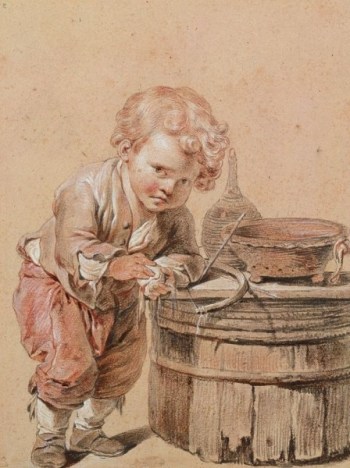
Jean-Baptiste Greuze, Boy with a Broken Egg, ca. 1756 (Vienna: Albertina).
Whether poetic love stories or mythological epics, whether atmospheric portrait studies or picturesque ruins—today, the masterpieces of French Baroque art are more enthralling than ever. 70 major works selected from the Albertina’s rich holdings of drawings sweep visitors into the dreamy and multi-layered cosmos of French art from the Baroque and Rococo periods: the works on display include Nicolas Poussin’s breath-taking free landscape studies as well as Claude Lorrain’s light-drenched depictions of nature, and playful masterpieces by François Boucher and Jean-Honoré Fragonard likewise assume their rightful places here, as do the lovely scenes of Jean-Baptiste Greuze. The crowning conclusion of this showing, which reflects two centuries of French art, is provided by the imposing creations of Jacques Louis David.
Christine Ekelhart, ed., From Poussin to David: French Drawings at the Albertina (Munich: Hirmer, 2017), 176 pages, ISBN: 978 37774 28369, $45.
Salon du Dessin 2017
From the press kit for the fair:
Salon du Dessin 2017
Palais Brongniart, Paris, 22–27 March 2017
 The Salon du Dessin is a made-in-France success that is admired around the world. For an entire week, it brings together art lovers, collectors, novices, and museum curators interested in drawings, whether old masters, modern or contemporary. During that week, the Salon du Dessin is the epicentre of Paris’s cultural scene, attracting an intellectual community delighted to share with the public its passion for knowledge and the excitement of discovery.
Even curators from major museums make discoveries at the Salon du Dessin. The art of drawing requires great connoisseurship, and it has now been rediscovered by a wider public thanks to the Salon du Dessin and its off-site events, which help neophytes acquire greater understanding by providing access to museum reserves.
The fair website is available here»
Poster Image: Anne-Louis Girodet-Trioson, Detail of a Drapery Study, 1806 (Nantes, Musée des Beaux-Arts).
◊ ◊ ◊ ◊ ◊
From H-ArtHist:
Salon du Dessin Symposium: De David à Delacroix, II
Palais Brongniart, Paris, 22–23 March 2017
Under the direction of Pierre Rosenberg and Louis-Antoine Prat
 L’exposition du Grand Palais, De David à Delacroix: La peinture française de 1774 à 1830 (1974–75), et l’exposition de dessins qui la complétait, avaient permis de redécouvrir bon nombre de peintres et d’oeuvres couvrant un pan de l’histoire de l’art, allant du Serment des Horaces de David à La Liberté guidant le peuple de Delacroix.
Depuis 1974, de multiples dessinateurs ont fait l’objet d’études novatrices que ces XIe et XIIe Rencontres du Salon du dessin se proposent d’enrichir. Sous le titre De David à Delacroix: Du tableau au dessin, les communications de cette deuxième session offrent, plus de quarante ans après cette exposition qui a fait date, une relecture de l’oeuvre graphique de plusieurs des principaux artistes français et étrangers de l’époque de Louis XVI à la Révolution de juillet.
W E D N E S D A Y , 2 2 M A R C H 2 0 1 7
• Nicole Willk-Brocard (Docteur ès lettres, Paris), Noël Hallé, F-G Ménageot, J.-A. Renard et J.-B. Restout
• Pierre Rosenberg (Président directeur honoraire du musée du Louvre, Paris), Dessins de David (II)
• Yuriko Jackall (Conservateur, National Gallery of Art, Department of French Paintings, Landover, Maryland), Greuze éclipsé?: Considérations autour de ses dernières années
• Marie Yvonneau-Fournier (Doctorante, Université Paris-Sorbonne, Paris), Jacques-Philippe Caresme (1734–1796), dessinateur licencieux?
• Andreas Stolzenburg (Chief Curator Prints & Drawings, Hamburger Kunsthalle, Hambourg), François-Marius Granet, Franz Ludwig Catel und die Mönchs-Romantik in Rom um 1815
• Jan Gorm Madsen (Historien de l’art, chercheur indépendant, Frederiksberg), Drawings by the Danish Artist C.W. Eckersberg from His Parisian Sojourn, 1810–13
• Florence Viguier-Dutheil (Conservateur en chef du Patrimoine, Directrice du musée Ingres, Montauban), Les dessins d’Ingres, un monde à part
T H U R S D A Y , 2 3 M A R C H 2 0 1 7
• Rosalba Dinoia (Docteur en histoire de l’art, chercheur indépendant, Rome), L’énigmatique Stratonice: Un cadeau inédit de Calamatta à Ingres
• Dominique de Font-Réaulx (Directrice du musée national Eugène-Delacroix, Paris), Taches colorées et notes poétiques, Eugène Delacroix dessinateur et écrivain
• Françoise Heilbrun (Conservateur en chef honoraire au musée d’Orsay, Paris), Paul-Arthur Cheramy (1840–1912) et Etienne Moreau-Nélaton (1859–1927): un collectionneur de Delacroix peut en cacher un autre
• Bénédicte Savoy (Professeure, Technische Universität Berlin) et David Blankenstein (Historien de l’art, Berlin), Paris-Berlin 1800: L’album de Frédéric Christophe d’Houdetot
• Guillaume Kazerouni (Responsable des collections anciennes de peintures et dessins, musée des Beaux-Arts de Rennes), Un carnet de calques inédit de Léon Cogniet au musée des Beaux-Arts de Rennes
Exhibition | Drawing Gold and Silver: Odiot
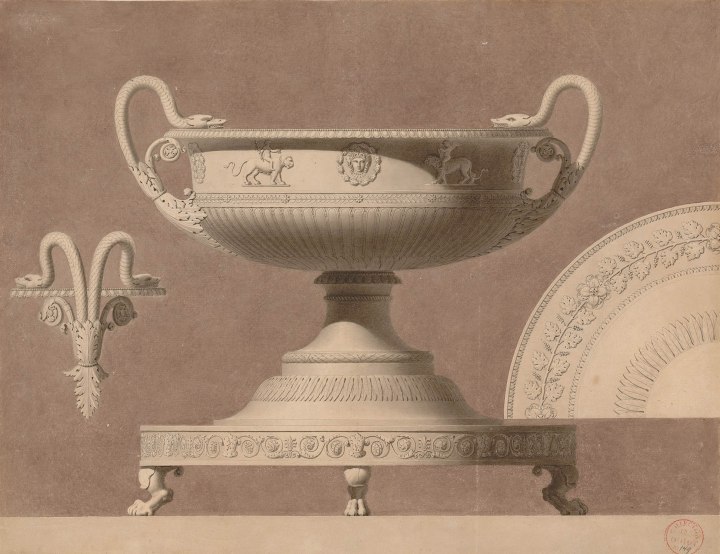
‘Snake handles’ dish, attributed to Charles-Jean-Alexandre Moreau, creator of the model; drawing attributed to Auguste Garneray, draughtsman in Jean-Baptiste-Claude Odiot’s workshop, ca. 1810; graphite, pen and grey ink, grey and sepia wash on paper (Paris: Les Arts Décoratifs).
◊ ◊ ◊ ◊ ◊
Now on view at the Musée des Arts Décoratifs:
Drawing Gold and Silver: Jean-Baptiste-Claude Odiot
Dessiner l’or et l’argent: Odiot (1763–1850), orfèvre
Musée des Arts Décoratifs, Paris, 8 March — 7 May 2017
Jean-Baptiste-Claude Odiot (1763–1850) became one of the most successful and prolific gold and silversmiths during the Empire and Restoration periods. He received several important royal commissions from the courts of Europe, including a sumptuous table service, a dressing table for empress Marie-Louise, and a cradle for the King of Rome.
The Musée des Arts Décoratifs has an exceptional collection of 33 silverware pieces and—acquired in 2009—176 original drawings from Odiot’s workshop, classified as important works of heritage by the Ministry of Culture’s Consultative Commission on National Treasures. On display for the first time, this exhibition reunites Odiot’s design drawings with the executed pieces, demonstrating his creative process, as well as his formal development and experimentation. Dating from the first quarter of the 19th century, these drawings are superbly executed in graphite and pen and enhanced with ink wash, watercolor, and gouache.
The drawings illustrate the various stages of a piece’s creation, from the initial sketches to the final detailed drawings presented to clients. On sheets of paper often measuring more than one meter high, tableware, dressing tables, and desks pieces are represented to scale, displaying the splendor and refinement of the art of living in the early 19th century. The drawings also propose different versions of the same model, offering alternatives for applied ornaments, handles, etc. Each drawing reveals an ornamental repertoire that became Odiot’s hallmark that he repeatedly employed in varying combinations from the beginning of the Empire period to the end of the Restoration. Only ten of the drawings are signed by colleagues of Odiot, including draughtsmen Auguste Garneray (1785–1824) and Adrien-Louis-Marie Cavelier (1785–1867), and the silversmith Jacques-Henry Fauconnier (1779–1839). The drawings also feature the names of prestigious clients such as Count Demidov, Countess Branicka, and members of the Imperial Family, including Madame Mère (Napoleon’s mother), Empress Marie-Louise, and Jerome I of Westphalia. These 176 drawings complement the Museum’s collection of 31 bronze models, a sugar bowl, and ‘Venus’s breast and butterfly’ bowl in vermeil, all by Odiot.

Jean-Baptiste-Claude Odiot, ‘Venus breast and butterfly’ bowl, ca. 1810–20; silver-gilt, hammered, cast, chased and engraved (Paris: Les Arts Décoratifs, Paris / photo: Jean Tholance).
The forms of the bronze models are as varied as the drawings: tea urns, soup tureens, dishes, wine coolers, oil cruets, saltcellars… Their handles, legs, and applied decoration incorporate an ornamental vocabulary derived from Antiquity. In addition to the central theme of the procession of Bacchus, Odiot’s pieces and drawings incorporates other iconographical figures such as of Hebe, Ceres, Leda, Venus, Adonis, Flora, and allegories of Victory. Snakes, swans, and mermaids lend their sinuous forms to handles, while monopod winged sphinxes and lion’s paws were better suited as legs. The foliated friezes framing the piece’s main body are decorated with panthers, reeds, vine branches, ears of wheat, and dolphins.
In 1835, Odiot donated 31 models to the Chambre des Pairs (Upper House of the French Parliament) for posterity and to serve as models for his successors. The models were initially displayed in the Musée du Luxembourg, which was, in the 19th century, devoted to painting and sculpture by living artists. In 1852, the models were transferred to the storerooms of the Louvre where they were gradually forgotten.
Simultaneously, initiatives were taking place to create the Musée des Arts Décoratifs during the second half of the 19th century. The museum of the ‘beautiful in the useful’ opened in 1882 with the goal of encouraging links between art and industry by providing models and references for workers and artisans. As there was a clear connection between Odiot’s motives and those of the new museum, Odiot’s models were put on permanent loan to the Musée des Arts Décoratifs in 1892. In 1907–08, the Musée des Arts Décoratifs commissioned Christofle to gold and silver-plate these models in order to give them the appearance of silver. In 2016, the models were officially added to the inventory of the Musée des Arts Décoratifs.
 These models were executed with great finesse. Their components, assembled by a system of nuts and bolts, were chased to heighten the relief decoration and provide contrast between matte and reflective surfaces. As a result of recent scientific analysis by the Centre de Recherche et de Restauration des Musées de France, the pieces, previously described in Odiot’s terminology as bronze, are, in fact, made of brass. The rare opportunity to showcase the Museum’s collection of Odiot silver alongside the drawings creates a unique dialogue in the history of decorative arts.
The Silversmith Jean-Baptiste-Claude Odiot’s Designs for Silver and Gold exhibition explores this dialogue between a piece’s initial conception on the drawing board and the finished work in Jean- Baptiste-Claude Odiot’s workshop. A selection of approximately 100 drawings, exhibited for the first time, will be displayed alongside 33 pieces of silver, revealing this great silversmith’s creative process. The exhibition will be accompanied by a catalogue of the collection and interactive digital media.
Audrey Gay-Mazuel and Julie Ruffet-Troussard, Odiot: Un atelier d’orfèvrerie sous l’Empire et la Restauration (Paris: Les Arts Décoratifs, 2017), 240 pages, ISBN : 978 2916914 688, 45€.
Exhibition | 18th-Century Masterpieces in the Churches of Paris
From the press release for the exhibition:
Enlightenment Baroque: 18th-Century Masterpieces in the Churches of Paris
Le Baroque des Lumières: Chefs-d’œuvre des églises parisiennes au XVIIIe siècle
Petit Palais, Paris, 21 March — 9 July 2017
Curated by Christophe Leribault and Marie Monfort
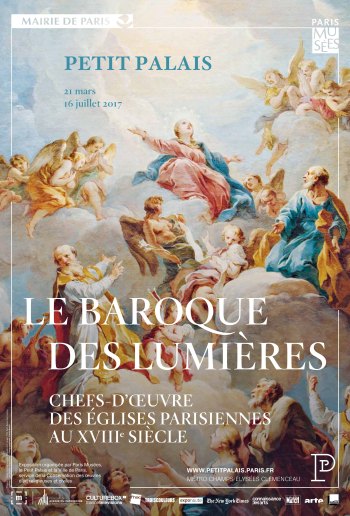 For the first time the Petit Palais is offering the public a spectacular ensemble of 18th-century religious paintings created for the churches of Paris. Through some 200 works the museum will reveal the significance and diversity of artistic output in Paris from the Regency to the French Revolution: from such heirs to the age of Louis XIV as Largillière and Restout to the exponents of rocaille, from Lemoine to Carle Van Loo, and the best of Neo-Classicism, from Vien to David. Produced in partnership with COARC (Conservation of Religious and Secular works of Art for the City of Paris), this exhibition is an extension of the one at the Musée Carnavalet (Paris) in 2012, which focused on 17th-century painting in Paris churches and the rediscovery of an enormous, little-known heritage.
The emphasis of 18th-century French painting was more on the sophistication of the fête galante and the portrait than the elaborateness of great religious art. Outside the Salon season, however, it was in the churches of Paris that art lovers could view contemporary painting, and so the city’s artists gave of their best there. Indeed, parishes and congregations bent on renovating the capital’s places of worship were among the main sponsors of history painting, and it is this forgotten segment of 18th-century art that Enlightenment Baroque aims to reassess. In a spectacular decor evocative of the inside of a church and its related spaces—the chapels and the sacristy, for example—the exhibition itinerary highlights numerous masterpieces, often very large, that have benefited from unprecedentedly thorough renovation. In addition to the pictures still to be seen in churches today, the exhibition brings together works which since the Revolution have been scattered. The masterpieces come from institutions (the Louvre, the Château de Versailles, and the art museums of Lyon, Rennes, Marseille, Brest, and elsewhere), churches and cathedrals nearby (Saint Denis and Villeneuve-Saint-Georges, for example), or further away (Mâcon, Lyon).
Divided into eight sections, the exhibition delights the eye with the finesse and varying styles of altarpieces, the colourful grace of François Lemoine, Jean-François de Troy and Noël Hallé, and the unadorned Neo-Classicism of Drouais and, of course, David, whose large portrait of Christ closes the exhibition. There are also references to ornamental ensembles, some of which, like Charles Natoire’s decor for the Chapelle des Enfants Trouvés have been lost or destroyed. Other sections are devoted to images of the new saints of the Counter-Reformation, smaller works intended for private devotion, commissioning procedures and the restorations that took place at the time in ancient buildings like the Invalides.
Along the way viewers will find two educational spaces, one given over to restoration campaigns and the other to religious imagery. Visitors will also be able to take part in guided tours of various religious edifices in Paris. This groundbreaking panorama of religious painting in 18th-century Paris is nothing short of a revelation: the pictures brought together for the occasion have been endowed with an unsuspected vividness of colour harking back to what we find so agreeable in the art of the Age of Enlightenment.
Christine Gouzi and Christophe Leribault, eds, Le Baroque des Lumières: Chefs-d’œuvre des églises parisiennes au XVIIIe siècle (Paris: Paris musées, 2017), 368 pages, ISBN : 978 27596 03442, 50€.
Curators
Christophe Leribault, Director, Petit Palais
Marie Monfort, Head of Conservation of Religious and Secular works of Art for the City of Paris
Associate Curators
Maryline Assante di Panzillo (Petit Palais), Lionel Britten (Musée d’Orsay), Jessica Degain, Nicolas Engel et Emmanuelle Federspiel (COARC), Christine Gouzi (Université de Paris- Sorbonne), et Guillaume Kazerouni (Musée des Beaux-Arts de Rennes)
Exhibition | From Watteau to David: The Horvitz Collection
From the press release for the exhibition:
From Watteau to David: The Horvitz Collection
Petit Palais, Paris, 21 March — 9 July 2017
Curated by Alvin Clark, Isabelle Mayer-Michalon, and Christophe Leribault
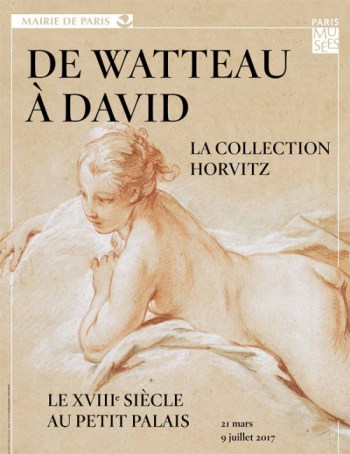 The Petit Palais is delighted to present an anthology of some 200 18th-century French paintings, sculptures, and drawings from the Horvitz Collection in Boston. The work of thirty years, this is the largest private collection of 18th-century French drawings outside of France and is home to such artists of the first rank as Watteau, Boucher, Fragonard, Greuze, and David. It also offers an overview of all the major artists of the period, ranging from Oudry to De Troy, from Natoire to Bouchardon, and from Hubert Robert to Vincent—and all of them at their best.
The exhibition offers the visitor an exhaustive panorama of French painting and drawing from the Regency to the Revolution, together with a small but impeccable selection of of sculptures, including pieces by Lemoyne, Pajou, and Houdon. It comprises fifteen chronologically organised thematic and monographic sections, whose elegant scenography provides an overview of a century rich in artistic innovation.
The exhibition opens with portraits by Rigaud, Largillière, and Jean-François de Troy, before addressing the mythological and religious painting of the early 18th century via works by François Lemoyne and Charles de la Fosse. The viewer then moves on to the fête galante, with drawings by Watteau and Lancret, and to landscape and animal painting, with Oudry and Desportes. The exhibition also takes in architecture and the triumph of ornamentation as typified by the whimsicality of Oppenord and Lajoüe. An entire section given over to François Boucher is followed by a group of academic nudes and head studies by Coypel, Lépicié, Vien, and others. Next comes mid-century history painting, represented by Natoire and Carle Van Loo, and the tour continues with drawings by sculptors like Bouchardon and Pajou. A second monographic section is dedicated to Fragonard, after which visitors are treated to views of ruins and landscapes by Hubert Robert and Joseph Vernet, and, in a more sentimental vein, works by Greuze, Prud’hon, and Boilly. The exhibition closes with an assertion of neo-Classicism by Jacques-Louis David, Perrin, and Vincent.
The Horvitz Collection—with its meticulous documentation and works in perfect condition—has become a touchstone for the period. Its presentation in Paris is a major event whose prestige and intimist character make it a perfect complement to Enlightenment Baroque: 18th-century Masterpieces in the Churches of Paris, an exhibition devoted to the big, forgotten religious paintings of the period.
Curators
Alvin L. Clark, Jr., The Horvitz Collection and The J.E Horvitz Consultative Curator Department of Drawings, Division of European and American Art, Harvard Art Museum, in association with Isabelle Mayer-Michalon, Doctor of Philosophy in Art History. Christophe Leribault, Director, Petit Palais.
Alvin Clark, ed, Tradition & Transitions: Eighteenth-Century French Art from The Horvitz Collection (Boston: The Horvitz Collection, 2017), 701 pages, ISBN: 9780991262519, $115.
Note (added 21 January 2018) — The original posting did not include information on the catalogue.
Conference | Enchanted Isles, Fatal Shores: Living Versailles

Hall of Mirrors (Galerie des Glaces), 1678–84
(Château de Versailles)
◊ ◊ ◊ ◊ ◊
From the conference programme and website:
Enchanted Isles, Fatal Shores: Living Versailles
NGA, the Australian National University, and the University of Sydney, 17–18 March 2017
Organized by Mark Ledbury, Robert Wellington, and Lucina Ward
On the occasion of the Versailles: Treasures from the Palace exhibition at the NGA, which brings major works of art from the Palace of Versailles to Canberra, this conference explores the history of art, design and architecture, and the enduring influence and resonance of Versailles, its desires and self-perceptions of modernity, from film to fashion to architecture. Gathering a generation of scholars whose work is shifting our perceptions of the art, culture and life of the ancien régime, Versailles and its reception, this is the occasion for fresh and challenging research, and new perspectives on canon-defining works.
The conference will be live streamed from the Australian National University School of Art & Design Facebook page on Friday March 17 (10:00–16:30 AEST) and Saturday March 18 (9:30–16:30 AEST). Please note the following time differences: Los Angeles -18hrs, New York -15hrs, London -11hrs, Paris -10hrs, Perth -3hrs, NZ +2hrs.
◊ ◊ ◊ ◊ ◊
F R I D A Y , 1 7 M A R C H 2 0 1 7
10.00 Director’s Welcome
10.30 Session One: Making the Palace
• Hannah Williams (London), The Other Palace: Versailles and the Louvre
• Wolf Burchard (National Trust, UK), At the Centre of the World: Charles Le Brun’s Ambassadors Staircase at Versailles
• Bénédicte Gady (Louvre), The Grands Décors of Charles Le Brun: Between Plan and Serendipity
1.00 Session Two: The Culture Industry
• Sing d’Arcy (UNSW), Heavenly Voice, Earthly Bodies: The Physical Presence of Music Making in the Architectural Space of Versailles
• Matthew Martin (NGV), Porcelain and Power: The Meaning of Porcelain in Ancien Régime France
• Florian Knothe (HKU), Artisans du Roi: Collaborations at the Gobelins, Louvre and the Academie Royale de Peinture et de Sculpture under the Influence of the Petite Académie
3.00 Session Three: Living at Versailles
• Mimi Hellman (Skidmore), (Re)Imagining the ‘Government’ of a Royal Governess
• Sarah Grant (V&A), Courting Favour: The Apartments and Residence of the Princess of Lamballe at Versailles
• Kimberly Chrisman-Campbell (LA), Bigwigs: Hair, Politics, and Power at the Court of Versailles
S A T U R D A Y , 1 8 M A R C H 2 0 1 7
9.30 Session Four: Outsiders
• David Maskill (Wellington), A Turk in the Hall of Mirrors
• Meredith Martin (NYU/IFA), From Port to Palace: Maritime Art and Mediterranean Servitude at Louis XIV’s Versailles (via video link)
• Daniëlle Kisluk-Grosheide (Met), Outside Insider: Cornelis Hop (1685–1762), Dutch Ambassador to the Court of Louis XV
11.30 Session Five: Representation
• Mark de Vitis (USyd), The Politics of Embellishment in Prints of Louis XIV
• Louis Marchesano (Getty), Strategies of Engraving and Etching in Description de la Grotte de Versailles 1676
• Sophie Matthiesson (NGV), From Fountains of Apollo to Fountains of Liberty: Artificial Landscapes as Political Spectacle in Eighteenth-Century France
2.00 Session Six: Versailles Now
• Allison Holland (Perth), Reverberations of Japanese Art at Versailles
• Jennifer Ferng (USyd), American Versailles: Kitsch Opulence, Capitalism and McMansion Dreams in Florida
• Robert Wellington (ANU), Tanned by the Sun King: Donald Trump and Louis XIV
3.30 Round Table
◊ ◊ ◊ ◊ ◊
Note (added 8 May 2017) — Video recordings of the presentations are available via YouTube.
Exhibition | The Art of Power: Treasures from the Bute Collection
Opening at the end of the month at both The Hunterian and Mount Stuart:
The Art of Power: Treasures from the Bute Collection at Mount Stuart
Hunterian Museum and Art Gallery, Glasgow, 31 March 2017 — 14 January 2018
Mount Stuart, Isle of Bute, 31 March 2017 — 14 January 2018
Curated by Caitlin Blackwell and Peter Black

Sir Joshua Reynolds, Portrait of John Stuart, 3rd Earl of Bute, 1773 (The Bute Collection at Mount Stuart).
This new exhibition offers a unique opportunity to see major paintings from the Bute Collection at Mount Stuart on the Isle of Bute. Merging art, biography and cultural history, Art of Power uncovers the fascinating Enlightenment figure, John Stuart, Third Earl of Bute, and his collection of rarely-seen masterpieces.
The exhibition is split across two venues—The Hunterian and Mount Stuart—offering visitors the chance to experience two world-class collections. Art of Power: Treasures from Mount Stuart marks the tercentenary of Mount Stuart, an architectural jewel on the Isle of Bute which houses the Bute Collection, one of the foremost private collections of artworks and artefacts in the UK.
The exhibition reveals a selection of rarely-seen masterpieces collected by the fascinating Enlightenment figure, John Stuart, Third Earl of Bute (1713–1792), the first Scottish-born Prime Minister and ‘favourite’ of George III. After retiring from politics, Bute amassed a great art collection, which was particularly renowned for its Dutch and Flemish paintings. This major exhibition brings a selection of European and British masterpieces from the Bute Collection to the Hunterian Art Gallery, many of which have not been on public display in over a century.
Highlights include works by Dutch Golden Age masters like Jan Steen and Jacob van Ruisdael, Grand Manner portraits by Sir Anthony Van Dyck, Joshua Reynolds and Allan Ramsay, and Italianate landscapes and history subjects by Claude Lorrain and Veronese. A portion of these works will be displayed at the Hunterian, along with works on paper, including botanical illustrations and satirical engravings from the collection. The remainder of the paintings will be displayed at Mount Stuart, where they will be accompanied by historical artefacts, such as costume, letters, and rare books.
◊ ◊ ◊ ◊ ◊
Caitlin Blackwell, Peter Black, and Oliver Cox, Art of Power: Masterpieces from the Bute Collection at Mount Stuart (New York: Prestel, 2017), 144 pages, ISBN: 978 37913 56631, $50.
John Stuart, 3rd Earl of Bute, was one of history’s most enthusiastic art collectors. As tutor to Prince George, Bute became indispensable to the royal household. Soon after his accession to the throne, the King made Bute Prime Minister―a career that was cut short after the Peace of Paris in 1763.
Forced out of London by an angry mob, Bute retired to an estate at Luton, where he spent the rest of his years in private study and amassing a collection of 500 paintings, including major works by Venetian painters such as Tintoretto, Bordone, and Veronese. Bute had a special interest in Dutch and Flemish pictures, building the greatest collection of its kind in Britain. This book features over thirty masterpieces, mainly genre paintings and landscapes, and including jewel-like landscapes by Brueghel and Savery. The collection is housed at the Bute family’s Scottish seat, Mount Stuart, on the Isle of Bute. Essays by leading scholars delve into the history of Bute’s collection, focusing on his relationship with King George III, and his wide ranging passions, which resulted in rooms filled floor to ceiling with works of art.
Caitlin Blackwell is the inaugural Bute Fellow at Mount Stuart, which is located on the Isle of Bute off the coast of Scotland. Peter Black is curator at the Hunterian and has published widely on Dutch and Flemish art. Oliver Cox is Heritage Engagement Fellow at the University of Oxford.
◊ ◊ ◊ ◊ ◊
From CODART, with text from Peter Black, Curator of Dutch and Flemish Paintings and Prints, Hunterian Museum and Art Gallery (12 December 2016). . .
The Bute Collection is housed at Mount Stuart (1880–1912), the Gothic Revival Palace by Robert Rowand Anderson on the Isle of Bute. It contains, besides a truly great collection of 18th-century portraits, important Dutch and Flemish works that were collected in the 1760s and 1770s by John Stuart, Third Earl of Bute (1713–1792). Bute was tutor to King George III when he was Prince of Wales, advising him, among other things, on acquisitions for the royal collection. Soon after the coronation in 1760, Bute was given power by his former pupil, becoming Prime Minister in 1762. His main business was to negotiate the Peace of Paris, ending the Seven Years’ War. Within one year, however, Bute resigned and was forced to leave London to escape the London mob. He bought a country house at Luton, which he had remodeled by Adam, and landscaped by Capability Brown. There he settled down to become the most important British collector of Dutch paintings, assembling for the purpose a library and collection of prints and drawings (dispersed 1794–1809). At the time of his death, there were 500 works in the house. Bute had more than a penchant for Venetian art and the grand rooms on the ground floor were hung with works by Tintoretto, Veronese and Bordone, as well as some of the finest examples of the work of Francesco Zuccarelli. Masterpieces by Dutch artists in the library included a magnificent Windy Autumn Day landscape by Berchem (Mount Stuart), and Cuyp’s River Landscape with Horseman and Peasants (now in the National Gallery, London). That painting is said to have started the craze for Cuyp among British collectors when Bute acquired it in the early 1760s. The smaller Dutch paintings were accommodated on the upper floor, clustered in dense thematic hangs in the bedrooms and dressing rooms.
The exhibition of 26 pictures in Glasgow University provides a window onto the riches of Mount Stuart, which can be visited in a day-trip by train and ferry from Glasgow. They are generally smaller works, including jewel-like landscapes by Savery, De Momper/Brueghel, Jan van der Heyden, Cuyp, Berchem, and Ruisdael, as well as genre scenes by Steen, Teniers, Verelst, Metsu and Bega. Visitors to Mount Stuart will see the extraordinary collection of family portraits by Batoni, Ramsay and Reynolds as well as works by Hobbema, Steen, Willem van Herp and Pieter van Slingelandt.

Mount Stuart, Isle of Bute (Wikimedia Commons, July 2006).
Exhibition | Aert Schouman and the Imagination of Nature

From CODART regarding the exhibition now on view at the Dordrechts Museum:
A Royal Paradise: Aert Schouman and the Imagination of Nature
Een Koninklijk Paradijs: Aert Schouman en de verbeelding van de natuur
Dordrechts Museum, 19 February — 17 September 2017
The Dordrechts Museum dedicates an exhibition to the Dordrecht painter Aert Schouman (1710–1792). On view will be a wall decoration of the Il Pastor Fido series. The paintings, only rediscovered in 2016, are an example of Schouman’s early work. The recently restored wall paintings of the Huis ten Bosch Palace will also be display. Due to the renovation work taking place at the palace, the series depicting the menagerie of Willem V may be exhibited in Dordrecht exclusively.
Het mooiste werk van dierenschilder Aert Schouman (1710–1792) komt samen in een feestelijke tentoonstelling voor kunst- en natuurliefhebbers. Absoluut hoogtepunt vormt de complete kamerbeschildering van Willem V uit Huis ten Bosch met daarop zijn bijzondere dierenverzameling. Deze ‘kamer in het rond’ is onlangs gerestaureerd en straks in het Dordrechts Museum nog één keer te bewonderen, voordat ze weer binnen de muren van het toekomstige woonpaleis van koning Willem-Alexander en koningin Máxima verdwijnt.
Met stukken uit musea en particuliere collecties in binnen- en buitenland laat de tentoonstelling het paradijs van Schouman zien vol inheemse en exotische dieren. Vooral zijn werken met schitterende vogels spreken tot de verbeelding. Schouman tekende bovendien de buitenplaatsen en tuinen die zijn rijke opdrachtgevers als aardse paradijzen lieten aanleggen.
Emile Havers, ed., Een Koninklijk Paradijs: Aert Schouman en de verbeelding van de natuur (Zwolle, W Books, 2017), 360 pages, ISBN: 978 94625 81852, 30€.
New Book | Inclinations: A Critique of Rectitude
The eighteenth century comes into the argument primarily only through Kant, but there might be wider implications: might the Rococo serve as a useful counter-example to the upright independence that Cavarero sees in Kant? –CH
Published in November by Stanford UP:
Adriana Cavarero, Inclinations: A Critique of Rectitude (Stanford: Stanford University Press, 2016), 208 pages, ISBN: 978 08047 92189 (cloth), $70 / ISBN: 978 15036 00409 (paperback), $20.
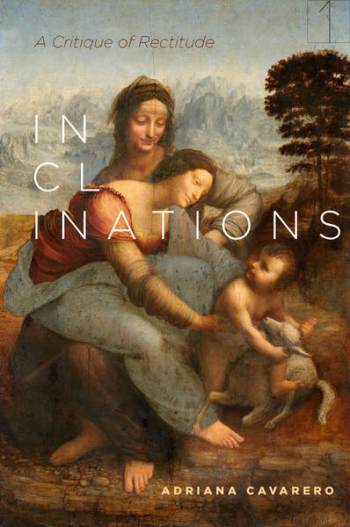 In this new and accessible book, Italy’s best known feminist philosopher examines the moral and political significance of vertical posture in order to rethink subjectivity in terms of inclination. Contesting the classical figure of homo erectus or ‘upright man’, Adriana Cavarero proposes an altruistic, open model of the subject—one who is inclined toward others. Contrasting the masculine upright with the feminine inclined, she references philosophical texts (by Plato, Thomas Hobbes, Immanuel Kant, Hannah Arendt, Elias Canetti, and others) as well as works of art (Barnett Newman, Leonardo da Vinci, Artemisia Gentileschi, and Alexander Rodchenko) and literature (Marcel Proust and Virginia Woolf).
Adriana Cavarero is Professor of Political Philosophy at the University of Verona. Her books in English include For More than One Voice (2005) and Horrorism (2008).
Call for Papers | Naples and the Capodimonte
From the Call for Papers:
Naples and the Museo e Real Bosco di Capodimonte in a Global Context
Naples, 12–14 October 2017
Proposals due by 24 April 2017

‘Transport des Antiquités d’Herculanum du Museum de Portici au Palais des Etudes à Naples’, in J. C. R. de Saint-Non, Voyage pittoresque, ou Description des Royaumes de Naples et de Sicile, vol. II (Paris, 1782). J. Duplessi-Bertaux after L.-J. Desprez. Included in Arturo Fittipaldi, “Museums, Safeguarding and Artistic Heritage in Naples in the Eighteenth Eentury: Some Reflections,” Journal of the History of Collections 19 (2007): 191–202.
One of the world’s oldest cultural centers and one of the largest ports in Europe, the city of Naples is a node in a cultural and economic network that spans the Mediterranean and beyond. The story of art in Naples is one of encounter and exchange, of rupture and unexpected convergence. It is above all a story of movement: of people, artworks, and forms, of technologies, traditions, and ideas. Naples thus challenges us to envision a new history of art that ranges across geography, chronology, and medium. Art in Naples has long been marginalized or misunderstood. Instead, we take Naples as a laboratory for new art historical research with global implications.
To launch a new collaboration between the Edith O’Donnell Institute of Art History and the Museo e Real Bosco di Capodimonte dedicated to innovative research on art in Naples and on the cultural histories of port cities, this symposium brings together an international group of scholars for two days of on-site presentations that will set Naples and the Capodimonte in a global context. After a public keynote lecture and celebratory reception on the evening of Thursday, October 12, a group of around 30 scholars will spend the next two days participating in a series of presentations in the form of gallery talks and site visits that will focus on individual artworks in the Capodimonte collections and on sites within its surrounding gardens. Each presentation will be followed by discussion. Moderated roundtables and shared meals will provide further opportunities for participants to respond to each other’s presentations and to engage with broader themes.
We invite scholars at all professional stages (including advanced graduate students) to propose 20-minute presentations that focus either on individual artworks at the Capodimonte or on specific sites in the Bosco. Through these individual objects and sites, presentations should open onto larger questions related to Naples and the Capodimonte in a global context: for example, the formation of the Capodimonte’s collections and gardens, the cultural history of Naples as a port city, the mobility of objects and people, and processes of circulation, encounter, and exchange. Presentations may be made in Italian or English. To propose a presentation on a specific artwork or site at the Capodimonte, please submit via email attachment a proposal of under 350 words and a short CV to Elizabeth Ranieri, The Edith O’Donnell Institute of Art History (enr101020@utdallas.edu), by April 24, 2017. Proposals will be reviewed by collaborators at the O’Donnell Institute and the Capodimonte. A certain number of presenters not based in Naples will be offered a small grant to contribute toward the cost of travel.










 Enfilade
leave a comment