New Book | Red: The History of a Color
From Princeton UP:
Michel Pastoureau, Red: The History of a Color (Princeton: Princeton University Press, 2017), 216 pages, ISBN: 978 06911 72774, $40 / £33.
 The color red has represented many things, from the life force and the divine to love, lust, and anger. Up through the Middle Ages, red held a place of privilege in the Western world. For many cultures, red was not just one color of many but rather the only color worthy enough to be used for social purposes. In some languages, the word for red was the same as the word for color. The first color developed for painting and dying, red became associated in antiquity with war, wealth, and power. In the medieval period, red held both religious significance, as the color of the blood of Christ and the fires of Hell, and secular meaning, as a symbol of love, glory, and beauty. Yet during the Protestant Reformation, red began to decline in status. Viewed as indecent and immoral and linked to luxury and the excesses of the Catholic Church, red fell out of favor. After the French Revolution, red gained new respect as the color of progressive movements and radical left-wing politics.
In this beautifully illustrated book, Michel Pastoureau, the acclaimed author of Blue, Black, and Green, now masterfully navigates centuries of symbolism and complex meanings to present the fascinating and sometimes controversial history of the color red. Pastoureau illuminates red’s evolution through a diverse selection of captivating images, including the cave paintings of Lascaux, the works of Renaissance masters, and the modern paintings and stained glass of Mark Rothko and Josef Albers.
Michel Pastoureau is a historian and director of studies at the École Pratique des Hautes Études de la Sorbonne in Paris. A specialist in the history of colors, symbols, and heraldry, he is the author of many books, including Green, Black, and Blue (all Princeton) and The Devil’s Cloth: A History of Stripes. His books have been translated into more than thirty languages.
ASECS 2017, Minneapolis: Memorial Session for Mary Sheriff
In addition to this year’s regular ASECS offerings, the schedule will include a memorial gathering dedicated to Mary Sheriff (1950–2016).
Please join us Thursday, March 30, from 6:00 to 7:00pm as we remember our colleague, dear friend, and mentor. There will be a cash bar, a short program, and an opportunity for people to share memories and celebrate Mary’s vibrant life.
The room is Lakeshore A, on the first floor of the Hyatt Regency Minneapolis. Please email Joanna Gohmann at jgohmann@thewalters.org or Hyejin Lee at hyejinlee.18e@gmail.com with any questions.
Exhibition | Splendour! Art in Living Craftsmanship
Now on at The Georgian Group:
Splendour! Art in Living Craftsmanship
The Georgian Group, Fitzroy Square, 2-25 February 2017
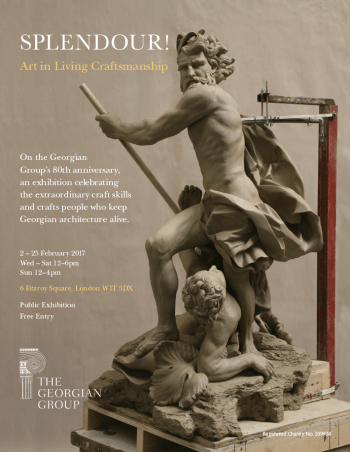 In February 2017 the Georgian Group opens its Fitzroy Square townhouse for an exhibition celebrating 80 years of conservation work by the charity. Splendour! promises to transport the visitor into a world of craftsmanship, beauty, and design. Gathering together an eclectic selection of traditional ‘Georgian’ arts and crafts practiced in the 21st century, objects range from silk wallpaper and chandeliers to carved stone sculpture and ceiling designs. Work by the most promising recent graduates features alongside the most experienced practitioners in the UK; this is an exhibition that displays talent from across the spectrum of British craftsmanship. History, architecture, art, and design come together with exciting relevance to craft today.
Details of our Tuesday talk series, Saturday demonstrations by leading practitioners, and our interactive Sunday workshops are available at The Georgian Group website.
New Book | City of Refuge: Separatists and Utopian Town Planning
From Princeton UP:
Michael Lewis, City of Refuge: Separatists and Utopian Town Planning (Princeton: Princeton University Press, 2016), 256 pages, ISBN: 978 0691 171814, $45 / £38.
 The vision of Utopia obsessed the nineteenth-century mind, shaping art, literature, and especially town planning. In City of Refuge, Michael Lewis takes readers across centuries and continents to show how Utopian town planning produced a distinctive type of settlement characterized by its square plan, collective ownership of properties, and communal dormitories. Some of these settlements were sanctuaries from religious persecution, like those of the German Rappites, French Huguenots, and American Shakers, while others were sanctuaries from the Industrial Revolution, like those imagined by Charles Fourier, Robert Owen, and other Utopian visionaries.
Because of their differences in ideology and theology, these settlements have traditionally been viewed separately, but Lewis shows how they are part of a continuous intellectual tradition that stretches from the early Protestant Reformation into modern times. Through close readings of architectural plans and archival documents, many previously unpublished, he shows the network of connections between these seemingly disparate Utopian settlements—including even such well-known town plans as those of New Haven and Philadelphia.
The most remarkable aspect of the city of refuge is the inventive way it fused its eclectic sources, ranging from the encampments of the ancient Israelites as described in the Bible to the detailed social program of Thomas More’s Utopia to modern thought about education, science, and technology. Delving into the historical evolution and antecedents of Utopian towns and cities, City of Refuge alters notions of what a Utopian community can and should be.
Michael J. Lewis is the Faison-Pierson-Stoddard Professor of Art History at Williams College. His books include Frank Furness: Architecture and the Violent Mind, The Gothic Revival, and American Art and Architecture. His essays and reviews have appeared in such publications as The Wall Street Journal and The New York Times.
C O N T E N T S
1 The Idea of the City of Refuge
2 The Sacred Squareness of Cities
3 The Protestant Tempering of Utopia
4 Christianopolis
5 The Lord’s Grove
6 Harmony
7 Economy
8 Conclusion
Notes
Selected Bibliography
Index
Illustration Credits
Acknowledgments
Mia Jackson Appointed Curator of Decorative Arts at Waddesdon
Waddesdon Manor is delighted to announce the appointment of Dr Mia Jackson as Curator of Decorative Arts. She joined Waddesdon on 1 February 2017.
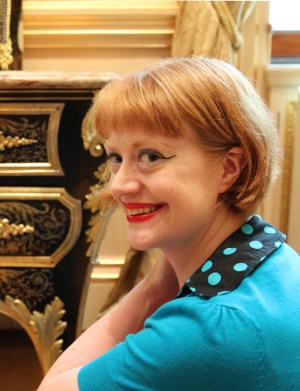 Jackson’s experience would seem tailor-made for Waddesdon. It was whilst finishing her undergraduate degree in French and philosophy that she noticed books on ceramics in her college library at Oxford. These included books on French porcelain that sparked a fascination. Jackson tracked down their author, Dr Aileen Dawson, and volunteered with her one day a week at The British Museum while studying for her MA in eighteenth-century French decorative arts at the Courtauld (2005). When a museum assistant job came open in the Prints and Drawings Department, Jackson was advised to apply. Of her four years at The British Museum, she notes, “I think I got the best art-historical education I could have dreamt of from Solander boxes and boxes of the most amazing prints and drawings.”
Returning to the decorative arts, Jackson was hired in 2008 as a museum assistant at The Wallace Collection. She spent three happy years under the directorship of Rosalind Savill, and at Savill’s encouragement, she embarked on a doctoral thesis at Queen Mary University of London on the French furniture maker André Charles Boulle and his collection of prints and drawings, finishing her PhD in 2016.
Also during her time at The Wallace Collection, Jackson participated in the Attingham Summer School, which opened her eyes to historic houses. She became Curator of Collections at English Heritage in January 2015 with curatorial responsibility for the collections at Audley End House in Essex and Wrest Park in Bedfordshire. Jackson was named the Art Fund curator of the month in November 2016.
Jackson notes, “I am hugely excited about joining the curatorial team at Waddesdon Manor, where I will be able to return to the French decorative arts that I love with such passion.”
New Book | The Art of Philosophy: Visual Thinking in Europe
From Princeton UP:
Susanna Berger, The Art of Philosophy: Visual Thinking in Europe from the Late Renaissance to the Early Enlightenment (Princeton: Princeton University Press, 2017), 352 pages, ISBN: 978 06911 72279, $65 / £55.
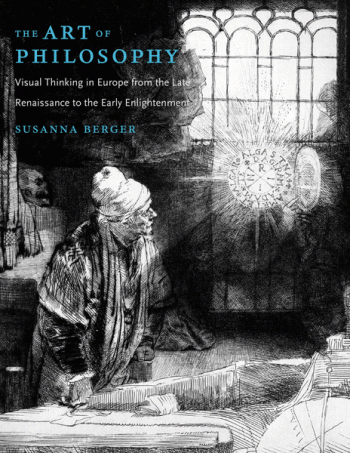 Delving into the intersections between artistic images and philosophical knowledge in Europe from the late sixteenth to the early eighteenth centuries, The Art of Philosophy shows that the making and study of visual art functioned as important methods of philosophical thinking and instruction. From frontispieces of books to monumental prints created by philosophers in collaboration with renowned artists, Susanna Berger examines visual representations of philosophy and overturns prevailing assumptions about the limited function of the visual in European intellectual history.
Rather than merely illustrating already existing philosophical concepts, visual images generated new knowledge for both Aristotelian thinkers and anti-Aristotelians, such as Descartes and Hobbes. Printmaking and drawing played a decisive role in discoveries that led to a move away from the authority of Aristotle in the seventeenth century. Berger interprets visual art from printed books, student lecture notebooks, alba amicorum (friendship albums), broadsides, and paintings, and examines the work of such artists as Pietro Testa, Léonard Gaultier, Abraham Bosse, Dürer, and Rembrandt. In particular, she focuses on the rise and decline of the ‘plural image’, a genre that was popular among early modern philosophers. Plural images brought multiple images together on the same page, often in order to visualize systems of logic, metaphysics, natural philosophy, or moral philosophy. Featuring previously unpublished prints and drawings from the early modern period and lavish gatefolds, The Art of Philosophy reveals the essential connections between visual commentary and philosophical thought.
Susanna Berger is assistant professor of art history at the University of Southern California.
C O N T E N T S
Acknowledgments
Abbreviations
Introduction
1 Apin’s Cabinet of Printed Curiosities
2 Thinking through Plural Images of Logic
3 The Visible Order of Student Lecture Notebooks
4 Visual Thinking in Logic Notebooks and Alba amicorum
5 The Generation of Art as the Generation of Philosophy
Appendix 1 Catalogue of Surviving Impressions of Philosophical Plural Images
Appendix 2 Transcriptions of the Texts Inscribed onto Philosophical Plural Images
Notes
Bibliography
Index
Illustration Credits
Symposium | Bouchardon and His Contemporaries
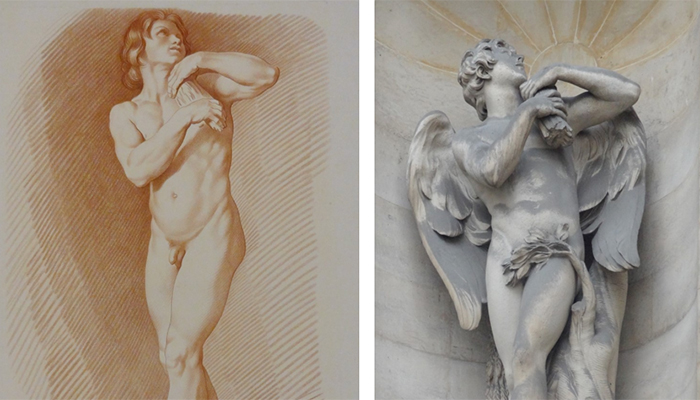
Left: Gilles Demarteau after Edme Bouchardon, Model Posing for ‘The Genius of Summer’, ca. 1740s–50s (Los Angeles: Getty Research Institute, 2015.PR.58). Right: Edme Bouchardon, The Genius of Summer, 1745 (Paris: Grenelle Fountain).
◊ ◊ ◊ ◊ ◊
Bouchardon and His Contemporaries
The Getty Center, Los Angeles, 2 April 2017
In parallel with the exhibition Bouchardon: Royal Artist of the Enlightenment (on view at the Getty Center until 2 April), this symposium explores the relationships Bouchardon had with his contemporaries (artists, patrons, and connoisseurs) and investigates the diffusion and reception of his oeuvre. Admission to this event is free, but a ticket is required to attend. More information is available here.
Participants
Malcolm Baker, University of California, Riverside
Anne-Lise Desmas, J. Paul Getty Museum
Peter Fuhring, Fondation Custodia
Thomas W. Gaehtgens, Getty Research Institute
Edouard Kopp, Harvard Art Museums
Monique Kornell, University of California, Los Angeles
Ewa Lajer-Burcharth, Harvard University
Louis Marchesano, Getty Research Institute
Guilhem Scherf, Musée du Louvre
Katie Scott, The Courtauld Institute of Art
Kristel Smentek, Massachusetts Institute of Technology
Perrin Stein, The Metropolitan Museum of Art
Juliette Trey, Musée du Louvre
Annual Workshop of the Women’s Studies Group, 1558–1837
From the Women’s Studies Group website:
Annual Workshop of the Women’s Studies Group, 1558–1837
The Fruitful Body: Gender and Image
The Foundling Museum, London, 6 May 2017
The Women’s Studies Group, 1558–1837 annual workshop takes place every spring at The Foundling Museum in London. A distinguished invited speaker provides the keynote in the morning, followed by discussion and lunch; in the afternoon, participants each give a 5-minute presentation on a subject relevant to the theme of the keynote, followed by discussion. Previous speakers have included Jacqueline Labbe of the University of Sheffield and Laura Gowing of King’s College London. This year’s speaker is Karen Hearn of University College London, presenting “Women, Agency, and Fertility in Early Modern British Portraits.”
Cost (including lunch and refreshments): £18 (WSG members), £15 (students/unwaged), £22 (non-WSG members). To register, please complete the registration form available here. All attendees should bring a 5-minute presentation, from any discipline and any period covered by the Group, exploring the workshop theme. Topics might include
• caricature
• texts
• novels
• conduct manuals
• medicine
• philosophy
• motherhood
• women artists
New Book | ‘Drawing on Copper’: The Basire Family
From the newsletter of the Society of Antiquaries of London, Salon 379 (7 February 2017) . . .
Richard Goddard, ‘Drawing on Copper’: The Basire Family of Copper-Plate Engravers and their Works (Maastricht, 2017), 332 pages, ISBN: 978 946159 5911.
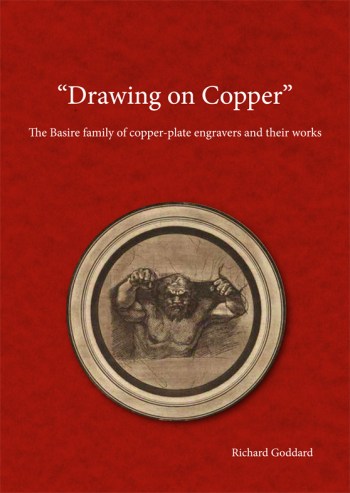
Julian Pooley FSA writes with news of a book about copper-plate engraving. Four generations of the Basire family of skilled printmakers, draughtsmen, and engravers, spanning 1730–1883, were celebrated for their skill in drawing, on copper and stone, accurate representations of monuments and antiquities. Their pictures can be found throughout Archaeologia, Vetusta Monumenta, and many of the most celebrated works of 18th- and 19th-century topography and antiquarianism (James Basire, 1730–1802, was engraver to the Society of Antiquaries for 20 years). Richard Goddard, a descendent of the Basire family, has published a meticulously researched and beautifully written study of their careers, interests and influence called ‘Drawing on Copper’: The Basire Family of Copper-Plate Engravers and their Works. It is beautifully illustrated by over 70 plates, says Pooley, and has six chapters assessing the medium of engraving and careers of successive members of the Basire family. Details can be found on the author’s website, where a PDF of the book can be downloaded.
Call for Papers | Kings and Queens 6
From The Royal Studies Network:
Kings and Queens 6: In the Shadow of the Throne
Madrid, 12–15 September 2017
Proposals due by 30 March 2017
The Kings & Queens conference series will travel to Madrid in 2017 for its sixth edition. On this occasion, we aim to connect scholars across the world whose research focuses on topics related to royal history, diplomacy, art history, political history, biographical studies, or any other issues included in the scope of royal studies. In particular, this edition of the Kings and Queens congress will focus on the secondary members of royal families, such as siblings, spouses, cousins, as well as the people closest to the king, like lovers, favourites, members of the royal entourage, etc. We especially invite studies related to figures with family ties to a monarch who were not kings or queens in their own right but had a significant influence in spheres such as international politics, the court, the arts, the society, or dynastic strategies during their time—with the objective of obtaining a better understanding of figures who are usually in the shadow of the throne. All kind of topics related to these issues will be welcomed, from diverse chronological periods and parts of the world. In the potential topics for papers or panels we may include, but are not limited to, the following:
• Biographical, dynastical, and political studies of different members of the royal families who were not kings or queens on their own right
• Power, role, and importance of different people close to the monarch, like favorites, lovers, relatives with military, diplomatic or dynastic posts, ambassadors or diverse members of their entourage
• The relationship between power and art; patronage, collecting, and diplomatic exchanges
• Monarchy, high nobility, and the representation of status, power, and influence through art, culture, and image
• The importance of the dynasty and the ‘dynastic mirror’
• Informal power, royal favour, and disfavour
Proposals should include a title, institutional affiliation, an abstract of around 500 words, and a one-page CV. In the case of panels, the proposal should include a maximum of three different papers accompanied by the same information required for individual proposals along with the name, affiliation, and one-page CV of the sponsor (if they are not presenting a paper in the same panel). All the proposals should be submitted by March 30, 2017, to Kq6Madrid@gmail.com. Please remember that English will be the official language of the congress.
Also, we are pleased to announce that we offer 20 bursaries for young researchers to help them with the costs. Those interested in said bursaries should write to the aforementioned email to obtain more details about them and what they cover. Those who want to apply must send us the title of the proposal, an abstract of around 500 words, institutional affiliation, a one-page CV, and one-page report focusing on why this congress is relevant for them and how their research could improve the field of royal studies.










 Enfilade
leave a comment