New Book | City of Refuge: Separatists and Utopian Town Planning
From Princeton UP:
Michael Lewis, City of Refuge: Separatists and Utopian Town Planning (Princeton: Princeton University Press, 2016), 256 pages, ISBN: 978 0691 171814, $45 / £38.
 The vision of Utopia obsessed the nineteenth-century mind, shaping art, literature, and especially town planning. In City of Refuge, Michael Lewis takes readers across centuries and continents to show how Utopian town planning produced a distinctive type of settlement characterized by its square plan, collective ownership of properties, and communal dormitories. Some of these settlements were sanctuaries from religious persecution, like those of the German Rappites, French Huguenots, and American Shakers, while others were sanctuaries from the Industrial Revolution, like those imagined by Charles Fourier, Robert Owen, and other Utopian visionaries.
Because of their differences in ideology and theology, these settlements have traditionally been viewed separately, but Lewis shows how they are part of a continuous intellectual tradition that stretches from the early Protestant Reformation into modern times. Through close readings of architectural plans and archival documents, many previously unpublished, he shows the network of connections between these seemingly disparate Utopian settlements—including even such well-known town plans as those of New Haven and Philadelphia.
The most remarkable aspect of the city of refuge is the inventive way it fused its eclectic sources, ranging from the encampments of the ancient Israelites as described in the Bible to the detailed social program of Thomas More’s Utopia to modern thought about education, science, and technology. Delving into the historical evolution and antecedents of Utopian towns and cities, City of Refuge alters notions of what a Utopian community can and should be.
Michael J. Lewis is the Faison-Pierson-Stoddard Professor of Art History at Williams College. His books include Frank Furness: Architecture and the Violent Mind, The Gothic Revival, and American Art and Architecture. His essays and reviews have appeared in such publications as The Wall Street Journal and The New York Times.
C O N T E N T S
1 The Idea of the City of Refuge
2 The Sacred Squareness of Cities
3 The Protestant Tempering of Utopia
4 Christianopolis
5 The Lord’s Grove
6 Harmony
7 Economy
8 Conclusion
Notes
Selected Bibliography
Index
Illustration Credits
Acknowledgments
Mia Jackson Appointed Curator of Decorative Arts at Waddesdon
Waddesdon Manor is delighted to announce the appointment of Dr Mia Jackson as Curator of Decorative Arts. She joined Waddesdon on 1 February 2017.
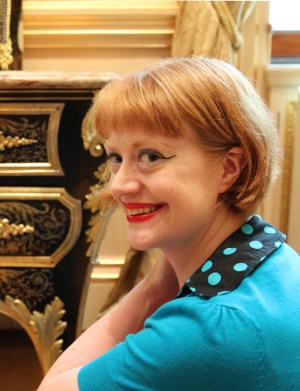 Jackson’s experience would seem tailor-made for Waddesdon. It was whilst finishing her undergraduate degree in French and philosophy that she noticed books on ceramics in her college library at Oxford. These included books on French porcelain that sparked a fascination. Jackson tracked down their author, Dr Aileen Dawson, and volunteered with her one day a week at The British Museum while studying for her MA in eighteenth-century French decorative arts at the Courtauld (2005). When a museum assistant job came open in the Prints and Drawings Department, Jackson was advised to apply. Of her four years at The British Museum, she notes, “I think I got the best art-historical education I could have dreamt of from Solander boxes and boxes of the most amazing prints and drawings.”
Returning to the decorative arts, Jackson was hired in 2008 as a museum assistant at The Wallace Collection. She spent three happy years under the directorship of Rosalind Savill, and at Savill’s encouragement, she embarked on a doctoral thesis at Queen Mary University of London on the French furniture maker André Charles Boulle and his collection of prints and drawings, finishing her PhD in 2016.
Also during her time at The Wallace Collection, Jackson participated in the Attingham Summer School, which opened her eyes to historic houses. She became Curator of Collections at English Heritage in January 2015 with curatorial responsibility for the collections at Audley End House in Essex and Wrest Park in Bedfordshire. Jackson was named the Art Fund curator of the month in November 2016.
Jackson notes, “I am hugely excited about joining the curatorial team at Waddesdon Manor, where I will be able to return to the French decorative arts that I love with such passion.”
New Book | The Art of Philosophy: Visual Thinking in Europe
From Princeton UP:
Susanna Berger, The Art of Philosophy: Visual Thinking in Europe from the Late Renaissance to the Early Enlightenment (Princeton: Princeton University Press, 2017), 352 pages, ISBN: 978 06911 72279, $65 / £55.
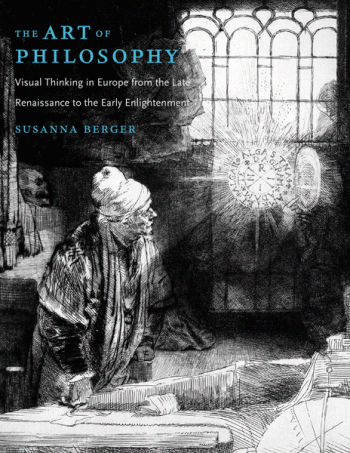 Delving into the intersections between artistic images and philosophical knowledge in Europe from the late sixteenth to the early eighteenth centuries, The Art of Philosophy shows that the making and study of visual art functioned as important methods of philosophical thinking and instruction. From frontispieces of books to monumental prints created by philosophers in collaboration with renowned artists, Susanna Berger examines visual representations of philosophy and overturns prevailing assumptions about the limited function of the visual in European intellectual history.
Rather than merely illustrating already existing philosophical concepts, visual images generated new knowledge for both Aristotelian thinkers and anti-Aristotelians, such as Descartes and Hobbes. Printmaking and drawing played a decisive role in discoveries that led to a move away from the authority of Aristotle in the seventeenth century. Berger interprets visual art from printed books, student lecture notebooks, alba amicorum (friendship albums), broadsides, and paintings, and examines the work of such artists as Pietro Testa, Léonard Gaultier, Abraham Bosse, Dürer, and Rembrandt. In particular, she focuses on the rise and decline of the ‘plural image’, a genre that was popular among early modern philosophers. Plural images brought multiple images together on the same page, often in order to visualize systems of logic, metaphysics, natural philosophy, or moral philosophy. Featuring previously unpublished prints and drawings from the early modern period and lavish gatefolds, The Art of Philosophy reveals the essential connections between visual commentary and philosophical thought.
Susanna Berger is assistant professor of art history at the University of Southern California.
C O N T E N T S
Acknowledgments
Abbreviations
Introduction
1 Apin’s Cabinet of Printed Curiosities
2 Thinking through Plural Images of Logic
3 The Visible Order of Student Lecture Notebooks
4 Visual Thinking in Logic Notebooks and Alba amicorum
5 The Generation of Art as the Generation of Philosophy
Appendix 1 Catalogue of Surviving Impressions of Philosophical Plural Images
Appendix 2 Transcriptions of the Texts Inscribed onto Philosophical Plural Images
Notes
Bibliography
Index
Illustration Credits
Symposium | Bouchardon and His Contemporaries
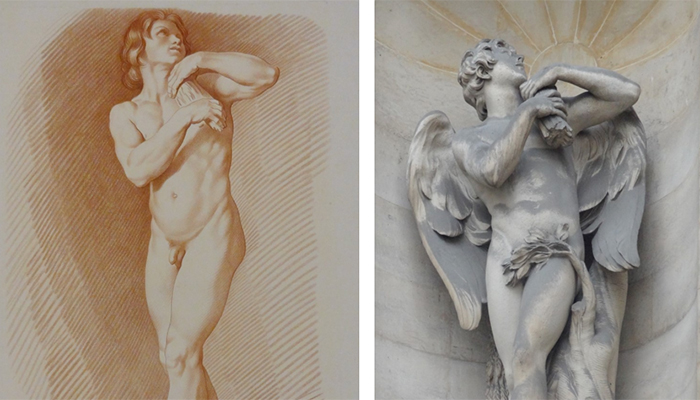
Left: Gilles Demarteau after Edme Bouchardon, Model Posing for ‘The Genius of Summer’, ca. 1740s–50s (Los Angeles: Getty Research Institute, 2015.PR.58). Right: Edme Bouchardon, The Genius of Summer, 1745 (Paris: Grenelle Fountain).
◊ ◊ ◊ ◊ ◊
Bouchardon and His Contemporaries
The Getty Center, Los Angeles, 2 April 2017
In parallel with the exhibition Bouchardon: Royal Artist of the Enlightenment (on view at the Getty Center until 2 April), this symposium explores the relationships Bouchardon had with his contemporaries (artists, patrons, and connoisseurs) and investigates the diffusion and reception of his oeuvre. Admission to this event is free, but a ticket is required to attend. More information is available here.
Participants
Malcolm Baker, University of California, Riverside
Anne-Lise Desmas, J. Paul Getty Museum
Peter Fuhring, Fondation Custodia
Thomas W. Gaehtgens, Getty Research Institute
Edouard Kopp, Harvard Art Museums
Monique Kornell, University of California, Los Angeles
Ewa Lajer-Burcharth, Harvard University
Louis Marchesano, Getty Research Institute
Guilhem Scherf, Musée du Louvre
Katie Scott, The Courtauld Institute of Art
Kristel Smentek, Massachusetts Institute of Technology
Perrin Stein, The Metropolitan Museum of Art
Juliette Trey, Musée du Louvre
Annual Workshop of the Women’s Studies Group, 1558–1837
From the Women’s Studies Group website:
Annual Workshop of the Women’s Studies Group, 1558–1837
The Fruitful Body: Gender and Image
The Foundling Museum, London, 6 May 2017
The Women’s Studies Group, 1558–1837 annual workshop takes place every spring at The Foundling Museum in London. A distinguished invited speaker provides the keynote in the morning, followed by discussion and lunch; in the afternoon, participants each give a 5-minute presentation on a subject relevant to the theme of the keynote, followed by discussion. Previous speakers have included Jacqueline Labbe of the University of Sheffield and Laura Gowing of King’s College London. This year’s speaker is Karen Hearn of University College London, presenting “Women, Agency, and Fertility in Early Modern British Portraits.”
Cost (including lunch and refreshments): £18 (WSG members), £15 (students/unwaged), £22 (non-WSG members). To register, please complete the registration form available here. All attendees should bring a 5-minute presentation, from any discipline and any period covered by the Group, exploring the workshop theme. Topics might include
• caricature
• texts
• novels
• conduct manuals
• medicine
• philosophy
• motherhood
• women artists
New Book | ‘Drawing on Copper’: The Basire Family
From the newsletter of the Society of Antiquaries of London, Salon 379 (7 February 2017) . . .
Richard Goddard, ‘Drawing on Copper’: The Basire Family of Copper-Plate Engravers and their Works (Maastricht, 2017), 332 pages, ISBN: 978 946159 5911.
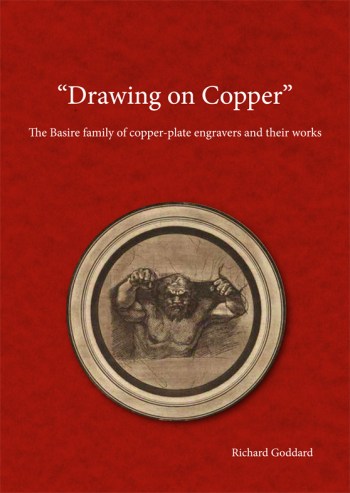
Julian Pooley FSA writes with news of a book about copper-plate engraving. Four generations of the Basire family of skilled printmakers, draughtsmen, and engravers, spanning 1730–1883, were celebrated for their skill in drawing, on copper and stone, accurate representations of monuments and antiquities. Their pictures can be found throughout Archaeologia, Vetusta Monumenta, and many of the most celebrated works of 18th- and 19th-century topography and antiquarianism (James Basire, 1730–1802, was engraver to the Society of Antiquaries for 20 years). Richard Goddard, a descendent of the Basire family, has published a meticulously researched and beautifully written study of their careers, interests and influence called ‘Drawing on Copper’: The Basire Family of Copper-Plate Engravers and their Works. It is beautifully illustrated by over 70 plates, says Pooley, and has six chapters assessing the medium of engraving and careers of successive members of the Basire family. Details can be found on the author’s website, where a PDF of the book can be downloaded.
Call for Papers | Kings and Queens 6
From The Royal Studies Network:
Kings and Queens 6: In the Shadow of the Throne
Madrid, 12–15 September 2017
Proposals due by 30 March 2017
The Kings & Queens conference series will travel to Madrid in 2017 for its sixth edition. On this occasion, we aim to connect scholars across the world whose research focuses on topics related to royal history, diplomacy, art history, political history, biographical studies, or any other issues included in the scope of royal studies. In particular, this edition of the Kings and Queens congress will focus on the secondary members of royal families, such as siblings, spouses, cousins, as well as the people closest to the king, like lovers, favourites, members of the royal entourage, etc. We especially invite studies related to figures with family ties to a monarch who were not kings or queens in their own right but had a significant influence in spheres such as international politics, the court, the arts, the society, or dynastic strategies during their time—with the objective of obtaining a better understanding of figures who are usually in the shadow of the throne. All kind of topics related to these issues will be welcomed, from diverse chronological periods and parts of the world. In the potential topics for papers or panels we may include, but are not limited to, the following:
• Biographical, dynastical, and political studies of different members of the royal families who were not kings or queens on their own right
• Power, role, and importance of different people close to the monarch, like favorites, lovers, relatives with military, diplomatic or dynastic posts, ambassadors or diverse members of their entourage
• The relationship between power and art; patronage, collecting, and diplomatic exchanges
• Monarchy, high nobility, and the representation of status, power, and influence through art, culture, and image
• The importance of the dynasty and the ‘dynastic mirror’
• Informal power, royal favour, and disfavour
Proposals should include a title, institutional affiliation, an abstract of around 500 words, and a one-page CV. In the case of panels, the proposal should include a maximum of three different papers accompanied by the same information required for individual proposals along with the name, affiliation, and one-page CV of the sponsor (if they are not presenting a paper in the same panel). All the proposals should be submitted by March 30, 2017, to Kq6Madrid@gmail.com. Please remember that English will be the official language of the congress.
Also, we are pleased to announce that we offer 20 bursaries for young researchers to help them with the costs. Those interested in said bursaries should write to the aforementioned email to obtain more details about them and what they cover. Those who want to apply must send us the title of the proposal, an abstract of around 500 words, institutional affiliation, a one-page CV, and one-page report focusing on why this congress is relevant for them and how their research could improve the field of royal studies.
At Auction | Fourteen Lots of Porcelain from the ‘Geldermalsen’

Diane KW, The Geldermalsen Triptych: The Harvest, The Catastrophe, The Politics, 2013; found Chinese porcelain shards with digital ceramic transfers (Groninger Museum). The large basin shards in this triptych work recount their history from the order and production of decorated porcelain pieces (The Harvest), to the shipwreck (The Catastrophe) and loss of the porcelain, to the storm of controversy after the sale of the salvaged pieces (The Politics). The triptych was part of the exhibition At World’s End—The Story of a Shipwreck: Works by Diane KW (Honolulu Museum of Art, January — April 2014).
◊ ◊ ◊ ◊ ◊
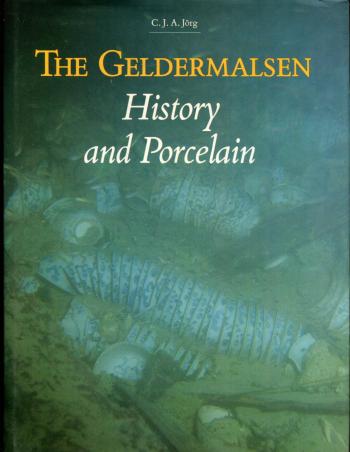 An upcoming auction in Atlanta recalls a 1752 shipwreck, a 1986 auction and monograph, a 1992 article, a 2014 exhibition, and lots of questions about looted artifacts. There’s a measure of wry tragedy in the fact that this week’s sale takes place at Great Gatsby’s Auction Gallery. In a Borgesian universe, one might imagine a litany of items with similarly dubious histories on offer at the gallery. Please, someone write that story! It would make for a fabulous reading at a HECAA luncheon. Or maybe it would work as a theme for structuring a conference panel. Wanted: proposals with rapacious villains, international stakes, ethical quandaries, and plenty of misinformation (‘alternative facts’ to use the current jargon), all as reception history for material that is of genuine scholarly significance. –Craig Hanson
George L. Miller, “The Second Destruction of the Geldermalsen,” Historical Archaeology 26 (1992): 124–31.
Abstract: This review of C. J. A. Jörg’s book on the Chinese porcelain from the Dutch East India Company ship Geldermalsen, which sank in 1752 [The Geldermalsen: History and Porcelain (Groningen: Kemper Publisher, 1986)], addresses some broader questions involved in the destruction of shipwreck sites for commercial profit. These questions grew out of the issue of what relationship scholars should have with those who destroy sites and acquire objects from them. The first part of the article is a review of Jorg’s book, followed by a commentary on the problems that collecting from looted sites raise.
◊ ◊ ◊ ◊ ◊
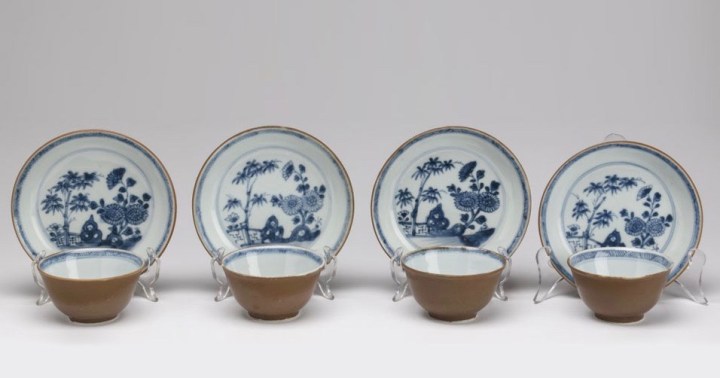
Blue and white porcelain cups and saucers recovered from the shipwrecked Geldermalsen in 1985
(Great Gatsby’s Auction Gallery, Atlanta)
◊ ◊ ◊ ◊ ◊
From the auction press release, via Art Daily (5 February 2017). . .
When the Geldermalsen ship crashed into a reef and sank in the South China Sea during its return journey to the Netherlands in January of 1752, it claimed the lives of eighty crew members who went down with the vessel’s precious cargo of tea, textiles, gold, silk, lacquer, and porcelain. As part of the fleet of the powerful Dutch East India Company commissioned for the Zeeland division, the loss of the mighty Geldermalsen hardly went unnoticed.
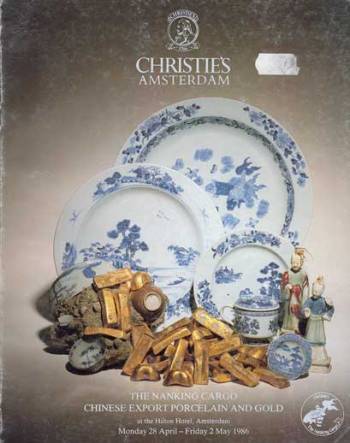
The press release mistakenly dates the Christie’s auction to 1985. While the catalogue was released in December of 1985, the auction itself took place in April and May 1986. Image from a 2011 article on Hatcher from China.org.cn.
Over two hundred years later, a successful salvage expert named Captain Michael Hatcher would excavate the ship and its contents, giving new understanding of eighteenth-century trade demands and the rise of porcelain’s availability. Great Gatsby’s Auction Gallery will offer fourteen lots of blue and white porcelain from this incredible salvage from the personal collection of one of the expedition’s private backers. The auction is slated for February 10, 11, and 12, with 11am start times all three days, online and in the firm’s Atlanta gallery at 5180 Peachtree Boulevard.
Hatcher, along with his partner Max de Rham, a marine geophysicist, led a successful team of divers who unearthed the precious bounty that would catapult its already famous hunter into superstardom. ‘The Nanking Cargo’, as it became known by its sale at Christie’s Amsterdam in April of 1985 [sic], contained a massive trove of the aforementioned blue and white porcelain, which was originally potted in China’s Jiangzi province bound for European markets. The sheer scope of this find shed light on the true nature of the market’s demands, as traditional experts had always believed the records kept by the DEIC [Dutch East India Company, or VOC] had exaggerated their shipments of porcelain. Safely protected underwater by the tea loosely packed in wooden crates, the porcelain in the Nanking Cargo represented the range of influence eastern artisans had over western tastes during the eighteen century.
Hatcher and his team had the untouched archives of the DEIC in Holland to thank for locating the whereabouts of this famous—and suspicious wreck. Due to the nature of the disaster—in well chartered waters by one of the world’s most esteemed shipping companies—the DEIC spent weeks interrogating the survivors who had made it to present-day Jakarta on two open boats. Not only was an entire cargo worth of precious porcelain and trade goods missing, but so was the gold, at first believed to be hidden by the survivors. With such detailed records on hand, Hatcher would embark on months of searching, believing his efforts to be worthless until they unearthed the treasure from a three foot layer of silt and coral.
The excitement generated by the find was evident during the first frenzied days of the cargo’s namesake auction at Christie’s Amsterdam. International interest—both financial and historical—had taken hold and this caught the attention of the Chinese government, who tried unsuccessfully to bring the porcelain back to its country of origin. Maritime salvage laws permitted the cargo to go across the auction block, where it broke numerous records and raised a staggering $20 million USD.
Fellowships | Bard Graduate Center, 2017–18
From the Bard Graduate Center:
BGC Visiting Fellowships, 2017–18: What Is Distance?
Bard Graduate Center, New York
Applications due by 1 March 2017 [extended from 1 November 2016]
Bard Graduate Center invites scholars from university, museum, and independent backgrounds with a PhD or equivalent professional experience to apply for non-stipendiary visiting fellowships, to be held during the 2017–18 academic year. The theme for this period is “What is distance?” Applicants are asked to address in a cover letter how their projected work will bear on this question. Bard Graduate Center Visiting Fellowships, which are intended for scholars who have already secured means of funding, provide scholars with workspace in the Bard Graduate Center Research Center and enable them to be a part of our dynamic scholarly community in New York. Eligible disciplines and fields of study include—but are not limited to—art history, architecture and design history, economic and cultural history, history of technology, philosophy, anthropology, and archaeology. Visiting Fellowships may be awarded for anywhere from one month to the full academic year.
Bard Graduate Center is a graduate research institute devoted to the study of the decorative arts, design history, and material culture, drawing on methodologies and approaches from art history, economic and cultural history, history of technology, philosophy, anthropology, and archaeology. It offers MA and PhD degrees, possesses a specialized library of 60,000 volumes exclusive of serials, and publishes the journals West 86th: A Journal of Decorative Arts, Design History, and Material Culture and Source: Notes in the History of Art, the book series Cultural Histories of the Material World (all with the University of Chicago Press), and the catalogues that accompany the exhibitions it presents every year in its gallery (with Yale University Press). Over 50 research seminars, lectures, and symposia are scheduled annually and are live-streamed around the world on Bard Graduate Center’s YouTube channel.
To apply, please submit the following materials electronically, via email to fellowships@bgc.bard.edu, in a single PDF file: (1) cover letter explaining why Bard Graduate Center is an appropriate research affiliation and how your work bears on the question “What is distance?” Please also indicate your preferred length and dates of the fellowship; (2) 150-word abstract of project; (3) detailed project description; (4) CV; (5) publication or academic writing sample of approximately 20–30 pages; (6) names and contact information for two references. Letters of recommendation are not required. All materials must be received by March 1, 2017. Incomplete or late applications will not be considered.
We do not reimburse fellows for travel, relocation, housing, or visa-related costs in connection with this fellowship award. Fellowships are awarded without regard to race, color, gender, religion, national origin, sexual orientation, age, or disability. Please direct questions to the Visiting Fellowship Committee via email (fellowships@bgc.bard.edu) and see our Frequently Asked Questions page.
New Book | Art and Celebrity
From Penn State University Press:
Heather McPherson, Art and Celebrity in the Age of Reynolds and Siddons (University Park: The Pennsylvania State University Press, 2017), 272 pages, ISBN: 978 0271 074078, $90.
 In this volume, Heather McPherson examines the connections among portraiture, theater, the visual arts, and fame to shed light on the emergence of modern celebrity culture in eighteenth-century England. Popular actors in Georgian London, such as David Garrick, Sarah Siddons, and John Philip Kemble, gave larger-than-life performances at Drury Lane and Covent Garden; their offstage personalities garnered as much attention through portraits painted by leading artists, sensational stories in the press, and often-vicious caricatures. Likewise, artists such as Joshua Reynolds and Thomas Lawrence figured prominently outside their studios—in polite society and the emerging public sphere. McPherson considers this increasing interest in theatrical and artistic celebrities and explores the ways in which aesthetics, cultural politics, and consumption combined during this period to form a media-driven celebrity culture that is surprisingly similar to celebrity obsessions in the world today.
This richly researched study draws on a wide variety of period sources, from newspaper reviews and satirical pamphlets to caricatures and paintings by Reynolds and Lawrence as well as Thomas Gainsborough, George Romney, and Angelica Kauffman. These transport the reader to eighteenth-century London and the dynamic venues where art and celebrity converged with culture and commerce. Interweaving art history, history of performance, and cultural studies, Art and Celebrity in the Age of Reynolds and Siddons offers important insights into the intersecting worlds of artist and actor, studio and stage, high art and popular visual culture.
Heather McPherson is Professor of Art History at the University of Alabama at Birmingham.
C O N T E N T S
List of Illustrations
Acknowledgments
Introduction: Studio and Stage in the Age of Reynolds and Siddons
1 Garrick, Reynolds, and the Apotheosis of Performance
2 Portraiture, Public Display, and the Politics of Representation
3 Staging Celebrity: Siddons and Tragic Pallor
4 Targeting Celebrity: Caricature and Cultural Politics
5 Artistic Afterlives and the Historiography of Fame
Notes
Selected Bibliography
Index










 Enfilade
leave a comment