Michael Twitty Named Williamsburg’s First ‘Revolutionary in Residence’
Press release (20 January 2017) from Colonial Williamsburg:
Michael Twitty Launches Williamsburg’s ‘Revolutionaries in Residence’ Program

Michael Twitty at work in the Peyton Randolph House kitchen in the Historic Area of Colonial Williamsburg (Photo: Joe Straw).
Acclaimed culinary historian, author, interpreter and Afroculinaria blogger Michael Twitty launches Colonial Williamsburg’s new Revolutionaries in Residence program, in which Virginia’s 18th-century capital hosts modern-day innovators to engage the nation with fresh perspectives that capture the spirit and relevance of its founding era. As part of the Revolutionaries in Residence program, Twitty delivers Colonial Williamsburg’s inaugural REV Talk at 5:30pm on February 11, 2017. The event, in which he shares insights and fields audience questions, coincides with Colonial Williamsburg Black History Month 2017 programs including the Films of Faith and Freedom series and original live dramatic programming like Journey to Redemption, all at the Kimball Theatre in Merchants Square. During Revolutionary City visits through February, Twitty is also scheduled to provide demonstrations and training for Historic Foodways staff and historical interpreters, to engage guests, and to collaborate with Colonial Williamsburg’s hospitality team on authentic new culinary offerings in the Historic Taverns and at Traditions Restaurant in the Williamsburg Lodge.
“Colonial Williamsburg explores the events and ideas of the 18th century that continue to define our lives and challenge us today,” said Colonial Williamsburg President and CEO Mitchell B. Reiss. “With the Revolutionaries in Residence program, we engage thinkers who question convention and capture the disruptive spirit of America’s founding generation. I can think of no one better suited to begin that journey than Michael Twitty, who illuminates huge aspects of our shared history that too often have been overlooked.”
Twitty’s work takes him throughout the country to preserve, prepare and promote African-American foodways along with the culinary traditions of Africa, the African diaspora and the American South. His past projects include a presentation with the Center for the Study of Southern Culture and the Southern Foodways Alliance, and as a 2016 TED fellow he delivered the TED Talk “Gastronomy and the Social Justice Reality of Food.” He is the author of The Cooking Gene: A Journey through African-American Culinary History in the Old South, scheduled for release later this year by HarperCollins.
“Colonial Williamsburg has been a part of my life for almost four decades. I hope my presence will attract a wider audience to the pleasures of lifelong learning, exploring our past and moving forward into the future with purposeful vision,” Twitty said. “As we approach the incredible 400th year anniversary of African arrival in mainland British America, there needs to be a homecoming of all African Americans to this very sacred place. The Historic Triangle has incredible stories to tell and Colonial Williamsburg is at its heart and I’m excited to help illuminate those stories.”
The Revolutionaries in Residence program is generously sponsored by The Grainger Foundation of Lake Forest, Illinois.
Other events to mark Black History Month include the reopening of the Historic Area’s newly renovated African-American Religion exhibit on Nassau Street, programs including A Gathering of Hair and the ongoing exhibit A Century of African-American Quilts at the Abby Aldrich Rockefeller Folk Art Museum.
Highlights of the Films of Faith and Freedom series include Golden Globe winner Moonlight and Golden Globe nominee Loving as well as the Virginia premiere of the documentary Maya Angelou: And Still I Rise at 7pm on February 10 before its national broadcast premiere on PBS. Also in February, Colonial Williamsburg continues its partnership with the city’s historic First Baptist Church at 727 Scotland St., which again calls on the community and nation to ring the congregation’s restored Freedom Bell for justice, peace and healing.
◊ ◊ ◊ ◊ ◊
Here’s a recent video addressing the history of okra, which Twitty made with John Townsend (of Jas. Townsend and Son) at George Mason’s Gunston Hall Plantation in Virginia. Twitty’s book The Cooking Gene: A Journey through African-American Culinary History in the Old South is scheduled for August publication from Harper Collins.
Acquisitions at Williamsburg Highlight African American Experiences
Press release (31 January 2017) from Colonial Williamsburg:
With its mission to tell America’s enduring story through its material culture, the Art Museums of Colonial Williamsburg has actively diversified its collections over recent years and has bolstered efforts to increase its holdings of African-American works of art and artifacts. In the past six months, the Art Museums have acquired by purchase, gift, or loan several significant pieces that further this goal.
“Colonial Williamsburg has long believed that art and artifacts speak loudly about the people, places, and events of the past. Because we strive to tell the broader American story, it is important that we continue to seek out those objects that speak to the African-American experience during the colonial and early national periods. These newly acquired works address that mission handsomely,” said Ronald L. Hurst, the foundation’s Carlisle Humelsine Chief curator and vice president for collections, conservation, and museums.

Cesar Chelor, A ‘plow plane’ (Colonial Williamsburg Foundation).
While it is noteworthy to discuss individual objects that a museum acquires, it is especially so when an entire collection joins its existing holdings. Such is the case with one recent acquisition. The Art Museums have just received the country’s most extensive collection of pre-Revolutionary woodworking planes made by African-American artisan Cesar Chelor. Prior to receiving his freedom, Chelor was owned by the earliest documented American plane maker, Francis Nicholson (1683–1753) of Wrentham, Massachusetts, and eventually became his apprentice. Chelor later became a plane maker in his own right as did Nicholson’s son John. Upon the elder Nicholson’s death, he willed Chelor his freedom, 10 acres of land and the tools and materials to continue his work on his own, thus making him the earliest known African-American tool maker in North America. Of the more than 700 Chelor and Nicholson planes known to exist, the Colonial Williamsburg collection now owns more than one third of them. This new group of almost 250 planes was amassed over several decades by the late David V. Englund of Seattle; it was Englund’s longtime vision that his collection should go to Colonial Williamsburg where the tools could be shared and studied. The example illustrated here, called a ‘plow plane’ for its resemblance to the farming tool, was perfect for cutting long grooves in a board. Since the handy wooden adjusting screws first appeared in New England, these became known as ‘Yankee plow’ planes.
“The Englund collection encompasses the spectrum of woodworking planes crafted by the first dynasty of truly American tool-makers,” said Erik Goldstein, senior curator of mechanical arts and numismatics. “Spanning the middle quarters of the 18th century, it is highlighted by the products of Caesar Chelor, Francis Nicholson’s manumitted slave, and latter free tradesman. This unique assemblage of colonial planes will serve as a core of Colonial Williamsburg’s woodworking tool collection.”

Peter Bentzon, pair of silver teaspons, marked ‘P. BENTZON’., made in either Philadelphia or St. Croix between 1815 and 1830 (Colonial Williamsburg Foundation).
Another exceedingly rare addition to the Art Museums’ collections this month is this pair of silver teaspoons marked by Peter Bentzon, examples from the less than two dozen known objects bearing his touchmarks (of either his initials or ‘P. BENTZON’, as seen here). Bentzon, a free man of color, was born about 1783 in the Danish West Indies (now the United States Virgin Islands) to a mother of African and European descent and a Norwegian father. Trained as a silversmith in Philadelphia, he worked both there and in St. Croix, moving several times between these locations prior to his death sometime after 1850. These two teaspoons were made in either Philadelphia or St. Croix between 1815 and 1830.
“Few objects survive to bear testament to the work of enslaved and free people of color as silversmiths in early America. We are very pleased to share these spoons as examples of the diversity of craftsmanship on these shores,” said Janine E. Skerry, senior curator of metals.
Another exciting addition to the collections is this pale pink silk drawstring workbag made in 1827 by the Birmingham (England) Female Society for the Relief of British Negro Slaves. English and American women of the day carried workbags as a fashionable accessory to hold their pocketbooks, handkerchiefs, and even keys.
While often embroidered with floral motifs, this workbag takes a more political and moral conviction. The Female Society for the Relief of British Negro Slaves, established on April 8, 1825, produced literature, printed albums, purses, and workbags for sale to help raise awareness of the cruelty toward enslaved Africans and to provide money for their relief. Identical objects and literature crossed the Atlantic and helped to fuel the American abolitionist movement.

Pink silk work bag, made in England in 1827 by the Birmingham Female Society for the Relief of British Negro Slaves (Colonial Williamsburg Foundation).
The workbag’s central roundel is printed with a copper plate image of a slave kneeling and chained to the ground. The foreground shows a group of slaves being whipped by their master. The reverse is also printed, but with a stanza from William Cowper’s poem on slavery printed in The Task in 1784. The stanza reads:
Thus man devotes his brother, and destroys;
And worse than all, and most to be deplored,
As human nature’s broadest, foulest blot,
Chains him, and tasks him, and exacts his sweat.
With stripes, that mercy, with a bleeding heart,
Weeps when she sees inflicted on a beast.
“This small work bag shows the very active role that Female Societies took in working towards the abolition of slavery during the nineteenth-century. While many fancy workbags survive from this time period, these politically and morally charged women’s accessories are seldom found and make this piece a unique acquisition to the Colonial Williamsburg’s collection,” said Neal Hurst, associate curator of costumes and textiles.
From roughly the same time period as the workbag, comes another extraordinary acquisition: a signed, ash-glazed stoneware storage jar made in 1849 by the enslaved African American potter, David Drake, often known as ‘Dave’, who worked for various owners in the Edgefield district of South Carolina for more than 50 years. This is the first signed piece of Drake pottery to join the collection. At a time when it was illegal for slaves to be literate, David Drake not only signed many of his pieces but also was known to inscribe verses on them. Although this jar, which stands almost 17 inches in height and includes distinctive features, such as five incised punctuates to indicate its five-gallon capacity, does not include any of Drake’s poetry, it is, however, signed ‘Mr. Miles Dave’ and dated October 15, 1849. Miles refers to Lewis J. Miles, who owned David Drake from about 1840 to 1843 and again from 1849 until Emancipation.
“The work of David Drake is important for many reasons: It speaks to the role enslaved labor played in the manufacture of utilitarian wares in 19th-century South Carolina; it helps to illuminate some of the complexities of that system; and most of all it gives us a glimpse into the life of this man and the world he inhabited,” said Suzanne Findlen Hood, curator of ceramics and glass. “This storage jar relates directly to the attributed, but unsigned example that has been in the collection since the 1930s and will allow us to more fully interpret the life and work of David Drake.”
Although Drake’s stoneware vessels were made for strictly functional purposes, often for storing large amounts of food, they were refined works of art in their own right. To make some of these containers, he combined turning and coiling techniques in which he turned the bottom portion of the pot on a wheel and then coiled clay ropes around the top of its walls. This enabled him to create vessels of remarkable height and diameter.
In 2016, A Century of African-American Quilts opened in the Abby Aldrich Rockefeller Folk Art Museum to great acclaim and features twelve quilts created by African-American quilt makers in the years following the abolition of slavery (from the 1870s to approximately 1990), half of which had never before been exhibited. By generous loan, this colorful variation on the typical ‘schoolhouse’ pattern joins the exhibition, which remains on view through April 2018. According to family tradition, Margaret Carr (b. ca. 1909), an African-American school teacher in Rogersville, Tennessee, made the quilt or inherited it from her mother, Lema Carr, between 1940 and 1960. The quilt features eight houses facing each other on either side of a central vertical band. Shiny synthetic fabrics in bright solid colors create the houses, each of which is further embellished with charming embroidered flowers around the foundations and bordering the windows, doors and rooflines.
“Margaret Carr’s quilt is a wonderful addition to the exhibition of African-American quilts. The charming ‘schoolhouse’ pattern seems especially appropriate for a woman who was a teacher,” said Linda Baumgarten, senior curator of textiles and costumes. “We are indebted to collector and scholar Mary Jo Case for lending us this bold and colorful example of Tennessee quiltmaking.”
As the Art Museums of Colonial Williamsburg continue to acquire important pieces to its collections, the priority will remain to expand the scope of them to reflect the cultural diversity of our country both past and present.
Exhibition | In the Name of the Lily: French Printmaking
Press release for the exhibition now on view in Bremen:
In the Name of the Lily: French Printmaking in the Age of Louis XIV
Im Zeichen der Lilie: Französische Druckgraphik zur Zeit Ludwigs XIV
Kunsthalle Bremen, 1 February — 28 May 2017

Pierre Drevet after Hyacinthe Rigaud, Portrait of Louis XIV, 1714/15, 39 × 52 cm (Kunsthalle Bremen).
This exhibition presents outstanding French prints from 1650 to 1715, an era in which the magnificence of Absolutism reached its climax. During the reign of Louis XIV, a principal task of the fine arts was to spread the glory and splendour of the Sun King as a statesman, general, and patron far beyond the borders of his own country. Prints were especially suited to this purpose. They were easy to transport; they could be produced in great numbers; they were sold individually or sumptuously bound together; and they could unequivocally serve political aspirations. Engravings after paintings in the King’s collections, views of his palaces, and images of his military victories advanced them to highly respected prestige objects.
In 1660, Louis XIV freed engravers from the restrictions of the guild system and elevated them to the rank of free artists. In 1663 they were allowed to enter the Royal Academy, which provided standardized training and thereby ensured an extraordinarily high level of technical skills. The precision and inventiveness of engravers such as Gérard Edelinck, Robert Nanteuil, Pierre Drevet, and Jean Audran—who used subtle graduated tonality, sophisticated lighting, and elaborately worked surfaces—contributed significantly to the formation of a French style that set the standard for later printmaking.
The engraver Anton Würth (b. 1957), who has explored the aesthetic quality of 17th-century French engravings in depth, has been invited to make a guest contribution.
Only a few minutes’ walk away from Bremen’s central market square, the Kunsthalle Bremen’s building has stood in the Wall gardens for over 150 years. The gallery’s private owner is to this day is the Kunstverein in Bremen (the Bremen Art Association), founded by the citizens of Bremen in 1823, making it one of the oldest art associations in Germany. With more than 9,000 members, it counts today one of the strongest memberships in the Federal Republic of Germany. As the city’s most distinguished art and cultural institution, its impact extends far beyond the region. Generous endowments, private donations, bequests by friends of the arts and allocations from the City of Bremen municipality form the basis for the gallery’s successful pursuit of its historic activity. Over the centuries, a rich and diverse collection has been assembled, containing outstanding paintings and sculptures as well as precious holdings of graphic art.
◊ ◊ ◊ ◊ ◊
Christien Melzer and Anton Würth, Im Zeichen der Lilie: Französische Druckgraphik zur Zeit Ludwigs XIV (Bremen: Kunstverein Bremen, 2017), 96 pages, ISBN: 978-3935127332.
 Der französische Kupferstich erlebte zwischen 1650 und 1715 eine besondere Blüte. Ausstellung und Katalog Im Zeichen der Lilie. Französische Druckgraphik zur Zeit Ludwigs XIV. stellen vom 1. Februar bis 28. Mai 2017 erstmals in der Kunsthalle Bremen eine Auswahl von rund 70 Kupferstichen und Radierungen von 25 Künstlern des Barock vor. Die Zeitspanne umfasst in etwa die Regierungszeit des französischen Sonnenkönigs, Ludwig XIV., der alle Künste der Staatsräson unterordnete. In der Druckgraphik erkannte er ein Massenmedium par excellence, um seinen Ruhm über die Grenzen Frankreichs hinaus zu verbreiten und seine Macht zu festigen. Zahlreiche, teils monumentale Kupferstiche in ausgezeichneter Qualität und hervorragender Erhaltung spiegeln die Machtentfaltung des französischen Monarchen. Auf höchstem technischem Niveau zeigen sie die Besitztümer des Königs, seien es Gemälde, Tapisserien, Fresken oder Gebäude. Dramatische Schlachtenbilder illustrieren die militärischen Erfolge des Königs, brillante Porträts hn unterordnete. In der Druckgraphik erkannte er ein Massenmedium par excellence, um seinen Ruhm über die Grenzen Frankreichs hinaus zu verbreiten und seine Macht zu festigen. Zahlreiche, teils monumentale Kupferstiche in ausgezeichneter Qualität und hervorragender Erhaltung spiegeln die Machtentfaltung des französischen Monarchen. Auf höchstem technischem Niveau zeigen sie die Besitztümer des Königs, seien es Gemälde, Tapisserien, Fresken oder Gebäude. Dramatische Schlachtenbilder illustrieren die militärischen Erfolge des Königs, brillante Porträts halten die Subjekte seines Staatswesens für die Ewigkeit fest, prachtvolle Allegorien führen seine Tugenden vor Augen. Die präzisen und zugleich höchst sinnlichen Stiche von Gérard Edelinck, Robert Nanteuil, Pierre Drevet oder Jean Audran zeichnen sich durch subtil abgestufte Tonalitäten, eine raffinierte Lichtregie und differenziert ausgearbeitete Oberflächen aus und etablierten einen genuin französischen Stil, der geschmacksbildend für ganz Europa werden sollte.
New Book | Battlefield Emotions, 1500–1800
From Palgrave Macmillan:
Erika Kuijpers and Cornelis van der Haven, eds., Battlefield Emotions, 1500–1800: Practices, Experience, Imagination (Basingstoke: Palgrave Macmillan, 2016), 303 pages, ISBN: 978 1137 564894, $109.
 This book explores changes in emotional cultures of the early modern battlefield. Military action involves extraordinary modes of emotional experience and affective control of the soldier, and it evokes strong emotional reactions in society at large. While emotional experiences of actors and observers may differ radically, they can also be tightly connected through social interaction, cultural representations and mediatisation. The book integrates psychological, social and cultural perspectives on the battlefield, looking at emotional behaviour, expression and representation in a great variety of primary source material. In three steps it discusses the emotional practices in the army, the emotional experiences of the individual combatant and the emotions of the mediated battlefield in the visual arts.
Erika Kuijpers teaches cultural history at VU University, the Netherlands. Her previous work concerned the social history of early modern migration and labour relations. From 2008 to 2013 she worked at Leiden University, researching memories of the Dutch Revolt, as part of the VICI research project Tales of the Revolt: Memory, Oblivion and Identity in the Low Countries, 1566–1700. She is co-editor of the volume Memory before Modernity: Practices of Memory in Early Modern Europe (2013) and is working on a monograph about the way early modern witnesses and victims of war dealt with traumatic memories.
Cornelis van der Haven is a literary historian who has published on Dutch and German theatre and literature in the 17th and 18th centuries, with a strong focus on the role of literary texts in shaping cultural and social identities. He lectures at the Literary Department of Ghent University, Belgium.
C O N T E N T S
1 Erika Kuijpers and Cornelis van der Haven, Battlefield Emotions 1500–1800: Practices, Experience, Imagination
2 Cornelis van der Haven, Drill and Allocution as Emotional Practices in Seventeenth-Century Dutch Poetry, Plays, and Military Treatises
3 Andreas Bähr, Magical Swords and Heavenly Weapons: Battlefield Fear(lessness) in the Seventeenth Century
4 Bettina Noak, Emotions, Imagination, and Surgery: Wounded Warriors in the Work of Ambroise Paré and Johan van Beverwijck
5 Ilya Berkovich, Fear, Honour and Emotional Control on the Eighteenth-Century Battlefield
6 Johan Verberckmoes, Early Modern Jokes on Fearing Soldiers
7 Brian Sandberg, ‘His Courage Produced More Fear in His Enemies than Shame in His Soldiers’: Siege Combat and Emotional Display in the French Wars of Religion
8 Marian Füssel, Emotions in the Making: The Transformation of Battlefield Experiences during the Seven Years’ War (1756–63)
9 Ian Germani, Mediated Battlefields of the French Revolution and Emotives at Work
10 Mary Favret, Whose Battlefield Emotion?
11 Lisa De Boer, The Sidelong Glance: Tracing Battlefield Emotions in Dutch Art of the Golden Age
12 Valerie Mainz, Deflecting the Fire of Eighteenth-Century French Battle Painting
13 Philip Shaw, Picturing Valenciennes: Philippe-Jacques de Loutherbourg and the Emotional Regulation of British Military Art in the 1790s
14 Dorothee Sturkenboom, Battlefield Emotions in Early Modern Europe: Trends, Key Issues, and Blind Spots
New Book | Days of Glory? Imaging Military Recruitment
From Palgrave Macmillan:
Valerie Mainz, Days of Glory? Imaging Military Recruitment and the French Revolution (Basingstoke, Palgrave Macmillan, 2016), 298 pages, ISBN 978 1137 542946, $90.
 This book examines a range of visual images of military recruitment to explore changing notions of glory, or of gloire, during the French Revolution. It raises questions about how this event re-orientated notions of ‘citizenship’ and of service to ‘la Patrie’. The opening lines of the Marseillaise are grandly declamatory: Allons enfants de la Patrie/le jour de gloire est arrivé! or, in English: Arise, children of the Homeland/The day of glory has arrived! What do these words mean in their later eighteenth-century French context? What was gloire and how was it changed by the revolutionary process? This military song, later adopted as the national anthem, represents a deceptively unifying moment of collective engagement in the making of the modern French nation. Valerie Mainz questions this through a close study of visual imagery dealing with the issue of military recruitment. From neoclassical painting to popular prints, such images typically dealt with the shift from civilian to soldier, focusing on how men, and not women, were called to serve the Homeland.
Valerie Mainz is Senior Lecturer in the School of Fine Art, History of Art and Cultural Studies at the University of Leeds, UK, having previously worked in both the commercial and subsidised sectors of the theatre. She has curated exhibitions on the French Revolution at the University Gallery, University of Leeds in 1998, at the Musée de la Révolution française, Vizille in 1999 and, together with Richard Williams, at the Henry Moore Institute, Leeds in 2006.
C O N T E N T S
Introduction
Signing Up before the Revolution
Transforming
Recruitment and Revolution before Thermidor
Fighting Women
Fame’s Two Trumpets
Exhibition | Clouds in a Bag
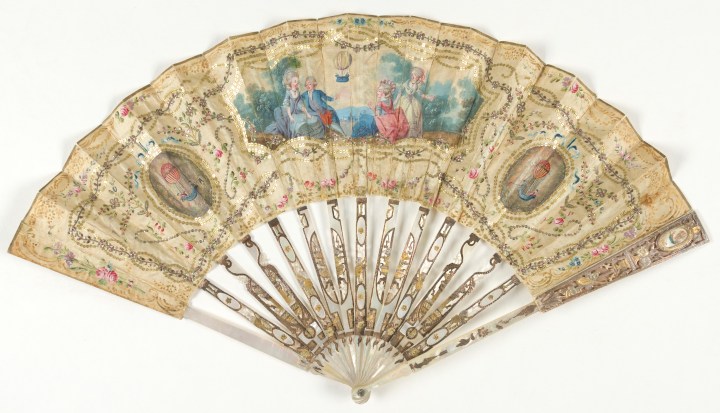
Late eighteenth-century fan showing three images of the first hydrogen balloon, flown by J. A. C. Charles and M. N. Robert in 1783. The sticks are carved Mother of Pearl (Evelyn Way Kendall Collection, National Air and Space Museum, Smithsonian Institution, WEB14851-2015).
◊ ◊ ◊ ◊ ◊
Press release (24 January 2017) from the National Air and Space Museum:
Clouds in a Bag: The Evelyn Way Kendall Ballooning and Early Aviation Collection
The Udvar-Hazy Center, Smithsonian National Air and Space Museum, Chantilly, Virginia, 28 January 2017 — 2018
Curated by Tom Crouch
The Smithsonian’s National Air and Space Museum opened the exhibition Clouds in a Bag: The Evelyn Way Kendall Ballooning and Early Aviation Collection on January 28 at the Steven F. Udvar-Hazy Center, in Chantilly, Virgnia. This is the first time these early aviation artifacts are on public display since the Smithsonian acquired the collection in 2014.
When the first balloon rose over the rooftops of Paris in the late 18th century, enormous crowds gathered to watch. This phenomenon spurred a new age of aeronauts dreaming of what else could fly. The excitement of this achievement was captured much like it would be today—in artwork and on memorabilia. Objects such as decorative fans, china, snuff boxes, and prints will be on display. Clouds in a Bag explores the fascination of the first balloon flights through these pieces.
“The invention of the balloon struck the men and women of the late 18th century like a thunderbolt,” said Tom Crouch, senior curator of aeronautics at the National Air and Space Museum. “After centuries of dreaming, we were airborne at last! Visitors to the exhibition will be able to share some of the excitement experienced by those who watched the first aerial travelers rise into the sky.”
The exhibition includes 51 prints, paintings and drawings, and 35 examples of 18th- and 19th-century memorabilia. This is a small portion of the collection of over 1,000 pieces in the Evelyn Way Kendall Ballooning and Early Aviation Collection, donated to the museum by the Norfolk Charitable Trust in 2014. The Norfolk Charitable Trust also supported the processing, conservation, and exhibition of the collection. Clouds in a Bag will be open through 2018.
The National Air and Space Museum building on the National Mall in Washington, D.C., is located at Sixth Street and Independence Avenue S.W. The museum’s Steven F. Udvar-Hazy Center is located in Chantilly, Virgnia, near Washington Dulles International Airport. Attendance at both buildings combined was 9 million in 2016, making it the most-visited museum in America.
New Book | Staging Blackness and Performing Whiteness
From Routledge:
Wendy Sutherland, Staging Blackness and Performing Whiteness in Eighteenth-Century German Drama (New York: Routledge, 2016), 272 pages, ISBN: 978 14094 24024, $150.
 Focusing on eighteenth-century cultural productions, Wendy Sutherland examines how representations of race in philosophy, anthropology, aesthetics, drama, and court painting influenced the construction of a white bourgeois German self. Sutherland positions her work within the framework of the transatlantic slave trade, showing that slavery, colonialism, and the triangular trade between Europe, West Africa, and the Caribbean function as the global stage on which German bourgeois dramas by Friedrich Wilhelm Ziegler, Ernst Lorenz Rathlef, and Theodor Körner (and a novella by Heinrich von Kleist on which Körner’s play was based) were performed against a backdrop of philosophical and anthropological influences. Plays had an important role in educating the rising bourgeois class in morality, Sutherland argues, with fathers and daughters offered as exemplary moral figures in contrast to the depraved aristocracy. At the same time, black female protagonists in nontraditional dramas represent the boundaries of physical beauty and marriage eligibility while also complicating ideas of moral beauty embodied in the concept of the beautiful soul. Her book offers convincing evidence that the eighteenth-century German stage grappled with the representation of blackness during the Age of Goethe, even though the German states were neither colonial powers nor direct participants in the slave trade.
Wendy Sutherland is Associate Professor of German at New College of Florida.
C O N T E N T S
Introduction
Race in Eighteenth-Century Germany
Slavery, Colonialism, and the Eighteenth-Century Global Stage
‘Looking at the Overlooked’: Stage Properties and the Table in Karl Lessing’s Die Mätresse (1780)
Excursus: The Court Moor and Eighteenth-Century Court Painting
The Construction of Whiteness in the Traditional German Bourgeois Drama
Race, Doubles, and Foils: Staging Blackness in Friedrich Wilhelm Ziegler’s Die Mohrinn (1801)
Race, Homosocial Desire, and the Black in Ernst Lorenz Rathlef’s Die Mohrinn zu Hamburg (1775)
Reading in the Dark? Racial Hierarchy and Miscegenation in Heinrich von Kleist’s Die Verlobung in St. Domingo (1811) and Theodor Körner’s Toni (1812)
Epilogue
Bibliography
Index
Call for Papers | Full Circle: The Medal in Art History
From H-ArtHist:
Full Circle: The Medal in Art History
The Frick Collection, New York, 8–9 September 2017
Proposals due by 1 March 2017
An invention of the Italian Renaissance inspired by ancient coins, medals were first created to commemorate individuals and significant events. Over time and as the art form flourished across Europe, they came to be made and to function in new ways, including to celebrate the éclat of the ruling class (and ascendance of the bourgeoisie), document achievements in the arts and sciences, and serve as a resource for the study of the distant past. The study of medals—too often overlooked in narratives of western art history—illuminates the aesthetic landscape of the five centuries in which they enjoyed wide popularity and provides vital insights into the social and political history of Europe. Medalists were celebrated members of the arts community, and medal making was not an isolated practice. Artists from Pisanello to Dürer to David d’Angers designed and/or produced medals alongside their paintings, prints, and sculptures. The medal has long been held to bridge these disciplines, and recent scholarship has begun to probe the rich intersections between medals and other arts.
On the occasion of the exhibition The Pursuit of Immortality: Masterpieces from the Scher Collection of Portrait Medals—which celebrates an initial gift to The Frick from the unparalleled collection of Stephen K. and Janie Woo Scher—and in honor of Stephen Scher’s contributions to the study of medals as a collector, curator, and scholar, The Frick Collection is organizing Full Circle: The Medal in Art History. This symposium builds upon the work of Scher and others who have sought to re-center the medal in art-historical discourse and to bring this important class of object to the attention of the broader scholarly community and the public.
We invite proposals for 20-minute papers focusing on any aspect of the production, collection, and interpretation of commemorative medals made from the fifteenth to the nineteenth century that situate them in relation to a broader artistic and cultural context. We strongly encourage submissions by emerging scholars to promote future research in this field. Please send an abstract (max. 250 words) and CV by Wednesday, 1 March 2017, to the conveners:
• Aimee Ng, Associate Curator, The Frick Collection, ang@frick.org
• Robert Wellington, Lecturer, Centre for Art History and Art Theory, Australian National University, robert.wellington@anu.edu.au
• Melanie Vandenbrouck, Curator of Art, Royal Museums Greenwich, MVandenbrouck@rmg.co.uk
Please include ‘The Medal in Art History: Proposal’ in the subject line.
Esther Bell Named Senior Curator of Clark Art Institute
Press release (January 2017) from The Clark:
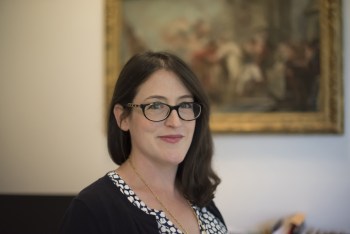 Esther Bell has been selected to serve as the Robert and Martha Berman Lipp Senior Curator of the Clark Art Institute in Williamstown, Massachusetts. Her appointment was announced today by Olivier Meslay, Felda and Dena Hardymon Director of the Clark.
Bell currently serves as the curator in charge of European paintings at the Fine Arts Museums of San Francisco, where she has organized a number of important exhibitions, including the recent critically acclaimed The Brothers Le Nain: Painters of Seventeenth-Century France, presented in partnership with the Kimbell Art Museum, Fort Worth, Texas and the Musée du Louvre. On February 25, Bell will open Monet: The Early Years at San Francisco’s Legion of Honor, an exhibition organized by the Kimbell in collaboration with the Fine Arts Museums of San Francisco.
“Esther Bell is one of the brightest curators working today,” said Meslay. “Her creativity, intellect, and scholarship are only equaled by her passion and energy for the diverse demands of curatorial work. Esther’s international experience and her deep expertise in French paintings will be of great importance in her work here at the Clark. We are delighted to welcome her as a colleague.”
Prior to joining the staff of the Fine Arts Museums in 2014, Bell was the curator of European paintings, drawings, and sculpture at the Cincinnati Art Museum. She began her career in New York, serving as a research assistant at the Metropolitan Museum of Art and as both a research assistant and curatorial fellow at the Morgan Museum and Library. In 2015, Apollo magazine named Bell as one of the top ten curators in North America under the age of forty.
Bell received her doctorate in the history of art from the Institute of Fine Arts, New York University, with a specialization in seventeenth- and eighteenth-century European art. She earned a master’s degree from the Williams College/Clark Graduate Program in the History of Art, and a bachelor’s degree in the history of art from the University of Virginia. She completed a Fulbright Fellowship at the Musée du Louvre in 2003, and held numerous fellowships, including those at New York University and the Metropolitan Museum of Art.
“I am honored to join the Clark Art Institute at this important moment in its history,” said Bell. “I have deep admiration for the Clark’s talented staff, world-class collections, its highly regarded Research and Academic Program, and, of course, the new and beautiful campus. While it is hard to leave the outstanding program and people at the Fine Arts Museums of San Francisco after such good years, the opportunity to return to Williamstown and be a part of the excitement of the new Clark was irresistible.”
During her tenure at the Fine Arts Museums of San Francisco, Bell has been responsible for a diverse array of exhibitions, including Botticelli to Braque: Masterpieces from the National Galleries of Scotland; J.M.W. Turner: Painting Set Free; and Pierre Bonnard: Painting Arcadia. She is the co-curator for Degas, Impressionism, and the Paris Millinery Trade, currently on view at the Saint Louis Art Museum and opening in San Francisco in June 2017. At the Cincinnati Art Museum, Bell’s curatorial work included the recently completed Van Gogh: Into the Undergrowth, as well as exhibitions on Peter Paul Rubens, Jacob Ruisdael, Edgar Degas, Pierre-Auguste Renoir, and François Boucher.
An accomplished scholar and author, Bell is a member of the editorial board of Journal18, a scholarly journal focused on eighteenth-century studies. She is the author and editor of a number of publications related to the exhibitions she has organized, and is regularly published in academic journals. Bell has delivered lectures in distinguished international venues such as the University of St. Andrews, Scotland; the Musée des Beaux-Arts, Nantes; the Institut National d’Histoire de l’Art, Paris; and the Metropolitan Museum of Art, New York.
Bell currently resides in San Francisco. She will begin her work at the Clark in July 2017.
Funding Streams for New Museum of London in West Smithfield

Architects Stanton Williams and Asif Khan were selected in July 2016 to design the new Museum of London; the design team also includes conservation architect Julian Harrap and landscape design consultant J&L Gibbons.
◊ ◊ ◊ ◊ ◊
Press release (24 January 2017) from the Museum of London:
The Museum of London’s plans for a new museum in West Smithfield were today given a major boost thanks to huge support from the City of London Corporation and the Mayor of London, who have pledged £110 million and £70 million respectively. This marks an important next step for the project, which will save one of the last remaining derelict Victorian buildings in central London and transform an area of the capital with a rich and fascinating history. The support from Sadiq Khan is the largest cultural investment made by any Mayor of London, and together with City of London Corporation’s unprecedented investment, provides a £180 million package of confirmed funding towards its approximate £250 million cost.
In addition to conserving this historically important West Smithfield site, this ambitious project will deliver significant economic and social benefits for London and Londoners. This includes traineeship opportunities across London and approximately 1,700 new jobs. Located right next to the major new transport hub to be created at Farringdon, the new museum will be ideally situated to make the most of London’s biggest infrastructure project, Crossrail, and help to turn the area into a dynamic destination. As part of a burgeoning cultural hub within the City, the new museum will aim to broaden its visitor profile and double its visitor attendance from one million to more than two million, displaying much more of its rich collection of over 6 million items, telling the 2,000-year story of London, in 8,000m2 of permanent gallery space plus 1,500m2 of temporary exhibition space.

Sadiq Khan, Mayor of London, who was touring the West Smithfield site, said: “From the outset of my Mayoralty, I pledged to make culture a core priority and I’m proud that this is the biggest ever cultural investment made by any Mayor of London to date. The world’s greatest city deserves the world’s greatest museum, which is why I’m delighted to announce £70 million of funding for the new Museum of London. This is on top of the £110m funding announced by the City of London Corporation. This major landmark project will be a jewel in our crown. It will reveal 2,000 years of fascinating London history for Londoners, visitors, and every schoolchild in the capital. It will rejuvenate West Smithfield, protecting its heritage while also creating a dynamic new public space—strengthening London’s credentials as an international powerhouse for culture.”
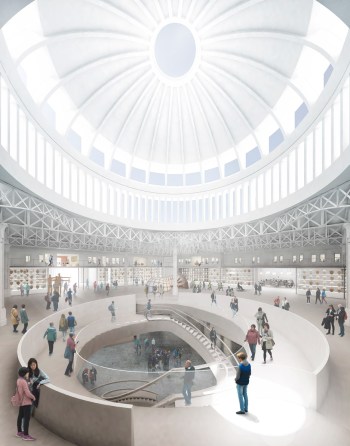 Mark Boleat, Chairman of the Policy and Resources Committee at the City of London Corporation, said: “It is widely recognised that the current building at London Wall does not allow the Museum to expand and flourish, and that the former market buildings are in a poor state of repair. The approval of this significant contribution makes good business sense and is a major step forward towards the creation of a new Museum of London, both iconic in design and unparalleled in the way in which it tells the capital’s vibrant history.”
Sharon Ament, Director of the Museum of London, said: “This is simply fantastic news and a great way to start 2017. The £180m funding package from the City of London Corporation and Mayor of London provides us with the perfect springboard for the fundraising drive for the new Museum of London at West Smithfield. It also shows that, like us and many others, the Mayor of London and City of London Corporation recognise the huge benefits for London that a new Museum of London at a rejuvenated West Smithfield will deliver. Working with our design team we can now move forward confidently with detailed plans for the new museum and remain firmly on target to open the new Museum in 2022.”
This funding milestone follows the appointment of the architects Stanton Williams and Asif Khan in July 2016. The design team, which also includes conservation architect Julian Harrap and landscape design consultant J&L Gibbons, is now working to turn the initial concepts into a fully formed vision for the new museum alongside the City of London Corporation and the GLA. This includes further analysis of the complex West Smithfield site, a critical piece of work that will feed into the design process. Following a full and extensive public consultation process, a planning application is expected in 2018 to enable the delivery of the new museum by 2022. Further appointments to the project team are due to be announced over the next few months.










 Enfilade
2 comments