Attingham: The London House Course, 2017

View of Soho Square in London, from Ackermann’s Repository of Arts, 1812
(Wikimedia Commons)
◊ ◊ ◊ ◊ ◊
From the programme flyer:
Attingham: The London House Course, 3–9 October 2017
Applications due by 12 April 2017
The programme studies the development of the London house from the Renaissance to the present. It combines numerous visits to houses—many of them private—with a series of lectures by leading authorities. Progressing chronologically and exploring all over London, the course takes members inside grand aristocratic buildings, smaller domestic houses, artists’ studios, and the garden suburb.
Beginning in the medieval period, the course starts with a visit to the Abbot’s House at Westminster (now the Deanery). The following day is spent at Lambeth Palace and the Charterhouse. The Restoration period and eighteenth centuries are explored in Bloomsbury and Spitalfields, before we spend the following day in the aristocratic grandeur of great houses in St. James’s. Day five focuses on the artists’ houses and studios of Chelsea and Holland Park. On day six we study the Garden Suburb and consider twentieth-century domestic developments. The course concludes with an in depth study of Sir John Soane’s house and a look at the London house in the twenty-first century. Speakers include Neil Burton, Caroline Dakers, Joseph Friedman, Sarah Nichols, and Gavin Stamp. The course is directed by David Adshead.
The fee for the course is £1280. This is a non-residential course, which will include all lunches, travel by coach, admission fees, and receptions on a few evenings. All applications should be received by 12th April 2017. Candidates will be informed by 30th April 2017. For further information please consult the Attingham website or contact Rebecca Parker, rebecca.parker@attinghamtrust.org.
Call for Papers | The Room Where It Happens
From the Call for Papers:
The Room Where It Happens: On the Agency of Interior Spaces
The Harvard Art Museums, Cambridge, 13–14 October 2017
Proposals due by 15 April 2017
Keynote Speaker: Louis Nelson, University of Virginia
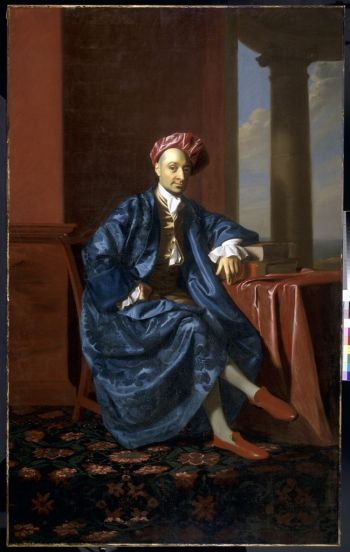
John Singleton Copley, Portrait of Nicholas Boylston, 1773, oil on canvas (The Harvard Art Museums, Painted at the request of the Harvard Corporation, 1773, H20).
This symposium, held in conjunction with the Harvard Art Museum’s forthcoming exhibition, The Philosophy Chamber: Art and Science in Harvard’s Teaching Cabinet, 1766–1820, seeks papers that investigate spaces of artistic, artisanal, and intellectual production throughout global history. From artist’s studios to experimental laboratories, from offices to political chambers, rooms and their contents have long impacted history and transformed their inhabitants. We invite case studies that address questions like the following: How might an assemblage of objects within a given space intersect or clash with ideological narratives? How have secret or privileged rooms, or rooms to which access is limited, served to obfuscate and facilitate the generation and dissemination of ideas? As historians and critics, how should we interpret and recreate such spaces—many of which no longer exist?
The Philosophy Chamber exhibition, on view at the Harvard Art Museums from May 19 to December 31, 2017, will explore the history and collections of one of the most unusual rooms in early America. Between 1766 and 1820, the Philosophy Chamber, a grand room adjacent to the College Library on Harvard’s Campus, was home to more than one thousand artifacts, images and specimens. Named for the discipline of Natural Philosophy, a cornerstone of the college’s Enlightenment-era curriculum that wove together astronomy, mathematics, physics, and other sciences interrogating natural objects and physical phenomena, the Philosophy Chamber served as a lecture hall, experimental lab, picture gallery and convening space. Frequented by an array of artists, scientists, travelers, and revolutionaries, the room and its collections stood at the center of artistic and scholarly life at Harvard and the New England region for more than fifty years. The exhibition considers the wide-ranging conversations, debates, and ideas that animated this grand room and the objects and architectural elements that shaped, supported or unintentionally undermined these discourses.
Potential case study ‘rooms’ include:
• Teaching cabinets
• Workshops
• Civic spaces
• Laboratories
• Domestic spaces
• Toxic rooms
• Secret rooms
• Studies or offices
• Artist studios
• Theaters
• Classrooms or lecture halls
• Chatrooms or other digital ‘rooms’ and platforms
• Museum and gallery installations
• Exchanges
• Train Stations
• Ruins, war-torn rooms
Due the interdisciplinary nature of this symposium, we welcome proposals from a variety of fields, including art history, architectural history, material culture studies, history, English and literature studies, American studies, anthropology, and archaeology, as well as the fine arts. To apply, please submit a 300-word abstract and two-page CV to laura_igoe@harvard.edu by April 15, 2017.
Display | Batoni, the Rezzonico Family, and Occasional Portraiture
This new acquisition is now on view at the Palazzo Barberini:
The Painter and the Great Lord: Batoni, the Rezzonico Family, and Occasional Portraiture
Il pittore e il gran signore: Batoni, i Rezzonico e il ritratto d’occasione
Palazzo Barberini, Rome, 11 January — 23 April 2017

Pompeo Batoni, Portrait of Abbondio Rezzonico, Palazzo Barberini, 1766.
Prince Abbondio Rezzonico returns to Rome. In 2016 the Italian state acquired from the heirs of the Rezzonico family the striking portrait of the Senator of Rome, painted by Pompeo Batoni in 1766 on the occasion of his triumphal entry to Palazzo Senatorio on the Capitol. Abbondio Rezzonico (1742–1810), a member of a noble Venetian family and nephew of Pope Clement XIII, was appointed in 1765 to the rank of Senator—one of the most important magistracies in the city’s government. The portrait, commissioned from Pompeo Batoni (1708–1787), was celebrates this solemn occasion. The canvas will be displayed with a small group of other works illustrating the social context of the painting as well as the artist’s output. Visitors will be able to compare two portraits of Pope Clement XIII Rezzonico, one by Batoni and the other splendidly painted by his talented rival, Anton Raphael Mengs. The latter work is on loan from the Pinacoteca Nazionale of Bologna. Together with these two portraits there will be other works from the National Gallery’s collection of eighteenth-century paintings, not always on display. They include the elegant portraits of Count Soderini and Sir Henry Peirse by Batoni and the exceptional portrait of the Governor Robert Clive by Anton von Maron.
UK Export Ban Placed on Mughal Flask and Huqqa Set
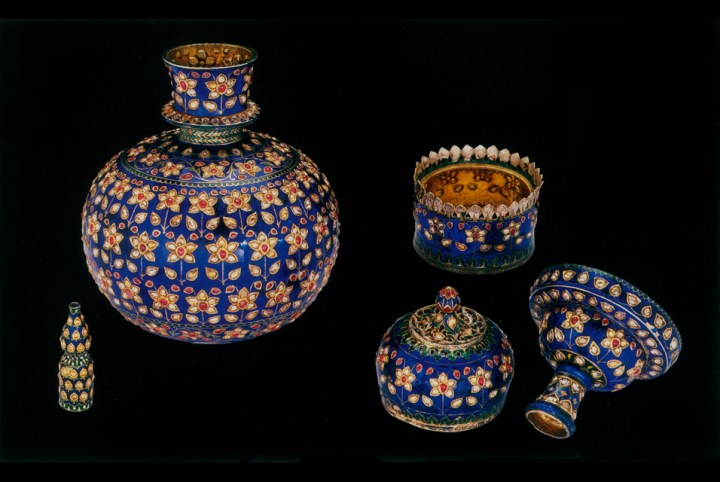
Silver huqqa set made up of five separate parts: 1) globular base, ht. 16.9 cm; 2) tobacco bowl, ht. 9 cm and 3) its cover, ht. 7 cm; 4) ring, ht. 5 cm; 5) mouthpiece, ht. 6.5 cm, North India, ca. 1750.
◊ ◊ ◊ ◊ ◊
Press release (18 January 2017) from Gov.UK’s Department for Culture, Media & Sport:
Culture Minister Matt Hancock has placed a temporary export bar on Clive of India’s huqqa set and flask to provide an opportunity to keep them in the country. The Mughal ruby and emerald flask and the sapphire and ruby huqqa set are both at risk of being exported from the UK unless a buyer can be found to match the asking price of £6,000,000 for the flask or £240,000 for the huqqa set.

Wine flask made of jade, lined with silver and set with rubies and emeralds; 25.3 × 11.2 cm, India, 17th century.
It is believed that Robert Clive, also known as Clive of India, was presented with the flask as a gift following the Battle of Plassey. Clive was governor and commander-in-chief of India and became famous for his victory over the Nawab of Bengal during the battle in 1757. The flask itself is incredibly rare and there is no other object like it anywhere in the world, let alone in Britain. It has a silver interior and a gold exterior decorated in jade, emeralds and rubies. Clive of India also brought the huqqa set back to the UK from India. Set with white sapphires and rubies, it was part of an original collection at the imperial court in Delhi. The huqqa set is considered to be an extremely rare survival as such lavish courtly objects were often broken down for their component parts. It isn’t known how Clive of India acquired the set, but smoking was widespread in India at the time and had become popular amongst the British living there as well. In fact, the British often had themselves portrayed in paintings reclining against brocade-covered bolsters on a terrace, peacefully smoking.
Minister of State for Digital and Culture Matt Hancock said: “These treasures are not only exquisite, they provide us with a glimpse into the fascinating lifestyle and traditions of the Mughal Court and the British presence in India at the time. I hope that we are able to keep these unique artefacts in the country to learn more about this extraordinary history.”
The decision to defer the export licence follows a recommendation by the Reviewing Committee on the Export of Works of Art and Objects of Cultural Interest (RCEWA), administered by The Arts Council. The RCEWA made its recommendation on the flask on the grounds of its close connection with our history and national life, its aesthetic importance and its outstanding significance for the study of Mughal political and technical history, the consumption of wine and gift-giving in Mughal India, Clive of India and the British expansion in India. The RCEWA made its recommendation on the huqqa set on the grounds of its close connection with our history and national life and on the grounds of its outstanding significance for the study of Mughal court arts, gold and silver-smithing, jewel-setting, enamelling, and the place of tobacco in the social etiquette of early modern India and its adoption by British administrators in the later 18th century.
Sir Hayden Phillips, Chairman of the RCEWA said: “Apart from the intrinsic quality of these objects, and their outstanding importance for scholarship, the Reviewing Committee was unanimous in its recognition of their emblematic significance for our history and national life. Robert Clive was an outstanding and, indeed, controversial figure, but absolutely central to the creation of British rule in India. His statue, gazing out towards St James’s Park, stands guard at Clive Steps as they lead to the Foreign Office and The Treasury; a tellingly symbolic location for what he contributed to our history.”
The decision on the export licence application for the flask will be deferred until 17 May 2017. This may be extended until 17 November 2017 if a serious intention to raise funds to purchase it is made at the recommended price of £6,000,000 (plus VAT of £1,200,000). The decision on the export licence application for the huqqa set will be deferred until 17 April 2017. This may be extended until 17 July 2017 if a serious intention to raise funds to purchase it is made at the recommended price of £240,000 (plus VAT of £48,000). Organisations or individuals interested in purchasing the flask or huqqa set should contact the RCEWA.
◊ ◊ ◊ ◊ ◊
Note (added 24 February 2017) — This ban comes thirteen years after “an earlier attempt to send” the objects “from the UK to Qatar,” as reported by The Art Newspaper (February 2017), p. 10. “After the Qataris withdrew the export licence applications in 2005, they were required to keep the objects in the UK and so lent the flask and huqqa to the V&A. Last year, the museum learned that the loan agreement would not be renewed. Qatar Museums wants to display them in Doha’s Museum of Islamic Art.”
Conference | Private Collecting and Public Display

Frederick MacKenzie, The National Gallery When at Mr J. J. Angerstein’s House, Pall Mall, 1824–34, watercolour
(London: V&A, 40-1887)
◊ ◊ ◊ ◊ ◊
From the conference programme:
Private Collecting and Public Display: Art Markets and Museums
University of Leeds, 30–31 March 2017
Registration due by 20 March 2017
The Centre for the Study of the Art and Antiques Market at the University of Leeds is delighted to announce that registration is now open for an international two-day conference exploring the relationship between the ‘private’ and ‘public’ spheres of the art market and the museum. This interdisciplinary conference offers the opportunity to hear new research in the fields of art market studies, museum studies, and the histories of collecting. Registration information is available here. For any further information, please contact csaa@leeds.ac.uk.
T H U R S D A Y , 3 0 M A R C H 2 0 1 7
9.00 Registration
9.30 Welcome, Mark Westgarth, Director, Centre for the Study of the Art & Antiques Market, University of Leeds
9.45 I | Birth of the Museum
• Marie Tavinor (Christie’s Education, London), The ‘Potent Tate’ and the Founding of the Tate Gallery: An Insight into Taste and the Politics of Donation in Late Victorian England
• Margaraet Iacono (The Frick Collection, New York), Going Public: The Frick Collection’s Transformation from Private Home to House Museum
• Helen Glaister (Victoria & Albert Museum, London), From Buxted Park to South Kensington and Beyond: The Ionides Collection of Chinese Export Porcelain
11.00 Coffee and tea
11.30 II | Legacy through Display: From Private to Public
• Nicole Cochrane (University of Hull), Ancient Sculpture and the Narratives of Collecting: (Re)Contextualizing Museum Space
• Alison Clarke (University of Liverpool / National Gallery London), Pure Eighteenth-Century Art Unspoiled by Any Element Foreign to Its Nature: The Agnew’s Exhibitions of The Frick Fragonards
• Isobel MacDonald (University of Glasgow / The Burrell Collection), Tracing The Development of the Burrell Collection from Deed of Gift (1944) to Pollok Park, Glasgow (Present Day)
12.45 Lunch
1.45 III | Dealers and Markets: Thinking of the Past, Looking towards the Future
• Pamella Guerdat (University of Neuchatel, Paris), A Heritage under Construction: René Gimpel’s (1881–1945) Roles between Private Collectors and Public Museums
• Ana Mântua (Dr Anastácio Gonçalves House Museum, Lisbon), One Man’s Choices and the Portuguese Art Market, 1925–1965
• Kerry Harker and John Wright (University of Leeds), Blurring the Boundaries: Reconsidering ‘Public’ and ‘Private’ in the Alternative Art Market Activities of Artist-Led Groups, Organisations, and Collectives
3.00 IV | Power, Influence, and Agency: A Critical Look at Private Collections Going Public
• Pier Paolo (IES Abroad Italy, Rome), From Objects of Devotion to Icons of Beauty: The Institution of the National Museum in the Vatican at the Time of the Roman Republic, 1798–99
• Verda Bingol (Istanbul Technical University), From the Cradle to the Museum: The Elgiz Collection
• Dorothy Barenscott (Independent Art Historian), Steve Wynn: Art Collecting and Exhibition, ‘Vegas Style’
4.15 Coffee and tea
4.45 Keynote Address
• Susanna Avery-Quash, Senior Research Curator (History of Collecting), National Gallery London
6.00 Drinks Reception
F R I D A Y , 3 1 M A R C H 2 0 1 7
9.00 Registration
9.40 V | The Visibility of Private Collections within the Public Arena
• Marcela Drien (Universidad Adolfo Ibáñez, Chile), Exhibiting Domestic Museums: Chilean Art Collectors at Santiago’s Exposicion Internacional of 1875
• Rasmus Kjaerboe (Ribe Art Museum, Denmark), Collecting To Be Modern: The Early Twentieth-Century Art Collections of Prince Eugen, Ernest Thiel, and Klas Fåhraeus
• Kathryn Brown (University of Loughborough), Patrimony and Patronage: Collecting and Exhibiting Contemporary Art in France
11.00 Coffee and tea
11.30 VI | Museum Quality? Deaccessioning Museums onto the Art Market
• Gareth Fletcher (Sotheby’s Institute of Art, London), But Is It Really Museum Quality? – Evaluating the Impact of Institutional Provenance within the International Art Market
• Nicola Sinclair (University of York), ‘You Have Culled One or Two Beauties But the Memorial of Art Is Gone’: How (Not) To Translate Paintings of Historical Value from Private to Public Collections and back again in Mid-Nineteenth-Century Britain
• Martin Hartung (ETH Zürich, Switzerland), A Philanthropic Legacy: The Controversial Case of DIA in New York
12.45 Lunch
1.45 VII | Private Collections and Public Museums: Working across Boundaries
• Kate Beats (University of Cambridge), Cambridge’s First Museums: The Private College Collections behind the Public Museums in Cambridge
• Helen Ritchie (Fitzwilliam Museum, Cambridge), The Frua-Valsecchi Collection at The Fitzwilliam Museum: A Case Study
• Tom Boggis (Holburne Museum, Bath), Public Collection, Private House: Display of the Heveningham Furniture Collection in the Twentieth Century
3:00 Coffee and tea
3.30 Round Table Discussion
5.00 Closing Remarks
Workshop | The Pencheon Collection in Context

From the workshop flyer:
The Pencheon Collection in Context: Collecting and Recollecting the French Revolution
University of Leeds, 17 March 2017
The Pencheon Collection in the Brotherton Library, University of Leeds, of material relating to the French Revolution contains nearly 3,000 volumes in French and English along with boxes of miscellaneous items—manuscripts, pamphlets, prints, maps, booksellers’ catalogues, newspaper clippings, correspondence and additional ephemera—many of them related to the process of collection. It was created by James Michael Pencheon (1924–1982), a neurosurgeon and psychiatrist, who had studied medicine at the University of Leeds but who then developed an interest in the historical knowledge of the French Revolution ostensibly outside his disciplinary field, but perhaps inflected by his research in psychology. This resource raises questions about the formation of the cultural memory of the French Revolution in Britain, about the role and approach of individual collectors of materials on the French Revolution, and about what can be learnt about the acquisitions policies and subsequent use of such collections in university libraries. This workshop will enable networking about the collection and its use to begin.
Speakers—including Madame Valérie Guillaume, Directrice of the Musée Carnavalet, Paris, and leading UK specialists from the fields of History, History of Art, and French Studies—will give short presentations on their work on analogous collections, sharing insights and ideas and helping us to refine our aims and objectives for the future exploitation of the collection. All are welcome to attend. The £20 cost includes lunch and refreshments. Registration information is available here.
Contacts: Dr Valerie Mainz, v.s.mainz@leeds.ac.uk; and Dr Paul Rowe: P.Rowe@leeds.ac.uk
In collaboration with the Institut français du Royaume-Uni and the Centre for the Comparative History of Print (CentreCHoP)
◊ ◊ ◊ ◊ ◊
P R O G R A M M E
10.00 Introduction
• Valerie Mainz, School of Fine Art, History of Art and Cultural Studies, University of Leeds
• Paul Rowe, School of Languages, Cultures and Societies, University of Leeds
10.15 French Revolutionary Collections in Britain, 1: The Contexts and Methodological Challenges
• Tom Stammers, Department of History, University of Durham/Bowes Museum
• Richard Taws, Department of History of Art, UCL London/UCL prints
11.15 Coffee
11.30 Plenary: The Musée Carnavalet and the Collecting of the French Revolution in France
• Valérie Guillaume, Directrice, Musée Carnavalet
12.15 French Revolutionary Collections in Britain, 2: The Contexts and Methodological Challenges
• Kate Astbury, School of Modern Languages and Cultures, University of Warwick/Marandet Collection
• Phillippa Plock, Waddesdon Manor/Ferdinand de Rothschild Collection
13.15 Lunch
14.15 The French Revolution in Britain: Historians’ Perspectives
• Munro Price, Department of Peace Studies and International Development, University of Bradford
• Juliette Réboul, Historical, Literary and Cultural Studies, Radboud University, Nijmegen/Emigrés and memoirs
15.15 The Psychopathology of the French Revolution
• Mechthild Fend, Department of History of Art, UCL London
15.45 Round Table: The Potential of the Pencheon Collection and Next Steps
• The Pencheon Collection as a resource for researchers
• Studying the Pencheon Collection: UG, PGT, PGR
• Public engagement
• Impact
• What are the priorities?
CAA 2017, New York: Memorial Session for Mary Sheriff
In addition to this year’s regular CAA offerings, the schedule includes a memorial session for Mary Sheriff (other Enfilade postings for CAA 2017 have been updated with the addition). The session is open to the public, and no conference registration is required to attend. Tara Zanardi’s session ‘Superpowers in the Global Eighteenth Century: Empire, Colonialism, and Cultural Contact’ (Friday, 17 February 2017, 10:30–12:00) will also be dedicated to Mary.
Beyond CAA, other events are planned, including two symposia in conjunction with the exhibition Becoming a Woman in the Age of Enlightenment, curated by Mary Sheriff and Melissa Hyde. In addition, there’s a gathering in Paris at INHA scheduled for Saturday, February 25 at 3:30 in the Salle Mariette.
Key Conversation: Mary Sheriff (1950–2016): A Memorial Session
Saturday, 18 February 2017, 12:15–1:15, Madison Suite, 2nd Floor
Chair: Francesca Fiorani (University of Virginia)
Join this session to remember Mary Sheriff. Come together, share memories, and celebrate her achievements.
◊ ◊ ◊ ◊ ◊
Note (added 26 January) — The original posting listed an incorrect date for the Paris event; it’s been corrected.
Round Table | Les femmes artistes au XVIIIe et XIXe siècles
From INHA:
Les femmes artistes au XVIIIe et XIXe siècles
Columbia Global Centers, Paris, 26 January 2017
Table-ronde animée par Anne Lafont (INHA/LEGS/CNRS) avec Charlotte Foucher-Zarmanian et Séverine Sofio
Deux monographies viennent de paraître sur la question des femmes artistes et/ou des artistes femmes dans les mondes de l’art français des XVIIIe, XIXe et XXe siècles. Écrits par deux historiennes de l’art et chercheuses au CNRS : Charlotte Foucher-Zarmanian et Séverine Sofio, ces livres, forts d’une historiographie artistique abondante et conflictuelle, reposent, de manière inédite et dans un débat en français, la question de l’histoire des femmes, des études de genre, des approches quantitatives, de l’interprétation des imaginaires, mais aussi du statut social et professionnel dans le milieu de l’art. Quels sont les jalons posés par ces deux ouvrages qui ouvrent à une nouvelle histoire de l’art travaillée par les études de genre ?
Jeudi, 26 Janvier 2017, 18h30
New Book | Artistes femmes
From CNRS:
Séverine Sofio, Artistes femmes: La parenthèse enchantée, XVIIIe–XIXe siècles (Paris, CNRS, 2016), 384 pages, ISBN: 978 2271 091918, 25€.
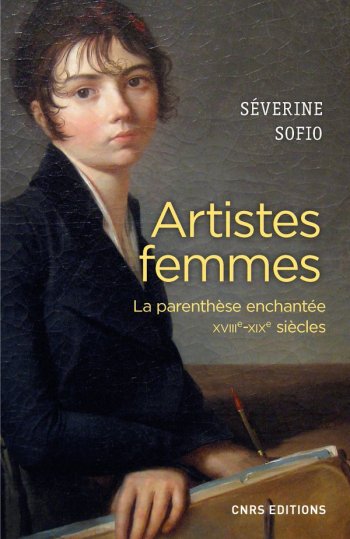 Entre 1750 et 1850, l’univers des beaux-arts connaît de profondes mutations, dont l’une des conséquences est la banalisation d’une image positive de la dame artiste. Progressivement, des barrières s’abaissent, des contraintes se desserrent et la pratique de la peinture est rendue plus accessible aux femmes. S’ouvre alors une période de créativité foisonnante associée aux noms—parfois oubliés aujourd’hui—d’Elisabeth Vigée-Lebrun, Adélaïde Labille-Guiard, Marie-Guillemine Benoist, Marguerite Gérard, Constance Mayer, Victoire Jaquotot, Lizinka de Mirbel, Rosa Bonheur…
Pourquoi les artistes femmes, à ce moment précis de l’histoire, ont-elles bénéficié de l’intérêt de leurs contemporains et de conditions de travail relativement égalitaires ? Pour saisir ce phénomène, Séverine Sofio réintègre les artistes des deux sexes dans la réalité quotidienne de leur travail de création.
Ni recueil d’analyses d’œuvres, ni histoire des femmes dans l’art, cet ouvrage traite de la pratique des beaux-arts, de son organisation et de ses réalités professionnelles, institutionnelles et économiques. Cette suspension relative de l’infériorisation des femmes dans les beaux-arts n’en demeure pas moins provisoire : si la parenthèse s’ouvre timidement dans les dernières décennies de l’Ancien Régime, elle se referme progressivement avant le milieu du siècle suivant.
Sociologue, diplômée de l’École du Louvre, Séverine Sofio est chargée de recherche au CNRS. Elle a notamment co-dirigé, avec Wenceslas Lizé et Delphine Naudier, Les Stratèges de la notoriété. Intermédiaires et production de la valeur dans les univers artistiques (2014).
Call for Nominations | Schulman and Bullard Article Prize from APS
From APS:
Schulman and Bullard Prize for an Outstanding Article on Printmaking
Nominations due by 31 January 2017
The Association of Print Scholars invites applications for the Schulman and Bullard Article Prize. The Prize is given annually to an article published by an early-career scholar that features compelling and innovative research on fine art prints or printmaking (versus printed matter). The award, which carries a $2,000 prize, is generously sponsored by Susan Schulman and Carolyn Bullard. Following the mission of the Association of Print Scholars, articles can feature aspects of printmaking across any geographic region and all chronological periods. Articles will be evaluated by a panel of advanced scholars and print experts for the author’s commitment to the use of original research and the article’s overall contribution to the field of print scholarship.
The Association of Print Scholars invites nominations and self-nominations for the 2017 Schulman/Bullard Article Prize meeting the following criteria:
• Authors must have graduated with an MA, MFA, or PhD fewer than 10 years prior to article publication and have less than 10 years of experience as a practicing professional in an academic or museum institution or as an independent scholar.
• Authors must be current members of APS.
• Articles must have been published in a journal, exhibition catalogue, or anthology between January 1, 2016 and December 31, 2016. Online publications will be considered on a case-by-case basis.
• Articles must be between 3,000 and 10,000 words, inclusive of footnotes and references.
• Entries for consideration must be in English, though the text of the original article may be in any language.
To submit an article for consideration, please send the completed nomination form along with an electronic copy of the article to Angela Campbell, the APS Grants Coordinator, angela@printscholars.org.










 Enfilade
leave a comment