New Book | Tudor Place: America’s Story Lives Here

The north facade and back gardens of Tudor Place, Washington, D.C. (Georgetown). The house was built in 1816–17 by Thomas and Martha Parke Custis Peter with William Thornton (Photo: Wikimedia Commons, December 2011).
◊ ◊ ◊ ◊ ◊
From The White House Historical Association:
Leslie Buhler, ed., with photography by Bruce White, Tudor Place: America’s Story Lives Here (Washington, D.C., The White House Historical Association, 2016), 304 pages, ISBN: 978 1931 917568 $50.
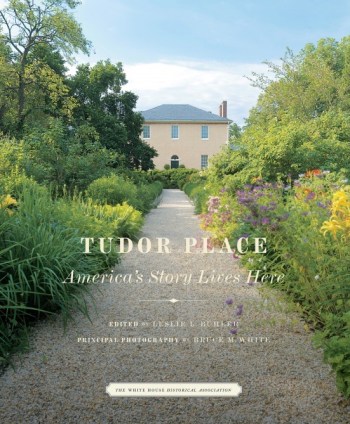 Released to mark the bicentennial of Tudor Place, this new title is the first comprehensive record of this important National Historic Landmark in the Georgetown neighborhood of Washington, D.C. Two grand houses were under construction in the young Federal City in 1816: one the President’s House, reconstructed after it was burned by the British in 1814, and the other Tudor Place, an elegant mansion rising on the heights above Georgetown. The connection between these two houses is more than temporal, as they were connected through lineage and politics for generations. The builders of Tudor Place were Thomas and Martha Parke Custis Peter, Martha Washington’s granddaughter. In the 1790s George Washington had been a frequent guest at the Peters’ townhouse when he was in the nascent Federal City, attending to its planning and selecting sites for the U.S. Capitol and the President’s House. In 1817, when President James Monroe moved back into the reconstructed President’s House following the fire of 1814, the Peters were completing their own grand home, Tudor Place, designed in concert with their friend, Dr. William Thornton, architect for the first U.S. Capitol Building. The White House and Tudor Place each represent the spirit and aspirations of the early Republic. Little more than two miles apart, each survives as a national architectural landmark. While the White House is perhaps the most well known building in the world, Tudor Place remained a family home until 1983 and very private, although the Peters welcomed some of the nation’s foremost leaders as their guests and were themselves guests at the White House.
Now a historic house and garden museum (open to the public since 1988), the house remains as the Peters lived in it, preserving spaces and belongings of many eras while adapting their home and landscape to contemporary fashion and functions. This year, as Tudor Place turns 200, this lavishly illustrated book—the first definitive history of the house and its collection—takes us into the house to explore its rooms, gardens, archival collections, and such rare artifacts as one of only three surviving letters from George to Martha Washington.
Leslie L. Buhler served as Executive Director of Tudor Place for 15 years, retiring in 2015.
◊ ◊ ◊ ◊ ◊
C O N T E N T S
• Joseph Ellis, Introduction
• Leslie Buhler, The Custis-Peter Family of Georgetown
• William C. Allen, An Architectural History of Tudor Place
• Patricia Marie O’Donnell, The Landscape of Tudor Place
• Erin Kuykenall and Leslie Buhler, Living at Tudor Place
New Book | Black Georgetown Remembered
From Georgetown UP:
Kathleen Menzie Lesko, Valerie Babb, and Carroll R. Gibbs, Black Georgetown Remembered: A History of Its Black Community from the Founding of ‘The Town of George’ in 1751 to the Present Day (Washington, D.C.: Georgetown University Press, 2016), 232 pages, ISBN: 978 1626 163263, $28.
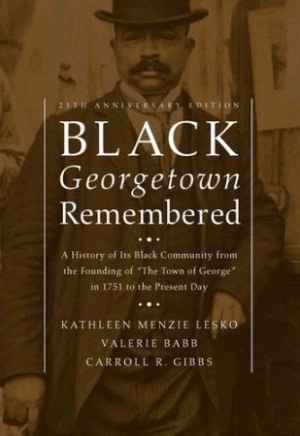 First published in 1991, Black Georgetown Remembered chronicles and celebrates the rich but little-known history of the Georgetown black community from the colonial period to the present. Drawing on primary sources, including oral interviews with past and current residents and extensive research in church and historical society archives, the authors record the hopes, dreams, disappointments, and successes of a vibrant neighborhood as it persevered through slavery and segregation, war and peace, prosperity and depression.
This 25th anniversary edition of Black Georgetown Remembered—with a new introduction by Kathleen Menzie Lesko and a foreword by Maurice Jackson—is completely redesigned and features high-quality scans of more than two hundred illustrations, including portraits of prominent community leaders, sketches, maps, and nineteenth-century and contemporary photographs. Kathleen Menzie Lesko’s new introduction describes the impact of this book.
Black Georgetown Remembered is a compelling and inspiring journey through more than two hundred years of history. It invites readers to share in the lives, dreams, aspirations, struggles, and triumphs of real people, to join them in their churches, at home, and on the street, and to consider how the unique heritage of this neighborhood intersects and contributes to broader themes in African American and Washington, DC, history and urban studies.
Kathleen Menzie Lesko is a former scholar-in-residence at the Folger Shakespeare Library and current research scholar at the Huntington Library in San Marino, California.
Valerie Babb is the Franklin Professor of English and director of the Institute for African American Studies at the University of Georgia.
Carroll R. Gibbs is a professional historian, lecturer, and author of numerous works on African American history.
New Book | Les progrès de l’industrie perfectionnée
This collection of essays grows out of the conference 2014, Workshops and Manufactures in the Years between the French Revolution and the Napoleonic Empire, 1789–1815. From PUM:
Natacha Coquery, Jörg Ebeling, Anne Perrin Khelissa, Philippe Sénéchal, eds., «Les progrès de l’industrie perfectionnée»: Luxe, arts décoratifs et innovation de la Révolution française au Premier Empire (Toulouse: Presses Universitaires du Midi, 2017), 200 pages, ISBN: 978 28107 04835, 22€.
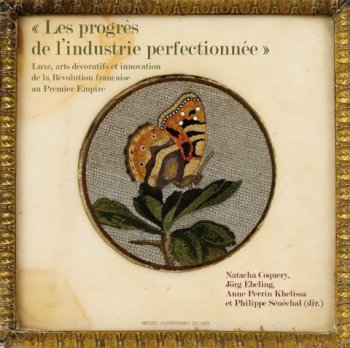 À la charnière entre les XVIIIe et XIXe siècles, entre la réunion des États généraux et la fin du Premier Empire, vingt-cinq ans s’écoulent pendant lesquels bouleversements politiques, économiques, sociaux et culturels créent un contexte d’instabilité pour le secteur du luxe et du demi-luxe français. Les ateliers et les manufactures sont confrontés à des conditions matérielles et organisationnelles difficiles. Le manque de matières premières, la détérioration des finances et la diminution du personnel en raison du départ des jeunes hommes aux armées ont un impact négatif sur la production artisanale. L’incertitude générale que représente cette période d’instabilité politique et de conflits armés n’empêche pourtant pas l’émergence de modes. De nouveaux marchés s’ouvrent et offrent de riches opportunités aux artistes et artisans pour diversifier et élargir leurs créations.
Souvent considérée comme un temps de rupture, en particulier dans le domaine du luxe dont elle remet en cause les fondements, la Révolution française apparaît au contraire comme le ferment d’une évolution vers l’innovation et l’industrialisation. Pluridisciplinaire, croisant l’histoire de l’art, l’histoire sociale, l’histoire économique, l’histoire culturelle et l’histoire des techniques, le présent ouvrage explore les conditions du changement et offre une approche plurielle des arts du décor.
T A B L E D E S M A T I È R E S
Remerciements
Introduction générale, Jean-François Belhoste, Philippe Bordes, Natacha Coquery, Jörg Ebeling, Anne Perrin Khelissa et Philippe Sénéchal
Partie I | L’État: Rôle et intervention
• Thomas Le Roux, La chimie, support du développement de l’industrie perfectionnée sous la Révolution et l’Empire
• Christiane Demeulenaere-Douyère, Le luxe sous l’Empire, ou la question des matières premières « indigènes »
• Camilla Murgia, The Crafty Link: Fine Arts and Industrial Exhibitions under the Consulate and the Empire
• Justin Beaugrand-Fortunel, Le mobilier de campagne de Napoléon ier: L’artisanat au service de l’Empereur
Partie II | Les secteurs de production: Organisation et fonctionnement
• Marie-Agnès Dequidt, L’horlogerie parisienne pendant la Révolution et l’Empire: Continuer à tourner dans un monde en bouleversement
• Élodie Voillot, Des canons aux statuettes: Les fabricants de bronze parisiens au début du xixe siècle
• David Celetti, Filer le luxe. Travail domestique, manufactures et usines dans la France révolutionnaire
• Stéphane Piques, L’organisation de la production dans l’industrie céramique sous la Révolution et l’Empire: La nébuleuse faïencière de Martres-Tolosane (Haute-Garonne)
Partie III | Les œuvres et les décors: Création et aménagement
• Bernard Jacqué, Des décors de luxe en papier peint pendant la Révolution française
• Valeria Mirra, Labor omnia vincit: La manufacture Piranesi de vases et ornements en terre cuite de Mortefontaine
• Iris Moon, Immutable Décor: Post-Revolutionary Luxury in the Platinum Cabinet at Aranjuez
• Ludmila Budrina, Lapidaires parisiens au service de Nicolas Demidoff: La collection d’objets en bronze doré et malachite avec mosaïques en relief de pierres dures réalisés par Thomire (d’après des documents inédits et les collections européennes)
• Hans Ottomeyer, Innovation by Design as Strategy for Luxury Goods
Index général
Bibliographie
Présentation des auteurs
Call for Papers | Fashion and Textiles between France and England


Matthew Darly, The Flower Garden, etching and engraving with watercolor, London, 1 May 1777 (New York: The Metropolitan Museum of Art); and wool sampler embroidered with silk, by Elizabeth Hawkins, Miss Powell’s Boarding School, Plymouth, England, 1797 (London: V&A).
◊ ◊ ◊ ◊ ◊
From the conference website:
Moving Beyond Paris and London: Influences, Circulation, and Rivalries
in Fashion and Textiles between France and England, 1700–1914
Au-delà de Paris – Londres: influences, circulations, rivalités
dans la mode et le textile. France-Angleterre, 1700–1914
Paris, 13–14 October 2017
Proposals due by 28 February 2017
The Séminaire Histoire de la mode (IHTP/CNRS) and the LARCA (Université Paris Diderot) are organizing a joint international conference in Paris, 13–14 October 2017: Moving Beyond Paris-London: Circulation and Exchange in Fashion and Textiles between France and England, 1700–1914. This conference is the latest in a series on cultural exchanges in fashion, which have included Haute Couture: Fashion and Consumption, France and England, 1947–1957 (11 April 2014), Franco-American Exchanges in Fashion (15 April 2016), and Franco-German Exchanges in Fashion (10–12 October 2016).
By looking closely at the relationship—at times friendly, at times not—between France and England through fashion and textiles between 1700 and 1914, this conference will touch on a number of topics, including: the circulation (lawful or illicit) of knowledge, individuals, and objects; the diffusion—and cross-fertilization—of design models between the two countries via press, engravings, or fashion dolls; the importation of textiles and clothing; the phenomena of copying, espionage, and counterfeits; the pursuit of protectionist policies which aimed to limit imports from the rival nation. Particular attention will be given to the different temporalities of industrialization of the two countries as a way to understand innovation and the progressive organization of professions in each. The comparison between the evolution of the two countries will also take into account examples of transfers across them such as with Charles Frederick Worth, the British designer who came to France in 1858 to open a couture house that rapidly became the symbol of haute couture in Paris.
These questions seek to examine the myriad ways in which fashion and textiles strengthened or frayed the political, economic, commercial, industrial, and cultural ties between the two countries. The conference also aims to shed new light on the geography of fashion by looking at capitals and production centers (Paris-London / Manchester-Rouen/ Lyon-Spitalfields), as well as by considering the more global context at a time of intense colonial rivalry between the two countries. Please send your paper proposals (200 words and a short biography) before February 28, 2017 to FrancoBritishFashion@gmail.com.
Scientific Committee / Comité Scientifique
Dr. Maude Bass-Krueger (Associated Researcher, IHTP/CNRS)
Dr. Ariane Fennetaux (MCF, LARCA [UMR 8225], Université Paris Diderot)
Dr. Sophie Kurkdjian (Associated Researcher, IHTP/CNRS)
Images: Matthew Darly, The Flower Garden, etching and engraving with watercolor, London, 1 May 1777 (New York: The Metropolitan Museum of Art); and wool sampler embroidered with silk, by Elizabeth Hawkins, Miss Powell’s Boarding School, Plymouth, England, 1797 (London: V&A).
Warm Thanks to the Fall 2016 Intern, Rebecca Woodruff
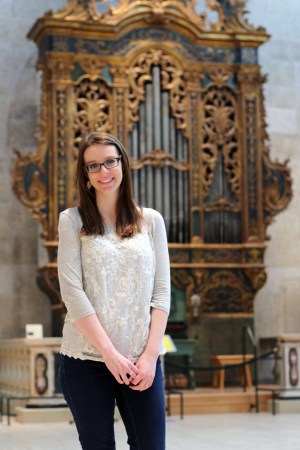 As Enfilade’s readership continues to grow, I receive more and more items to post. I wouldn’t want it any other way (and please keep the news coming), but it does mean that interns have become an increasingly helpful part of managing the site. I’ve therefore been most grateful for all Rebecca Woodruff has done to keep the ship afloat over the past six months! Rebecca is one of my students, and I had the good fortune of getting to know her better during a May interim course based in Stockholm, looking particularly at country houses and palaces (it was with Rebecca and a handful of other students I first visited Gustav III’s Museum of Antiquities, one of the really extraordinary museum spaces of the eighteenth century). As an aside, I’m also pleased to report that Rebecca will be presenting a paper for the undergraduate panel at the meeting of this year’s Midwest Art History Society (in April, at Cleveland and Oberlin)! She’s done a fabulous job as an intern.
Many thanks, Becca!
–Craig Hanson
Conference | Early Modern Viewers and Buildings in Motion
From H-ArtHist:
Early Modern Viewers and Buildings in Motion
St. John’s College, University of Cambridge, 25 February 2017
Registration due by 12 February 2017
Movement, both literal and metaphorical, lies at the heart of early modern European architectural theory, design and experience. Architectural authors invoked the notion of progress as temporal motion, structured their books as tours of buildings, and followed the ancient Roman Vitruvius in explaining how to manipulate the motions of winds through building design. Simultaneously, poets led their readers on tours of house and estate, and Aristotelian as well as mechanistic philosophers averred that motion was inherent to human perception from particle vibrations in one’s senses to neural vibrations in one’s brain. Across a range of scales in actual lived experience, moreover, viewers and buildings were frequently in motion; people walked through built spaces, interiors contained portable furnishings, and travellers and prints circulated ideas of buildings internationally.
This conference seeks to examine the range of scales, media, and theoretical discussions which foreground early modern intersections of architecture and motion. In so doing, it both puts into motion the usually static viewer and building of historical narratives and merges often independent yet overlapping strands of analysis—for instance, the ‘mobile viewer’ studied by art historians Michael Baxandall and Svetlana Alpers and the tensions surrounding early modern globalization discussed by cultural historians. These and other strands of inquiry are brought together by an international, interdisciplinary group of speakers examining case studies encompassing England, France, Italy, German-speaking areas, and the New World during the fourteenth through nineteenth centuries.
Supported by St. John’s College, University of Cambridge and by the Institute of Advanced Study, the Institute of Medieval and Early Modern Studies, and the School of Modern Languages and Cultures, Durham University.
The fee, which includes lunch and refreshments, is £15. More information is available here»
P R O G R A M M E
9.30 Registration
10.00 Welcome | Frank Salmon (University of Cambridge) and Kimberley Skelton (Durham University)
10.05 Session 1 | Chair: Kimberley Skelton (Durham University)
• Allison Stielau (University College London), The Censer as Mobile Mini-Building, Swung Structure, and Producer of Olfactory Space
• Andrew Chen (University of Cambridge), Fourteenth-century Ascetic Imagery in a Staircase at Santa Maria della Scala, Siena
• Donal Cooper (University of Cambridge), Fleeting Visions: Occluded Altarpieces and Mobile Eyes in the Italian Renaissance Church Interior
11.30 Coffee
12.00 Session 2 | Chair: Frank Salmon (University of Cambridge)
• Stefano Cracolici (Durham University), The Poliphilo Syndrome
• Kimberley Skelton (Durham University), Sensory Vibrations and Social Reform at San Michele a Ripa in Rome
• Bram Van Oostveldt (University of Amsterdam/Leiden University), Frantic Memories and Excessive Objects: Monicart’s Versailles immortalisé ou les merveilles parlantes de Versailles (1720)
1.30 Lunch
2.30 Session 3 | Chair: Donal Cooper (University of Cambridge)
• Caroline van Eck (University of Cambridge), Moving through Space and Time: Immersive Spaces at the Hôtel de Beauharnais in Paris
• Edmund Thomas (Durham University), Movement Through Ruins: Re-experiencing the Antique in Eighteenth-Century Travelogues
• Rebecca Tropp (University of Cambridge), Movement and the Central Core: Design Principles in the Country Houses of John Nash
4.00 Tea
4.30 Session 4 | Chair: Stefano Cracolici (Durham University)
• Daniel Jütte (New York University/University of Cambridge), Entering the Early Modern City: Gates as Sites of Passage
• James Campbell (University of Cambridge), Libraries in Motion
• Emily Mann (University of Kent), From Ship to Shore: The Architecture of Early Modern Trading Companies
6.00 Wine Reception
Call for Papers | The Street and the City: Thresholds
From the conference website:
The Street and the City: Thresholds
University of Lisbon, 5–7 April 2017
The Street and the City: Thresholds is the second of a series of multidisciplinary conferences with special emphasis on cities and the life that has evolved around them through time. Although English studies play a central role in this conference series from both cultural and geographical points of view, other fields of study relating to the conference theme are welcome. The first International Conference The Street and the City: Awakenings drew participants from a wide array of disciplines, such as literature, architecture, sociology, tourism or gender studies, to name but a few. This second conference aims for a comprehensive view of the street and the city focusing on its streets and people as well as on its less known spaces and hidden gems.
Throughout the centuries cities have been hubs of cultural experience and exchange, bringing people together time and again. The streets have been the public space where peoples and individuals both merge in a web and are isolated in the crowd. Cities have also channelled the voices of unsatisfied or rebellious citizens in periods of crises, or become a platform for gathering collective support in dire moments. In times of such conflicts, cities open up spaces for hope and multicultural dialogue. Such dynamics and challenges of an urban milieu constantly pose new questions to researchers concerning, for example, aspects of aesthetic and political representation, and the ways they are interpreted and experienced. Thus, studies of such currents and challenges have become highly diversified, promoting a variety of perspectives of the space we identify ourselves with.
Lisbon is the 2017 Ibero-American Capital of Culture, in the words of the City Council, an “event [which] will be the catalyst for a year of artistic innovation, in which there will be recognition of the historical processes and exchanges of ideas that underpin the relationships between European and American cities, and an acknowledgement of current artistic production, which is unique and intrinsically diverse.” In this sense, we wish to welcome everyone to share this urban atmosphere, which goes beyond the boundaries of Europe and connects the city in a global way.
The Second International Conference The Street and the City: Thresholds will take place at the School of Arts and Humanities, University of Lisbon, and at the Estoril Higher Institute for Tourism and Hotel Studies from 5 to 7 April 2017.
This scholarly meeting keeps its primary goal of fostering an interdisciplinary debate within English studies and of serving as a productive space for disseminating the most recent academic research alongside the studies of culture, urban studies and other fields of interest in relation to cities, their spaces and cultures. While encouraging the interchange of different academic perspectives, the Organising Committee also aims to promote informal networking gatherings among its participants. As such, topics and themes of interest—related to the Street and/or the City—include, but are not restricted to, the following:
• Aesthetic Representations of the City
• Cities as Havens of Hope or Despair
• Streets and Cities as Hives of Negotiation
• Gendered Urban Spaces
• Imagined Cities
• Literary Cities
• Mobility in the City and Urban Flows
• Streets, Consumerism and Fashion
• Sustainable Cities
• The City and Community Expressions
• The City and the Commons
• The Street and the Senses
• The Political Street
• The Tourist and the Flâneur
• Urban Cultural Heritage
• Urban Rhythms
We welcome suggestions for papers, pre-organised panels, and roundtables (20 minutes per speaker) by 28th February 2017, to be submitted on the conference webpage. Abstracts of 300 words for individual papers of twenty-minute duration. Please include the full title of your paper, name, institutional affiliation, contact information (postal address and e-mail address) and a bionote (max. 100 words).
Display | The First Inauguration
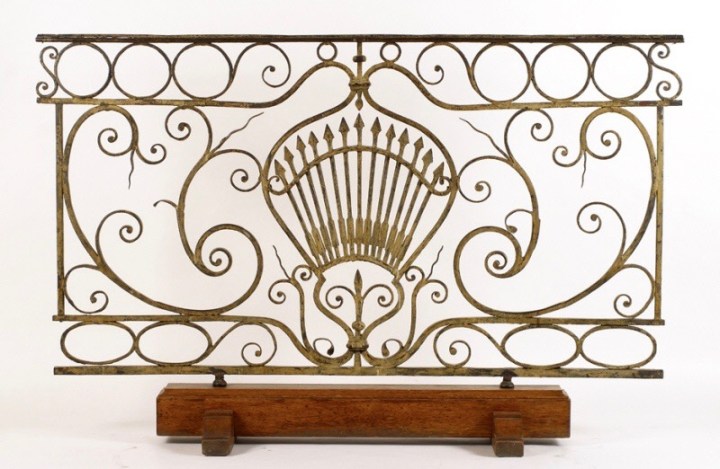
Balustrade Section from Federal Hall, New York, 1788–89, painted wrought iron, 95 × 178 × 4 cm (New York Historical Society, 1884.3). More information is available here»
◊ ◊ ◊ ◊ ◊
This installation is part of The Presidency Project at the New-York Historical Society:
The First Inauguration: George Washington’s 1789 Ceremony at Federal Hall
New-York Historical Society, 9 January — 26 February 2017
On April 30, 1789, George Washington was sworn in as president of the United States on the balcony of Federal Hall in lower Manhattan, uttering for the first time the words that every succeeding president would recite: “I do solemnly swear that I will faithfully execute the Office of President of the United States, and will to the best of my ability, preserve, protect, and defend the Constitution of the United States.” To mark the 2017 inauguration and as part of the The Presidency Project, the New-York Historical Society presents artifacts and documents linked to the nation’s first presidential inauguration. At its center, the installation showcases an original section of the wrought-iron railing from Federal Hall, a municipal building that was transformed by French architect Pierre-Charles L’Enfant into a suitable headquarters for the national government. L’Enfant adorned the facade with classical and patriotic motifs, including the railing’s thirteen arrows—one for each state in the republic.
This special installation also features an armchair used by George Washington in the Senate chamber of Federal Hall just after his swearing in. The storied armchair, designed in the latest neoclassical fashion, was later used for the inaugurations of Ulysses S. Grant and James A. Garfield. A printed broadside of Washington’s inaugural address is also on view.
New Book | A Taste for Luxury in Early Modern Europe
Due out in June from Bloomsbury Publishing:
Johanna Ilmakunnas and Jon Stobart, eds., A Taste for Luxury in Early Modern Europe: Display, Acquisition, and Boundaries (London: Bloomsbury Academic, 2017), 304 pages, ISBN: 978 14742 58234, $112.
 In the 18th century, debates raged about the economic, social and moral impacts of luxury, whilst taste was viewed as a refining influence and a marker of rank and status. This book takes a fresh, comparative approach to these ideas, drawing together new scholarship to examine three related areas in a wide variety of European contexts. First, the deployment of luxury goods in displays of status and how these practices varied across space and time. Secondly, the processes of communicating and acquiring taste and luxury: how did people obtain tasteful and luxurious goods, and how did they recognise them as such? Thirdly, the ways in which ideas of taste and luxury crossed national, political and economic boundaries: what happened to established ideas of luxury and taste as goods moved from one country to another, and during times of political transformation? Through the analysis of case studies looking at consumption practices, material culture, political economy, and retail marketing, A Taste for Luxury in Early Modern Europe challenges established readings of luxury and taste.
Johanna Ilmakunnas is Postdoctoral Research Fellow at the University of Helsinki, Finland. Jon Stobart is Professor of Social History at the University of Northampton, UK and Founding Editor of the new journal History of Retailing and Consumption.
◊ ◊ ◊ ◊ ◊
C O N T E N T S
I. Displaying Taste and Luxury
1 The Fabric of a Corporate Society: Sumptuary Laws, Social Order and Propriety in Early Modern Tallinn – Astrid Pajur (Uppsala University)
2 New and Old Luxuries Between the Court and the City: A Comparative Perspective on Material Cultures in Brussels and Antwerp, 1650–1735 – Bruno Blondé and Veerle de Laet (University of Antwerp)
3 Luxury and Taste in Eighteenth-Century Naples: Representations, Ideas and Social Practices at the Intersection Between the Global and the Local – Alida Clemente (University of Foggia).
4 What About the Moorish Footman? Portrait of a Dutch Nabob as a Dedicated Follower of Fashion– Yme Kuiper (University of Groningen)
5 Fashion and Luxury in Eighteenth-Century Germany – Michael North (University of Greifswald)
II. Making and Acquiring Taste
6 Taste Inequalities in the Art Consumption of Prince Nicolaus I Esterházy ‘the Magnificent’ – Kristof Fatsar (Corvinus University of Budapest)
7 Making an English Country House: Taste and Luxury in the Furnishing of Stoneleigh Abbey, 1763–1765 – Jon Stobart (Manchester Metropolitan University)
8 Between the Exotic and the Everyday: Sabine Winn at Home, 1765–1798 – Kerry Bristol (University of Leeds)
9 Books, Wine, and Fine China: Consumption Patterns of a Brukspatron in Early Nineteenth-Century Sweden – Marie Steinrud (Stockholm University)
10 To Buy a Plate: Retail and Shopping for Porcelain and Faience in Stockholm During the Eighteenth Century – Sofia Murhem and Göran Ulväng (Uppsala University)
III. Crossing Boundaries of Taste and Luxury
11 A Taste for French Style in Bourbon Spain: Food, Drink and Clothing in 1740s Madrid – Nadia Fernández-de-Pinedo (Universidad Autónoma de Madrid) and Corinne Thépaut-Cabasset (V&A Museum and Château de Versailles)
12 French Fashions: Aspects of Elite Lifestyle in Eighteenth-Century Sweden – Johanna Ilmakunnas (University of Helsinki)
13 English Luxuries in Nineteenth-Century Vyborg – Ulla Ijäs (University of Helsinki)
14 Luxury Goods Beyond Boundaries: The Parisian Market During the Terror – Natacha Coquery (University of Lyon 2)
Bibliography
Index
Exhibition | Legacy: The Artist’s Album and Richard Cooper, Jr
From UCL Art Museum:
Legacy: The Artist’s Album and Richard Cooper Jnr
UCL Art Museum, London, 10 January — 9 June 2017
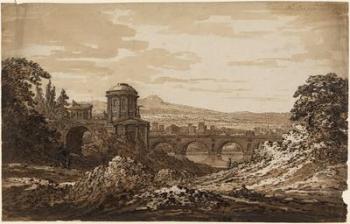
Richard Cooper Jr, Italian Landscape with Bridge, pen and brown ink with brown wash (London: UCL Art Museum 3751).
Legacy at UCL Art Museum features for the first time various artist’s albums by Richard Cooper, Jr (1740–1822). Cooper was a versatile and experimental artist, highly regarded by his contemporaries for his contributions to printmaking, draftsmanship, and art education. A true child of the Scottish enlightenment, Cooper worked in France, Spain, and Italy, where he was closely associated with the leading lights of his generation, including Jacob More, Gavin Hamilton, and Joseph Wright of Derby. Upon his return to London around 1777, he was celebrated for his capriccios or ‘invented views’ of the Roman Campagna, which he reproduced using the latest printmaking technologies. The contents of Cooper’s marbled-paper covered albums—carefully assembled with original prints and copy drawings—reveal the breadth of his involvement with the new techniques of lithography and soft-ground etching. They introduce Cooper as an innovative printmaker and highlight technological developments in printmaking that took place in the late eighteenth century.
In addition, the exhibition provides an opportunity to consider artists’ albums more broadly—how and why they are compiled and used and the role they can play in establishing a legacy. Also on display are more contemporary examples of the artist’s albums from our Slade Collections, including an album of discarded sketches by Augustus John, which was collected and assembled by fellow student Cuthbert Hamilton, as well as Stanley Spencer’s bound postcard collection. Also a feature of Legacy will be a changing display of contemporary innovations in printmaking by Phyllida Barlow, Bartolomeu dos Santos, Philip Sutton, and others.
P R O G R A M M I N G
Who Was Richard Cooper, Jr?
17 January 2017, 1:00–2:00
Richard Cooper, Jr was well regarded by his peers as a draughtsman, printmaker, drawing master, and antiques dealer; yet no thorough study of his life and work exists. Art dealer Tom Edwards tells us more about the artist and his influence.
Pop-up Exhibition: Printing Innovation at UCL
1 February 2017, 1:00–5:00
UCL Art Museum’s volunteers put together a pop-up exhibition of highlights from the collection with a focus on printing innovation at the Slade School of Art.
Innovation in Printmaking
15 February 2017, 1:00–2:00
Come and learn about innovation in printmaking at UCL Art Museum directly from the artists.
Liz Rideal on Rome and the Campagna
28 February 2017, 1:00–2:00
Artist and Slade lecturer Liz Rideal talks about her Leverhume research project to create images, curate period photographs, and organise these into an interactive digital map of Rome and the Campagna in relation to the Legacy exhibition.










 Enfilade
leave a comment