New Book | A Potted History
From ACC Distribution:
Stella Beddoe, A Potted History: Henry Willett’s Ceramic Chronicle of Britain (Woodbridge: Antique Collectors Club, 2015), 352 pages, ISBN: 978-1851498116, £45 / $90.
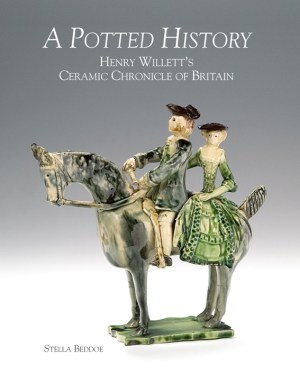 The Willett Collection at the Brighton Museum & Art Gallery is the only collection formed to illustrate what 19th-century businessman Henry Willett called ‘popular British history’. The collection of nearly 2,000 items is arranged here in chapters corresponding to Willett’s own cataloguing system. Many of the groupings commemorate historical events and personalities, such as ‘Royalty and Loyalty’, its content running from the Tudors through to Queen Victoria, and ‘Statesmen’, with its ceramic representations of Disraeli and Gladstone. Other chapters focus on social history, from the grisly murder in the Red Barn to bull baiting, pugilism, animal husbandry and teetotalism.
Stella Beddoe’s engaging, informative text places each item in context, exploring the maker and the subject matter depicted. The introduction on Henry Willett the man reveals the life that spawned such a diverse, irreplaceable collection of ceramics. The items, depicted in more than 800 colour illustrations, comprise hollow ware and flat ware, ornamental busts and figures, dating from the late sixteenth to the late nineteenth centuries. They represent a complete range of ceramic bodies and manufacturing technology.
Stella Beddoe worked at Brighton Royal Pavilion & Museums as Keeper of Decorative Art (including the Willett Collection) and, later, Senior Keeper, from 1978 to 2012.
◊ ◊ ◊ ◊ ◊
C O N T E N T S
1 Henry Willett, The Man and The Collection
2 Royalty and Loyalty
3 Military Heroes
4 Naval Heroes
5 Soldiers and Sailors
6 England and France
7 England and America
8 Statesmen
9 Clubs and Societies, and Professions and Trades
10 Philanthropy
11 Crime
12 Architecture
13 Scripture History and Religion
14 Music and Drama
15 Poetry Science and Literature
16 Sporting and Field Sports
17 Pastimes and Amusements
18 Agriculture
19 Conviviality and Teetotalism
20 Domestic Incidents
Call for Papers | Private Collecting and Public Display
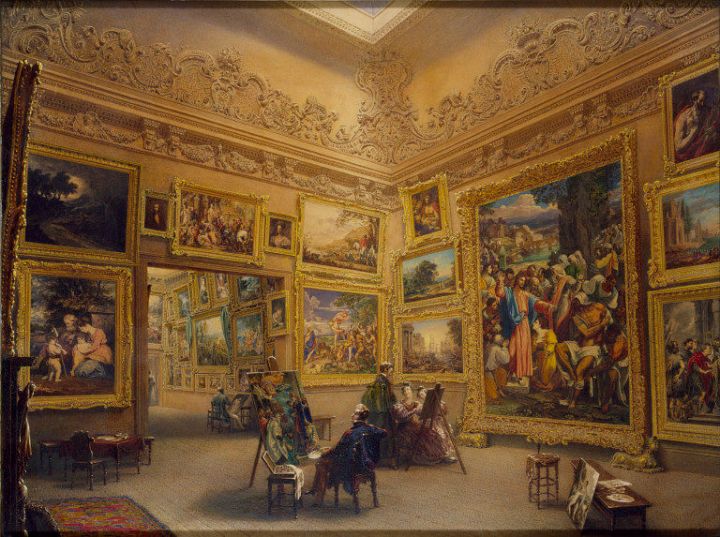
Frederick MacKenzie, The National Gallery When at Mr J. J. Angerstein’s House, Pall Mall, 1824–34, watercolour
(London: V&A, 40-1887)
◊ ◊ ◊ ◊ ◊
Private Collecting and Public Display: Art Markets and Museums
University of Leeds, 30–31 March 2017
Proposals due by 1 November 2016
Keynote Speaker: Susanna Avery-Quash
This two-day conference investigates the relationships between ‘private’ collections of art (fine art, decorative art, and antiquities) and the changing dynamics of their display in ‘public’ exhibitions and museums. This shift from ‘private’ to ‘public’ involves a complex dialectic of socio-cultural forces, together with an increasing engagement with the art market. The conference aims to explore the relationship between the ‘private’ and ‘public’ spheres of the home and the museum and to situate this within the scholarship of the histories of the art market and collecting.
Art collections occupy a cultural space which can represent the individual identity of a collector—often as a manifestation of self-expression and social class. Many museums today arose from ‘private’ collections including The Wallace Collection, Musée Nissim de Camondo, The Frick Collection, and the Isabella Stewart Gardner Museum. Whilst they now exist as ‘public’ spaces, many still signify the residues of the ‘private’ home of a collector. What processes do collections undergo when they move from a ‘private’ sphere to a ‘public’ exhibition space? In what ways are collections viewed differently in these environments?
How and when do ‘private’ collections move into the ‘public’ domain, and what does this tell us about the increasingly porous nature of these boundaries? Whilst the relationship between ‘private’ and ‘public’ art collecting takes on particular forms from the early modern period onwards, it emerged particularly in the latter half of the nineteenth century, with the creation of temporary exhibitions and permanent displays in museums that relied on donations from collectors. Many national museums are indebted to loans made by private individuals. The Waddesdon Bequest at The British Museum, the Wrightsman Galleries at The Metropolitan Museum, and the John Jones Collection at the Victoria and Albert Museum are key examples of the continuity of the private in the public. What are the ‘private’ to ‘public’ dynamics of these exchanges? How have museums negotiated the restrictions proposed by the collector for the display, containment, expansion or reinterpretation of their collection? What is the implication for the status and value of an object when ‘public’ works are sold and re-enter the art market? What meanings are attached to ‘public’ art objects when they begin, once again, to circulate in the art market?
The PGR subcommittee of the Centre for the Study of the Art and Antiques Market welcomes proposals for 20-minute papers which explore these themes or which address any other aspect of the private collecting and public display of collections, from the Early Modern period until the 21st century. We are delighted to confirm Dr. Susanna Avery-Quash, Senior Research Curator (History of Collecting) at the National Gallery, London as our keynote speaker.
Topics can include but are not limited to
• The relationships between ‘private’ and ‘public’ spheres
• The role and impact of the art market in the ‘public’ and ‘private’ realms
• The history and role of temporary loan exhibitions
• The role played by gender in collecting practices and bequests
• Collecting and loaning objects by minority groups
• Legacies of the collector
• Philanthropy vs self-promotion
• Deaccessioning- public museums selling art back into art market/into private collections
• The dynamic of contemporary art collecting and public art galleries
To propose a paper, please send a Word document with your contact information, paper title, an abstract of 300-500 words, and a short biographical note. Full session proposals for a panel of three papers are also welcomed. Some travel bursaries will be available for accepted speakers. Proposals should be sent to csaa@leeds.ac.uk by 1st November 2016.
New Book | Paper Peepshows
From ACC Distribution:
Ralph Hyde, Paper Peepshows: The Jacqueline and Jonathan Gestetner Collection (Woodbridge: Antique Collectors’ Club, 2015), 272 pages, ISBN: 978-1851498000, $90.
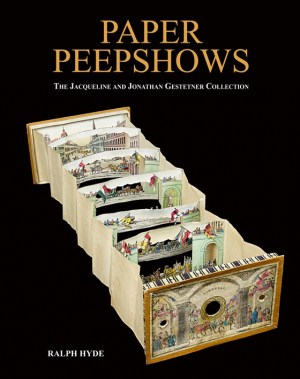 Peepshows were introduced in the mid-eighteenth century by Martin Engelbrecht in Augsburg. They called for a long wooden cabinet designed for purpose incorporating a viewing lens and sometimes a mirror. In the 1820s peepshows made entirely of paper appeared on the scene more or less at the same moment in Vienna, London and Paris. The clumsy cabinet was no longer called for. The new peepshow was equipped with paper bellows so it could be expanded or contracted in a trice. Paper peepshows were light; they were comparatively cheap. They fitted neatly into the pocket. Viewing a Paper Peepshow is an intimate, individual experience that, in the age of television and hand-held computers, gives a real sense of personal discovery. The viewer engages by peeping through a tiny hole and thereby discovers inside layers of images, like a pocket-sized stage set.
The format lent itself to a wide variety of subjects: to coronations and to state visits and funerals, to pleasure gardens, to trips up rivers and to the ceremonial openings of new railways, to distant views of cities and to tourist landmarks, to military engagements in exotic places, and to the July Revolution and the fall of the Bourbons in France in 1830. The Crystal Palace, erected in Hyde Park 1851 for the Great Exhibition, inspired the production of very large numbers of peepshows, mostly made overseas and imported. Peepshows made possible visits to sites existing in the imagination, to plunge down Alice’s rabbit hole, for example, and to wander through the Garden of Eden in Paradise.
The main center of peepshow manufacture in the nineteenth century was toy-making Nuremburg. Briefly in the 1950s it was Britain. Nowadays it is the United States. Paper peepshows are no longer intended essentially for children but for bibliophiles and art-appreciating adults.
This stunning book charts the history of these charming collectables. The illustrated catalogue section includes the following data where known: country of origin, publisher, date, method of printing (e.g. chromolithograph), shape and dimensions, and number of scenes. As well as a full description of each piece, the author gives fascinating historical and cultural context for these items—ranging from depictions of the July Revolution (Paris, 1830), to the opening of the Thames Tunnel, to the nursery tale of Puss in Boots.
C O N T E N T S
Foreword by Erkki Huhtamo
• The Gestetner Paper Peeshow Collection at the V&A
• The Story of Paper Peepshows
• What We Peep With
Catalogue: Austria, Canada, China, Denmark, France, Germany, Great Britain, Italy, Russia, The Netherlands, United States of America, Unknown Origin
Appendix 1: Peepshow View Boxes
Appendix 2: Table-top Tableaux in the Gestetner Collection
Appendix 3: Boîtes d’optique in the the Gestetner Collection
Bibliography
Acknowledgments
General Index
Title Index
Display | Masterpieces & Curiosities: The Fictional Portrait
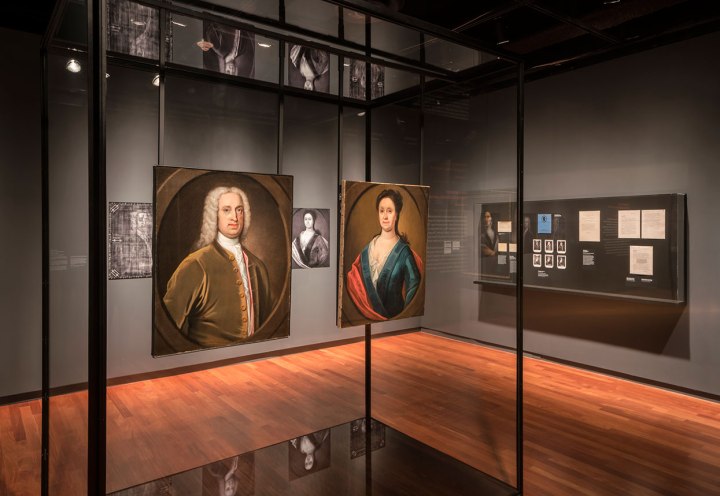
Unknown Artist, Portraits of a Man and a Woman, n.d., oil on canvas. 30⅜ × 25¼ inches (New York: Jewish Museum, Gift of Dr. Harry G. Friedman, F 4922a). Installation view at the Jewish Museum, 2016.
◊ ◊ ◊ ◊ ◊
Now on view at the Jewish Museum:
Masterpieces & Curiosities: The Fictional Portrait
Jewish Museum, New York, 18 March — 14 August 2016
Curated by Stephen Brown
The latest iteration of the essay-style exhibition series studies two companion portraits in the Jewish Museum’s collection, revealing a tale far different from what has been assumed for almost a century.
If every picture tells a story then, at a glance, a portrait tells a simple one—the faithful biography of a sitter as conveyed by a named artist. This often misleading assumption lies at the heart of Masterpieces & Curiosities: The Fictional Portrait, which illuminates the complex relationship between portraiture and truth.
Stephen Brown, Associate Curator, examines two paintings in the Museum’s permanent collection: Acquired in 1957, the ‘Mears’ portraits were credited to an 18th-century American artist and thought to represent a prominent Jewish merchant of colonial New York and his wife. After a decade of research, the identities of the artist and sitters have been reconsidered through archival investigation, genealogical studies, and X-ray analysis.
“The idea of portraiture is based on the belief in some direct relation between the image and the sitter,” asserts Brown. “But every image is a representation, and all representation is fiction.”
By separating fact from fiction and unveiling the truth behind these enigmatic portraits, Masterpieces & Curiosities: The Fictional Portrait lays to rest a mystery centuries-old while challenging our notions concerning the genre of portraiture.
Conference | The Age of Luxury: The Georgian Country House
Looking ahead to the fall, from the Sussex Archaeological Society:
The Age of Luxury: The Georgian Country House and Its Setting, 1700–1820
King’s Church, Lewes, 15 October 2016
Organized by Sue Berry

J. Lambert of Lewes, detail of a watercolour showing Newick Place near Lewes, the home of Lady Vernon, 1780 (Sussex Archaeological Society)
Between 1700 and 1820, old houses were transformed and new ones built, some on a spectacular scale by owners who would now be regarded as multi-millionaires. From the later seventeenth century right throughout the eighteenth, the influence of the Grand Tour on country house owners was considerable, not least as many of them travelled abroad themselves, seeing European fashions at first hand. Some Sussex houses still have collections purchased on Grand Tours, though many have since been sold off. Architectural styles were varied, reflecting the influence of Dutch, French, and Classical inspirations as well as our home grown Gothic. Landscapes also evolved from formal to the famous landscape parks of the mid to later eighteenth century. Interiors became more showy, increasingly reflecting the high quality of British craftsmanship. Ever more servants were needed to run a lavish lifestyle which included racing, hunting and other expensive social activities. Our speakers, all specialists in their fields, will address these many aspects of the Georgian country house.
We are hoping to organise visits related to this conference during the summer of 2016, which will offer participants the opportunity to explore aspects of our themes ahead of the conference itself. These events will be advertised to Sussex Archaeological Society members in our April newsletter and details will be available to everyone online. Charges and number restrictions will apply to these. Priority will be given to those who have booked to attend this conference.
Advance booking is strongly recommended as we cannot guarantee there will be places available on the door. Registration on the day opens at 9.30am when you can sign in and collect your copy of the delegate handbook. The ticket price includes a light lunch and coffee and tea on arrival and in the breaks. If you have special dietary requirements or particular access needs, we will do our best to accommodate these if we have advance notice.
King’s Church, Brooks Road, Lewes BN7 2BY. Lewes is easily accessible by road and public transport. There is no parking on site, but there is on-street parking around the building and a long-stay car park half a mile away. Lewes station with its large car park is just under one mile away, and buses stop at the start of Brooks Road. Further details, including directions, will be sent with confirmation of your booking. Non-members are welcome. Please direct all conference enquiries to: Lorna Gartside, Sussex Archaeological Society, Bull House, 92 High Street, LEWES BN7 1XH, email: members@sussexpast.co.uk.
◊ ◊ ◊ ◊ ◊
S A T U R D A Y, 1 5 O C T O B E R 2 0 1 6
10:00 Welcome and introduction, Maurice Howard (University of Sussex)
10:05 The English Country House, 1680–1820: Architecture and Planning, Geoffrey Tyack (Kellogg College, University of Oxford)
10:45 The Grand Tour and the Creation of the Country House in Eighteenth-Century Britain, Jonathan Yarker (Lowell Libson, Ltd.)
11:25 Tea and coffee
11:45 England, France, and the Netherlands: Garden Design in England, 1680–1710, Sally Jeffery (independent architectural and garden historian)
12:25 Pleasure in the Pleasure Gardens of Georgian England, Stephen Bending (University of Southampton)
1:05 Lunch
2:00 From Rococo to Neo-Classicism: Fashioning the Georgian Interior, Susan Bracken (independent historian specialising in furnishings)
2:40 ‘It gives me Reason to believe your Ladyship does not think me a servant to sute her.’ Household Management and Servant Organisation, Julie Day (independent historian of the English country house)
3:20 Tea and coffee
3:40 The Country House Guidebook in the Long Eighteenth Century: A Nuanced Message, Paula Riddy (independent art historian)
4:20 Much Spending, Not Always Afforded: The Transformation of the Country House and Its Setting in Sussex, Sue Berry (specialist in Georgian seaside resorts and the country house estates of Sussex)
5:00 Questions and end
Call for Essays | Garden Narratives in Literature, Art, and Film
From H-ArtHist:
Enchanted, Stereotyped, Civilized: Garden Narratives in Literature, Art, and Film
Proposals due by 15 October 2016
Gardens have been a crucial part of mythology and literature. Throughout English literature for example, the idea of a garden is a recurrent image; these images largely stem from the story of the Garden of Eden as found in Genesis. If gardens reveal the relationship between culture and nature—the garden can be seen as civilized and ‘shaped’ and therefore domesticated nature—in the vast library of garden literature few books focus on what the garden means—on the ecology of garden as idea, place, and action. Our volume will discuss the topic of the garden in different theoretical contexts such as ecological, botanical, literary, filmic, art historical, and cultural ones. We want to investigate the representations of and the interconnections between gardens and the above named fields over a wide timescale, with consideration of how gardens are represented and used as symbols and of how literature or visuality took form in, or influenced, gardens.
Suggested topics include, but are by no means limited to the following:
• The Biblical/Theological Garden
• The Mythological Garden
• The Renaissance Garden
• The Romantic Garden
• The Revolutionary Garden
• The Colonial/Postcolonial Garden
• Gardens in Film
• Gardens in Art History
• The Garden as… a location in general and as a place of romanticism specifically, or a crime scene, or a labyrinth and therefore as a mirror of psychological conditions
• Ecological Aspects on Garden Culture
The timetable for the volume is as follows
• Deadline for abstracts: 15 October 2016
• Feedback: 31 October 2016
• Submission for articles (completed): 30 April 2017
• Double peer review process and feedback due to: 30 May 2017
• Articles sent back to editors: mid of June 2017
• A publication is planned during autumn/winter 2017.
Chapters may explore different media (literature, movies, art, visual arts, television, etc.) and address topics on gardens. If you are interested in proposing a chapter, please email an abstract of 500 words and a short CV to both Dr. Feryal Cubukcu (cubukcu.feryal@gmail.com) and Dr. Sabine Planka (planka@phil.uni-siegen.de). Your abstract should outline your hypothesis and briefly sketch the theoretical framework within which your chapter will be situated. All submissions will be acknowledged. If you do not receive a confirmation of receipt within 48 hours, you may assume that your email was lost in the depths of cyberspace. In that case, please re-submit. Please note that we will not include previously published essays in the collection.
New Book | Italian Watermarks, 1750–1860
From Brill:
Theo Laurentius and Frans Laurentius, Italian Watermarks, 1750–1860 (Leidin: Brill, 2016), 175 pages, ISBN: 978-9004310612, €175 / $210.
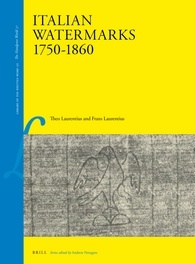 The knowledge of papermaking spread slowly over Italy from the start of the 13th century. Scholarly interest in the history of Italian paper manufacture has concentrated especially on the earliest period. Research into Italian paper from the 17th, 18th, and 19th centuries has lagged somewhat behind.
Watermarks are extremely important for investigating the origins of paper. Until quite recently watermarks were copied and reproduced by placing them on a light source and then tracing them over onto some kind of transparency. It should be clear, however, that in many instances this technique could never achieve reproductions that were one hundred per cent accurate. Italian Watermarks, 1750–1860 offers x-rays and descriptions of approximately three hundred Italian watermarks. A selection of paper produced in different areas of Italy is presented with an identification.
Theo Laurentius has been active as a paper researcher for over fifty years. He has published several studies on watermarks and paper, including two important catalogues: Watermarks 1600–1650 Found in the Zeeland Archives (Hes & De Graaf, 2007) and Watermarks 1650–1700 Found in the Zeeland Archives (Hes & De Graaf, 2008).
Frans Laurentius, Ph.D., is an art historian. He has published several studies on graphic arts, Dutch pottery, and watermarks, as well as a monograph on the Dutch print dealer Clement de Jonghe: Clement de Jonghe (ca. 1624–1677): Kunstverkoper in de Gouden Eeuw (Hes & De Graaf, 2010).
Exhibition | Italian Landscape of the Romantic Era

Ferdinand Oehme, Villa d’Este in Tivoli, detail, 1833
(Dresden: Albertinum, Galerie Neue Meister)
◊ ◊ ◊ ◊ ◊
From the Staatliche Kunstsammlungen Dresden:
Italian Landscape of the Romantic Era: Painting and Literature
Italienische Landschaft der Romantik: Malerei und Literatur
Neues Schloss, Bad Muskau, 11 May — 21 August 2016
The whole sky was covered with a whitish haze of cloud, through which the sun, without its form being distinguishable, gleamed over the sea, which displayed the most beautiful sky blue hue that one ever could see. –Johann Wolfgang von Goethe, 1787
Tivoli and the Roman Campagna, Capri and the Bay of Naples, majestic silhouettes of lofty mountains, glittering expanses of sea, dignified ancient architecture and Mediterranean flora: il bel paese (‘the beautiful country’) as seen by writers and artists, is at the focus of this special exhibition.
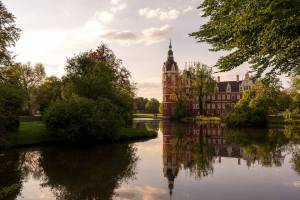
Neues Schloss in Bad Muskau (Photo by David Pinzer)
In the late 18th and early 19th centuries travelers to Italy increasingly focused on the perception of nature. Their encounters with southern climes promised a substantial impetus for artistic development and regeneration. Hence, the Italian landscape became a new ideal for landscape gardens which spread more or less simultaneously from England over the whole continent of Europe. One of the most important protagonists of this movement in Germany was Prince Hermann von Pückler-Muskau (1785–1871), whose park and castle in Bad Muskau are an ideal venue for the exhibition. His landscape park, which was begun in 1815, is now one of the most beautiful in Europe and has been a UNESCO World Heritage site since 2004. Indeed, the park itself was originally conceived as a kind of museum: “A park must be like an art gallery: every few steps you should see a new picture” (Pückler-Muskau).
The special exhibition in the New Castle (Neues Schloss) features more than 20 masterpieces—landscapes full of light by painters such as Jakob Philipp Hackert, Ludwig Richter, Ernst Ferdinand Oehme, Carl Rottmann, and Carl Blechen. All these paintings reflect the poetry of nature, the rich colours, and forms found in the south. Most of them are usually housed in the Dresden Albertinum and are among the highlights of the Galerie Neue Meister; thanks to the restoration of several paintings from the store room, their original radiance has been revitalized.
Selected writings by contemporary authors who also traveled around Italy—Johann Wolfgang von Goethe, Johann Gottfried Seume, Madame de Staël, and Wilhelm Waiblinger—enable the Italian landscape to be experienced in a combination of genres. The most important starting point for such painted and written projections of this land of longing, Goethe’s Italian Journey was first published in installments in 1816, and so the year 2016 marks the 200th anniversary of its publication. It initiated a period of German fascination for the “land where the lemon trees bloom” (Goethe), a fascination which—with few exceptions and several interruptions—extended into broad social circles and whose effect is still felt today.
New Book | Silver in Georgian Dublin
From Routledge:
Alison FitzGerald, Silver in Georgian Dublin: Making, Selling, Consuming (New York: Routledge, 2016), 256 pages, ISBN: 978-1472427878, $150.
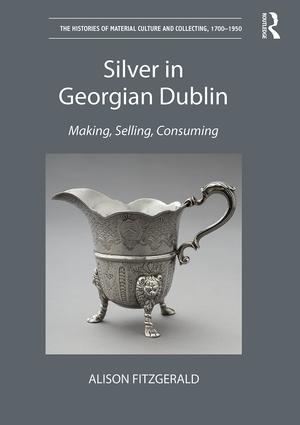 Georgian Dublin is synonymous with a period of unprecedented expansion in the market for luxury goods. At a time when new commodities, novel technologies, and fashionable imports seduced elite society, silver enjoyed an established association with gentility and prestige. Earlier studies have focused predominantly on the issue of style. This book considers the demand for silver goods in Georgian Ireland from the perspectives of makers, retailers, and consumers. It discusses the practical and symbolic uses of silverware, interpreted through contemporary guild accounts, inventories, trade ephemera, and culinary manuscripts. For the first time the activities of Dublin’s goldsmiths and their customers are considered in the context of the British Isles, acknowledging Dublin’s ‘second city’ status in relation to London. How did the availability of new products like English porcelain and Sheffield Plate affect the demand for silver in Dublin, and how did silver imports from London affect the Dublin trade? To what extent do the practices of Dublin goldsmiths mirror their North American counterparts seeking to infer associations with the fashionable metropolis of London? Drawing on an extensive range of documentary and object evidence this wide-ranging analysis considers the context in which silver goods were made, used, valued, and displayed in Georgian Ireland.
Alison FitzGerald is a Lecturer in the Department of History at Maynooth University, Ireland.
◊ ◊ ◊ ◊ ◊
C O N T E N T S
Introduction
1 The Business of Becoming a Goldsmith in Eighteenth-Century Dublin
2 Goldsmiths and Market Forces in Eighteenth-Century Ireland
3 Shopping for Plate in Dublin and London
4 Silver and Its Meaning in Georgian Ireland
5 The Silver Trade in Post-Union Ireland
Conclusion
Exhibition | Elegance and Intrigue: French Society in Prints and Drawings

Charles Thévenin, The Storming of the Bastille, 14 July 1789, etching, 1790, sheet: 41.6 × 58.5 cm
(The Cleveland Museum of Art, 2015.21)
◊ ◊ ◊ ◊ ◊
From the The Cleveland Museum of Art:
Elegance and Intrigue: French Society in 18th-Century Prints and Drawings
The Cleveland Museum of Art, 16 July — 6 November, 2016
Curated by James Wehn
Sumptuous designs, classical tales, political zeal, and erotic rendezvous pervade this selection of more than ninety prints, drawings, and decorative objects from the final decades of the ancien régime through the French Revolution and the early years of Napoleon’s empire.
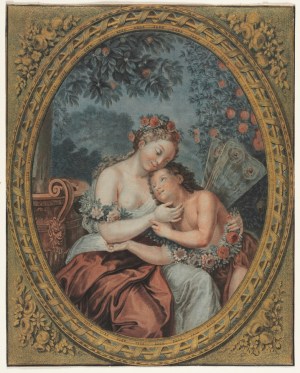
Jean François Janinet, after Antoine Coypel, Zephyre and Flore, ca. 1776, color wash-manner etching and engraving with applied gold leaf; 33.3 × 26.5 cm (The Cleveland Museum of Art, 1987.91)
In celebration of the CMA’s centennial year, Elegance and Intrigue: French Society in 18th-Century Prints and Drawings showcases works from the museum’s collection, including a rare impression of Jean-Antoine Watteau’s etching The Clothes Are Italian, several prints and drawings by court favorite François Boucher, and Jean-Honoré Fragonard’s ravishing drawing Invocation to Love.
At the heart of the exhibition is a selection of color etchings and engravings meticulously crafted to imitate chalk and gouache drawings, a trend in elite home décor at the time. Charles Thévenin’s expressive etching The Storming of the Bastille captures a sense of revolutionary spirit, while Juste-Aurèle Meissonnier’s Tureen, a quintessential masterpiece of silverwork fashioned for the English duke of Kingston, is displayed alongside Gabriel Huquier’s etching featuring two views of the tureen set in a lavish rococo interior.
James Wehn’s extended description of the exhibition is available here.










leave a comment