Exhibition | A Civic Utopia: France 1760–1840
The display is part of Somerset House’s larger celebration Utopia 2016: A Year of Imagination and Possibility, marking the 500th anniversary of the publication of Thomas More’s inspirational text, Utopia—with a varied and vibrant programme of special events, exhibitions, new commissions, and activities across the entire site, spanning the realms of art, literature, society, fashion, design, architecture, theatre, and film.
A Civic Utopia: France 1760–1840
The Courtauld Institute of Art, London, 8 October 2016 — 8 January 2017
Curated by Nicholas Olsberg
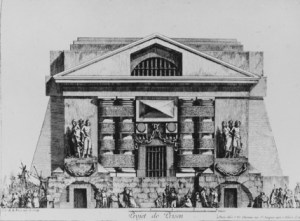
Jean Charles Delafosse, Project for a Prison (exterior view, rear), 18th century (London: Courtauld Institute of Art)
A Civic Utopia: France 1760–1840 examines the place of architecture in establishing the notion of public life. Bringing together a number of drawings of public buildings and spaces from the late Ancien Régime through to the early years of King Louis-Philippe in France, the display explores the idea of a ‘scientific’ city, in which rational and symbolic expressions of civic life established a pattern for the improvement of society. If Utopia is defined as the imagining of a comprehensive ideal system or pattern of civil organisation, then we can see this French vision as utopian, in which public places and buildings function to encourage the moral character of society.
Exhibition | Versailles and the American Revolution
Now on view at Versailles:
Versailles and the American Revolution / Versailles et l’Indépendance Américaine
Château de Versailles, 5 July — 17 October 2016
Curated by Valérie Bajou
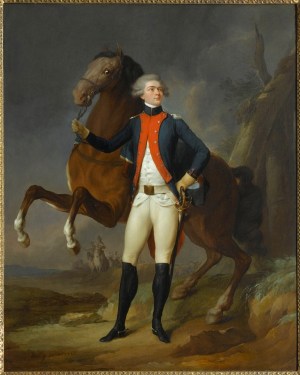
Louis-Léopold Boilly, Portrait de La Fayette, 1788 (RMN-Grand Palais / Château de Versailles)
From 5 July to 2 October 2016, on the occasion of the 240th anniversary of the Declaration of Independence, the Palace of Versailles dedicates an exhibition highlighting the war during which the fate of three countries met: the United States, the United Kingdom, and France.
As the first country to recognise the United State of America as a new nation, it was France’s duty to commemorate the event, especially at Versailles where this decision was taken, where the War of Independence was supported, and where the peace treaty with England was signed in 1783. The exhibition aims to remind viewers of facts that are often forgotten but which bear testimony to the circumstances, scale, and consequences of France’s involvement in the war.
The exhibition recounts the events and highlights the context of French and English rivalry after the Seven Years’ War as well as internal divisions in the French side, the American side between ‘patriots’ and ‘loyalists’, and the English side due to some opposition to the way the settlers were treated. It recounts the decision-making process at Versailles, the personalities of key figures—notably Benjamin Franklin—and the exact locations in the palace where discussions were held. Finally, it explains the international spread of the fighting—from India across the Mediterranean Sea, to the shores of America—and the human losses due to the violence and scale of the battles, the largest of both the 18th and 19th centuries.
The War of Independence has been interpreted by artists from all three countries; so iconic works seen for the first time outside the USA will illustrate the exhibition’s discourse. The generosity of the loans granted must also be stressed, a key example being the Diamond Eagle of George Washington from the Society of the Cincinnati.
The exhibition is the result of scientific collaboration with researchers from American museums and universities, the Congress, and the Society of the Cincinnati, as well as French, Spanish, and English historians. It aims to present different points of view in order to avoid presenting a perspective of the events which is too narrow.
The exhibition will be held in an unusual location, the Battles Gallery, near The Battle of Yorktown, which represents the deciding battle of 1781. Commissioned in 1835 by Louis-Philippe, a year after the death of Lafayette, this commemorative painting indicates that the memory of the war and the sacrifices made had not been forgotten but were kept alive on the other side of the Atlantic like a debt of blood, also explaining the fervour in the famous expression of 1917: “Lafayette, here we are!”
Valerie Bajou : Curator in chief at the national museum of the Palaces of Versailles and Trianon
Scenographer : Loretta Gaïtis
A symposium opened the exhibition on July 5; the programme is available as a PDF file here.
◊ ◊ ◊ ◊ ◊
The catalogue is available from ACC Distribution:
Valérie Bajou, ed., Versailles and the American Revolution (Montreuil: Gourcuff Gradenigo, 2016), 208 pages, ISBN: 978-2353402465, £35 / $40.
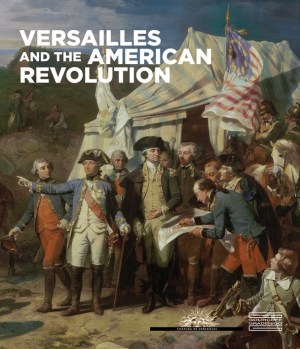 Published to accompany an exhibition at the Palace of Versailles, this catalogue is a collective work bringing together contributions from French, American, and British specialists in this field, which together shed light on the importance of the relationship between France and America in the closing years of the Ancien Régime. During the reign of Louis XVI, the Palace of Versailles—the seat of power and government in France—played a crucial role in the history of America, in its struggle for independence, and in the recognition of the United States by the great European powers. In tracing this remarkable story, the catalogue demonstrates the constant interest displayed in the fledgling United States by the French monarchy.
Richly illustrated throughout, it documents the events of the War of Independence, before exploring the consequences of the entry of France into the war, the siege of Yorktown, and the peace treaty signed at Versailles in 1783. Finally, it analyses the origins and development of the mythology of the ‘American Revolution’ in both France and the United States, a source of enduring inspiration for artists and history painters.
New Book | Una Rivoluzione di Cera: Francesco Orso
Published by Officina Libraria and available from Artbooks.com:
Andrea Daninos, Una Rivoluzione di Cera: Francesco Orso e e i «cabinets de figures» in Francia (Milano: Officina Libraria, 2016), 160 pages, ISBN: 978-897737759, 20€ / $35.
 Con questo studio Andrea Daninos riporta alla luce per la prima volta la figura dello scultore piemontese Francesco Orso, attivo nella seconda metà del Settecento. Unico tra gli scultori piemontesi ad essersi specializzato nella realizzazione di ritratti in cera policromi raffiguranti membri della corte sabauda, opere dall’impressionante realismo, Francesco Orso fu anche l’unico scultore italiano a trasferirsi stabilmente dal 1785 a Parigi, vivendo in tal modo in prima persona negli anni successivi, i momenti cruciali della Rivoluzione francese. A Parigi Orso, che aveva mutato il nome in Orsy, aprirà un’esposizione di figure in cera, che sarà talvolta al centro degli eventi rivoluzionari. Di Francesco Orso viene ricostruita per la prima volta la vita, unitamente al catalogo delle sue opere, sia in cera che in terracotta, molte delle quali sinora inedite. Per meglio delineare la presenza di Orso a Parigi il volume si propone di analizzare la storia delle esposizioni di figure in cera a grandezza naturale in Francia alla fine del Settecento, all’origine dei moderni musei delle cere. Una storia sinora mai studiata compiutamente e che attraverso le biografie dei principali protagonisti di questo genere di esposizioni riporta alla luce un fenomeno che godette di grande popolarità per più di due secoli. In particolare vengono analizzate estesamente la vita e le opere di Philippe Curtius, padre della futura Madame Tussaud, che operò a Parigi negli anni della Rivoluzione francese vivendone alcuni momenti chiave in prima persona. Suoi erano i busti in cera di Necker e del duca d’Orléans portati in trionfo dalla folla il 12 luglio 1789 negli scontri alle Tuileries che diedero il via ai moti rivoluzionari. Completano il volume il catalogo delle opere di Francesco Orso e la trascrizione di numerosi documenti inediti, frutto di capillari ricerche negli archivi francesi e italiani.
Andrea Daninos dedica da anni allo studio della ceroplastica e sul tema ha pubblicato vari articoli. Nel 2009 ha tenuto un corso di specializzazione all’Università Statale di Milano sulla storia della scultura in cera. Vive e lavora a Milano.
New Book | Rome, Travel, and the Sculpture Capital, c. 1770–1825
From Routledge:
Tomas Macsotay, ed., Rome, Travel, and the Sculpture Capital, c. 1770–1825 (New York: Routledge, 2016), 268 pages, ISBN: 978-1472420350, $150.
 The world that shaped Europe’s first national sculptor-celebrities, from Schadow to David d’Angers, from Flaxman to Gibson, from Canova to Thorvaldsen, was the city of Rome. Until around 1800, the Holy See effectively served as Europe’s cultural capital, and Roman sculptors found themselves at the intersection of the Italian marble trade, Grand Tour expenditure, the cult of the classical male nude, and the Enlightenment republic of letters. Two sets of visitors to Rome—the David circle and the British traveler—have tended to dominate Rome’s image as an open artistic hub, while the lively community of sculptors of mixed origins has not been awarded similar attention. Rome, Travel, and the Sculpture Capital, c. 1770–1825 is the first study to piece together the labyrinthine sculptors’ world of Rome between 1770 and 1825. The volume sheds new light on the links connecting Neo-classicism, sculpture collecting, Enlightenment aesthetics, studio culture, and queer studies. The collection offers ideal introductory reading on sculpture and Rome around 1800, and its provocative perspectives will appeal to a readership interested in understanding a modernized Europe’s transnational desire for Neo-classical, Roman sculpture.
Tomas Macsotay has held postdoctoral grants from the Henry Moore Foundation and the Marie Curie Co-fund Programme M4 Human, Gerda Henkel Foundation. He is currently based in Barcelona.
Display | Drawn to Sicily: Early British Exploration
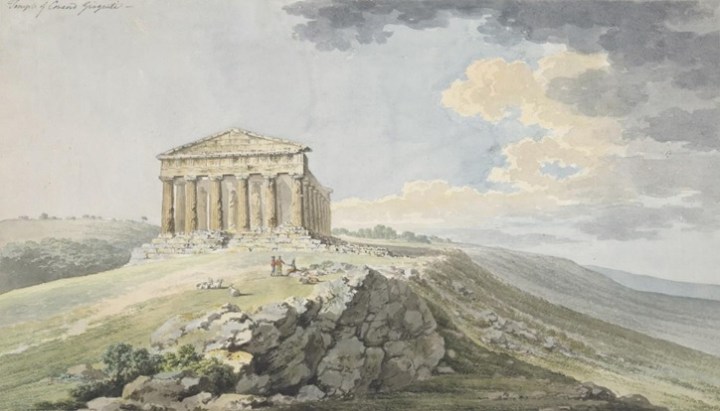
Charles Gore, View of the Temple of Concord at Agrigento, 1777, watercolour over graphite, with some pen and ink
(London: The British Museum)
◊ ◊ ◊ ◊ ◊
Closing this week at The British Museum:
Drawn to Sicily: Early British Exploration of the Classical World
The British Museum, London, Late April — 14 July 2016
In the 18th century, Sicily was a Grand Tour destination only for the intrepid few, an optional extension to the more conventional tour that focused on Rome, Florence, Venice, and Naples. Travel on the rural, rugged island was challenging and many parts were inaccessible. Furthermore, the countryside could be dangerous, as groups of bandits preyed on travelers. Yet those with a specific interest in ancient art and architecture went to admire and study first-hand the remains of the majestic Greek temples.
The presence of European diplomats at the court of the Kingdom of the Two Sicilies in Naples made access to, and travel in, Sicily somewhat easier. Diplomats could provide travel passes—such as one which was issued to Charles Townley (1737–1805) and displayed in this show—as well as letters of introduction to the cultured élite in the main cities: Palermo, Catania, and Syracuse. A travel pass could ensure lodging when presented, as English visitors were well-respected. This display illustrates four expeditions undertaken by some of Britain’s best-known Grand Tourists and renowned architects.
Exhibition | The Ince Blundell Collection of Classical Sculpture

Pantheon interior Blundell Hall
◊ ◊ ◊ ◊ ◊
Now on view at The Atkinson:
Pantheon: Roman Art Treasures from the Ince Blundell Collection
The Atkinson, Southport, 11 June 2016 — 12 March 2017
At the end of the eighteenth century local landowner Henry Blundell (1724–1810) of Ince Blundell Hall amassed a spectacular collection of antique sculpture to rival that of the British Museum. Housed in a scaled-down replica of the Pantheon at Rome, the collection included highly characterful Roman portraits, classical subjects, and elaborate funerary sculpture. The collection has remained virtually intact and this exhibition brings together many of its highlights. The story of Henry Blundell’s creation of the collection and the magnificent setting in which he housed it is a fascinating one and brings to life a powerful and driven personality who played a major role in the art market of the time.
◊ ◊ ◊ ◊ ◊
And due out in October from Liverpool University Press:
Elizabeth Bartman, The Ince Blundell Collection of Classical Sculpture (Liverpool: Liverpool University Press, 2016), 272 pages, ISBN: 978-1781383100, £75 / $125.
This book investigates the important antiquities collection formed by Henry Blundell (1724–1810) of Ince Blundell Hall outside Liverpool in the late eighteenth century. Consisting of more than 500 ancient marbles—the UK’s largest collection of Roman sculptures after that of the British Museum—the collection was assembled primarily in Italy during Blundell’s various ‘Grand Tour’ visits. As ancient statues were the preeminent souvenirs of the Grand Tour, Blundell had strong competition from other collectors, both British nobility and European aristocrats, monarchs, and the Pope. His statues represent a typical cross-section of sculptures that would have decorated ancient Roman houses, villas, public spaces, and even tombs, although their precise origins are largely unknown. Most are likely to have come from Rome and at least one was found at Hadrian’s Villa at Tivoli.
Although most of the works are likely to have been broken when found, in keeping with the taste of the period they were almost all restored. Because of their extensive reworking, the statues are today not simply archaeological specimens but rather, artistic palimpsests that are as much a product of the eighteenth century as of antiquity. Through them we can learn what antiquarians and collectors of the eighteenth century—a key period in the development of scientific archaeology as a discipline—thought about antiquity. Steeped in the work of such writers as Alexander Pope, an educated Englishman like Blundell sought a visual expression of a lost past. Restoration played a major role in creating that visual expression, and the book pays close attention to the aims and methods by which the Ince restorations advanced an eighteenth-century vision of the ‘classical’. The image of antiquity formed at this time has continued to exert a profound effect on how we see these pieces today. The book will be the first to examine the ideal sculpture of Ince Blundell Hall in nearly a century. In so doing it aims to rehabilitate the reputations of a collector and collection that have largely been been ignored by both art-lovers and scholars in post-war Britain.
Elizabeth Bartman was President of the Archaeological Institute of America between 2011 and 2014 and is a Fellow of the Society of Antiquaries, London, as well as a Fellow of the American Academy in Rome. Elizabeth is also a Paul Mellon Visiting Senior Fellow at the Center for the Advanced Study of the Visual Arts, National Gallery of Art, Washington, DC and a Corresponding Member for the Deutsches Archäologisches Institut.
Display | Jacques-Louis David’s ‘Napoleon’
Now on view at AIC:
Jacques-Louis David’s Napoleon
Art Institute of Chicago, 28 May — 9 October 2016

Jacques-Louis David, The Emperor Napoleon in His Study at the Tuileries, 1812 (Washington, D.C.: National Gallery of Art)
The dominant French painter of the late 18th and early 19th century, Jacques-Louis David responded with brilliant artistry to the extraordinary events unfolding during the French Revolution and its aftermath. With his painting The Emperor Napoleon in His Study at the Tuileries, David created the quintessential image of the legendary leader as a figure of deliberation and action. At the time, Napoleon’s empire was at its height—he had not yet led his army on the disastrous invasion of Russia—and David himself had referred to Napoleon as “the man of the century.” For his painting of this exalted figure, David drew on the tradition of the state portrait, a full-length standing representation that had served as the public image of a ruler since the Renaissance, but he brought new life to the conventional type by placing Napoleon in the foreground and framing him with details that tell a story. David described that story in this way: “Having passed the night composing his Napoleonic code, [the emperor] only realizes that it is dawn from the guttering candles that are about to go out. The clock has just struck four in the morning. With that, he rises from his desk to strap on his sword and review his troops.”
The loan of this great painting from the National Gallery of Art, Washington, D.C., provides occasion to highlight related paintings, works on paper, and sculpture in the Art Institute’s own collection. Featured objects include a rarely exhibited sketchbook of studies for another renowned Napoleonic painting by David, The Distribution of the Eagle Standards, which records the ceremonial oath-taking of the generals and officers of the imperial army following Napoleon’s coronation in 1804. This original sketchbook is displayed near an interactive digital reconstruction that allows visitors to turn the book’s pages.
In addition to the NGA loan, the display includes Marie Denise Villers’s 1801 portrait of Charlotte du Val d’Ognes, on loan from The Met (though I’ve been unable to find any mention of it online). The digitized sketchbook is remarkable, but I’m not sure why it’s not also available through the AIC website. –CH
◊ ◊ ◊ ◊ ◊
Lecture | Napoleon, and the Legacy of the Storming of the Bastille
Fullerton Hall, Art Institute of Chicago, 14 July 2016, 2:00pm
In honor of Bastille Day, this lecture interweaves a discussion of Jacques-Louis David’s Napoleon with the history of the Bastille as event, monument, and symbol. Registration required—register today!
At Sotheby’s | English Watches
Press release (8 July 2016) from Sotheby’s, via Art Daily:
Celebration of the English Watch, Part II
John Harrison’s Enduring Discovery, Sale #L16055
Sotheby’s London, 7 July 2016

John Arnold, silver consular cased pocket chronometer, 1781.
At Sotheby’s London, auction records for watches made by two of England’s most important watchmakers were set when a silver pocket chronometer by John Arnold (Lot 38) sold for £557,000 ($722,318) and a gold pocket chronometer by Thomas Earnshow (Lot 39) fetched £305,000 ($395,524).
Made in 1781 and estimated at £130,000–150,000, the large silver consular cased pocket chronometer by John Arnold is remarkable in that it has survived in its completely original state. Arnold introduced the ‘double S’ balance in 1780. The ‘S’ sections of the balance were shaped bi-metallic bars that were designed to overcome the changing elasticity of the balance spring and expansion of the balance’s rim. The watch sold yesterday is the only example of a watch by Arnold which survives without restoration and with its original case, dial, pivoted detent and ‘double S’ balance.
Thomas Earnshaw invented the spring detent escapement and Thomas Wright, watchmaker to King George III, agreed to pay for the patent in his name. Dating from 1784, the gold pair cased pocket chronometer in yesterday’s sale was the only surviving example of a watch made strictly to Wright’s patent details (est. £250,000–300,000).
The sale included some of the finest precision timekeepers of the English horological Golden Age. It was the second part in a series of sales entitled Celebration of the English Watch, featuring the most important collection of English watches in private hands.
Call for Proposals | The Phillips Collection 2016 Book Prize
From H-ArtHist:
The Phillips Collection 2016 Book Prize
The University of Maryland Center for Art and Knowledge at The Phillips Collection
Applications dues by 15 September 2016
The University of Maryland and Phillips Collection Book Prize supports publication of a first book by an emerging scholar. The manuscript selected for this award represents new and innovative research in modern and contemporary art from 1780 to the present. The Phillips Book Prize is awarded by an editorial committee, which (since 2012) meets every other year at The University of Maryland Center for Art and Knowledge at The Phillips Collection in Washington, D.C.
The past recipients of the Phillips Book Prize are Alicia Volk, In Pursuit of Universalism: Yorozu Tetsugoro and Japanese Modern Art; Terri Weissman, The Realisms of Berenice Abbott: Documentary Photography and Political Action; Andre Dombowski, Cezanne, Murder, and Modern Life; Lauren Kroiz, Creative Composites: Modernism, Race, and the Stieglitz Circle; Robert Slifkin, Out of Time: Philip Guston and the Refiguration of Postwar American Art; Charles F.B. Miller, Radical Picasso: Surrealism and the Theory of the Avant-Garde; and Joyce Tsai, László Moholy-Nagy: Painting after Photography.
The winning author receives $5,000, and his or her manuscript will be published jointly by the University of California Press, The University of Maryland, and The Phillips Collection. The author will present at least one public lecture and book signing after the completion of the book. Scholars who received their PhDs within the past five years are encouraged to apply.
The application deadline is September 15, 2016; award recipient will be notified within two months following the application deadline. To apply, send a single PDF document to bookprize@phillipscollection.org. A complete application consists of the following:
• Curriculum vitae
• Cover letter
• Book proposal (eight- to ten-page maximum)
• One completed chapter
• Chapter outlines
• Timeline for revisions and completion of the manuscript
• Statement of the book’s significance in the context of the existing literature of modern or contemporary art
• Three current letters of recommendation
Call for Papers | CAA in New York, 2017
105th Annual Conference of the College Art Association
New York, 15–18 February 2017
Proposals due by 30 August 2016
The 2017 Call for Participation for the 105th Annual Conference, taking place February 15–18 in New York, describes many of next year’s sessions. CAA and the session chairs invite your participation: please follow the instructions in the booklet to submit a proposal for a paper or presentation. This publication also includes a call for Poster Session proposals. Also, bear in mind that with the changes to next year’s schedule, some sessions have already been fully formed at the time of acceptance; a schedule of those will appear in the coming weeks.
◊ ◊ ◊ ◊ ◊
Charting a New Course: Reorienting the Discourse of Early African American Art History
Mia L. Bagneris (Tulane University) and Anna Arabindan-Kesson (Princeton University), mbagneri@tulane.edu and akesson@princeton.edu
Since the 1943 publication of James Porter’s Modern Negro Art formally inaugurated the field, the study of twentieth- and twenty-first-century artists has dominated African American art historical scholarship. However, Porter’s seminal text began with three important chapters chronicling a history of African American artists and artisans before 1900; likewise, the pioneering scholars of early African American art largely engaged in a heroic sort of recovery project, rescuing the names, biographies, and works of forgotten artists from obscurity, and, to some extent, situating them within the larger context of American art history. With the publication of Lisa Farrington’s new survey text earlier this year and with much—though, importantly, not all—of this rescue mission completed, what new concerns, perspectives, paradigms, and methodologies will inform the direction of early African American art history? This panel seeks to take account of the shifting terrain of the field by beginning to articulate such new approaches and their implications for expanding the study of eighteenth- and nineteenth-century African American art. Possible themes include (but are not limited to) concepts like ‘movement’ or ‘exchange’ as useful lenses of critical analysis, a consideration of African American artists within their very local contexts or the greater diaspora, and how reappraising the place of enslaved artisans and artists reorients the larger field. We invite papers that directly re-imagine the field itself from a theoretical point of view, as well as those that are engaged in unearthing material that can lead to new directions in early African American art historical scholarship.
◊ ◊ ◊ ◊ ◊
Early Modern Objects and the Boundaries of Materialities
Lauren R. Cannady (Clark Art Institute) and Valérie Kobi (Universität Bielefeld), lcannady@clarkart.edu and valerie.kobi@uni-bielefeld.de
This session will explore objects situated at the boundaries of materialities, such as plaster painted to resemble terracotta, wax portraits or specimens reproducing the properties of flesh, glass and porcelain flowers, tapestries framed as paintings, and gardens designed as grottoes. These are just a few examples of the ambivalent materiality of certain early modern artifacts. One might say that these are equivocal art objects—things that resist precise classification. Questions we are interested in pursuing include: what might it mean to substitute one material for another, to translate an object or concept into a different medium? How do we reconcile the mutability and instability of things? How were such objects theorized then and how are they now? How does an object’s materiality—and the questions of likeness, illusion, allusion, metonymy, and metaphor potentially associated with it—substantiate and/or complicate the interdisciplinary claims of art historians and material culture specialists? In addition to addressing the creation, reception, and categorization of such objects, this panel will be an opportunity to question the intersections between the arts and other fields including but not limited to the sciences or landscape and garden studies. We invite contributions that introduce new historical and methodological approaches. Proposals that seek to go beyond the case study are especially encouraged.
◊ ◊ ◊ ◊ ◊
Historians of Netherlandish Art (HNA)
The Netherlands and the Global Baroque, 1580–1750
Caroline Fowler (Yale University), covertonfowler@gmail.com
For the Kochi-Muziris Biennale (in Kochi, Kerala, India) in 2012, seventeenth-century Dutch warehouses built by the Dutch East India Company (Vereenigde Oost-Indische Compagnie, or VOC) became sites for contemporary art installations. Many of these works engaged with the history of the VOC in the region of the Indian Ocean and its continuing in uence in economics, trade and urbanism. Following in the footsteps of the Kochi-Muziris Biennale and the more recent exhibition Asia in Amsterdam (Amsterdam and Salem, MA), this panel seeks to explore the architectural, artistic and urban imprint of the Dutch in the regions of their global trade centers, as well as the in uence of the Indian and Atlantic regions and their cultures on Dutch artistic practice and theory. This panel will examine the economic, environmental and visual impact of both the VOC and the WIC (De Geoctroyeerde West-Indische Compagnie, or West India Company) in early Dutch colonial enterprises. Papers will explore a visual archaeology of how ideas and objects from Dutch trade and territorial enterprises in uenced concepts of art, material culture, and religion in the Netherlands, as well as the impression of the Dutch on the landscapes of trade partners such as Brazil, India, Indonesia, South Africa, Sri Lanka, Suriname, and the United States in architecture, material culture, and urbanism in the seventeenth and eighteenth centuries.
◊ ◊ ◊ ◊ ◊
Graphic Growth: Discovering, Drawing, and Understanding Nature in the Early Modern World
Catherine Girard (Williams College) and Jaya Remond (Max Planck Institute for the History of Science), catherine.girard@yahoo.com and jremond@mpiwg-berlin.mpg.de
This panel explores how drawing and related graphic media were used to gain insight into nature during the early modern period. Naturalists and artists faced a natural world in expansion, which they sought to describe in detail as new realms of natural history emerged, facilitated by a conjunction of events ranging from geographic explorations to the invention of the microscope. As rich scholarship in the history of science and of art has shown, images could function as powerful instruments of knowledge and as repositories of newly gained information about plants, animals, and minerals. Addressing the epistemological encounter between artists, scientists, and the natural world, this panel zooms in on how this moment of intersection called for innovative strategies of visualization and shaped new graphic conventions in the production of images. It interrogates how techniques of up-close observation, connected to technological progress, informed innovative modes of depiction and vice-versa, as exemplified by figures as diverse as Robert Hooke, Claude Aubriet, and Maria Sybilla Merian. When exposed to lush tropical botany or seemingly hybrid organisms (such as polyps and corals), how did naturalists and artists use drawing to stabilize nature? What were the operations that transformed observation into a graphic act? How did experienced observers respond to this abundance of information and translate into lines the sensorial overload triggered by unfamiliar morphologies? Papers using interdisciplinary approaches and with a focus on France and Northern Europe in a global context are particularly welcome.
◊ ◊ ◊ ◊ ◊
Methods for the Study of Colonial Visual and Material Culture
John F. López (Skidmore College), jlopez1@skidmore.edu
With the turn towards visual and material culture, art and architectural historians have put to task the periphery-metropole binary, questioning the applicability and validity of art historical categories such as ‘artist’, ‘art’, and ‘genius’ in colonial artworks. Inherent in this binary was the belief that hermetically sealed ‘superior’ civilizations bestowed culture upon socially backward and morally corrupt societies in far away places. The discipline has already acknowledged that this unidirectional movement of culture is more myth than fact and that the periphery was not just a passive receptor of metropolitan models, but rather, a mutually constitutive body in a global network of artistic ideas, material exchanges, and aesthetic concerns. Attuned to the asymmetrical and incongruent relationship between colonial artworks and canonical art historical categories, scholars have offered a myriad of models, such as ‘mestizaje’, ‘prime object’, or ‘mutual entanglement’ to name but three, as methodological inroads for locating and scrutinizing the production of art and architecture in a colonial context.
Open to any geographic location and time period, this panel aims to engage in a trans-regional discussion about the interpretative frames employed in the study of colonial African, Asian, and Latin American art and architecture. In doing so, the session chair welcomes papers that examine historical and historiographical themes, concepts, or problems from a methodological standpoint that aid understanding strategies for considering colonial visual and material culture.
◊ ◊ ◊ ◊ ◊
Biographies of Early Modern Works of Art
Anita Moskowitz (Stony Brook University) and Virginia Brilliant (Ringling Museum of Art), anita.moskowitz@stonybrook.edu and virginia.brilliant@ringling.org
Museum-goers looking at art within gallery spaces view, frequently unbeknownst to themselves, not the pristine state of new-born objects, but rather their mature state– that moment akin to the cosmeticized appearance of a successful adult’s public body. While the didactic information generally shared with visitors on wall displays tends to be more transparent now than in the past, the complex vicissitudes of an object’s life history remain difficult to fully perceive. Most scholars know, however, that a huge percentage of Old Master museum objects have undergone restoration and conservation treatments throughout the centuries and particularly during the golden age of collecting and the art market during the decades before and after 1900. This panel seeks papers that o er case studies of painting, sculpture and decorative art demonstrating the additions, subtractions, and alterations made, for purposes of religious efficacy, aesthetic pleasure, conservation and, not least, successful marketing, during the course of an object’s life history. In addition, papers are welcome that confront the legitimacy, social context, and theoretical framework of such interventions, as well as proposals for viewing and display strategies that promote a more informed encounter between the museum object and the visitor. Is it possible to view a work in a gallery space with a dual vision: the object’s present material state as well as—based on visual clues within or didactic information auxiliary to the object—its life history, in order to appreciate both the authentic, i.e., original and the less than authentic elements before one’s eyes?
◊ ◊ ◊ ◊ ◊
History through Things / Things through History: Design Objects in the Museum
Emily Orr (Cooper Hewitt, Smithsonian Design Museum) and Christine Guth (Independent Scholar), orrem@si.edu and cmeguth@gmail.com
At a time when many museums are reevaluating their collection and display practices, this panel proposes to explore how exhibitionary culture has been and may be productively informed by object based design historical thinking. Design history has challenged canonical categories and hierarchies and blurred the boundaries between art and commerce. It has promoted a new focus on how things materialize the past and brought to their study interpretive strategies that emphasize processes of production, circulation, and consumption and their global interconnectedness. Things ranging from Tupperware to iPhones have been analyzed as valuable repositories of socio-cultural, historical, and technological information. In so doing the discipline has contributed to critical awareness and preservation of previously overlooked objects whose use, appeal, and impact shape the modern world. What has been and is now the placeof design objects in the museum and what display practices and interpretive approaches are best suited for fostering public engagement with the messages their materiality may convey? What narratives about past and present have they and can they serve to construct? How does their collection and display help the public make sense of the contemporary world and also prompt a reevaluation of history? How have collecting and exhibition practices shifted over time and what roles have gender and nationality played? This panel invites proposals from scholars in any discipline that consider the relationship between design history and the collection, circulation, and the display of objects in the museum context. Papers may focus on any historical period or geography.
◊ ◊ ◊ ◊ ◊
Taking Place: Renegotiating Art and Ecology from the Eighteenth Century to Today
Kelly Presutti (Massachusetts Institute of Technology) and Monica Bravo (Yale University), kelly.presutti@gmail.com and monicacbravo@gmail.com
‘Place’, a concept that remains loosely defined, suggests an inalienable relationship between an individual person or object and a particular, delimited locale. Since the discipline’s inception, art historians—often following their artists’ leads—have been taking place: claiming or deploying geographical origin as an integral part of the art makers’ and objects’ identity and character. For Johann Joachim Winckelmann the Laocoön’s majesty could be attributed to its Mediterranean climate; Heinrich Wölfflin took the concept to an extreme in his formulation of the German Renaissance. But are environmental factors or the relations between an individual and physical surroundings such strongly determining factors, especially at a moment when the connection between artwork and place seems increasingly tenuous or non-existent? How might we reconsider the sitedness of artistic production at a moment when humanity’s negative impact on the environment is becoming increasingly inescapable? And how might a theory of autochthony meaningfully engage with issues of art and ecology? Beyond serving as an explanatory mechanism, place holds potential for the critically-minded art historian to engage issues of environment, ecology, and nation today. This panel uses ‘place’ as a lens to reconsider the ecological networks—in both a biological and political sense—of art making over a long period of time, in order to reframe the relationship between art and context for a more environmentally responsible history.
◊ ◊ ◊ ◊ ◊
Modernism’s Craft Discourse
Kay Wells (University of Wisconsin-Milwaukee), wellsk@uwm.edu
Over the past ten years, the emerging field of craft studies has emphasized the hierarchical and antithetical relationships between modernism and craft. By treating craft as the theoretical limit or dialectical other to modern art, this scholarship has contested earlier assumptions about the need to elevate craft or incorporate it into the modernist canon. But in what ways have modernists historically understood their own work in painting, sculpture, photography, or collage as craft practices? And how have the discourses defining craft—notions of process, medium, labor, and reform—contributed to the development of modernist art and its criticism? In what ways can we understand modernism itself as a craft discourse? This session invites papers that investigate the overlaps, intersections, and correspondence between modernist and craft discourses from the late- eighteenth to the mid-twentieth centuries. Topics can include the appropriation of craft media and historical considerations of modernist media as crafts; the appropriation of an artisanal or craftsperson persona; definitions of professionalism versus amateurism; preoccupations with hand labor or anonymity; the legacy of workshop modes of production; changes in art education; the development of medium specificity and its relationship to the doctrine of truth-to-materials; and shared commitments to Marxism or social praxis. T’ai Smith, author of Bauhaus Weaving Theory: From Feminine Craft to Mode of Design, will serve as respondent.
◊ ◊ ◊ ◊ ◊
Art and Caricature
Phoebe Wolfskill (Indiana University), pwolfski@indiana.edu
Caricature, from the Italian caricatura, essentially meaning, ‘a loaded picture’, is a form of figurative distortion used for comic, political, and sometimes derisive purposes. Although caricatures may target individuals, they also function to categorize specific social groups in terms of race, ethnicity, gender, sexuality, and other identity formations. The caricatured ‘type’ is intended to be immediately recognizable, or to use Barbara Johnson’s words, “an already read text.” Foundational caricaturists in Western art include William Hogarth and Honoré Daumier; their tradition is continued in the work of twentieth and twenty-first century cartoonists, as well as artists including Reginald Marsh, Palmer Hayden, Betye Saar, Roger Shimomura, Robert Colescott, Kara Walker, and John Currin. Cultural critic Kobena Mercer applauds the subversive power of caricature within the visual arts, writing that it can, “subvert the monologic voicing of institutional authority.” The adoption of caricatured types can be explosive, however, depending on its application. For some audiences, the difficulty and pain associated with stereotype can arguably undermine an artist’s attempt to challenge it. Contributors to this panel may deal with any aspect of historical or contemporary use of caricature or figurative distortion. Papers might address the cultural politics of caricature and stereotype, the use of expressive distortion as a modernist device, or the ways in which caricature may be used to subvert or, by contrast, advance existing representational and power structures. Topics may include a discussion of an individual artist and/or media or more theoretical discussions of the politics of figurative distortion.










leave a comment