Installation | Kent Monkman’s ‘Scent of a Beaver’

◊ ◊ ◊ ◊ ◊
Now on view at the University of Michigan:
Scent of a Beaver: An Installation by Kent Monkman
University of Michigan, Institute for the Humanities, Ann Arbor, 21 January — 26 February 2016
Based on the rococo masterpiece The Swing by Jean-Honoré Fragonard, Scent of a Beaver is a sculptural installation that features the artist Kent Monkman’s alter ego Miss Chief Eagle Testickle dangling on a swing between a French and English general. With Miss Chief dressed in an opulent silk and fur gown, the work functions as a metaphor for the power relationships between the major players that shaped the social fabric, political structures, and economy of North America. True to Monkman’s modus operandi, Scent of a Beaver takes on white-washed, colonialist notions of history and overturns them, employing kitsch as a path toward self-determination and veering away from painful, misrepresented histories. It is this sort of conversion that is at the crux of Monkman’s powerful work—the transformation from age-old traditional stories which distort and oppress into something a little fantastical, a bit cathartic, and ultimately redeeming.
Kent Monkman is well known for his provocative reinterpretations of romantic North American landscapes. He explores themes of colonization, sexuality, loss, and resilience—the complexities of historic and contemporary Native American experience—in a variety of mediums including painting, film and video, performance, and installation. Monkman’s glamorous diva alter-ego Miss Chief appears in much of his work as an agent provocateur, trickster, and supernatural being who reverses the colonial gaze, upending received notions of history and indigenous people.
More information and installation photos are available from a piece by Sarah Rose Sharp for Hyperallergic (18 February 2016).
Exhibition | Heavy Retro: Painted Furniture, 1750–1850
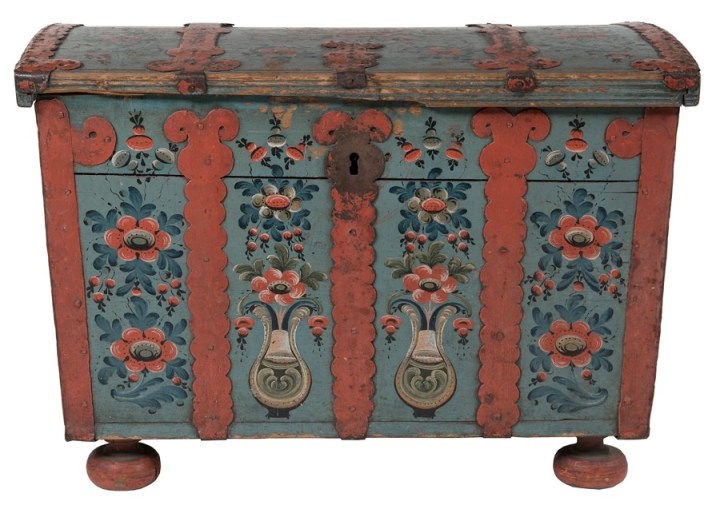
Painted chest, inscribed P.J.D 1802.
◊ ◊ ◊ ◊ ◊
Now on view at Stockholm’s Nordic Museum:
Rejält Retro: Målade Allmogemöbler, 1750–1850
Nordiska Museet, Stockholm, 21 October 2015 — 4 September 2016
The well-made, durable, patterned, and colorful are clear trends today, and just what characterizes rustic furniture from the 1700s and 1800s. Rejält Retro features grandfather clocks, cabinets, boxes, and chests—over fifty items from across the country, against a contemporary background in unexpected combinations.
◊ ◊ ◊ ◊ ◊
Det välgjorda, hållbara, mönstrade och färgstarka är tydliga trender idag, och precis vad som utmärker allmogemöblerna från 1700- och 1800-talen. I Rejält retro visas golvur, skåp, skrin och kistor, drygt femtio utvalda statusobjekt från hela landet, mot en modern bakgrund i oväntade kombinationer.
Vilka är dagens statusmöbler? En exklusiv soffa kanske? Danskt 50-tal eller modernisternas designikoner? I en välbärgad bondgård för 200 år sedan motsvarades de av kistan, skrinet, skåpet och golvuret. Mycket var väggfast och platsbyggt men det här var möbler man kunde ta med sig om man flyttade. Och med stora ytor perfekta för målad dekor.
Skåpet var den möbel som ett nygift par vanligtvis skaffade när de skulle sätta bo. Helst ett som stod på golvet, ett ståndskåp, med både hans och hennes initialer. Kistan hade den nygifta kvinnan med sig till det nya hemmet, fylld med dyrbara inredningstextilier. En möbel med gamla anor och högt symbolvärde. Skrinet hade ett symboliskt värde som förvaring för trolovningsgåvan – handskar, psalmbok och sjal. När kvinnan i vittnens närvaro tackat ja till skrinet var trolovningen klar och offentliggjord. Golvuret var precis som skåpet en modebetonad statusmöbel. Få använde det som klocka. Många urverk tillverkades i Mora och såldes över hela landet. Men själva möbeln, golvursfodralet, tillverkades lokalt.
Allmogekonst är konst skapad av folk på landet, för folk på landet. Under ungefär hundra år, från mitten av 1700-talet till mitten av 1800-talet, blomstrade allmogens möbelmåleri. Det typiska för dessa möbler är stiliserade mönster, starka färger som blymönjerött och pariserblått, att flera stilar blandas och att hela ytan fylls ut med dekoration. Allmogemålarnas ambition var att göra mönster, inte att avbilda verkligheten.
Reportage från lyxiga hem påverkar hur vi inreder hemma i dag och så även förr. I vissa områden är allmogemöblerna tydligt påverkade av herrgårdsmodet och de möbler som tillverkades av städernas skråsnickare. Då är motiven också mer verklighetstrogna.
Six-Week Online Course | The Gothic Revival, 1700–1850
◊ ◊ ◊ ◊ ◊
From Open Education:
Six-Week MOOC | The Gothic Revival, 1700–1850: Interdisciplinary Perspectives
Beginning 29 February 2016
Taught by Dale Townshend and Peter Lindfield
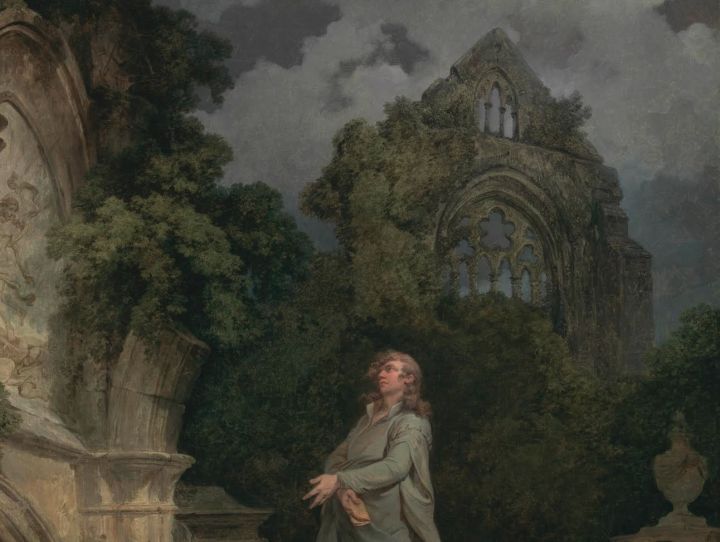
Designed for the non-specialist learner, this six-week course is intended as an introduction to the inter-disciplinary dimensions of the Gothic Revival in British culture of the long eighteenth century (1700–1850). Over 6 weekly sessions, you will be guided by acknowledged experts in the field of Gothic studies through the following topics:
1 Introduction, and the Meanings of the Term ‘Gothic’ in the Eighteenth Century
2 An Introduction to Gothic Literature: Horace Walpole’s The Castle of Otranto (1764)
3 Gothic Literature after Walpole
4 The Gothic Revival in Architecture
5 Gothic Interiors in the Eighteenth Century
6 Gothic in Eighteenth-Century Visual Art
The MOOC commences on Monday 29 February 2016. Each session consists of three mini-lectures, quizzes, the use of reflective diaries, and peer discussion. Your tutors will be available for a one-hour live Question and Answer session per week. Further details about this will follow in due course.
Prerequisites: None, other than an abiding interest in the early Gothic aesthetic.
Time Commitments: Approximately 1 hour of formal instruction time per week, excluding your own personal study and reading.
Rules of Progression: Each successive week will only become available to you once you have completed the quiz for the previous week. Although these weekly exercises to do not count towards your certificate of completion, you are encouraged to complete them in preparation for the final quiz.
Certificates of Completion: Proof of having successfully completed the MOOC will be available at the end of the course. In order to qualify for a certificate, you will have to have scored at least 50% in the final quiz, an informal test comprised of a selection of questions encountered in earlier sessions.
Instructors: Dale Townshend (Senior Lecturer in Gothic and Romantic Studies Division of English Studies, University of Stirling) and Peter Lindfield (Postdoctoral Research Fellow, Literature and Languages, University of Stirling)
◊ ◊ ◊ ◊ ◊
New Book | Benjamin Franklin in London
From Yale UP:
George Goodwin, Benjamin Franklin in London: The British Life of America’s Founding Father (New Haven: Yale University Press, 2016), 400 pages, ISBN: 978-0300220247, $32.50.
 For more than one-fifth of his life, Benjamin Franklin lived in London. He dined with prime ministers, members of parliament, even kings, as well as with Britain’s most esteemed intellectuals—including David Hume, Joseph Priestley, and Erasmus Darwin—and with more notorious individuals, such as Francis Dashwood and James Boswell. Having spent eighteen formative months in England as a young man, Franklin returned in 1757 as a colonial representative during the Seven Years’ War, and left abruptly just prior to the outbreak of America’s War of Independence, barely escaping his impending arrest.
In this fascinating history, George Goodwin gives a colorful account of Franklin’s British years. The author offers a rich and revealing portrait of one of the most remarkable figures in U.S. history, effectively disputing the commonly held perception of Franklin as an outsider in British politics. It is an enthralling study of an American patriot who was a fiercely loyal British citizen for most of his life—until forces he had sought and failed to control finally made him a reluctant revolutionary at the age of sixty-nine.
George Goodwin is the author of numerous articles and two previous histories, Fatal Colours: Towton 1461 and Fatal Rivalry: Henry VIII, James IV, and the Battle for Renaissance Britain. He is currently Author in Residence at the Benjamin Franklin House in London and was a 2014 International Fellow at the Robert H. Smith International Center for Jefferson Studies, Monticello. He lives close to London’s Kew Gardens.
◊ ◊ ◊ ◊ ◊
C O N T E N T S
Prologue
Life Before London
A Young Man in London
Foundations
Conductor
Return to London
A London Life
Benjamin Franklins British Family
Moves and Countermoves
Intermission
The Stamp Act
Pivotal Years
12 Home Comforts and Discomforts
Seeking Balance
Movements
Drawn to the Cockpit
The Last Year in London
A Little Revenge
Selected Places to Visit and Related Organizations
Bibliography
Notes
Acknowledgements
Index
Redwood Library Acquires Collection of Early Modern Architecture Books

Redwood Library and Athenaeum in Newport, Rhode Island, with Harrison’s Mirror mounted on the front pediment of the 1750 building, designed by Peter Harrison; the mirror was one element of the installation exhibition To Arrive Where We Started by Peter Eudenbach (July 2012 — July 2013).
◊ ◊ ◊ ◊ ◊
From Art Daily (17 February 2016) . . .
The Redwood Library and Athenaeum—a hybrid historic site, museum, rare book repository, and the oldest continuously operating lending library in America (1747)—has acquired a comprehensive collection of seventeenth- and eighteenth-century British architecture books and building manuals from the antiquarian bookseller Charles Wood. Comprising 53 titles, the collection deepens the Library’s already significant holdings of material devoted to early modern architecture and design, one of its cornerstone collecting areas. The acquisition was made possible by a grant from the B.H. Breslauer Foundation, as well as from donations from a number of local and national benefactors.
 “By virtue of what the Redwood is—the country’s oldest public Neo-Classic structure and a touchstone of the nation’s architectural patrimony—we are duty bound to remain a center for the study of early American architecture,” said Benedict Leca, Executive Director of the Redwood Library. “This collection dovetails perfectly with our existing holdings, notably the Cary Collection of supremely rare eighteenth-century pattern books, and exemplifies our commitment to the scholarly interpretation of our own building and those of colonial Newport.”
Newport’s historic center of learning and a designated national landmark, the Redwood Library has been serving New England and beyond as a resource supporting the range of intellectual pursuit for nearly three hundred years. In a city especially known today as a hub of historic preservation, garden design and place making, the Redwood endures as a locus of research in these domains through a constellation of related collections, making this acquisition especially pertinent.
The Redwood’s Newport Collection, an indispensable trove when researching Newport and Aquidneck Island, comprises over 5,000 books and hundreds of archives and manuscripts. The Doris Duke Preservation Collection focuses on New England colonial and nineteenth-century architecture, with an emphasis on the preservation and restoration of both the exterior architectural structure, including windows, doors and moldings, and on interior decorative elements, such as wallpaper and textiles. The Dorrance Hamilton Gardening Collection currently holds over 500 titles of landscape architecture, classic ‘how-to’ guides by important historic designers, such as Geoffrey Jellicoe and Lancelot ‘Capability’ Brown, as well as a number of discerning treatments of historic world gardens. The Cynthia Cary Collection, collected over decades by Mr. and Mrs. Guy Fairfax Cary, Sr., contains nearly 200 fifteenth- to mid-nineteenth-century English and continental pattern books of furniture, decoration, and ornament. All of these collections are a resource for scholars from all over the world, and continue to grow through the acquisition of primary works and authoritative scholarly titles.
“This outstanding collection is particularly noteworthy as it is a blend of builder’s manuals on one hand, and of illustrated, so-called gentlemen’s folios on the other,” specified Benedict Leca. “It gives us a window not only on period building techniques, but also on the diffusion of architectural knowledge, its styles and fashions, by way of some real rarities. The Scamozzi Mirror of Architecture, for example, was often used practically by builders and thus literally consumed; for this reason it rarely survives complete. Of appeal to the connoisseur rather than the builder is a very rare suite of nine copperplate engravings of Chinese lattice designs by William Halfpenny, with the only two other known copies at the British and Avery libraries.”
Further highlights from the collection include a number of rare manuals and pamphlets, including Henry Cook’s Patent artificial slate manufactory (1786), one of only three copies listed in the National Union Catalog (NUC); Abraham Fletcher’s The Universal Measurer (1766), one of only six copies on OCLC; and The Rudiments of Architecture or the Young Workman’s Instructor (1775), one of only two known copies, the Redwood’s having an eighteenth-century Boston provenance. The folios include a copy of the now scarce pattern book produced by Abraham Swan, The British architect or the builder’s treasury of stair-cases (1765?); and Christopher Wren Jr’s Parentalia: or memoirs of the family of Wrens (1750), an exceptional copy complete with the often-missing mezzotint frontis portrait of Wren.
Display | Majestic Mountain Retreats
From the Norton Museum of Art:
Majestic Mountain Retreats: 17th- and
18th-Century Monumental Chinese Landscape
Norton Museum of Art, West Palm Beach, 6 February — 15 May 2016

Wang Jiu, Chinese, Landscape in the Manner of Wang Meng, dated 1774; hanging scroll, ink on paper 136.8 x 64.1 cm (Nortom Museum of Art; photography by C.J. Walker)
Inspired by Stormy Landscape, likely painted in the late 1730s to mid-1740s, and the most recent hanging scroll added to the Norton’s Chinese Collection, the three works in this installation depict mountain retreats. The inscription and artists’ seals on Stormy Landscape, suggest that it is a painting of a Taoist monastery. It is reminiscent of extant Taoist mountaintemples in Fujian province not far from the artist’s home. The other two works are, Waterfall in a Bamboo Grove, probably painted in the mid-17th century, and Landscape in the Manner of Wang Meng, dated 1744.
New Book | Parsonages
From Bloomsbury:
Kate Tiller, Parsonages (New York: Bloomsbury Shire Publications, 2016), 88 pages, ISBN: 978-1784421373, $15.
 From the Middle Ages to the present day, parsonages—vicarages, rectories, and later manses, presbyteries, and chapel houses—have been among the most significant dwellings in every kind of British community. Their roles have been wide and varied. Architecturally important, and ranging from medieval vernacular buildings to the bespoke house designs of leading architects of the nineteenth and twentieth centuries, to the more modest homes of today’s clergy, parsonages are important not only as buildings but for the part they—and their occupants—have played in the life of local communities, and in their links with the wider world. The parsonage, a hub of activity and connection, a place of change and continuity, provides fascinating historical insights both general and local. This study draws on the evidence of architecture, official documents, private records, literary accounts, and contemporary and modern images to build a picture of parsonages and their occupants. It includes a section on tracing the history of a parsonage.
C O N T E N T S
Parsonage Histories: Houses, Priests and People
Setting the Pattern: Medieval Priests’ Houses
The Post-Reformation Parsonage
Georgian Parsonages: A Golden Age?
Victorian and Edwardian Heyday
Vicarages and Rectories: The Recent Past
Further Reading
Tracing the History of a Parsonage: A Checklist of Sources
Index
Summer Course Offerings at Sotheby’s, 2016

◊ ◊ ◊ ◊ ◊
Among the course offerings this summer at Sotheby’s (for undergraduate credit). . .
European Decorative Arts: From Baroque to Art Nouveau
Sotheby’s Institute of Art, London, 31 May — 24 June 2016
Beginning in the seventeenth century with the rise of the Baroque and culminating in Art Nouveau at the end of the nineteenth, this varied and exciting course provides a comprehensive understanding of key stylistic developments in Western European design and the decorative arts. The course focuses on furniture, ceramics, glass and metalwork, explored within the context of architecture and interiors and the broader historical and cultural forces that have influenced the production and consumption of decorative art objects. It seeks also to provide students with a basic knowledge of materials and techniques.
A diverse programme of lectures is complemented by visits to leading museums, galleries and historic houses. Students are taught by a range of in-house tutors and visiting experts from the art world. The course is introductory and requires no prior knowledge. The teaching approach is object-based and enables students to gain confidence in analyzing and identifying a wide range of art objects. It promotes skills that will be useful for working in the art world and also serves as a bridging course for further study. Faculty: Helena Pickup (Course Leader), Lis Darby, Anne Ceresole, Daniel Packer, Elisabeth Bogdan.
◊ ◊ ◊ ◊ ◊
London, Art Capital of the World, 1700–2000
Sotheby’s Institute of Art, London, 28 June — 22 July 2016
The history of the market holds valuable lessons for those hoping to work in the commercial art world. London has been synonymous with the exhibiting, collecting, buying, and selling of art for centuries. This course will provide an in-depth exploration of the institutions, personalities, and locations that have made London the epicenter of the art world, historically and today. With many of these historic works and buildings still in existence and accessible, students will experience themselves how the art scene evolved along with the city itself. We will examine the key factors that led to an increase in the demand for fine arts and how London emerged as the favored location for auctions in the eighteenth century. The connection between opportunities to view works of art and the growth of collecting will be analyzed, as will the impact of the market on ‘native’ artists. Students acquire an understanding of the history of the art market, collecting, and museums. A comprehensive course of lectures is enhanced by visits to galleries, museums, and auction houses. Faculty: Elizabeth Pergam.
New Book | Architecture and Empire in Jamaica
From Yale UP:
Louis P. Nelson, Architecture and Empire in Jamaica (New Haven: Yale University Press, 2016), 324 pages, ISBN: 978-0300211009, $85.
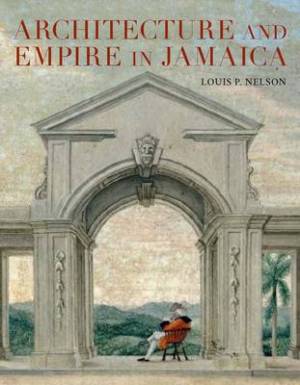 Through Creole houses and merchant stores to sugar fields and boiling houses, Jamaica played a leading role in the formation of both the early modern Atlantic world and the British Empire. Architecture and Empire in Jamaica offers the first scholarly analysis of Jamaican architecture in the long 18th century, spanning roughly from the Port Royal earthquake of 1692 to Emancipation in 1838. In this richly illustrated study, which includes hundreds of the author’s own photographs and drawings, Louis P. Nelson examines surviving buildings and archival records to write a social history of architecture.
Nelson begins with an overview of the architecture of the West African slave trade then moves to chapters framed around types of buildings and landscapes, including the Jamaican plantation landscape and fortified houses to the architecture of free blacks. He concludes with a consideration of Jamaican architecture in Britain. By connecting the architecture of the Caribbean first to West Africa and then to Britain, Nelson traces the flow of capital and makes explicit the material, economic, and political networks around the Atlantic.
Louis P. Nelson is professor of architectural history and associate dean for research in the School of Architecture, University of Virginia.
University of Buckingham’s MA in Decorative Arts and Historic Interiors
MA in French and British Decorative Arts and Historic Interiors
University of Buckingham
Applications are invited for a partial studentship on the London-based MA in Decorative Arts and Historic Interiors offered by the University of Buckingham starting in September 2016.
The bursary, worth £7500, will cover 82% of the course fees for EU students and 55% for international students. Priority will be given to applicants with excellent academic qualifications seeking, or currently pursuing, curatorial careers in museums or the built heritage. The bursary is also open to part-time students currently working in the field, who can take the course as a form of in-service training over two years.
This unique one-year MA in French and British Decorative Arts and Historic Interiors provides sounds vocational and academic training, first-hand study of furniture, silver and ceramics in the context of historic interiors, numerous study trips to museums and historic house collections, (including a study week in Paris) and placements in museums and heritage institutions.
For further details please visit our website or contact Dr Barbara Lasic: barbara.lasic@buckingham.ac.uk










 Enfilade
leave a comment