Conference | Making Britain Modern
From The Courtauld:
Conference in Celebration of Professor David H. Solkin: Making Britain Modern
The Courtauld Institute of Art, Somerset House, London, 2 July 2016
Organized by Katie Scott

Thomas Rowlandson, The Exhibition Stare-Case, Somerset House, Watercolor and pen and ink on medium, slightly textured, cream wove paper, ca. 1800 (Yale Center for British Art, Paul Mellon Collection)
This conference will celebrate the scholarship of Professor David H. Solkin and his outstanding contribution to the study of British art. Convening a younger generation of academics and curators whose work has been marked by David Solkin’s teaching and writing, the day will encapsulate the diverse ways in which his call for a trenchant social history of eighteenth-century British art has been answered.
The title Making Britain Modern alludes to David Solkin’s profound and wide-ranging engagement with the years between the Glorious Revolution and the death of George IV, a period in which the nation’s visual culture was transformed by broader ‘modernising’ processes of commercialisation, industrialisation and overseas expansion. Through extensive original research, acute dialectic analysis and incisive argumentation, Solkin’s historiography has advocated enquiry that is sensitive to the impact of broader social and political change on the era’s artists and artworks, and its public and commercial institutions. Thanks to an important corpus of monographs, essays, and ground-breaking exhibition catalogues, David Solkin has taught a whole generation of researchers how rigorous scholarship can be used to conjure a vivid impression of this transformational moment in British art and to restore the social significance of forgotten paintings, revising the standard account of such eminences as Richard Wilson, Joshua Reynolds, William Hogarth, Joseph Wright of Derby, and J.M.W. Turner in the process.
Making Britain Modern will offer a series of presentations on subjects and questions that are also themes current in David’s work. Dian Kriz takes up the issue of the portrayal of heroic masculinity as repurposed for contemporary colonial Jamaica. Violence is also a theme for Meredith Gamer and Joseph Monteyne, as spectacle of execution in the case of the former and as Gillray’s practice of etching in the case of the latter. In counterpoint, Matthew Hargraves considers narratives of modern sentiment in religious painting, while John Chu explores Constable’s sketches of the polite and leisured in commercial society. Questions of invention and experimentation in the context of industrialisation are raised by Richard Johns through a consideration of Wedgwood’s jasperware. Finally, Kate Grandjouan broaches the remaking of national identity in the context of British ascendency in Europe. The programme will open with a conversation between Martin Myrone and David Solkin, which explores the themes of his writing and the range of his contribution. A pop-up exhibition of works in the Courtauld Gallery, curated by Mark Hallett, will provide an opportunity to inspect important examples of the kinds of British drawings, watercolours, and prints which have been subjects of David Solkin’s research and teaching, but also allude to his long-standing activities as a collector. Sarah Monks will offer a summation of the day and consider what it conveys about his on-going impact to British art studies.
P R O G R A M M E
9.00 Registration
9.25 Welcome by Alixe Bovey (The Courtauld Institute of Art)
9.30 Martin Myrone (Tate Britain) in conversation with David Solkin
10.00 Meredith Gamer (Columbia University): The ‘Fine Art’ of Execution in Eighteenth-Century Britain
10.30 Kate Grandjouan (independent scholar): French Disruption: Alterity and the Satirical Print
11.00 Tea / coffee break
11.30 Matthew Hargraves (Yale Center for British Art): Devotions in Doncaster: Francis Hayman’s Good Samaritan
12.00 Richard Johns (University of York): The Trials of Josiah Wedgwood
12.30 Discussion and questions
13.00 Lunch break and pop-up exhibition in Prints and Drawings’ Room at The Courtauld Gallery curated by Mark Hallett
15.00 Joseph Monteyne (University of British Columbia): The Eye Under Attack: James Gillray’s Violent Ground of the Image
15.30 Dian Kriz (Brown University): A Military Artist Takes on the Indies: Abraham James and the Colonial Display of Martial Masculinity
16.00 Discussion and questions
16.30 Tea / coffee break
17.00 John Chu (National Trust; The Courtauld Institute of Art): Drawn Indoors: John Constable’s Idle Works
17.30 Sarah Monks (University of East Anglia): Summation and Discussion
18.00 Reception
Exhibition | Netherlandish Drawings, 15th to 18th Centuries

Now on view at the GNM in Nuremberg:
Netherlandish Drawings: Newly Discovered Works from the Germanisches Nationalmuseum
Niederländische Zeichnungen: Neu entdeckte Werke aus dem Germanischen Nationalmuseum
Germanisches Nationalmuseum, Nuremberg, 18 February — 22 May 2016
Since the Renaissance, drawing has been particularly valued—not just because of its relevance to the creative process in all the arts, but also as an insight into an artist’s inspiration. In his Schilder-Boeck (Book of Painters) of 1604, the Dutch biographer Carel van Mander also describes it admiringly as the “father of painting.”
The prominent role of graphic art is also reflected in the GNM’s holdings of Netherlandish drawings of the 15th to 18th century, which are now being shown for the first time in a special exhibition. Featuring around 90 selected works, the exhibition traces an arc from pieces from the workshop of Jan van Eyck through to the decorative designs of Jacob de Wit. The diversity of techniques and themes so typical of the Flemish and Dutch masters is revealed in depictions of landscapes, figure studies, genre scenes, allegories or religious subjects. The exhibition also looks at the various functions of draughtsmanship: from the first sketched idea through to independent works produced for the art market.
The GNM’s Department of Prints and Drawings includes around 150 drawings by Netherlandish artists from the 15th to the 18th century. The geographical term ‘Netherlandish’ refers to both the northern provinces of Holland and the Flemish areas in present-day Belgium. With a few exceptions, these drawings, from the hand of both prominent and not so prominent masters, have remained unpublished and therefore unknown to art historical research.
The museum’s founder, Freiherr Hans von und zu Aufseß, owned Netherlandish drawings, e.g. a sheet signed and dated by Bartholomeus Spranger. However, most of the holdings were acquired through individual purchases between 1866 and 1939. The Netherlandish collection also grew in 1940 and 1982 as a result of bequests from two private collectors.
In addition to a couple of early works, the holdings contain many 17th-century drawings from the Dutch Golden Age. The pictorial genres include landscapes, figures, genre scenes, allegories and religious and mythological subjects. A few 18th-century technical drawings of Netherlandic origin from the ‘Historical Sheets’ are worthy of note as items specific to the collection. The functional relationships between the drawings are diverse, and not always obvious—studies, sketched ideas, drafts for specific paintings, printed graphics etc. can be found alongside independent works produced for the art market.
The goal is to created a printed catalogue describing and depicting the Department of Prints and Drawings’ Netherlandish drawings in accordance with scientific standards and thus open them up for further research. This work is focusing on collecting and evaluating the technical findings, stylistic peculiarities and possible functions of the drawings, particularly in view of the discussion about issues of dating and attribution. The results of the research project are presented in this special exhibition, from February 18 to May 22, 2016.
◊ ◊ ◊ ◊ ◊
Claudia Valter, with contributions by Frank Matthias Kammel and Thomas Ketelsen, Die Niederländischen Zeichnungen 1400–1800 im Germanischen Nationalmuseum (Nuremberg, 2016), 280 pages, ISBN: 978-3936688979, 60€.
 Die Graphische Sammlung des Germanischen Nationalmuseums bewahrt rund 130 niederländische Zeichnungen des 15. bis einschließlich 18. Jahrhunderts, die durch Ankäufe, Schenkungen und Vermächtnisse in den Jahren 1858 bis 1982 erworben wurden. Hierzu zählen Werke von Jan Breughel d.J., Philips Koninck oder Bartholomeus Spranger, aber auch Arbeiten von weniger bekannten und anonymen Meistern. In dem vorliegenden Bestandskatalog sind die niederländischen Zeichnungen nun erstmals in ihrer Gesamtheit wissenschaftlich bearbeitet, mit Provenienzangaben sowie den technischen und bibliographischen Daten dokumentiert und farbig abgebildet. Den Katalog ergänzen Textbeiträge zur Sammlungsgeschichte niederländischer Kunst am Germanischen Nationalmuseum sowie zu den Funktionen niederländischer Zeichnungen.
Odes on a Cat Drowned in a Goldfish Bowl
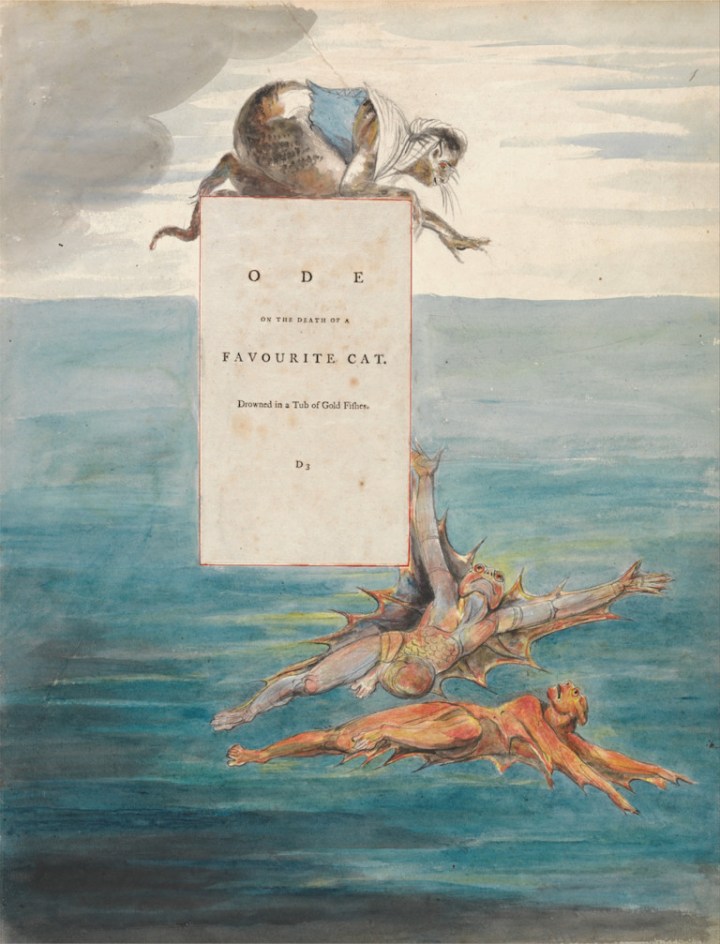 William Blake, illustration for “Ode on the Death of a Favourite Cat,” in ‘The Poems of Thomas Gray (1797-98), watercolor with pen and black ink and graphite on paper with inlaid letterpress page (New Haven: Yale Center for British Art, Paul Mellon Collection)
◊ ◊ ◊ ◊ ◊
Taking as a point of departure a painting at auction this week at Bonhams, Allison Meier highlights for Hyperallergic readers some of the artistic responses to Horace Walpole’s cat, which drowned in 1747, including William Blake’s extraordinary watercolors.

Attributed to Martin Ferdinand Quadal (Nietschitz 1736–1811 St. Petersburg), Ode on the Death of a Favourite Cat Drowned in a Tub of Goldfishes (Estimate: £1000–1500 / US$1400–2200)
Allison Meier, “18th-Century Odes to a Cat that Drowned in a Goldfish Bowl,” Hyperallergic (8 April 2016).
A cat that fell into a goldfish bowl in 1747 and subsequently drowned from her pyrrhic hunt inspired an unlikely series of artworks in the 18th century. Selima, as the unfortunate feline was called, was the companion of art historian and author Horace Walpole, and like any eccentric aristocrat worth his earldom, he asked friend and poet Thomas Gray to pen a tribute. Gray went beyond a simple epitaph and scribed a whole mock elegy for the cat, called “Ode on the Death of a Favourite Cat Drowned in a Tub of Goldfishes.” . . .
The painting is included in Bonhams Old Master Sale this Wednesday (27 April 2016, Auction 23252, Lot 200).
New Book | Poetical Dust: Poets’ Corner and the Making of Britain
Happy Bard Day!—on the 400th anniversary of the death of William Shakespeare (died on 23 April 1616). Global programming details are available at Shakespeare400. From Penn Press:
Thomas A. Prendergast, Poetical Dust: Poets’ Corner and the Making of Britain (Philadelphia: University of Pennsylvania Press, 2015), 256 pages, ISBN: 978-0812247503 (cloth), ISBN: 978-0812291902 (ebook), $60 / £39.
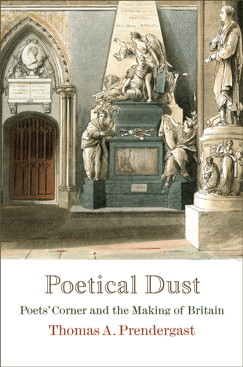 In the South Transept of Westminster Abbey in London, the bodies of more than seventy men and women, primarily writers, poets, and playwrights, are interred, with many more memorialized. From the time of the reburial of Geoffrey Chaucer in 1556, the space has become a sanctuary where some of the most revered figures of English letters are celebrated and remembered. Poets’ Corner is now an attraction visited by thousands of tourists each year, but for much of its history it was also the staging ground for an ongoing debate on the nature of British cultural identity and the place of poetry in the larger political landscape.
Thomas Prendergast’s Poetical Dust offers a provocative, far-reaching, and witty analysis of Poets’ Corner. Covering nearly a thousand years of political and literary history, the book examines the chaotic, sometimes fitful process through which Britain has consecrated its poetry and poets. Whether exploring the several burials of Chaucer, the politicking of Alexander Pope, or the absence of William Shakespeare, Prendergast asks us to consider how these relics attest to the vexed, melancholy ties between the literary corpse and corpus. His thoughtful, sophisticated discussion reveals Poets’ Corner to be not simply a centuries-old destination for pilgrims and tourists alike but a monument to literary fame and the inevitable decay of the bodies it has both rejected and celebrated.
Thomas Prendergast is Professor of English at The College of Wooster and author of Chaucer’s Dead Body: From Corpse to Corpus.
C O N T E N T S
Preface
Introduction
1 Westminster Abbey and the Incorporation of Poets’ Corner
2 Melancholia, Monumental Resistance, and the Invention of Poets’ Corner
3 Love, Literary Publicity, and the Naming of Poets’ Corner
4 Absence and the Public Poetics of Regret
5 Poetic Exhumation and the Anxiety of Absence
Coda: Necromancy and the American Poets’ Corner
Poets’ Corner Graveplan
Poets’ Corner Alphabetical Burial and Monument List
Chronological List of Stones and Monuments in the South Transept
Notes
Bibliography
Index
Acknowledgments
Exhibition | Heavy Metal: Arms and Armour

From the National Museum of Finland (Kansallismuseo) . . .
Heavy Metal: Arms and Armour (Aseita ja haarniskoja) from the 16th to 18th Century
Häme Castle, Hämeenlinna, Finland, 22 April — 23 October 2016
In the end of April 2016 an armour exhibition of international stature will be opened in Häme Castle. Originally from Graz Austria the exhibition demonstrates large collection of arms and armour from the 16th to 18th centuries. The exhibition will also include one of the few whole preserved horse armour and weapons. The infantry half armours on display are related to Finnish history, since similar armour was used by the Finnish light cavalrymen in the service of King Gustavus Adolphus of Sweden during the Thirty Years’ War in the 17th century.
Medieval Häme Castle provides a unique and authentic setting for the exhibits. During the exhibition there will be plenty of additional activities such as a medieval feast, market and jousting. The seventeen pieces of armour in the exhibition are from the Styrian Armoury of the Universaalmuseum of Joanneum in Austria, which has the world’s largest and oldest collection of armour. They are on display for the first time in Northern Europe. The exhibition gives a unique opportunity to explore armour from the 16th to 18th century. Five of the pieces featured are whole breastplate armours (Maximilian and Italian type); twelve are infantry half armours. Also on display will be helmets, halberds, boar spears, swords, muskets, and wheel-lock pistols.
Display | Spotlight on French Royal Furniture by Riesener

Installation view of A Closer Look: Spotlight on French Royal Furniture by Jean-Henri Riesener (1734–1806) in the White Drawing Room at Waddesdon Manor, The Rothschild Collection (The National Trust), 23 March – 23 October 2016. © The National Trust, Waddesdon Manor.
◊ ◊ ◊ ◊ ◊
Press release for the display now on view at Waddesdon:
A Closer Look: Spotlight on French Royal Furniture by Jean-Henri Riesener (1734–1806)
Waddesdon Manor, Buckinghamshire, 23 March — 23 October 2016
Curated by Ulrich Leben and Emily Roy
Waddesdon is unique in the world for having three extraordinary chests of drawers by Jean- Henri Riesener (1734–1806), two of which belonged to members of the French royal family. They are displayed in the White Drawing Room at Waddesdon for this special exhibition. The display allows visitors to look closely at these magnificent pieces and to learn about their design, technical construction, and fascinating history. It provides a rare opportunity to look in 360° at objects normally placed against walls.
You can see the magnificent chest of drawers commissioned by the Comtesse de Provence, sister-in- law of Louis XVI, magnificently veneered in purple heart, with marquetry of tulipwood, mahogany, sycamore, ebony, boxwood, casuarina, holly and burl wood with gilt-bronze mounts and marble top. She ordered this chest of drawers from Riesener on 8 February 1776 and it was delivered to her apartment in Versailles the following month. This was astonishingly fast for such a complex piece of furniture. Also in the collection is a chest of drawers for Louis XVI youngest sister Madame Elisabeth (1764–1794) for her coming of age at just 14 years old!
The exhibition includes a specially commissioned digital animation showing the construction of Madame Elisabeth’s chest of drawers and two films, produced by the J. Paul Getty Museum, showing the making of intricate marquetry and gilt-bronze mounts. The display marks the beginning of a research project—in collaboration with The Wallace Collection and The Royal Collection—which aims to learn more about Riesener, the techniques and materials he used, and the world of buying and making furniture in 18th-century France.
The curators would like to thank the following for their help with the preparation, design and installation of the exhibition: Colin Bailey, Vincent Bastien, Alexis Borde, Max Coppoletta, Fréderic D’Arras, Mike Fear, the J. Paul Getty Museum, Jürgen Huber, Helen Jacobson, Lindsay Macnaughton, David Mlinaric, Miriam Schefzyk, Christoph Vogtherr, and the Collections, Facilities, IT and Marketing Departments.
◊ ◊ ◊ ◊ ◊
Additional images are available here»
Study Session | French Royal Furniture by Jean-Henri Riesener
◊ ◊ ◊ ◊ ◊
Study day opportunities at Waddeson Manor in connection with the Riesener exhibition:
Study Session: Spotlight on French Royal Furniture by Jean-Henri Riesener
Waddesdon Manor, Buckinghamshire, 25 May, 28 July, and and 23 September 2016
Waddesdon Manor houses three extraordinary chests of drawers by court cabinet-maker Jean-Henri Riesener, two of which belonged to members of the French royal family. They are among twelve pieces of furniture now at Waddesdon that were originally at the Palace of Versailles. Riesener was perhaps the most celebrated cabinet-maker of the 18th century, the official cabinet-maker to King Louis XVI, and the favourite of Queen Marie Antoinette. Each of these chests of drawers is richly decorated with colourful marquetry (designs made with wood veneers) depicting flowers and trophies and geometric patterns, and mounted with finely chased and gilded bronzes. Learn about their design, technical construction, and fascinating history. £25 (includes grounds admission), £15 National Trust/Art Fund members, £10 students. Wednesday 25 May, Thursday 28 July, and Friday 23 September 2016. Coffee on arrival at 10.15; session 10.45–12.15.
Display | Persuading the King: A MS Petition by Gabriel de Saint-Aubin
Now on view at Waddesdon:
Persuading the King: A Manuscript Petition by Gabriel de Saint-Aubin (1724–1780)
Waddesdon Manor, Buckinghamshire, 23 March — 23 October 2016
Curated by Rachel Jacobs
 This display highlights a new addition to the collection at Waddesdon: Gabriel de Saint-Aubin’s volume, Placets de l’officier Desbans (1775). This elaborate manuscript petition (placet) was submitted to Louis XVI and Marie-Antoinette by a soldier, Edme Louis Desbans, asking for a long-promised promotion. Gabriel de Saint-Aubin was one of the greatest draughtsman of 18th-century France, and the drawings with which he brought this document to life were designed to glorify the royal couple while appealing to their artistic tastes and sensibilities. This unique work offers a glimpse into the politics of promotion and favour at the French court near the end of the Old Regime—in which the fortune of an individual depended upon the arts of persuasion. It has all sorts of resonances today, from patronage to the mysterious world of the political lobbyist.
A pdf file of the text panels is available at the Waddesdon website.
Study Session | Persuading the King
Study day opportunity at Waddeson Manor in connection with the exhibition:
Study Session Persuading the King: Gabriel de Saint-Aubin’s Placets
de l’officier Desbans and Other Books by the Saint-Aubin Brothers
Waddesdon Manor, Buckinghamshire, 24 June 2016
A rare opportunity to study Waddesdon’s newly acquired royal petition by Gabriel de Saint-Aubin, alongside other manuscript volumes, drawings, and prints by the artist and his brothers Charles-Germain and Augustin. Senior Curator Dr Juliet Carey and Curator Rachel Jacobs will offer a glimpse into the politics of promotion and favour near the end of the Old Regime. Works will include Gabriel de Saint-Aubin’s Memoire sur la reformation de la police de France (1749) and a special copy of Du Perron’s Discours sur la peinture et sur l’architecture (1757), made for the book’s dedicatee Madame de Pompadour. Charles-Germain de Aubin’s famous Livre de caricatures will provide a subversive counterpoint to the arts of flattery and persuasion that lay at the heart of court culture. £25 (includes grounds admission), £15 National Trust/Art Fund members, £10 students. Friday, 24 June 2016. Coffee on arrival at 10.15; study session 10.45–12.15. Book early to avoid disappointment.
Study Session | Books and Bindings at Waddesdon Manor
From Waddesdon:
Study Session: Books and Bindings
Waddesdon Manor, Buckinghamshire, 12 May and 15 September 2016
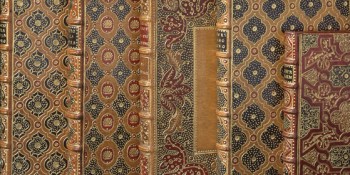 Come and explore the treasures of the Waddesdon collection of 17th- and 18th-century books and bindings. These include unique manuscripts and luxuriously illustrated printed volumes. Many of the books in the collection have illustrious provenances including great bibliophiles and members of the French Royal Family. The session will provide an opportunity to view some of the treasures of the Waddesdon Collection and to learn about book history through some of its finest examples. £25 (includes grounds admission), £15 National Trust/Art Fund members, £10 students. Thursday 12 May and 15 September 2016. Coffee on arrival at 10.15; study session 10.45–12.15.










leave a comment