Call for Papers | Nouveau Reach: Past, Present, and Future of Luxury
From the conference website:
Nouveau Reach: Past, Present, and Future of Luxury / Passé, présent et avenir du luxe
Ryerson University, Toronto, 11–14 May 2017
Proposals for complete panels and individual papers due by 15 March 2016
Nouveau Reach: Past, Present, and Future of Luxury brings together leading thinkers in luxury studies and industry to explore the future of luxury in the Canadian and global contexts. Taking place in Toronto, Canada from 11 to 14 May 2017, we invite scholars of anthropology, business, fashion, fine art, history, modern languages, museum studies, material art & design, and social sciences to share findings on historical and contemporary developments in luxury studies. We also invite established professionals currently working in luxury market—via fashion, curatorship, fine arts, auctioneering, design, commerce, and travel—to contribute their expertise and insight on the future of luxury in the global context.
The three-day conference is co-organized by Brock University and The School of Fashion at Ryerson University. It features both traditional panels of 20-minute papers and interactive workshops led by leading industry experts. Please submit 4-member panel proposals that include 300-word (max) abstracts per presenter and a 200-word rationale for the panel, as well as a brief curriculum vitae for all presenters by 15 March 2016. Proposals for individual papers will also be considered. Graduate students are strongly encouraged to apply. Participants will be asked to submit completed papers in January 2017 for consideration for a special issue of Luxury: History, Culture, Consumption by Bloomsbury Publishing.
Topics can include, but are not limited to:
• The history of and new frontiers in luxury
• Trajectories in Canadian luxury
• Luxury and global markets
• Luxury and the public
• Luxury as business model
• Curating luxury
• Luxury and nation, race, and/or sex
• Cultural/literary/artistic representations of luxury
• Luxury consumption and/or production
• Luxury and space
• Scandals, ruptures, and slippages in the pursuit of luxury
Please submit proposals, in Word format, to NouveauReachCAN@gmail.com.
Organizing Committee
Jessica Clark, History, Brock University
Nigel Lezama, Modern Languages, Literatures & Cultures, Brock University
Alison Matthews David, The School of Fashion, Ryerson University
Robert Ott, The School of Fashion, Ryerson University
Plenary Speakers
Jonathan Faiers, University of Southampton, Editor, Luxury: History, Culture, Consumption
Giorgio Riello, University of Warwick, The Luxury Network
Jana Scholze, Victoria & Albert Museum, Co-curator of the 2015 exhibition What is Luxury?
Exhibition | The Châtelet Family Archives

◊ ◊ ◊ ◊ ◊
Now on display just outside of Chaumont:
Dans les arcanes d’une famille illustre: les archives Du Châtelet révélées
Archives départementales de la Haute-Marne, Chaumont, 20 June — 18 December 2015
Après trois années d’acquisitions et de classement aux Archives départementales de la Haute-Marne, ce fonds riche de plusieurs milliers de documents allant du XIIIe au XVIIIe siècle, complété par des prêts d’objets en provenance de musées ou de collections privées et d’autres pièces rares des Archives, est présenté au grand public pour la première fois !
Si de nombreuses pièces concernent Cirey-sur-Blaise et la personnalité la plus connue de la famille, Émilie Le Tonnelier de Breteuil, marquise Du Châtelet et amie proche de Voltaire, l’ensemble du fonds reflète plus globalement un art de vivre en Haute-Marne sur une période de six siècles.
L’exposition aborde sept grands thèmes : la famille Du Châtelet et ses possessions domaniales ; la carrière des Du Châtelet au service de la Lorraine et de la monarchie française ; l’histoire du château et des jardins de Cirey ; les sources de revenu de la famille (bois, métallurgie…) ; les aspects littéraires et scientifiques liés à Émilie du Chatelet et Voltaire ; la vie quotidienne au château de Cirey ; madame de Simiane et Cirey au XIXe siècle. Chaque thème reposera avant tout sur les éléments du fonds d’archives familial, mais pourra s’enrichir de pièces provenant d’autres fonds des Archives départementales ou d’objets prêtés par des établissements extérieurs.
Pour plus d’information, téléchargez le communiqué de presse.
At Christie’s | Rebranding and Rescheduling the Old Masters
‘Classic Art’ and ‘Revolution’ are the latest labels chosen to make Old Master paintings more appealing to collectors of contemporary art. From The NY Times:
Scott Reyburn, “A New Battleground for ‘Classic Art’,” The New York Times (30 October 2015).
. . . Last month, Christie’s jolted the auction calendar by announcing that it would be introducing a new themed week devoted to auctions of historic artworks in New York in April. Instead of holding its old master paintings sales in January in the same week as Sotheby’s, Christie’s will offer them three months later, at the same time that it previews highlights of its May Impressionist, modern and contemporary auctions.
Traditionally, for the convenience of dealers and collectors, Sotheby’s and Christie’s, the two rival auction houses, have held their most important sales in the same week. . . .
[But] Christie’s is now going its own way with old masters, or what it now re-brands as “classic art.”
“There’s a sense that classical paintings aren’t fashionable,” said Jussi Pylkkanen, global president of Christie’s International. “But we’ve been selling them at the wrong time of year, when we haven’t been able to show them to our buyers of 20th-century art.” . . .
This shake-up of the New York auction calendar is the latest attempt—the Frieze Masters fair in London is another—to re-energize demand for historic works by exposing them to the wealthy collectors of 20th- and 21st-century art who dominate the buying. With that audience in mind, the April 2016 “Classic Art Week” will be given a modernist edge with a new themed “Revolution” sale comprising stand-out works from the 18th to 20th centuries, including photographs. . . .
Christie’s press release (6 October 2015) for the “Revolution” sale (New York, #11932, 13 April 2016) is available here»
Newly Refurbished Paul Mellon Centre Opens to the Public
From the Paul Mellon Centre (27 October 2015) . . .
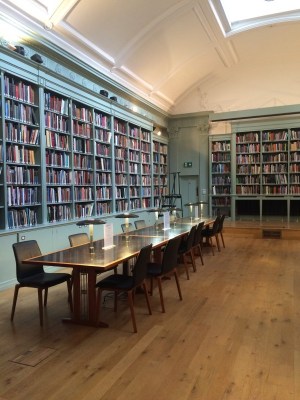 After our ten-month-long refurbishment and expansion project, the Paul Mellon Centre for Studies in British Art has re-opened its doors.
One of the jewels in the Centre’s crown is the Public Study Room (PSR), which, newly decorated, is once again open to readers from 10am to 5pm, Monday to Friday. Users of our PSR will enjoy improved, highly-convenient open-shelf access to the books that provide the mainstay or our rich library collections, and that cover all periods of British art and architecture. However, some of our Research Collection material is not yet installed on the premises; this includes journals, auction catalogues, rare books, and all of our archive and photographic archive collections. We hope that all of this material will be fully integrated into our collections, and available for use by readers, over the next few months. Please call 020 7580 0311 or email collections@paul-mellon-centre.ac.uk for further information.
◊ ◊ ◊ ◊ ◊
In addition to the renewed Public Study Room, the renovation project—completed by Wright and Wright—has doubled the size of the Centre’s listed Grade I premises with the acquisition of the lease of 15 Bedford Square, just next door. Bedford Square (built between 1775 and the 1780s) has been home to the Centre since 1996 (the Centre having previously been based at 20 Bloomsbury Square). The space that now serves as the Study Room had been heavily reworked in the 1920s; and as noted at the Mellon’s Centre’s website, based on “the evidence of the plaster ‘proscenium arch’ at the north end,” it “may well have been designed as a private cinema.” After nearly two decades, the unforgettable green room has been reborn, with this clever video showing the books going back onto the newly painted shelves. I can’t wait until my next visit. –CH
◊ ◊ ◊ ◊ ◊
Conference | The Impact of Empires on Collections and Museums
From Lorenzo de’ Medici:
Collecting and Empires: The Impact of the Creation and Dissolution
of Empires on Collections and Museums from Antiquity to the Present
San Jacopo in Campo Corbolini and Kunsthistorisches Institut in Florenz, Florence, 5–7 November 2015
The creation and dissolution of empires has been a constant feature of human history from ancient times through the present day, especially if one passes from a historical to a theoretical definition of empire as an open expanding global frontier. Establishing new identities and new power relationships to coincide with changing political boundaries and cultural reaches, empires also destroyed and/or irrevocably altered social structures and the material culture on which those social structures were partly based. The political activities of empires—both formal and informal to use Doyle’s definition—find their material reflection in the creation of new art forms and the reevaluation of old art forms which often involved the movement of objects from periphery to center (and vice versa) and promoted the formation of new collections. New mentalities and new social relationships were represented by those collections but they were (and are) also fostered through them.
In recent decades such issues surrounding objects and empire have become important components of our understanding of British colonialism, and to a lesser extent of anthropological approaches to colonial studies more broadly conceived. Concurrent with these developments, comparative studies of the political forms of empires have also appeared, though the baseline for such comparisons is invariably the Roman Empire, from whose imperium we derive our word, but which is ill-suited to describe post-WW-II hegemonies or even Asian historical examples. This conference seeks to cast a wider net temporally, spatially and conceptually by exploring the impact of the expansion and contraction of empires on collecting, collections, and collateral phenomena such as cultural exchange in a selection of the greatest empires the world has known from Han China to Hellenistic Greece to Aztec Mexico to the Third Reich without privileging particular political models and always with an eye to how these historical situations invite comparisons not only with each other but also with contemporary imperial tendencies.
While some scholars would argue that the term empire no longer applies to today’s global and transnational environment, others have redefined ‘empire’ in terms of contemporary capitalism and a developing post-modern global order. Exclusively based on political and economic concerns (including identity politics) and for the most part distressingly Eurocentric, these analyses of empire or its evolution into something else yet to be defined, also neglect the impact of material culture, even though material culture studies have made great strides in recent decades by addressing issues of the migration of objects and people for both political and non-political reasons. Therefore by investigating empires and imperialism in a comparative manner through the lens of collecting practices, museum archetypes and museums proper, it is hoped that this conference workshop will help shape our understanding of what is indeed imperial about our own approach to material culture.
While individual empires have been studied extensively, it is only in recent decades that they have been examined from comparative political, social and cultural perspectives. It is also only recently that scholarship in history of collecting and anthropology has begun to address the role imperial expansion on collecting and museums in reference to European and particularly British colonialism. Still there is very little written on the history of collecting from any perspective outside of the European tradition or from before the Renaissance. This conference would—for the first time—approach the subject of collecting and empires from a global and inclusive comparative perspective, from which it is hoped that significant conclusions may be drawn about the social, cultural and political impact of collecting and display across the centuries and down to present times.
◊ ◊ ◊ ◊ ◊
T H U R S D A Y , 5 N O V E M B E R 2 0 1 5
8:30 Welcome and Opening Remarks – Rappresentanti degli enti coinvolti
Royal Collections in the Ancient World
Chair: Maia Wellington Gahtan
9.00 Zainab Bahrani (Columbia University, New York), The Biopolitics of Collecting: Empires of Mesopotamia
10:00 Alain Schnapp (Université Paris 1 Panthéon-Sorbonne), The Idea of Collecting from Mesopotamia to the Classical World: Convergences and Divergences
11:30 Carrie Vout (University of Cambridge), Collecting like Caesar: The Pornography and Paideia of Amassing Artefacts in the Roman Empire
12:30 Michèle Pirazzoli-t’Serstevens (École pratique des Hautes Études, Paris), Princely Treasures and Imperial Expansion in Western Han China (Second to First Century BCE)
Collections and Questions of National Identity
Chair: Daniel J. Sherman
15:00 Enrique Florescano (Conaculta, México), The Mexica Empire: Memory, Identity, and Collectionism
16:00 Dominique Poulot (Université Paris 1 Panthéon-Sorbonne) Empire and Museums: The Case of Napoleon I
17:30 Christoph Zuschlag (Universität Koblenz-Landau, Landau), Looted Art, Booty Art, Degenerate Art: Aspects of Art Collecting in the Third Reich
18:30 Katia Dianina (University of Virginia, Charlottesville), The Dispersal of the Russian Art Empire
F R I D A Y , 6 N O V E M B E R 2 0 1 5
Expanding Empires, Morning Session
Chair: Eva Maria Troelenberg
9:00 Gerhard Wolf (Kunsthistorisches Institut, Florence), Material versus Visual Culture: Collecting, Dispersing and Display in Imperial Dynamics, 400–1600
10:00 Catarina Schmidt Arcangeli (Kunsthistorisches Institut, Florence), Collecting in Venice and Creating a Myth
11:30 Hannah Baader (Kunsthistorisches Institut, Florence), Title to be confirmed
12:30 Michael North (Ernst Moritz Arndt Universität Greifswald), Collecting European and Asian Art Objects in the Dutch Colonial Empire, Seventeenth and Eighteenth Centuries
Expanding Empires, Afternoon Session
Chair: Francesca Baldry
15:00 Thomas DaCosta Kaufmann (Princeton University), Habsburg Imperial Collecting
16:00 Ebba Koch (Universität Wien, Vienna), The Mughal Emperors as Collectors: Jahangir (rul. 1605–27) and Shah Jahan (rul. 1628–58)
17:30 Tapati Guha-Thakurta (Centre for Studies in Social Sciences, Calcutta), The Object Flows of Empire: Cross-Cultural Collecting in Early Colonial India
18:30 Ruth B. Phillips (Carleton University, Ottawa), Imperfect Translations: Indigenous Gifts and Royal Collecting in Victorian Canada
21:00 Concert: Conservatorio Luigi Cherubini – Sala del Buonumore, Piazza delle Belle Arti 2, 50122 Florence; L’Ensemble Marâghî – Ottoman Classical Music, Music of the Habsburg Empire, directed by Maestra Daniela De Santis
S A T U R D A Y , 7 N O V E M B E R 2 0 1 5
Late and Post-Empire, De-Colonization and Museums
Chair: Thomas DaCosta Kaufmann
9:00 Edhem Eldem (Bogaziçi University, Istanbul), Ottoman Imperial Collections in the Nineteenth Century: A Critical Reassessment
10:00 Eva Maria Troelenberg (Kunsthistorisches Institut, Florence), Collecting Big: Monumentality and the Berlin Museum Island as a ‘World Museum’ between the Imperial and Post-Imperial Age
11:30 Daniel J. Sherman (University of North Carolina at Chapel Hill), The (De) Colonized Object: Museums and the Other in France since 1960
12:30 Wendy Shaw (Freie Universität Berlin), Islam and the Legacies of Empire: Ownership of Islam in Twenty-First-Century Museums
15:00 Roundtable
Moderated by Krzysztof Pomian (Uniwersytet Mikolaja Kopernika, Torun; Ecole des hautes Études)
For more information, contact Myra Stals, myra.stals@lorenzodemedici.it.
New Book | Visual Cultures of Death in Central Europe
From Brill:
Aleksandra Koutny-Jones, Visual Cultures of Death in Central Europe: Contemplation and Commemoration in Early Modern Poland-Lithuania (Leiden: Brill, 2015), 256 pages, ISBN: 978-9004305076, 110€ / $142.
 In Visual Cultures of Death in Central Europe, Aleksandra Koutny-Jones explores the emergence of a remarkable cultural preoccupation with death in Poland-Lithuania (1569–1795). Examining why such interests resonated so strongly in the Baroque art of this Commonwealth, she argues that the printing revolution, the impact of the Counter-Reformation, and multiple afflictions suffered by Poland-Lithuania all contributed to a deep cultural concern with mortality.
Introducing readers to a range of art, architecture and material culture, this study considers various visual evocations of death including ‘Dance of Death’ imagery, funerary decorations, coffin portraiture, tomb chapels and religious landscapes. These, Koutny-Jones argues, engaged with wider European cultures of contemplation and commemoration, while also being critically adapted to the specific context of Poland-Lithuania.
Aleksandra Koutny-Jones, Ph.D. (2007), University of Cambridge, is an art historian of early modern Central Europe. She has published on artistic and cultural transmission within Europe, dealing especially with macabre art, orientalising portraiture, and the impact of the printed image.
Call for Papers | Sculpture and Parisian Decorative Arts in Europe, Part II
From H-ArtHist:
The Role of Sculpture in the Design, Production, Collecting, and
Display of Parisian Decorative Arts in Europe, 1715–1815, Part II
Paris, 14–15 March 2016
Proposals due by 4 November 2015
International Conference Part II, following the first held on 29 August 2015 at Mons, European Capital of Culture.
Between 1715 and 1830 Paris gradually became the capital of Europe, “a city of power and pleasure, a magnet for people of all nationalities that exerted an influence far beyond the reaches of France,” as Philip Mansel wrote, or as Prince Metternich phrased it, “When Paris sneezes, Europe catches cold.” Within this historical framework and in a time of profound societal change, the consumption and appreciation of luxury goods reached a peak in Paris.
The focus of this one-day international conference will be to investigate the role of the sculptor in the design and production processes of Parisian decorative arts, from large-scale furniture and interior decoration projects to porcelain, silver, gilt bronzes and clocks. In the last few years a number of studies were carried out under the auspices of decorative arts museums and societies such as the Furniture History Society and the French Porcelain Society. It now seems appropriate to bring some of these together to encourage cross-disciplinary approaches on a European level and discussion between all those interested in the materiality and the three-dimensionality of their objects of study.
The relationships between, on the one hand, architects, ornemanistes and other designers, and on the other sculptors, menuisiers, ébénistes, goldsmiths, porcelain manufacturers, bronze casters and other producers, as well as the marchands merciers, will be at the heart of the studies about the design processes. A second layer of understanding of the importance of sculpture in the decorative arts will be shown in the collecting and display in European capitals in subsequent generations, particularly those immediately after the French Revolution, as epitomised by King George IV.
Overall, the intention of this conference is to attempt to shed light on the sculptural aspect of decorative arts produced in Paris in the long 18th century and collected and displayed in the capitals of Europe. Without pretending to be exhaustive, this study day—and its publication—hopes to bring together discussions about the histories and methodologies that could lead to furthering the study of hitherto all too often neglected aspects of the decorative arts.
Research questions may include (non-exhaustive list):
• What are the specificities of the Parisian approach to three-dimensional sculptural design that made it collectable, or was it only collectable in Europe due to its availability at vastly reduced prices when the art market was flooded by the revolutionary auctions?
• What relationships can be established between the ‘Frenchness’ of sculptural designs produced in Paris and the large number of ‘foreign’ designers and craftspeople there (coming in particular from the Low Countries and Germany)?
• What was the impact of public authorities (e.g. guilds and schools), intermediaries (marchands merciers, agents, etc.), private salons, societies and other networks, on the three-dimensional design aspect decorative arts produced in Paris?
• Taste leaders: the role of the monarch, the court, Paris vs. Versailles, and their interest in ‘sculptural’ decorative arts
• Taste disseminators: the role of prints and treatises regarding ‘sculptural’ decorative arts
• The collaborative efforts between architects, designers, sculptors, cabinet makers, ‘porcelainiers’, bronze casters, goldsmiths, engravers, etc. were they specific to luxury items produced in Paris? Were certain disciplines more appropriate for ‘sculptural design’?
• How do case studies inform us about the role of sculptors in the design and production processes for decorative arts?
• How is sculptural illusionism in painted decorative panels, such as those by Tournai-born Piat-Joseph Sauvage (1744–1818) or in the Casa del Labrador at the royal palace of Aranjuez, related to the design and perception of Parisian decorative arts?
• What was the impact of collectors of old/existing Parisian decorative arts on the design of spaces to display these in European capitals?
• Are centre-periphery theories applicable to the interpretation of decorative arts produced in Paris and its hinterland? Is the work of Abraham Roentgen and his bronze casters an appropriate case study for this?
Potential speakers are invited to submit proposals for conference papers. These should be limited to a maximum of 300 words, should be accompanied by a brief CV (no more than a few lines) and should be sent to the Low Countries Sculpture Society by Wednesday 4 November 2015. A scientific committee drawn from the Society and invited scholars will take a decision on selected speakers shortly after that date. For foreign participants one hotel night in Paris and modest travel expenses can be covered. Please note that this conference is planned shortly after the opening on 10 March 2016 of the TEFAF Fair at Maastricht to encourage American colleagues to attend.
Exhibition | Ceci n’est pas un portrait: Figures de fantaisie
Opening next month at the Musée des Augustins in Toulouse:
Ceci n’est pas un portrait: Figures de fantaisie de Murillo, Fragonard, Tiepolo…
Musée des Augustins, Toulouse, 21 November 2015 — 28 February 2016
Curated by Melissa Percival and Axel Hémery
Le Musée des Augustins, musée des beaux arts de Toulouse présentera, à partir du 21 novembre 2015, une exposition totalement inédite sur les figures de fantaisie en Europe du XVIe au XVIIIe siècle. Encore peu étudiées comme un sujet à part entière dans l’histoire de l’art, les figures de fantaisie regroupent des peintures illustrant la fascination qu’ont pu exercer la figure et le corps humains sur l’art européen pendant plus de deux siècles.

Jean-Honoré Fragonard, Cavalier assis près d’une fontaine, ca. 1769 (Barcelone, MNAC, Museu Nacional d’Art de Catalunya de Bellas Artes)
Centrées sur les émotions et les passions humaines, elles offrent au regard une intimité au plus près du sujet et abordent des thèmes universels, toujours étonnement modernes, comme l’apparence des sentiments, l’ambivalence des êtres humains ou la question du genre. Loin de l’art du portrait contraint par la commande ou la mode, cette exposition est un véritable éloge à la liberté, à l’invention et à la virtuosité en peinture.
Quatre-vingt tableaux provenant de musées français et européens seront réunis au musée des Augustins pour évoquer cet art intemporel en marge des traditionnelles classifications et mouvements de l’histoire de l’art. Les plus grands comme les plus attachants des peintres y seront représentés comme Annibal Carrache, Van Dyck, Jordaens, Hals, Murillo, Fragonard, Greuze, Tiepolo, mais aussi Dosso Dossi, Sweerts, Schalcken, Giordano, Piazzetta, Grimou, Ceruti, Morland… Cette sélection d’œuvres exceptionnelles sera présentée sous un angle inhabituel mélangeant provenances, époques et écoles pour se concentrer sur des sections dynamiques.
Les thèmes développés par le parcours de l’exposition seront les suivants : Jeux de regards ; Musiciens ; Vies intérieures ; Dormeurs ; Rires et sarcasmes ; Le laboratoire du visage ; L’atelier du costume. Tous ces sujets permettront de mettre en valeur l’originalité profonde de cette peinture et la cohérence de ces œuvres à travers le temps et l’espace.
Commissariat de l’exposition
Melissa Percival : professeur d’histoire de l’art et de français à l’université d’Exeter, auteur de Fragonard and the Fantasy Figure (auteur pour le catalogue qui accompagnera cette exposition de l’essai principal et des notices sur le XVIIIème siècle)
Axel Hémery, Co-commissaire : Directeur du musée des Augustins de Toulouse, conservateur en chef du patrimoine spécialiste de peinture du XVIIème siècle (auteur pour le catalogue d’un avant-propos et des notices XVIème et XVIIème).
Pour plus d’information, téléchargez le communiqué de presse.
◊ ◊ ◊ ◊ ◊
The catalogue is published by Somogy:
Melissa Percival and Axel Hémery, ed., Figures de fantaisie du XVIe au XVIIIe siècle (Paris, Somogy éditions d’Art, 2015), 288 pages, ISBN: 978-2757209981, 35€.
 Figures de fantaisie du XVIe au XVIIIe siècle explore les recherches et inventions des artistes européens autour de la figure humaine, sur presque trois siècles. Le rapprochement d’œuvres jusque-là rattachées aux catégories usuelles de l’histoire de l’art (peinture d’histoire, portrait, scène de genre, etc.) éclaire de façon saisissante la récurrence de certains types de figures, dans différents pays et à différentes périodes de l’histoire : ici, les mendiants italiens se comparent aux vagabonds d’Espagne, les courtisanes de la Renaissance rencontrent les bergères du Nord du XVIIe siècle, les tronies nordiques renvoient aux figures caravagesques, les têtes d’expression de Tiepolo, aux figures de fantaisie de Fragonard, et Greuze répond aux fancy pictures anglaises. Il s’en dégage un ensemble d’une cohérence inattendue, véritable éloge de la liberté et de la virtuosité en peinture.
S O M M A I R E
Avant-propos
• Les figures de fantaisie. Un phénomène européen / Melissa Percival
• Sensualité des figures à mi-corps et théâtralité de la peinture / Bronwen Wilson
• Pathos et mystère : la figure de fantaisie endormie / Petra ten-Doesschate Chu
• La tête de vieillard dans l’art européen : sacrée et profane / Martin Postle
• Les fenêtres du possible : la figure de fantaisie et l’esprit d’entreprise au début du XVIIIe siècle / John Chu
Œuvres exposées
Jeux de regards, cat. 1–15
Musiciens, cat. 16–22
Vies intérieures, cat. 23–34
Dormeurs, cat. 35–41
Rires et sarcasmes, cat. 42–55
Le laboratoire du visage, cat. 56–69
L’atelier du costume, cat. 70–83
Annexes
Index des artistes exposés
Bibliographie
Study Days | Fancy‒Fantaisie‒Capriccio: Diversions and Distractions
From the conference programme (in conjunction with the exhibition Ceci n’est pas un portrait: Figures de fantaisie) . . .
Fancy‒Fantaisie‒Capriccio: Diversions and Distractions in the Eighteenth Century
Musée Paul-Dupuy, Toulouse, 3–4 December 2015
Organized by Muriel Adrien, Melissa Percival, and Axel Hémery
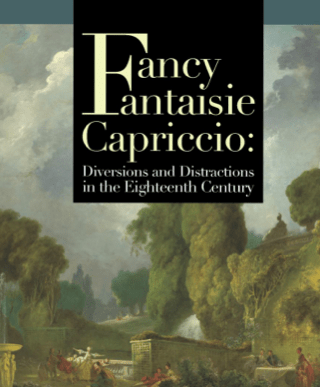 Associated with the imagination and not reason, fancy (fantaisie) in the eighteenth century was a sort of whimsical distraction from the everyday. For Voltaire it was ‘a singular desire, a passing whim’ (‘un désir singulier, un goût passager’), while for Samuel Johnson it was ‘something that pleases or entertains without real use or value’. Together with its near-synonym caprice (capriccio), fancy was part of a rich semantic network, connecting wit, pleasure, erotic desire, spontaneity, improvisation, surprise, deviation from norms, the trivial and inconsequential. Unpredictable and quirky, it offered many outlets for artistic creativity.
These study days will explore the expressive freedom of fancy (fantaisie, capriccio) in European culture during the eighteenth century—in figure and landscape painting, architecture, and garden design, philosophy and fiction, theatre and music.
◊ ◊ ◊ ◊ ◊
T H U R S D A Y , 3 D E C E M B E R 2 0 1 5
14:00 Welcome and introduction
14:15 Chair: Melissa Percival
• Keynote Speaker — Martin Postle, Modelling for the Fancy Picture: Fact, Fiction, and Fantasy
• Frédéric Ogée, Fancying Nature: The Posterity of Joseph Addison’s’ Pleasures’ in English Enlightenment Culture
15:30 Tea and coffee
16:00 Chair: Xavier Cervantes
• John Chu, ‘The Many Peopled Wall’: Fancy Pictures and Annual Exhibitions in Eighteenth-Century London
• Isabelle Baudino, Picturing the Past: The Fancy Picture and the Historical Imagination in Britain
• Hélène Ibata, British Capricci: From the Picturesque to the Sublime
18:30 Viewing of the exhibition Fantasy Figures at the Musée des Augustins
20:30 Dinner
F R I D A Y , 4 D E C E M B E R 2 0 1 5
9:15 Chair: Muriel Adrien
• Keynote Speaker — Guillaume Faroult
• Emmanuel Faure-Carricabururu, Figures de fantaisie de Jean-Baptiste Santerre et limites des cadres génériques d’interprétation
10:30 Tea and coffee
11:00 Chair: Frédéric Ogée
• Christophe Guillouet, La production gravée parisienne au cœur de L’invention d’un genre? Les «fantaisies» de Poilly et Courtin (1710–1728)
• Bénédicte Miyamoto, ‘As Whimsical and Chimearical as their Forms Are’: Ornamental and Fanciful Motives in English Drawing Books
• Pierre-Henri Biger, De la fantaisie des éventails aux éventails de fantaisie
12:30 Lunch
14:00 Chair: Isabelle Baudino
• Vanessa Alayrac, ‘A Butterfly Supporting an Elephant’: Chinoiserie in Eighteenth-Century England, or ‘the Luxuriance of Fancy
• Xavier Cervantes, Réminiscences vénitiennes et hybridité culturelle dans les vues et capricci anglais de Canaletto
• Adrián Fernández Almoguera, Du cabinet privé à la villa suburbaine: caprices et fantaisies artistiques dans la capitale des Lumières espagnoles
15:30 Tea and coffee
16:00 Chair: Hélène Dachez
• Laurent Châtel, Fancy a Garden? The Hortulean Pleasures of Imagination and Virtuality
• Nathalie Vincent-Arnaud, Cappricioso, Or a New ‘Grammar in Motion’ in Music and Ballet
• Alice Labourg, ‘Fancy Paints with Hues Unreal’: Pictorial Fantasy and Literary Creation in Ann Radcliffe’s Gothic Novel
Peggy Fogelman Named Director of the Gardner Museum
From the Gardner:
Peggy Fogelman Named Next Director of Isabella Stewart Gardner Museum
 The Isabella Stewart Gardner Museum announced today that Peggy Fogelman is the next Norma Jean Calderwood Director, succeeding Anne Hawley as the fifth director in the Museum’s history. Hawley will step down after 26 years at the end of the year, and Fogelman will assume the directorship in January 2016.
“I am overjoyed to be entrusted with leading the Gardner, a unique and treasured museum where visitors feel so closely connected to the collection,” Fogelman said. “Being located in this creative and intellectual hub makes the potential enormously exciting as we continue to reach the next generation of museum-goers. It is truly a privilege to apply all my experience to a place that is beloved by so many.”
Since 2013, Peggy has been Director of Collections at the Morgan Library & Museum in New York, overseeing eight curatorial departments, conservation, registration, and 16 to 20 exhibitions per year. Earlier this year, Peggy served for 12 months as Acting Director while the Morgan searched for a new Director. She previously worked at the Metropolitan Museum of Art as Chairman of Education, the Peabody Essex Museum as Director of Education and Interpretation, and the J. Paul Getty Museum as Associate Curator of European Sculpture and later Assistant Director and Head of Education and Interpretive Programs.
“Peggy is the perfect fit for the Gardner with her impressive background ranging from work in large prestigious institutions to small, intimate museums,” said Steve Kidder, the Gardner Museum’s Board President. “She brings us the best intersection of creativity, vision, and successful execution. We look forward to seeing what she dreams up for this very special Museum.”
Longtime Gardner Museum Trustee and former Board President, Barbara Hostetter chaired the committee that conducted an international search to find Hawley’s successor. “We are overjoyed that the Museum has found a new director with the vision and expertise to take it to new heights,” she said “Peggy comes to us with a seasoned perspective, honed by working at some of the nation’s finest museums, and with a freshness of spirit that makes being part of the Gardner leadership so rewarding.”
The Morgan began much like the Gardner Museum as a private collection that evolved into a vibrant cultural institution offering exhibitions, musical concerts, public lectures and special events. Fogelman has been instrumental in building a larger audience, developing the exhibition program, and forging meaningful collaborations with other institutions, foundations, and private collectors.
From 2009 to 2013, Fogelman was the Met’s Frederick P. and Sandra P. Rose Chairman of Education where she oversaw education, concert, and lecture programs. She took on the challenge of restructuring the education department to advance visitor engagement and to create more collaboration in the large institution. She spearheaded first time artist-based residencies and commissioned performances, fellowships in education and public practice, studio classes, gallery talks, artists’ study days, and digital art-making activities.
Before being recruited to the Met, Fogelman was Director of Education and Interpretation at the Peabody Essex Museum in Salem. She began her career at the J. Paul Getty Museum with a curatorial focus, and over the next 13 years, rose to Associate Curator in the Department of Sculpture and Works of Art. She was then appointed Senior Project Specialist to the Director, and transitioned to become Assistant Director and Head of Education and Interpretative Programs, achieving a major restructuring of the museum education program at the Getty. She holds a Bachelor of Arts from Johns Hopkins University and a Master of Arts from Brown University. Her work has been published widely for both general and specialized audiences.
As Anne Hawley prepares for her next chapter, she said she is delighted that the Museum will be in such capable hands. “I trust the magic and uniqueness of the Gardner Museum will continue to soar under Peggy’s leadership,” she said.










 Enfilade
leave a comment